Career Identity Anxiety in Disguise—And a 90-Day Craft-Building Way Forward

Finding Clarity in the Sunday Night LinkedIn Spiral
If you’re a late-20s/early-30s Toronto tech ops person who keeps a “Resume_FINAL_final” file and still refreshes LinkedIn after a normal Monday meeting, this is for you.
When Alex showed up for our session, they didn’t look dramatic. They looked… operational. Tidy. Controlled. The kind of person who can run a rollout, herd stakeholders, and still remember to thumbs-up a Slack message at the right time.
But when they described Sunday night, the control got thin.
“It’s like… I’m half-watching Netflix,” they said, rubbing a thumb along the edge of their phone case, “and then I see one of those ‘I’m excited to announce…’ posts. Promotions. New titles. Big shiny logos. And my body just… reacts.”
I could picture it with the precision of a scene I’ve heard a hundred times in different cities: Sunday, 10:23 p.m., condo living room. Dishwasher humming like a low-grade threat. The cold blue light of a phone making your eyes sting. Your phone slightly hot from refresh. Shoulders inching upward until they nearly touch your ears.
Alex’s voice went flatter on the last part. “I want stability. I want meaning. But the second a job stops feeling clean, I’m like—maybe this is the sign.”
Restlessness, in their case, wasn’t a vibe. It was a wired-but-tired buzz under the skin, like their nervous system had three tabs open that wouldn’t close: Slack, a calendar invite, and a silent loop of What if I’m wasting my time?
They looked at me and said the question that had brought them here: “After three job hops in two years… what pattern is actually guiding my next move?”
I nodded slowly. “We can work with that. Not to judge the hops—Toronto rent doesn’t exactly reward patience—but to understand what the hops are doing for you. And then to find a next step that’s chosen, not reactive. Let’s try to draw a map through the fog—something that gives you clarity without demanding a perfect answer tonight.”

Choosing the Compass: The Celtic Cross · Context Edition
I asked Alex to take one slow breath and notice their shoulders. Not as a mystical ritual—more like the way you’d pause before replying to a message you might regret. A small transition. A signal to the body: We’re not sprinting right now.
As I shuffled, I explained what I’d use. “Today, we’ll work with a spread called the Celtic Cross · Context Edition.”
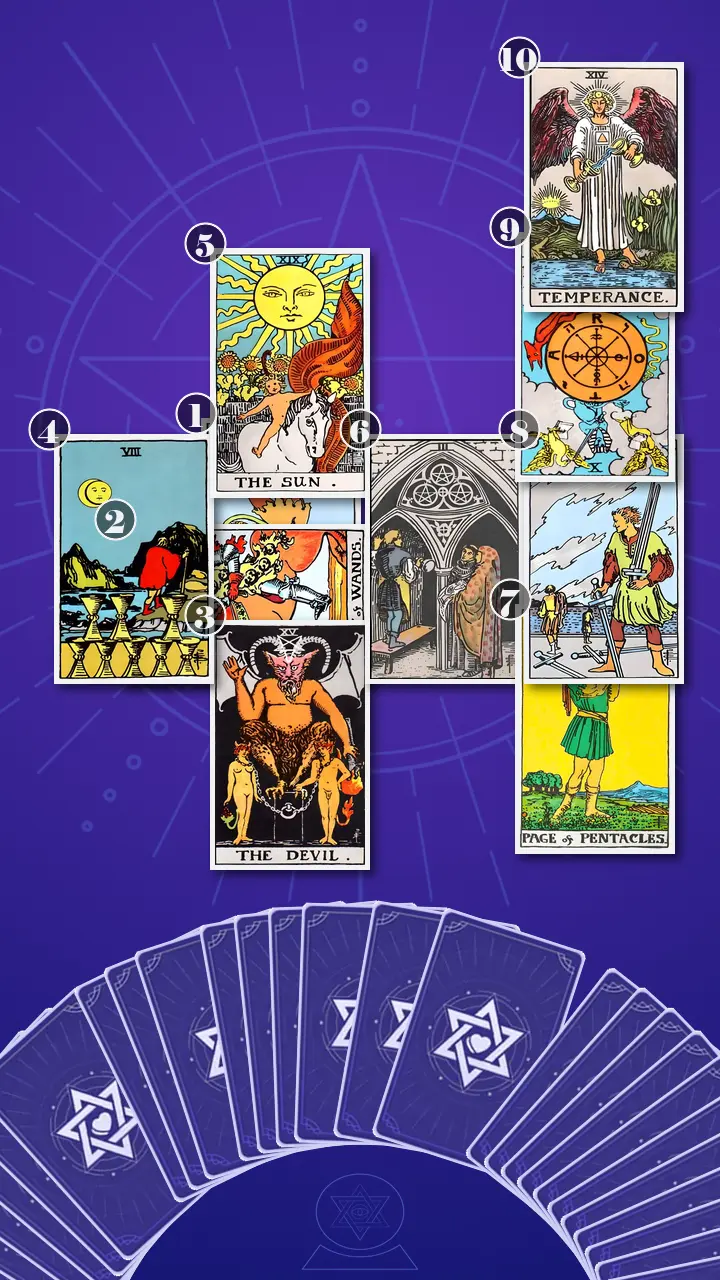
For readers who are curious about how tarot works in a practical way: I like this spread when someone is at a career crossroads and the real question isn’t ‘Which job should I take?’ but ‘Why does this keep happening?’ The Celtic Cross is built for patterns. It tracks a full chain—present behavior, the immediate block, the deeper driver underneath, the most recent trigger, and then an integration path. It’s less fortune-telling and more like pattern recognition with symbols.
This version stays anchored in the specifics of job hopping: position 4 focuses on the most recent “last straw,” and position 9 names the hopes and fears about repeating the cycle—so we don’t drift into vague career advice.
“Here’s what to watch,” I told Alex. “The first card shows your current pattern in motion. The crossing card shows what blocks you from stability even when you want it. And the last card—position 10—doesn’t ‘predict’ your future. It shows the direction you move toward when you work the pattern consciously.”
Alex exhaled, and I watched their hands unclench around their coffee cup—just slightly, like a system lowering its alert level by one notch.
Reading the Map: From Looping to Flowing
Position 1: Current pattern in motion
“Now we turn over the card that represents your current pattern in motion: what your job-hopping cycle looks like day-to-day right now.”
Two of Pentacles, reversed.
“This is painfully specific,” I said, keeping my tone steady. “It’s 2:06 p.m. and you’re ‘working,’ but you’ve got Slack, a spreadsheet called ‘Career Options,’ and three LinkedIn tabs open. You answer messages fast enough to look competent, while quietly imagining your next title and how you’ll explain leaving again.”
Alex let out a short laugh—bitter, almost impressed. “That’s… kind of brutal.”
“I know,” I said. “And I’m not saying it to shame you. I’m saying it because it’s accurate data.” I tapped the card lightly. “Reversed, the Two of Pentacles isn’t healthy flexibility. It’s overwhelm. Split attention. Two identities running at once: committed employee and secret exit-planner.”
“Refreshing job boards isn’t always ambition—sometimes it’s nervous-system first aid.”
Alex’s eyes dropped to the table. Their jaw tightened for a moment, then softened—like they’d been caught, but also relieved to be named correctly.
Position 2: Primary block
“Now we turn over the card that represents your primary block: what keeps you repeating the cycle even when you want stability.”
Knight of Wands, reversed.
“This is the accelerant,” I said. “Right after one ambiguous comment or awkward power dynamic, your body goes into ‘go’ mode. You fire off applications, book informational calls, draft a resignation. You tell yourself you’re being strategic.”
I paused. “But the card is showing that speed is doing emotional work. It gives relief before you’ve even clarified what happened.”
Reversed, the Knight’s energy is blocked and dysregulated—fire without a hearth. Not passion as purpose, but urgency as anesthesia.
I leaned back a fraction, letting the image land. Alex stared at the Knight like it was a security camera still from their own Thursday afternoons.
In my mind—an involuntary professional flashback—I saw a different kind of urgency: graduate students on a dig site, desperate to uncover something spectacular in a single afternoon, brushing too hard and snapping an edge they couldn’t replace. In archaeology, impatience costs evidence. In careers, it costs learning.
Alex nodded tightly. “It’s like… the moment it gets complicated, I start thinking about leaving.”
“Exactly,” I said. “And notice the loop: if you slow down, you fear you’ll lose control. If you speed up, you lose roots.”
Position 3: Root driver
“Now we turn over the card that represents the root driver: the deeper need or fear your career choices are trying to manage.”
The Devil, upright.
Alex went still. That particular stillness—the kind that isn’t calm, but braced.
“People get spooked by this card,” I said, “but I read it in a grounded way. In career readings, The Devil often shows attachment to proof. Outsourcing self-trust to external signals: a recruiter DM, an interview request, a shiny title, a compensation band.”
“That’s… yep,” Alex said quietly. “When someone wants me, I’m okay. When it’s quiet, I feel like I’m free-falling.”
“Look at the detail,” I said, pointing gently. “The chains are loose. The bind is real, but not absolute. The trap isn’t your job. It’s the idea that a job has to certify your worth.”
In terms of energy, this is a sticky, magnetic attachment. It keeps your attention glued to outcomes that can’t actually hold you the way you need to be held.
Position 4: Most recent trigger
“Now we turn over the card that represents your most recent trigger: what pushed the latest job hop—the ‘last straw’ pattern.”
Eight of Cups, upright.
“This matters,” I told Alex. “Because this card says your last hop wasn’t random. It wasn’t laziness. It was emotional truth.”
“You left after you’d already built something—relationships, processes, wins—but the work stopped feeling meaningful. And under that moon—the uncertainty—you chose walking away over renegotiating what you needed.”
Alex’s face flickered with something like grief, fast and almost hidden. “I did build things,” they said. “That’s the messed up part. I leave right when I finally understand the place.”
“And that’s the pattern we’re mapping,” I replied. “Not to force you to stay anywhere harmful—but to see the exact moment your system decides: ‘Better to reset than to risk struggling.’”
Position 5: Conscious aim
“Now we turn over the card that represents your conscious aim: what you think you’re trying to get by making a change.”
The Sun, upright.
“You’re not chasing chaos,” I said. “You’re chasing daylight.”
“A career that feels obvious in your body: clear expectations, visible progress, confidence that doesn’t require constant self-defense. After a few fast pivots, it makes total sense you’d crave something uncomplicated.”
I watched Alex’s shoulders drop a millimeter. The Sun has that effect—just seeing your true aim named can reduce the mental noise.
“And here’s a practical reframing,” I added. “Clarity isn’t only a feeling. It’s often a structure: boundaries, feedback cadence, skill milestones. Sunlight you can measure.”
Position 6: Next stabilizer
“Now we turn over the card that represents your next stabilizer: what becomes possible if you stay with the learning curve long enough to collect real data.”
Three of Pentacles, upright.
The energy in the room shifted—less buzzing, more grounded. If the earlier cards felt like browser tabs multiplying, this one felt like a shared doc with headings and dates.
“This is apprenticeship,” I said. “A calendar invite titled ‘Feedback & Growth Plan.’ A manager who can define ‘good.’ A team that reviews work without gotchas. A 90-day plan with metrics—so you’re collecting real data instead of vibes.”
“Discomfort isn’t a sign to leave; it’s data you haven’t collected yet.”
Alex’s eyes brightened with something that wasn’t excitement, exactly—more like curiosity with relief. “I want that,” they said. “I want to stop guessing.”
“And notice,” I replied, “this card doesn’t say ‘find the perfect company.’ It says ‘find—or build—the conditions where skill can actually form.’”
Position 7: Self-positioning
“Now we turn over the card that represents self-positioning: how you’re showing up internally and what you’re ready to practice.”
Page of Pentacles, upright.
“You’re ready for a different identity,” I said, and I meant it. “Not ‘the person who reinvents fast,’ but ‘the person who learns steadily.’ One coin. One lesson. One season.”
Upright, the Page’s energy is balanced: practical, curious, willing to do reps without needing the rep to be impressive on LinkedIn.
Alex smiled, small and surprised. “That sounds… calmer.”
“It is,” I said. “And it’s not less ambitious. It’s just ambition with roots.”
Position 8: External context
“Now we turn over the card that represents external context: workplace dynamics and pressures that amplify the urge to leave.”
Five of Swords, upright.
“This is the air you’ve been breathing,” I said. “Meetings where credit feels contested. Feedback that lands like a trap. Sharpness as a culture.”
It isn’t always overt bullying. Sometimes it’s a subtle, constant ambiguity—enough to make your nervous system interpret normal friction as threat.
Alex’s fingers tightened around their cup again. “My last team was like that,” they said. “And parts of this one too.”
“Then it makes sense that leaving starts to feel like self-protection,” I replied. “But this card also asks: what boundary, what conversation, what request could protect your energy before you assume the only solution is to exit?”
Position 9: Hopes and fears
“Now we turn over the card that represents your hopes and fears about repeating the pattern: what you want to believe vs what you dread will happen again.”
Wheel of Fortune, reversed.
“There it is,” I said softly. “The loop fear.”
“You look at the last three exits and think, ‘It always ends up like this.’ Part of you hopes the next job will magically break the cycle. Part of you fears you’ll re-live the same arc: excitement → ambiguity → bolt.”
I held Alex’s gaze. “Three hops in two years is information—not destiny.”
Reversed, the Wheel’s energy is stuck—repetition without learning. And that’s the invitation: change one lever you control. Not every variable. Just one.
Alex swallowed. “I’m scared it’s me,” they said. “Like, if I stay and it still doesn’t work… then I’m the problem.”
“That’s the heart of it,” I answered. “And it’s exactly why the last card matters.”
When Temperance Spoke: Turning Separate Cups into One Steady Flow
I let the room get quiet on purpose, the way you pause before opening an email you’ve been avoiding. Outside my window, street noise in Toronto came and went in soft swells—cars, a distant streetcar bell—like a reminder that the city keeps moving even when you stop sprinting.
“Now we turn over the card that represents the integration outcome: the direction you move toward when you work the pattern consciously,” I said. “This is the core of your ‘next move’ question.”
Temperance, upright.
Alex blinked, once, slowly. Like their eyes were trying to focus on a different kind of answer than the one LinkedIn offers.
Setup: They were stuck in the familiar logic of decision fatigue—if they didn’t choose the right job next, everything would collapse into a story of failure. Uncertainty felt like danger. Struggling through a learning curve felt like exposure.
Delivery:
Stop treating every discomfort as a sign to leave; start mixing what works and what matters, like Temperance turning separate cups into one steady flow.
I didn’t rush to explain. I let it sit between us.
Reinforcement: Alex’s reaction came in three waves. First, a physical freeze—breath paused, shoulders held high as if bracing for impact. Then the mind catching up—their gaze unfocused for a moment, as though replaying every “vague feedback → job board” pivot like a highlight reel they’d never asked to watch. Finally, the emotional release: a long exhale that sounded almost like a laugh, but softer, and their shoulders dropped with it.
Then—unexpectedly—anger flashed across their face. Not at me. At the idea itself.
“But if that’s true,” they said, voice tight, “doesn’t that mean I’ve been… wrong? Like I made all those moves for nothing?”
I shook my head, firm but kind. “No. It means you’ve been surviving. And you’re ready to do something more sophisticated than survive.”
This is where my own work—my odd, academic sort of intuition—kicks in. In archaeology we don’t call a collapsed layer ‘a mistake.’ We call it a record. A signal. We study it.
“Let me use what I call Historical Case Matching,” I said. “In the ancient world, civilizations hit crossroads all the time. Some reacted to the first friction by relocating—again and again—chasing an easier soil, a cleaner river, a less complicated neighbor. Others stayed long enough to build irrigation, laws, apprenticeships—systems that made life workable even when it wasn’t easy.”
I pointed to Temperance’s flowing motion. “Your pattern has been relocation energy. Temperance is systems energy. Integration. Not intensity.”
“Your next move doesn’t need more intensity. It needs more integration.”
I watched Alex absorb that, and I asked the question that turns insight into something lived: “Now, with this new lens—think back to last week. Was there a moment when you opened LinkedIn after a slightly uncomfortable meeting, and this perspective could’ve changed what you did next?”
Alex’s eyes watered, but they didn’t cry. They just nodded, once, like someone accepting a hard truth that also happens to be freeing.
“Wednesday,” they said. “Glass meeting room. Someone said I should be ‘more strategic’ and no one defined it. I smiled. I nodded. And I went straight to Easy Apply in the bathroom like it was… an inhaler.”
“That’s the moment,” I said gently. “Temperance doesn’t tell you to tolerate nonsense. It tells you to mix: your values and your boundaries, your ambition and your pace, your emotional truth and your practical plan.”
“This is you moving from restless urgency toward steadier self-trust,” I added, making it explicit. “From treating career as a verdict on your worth to treating it as a craft you can build.”
The 90-Day Craft-Building Voyage: Actionable Next Steps
I gathered the spread into a single story, the way I’d summarize a site report after a long dig.
“Here’s what I see,” I told Alex. “You’ve been juggling two lives at once—present job and future escape—so you never get clean evidence. When friction hits, you sprint for relief. Underneath that sprint is an attachment to proof: titles, offers, external signals that momentarily settle your nervous system. And because some environments really are sharp and political, the sprint feels justified. But the Wheel shows the fear: ‘It will always end up like this.’ Temperance offers the exit ramp: a sustainable rhythm where you blend what you’ve learned, set boundaries, and build skill through a 90-day experiment.”
“Your cognitive blind spot,” I said, “is this: you’ve been treating early discomfort as a final verdict on fit. But in reality, that discomfort is often the first layer of data.”
“In my work, I call the fix Time Stratigraphy,” I added. “We separate layers. The top layer is impulse—what your nervous system wants in the first hour after a trigger. The deeper layer is lasting value—what actually helps you build a career you can inhabit.”
Then Alex did the thing I’ve come to respect: they named the real constraint.
“Okay,” they said, “but I barely have time. My days are wall-to-wall meetings. I don’t know where I’m supposed to find even five minutes for ‘experiments.’”
“Good,” I replied. “That’s real. So we go small. Ancient navigators didn’t plan the whole ocean in a day. They kept a log, checked the stars, made the next safe adjustment.”
“Here are your next steps,” I said. “Pick the smallest version that you can actually do.”
- Build a 20-minute Career Container (7 days)Choose one consistent time (example: 7:40–8:00 p.m. after dinner). Only in that window: job boards, recruiter replies, resume edits. Outside that window: no LinkedIn tab, no “just checking”—especially not during work tasks.Expect resistance like “I’ll miss my chance.” You’re not banning job searching—you’re scheduling it. If 20 minutes feels impossible, do the 10-minute version and still count it.
- Use the 48-Hour Rule + a 6-Line Friction LogAfter your next trigger meeting, pause all “escape actions” for 48 hours (no applications, no recruiter messages, no resignation drafts). Instead, write 6 lines: 1) what happened, 2) what I assumed it meant, 3) what I need, 4) what boundary might help, 5) one clarifying question, 6) what action can wait 48 hours.Hour 6–12 is when the craving for momentum spikes. That’s normal. If 48 hours is too big, start with “sleep on it once.”
- Start a 90-Day “Voyage Log” Craft ExperimentPick ONE skill to deepen for 12 weeks (stakeholder management, analytics, ops tooling, process design). Define what evidence counts by Day 30/60/90. Then every Friday, update a 2-minute log: one thing I built, one friction I handled without bolting, one ask I made, one skill rep I completed.When your brain says “But what if I pick the wrong skill?” remind yourself: this is an experiment, not a forever identity. You’re allowed to revise after 90 days—with data.
I added one line, because Alex’s spread demanded it: “Make one request before you make an exit.”
And because Temperance is about mixing, not denying: “If a workplace is truly harmful, we don’t talk you into endurance. We talk you into clarity—so leaving is a decision, not a reflex.”

A Week Later: Ownership, Not Certainty
Seven days later, Alex texted me a screenshot: a Notes app entry titled “Friction Log (Wed).” Six lines. Clean. Honest.
Under it: “Also… I did the Career Container. I hated it the first two days. Then it got weirdly calming. Like my brain stopped free-running.”
They told me they’d asked their manager one clarifying question—one. Not a dramatic confrontation. Not a resignation. A request for an example of what “strategic” meant by next Friday.
And in a small, bittersweet way, the shift showed up where it always shows up first: sleep. They said they’d slept through the night once. In the morning, the first thought was still, What if I’m wrong?—but this time it came with a half-smile, not a spiral.
That’s what a real Journey to Clarity often looks like: not certainty, but ownership. Not a perfect career narrative, but a new relationship with discomfort—one where it becomes information instead of a fire alarm.
When the job stops feeling clean and certain, it can feel like your chest tightens and your brain hits “escape”—because staying long enough to struggle would risk proving you weren’t in control after all.
If you treated the next 90 days as an experiment in building craft—not a verdict on your worth—what’s one tiny piece of evidence you’d want to collect about yourself this week?