Staring at the Departure Board of My Life—Then Walking to the Gate

Finding Clarity in the 8:47 p.m. Calendar Rewrite
If you refresh email/Slack/notifications like it’s an airport departure board, chasing the one update that will finally let you relax, you already know the loop.
Alex (name changed for privacy) sat across from me with her tote bag still looped over one shoulder, like she hadn’t fully arrived in her own body yet. She was 28, mid-level, smart in that NYC way where competence becomes a second skin—tight and shiny and a little hard to breathe under.
She described Sunday at 8:47 p.m. in her Brooklyn walk-up: the kitchen dim except for the phone’s blue glow, the fridge hum weirdly loud, the air smelling faintly like yesterday’s coffee grounds. She kept toggling between Google Calendar and Notes, rewriting Monday’s plan for the third time. Her jaw tightened every time she tried to pick the first task, like the week needed to be “guarantee-able” before she was allowed to move.
“I’m not even making a huge decision,” she said, but her voice had the brittle edge of someone who’s been holding a pose for too long. “It’s just… everything feels like it could change. And if I choose wrong, it’ll blow up. So I keep building contingencies. It looks organized, but I’m… stuck.”
What she called “staying prepared” had the texture of apprehension in the body: a jaw that felt bolted, a chest like it was bracing for impact, and restless energy that never landed anywhere long enough to become a decision. Like trying to sleep on a train platform with one eye open.
I let a beat of silence hold her words—no rushing, no fixing. “We can look at this in a way that’s practical,” I told her, gentle but direct. “Not ‘what’s the perfect choice,’ but: what control pattern is fueling the anxiety, and what would a steadier process look like. Let’s make a map through the fog—your own Journey to Clarity.”

Choosing the Compass: The Celtic Cross Spread
I asked Alex to put one hand on her chest for ten seconds—just long enough to notice what was happening in her body before the mind sprinted ahead. Then I shuffled slowly, not as a performance, but as a transition: a way to move from spiraling thoughts into focused inquiry.
“Today, I’m going to use the Celtic Cross spread,” I said.
For anyone reading along and wondering how tarot works in a situation like this: her question wasn’t “Should I take job A or job B?” It was root-cause work—why does change feel like a threat, and what pattern keeps me freezing? The Celtic Cross is ideal for that because it’s a full-spectrum diagnostic. It maps the present coping stance, the immediate friction, the subconscious driver, the recent conditioning, and then moves toward an integration direction—actionable, self-empowering, and not fortune-telling.
I told her what to expect: “The first card will show what you’re doing right now to cope. The crossing card will show the control demand that blocks you. And the final card won’t be a fixed fate—it’ll be the direction you can move toward when you work with the pattern instead of feeding it.”
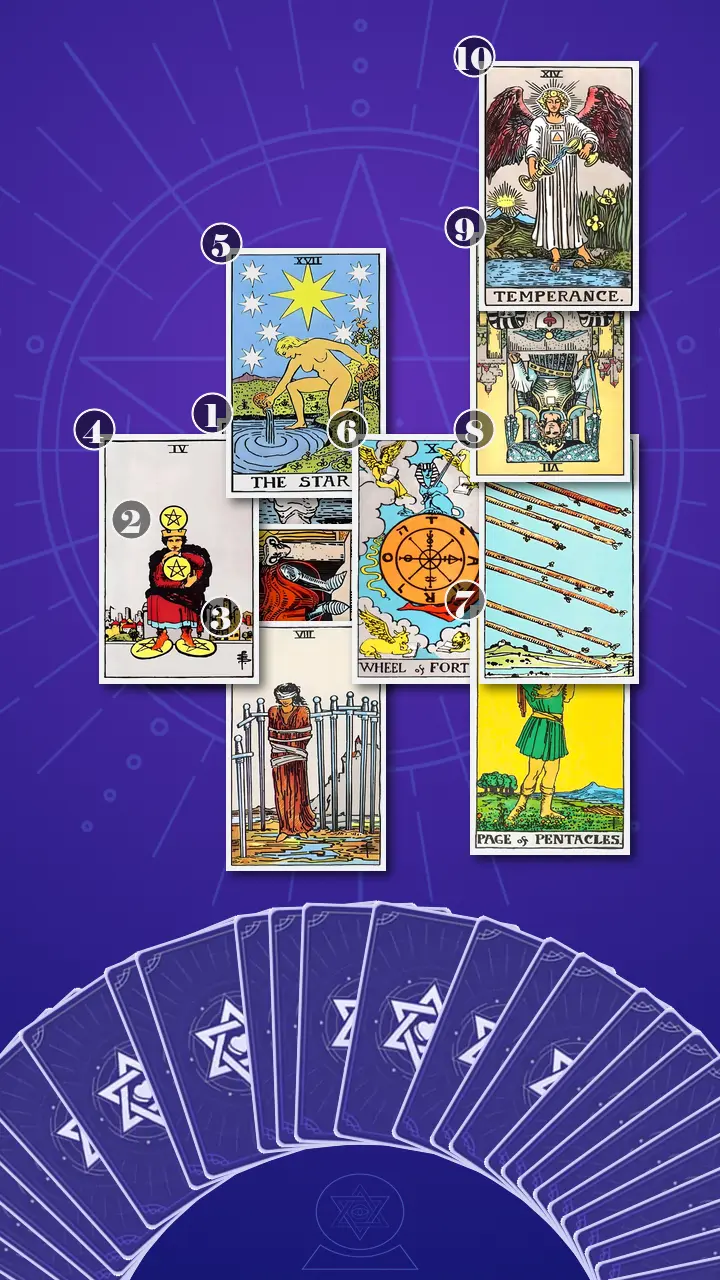
Reading the Map: Card Meanings in Context at a Career Crossroads
Position 1 — The current change-anxiety snapshot: what you’re doing right now
“Now turning over,” I said, “is the card that represents the current change-anxiety snapshot: what you’re doing right now to cope with uncertainty.”
Two of Swords, reversed.
I didn’t need to dramatize it; the image did the work. “This is you treating your career transition like an airport departure board: you keep scanning for the one option that feels ‘guaranteed,’ so you refresh inboxes, rewrite plans, and keep two paths equally open—because choosing one feels like losing safety. The result is mental overload that looks productive (notes, drafts, lists) while your actual next step stays on hold.”
Reversed, the energy isn’t balanced. It’s blocked—the ‘neutral’ stance has become a clamp. The blindfold in this card is the part of you that prioritizes mistake-prevention over preference. The crossed swords over the heart are the cost: you’re holding tension exactly where your real wants would normally speak.
Alex let out a small laugh—sharp, half-disbelieving, half-tired. “Okay,” she said, and her eyes flicked away from the cards like they were being a little too honest. “That’s… so accurate it’s kind of cruel.”
I nodded. “It’s not cruel. It’s specific. And specific means workable.” Then I added, because she needed to hear it early: “Refreshing for certainty is still a form of avoidance.”
Position 2 — The immediate block: the control demand that keeps you from moving
“Now we’re looking at the card that represents the immediate block—the friction point that crosses you.”
The Emperor, reversed.
“When uncertainty hits, you respond by tightening the rules: stricter schedules, more conditions, more ‘if/then’ plans, more micromanaging. You’re trying to build a stone-throne sense of safety in a city and industry that update in real time—so every change starts to feel like an indictment of your competence instead of a normal variable.”
This is control as protection—except reversed, it’s excess that turns rigid. The armor beneath the robes is that exact NYC phenomenon: looking fine on the outside while bracing hard internally.
I watched her shoulders as I spoke—one of my habits from years of reading people on transoceanic voyages, where you learn quickly that the body tells the truth before the mouth does. Her shoulders crept toward her ears the moment I said “indictment.” A classic mind-body pattern: the nervous system tries to become smaller and more defended when the psyche senses evaluation.
“Calendar armor,” I said, using the phrase the way you’d name a storm system. “The rigidity isn’t strength. It’s protection. The hidden equation is: ‘If it shifts, I failed.’”
She winced, then—almost immediately—relaxed a fraction. Recognition does that: it hurts, then it lets you stop arguing with reality.
Position 3 — The subconscious driver: the deeper belief about safety, worth, and control
“Now turning over is the card for the subconscious driver—what’s running quietly under the surface.”
Eight of Swords, upright.
“Under the surface, you’re operating with invisible rules like: ‘Don’t move until it’s safe’ and ‘Don’t decide until you can’t be wrong.’ So even when you objectively have options—send the email, apply, ask the question—your body reads the moment of action as danger, and you default to waiting for certainty that never arrives.”
This is deficiency of agency—not because you don’t have it, but because your mind labels it as unsafe. The ropes in the image are loose, which is the point: the restrictions feel binding, but they’re often internal rules masquerading as external barriers.
Her gaze went slightly unfocused, like she was replaying a familiar late-night scene. I didn’t push. In Jungian terms, this is where an unconscious complex around worth and competence tightens the whole system.
Position 4 — The recent pattern: what you’ve been repeating
“Now this card shows the recent pattern—what your nervous system learned from repetition.”
Four of Pentacles, upright.
“Recently, your nervous system has learned ‘security equals grip’: clinging to routines, roles, money, and familiar identity markers. So when change shows up, it doesn’t just feel unknown—it feels like losing proof you’re stable. You hold tighter (more planning, more guarding), which keeps you from moving at all.”
Here the energy is excess holding. It’s stability achieved by refusing to step forward—coins pinned under the feet. It makes sense in a city where rent is real and timelines are loud. But it also turns growth into a threat response.
Position 5 — What you think you need: the conscious ideal you’re aiming for
“Now we’re looking at the card for what you think you need—the conscious goal.”
The Star, upright.
Her face softened before I even spoke, like her system recognized the image. I said, “Consciously, you don’t actually want total control—you want a steady sense of direction that makes change feel meaningful, not threatening. You want the calm of knowing ‘I’m on track’ even if the details aren’t final. The Star is your north-star energy: values and self-trust as guidance, not perfect external certainty as proof.”
The Star’s energy is balance—a quiet faith that doesn’t require constant monitoring. The pouring from two jars is important: it’s ongoing. Not a single moment of certainty, but a steady practice of orientation.
Alex swallowed, then nodded once—small, like she didn’t want to ask the universe for too much.
Position 6 — What’s coming into awareness soon: the turning point you can’t ignore
“Now this card represents what’s coming into awareness soon—the next insight or pressure that makes the pattern impossible to ignore.”
Wheel of Fortune, upright.
“A turning point is making itself obvious: timing shifts, information updates, and the world moves whether you’re ready or not. This isn’t a prediction of a specific event—it’s the system’s truth. The board keeps updating.”
The energy here is movement—not good or bad, just real. And this is where I said a line I’ve had to learn myself, watching weather and water and human plans collide on open ocean: “Competence isn’t predicting perfectly—it’s adjusting without self-abandoning.”
Alex gave a tiny nod, like she’d been waiting for permission to stop treating uncertainty like a personal performance review.
Position 7 — Your role in the pattern: how you show up
“Now we look at your role in the pattern—how you’re currently operating inside this change.”
Page of Pentacles, upright.
“This is like when you treat change as something you can practice: one small skill, one concrete task, one step you can complete—rather than a single huge leap you must get right.”
This is healthy Earth energy: grounded, curious, willing to learn through doing. The Page doesn’t demand certainty; she studies what’s in her hands. One object. One step. It’s the opposite of frantic scanning.
Alex’s shoulders dropped a millimeter, like her body understood “small steps” more easily than her mind did.
Position 8 — The external pace: the environment that amplifies the need to control
“Now we’re looking at the external pace—what the environment is doing that amplifies your pattern.”
Eight of Wands, upright.
“This is notification velocity,” I said. “Slack pings. Calendar changes. Texts. Deadlines that move. It’s not all in your head—things are fast.”
The energy here is excess speed. Wands already in flight. Once something launches, the task becomes steering and timing—not re-deciding the launch every five minutes.
Alex exhaled through her nose, almost annoyed with the world. “It really is like that,” she said. “Like if I’m not tracking everything, I’ll miss the gate change.”
“Exactly,” I replied. “But your nervous system isn’t built to live like an airport app.”
Position 9 — The emotional knot: what you hope for and what you fear if you release control
“Now this card is the emotional knot: the hope and the fear tied together.”
The Chariot, reversed.
“This is like when you try to ‘power through’ change, but the inside of you isn’t unified—part wants safety, part wants growth—so the drive becomes exhausting and unstable.”
Reversed, the Chariot is blocked alignment. Not a lack of willpower. Two inner forces pulling. If you try to solve that with more force, you get wobble. If you solve it with integration, you get direction.
Alex pressed her tongue briefly to the back of her teeth—an anxious micro-movement I see all the time in high-achievers. “I hate that I’m like this,” she said, low. “Other people pivot. I… spiral.”
“You’re not ‘like this,’” I said. “You have a pattern. Patterns can change.”
When Temperance Poured Between Two Cups
Position 10 — Integration direction: what becomes possible when you work with the pattern
I could feel the room shift as I reached for the final card—like when a subway pulls into a station and the air changes pressure for a second. “This is the integration direction,” I said. “Not a verdict. A trajectory.”
Temperance, upright.
“This is like when you stop demanding a perfect plan and instead commit to a rhythm: plan a little, act a little, adjust a little—until change feels workable instead of threatening,” I told her. “The real ‘control’ you’re seeking is regulation: steady recalibration.”
Setup: I brought her back to her most familiar loop. “It’s 12:06 a.m., you’re in bed with three tabs open and one draft unsent, refreshing like the next update will finally let you breathe,” I said. “In that moment, your mind treats the decision like it’s pass/fail—like your worth is on the line.”
Delivery:
Stop treating change like a pass/fail test you must control; start treating it like careful mixing and adjusting—Temperance asks you to blend rather than clamp down.
I let the sentence sit in the air the way I used to let a ship’s horn fade across open water—long enough for the body to register it, not just the intellect.
Reinforcement: Alex’s reaction came in a chain, not a single emotion.
First, a freeze: her breath paused mid-inhale, and her fingers hovered above her phone as if she’d been caught refreshing in her own mind. Then cognitive seep: her eyes went distant, like she was watching herself from above—Brooklyn bed, laptop heat on her thighs, the silent violence of “one more data point.” Finally, emotional release: a slow exhale that seemed to come from her ribs, not her throat. Her shoulders dropped. Her jaw unclenched in a way that looked almost unfamiliar, like a door opening after years.
“But if I stop clamping down,” she said, and there was a flash of anger—quick, protective—“doesn’t that mean I’ve been doing it wrong this whole time?”
I didn’t flinch. “It means you’ve been doing what worked when you needed protection,” I said. “Now you’re upgrading the method.”
This is where my own lens—the one I’ve built from Jungian psychology and years reading energy shifts across crowded ship decks—kicked in. I call it Energy Flow Diagnosis, and it’s simple: when a person tries to control an outcome, the body often tells on them through the shoulders, neck, jaw. Alex had been living with her shoulders as ear-muffs and her jaw as a padlock.
“Temperance is literally water moving between cups,” I continued, letting my Venetian roots have a voice. “In Venice, if water can’t circulate, it stagnates. When your energy can’t circulate—when you grip—it gets noisy in the jaw and chest. So we don’t aim for ‘no fear.’ We aim for flow: a small pour, a tiny adjustment, and a return to center.”
I asked her, “Now, with this new frame—mixing and adjusting instead of pass/fail—can you remember one moment last week where this would’ve changed how you felt?”
She nodded, eyes wet but steady. “Thursday,” she whispered. “I had the draft open. I kept rewriting the first line to sound… bulletproof. If I’d thought of it as a test—like, an experiment—I could’ve just sent it.”
And there it was: the shift from tight apprehension toward cautious relief, not because the world became predictable, but because she could be with herself inside change.
The One-Page “Process, Not Verdict” Plan
When I looked at the whole spread together, the story was clean: Two of Swords reversed showed the airport-board loop—scan, refresh, re-decide. The Emperor reversed revealed the control demand underneath—calendar armor, rigidity as protection. Eight of Swords named the deeper belief—don’t move until you can’t be wrong. Four of Pentacles showed how grip became a learned safety strategy. The Star reminded us what she actually wants: calm direction. Wheel of Fortune and Eight of Wands confirmed the context—NYC speed, real-time updates. The Page of Pentacles offered a new identity: learner over performer. And Temperance gave the method: blend, adjust, circulate.
The cognitive blind spot was painfully common in career pivot anxiety: Alex kept trying to control outcomes to prove competence, when what she needed was to control a process that builds self-trust through feedback.
I said it plainly so it could land: “You don’t need more control. You need a controllable process.”
Then we made it concrete—actionable advice, not inspiration.
- 15-Minute Reversible Step SprintTonight or tomorrow morning, set a timer for 15 minutes. Choose one tiny action that doesn’t lock your whole future (send a first-message inquiry to one recruiter, update one resume bullet, or book one informational call). Stop when the timer ends—no expanding the scope.If 15 minutes feels impossible, do the 5-minute version: draft only the first line of the message. Your job is to start, not to finish perfectly.
- Write “What I’m Testing” at the Top of the NoteIn the Notes doc you keep reopening, add one sentence: “I’m testing whether reaching out to one recruiter gives me useful info, not whether it proves I’m behind.” This turns the moment from a verdict into data.When the urge to open another comparison tab hits, read that sentence out loud once. It interrupts the pass/fail trance.
- 48-Hour No Re-Deciding BoundaryAfter you take the step, you’re not allowed to reopen the decision for 48 hours. You can write feelings and observations, but no switching paths, no “maybe I should undo it.”If anxiety spikes, do a 3-minute reset: put your phone face-down, unclench your jaw on purpose, roll your shoulders back once (desk posture correction), and take three slower breaths. Name it: “I’m feeling apprehension, not danger.”
Alex hesitated at the “no re-deciding” part. “But I don’t have time to spiral,” she said, half-laughing, half-panicked. “Like, I literally can’t afford that.”
“Exactly,” I replied. “This isn’t asking you to spiral. It’s asking you to stop feeding the spiral long enough to learn.” I pointed to Temperance again. “We’re creating circulation. Not a dam.”
As a final support, I offered something I used to teach between cruise meetings: a micro “commute meditation” kit for NYC—three breaths on the subway platform, one hand on the pole, eyes soft, shoulders down. Not mystical. Just nervous-system training for a city that never pauses.

A Week Later: Ownership, Not Certainty
Six days later, Alex texted me a screenshot: a sent message thread. One recruiter. One clean inquiry. Under it, she wrote: “I did the 15-minute sprint. My chest freaked out for like two minutes, and then… it passed. I didn’t die. I didn’t re-decide. I actually slept.”
Her follow-up wasn’t a fairy tale. She added: “This morning my first thought was still, ‘What if I chose wrong?’ But I laughed a little. Then I opened my note and read ‘What I’m testing’ and went to work.”
That’s what I mean by a Journey to Clarity: not certainty, but ownership. A shift from contracted control to steadier self-trust—earned through small feedback loops, not heroic willpower.
And if you’re reading this with your own tight jaw and tight chest—staring at the ‘departure board’ of your life—remember this: When you’re staring at the ‘departure board’ of your life with a tight jaw and a tight chest, it can feel like choosing is dangerous—because if you can’t control the variables, it might mean you’re not as capable as you’re supposed to be.
If you didn’t need perfect certainty—just a steady way to adjust—what’s the smallest next step you’d be willing to try for 48 hours and let it teach you something?