From Portal-Tab Panic to Grounded Next Steps: Incomplete vs Withdraw

The 12:34 a.m. Portal Glow
You’re an upper-year student in a city schedule (classes + part-time work), and you keep reopening the incomplete/withdrawal form like it’s a browser tab you can’t emotionally afford to close—classic deadline decision paralysis.
Jordan (name changed for privacy) showed up to my session from a Toronto apartment that looked like it had been lived in hard this week—dish rack half-full, winter-dark pressed up against the windows, and that particular blue-white laptop light that makes a living room feel like a waiting room.
They didn’t even bother with a big intro. “I’m not trying to quit,” they said, rubbing their thumbs together like they were trying to erase a smudge off their own skin. “I’m trying not to ruin everything.”
I could practically see the scene they described: 12:34 a.m. on the couch, laptop balanced on knees, the student portal open, the cursor blinking inside a half-written email draft, the HVAC hum somehow louder than it should be. Their jaw would clamp without permission. Their shoulders would crawl upward. And every time the mind drifted toward the final Submit button, the body would do that stomach-drop like a missed step on stairs.
They kept the form open—Incomplete or Withdraw—like keeping it open counted as progress. Like rereading the same policy line could hand them a personality upgrade. Like a perfect email could protect them from consequences.
Under it all was the engine of the whole question: wanting to protect your progress and credibility vs fearing that any choice will prove you’re not capable.
I let that land gently before I spoke. “Okay,” I said, the way I would on a trading floor when someone’s about to make a panicked move—but softer. “We’re not here to force certainty. We’re here to get you back into agency. Let’s try to draw a map through the fog—something that gives you clarity and an actual next step.”
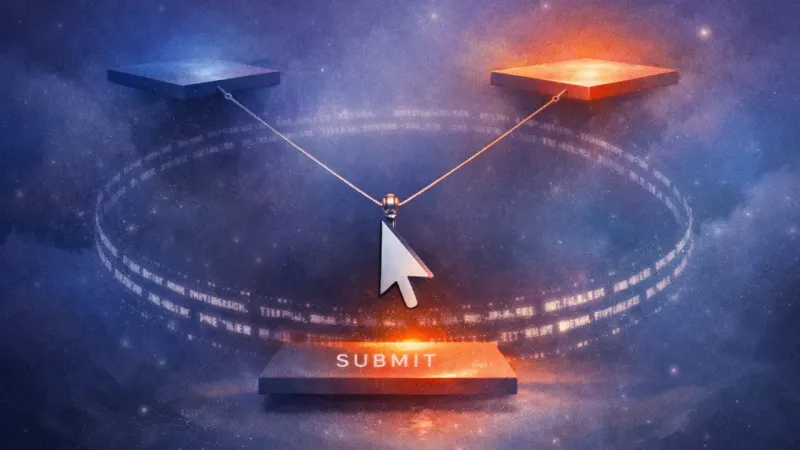
Choosing the Compass: A Decision Cross for Incomplete vs Withdraw
I asked Jordan to take one breath that was slower than they wanted it to be. Not as a mystical ritual—just as a nervous-system handbrake. While they exhaled, I shuffled, steady and quiet, until their shoulders dropped a fraction.
“Today,” I said, “we’ll use a spread I call the Decision Cross · Context Edition.”
If you’ve ever Googled how tarot works and felt like the answers were either too woo-woo or too vague, here’s the practical version: a good spread is a decision framework. This one is built for a two-option crossroads—exactly the ‘Incomplete vs withdrawal’ fork—while also exposing the hidden pressure that’s hijacking the choice.
The layout is a five-card cross. Card 1 goes in the center: what the stuckness looks like in real life. Cards 2 and 3 sit left and right: each path side-by-side so you’re not arguing with yourself in the dark. Card 4 goes above: the underlying fear (because with “submit-button freeze,” the obstacle is rarely missing information). Card 5 goes below: your grounded next step—what you can do this week to create real information and restore momentum.
“We’ll read it like a crossroads sign under a weight,” I told Jordan. “Center, then left/right comparison, then up to name what’s pressing on you, then down to the one clean action that changes the situation.”
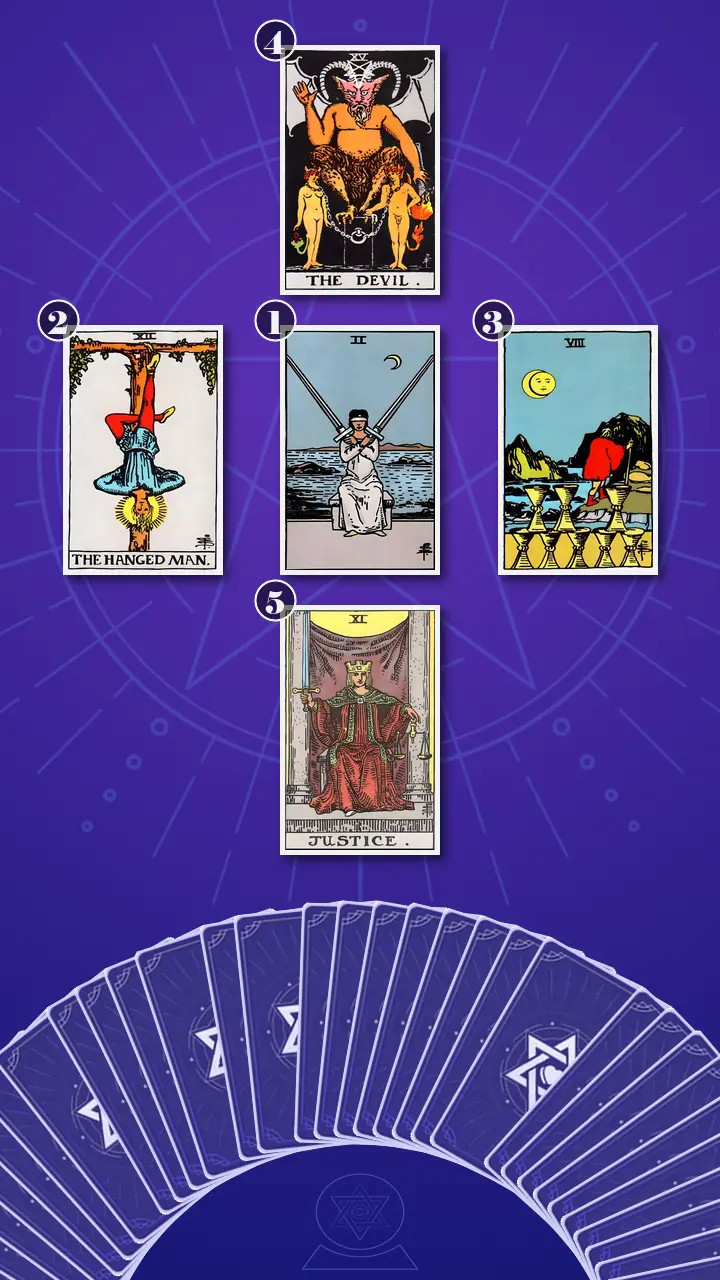
Reading the Map: Where the Loop Actually Lives
Position 1 — The Stuckness Loop in Real Life
“Now flipped over,” I said, “is the card that represents what your current stuckness looks like in real behavior and mindset around the open form.”
Two of Swords, upright.
The image is someone blindfolded, arms crossed tight over their chest, two blades held in a perfect X—like a human ‘do not disturb’ sign. Behind them, water sits unnaturally still.
“This is your portal-tab spiral,” I said. “Late night. Incomplete/Withdraw form open. You toggle between the grade policy, the course page, and the email draft. You’re trying to feel nothing so you can’t be wrong—keeping both options perfectly balanced—while the deadline quietly moves closer.”
In energy terms, this is blocked Air: the thinking mind working overtime to stay ‘neutral,’ but the neutrality is actually numbness. A protection strategy that costs you more each hour you keep paying it.
I described it like a quick micro-montage, because Jordan had lived it in frames: reopen portal → reread the same paragraph → open draft email → delete a sentence → check the clock → close laptop → promise “tomorrow.”
Then I said the line I’ve seen save people from self-hate more times than I can count: “Keeping the form open feels like progress—until you realize it’s just a way to avoid being seen.”
Jordan let out a tight, surprised laugh—half recognition, half sting. “That’s… rude,” they said, but their eyes stayed on the card. “It’s so accurate it’s almost mean.”
“I know,” I said. “And it’s not a character flaw. It’s your nervous system trying to keep you safe. The question is: safe from what? Disappointment? Embarrassment? The possibility that you’re not ‘the reliable one’ this week?”
Their fingers stopped tapping for a second. The stillness behind the Two of Swords felt like the room itself was holding its breath with them.
Position 2 — Path A: Taking an Incomplete (What It Requires)
“Now flipped over,” I said, “is the card that represents Path A: taking an Incomplete—what it requires from you and what it offers if used intentionally.”
The Hanged Man, upright.
Most people hear “pause” and think “avoidance.” This card is a different kind of pause: chosen, structured, and perspective-changing. The figure hangs inverted but calm, haloed—like the mind finally stopped sprinting long enough to let reality come into focus.
“In real life,” I said, “this looks like putting your phone face-down, closing the extra tabs, and taking a deliberate pause that actually changes the situation. Booking office hours. Writing a realistic one-week completion plan. Checking whether more time would be used for completion—not just for spiraling.”
Energetically, this is balance through suspension. Not a freeze. A conscious pause with conditions.
I watched Jordan swallow, like their throat had been bracing for a scolding that didn’t come. “So… Incomplete isn’t automatically me admitting I’m failing,” they said.
“Not if it’s used like this card,” I replied. “A pause only helps if it changes your perspective—not if it just extends the spiral.”
And because I’m a systems person by training, I gave them one clean litmus test: “If you can’t write the completion plan in six lines, don’t punish yourself. Treat that as data.”
Jordan nodded, small and careful—as if permission itself felt suspicious.
Position 3 — Path B: Withdrawing (What It Frees Up)
“Now flipped over,” I said, “is the card that represents Path B: withdrawing—what it frees up, what it costs emotionally, and what it protects long-term.”
Eight of Cups, upright.
A person walks away from neatly stacked cups under a moon—nothing smashed, nothing chaotic. It’s not a tantrum. It’s a sober departure.
“Withdrawing,” I said, “looks like closing the course tab not as a dramatic failure, but as a strategy to protect long-term momentum. It’s leaving something emotionally loaded—maybe even ‘almost done’—because continuing in its current form is costing too much mental bandwidth.”
Energetically, this is sufficient Water: emotional honesty that says, ‘This isn’t workable as-is.’
Jordan stared at the card like it was a dare. “It would free up… sleep,” they admitted, voice quieter. “And time. And maybe I’d stop feeling like my stomach is constantly falling.”
“That matters,” I said. “This card always asks: what are you walking toward, not just what you’re leaving.”
They exhaled, but it didn’t fully land yet—because we hadn’t named what was yanking the chains behind the scenes.
Position 4 — The Pressure That Turns Admin Into an Identity Trial
“Now flipped over,” I said, “is the card that represents the underlying fear/pressure that is distorting the decision and keeping you in a loop.”
The Devil, upright.
This is the card people misunderstand as ‘bad.’ I read it as the inner taskmaster—the part of you that equates worth with performance and tries to control perception to feel safe. The detail I always focus on is the same one Jordan needed: the chains are loose. They’re not welded shut. They’re default settings.
“This is the moment,” I told them, “when the decision stops being administrative and becomes a shame trial in your head.”
I mirrored their lived habit without judging it: refreshing the portal, rewriting the same email, searching for the policy line that would remove responsibility. “Shame makes admin decisions feel like identity trials,” I said. “Not because you’re dramatic—because your brain is trying to avoid the feeling of being seen as imperfect.”
Jordan’s shoulders jumped up like they’d been caught. Then they gave that uncomfortable nod—the one that says, yeah… that’s the voice. “It’s like an algorithm,” they said, surprising themself with the metaphor. “Once I click on the ‘I’m failing’ thought, it serves me ten more.”
“Exactly,” I said. “And notice the contrast: you’re negotiating with fear—‘I have to prove I’m not a failure’—instead of negotiating with the actual rules.”
They flexed their hands like the restlessness finally had a name. The laptop fan on their end whirred, and the sound suddenly felt like part of the card: heat from overuse, not from real movement.
When Justice Spoke: The One Fair Cut Forward
Position 5 — The Next Best Step to Regain Agency This Week
I let the silence settle for a beat before turning over the final card. “This is the grounded next step,” I said, “the action that moves you from paralysis to motion regardless of which option you choose.”
Justice, upright.
The card is almost painfully direct: scales in one hand, sword in the other, eyes forward. No theatrics. No pleading. A decision you can stand behind.
“Justice is facts-first,” I said. “Verifiable criteria. Clear deadlines. One clean message. Not vibes court.”
And because my old life was contracts and consequences, a memory flashed through me—standing on a trading floor, watching someone spiral because they didn’t want to read the clause that would force a choice. The clause was always there. The suffering came from pretending it wasn’t. I kept my voice calm as I brought it back to Jordan. “Fairness isn’t a feeling,” I said. “It’s a structure.”
In terms of the journey you came in with, this is the pivot from shame-driven deadline paralysis and "submit button" freeze to facts-based accountability, restored agency, and grounded relief. It’s not about becoming fearless. It’s about becoming precise.
Jordan’s eyes narrowed like they were bracing for the part where I told them what to choose.
Instead, I asked, “If you stopped treating this as ‘Which option proves I’m capable?’ and treated it as ‘What’s the next clarifying action that gives me real information?’ what would you do first?”
They swallowed. “I’d… ask for the criteria,” they said, like it felt too obvious to be allowed.
“Yes,” I replied. “Your next step isn’t the perfect choice. It’s the next clarifying action.”
For Jordan, I also used my own tool—what I call my 5-Minute Decision Tool, a tri-axis check that matches Justice’s scales and sword. I pulled out a blank sheet and drew three columns for each option: Advantage / Risk / Breakthrough. Not a 47-bullet pros/cons list. Just the essential forces.
“Justice doesn’t ask you to be certain,” I said. “It asks you to be clean. One page. One timestamp. One message. Then stop.”
Setup: I could see Jordan back on that couch at 12:30 a.m.—portal glowing, form half-done, five policy tabs open—finger hovering over Submit while their brain whispered, “If I pick wrong, it’ll follow me.” They were trying to make a perfect irreversible choice in the dark, using shame as the flashlight.
Stop treating the form as a verdict on you; weigh the real facts and make one fair cut forward—like Justice holding the scales in one hand and the sword in the other.
Reinforcement: Their body reacted before their words did, in a small three-beat chain I’ve learned to respect. First, a brief freeze—breath caught, lips parted, eyes locked on the sword like it was too sharp. Second, the thought landing—focus going slightly unfixed, as if they were replaying every late-night portal refresh in fast-forward. Third, a release—one long exhale that sounded like air finally allowed into a clenched room. Their jaw softened. Their shoulders sank. Then they blinked hard and gave me a look that was half relief, half grief for how much they’d been carrying alone.
“But if I do it like that,” they said, voice thin for a moment, “doesn’t it mean I was… being ridiculous before?”
There it was—an unexpected flare of resistance, the fear that clarity is an indictment.
“No,” I said, steady. “It means you were trying to survive a threat that felt real. Justice isn’t here to shame you for coping. It’s here to help you stop paying for the coping strategy with your options.”
I leaned in, gentle but exact. “Now, with this new frame—verdict versus process—think back to last week. Was there a moment where one clean, facts-first question would’ve made you feel even 10% less trapped?”
Jordan nodded immediately, almost annoyed at how clear it was now. “Monday,” they said. “I spent two hours on r/college threads and didn’t email anyone. I could’ve just… asked.”
“That,” I said, “is the key shift. Not ‘I need the perfect choice.’ It’s ‘I need the next clarifying action that gives me real information and restores agency.’”
From Cards to Calendar: Actionable Advice for the Next 24 Hours
I slid the whole spread into one coherent story for them: the Two of Swords showed the protective numbness—staying ‘neutral’ so you can’t be wrong—while the decision window shrinks. The Hanged Man offered a pause that only works if it’s structured. The Eight of Cups offered a clean exit that protects long-term capacity. The Devil named the real hijacker: performance-shame turning an admin step into an identity referendum. And Justice—clear-eyed and unromantic—restored the only thing that actually creates clarity: truth plus one action.
The blind spot was obvious once we named it: Jordan had been acting like more reading would create new information. But rereading policy PDFs and perfecting email tone is only “progress” if it changes the system. Most of the time, it just prolongs the freeze.
So I told them their transformation direction in one sentence: “We’re moving from fear-based reputation management to reality-based decision-making—facts first, feelings acknowledged, one clean message sent.”
Then I gave them a concrete plan—small, doable, and designed to break the loop without demanding a personality transplant.
- Send the One Clean Clarifying EmailTonight or tomorrow morning, send a short message to your instructor/TA: “Hi [Name], I’m deciding between an Incomplete and withdrawing. Could you confirm the exact criteria/steps and the final deadline for requesting an Incomplete in this course?”Clarity, not confession. Copy/paste a template and only edit the brackets. If replies spike your anxiety, schedule-send it for 9:10 a.m.
- Build a One-Screen Justice Facts SheetIn your Notes app, create a single screen titled “What I need to decide this.” List: your real deadline (with time zone), who approves an Incomplete, what you must submit, and your realistic hours this week.No extra tabs. If you catch yourself opening policy PDFs again, stop and write: “The one piece of info I’m missing is ____.”
- Use the 10-Minute Justice Move (Once—Then Stop)Set a 10-minute timer. Write only three bullets: (1) “My real deadline is: ____” (2) “The two options are: Incomplete / Withdraw” (3) “The one piece of info I’m missing is: ____” Then send one sentence asking for that missing info.If your jaw tightens or your stomach drops, do two slow exhales first. If “send” feels impossible, draft it and schedule it—then you’re done for the day.
And because Jordan’s whole pattern screamed what my Potential Mapping System calls a Deep Thinker under stress—someone who tries to earn safety through more analysis—I added one boundary that felt almost comically simple: “After you send the message,” I said, “you don’t get to reopen the portal as a soothing activity. Your brain will try. That’s the Devil’s loose chain. We’re editing the default setting.”

A Week Later: Ownership, Not Certainty
Six days later, Jordan’s name popped up on my phone. Their message was short, which told me everything.
“Sent the email. Scheduled it for the morning like you said. Got a clear reply. I still feel weird, but I’m not stuck refreshing the portal. I booked office hours and I can actually explain my choice to myself without spiraling.”
That’s what I mean when I talk about a Journey to Clarity. Not fireworks. Not a guaranteed perfect outcome. Just the quiet moment your shoulders drop because you finally did one real thing that created new information.
Jordan hadn’t magically stopped caring. They still woke up some mornings with that first thought—what if I chose wrong?—but now it was followed by something sturdier: I made a clean decision with the facts I had, and I’m allowed to be a person while I learn. Clear, and still a little tender.
When a deadline turns into a hovering “Submit” button, it’s not the form that hurts the most—it’s the fear that one click could become evidence that you were never as capable as people thought.
If you let this be a facts-first step instead of a worth-test, what’s the smallest clarifying action you’d be willing to take in the next 24 hours?