Hovering Over Open to Work: Turning Fear Into a 7-Day Visibility Test

Finding Clarity in the 11:32 p.m. Scroll
If you’ve ever hovered over LinkedIn’s “Open to Work” frame like it’s a public confession—and then closed the tab to avoid the shame hangover—this is your career visibility paralysis.
Jordan (name changed for privacy) sat across from me on a video call, Toronto night pressed up against their condo windows like dark glass. Somewhere outside, a streetcar hummed and faded. Their laptop fan made that soft, anxious whirr you only notice when everything else is quiet. They’d been scrolling, again—job listings, promotions, “Excited to announce…” posts—then opening settings, hovering over the toggle, and backing out like the cursor was wired to a tiny electric fence.
“It’s literally one click,” they said, and their voice did that half-laugh that isn’t laughter. “So why does it feel like a confession?”
I watched their shoulders lift the moment they said the words Open to Work, like their body was trying to become smaller. The emotion wasn’t just fear; it was fear with a private undertow of shame—like trying to breathe through a sweater pulled too high over your mouth. Wanting options, wanting career momentum… but not wanting the story people might attach to you wanting them.
“You’re not broken for freezing,” I told them. “You’re having a very human reaction to being seen. Let’s turn this into something workable. Not a verdict. A map.”
Jordan looked down at their hands. “Okay. Because right now it feels like fear is choosing for me when I don’t choose.”

Choosing the Compass: Four-Layer Insight Ladder · Context Edition
I’m Lucas Voss—ex–Wall Street, Oxford Business School, and now a Tarot reader who can’t stop hearing patterns the way I used to hear markets. Not because your life is a spreadsheet, but because anxiety loves vague uncertainty, and structure interrupts the spiral.
I asked Jordan to take one slow breath in, one slow breath out, and to name the question the way you’d name a tab on your browser—plain, specific. While they held that, I shuffled. Not as a mystical performance—more like a mental handoff. A way to step out of the LinkedIn group-chat noise and into signal.
“Today we’ll use a spread I call the Four-Layer Insight Ladder · Context Edition,” I said.
For anyone reading this who’s wondered how tarot works in a situation like “Open to Work anxiety,” this is why I like this layout: it’s not predictive. It’s diagnostic. It’s built for micro-decisions where the action is simple but the meaning is loaded. The ladder moves from what you’re doing on the surface, down through the social trigger and the root fear, then back up into your resource, the perspective shift, and one grounded next step.
I pointed to the roles we’d be reading, top to bottom—like walking down stairs from a tense thought into the body, then stepping onto solid ground.
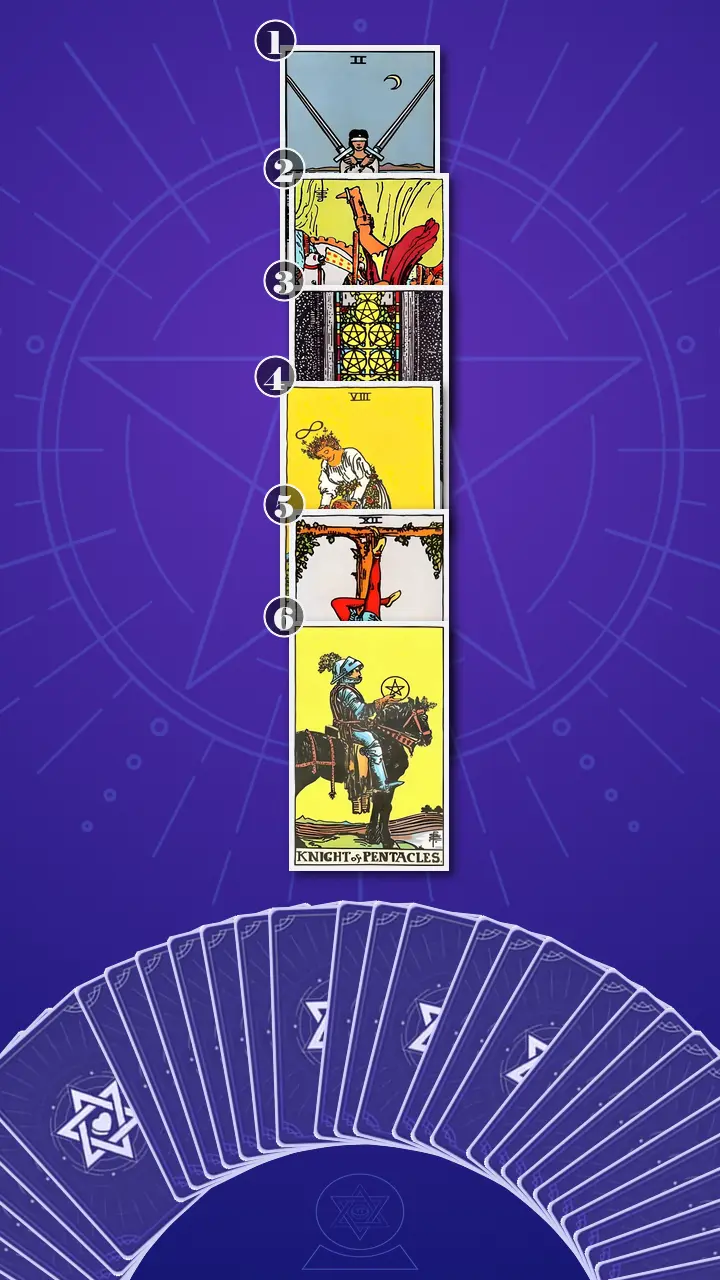
“Card one shows the exact freeze moment—what your ‘one click’ looks like from the outside,” I said. “Card two names the audience pressure—the people you feel watching. Card three goes beneath that into the real fear this hesitation is protecting. And then we climb: card four is what you can access in yourself to tolerate being seen, card five is the key shift, and card six is the boring, repeatable plan.”
Jordan swallowed. “Boring sounds… safe.”
Reading the Map: Card Meanings in Context
Position 1 — Surface snapshot: the hover-and-back-out loop
“Now we turn over the card representing the surface snapshot: the specific visible behavior and mental posture around the ‘Open to Work’ decision,” I said.
Two of Swords, upright.
It was almost too on-the-nose: blindfold, crossed arms, the body holding itself in a deliberate stalemate. I could feel Jordan recognize it before I said anything; their eyes did a quick dart to the side, the way someone looks when their browser history flashes in their mind.
“This is 11:30 p.m. LinkedIn settings,” I said, pulling directly from the lived translation of the card. “You preview the banner, your body tightens—shoulders up, breath held—so you exit out and edit your headline instead. You tell yourself you’re being strategic, but really you’re choosing the short-term safety of staying unseen.”
Energetically, the Two of Swords upright isn’t ‘indecision’ as a character flaw. It’s self-protection through non-decision. A blockage in Air—thoughts crossing like swords over the heart. It keeps you from absorbing messy feedback: your needs, your timeline, the fact that waiting is a choice too.
Jordan let out that unexpected reaction I’ve come to trust as a sign we’ve hit the true nerve: a small, bitter laugh. “That’s… yeah. That’s actually kind of cruelly accurate.”
“Cruel would be blaming you for it,” I said. “Accurate just gives us something to work with.”
I asked the question this position demands: “When was the last time you hovered over the toggle or drafted a message—then backed out? What exact thought, word-for-word, stopped your hand?”
Jordan didn’t even need to search. “If I turn it on and nothing happens, that’s the real answer I’m afraid of.”
Position 2 — Social trigger: the imagined audience
“Now we turn over the card representing the social trigger: the external audience-pressure story that intensifies hesitation,” I said.
Six of Wands, reversed.
“This card is LinkedIn as a public group chat,” I told them, “where you’re worried every reaction is a ranking—even though most people are half-scrolling on the subway.”
The modern-life scenario here is brutally simple: you’re not scared of job searching—you’re scared of what job searching will mean socially. The reversed Six of Wands turns a tool into a stage. A setting into a spotlight. The energy isn’t flowing outward; it’s getting kinked by reception anxiety—by the dread of not being applauded, or worse, being pitied.
I used the scene-contrast that always shows this loop cleanly: “There’s the stillness of your cursor hovering over the toggle… and then the frantic motion of ‘productive’ avoidance—editing the headline, refreshing profile views, checking posts, opening another tab.”
I let the inner monologue land like two captions on a screen: “If I don’t post, no one can judge me…” and then the second line: “…but if I don’t post, nothing can change.”
Jordan’s chest visibly dropped. Not dramatically—just enough to tell me their body recognized the pattern. Like a background app finally showing itself in the battery settings.
“Okay,” they said quietly. “It’s like I’m running reputation simulations in the background all day. It’s hot. It’s loud. And I can’t force-quit it.”
“Let’s name the audience,” I said, keeping it practical. “If you had to name the three people you’re most afraid will interpret your signal, who are they?”
Jordan answered immediately: an ex-manager, a classmate who’d just posted a promotion, and a recruiter they wanted to impress. Specific people. Real ghosts in the machine.
Position 3 — Root fear: the scarcity/belonging wound underneath
“Now we turn over the card representing the root fear: the deeper scarcity or belonging wound that the hesitation is protecting,” I said.
Five of Pentacles, upright.
This card always feels like winter. Two figures outside. A lit window nearby. Help exists—but it requires approaching it.
“Under the reputation anxiety,” I said, “is a quieter fear: that being visibly open to work will confirm you’re not chosen. That recruiters won’t respond. That ex-coworkers will pity you. So you’d rather not ask, not signal, not risk the cold reality—because the warm window is only available if you let yourself knock.”
I translated it into a modern Toronto scene the way the card insists on being translated: late-night streetcar glow reflecting off office towers that are still lit, the sense that everyone else has a plan, a path, a warm room—and you’re outside, snow in your collar, pretending you don’t want in anyway.
Jordan went still. Their fingers tightened around their mug, then loosened. Their throat worked like they were trying to swallow something that wasn’t there.
“If the banner got zero response for two weeks,” I asked, “what would you secretly decide it means about you?”
Jordan’s voice dropped. “That I’m not worth choosing.”
I nodded once, slow. “That’s the real driver. And it makes sense that the Six of Wands reversed is so loud—because it’s trying to protect you from this Five of Pentacles feeling. But here’s the part fear doesn’t mention: fear loves private prep because private prep can’t be rejected. It feels like strategy. It’s actually insulation.”
Position 4 — Inner resource: steadiness that can hold the discomfort
“Now we turn over the card representing the inner resource: the personal strength that can hold discomfort without obeying it,” I said.
Strength, upright.
The room—even through a screen—felt different. Strength is one of those cards that doesn’t hype you. It steadies you.
“The resource here isn’t louder confidence,” I said. “It’s calmer self-respect. It’s your body learning that visibility isn’t danger.”
I kept it grounded, non-clinical, but real: “Right now, your nervous system is treating LinkedIn settings like a threat. Like the green frame is a siren. Strength says: you don’t need to wrestle the lion. You place a gentle hand on it and keep breathing.”
I offered a tiny script swap—two sentences, no pep talk: “I’m allowed to want better fit.” and “One signal is not my worth.”
On camera, Jordan’s jaw unclenched. Their shoulders lowered a millimeter. They put both feet flat on the floor without me asking, like their body had been waiting for permission to stop bracing.
“That feels… smaller,” they said. “Like I could try a smaller version.”
“Exactly,” I said. “Strength isn’t ‘I’m fearless.’ It’s ‘I’m kind to myself while fear talks.’”
When The Hanged Man Turned the Screen Upside Down
Position 5 — Key shift: the perspective pivot that returns agency
I took a breath before flipping the next card. Not for drama—for precision. This position is where the loop breaks, if it’s going to break.
“Now we turn over the card representing the key shift: the reframing that breaks the fear-choice loop and returns agency,” I said.
The Hanged Man, upright.
In the card, the figure hangs upside down, not as punishment—more like a chosen pause. There’s a halo around his head: light that arrives when you stop trying to force the old angle to work.
Setup. I said it plainly, so Jordan could hear their own pattern without drowning in it: “You know that moment at 11:30 p.m. when you’re hovering over ‘Open to Work,’ shoulders up by your ears, already writing the explanation for what people might assume—so you fix one line in your headline again, close the tab, and call it ‘strategy.’”
I watched them freeze for half a second—breath caught—then their eyes went slightly unfocused, like a memory replaying behind their pupils.
I added the core sentence that sits at the center of this whole reading, the thing the card was building toward: Your fear isn’t protecting your career—it’s protecting your image, and the cost is your options.
Delivery.
Stop treating visibility as a verdict; treat it as a chosen perspective shift—hang the old story upside down and let the halo be your values, not other people’s opinions.
I let it sit. No extra words. Just a clean pause, like the moment on a trading floor when you’ve placed the order and you don’t get to talk it out of existing.
Reinforcement. Jordan’s reaction came in a three-step chain I’ve seen a thousand times in people who’ve been carrying a quiet, heavy fear: first, a physical stillness—their shoulders locked, their mouth slightly open, breath held. Second, the cognitive shift—eyes glassy, as if the phrase “visibility is a verdict” was scrolling like a caption across the inside of their skull, and then flipping. Third, the release—one long exhale that seemed to come from below the ribs, followed by a small shake of the head, like they couldn’t believe how long they’d been negotiating with the same story.
“So… I’ve been treating a setting like a trial,” they said, voice thin and honest. Then, quieter: “And I’ve been trying to control how everyone reads me, instead of controlling what I do.”
“Yes,” I said. “That’s the shift from image management to agency. From shame-driven stalling to values-led, grounded courage.”
Then I brought in my signature lens—the one that came from years of valuing companies and choices under uncertainty. “On Wall Street, when something feels scary, we don’t ask ‘Can I make the fear go away?’ We ask: what’s the expected value of each option, including opportunity cost.”
“Let’s do a quick Risk–Reward Matrix and a three-scenario forecast,” I continued, keeping it human. “Scenario A: you stay invisible. Reward: no one can judge you today. Risk: your option set shrinks quietly, and you keep paying with your nights. Scenario B: you do a tiny, controlled signal. Reward: information, conversations, weak ties activating. Risk: someone notices—and your brain writes a story. Scenario C: you do a huge public announcement. Reward: fast visibility. Risk: it spikes your nervous system and feeds the performance trap.”
“The Hanged Man isn’t asking for Scenario C,” I said. “It’s asking for Scenario B—with rules. A time-bounded experiment you control.”
I leaned closer to the camera. “Now, with this new lens, look back at last week. Was there a moment—on the subway, after a reorg ping, Sunday night in bed—where this insight would’ve made you feel different?”
Jordan’s eyes reddened, not with tears exactly—more like their body was finally acknowledging how exhausted it had been. “Monday,” they said. “Slack posted another ‘shifting priorities’ update. I opened a job board and minimized it like I was doing something illegal. If I’d thought ‘information-sharing, not verdict,’ I could’ve messaged someone. Instead I… researched PMM headlines until 1 a.m.”
“That’s the moment,” I said gently. “And we can build from that.”
I offered a 10-minute controlled visibility experiment right there—reversible, with a stop button, the way anxious brains need: “Set a timer. Open LinkedIn. Edit one thing only—your headline. Plain target role. Save. Close the tab. If your chest tightens, take three slower breaths. You are not required to turn on the green banner today. The win is one visible micro-step without negotiating with shame.”
Position 6 — Grounded next step: the boring plan that creates real data
“Now we turn over the card representing the grounded next step: one practical, repeatable action path that turns insight into momentum,” I said.
Knight of Pentacles, upright.
Jordan smiled—small, reluctant. “He looks… unbothered.”
“He’s unbothered because he’s consistent,” I said. “This is the antidote to doom-scrolling job posts at night and calling it prep. The modern translation is: the way out is boring on purpose.”
I described it as a checklist, not a glow-up: “Two reach-outs and one application per day for a week. A short log of what you learned. No rebranding marathon. No ‘FINAL_final_v7’ resume file spiral in Google Docs. Just steady movement that creates options—so the story in your head has to compete with real data.”
Jordan’s posture changed in the way it always does when someone can feel a plan forming—less floating, more grounded. “That actually sounds like something I’d do,” they said. “Like… meal-prep energy for my job search.”
“Exactly,” I said. “Credible. Repeatable. Not performative.”
The One-Week Visibility Ledger: Actionable Advice Without the Public Confession
I pulled the whole ladder together for them, story-style—because integration is where clarity actually becomes usable.
“Here’s what your spread is saying,” I told Jordan. “On the surface, the Two of Swords shows you freezing at the moment of visibility and soothing yourself with ‘neutral’ non-action. The Six of Wands reversed explains why the freeze is so intense—LinkedIn feels like a scoreboard, and you’re bracing for judgment. Underneath, the Five of Pentacles is the real wound: ‘If I’m not chosen, it means I’m not worth choosing.’ Strength is your stabilizer—self-respect and nervous-system steadiness. The Hanged Man flips the meaning: visibility isn’t a verdict, it’s information-sharing. And the Knight of Pentacles brings it down to earth: a boring routine that generates options.”
“Your cognitive blind spot,” I added, “is that you’ve been treating other people’s interpretation as the main risk, when the bigger risk is the slow opportunity cost of staying invisible. Protecting your image can cost your options.”
Jordan frowned. “But I’m so slammed. I don’t even know where I’d find time for a whole job search. And if I start, I’m scared I’ll spiral.”
“That’s real,” I said. “So we design it the way we’d design a sane system: small, time-bounded, track completion—not outcomes.”
I introduced one of my client-facing tools—my boardroom-style decision ledger. “Not because you need to be corporate about your feelings,” I said, a little wry. “But because a ledger stops shame from rewriting the rules mid-week.”
Then I gave them the next steps as a controlled experiment—clear enough to follow on a tired Tuesday night.
- The 12-minute headline edit (one visible micro-signal)Once this week, set a 12-minute timer. Open LinkedIn and update only your headline to one clear target (role + lane), e.g., “Product Marketing Manager | B2B SaaS | Open to PMM / GTM roles.” Save, then log off—no About-section spiral.Expect the thought “This is pointless unless it’s perfect.” Treat that as weather. The timer is your boundary; stop when it rings, even if your brain begs for “one more tweak.”
- A 7-day visibility experiment (reversible, values-led)Put a 7-day block on your calendar. Choose ONE signal: (a) headline update only, or (b) “Open to Work” visible to recruiters only. Before you click anything, write one sentence: “This week, I’m optimizing for options / information / conversations, not approval.”Make it reversible on purpose: you can switch it off after seven days. The success metric is “I ran the experiment,” not “I got hired instantly.”
- The “2 + 1” routine + Visibility Log (boring momentum)For five weekdays, do “2 + 1”: send two low-pressure messages (one to a trusted ex-coworker, one to a friend-of-friend) and submit one application. Then stop. In a note titled “Visibility Log,” record: date, action taken, discomfort (0–10), and one neutral fact learned.Boring is the feature. If you miss a day, you resume the next day—no punishment spiral. Track completion, not replies. Replies are market noise; actions are agency.
Before we ended, I taught Jordan a pre-commitment ritual I stole from trading floors and repurposed for anxious decisions: “Feet on the floor. Three slower breaths. Say out loud: ‘I’m allowed to collect information.’ Start the timer. When it ends, you close the tab—no renegotiation.”
They nodded like someone who’d finally been handed a handrail.

A Week Later: Ownership, Not Certainty
Eight days later, Jordan messaged me. Just a screenshot and one sentence: “I did the 12-minute headline edit. I didn’t die. And I didn’t ‘fix it’ afterward.”
Their follow-up note was even smaller—and that’s why it mattered. They’d run the experiment for five days. Some messages got polite replies. One got no reply. One turned into a coffee chat booked through Google Calendar with the subject line “Quick catch-up?” The world didn’t end. The halo didn’t shatter. It was information.
And in a 50-word moment that felt like the real proof, they said: “I slept through the night for the first time in weeks. In the morning, my first thought was still ‘What if I’m wrong?’—but this time I actually smiled. Like… okay. Then I’ll adjust. I’m not on trial.”
That’s what a Journey to Clarity looks like most of the time—not fireworks, not instant certainty. Just the quiet transfer of power: from image-protection anxiety to values-led, grounded courage. From reputation simulation to real data. From stalling to self-trust built through small steps.
When your hand is on the handle but you can’t turn it, it’s rarely laziness—it’s the terror that one visible signal will get translated into a story about your worth.
If you treated the next seven days as a visibility experiment you control—not a public verdict—what’s one small signal you’d be willing to try, just to see what information comes back?