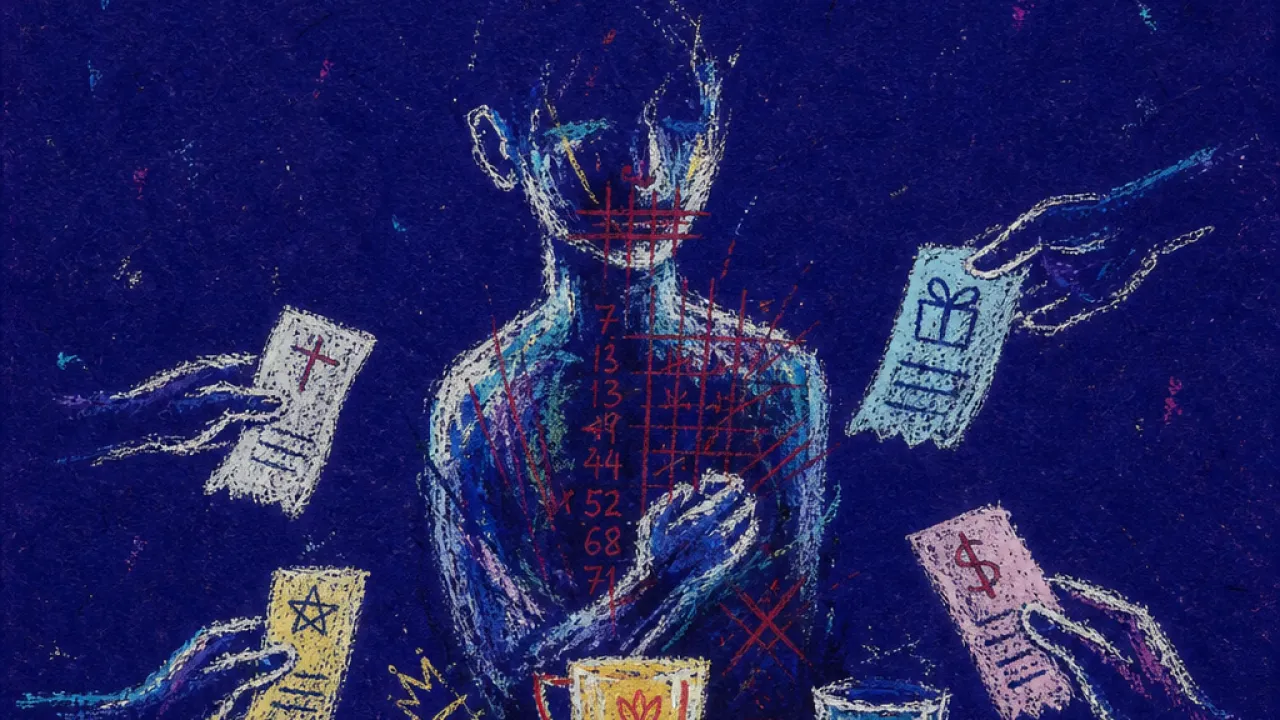
In Gratitude Policing, the pressure begins when support, comfort, or visible advantages are used to interrupt what you are trying to name. That tight checkpoint in your body, where every honest sentence has to prove it is not ungrateful, belongs to an environmental and structural dynamic, not a private flaw. The dynamic turns receiving into a managed posture: you may acknowledge the cups in front of you while still noticing the condition attached to them. These Tarot Cards reflect the outline of that exchange, where gifts, ledgers, silence, and consent sit in the same frame.
Four of Cups ReversedThree cups are already displayed in front of the seated figure, and another cup is held out as if the visible presence of offerings should settle the matter. Yet the body does not reach, and the exchange remains suspended. That image fits a family environment where help, comfort, or past provision is used as evidence that you should be satisfied. You are being shown the pressure created when resources are counted more loudly than consent, making your hesitation look like ingratitude instead of information about the relationship.
Five of Cups ReversedThe two upright cups behind the figure are real, but the three spilled cups dominate the foreground with equal physical reality. The card refuses a simple bright-side reading because its visual field contains both remaining value and visible damage. That is why it links so sharply to gratitude policing in growth spaces. When coaches, feeds, friends, or wellness scripts push you to focus only on what remains, the structure of the card shows what gets erased: the spill still has to be named before the bridge can become usable.
Six of Cups ReversedThe repeated golden cups make care countable. Each vessel is intact and filled, but in reversal that abundance can become a display case of what has been given, preserved, and brought back as proof. For you, Gratitude Policing appears when family support is no longer allowed to be ordinary care. The Six of Cups shows the ledger hidden inside the flowers: every past gift can be used to regulate present speech, silence, availability, or independence.
Seven of Cups ReversedThe jewels, castle, and wreath in Seven of Cups are visually persuasive. They invite admiration before they offer contact. The person below is positioned as a receiver of images, not as someone negotiating equal terms with the objects held above them. In family life, this becomes gratitude policing when support is repeatedly displayed as proof that you should not question the relationship. The gift, sacrifice, housing help, public pride, or past protection becomes a cup held over the conversation. Its purpose shifts from care to control when it is used to shut down boundaries. The card reveals the hidden cost beneath the glittering object. Gratitude can stay intact without becoming a gag order. Seeing the support and the leverage separately is how the family script starts to lose its power.
Eight of Cups ReversedThe eight cups can be read as proof that something was built and provided. In the reversed texture, that visible proof can become an inventory placed in front of the person who is trying to leave. Gratitude policing appears when family support or sacrifice is used to set the terms of your adult access, choices, and distance. The card's central gap matters because the visible cups do not cancel the missing one; provision and incompleteness can coexist. The figure walking away makes the conflict concrete. You can acknowledge what was given while still seeing that gratitude is being used to keep you beside a structure that does not fully hold you.
Nine of Cups ReversedThe raised cups make satisfaction visible, almost undeniable, while the seated figure is placed beneath the evidence of what has already been gained. The display can easily become a public argument that nothing more should be asked for. In personal growth, that is the pressure of being told your visible blessings, wins, stability, or comfort should cancel the next desire. The structure is external because other people, communities, or improvement spaces use the trophy shelf as proof that wanting more is excessive. The card reclaims the distinction between appreciation and confinement. You can recognize the cups without letting them become a ceiling on the next honest stage of becoming.
Ten of Cups ReversedThe Ten of Cups shows abundance so plainly that gratitude can become the dominant language of the scene: home, children, landscape, water, and a perfect arc of cups. When that abundance is used as evidence against discomfort, the image becomes a rule that says the visible blessings should cancel the hidden complexity. Gratitude Policing is an external context because it often arrives through other people’s reminders, family narratives, wellness language, or social comparison. In introspection, this blocks the audit by forcing every difficult signal to defend its legitimacy against what appears to be a good life. The card connects to this pressure through the perfection of its symbols. The more complete the image looks, the easier it is for the environment to treat unresolved material as unreasonable. This structure helps You separate real appreciation from enforced silence, making room for the inner system to name what is true without denying what is also supportive.
Page of Cups ReversedThe cup is lifted like something ceremonial, and the Page's handling of it is visible to the whole scene. The fish inside makes the object feel responsive, as if the way it is received and held can be judged. Gratitude policing in families turns care into a performance standard. A gift, sacrifice, or favor becomes less about support and more about whether you display the correct amount of appreciation, loyalty, or softness afterward. You may be trying to separate genuine gratitude from enforced indebtedness. The card reveals the stage around the exchange, where the family watches not only what was given but how you behave after receiving it.
Ace of Pentacles ReversedThe pentacle is displayed with precision, held where it can be seen and counted. Its brightness gives the offer public weight before it becomes fully integrated into the garden below. In family conflict, that visible offer can become evidence in a future argument. The card reveals how support turns into a record of what You are expected to tolerate, making gratitude less like appreciation and more like a rule used to manage speech, boundaries, and refusal.
Two of Pentacles ReversedThe figure performs in the open, keeping the pentacles moving in a visible loop. Reversed, the scene highlights not only the exchange itself, but the demand that the exchange be performed correctly under observation. Gratitude policing works through that visible performance. Family help, sacrifice, money, or favors become tied to an ongoing expectation that you display enough appreciation, loyalty, humility, or obedience to prove you deserved support. The card exposes the hidden contract inside the loop. You are not rejecting care by noticing the pressure; you are identifying when thanks has stopped being a human response and started functioning as a mechanism of control.
Four of Pentacles ReversedThe coin on the crown turns provision into status, while the coin at the chest turns possession into a claim on closeness. Because the figure displays what he holds, the scene carries a ledger-like quality: what was given remains visible and countable. In family systems, that ledger can become a way to police your reactions. You are not simply receiving help; you are being asked to keep proving that the help bought agreement, access, or silence.
Five of Pentacles ReversedThe window is bright enough to dominate the scene, yet its warmth does not reach the bodies outside. The image captures the difference between the appearance of generosity and the lived experience of being left to manage the cold. Gratitude Policing appears when a family points to the glowing window as proof that enough has been given. The pressure is not only to accept help, but to accept the family's version of help without naming the conditions, delays, comparisons, or emotional cost attached to it. The Five of Pentacles gives you a way to inspect that exchange without becoming trapped in the accusation of being ungrateful. It asks whether gratitude is being used to recognize care, or to prevent you from describing the boundary that still keeps you outside.
Six of Pentacles ReversedThe kneeling bodies, raised faces, and downward coins make need publicly visible. The scene does not simply show support; it shows a posture where receiving can become something that must be displayed correctly. In personal growth, this connects to gratitude policing when help comes with pressure to stay thankful, agreeable, and visibly improved. You may have received something real, but the card shows how the social script around receiving can start controlling what You are allowed to question next.
Seven of Pentacles ReversedThe one harvested coin on the ground can be pointed to, counted, and used as proof that something has been given. Around it, the six remaining coins still hang in view, turning the garden into a ledger of past effort and future expectation. Gratitude Policing emerges when family help is repeatedly cited to narrow what you are allowed to want. The card shows how thanks can be weaponized into a rule: because something was provided, your independence, privacy, or disagreement must be treated as ingratitude rather than as part of becoming a separate adult.
Eight of Pentacles ReversedThe pentacles hang like a record of what has been made. Their straight display turns effort into something countable, reviewable, and available for comparison against a standard. In a family system, gratitude policing works through a similar ledger. Past support, sacrifices, housing, tuition, or practical help can be repeatedly displayed as proof that you owe continued agreement, availability, or emotional compliance. The card clarifies the pressure without denying that support may have been real. It separates gratitude from control, showing where appreciation is being converted into a tool for limiting your adult choices.
Nine of Pentacles ReversedThe ripe grapes and pentacles make the gift of abundance impossible to miss, while the gloved bird shows that receiving care can also place the receiver in a managed position. The picture is generous, but it is not neutral; every resource sits inside a relationship of control. That is the family logic behind gratitude policing. You may hear reminders of what was paid for, sacrificed, or provided whenever you draw a boundary, and the card helps name how appreciation can be turned into a lever against adult autonomy.
Ten of Pentacles ReversedThe wealthy household, ornate clothing, loyal dogs, and family crest create a scene where support is visually undeniable. The image makes abundance public, almost impossible to dispute. Gratitude Policing fits when visible support is used to shut down the legitimacy of wanting more. You may have real advantages, but the structure reveals how those advantages can be turned into a rule against dissatisfaction, ambition, or change.
Page of Pentacles ReversedThe coin is held carefully enough to look ceremonial, as if the object must be acknowledged before anything else can happen. The Page's body is arranged around recognition of the resource. In family life, that image becomes painful when support is repeatedly converted into proof of debt. You may hear reminders about sacrifices, gifts, rent, tuition, time, or past help whenever you try to set a boundary or make an independent choice. The reversed structure is the policing of gratitude. The card shows how thankfulness stops being a free response and becomes a rule used to keep the family ledger open.
Queen of Pentacles ReversedThe garden is lush, the throne is carved, and the pentacle is whole. From the outside, the scene offers plenty of evidence that the Queen should be fine, because the visible environment is stable, beautiful, and materially supported. Gratitude Policing enters when visible comfort is used as proof that nothing difficult is allowed to be named. You are left trying to process inner material inside a setting that keeps pointing to what is already available, instead of making room for what still feels unresolved, heavy, or unseen.
King of Pentacles ReversedThe grapes and vines make abundance visible everywhere, yet the armor underneath the robe changes the texture of that abundance. The pentacle is displayed as provision, while the scepter keeps the giver's authority in the same frame. In a family system, gifts can become a performance stage where support must be repaid through silence, availability, or public loyalty. This card names the pressure point where care stops being clean care and starts functioning as a receipt that can be produced during conflict.
Eight of Swords ReversedThe red robe signals vitality, yet the pale bands make restraint look clean, quiet, and almost respectable. In the distance, the castle suggests protection and provision, but the route toward it is mediated by blades and restricted sight. That visual logic fits family gratitude policing, where past support or sacrifice is used to regulate what you are allowed to want now. The structure converts help into a moral debt ledger, making independence look ungrateful instead of developmental.
Nine of Swords ReversedThe quilt and bed offer visible shelter, yet the swords cut across the exact zone where speech, thought, and attachment would normally settle. Support is present in the picture, but it comes with a pressure field that refuses to let the body rest. In family life, this is the logic of help being converted into debt: money, housing, rides, favors, or sacrifices become evidence that you owe compliance. You are not rejecting care; the card separates real support from the control mechanism attached to it.
Four of Wands ReversedFruit, flowers, ribbons, and raised wreaths make abundance highly visible. Reversed, the decoration can become evidence presented back to the person: look at what was provided, look at what was celebrated, look at what you are expected to appreciate. That is the logic of gratitude policing in a family system. You may not be rejecting the help itself; you may be resisting the requirement to perform endless thankfulness in exchange for basic respect, privacy, or room to make your own choices.
Six of Wands ReversedThe laurel wreaths and cheering wands make gratitude visible in the scene. Recognition is not quiet or mutual; it is staged in front of witnesses, with the central figure surrounded by proof that support was given. In a family system, that visual logic becomes gratitude policing. Relatives may point to sacrifices, gifts, tuition, housing, introductions, or emotional labor as evidence that you owe compliance, access, or silence. The reversed Six of Wands clarifies the exchange. The problem is not gratitude itself; it is the conversion of support into a permanent invoice that keeps your autonomy under review.
Knight of Wands ReversedThe wand is raised like proof, and the salamander tunic announces origin before the rider moves. In the reversed field, those symbols of pride and support can harden into an honor code that must be repaid through behavior. Gratitude Policing appears when family help becomes a ledger rather than a gift. Past sacrifices, money, time, migration, parenting, or protection are invoked to make normal adult boundaries feel like ingratitude. The pressure is external and social: the family story turns appreciation into compliance. The reversed Knight of Wands fits because the mission on the body is larger than the journey itself. It shows how a person can be pushed to carry family pride as a debt, making independence feel like a public failure of gratitude.
Queen of Wands ReversedThe Queen's sunflower is bright, but it is singular against a dry desert field. Warmth appears concentrated, held, and displayed under the watch of crowns, lions, and throne symbols. In a strained family system, that visual economy can become gratitude policing. Care, sacrifice, tuition help, immigration effort, housing support, or past protection may be kept visible as a permanent ledger. The expectation is not just that you acknowledge help, but that you remain available, agreeable, and emotionally indebted. This card links to the context because its radiance is organized into a public code of proper response. You are not being asked merely to be thankful; you are being positioned inside a rule system where gratitude can be used to narrow your choices. Seeing that structure clearly helps separate real appreciation from compliance extracted through family accounting.
No cards available for this filter.