The 8:47 p.m. Group Chat Spotlight
If you’ve drafted three versions of the same reply, reread them like a PR statement, and still can’t hit send because you’re trying to prevent “a whole thing”… yeah.
Jordan said that to me with a half-smile that didn’t reach their eyes. They were on a video call from their Toronto apartment kitchen—Tuesday night, late enough that the overhead light felt too sharp. I could hear the range hood humming in the background like a low, anxious engine. Their phone kept lighting up on the counter, warm screen against laminate, the family group chat preview flashing: “We were really hoping you’d be here.”
Jordan’s hand hovered over the phone the way it hovers over a hot pan—careful, braced. Their shoulders were already pulled up, jaw tight. When the notification buzzed again, I watched their breath catch high in their chest, like their body had decided the message was a physical threat.
“I’m an adult,” they said, voice a little too light, “but one text from my mom and I’m 16 again.”
I nodded, letting the silence do its work for a beat. “That tight chest and the sinking stomach you described—your body is answering before your brain even gets a vote.”
Jordan’s eyes flicked to the chat, then back to me. “I just want to choose my own plans. But if I say no, it turns into a whole thing. So I over-explain, I offer alternatives, I buy extra gifts like… a peace payment.”
They exhaled hard, like they’d been holding air for days. “And then I resent it. Every year.”
I leaned in, warm and direct. “You’re not ‘bad at holidays’—you’re stuck in a guilt-management workflow. And we can absolutely work with that. Let’s make a map through this fog, the kind that leads to actual clarity, not just temporary peace.”

Choosing the Compass: The Celtic Cross · Context Edition
I asked Jordan to put the phone face down for a moment. “Not as a dramatic ritual,” I said, “just a nervous-system reset. Give your body one clean signal: we’re not answering yet.”
While they took a slow breath, I shuffled my deck on camera—steady, unhurried. The sound is always small but specific, like paper trying to remember its original shape. “Tarot works best for me when it’s treated like a thinking tool,” I told them, and by extension you. “Not a verdict. More like a way to see the system you’re stuck inside—what triggers it, what keeps it looping, and what lever actually changes it.”
“Today I’m using the Celtic Cross · Context Edition,” I continued. “I like the classic Celtic Cross for situations like holiday guilt texts because you need a full chain: the present trigger, the deeper conditioning underneath, and then practical integration—how to communicate without turning your text into a courtroom-level defense.”
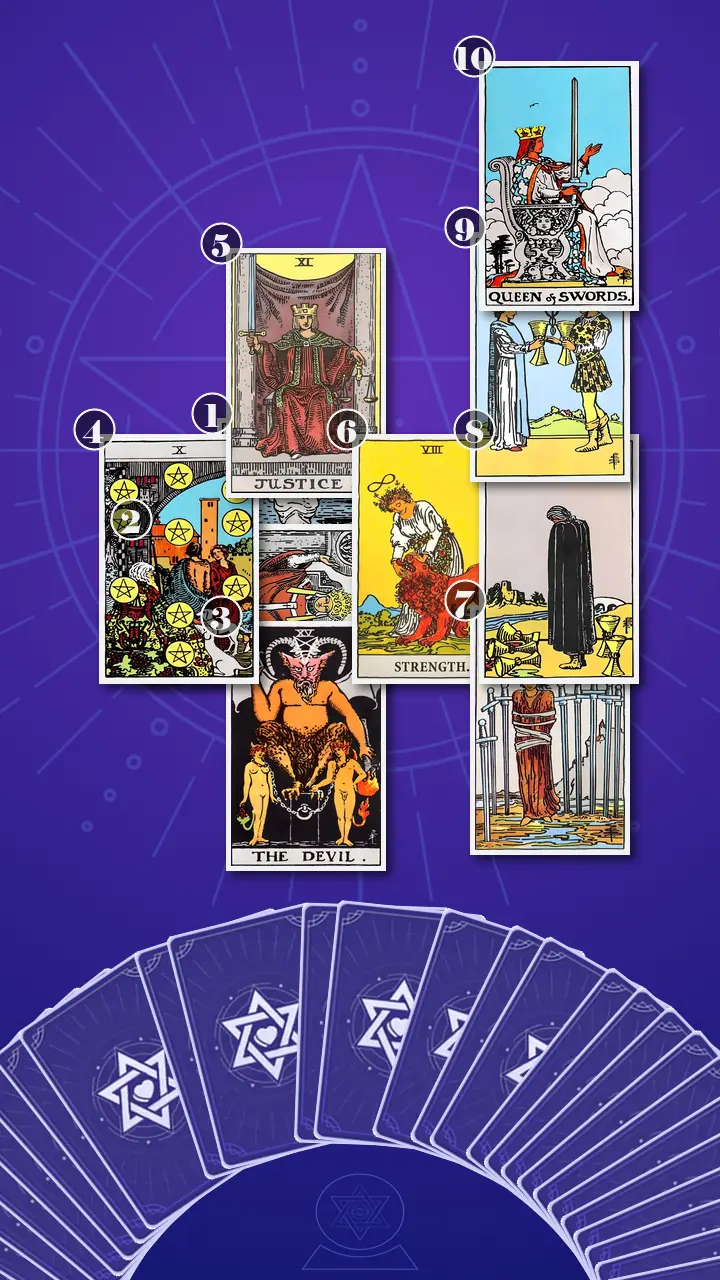
“A couple positions matter most here,” I said, sliding cards into place. “The first card will show the observable stuck point—what happens in your body and behavior the moment a guilt text lands. The crossing card shows the pressure point that makes this feel so hard. And there’s a near-future pivot card—your next inner move—where the whole dynamic can shift from guilt management to self-led choice.”
Reading the Map: Drafts, Rules, and Invisible Chains
Position 1 — The Observable Stuck Point
“Now flipped over,” I said, “is the card representing the current moment: how the guilt texts land in your body and behavior.”
Two of Swords, reversed.
“This is so specific it almost feels rude,” I told Jordan. “It’s 9 PM, the family group chat is open like a spotlight, and you keep saying ‘Let me see’ while flipping between your calendar and the chat. You’re trying to stay ‘neutral’—but the neutrality has become a freeze.”
I pointed to the image. “Those crossed swords over the chest? That’s your body. Tight chest, jaw clench. You’re trying to protect everyone with careful wording, and it turns into self-silencing.”
In energy terms, this is blockage: Air (thought, language) jammed in place. Too much mental motion, not enough decision. The mind is doing laps to avoid the discomfort of one clean yes or no.
Jordan let out a small laugh—bitter, quick. Then their lips pressed together like they regretted making a sound at all.
“Yeah,” they said. “That’s… too accurate. It’s like I’m A/B testing my personality in real time. Version A: obedient. Version B: independent. Both feel unsafe.”
“Exactly,” I said gently. “And here’s the line I want you to keep: You don’t need a legal brief. You need one plan and one caring line. We’ll get there.”
Position 2 — The Pressure Point That Crosses You
“Now we’re looking at the core challenge: the force that makes choosing your own plans feel hard.”
The Hierophant, upright.
“Holiday planning starts sounding like a rulebook you didn’t write,” I said. “The ‘correct’ dates, the ‘right’ traditions, the unspoken expectation that attendance equals loyalty. When your parents text, you don’t just hear a request—you hear a moral standard, like you’re about to fail a test if you choose differently.”
This is excess authority-energy. Not necessarily because your parents are villains—more because tradition has been elevated into something sacred and unquestionable. The Hierophant is the keeper of “this is how we do it.”
“It’s so messed up,” Jordan murmured. “Like… I can plan a whole campaign at work. But I can’t plan a holiday without feeling like I need permission.”
“That’s the Hierophant’s shadow,” I said. “Turning preference into morality.”
Position 3 — The Root Driver Under Your Nervous System
“Now flipped over is the root driver: the deeper pattern your nervous system learned about family, duty, and love.”
The Devil, upright.
I didn’t rush this one. “This is the guilt–belonging contract,” I said. “Like a subscription you never knowingly signed up for: ‘Pay in apology paragraphs to keep access to belonging.’”
“In modern life, it looks like this: the moment you sense disappointment, you start offering payment—extra apologies, extra gifts, extra days, extra access. Not because you’re fake. Because guilt hits like withdrawal.”
Here the energy is attachment—not to a plan, but to a belief: If they’re disappointed, I must fix it. The chains on the Devil card are loose for a reason. The bind feels absolute, but it’s adjustable once you can see it.
Jordan’s eyes went unfocused for a second, like they were replaying a week of texts at double speed. Their thumb rubbed the side of their phone without realizing it.
“Their feelings can be real without becoming your marching orders,” I said softly, watching the words land in Jordan’s posture. Their shoulders dropped a millimeter. Not peace—just the tiniest loosening.
Position 4 — The Legacy Still Shaping the Conversation
“Now we’re looking at the recent past: what family tradition or dynamic is still shaping the present conversation.”
Ten of Pentacles, upright.
“This tells me the holiday isn’t just a weekend,” I said. “It’s a family legacy event. The gathering is proof that the family is still intact. Your absence can feel, to them, like a crack in the whole structure.”
Energy-wise, this is stability—but it can become rigidity. It’s why even a practical decision (work, budget, rest) gets treated like a symbolic betrayal.
“That’s why it feels so heavy,” Jordan said quietly. “Like I’m not saying no to a date. I’m saying no to… the story.”
“Yes,” I replied. “And the story matters. We just don’t want it to crush your capacity.”
Position 5 — Your Conscious Aim: What You’re Trying to Do Ethically
“Now flipped over is your conscious aim: what you’re trying to achieve emotionally and ethically.”
Justice, upright.
“This is the moment your brain wants to finally stop bargaining,” I said. “You stop asking, ‘What will keep everyone happy?’ and ask, ‘What is fair to my capacity?’ Your calendar becomes a balance sheet.”
I’ve been trained in Paris to treat scent like structure—top notes, heart notes, base notes—each one has a job, and if you overload one, the whole composition collapses. Justice feels like that to me: not a feeling, a structure. A fair formula.
“Justice says two truths can exist without turning it into a moral trial,” I told Jordan. “You can care about your parents and care about yourself.”
Jordan gave a small exhale that sounded like air leaving a clenched fist. “Wait,” they said. “I can decide based on capacity, not permission.”
“Exactly.”
When Strength Held the Lion: The Boundary That Doesn’t Fight
Position 6 — The Near-Future Pivot
I let my hand rest on the deck for a beat. The kitchen sounds on Jordan’s end—the hum of the hood, a distant radiator click—suddenly seemed louder, as if the room itself leaned in.
“Now flipped over,” I said, “is the near-future pivot: the most likely next inner move that shifts this from guilt management to self-led choice.”
Strength, upright.
“In your real life scenario, this is: a guilt text comes in, you feel the spike—tight chest, stomach drop—and you don’t sprint into appeasing,” I said. “You pause. You keep your tone warm. You send a simple message anyway. You’re not trying to crush guilt; you’re holding it steady long enough to act from your values.”
Energy-wise, Strength is balance. Not too soft (collapsing into compliance), not too hard (going icy or cutting). Regulated courage.
Then I brought in my most personal lens—my work as a perfumer and intuitive consultant. “I want to use something I call a Family Energy Diagnosis,” I said. “It sounds fancy, but it’s simple: families have emotional ‘flow patterns’ the way perfumes have diffusion. Some families communicate like loud top notes—sharp, immediate, attention-grabbing. Others are base-note families—slow, heavy, lingering.”
Jordan blinked. “Okay.”
“Your parents’ guilt texts have a base-note strategy,” I continued. “They linger. They coat the conversation in disappointment—like smoke on a jacket. And your system has learned to scrub it off fast by over-explaining. That’s why you write paragraphs. You’re trying to deodorize disappointment.”
Jordan’s mouth opened, then closed. Their eyes got glassy, not with tears yet—more like recognition.
“Strength is you realizing you don’t have to deodorize it,” I said. “You can acknowledge it without obeying it.”
The Aha Moment (and the Lion in Your Body)
Setup: I pictured Jordan exactly as they’d described: standing in their kitchen at night, phone warm in their hand, rereading “We were really hoping you’d be here,” and their chest tightening like the message just grabbed the steering wheel of their calendar. The panic says: Fix this. Make them okay. Explain harder.
Delivery:
Stop wrestling the guilt like it’s a lion you must defeat; start holding it gently and firmly, the way Strength holds the lion—present, calm, and in control.
I let the sentence hang. No extra words. Just breathing.
Reinforcement: Jordan’s body did a three-step reaction chain so clear I could almost time it. First: a tiny freeze—breath paused, eyes wide, phone held mid-air like it weighed more. Second: the gaze drifted past the screen, as if their brain was replaying every “Are you really not coming?” message with a new subtitle. Third: the release—an unsteady exhale, shoulders dropping, and a hand moving to their sternum like they were checking if the tightness was still there.
And then—unexpectedly—anger flashed up. Not at me. At the whole pattern.
“But… if I stop wrestling it,” Jordan said, voice sharper now, “doesn’t that mean I’ve been doing it wrong? Like I’ve been negotiating my whole life?”
I didn’t correct them. I met them. “It means you’ve been surviving with the tools you had,” I said. “And now you’re upgrading the tools. Strength isn’t a judgment. It’s a new skill.”
I kept it practical, the way Strength demands. “Set a 10-minute timer. Draft a two-sentence reply—Plan + Caring line. Read it out loud once. If you feel the urge to add explanations, paste them into Notes instead of the chat. Then send. After you send, put the phone face down and take 6 slow breaths.”
I watched Jordan swallow, like the idea was both terrifying and… clean.
“Now,” I asked, “with this new lens—can you think of a moment last week when this would have changed how you felt?”
Jordan nodded slowly. “Sunday night. The typing bubbles. I felt trapped. I could’ve just… held it. Instead of paying.”
“That’s the shift,” I said. “From guilt-driven tightness toward steadier self-respect. Not perfect. Just steadier.”
The Staff Climb: From Trapped to Clear Words
Position 7 — How You’re Seeing Yourself in This Story
“Now flipped over is self-position: how you’re seeing yourself in this story.”
Eight of Swords, upright.
“This is the internal voice that says there’s no good option,” I explained. “If you choose yourself, you’re selfish. If you comply, you lose your holiday. So you stall.”
In energy terms, this is deficiency of perceived agency. The bindings are loose, but your mind treats them like steel. The trap is mostly the fear of the conversation—not an actual lack of options.
Jordan gave a tiny nod, eyes down. “My ‘can’t’ is really ‘I don’t want to handle the fallout.’”
“Exactly,” I said. “And Strength is proof you can handle it—without performing.”
Position 8 — The Messaging Climate Around You
“Now we’re looking at environment: the family messaging climate and the social pressure around the ‘right’ holiday plan.”
Five of Cups, upright.
“This is disappointment-colored communication,” I said. “What’s missing. What won’t be the same. What you’re not doing. It makes your nervous system treat boundaries like harm.”
Energy-wise, it’s excess focus on loss. And the key symbol here—two cups still standing behind the figure—matters a lot. There are still ways to connect that don’t require surrendering your whole holiday. They’re just not the loudest part of the conversation.
“It’s like the group chat algorithm learned guilt gets the fastest response time,” Jordan said, and then they looked at me like they couldn’t believe how true it sounded.
“Yes,” I replied. “And we’re about to teach it a new pattern.”
Position 9 — The Real Hope (and the Fear Under It)
“Now flipped over is hopes and fears: what you long for, and what you dread will happen if you choose yourself.”
Two of Cups, upright.
“This is your hope for adult-to-adult connection,” I said. “Mutual respect. An exchange that doesn’t require pleading or proving.”
And the fear? “That a boundary will be treated like rejection,” I added. “That the bond breaks instead of evolves.”
Jordan’s expression softened. “I don’t want distance,” they said. “I just don’t want my calendar negotiated through guilt.”
“That is Two of Cups,” I said. “Not compliance. Consent.”
Position 10 — Integration and Advice: The Healthiest Way to Speak
“Now we’re at integration and advice: the healthiest way to communicate and act so you keep connection without surrendering your plans.”
Queen of Swords, upright.
“This is ‘TL;DR boundaries,’” I said, and Jordan actually smiled. “Like a two-line Slack message that lands: clear, kind, and not over-explained.”
In energy terms, this is balance in Air. Swords go from binding you (Two and Eight) to serving you: discernment, clean language, reality stated without apology-spinning.
“The Queen’s open hand says: I’m not shutting you out,” I told them. “And the sword says: I’m not debating my reality.”
Jordan glanced at their phone again—still face down, still quiet. “I can actually picture the exact message I’d send,” they said, like the image surprised them.
The One-Plan, One-Line Method (Actionable Advice for Holiday Boundaries)
I pulled the whole spread together for Jordan in plain language. “Here’s the story these cards are telling,” I said. “Right now, you freeze and draft because you’re trying to be fair to everyone (Two of Swords reversed), but tradition makes the conversation feel like a moral exam (Hierophant), and underneath that is an old contract that says belonging must be earned by compliance (Devil). Your family legacy is real and meaningful (Ten of Pentacles), and you genuinely want to handle this with integrity (Justice). The pivot is learning regulated courage—holding guilt without letting it drive (Strength)—so you can speak with clean, warm directness (Queen of Swords).”
“Your cognitive blind spot,” I added, “is thinking the relationship is only safe if you can prevent their disappointment. That’s what keeps you over-explaining and bargaining. The transformation direction is different: clear, kind boundaries that don’t require a courtroom-level defense—long enough for your nervous system to trust you.”
Then I gave Jordan something they could do tonight—small, realistic, copy-and-paste-able. I also brought in my communication work through scent, because it’s not fluff; it’s state-change. If your chest is clamped, language gets wobbly.
- The 90-Second Justice CheckOpen your calendar and your Notes app. Write one sentence: “This holiday, I have capacity for ___.” (Example: “I have capacity for a 45-minute call on Christmas Day and a visit the weekend after.”) Do it before you open Messages.If you start adding reasons, label them “Nice-to-know, not required.” You’re writing a plan, not a defense.
- Strength Pause + Scent Anchor (60 seconds)When the guilt text lands, put the phone face down. Take 6 slow breaths. If you have it, dab a calming scent on your wrist (neroli, lavender, or a soft cedar). Smell it once—one inhale—and let that be your “hands on the steering wheel” cue.You’re not trying to become magically calm. You’re teaching your nervous system: “A boundary doesn’t equal danger.”
- The Two-Sentence Send (Plan + Caring Line)Draft exactly two sentences and send within 10 minutes. Sentence 1: your plan. Sentence 2: one caring line. Example: “I’m not coming on the 24th/25th this year. I love you and I’d like to call you on Christmas Day.”If you feel the urge to add paragraphs, paste them into Notes instead of the chat. Send the text, then step away—don’t keep negotiating with your own nervous system.
Jordan raised their eyebrows. “And if they push back?”
“One repeatable line,” I said. “Queen of Swords energy: ‘I hear you. My plan is still the same.’ Then you take a pause. You don’t have to keep engaging to prove you’re kind.”
I added one more perfumer’s trick, optional but powerful. “If holidays are a trigger, make your boundary a memory anchor,” I said. “Choose a simple scent you only use when you do the grown-up version of you—maybe a citrus spritz like bergamot on your sleeve. Every time you hold the boundary, you wear it. Over time, your body learns: this smell means ‘I’m safe to choose.’”

A Week Later: Ownership, Not Certainty
Eight days later, Jordan messaged me a screenshot—cropped tight, no family names, just the text they sent.
“I’m not coming on the 24th/25th this year. I love you and I’d like to call you on Christmas Day.”
Under it, their follow-up: “My hands were shaking. I did the breaths. I dabbed the neroli rollerball like you said. I sent it and literally went to wash one dish so I wouldn’t spiral. They weren’t thrilled… but I didn’t die. And I didn’t write an essay.”
Clear, but not magically easy—that’s the real win. They told me they slept through the night for the first time in a week, then admitted the next morning’s first thought was still, What if I’m wrong? “But this time,” they wrote, “I laughed a little. Like—okay. I’m allowed to be scared and still choose.”
That’s what a Journey to Clarity looks like in real life: not certainty as a personality trait, but ownership you can feel in your chest—space where the tightness used to live.
When a single “We were really hoping you’d be here” text makes your chest clamp down and your brain start writing apology paragraphs, it’s not that you don’t love them—it’s that you’ve been trained to treat belonging like something you have to earn by giving up your own plans.
If you let yourself stop trying to prevent their disappointment, what’s one small, clean sentence you’d want to send that simply tells the truth of your capacity this holiday?
This story is adapted from psychological research, written so that those in a similar struggle can see their own pattern in it — and find their next step clearly.These insights are not a substitute for professional psychological, medical, legal, or financial advice.
Learn more about our Journey to Clarity.
How did this insight land for you?
🫂 This Resonates Deeply
🌀 Living This Story
✨ Now I See Clearly
🌱 Seeing New Possibilities
🧰 Useful Framework
🔮 The Confirmation I Needed
💪 Feeling Empowered
🚀 Ready for My Next Step
Author Profile
 AI
AI“As a perfumer for fifteen years, I’ve learned to perceive human boundaries through the delicate metaphor of scent. Relationships need the right amount of space to breathe, and I've seen too many kind souls exhaust themselves trying to please everyone. I’m here with warmth and understanding—not to teach you to be guarded, but to help you gently clear the air and rediscover the comforting, safe boundaries that are rightfully yours.”
In this Family Tarot Reading :
Core Expertise
- Enmeshment & Permeability Diagnosis: Using scent diffusion as a metaphor to identify suffocating families where personal boundaries are virtually non-existent.
- Atmospheric Toxicity Auditing: Detecting passive-aggressive tension and unstated resentment quietly polluting the family emotional climate.
Service Features
- The Quarantine Zone Protocol: Establishing an impenetrable psychological 'airlock' to prevent family toxicity from bleeding into your independent adult life.
Also specializes in :
Explore Related Patterns:
Boundary DiffusionJordan is not confused about the practical issue: they want to choose their own holiday plans. The friction begins when their parents’ disappointment enters the decision space and starts to feel like evidence that Jordan’s calendar is no longer fully theirs. The boundary becomes diffused because care, loyalty, attendance, and identity are all blended together. Saying no to a date starts to feel like saying no to the family story, so Jordan tries to reduce the emotional cost by explaining, compensating, and negotiating against their own capacity. Boundary Diffusion fits because the story centers on the loss of a clean “you and me” distinction. You can care about your parents’ feelings without making those feelings the steering wheel of your plans. The two-sentence reply works because it restores separation: one sentence for the plan, one sentence for connection, and no surrender of the boundary in between.
Boundary DiscernmentJordan’s final message is simple: “I’m not coming on the 24th/25th this year. I love you and I’d like to call you on Christmas Day.” It does not punish, plead, or disappear. It separates the plan from the caring line and lets both be true. That is the psychological mechanism of discernment: sorting what belongs to Jordan from what belongs to the parents. Jordan can own their schedule, offer connection, and allow disappointment to exist without treating it as a command. Boundary Discernment fits because the story does not end with emotional cutoff or total compliance. It ends with a clean distinction between love and surrender. You are not being asked to become cold; you are practicing the skill of staying warm without making your own capacity negotiable.
Defensive OverexplainingJordan keeps drafting replies as if a holiday text needs to survive legal review. The story shows them rereading versions, trying to prevent “a whole thing,” and turning a simple plan into a carefully padded explanation designed to soften every possible reaction. That extra language is functioning as a defense mechanism. The overexplaining tries to prove care, prevent conflict, and control how the parents feel about the boundary. It gives Jordan a short burst of perceived safety, but it also keeps the family chat in charge of the decision. Defensive Overexplaining fits because the behavior repeats around the same threat: if the boundary is too clear, it might be judged as selfish or disloyal. You can see the pattern shift when Jordan sends only the plan plus one caring line. The insight is not “say less” as a communication hack; it is that you do not have to keep performing innocence before you are allowed to have capacity.
Family Role RegressionJordan’s line, “I’m an adult, but one text from my mom and I’m 16 again,” is the clearest anchor. The story shows a competent adult who can plan a work campaign, yet a family holiday text pulls them back into an older role where choice feels permission-based. That shift is not childishness; it is a role-state getting reactivated. The family chat carries old rules about loyalty, disappointment, and belonging, so Jordan’s adult self gets crowded by the younger self who learned that peace came from compliance, apology, and emotional monitoring. Family Role Regression fits because the present-day trigger opens an older relational script. You can see the repair when Jordan moves from “Do I have permission?” to “What do I have capacity for?” That is the adult self returning to the steering wheel without needing to cut off connection.
Guilt ConditioningJordan’s phone lighting up with “We were really hoping you’d be here” does more than interrupt a Tuesday night; it flips their body into a learned guilt response. Their tight chest, caught breath, and careful hovering over the phone show that the text is being processed as emotional danger before it is processed as a scheduling request. The repeated pattern is not simply that Jordan cares about their parents. It is that disappointment has become a control signal. When guilt appears, Jordan starts drafting, explaining, offering alternatives, and buying extra gifts as if belonging has to be re-earned through emotional payment. Guilt Conditioning fits because the story shows a trained association between parental disappointment and immediate self-correction. You are not looking at a lack of love or a lack of maturity; you are looking at a nervous-system rule that says, “If they feel bad, I must fix it before I am allowed to choose.” Naming that rule gives you a clean place to intervene: the feeling can be real without becoming your instruction manual.
Emotional RegulationJordan’s body still reacts after the boundary is sent: their hands shake, guilt rises, and the old fear asks whether they were wrong. The difference is that they breathe, use the scent anchor, put the phone down, and wash one dish instead of reopening the negotiation. That sequence matters because the pattern is being changed at the level where it starts: the body’s threat response. Jordan is not waiting to feel perfectly calm before choosing; they are creating enough regulation to stop guilt from driving the next behavior. Emotional Regulation fits because the story shows a practical shift from immediate appeasement to steady self-contact. You can be scared and still choose. The win is not emotional numbness; it is the ability to hold a feeling without letting it rewrite the boundary.
Analysis ParalysisJordan’s hand hovering over the phone captures the whole stuck point. They are not lacking information; they have a calendar, a clear preference, and a concrete message to answer. What stalls them is the pressure to find a reply that makes independence feel completely safe. The mind starts doing laps because every option carries emotional risk. “Obedient” protects belonging but abandons the plan; “independent” protects the plan but feels like it could trigger fallout. That conflict turns decision-making into identity testing, where each draft becomes another attempt to solve the emotional equation perfectly. Analysis Paralysis fits because the visible behavior is mental motion without choice. The way out is not more analysis; it is a regulated limit on the decision process. Jordan’s eventual two-sentence message shows the pivot from trying to think their way out of guilt to acting from a clear enough plan while the guilt is still present.
Explore Related Struggles:
Autonomy Guilt BindJordan wants to choose their own holiday plans, yet the group chat preview turns that choice into an immediate body event: the hovering hand, tight jaw, held breath, and stalled reply all show autonomy getting tangled with guilt before the plan can become language. You are not stuck because you lack a preference. The stuck point is that preference itself has been charged with emotional debt, as if choosing your calendar means creating damage you must instantly repair. Autonomy Guilt Bind names the exact pressure in this story: the right to choose is present, but every move toward self-direction activates the fear that someone else's disappointment now belongs to you to manage.
Boundary CollapseWhen the guilt text lands, Jordan's first move is not to state the plan. The message grows extra parts: more reasons, more alternatives, more gifts, more proof that they are still loving. You can watch the boundary lose its edges through politeness rather than open surrender. Each addition seems caring in isolation, but together they move the center of the decision away from your capacity and toward managing the group's reaction. Boundary Collapse fits because the line does not fail dramatically; it dissolves through over-explanation and compensatory access. The plan stops being a plan and becomes something everyone else's disappointment can keep renegotiating.
Earned Love BindThe apology paragraphs, extra gifts, extra days, and extra access all work like a payment system in Jordan's story. The moment disappointment appears, they start compensating, as if belonging has to be renewed through proof of care. You can love your parents and still notice when love has been organized like a debt. In this pattern, the question is no longer simply where you will spend the holiday; it becomes how much of yourself you must give up to keep emotional access open. Earned Love Bind captures the deeper contract underneath the guilt texts. The bond feels available, but only when you keep paying in reassurance, explanation, and self-abandoning flexibility.
Inner Tribunal LockThe holiday stops being a weekend and starts sounding like a rulebook Jordan did not write. Correct dates, right traditions, and attendance-as-loyalty turn a scheduling choice into a moral exam. You draft like a judge is waiting. That is why a simple text starts resembling a legal brief: the task is no longer communication, but defense against the charge of being uncaring. Inner Tribunal Lock captures the courtroom inside the decision. The pressure is not only coming from the family chat; it has been internalized as a standard you must satisfy before you feel allowed to tell the truth of your capacity.
Permission ParalysisJordan can plan a whole campaign at work, but one family text pulls them back into the role of someone waiting to be allowed. The adult calendar and the teenage family position end up occupying the same screen. You are not short on capability here; the problem is that capability gets paused when family approval becomes the invisible gate. The body knows the plan, but the old role asks for permission before action. Permission Paralysis names that frozen gap between knowing what you want and feeling authorized to choose it. The decision exists, but the family system makes it feel like it cannot become real until someone else implicitly signs off.
Memory-Loyalty BindThe family gathering is presented as proof that the family is still intact, so Jordan's absence carries more weight than a calendar conflict should have to hold. The holiday becomes a container for memory, continuity, and loyalty. You are not only declining a date in this structure. You are stepping outside a shared story, and that makes ordinary adult planning feel like a threat to something older and larger than the plan itself. Memory-Loyalty Bind names the pressure that appears when family history is treated as a loyalty test. The past matters, but it becomes binding when honoring it requires you to override your present capacity.
Explore Related Emotions:
Adult Child PanicJordan is standing in an adult kitchen with an adult calendar, but the family chat lights up and their hand hovers over the phone like it might burn them. Their shoulders rise, their jaw locks, and one text from their mom makes them say they are 16 again. Adult Child Panic names that instant collapse in inner age. The practical question is holiday plans, but the body answers from an older relational script where parental disappointment feels bigger than personal preference. You can be competent everywhere else and still feel suddenly younger when a familiar family tone hits the exact place that learned to brace. The useful clarity here is that the panic is not proof you are incapable of choosing. It is evidence that the choice is passing through a loaded family channel before it reaches your adult judgment. Once that channel is visible, you can slow the reaction down and let the adult part of you return to the conversation.
Boundary GuiltJordan drafts three versions of the same reply, rereads them like a PR statement, and still cannot hit send because the boundary already feels emotionally expensive. The message is not just a message; it becomes a small courtroom where every sentence has to prove that choosing their own holiday does not make them careless. That is the shape of Boundary Guilt: the body wants a clean yes or no, but the nervous system starts preparing apology paragraphs, backup offers, and compensating gestures before the decision is even spoken. You can see the guilt turning choice into debt when Jordan calls the extra gifts a peace payment. The emotional logic is precise. You are not avoiding your plan because you lack one; you are carrying the felt cost of disappointing someone. Naming this guilt makes the pressure visible enough to separate care from compliance, so a boundary can become an honest limit rather than a confession of failure.
Clarity ReliefJordan's relief begins when the decision stops orbiting permission and starts orbiting capacity. The line lands simply: they can decide what they have room for, then communicate it without turning their calendar into evidence for the defense. Clarity Relief is the clean emotional exhale that comes when the next honest sentence becomes visible. It does not erase fear, and it does not guarantee that everyone will be thrilled. It removes the extra fog of over-explaining, bargaining, and trying to prevent every possible reaction. By the end, Jordan still has the thought, What if I'm wrong? But this time the thought does not take over the whole room. The relief is in knowing that uncertainty can be present while ownership stays intact.
Enmeshed ResentmentJordan over-explains, offers alternatives, buys extra gifts, and then says they resent it every year. The resentment has a history in the story; it is not a sudden flare of impatience, but the aftertaste of repeatedly turning personal capacity into emotional payment. Enmeshed Resentment appears when another person's disappointment is allowed to occupy the driver's seat of your own decision. You still care, but the caring has become tangled with repair work you never explicitly agreed to perform. That is why the extra gestures do not feel generous for long; they start to feel like proof that your own needs had to be negotiated away. Naming this resentment does not make you unkind. It gives you a clean read on where the relationship has been asking for more access than your capacity can honestly provide. From there, the task becomes less about winning against your family and more about refusing to keep buying temporary peace with quiet self-erasure.
Grounded AgencyJordan's shift is visible in the smallest concrete moves: the phone goes face down, the breath slows, and the reply becomes one plan plus one caring line. They do not wait to feel completely certain before acting; they act from a steadier center while the discomfort is still present. Grounded Agency names that return to self-led choice. It is not cold distance and it is not a dramatic break from family. It is the feeling of having both feet under you while saying something true, warm, and limited. The final screenshot shows why this emotion belongs here. Jordan's hands are shaking, they still feel scared, and they send the message anyway. That is agency with weight: not a fantasy of perfect confidence, but ownership you can feel in the body where tightness used to live.
Hard-Won ComposureJordan still feels the spike: tight chest, stomach drop, the old urge to sprint into appeasing. The difference is that they hold the feeling long enough to send a simple message instead of turning the reply into a long defense. Hard-Won Composure fits because the calm in this story is not effortless. It is built through a timer, six breaths, two sentences, and the choice to step away after sending. The body is still charged, but the response becomes cleaner than the panic that came before it. This kind of composure gives you a realistic model of boundary work. You do not need to become emotionally untouched by guilt texts. You need enough steadiness to stop letting the first surge write the whole message for you.
No Way Out DreadJordan names the trap with brutal accuracy: Version A is obedient, Version B is independent, and both feel unsafe. The holiday choice becomes a closed loop where every path seems to threaten either belonging or self-respect. No Way Out Dread is the inner weather of that loop. It is not the absence of options; it is the feeling that every option carries a relational penalty. Choosing yourself feels selfish, complying feels like losing your own holiday, and the mind stalls because it cannot find a route that avoids discomfort completely. The story starts to loosen when Jordan sees that the trap is mostly the fear of the conversation, not a total lack of agency. That distinction matters. You may still feel dread, but dread no longer gets to masquerade as evidence that there is no possible clean move.
Permission AnxietyJordan can plan a whole campaign at work, but a holiday plan with family makes them feel like they need permission. That contrast matters because it shows the anxiety is not about basic competence; it appears when personal choice touches the old rulebook of family approval. Permission Anxiety lives in the gap between capacity and authorization. You know what you can offer, but your body hesitates as if the plan is not valid until someone else accepts it. The repeated drafting is a way of asking for approval without directly asking, trying to make the boundary sound acceptable enough to pass. This label fits because Jordan's core question is how to choose their own plans. The emotional block is not a missing plan; it is the feeling that a plan must be approved before it is allowed to count. Seeing that distinction gives you back a sharper form of agency: capacity can be a legitimate basis for choice.
Rulebook ShameHoliday planning starts sounding like a rulebook Jordan did not write: the correct dates, the right traditions, the quiet equation of attendance with loyalty. Inside that atmosphere, a scheduling choice begins to feel like a character test. Rulebook Shame is the sting that appears when preference gets mistaken for morality. Jordan is not simply choosing between two plans; they are trying to avoid becoming the wrong version of themself in the eyes of the family system. That is why they describe A/B testing their personality in real time, with obedience and independence both feeling unsafe. This emotion is central to the story because shame makes the boundary feel morally loaded before anyone has even replied. Once you can see the rulebook as a rulebook, not an absolute truth, you can decide which parts deserve respect and which parts no longer get to define your worth.
Explore Related Contexts:
Delayed Autonomy NegotiationJordan has an independent home and enough professional authority to plan a complete work campaign, but family holiday decisions still feel permission-based. Their material adulthood is established, while the family's decision-making structure continues to place parents above Jordan's calendar. Autonomy can therefore arrive unevenly across life domains. You may be fully responsible for work, housing, and everyday logistics while still encountering an older family process in which independent choices trigger questioning, guilt, and demands for justification. The negotiation is delayed because the external relationship has not yet caught up with the life stage already visible elsewhere. Locating that delay helps you stop treating parental approval as a missing credential and start communicating from the adult authority you already exercise in the rest of your life.
Family Boundary NegotiationJordan sends a specific message declining the 24th and 25th while offering a Christmas Day call. The parents are not thrilled, yet the plan remains in place and the relationship still has a defined channel for contact. The negotiation creates two clear boundaries at once: Jordan controls the calendar, and the parents retain the right to have their own reaction. You can preserve connection without granting another person's disappointment decision-making authority over your time. This is an active family transition rather than a single perfectly resolved conversation. Each concise plan, bounded alternative, and consistent follow-through gives the relationship a more adult structure in which care is expressed through consent and realistic capacity.
Family InfantilizationJordan can plan an entire campaign at work and maintain an independent apartment in Toronto, yet one message from their mother makes them "16 again." Holiday planning shifts them from a competent adult decision-maker into a subordinate role where a personal plan feels as though it requires parental permission. The external structure is a parent-child hierarchy that has not fully updated to match Jordan's adult life. You may hold responsibility and authority everywhere else while family communication continues to position your preference as a request that senior family members can approve, question, or morally evaluate. The mismatch is evidence about the relationship's role structure, not evidence that you lack adult judgment. Seeing where the old hierarchy is being reactivated helps you state a decision from your current position and evaluate family pushback without surrendering that position.
Off-Script Family PathJordan chooses not to attend on the expected dates and names a Christmas Day call as the form of contact they can genuinely offer. The new arrangement is concrete enough to follow and still recognizes the relationship as meaningful. An inherited holiday script often presents one arrangement as the only recognizable version of family participation. You create another viable route when you define what attendance, contact, rest, travel, and availability will look like under your current circumstances. The off-script path is still being established, so it may not receive immediate family approval. Its legitimacy comes from being clear, sustainable, and freely chosen, giving you a repeatable basis for building holiday traditions that fit your adult life.
Family Boundary BacklashJordan says that a simple no "turns into a whole thing," and the family chat continues delivering disappointment-focused prompts while the reply is still being considered. When the two-sentence boundary is finally sent, the parents are not pleased, confirming that independent plans carry an interpersonal cost. The backlash begins before any overt argument because its expected arrival changes Jordan's behavior in advance. You may draft, soften, compensate, or delay because the family system has taught you that stating a limit will reopen the decision and generate more work. A disappointed response is still a response, not a veto. Identifying backlash as the predictable reaction to a changed boundary allows you to prepare one repeatable line, limit further engagement, and keep the original plan from becoming an endless family referendum.
Direct Communication TrialJordan eventually sends two sentences: the holiday plan and a caring offer to call. The message reaches the parents without the usual essay, and Jordan leaves the decision intact even after learning that they are unhappy with it. The trial tests whether concise communication can carry both clarity and connection inside a family exchange accustomed to extended justification. You state the relevant reality, make one genuine offer, and give the message a firm endpoint so that wording does not become another negotiation channel. One successful send does not establish a permanent communication norm, but it provides observable evidence that direct language can survive contact with disappointment. Repeating that structure gives you a practical way to make self-led choices visible without turning every boundary into a legal defense.
Designated Peacekeeper BurdenJordan drafts three versions of the same reply, evaluates each one like a public statement, and adds alternatives or gifts to prevent "a whole thing." The recurring holiday task is therefore larger than scheduling: Jordan is expected to absorb tension, anticipate reactions, and produce a version of events everyone else can tolerate. This role assigns the cost of family peace to one person. You become responsible not only for communicating your availability but also for cushioning every disappointed response, and the resulting labor consumes time and resources before the holiday has even begun. Care does not require taking sole ownership of the emotional climate. Distinguishing your communication responsibility from the family's reaction responsibility makes it possible to offer one clear plan and one caring line without continuing to perform the unpaid job of universal peacekeeper.