Finding Clarity in the 9:18 p.m. Hover
If you’ve ever shown up to a party in Toronto where you only know one person, and they immediately drift into other groups—so you hover, smile, and start scrolling like your phone is your job (classic “I don’t belong” spiral).
That’s how Jordan started our session—like they were still standing in that condo living room, two steps behind their friend, trying to look casual while their nervous system did math.
They told me it was Saturday night, 9:18 p.m., in a Toronto condo where the music was too loud and the air smelled like someone’s candle and spilled beer. Their friend had already slipped into a couch-circle—bodies angled inward like a closed triangle—mid-laugh, mid-story. Jordan stood half a step behind, phone warm in their palm, thumb scrolling just to look occupied.
“They didn’t introduce me,” Jordan said. They tried to laugh like it wasn’t a big deal, but their voice had that tight, flattened sound people get when they’re trying not to need anything. “I’m not mad. I just feel… erased.”
I watched their shoulders stay slightly lifted, like they were bracing for a door to swing open and hit them. Shame doesn’t always show up as tears—sometimes it’s the small, held-breath feeling of trying to fold yourself into the seam of the room so no one notices you don’t have an ‘in.’
“We can work with this,” I told them, steady and simple. “Not to decide whether your friend is ‘good’ or ‘bad’—but to understand what old ‘I don’t belong’ loop this moment plugged into, and how you can get your agency back. Let’s turn this into a map. A real Journey to Clarity.”

Choosing the Compass: The Four-Layer Insight Ladder
I asked Jordan to take one slow breath—not as a mystical ritual, just a nervous-system handoff from replaying the party to looking at it. While they held the question in mind, I shuffled until the cards felt settled.
“Today I’m using a spread I built for moments exactly like this,” I said. “It’s called the Four-Layer Insight Ladder · Context Edition.”
For anyone reading this who’s ever Googled friend didn’t introduce me at party felt invisible at 1 a.m.: this spread is designed for the deeper leverage point. A classic relationship spread can describe the surface dynamic, but it won’t necessarily show you why one missed introduction can land like a verdict. The Four-Layer Insight Ladder keeps the arc tight and empowering—present trigger → internal meaning → old root imprint → protection pattern → inner antidote → one actionable next step. No prediction. Just clarity and traction.
I told Jordan what each rung would do. “The first card is the trigger—what your nervous system grabbed onto. The fourth card shows the specific protection move that keeps you stuck. And the fifth card is the turning point: the inner quality that lets you self-authorize belonging without waiting for someone else to do it for you.”
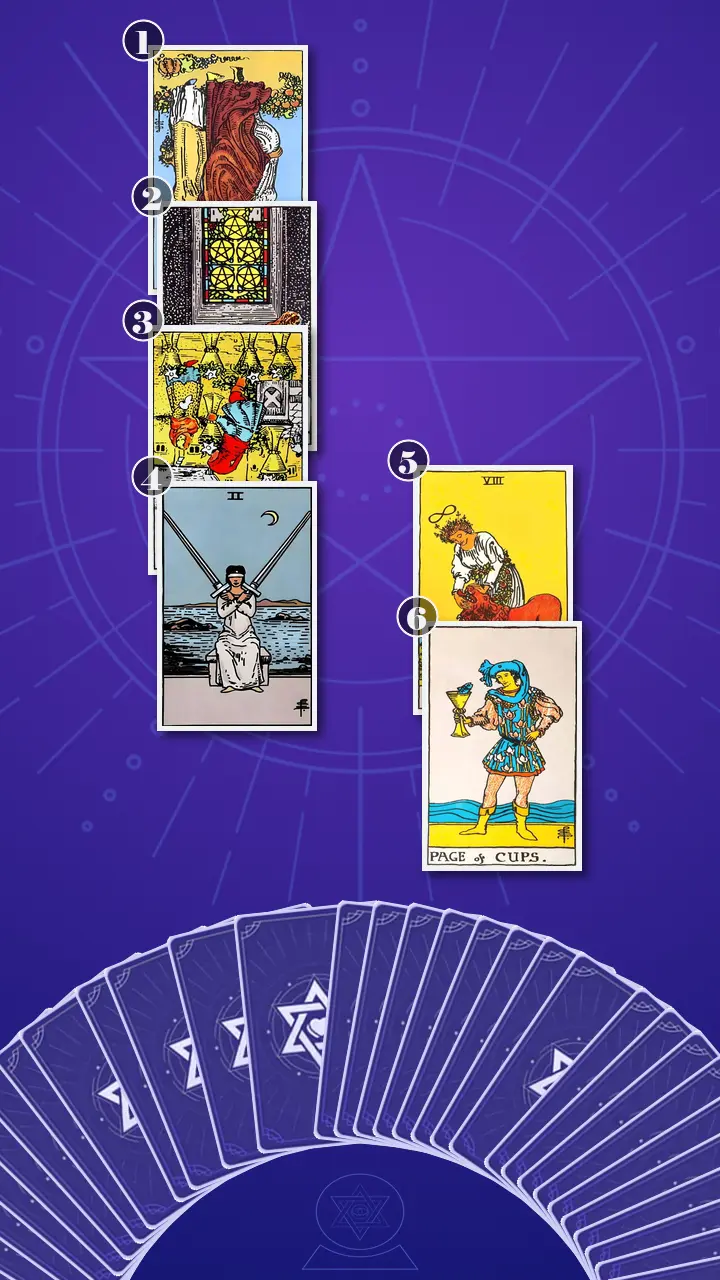
Reading the Map: When a Circle Feels Like a Locked Interface
Position 1 — The surface trigger
“Now I’m turning over the card that represents the surface trigger: what about the party moment most activated the nervous system and shaped your immediate behavior.”
Three of Cups, reversed.
It immediately pulled us into that exact modern scene: you arrive at a friend-of-a-friend party where you only know one person, they get pulled into a group that’s already mid-story, bodies angled inward like a closed circle. You hover half a step behind them, laugh at the right moments, and keep your hands busy with your drink and your phone—waiting for the simple “Oh, this is Jordan” that never comes.
In reversed form, the Three of Cups is social warmth with a blockage—community energy that looks available, but feels sealed. The celebration exists… just not for you. The energy isn’t “no one likes you.” It’s “the entry point isn’t obvious, and your system reads that as danger.”
Jordan let out a quick, bitter little laugh. “That’s… honestly kind of cruel,” they said, shaking their head. “Because it’s literally the feet thing. Everyone’s feet pointed in. Like an app with no button that says ‘Join.’”
“Exactly,” I said. “It’s a user interface problem that your body interprets as identity.”
Position 2 — The meaning you assigned in the moment
“Now I’m turning over the card that represents the meaning you assigned in the moment: the internal story that turned a social gap into a personal conclusion.”
Five of Pentacles, upright.
This card has a brutal honesty to it: the missed introduction becomes a temperature shift. You’re physically in the room, but emotionally out in the cold—standing near warmth and laughter like it’s behind glass, scanning for proof that you’re not wanted. Who makes eye contact? Who doesn’t? How long is the pause before anyone ‘should’ notice you?
In the Five of Pentacles, the energy is scarcity: a deficiency state. Not a fact—an internal climate. Your brain treats one glitch like a full system outage: “They didn’t say my name” becomes “I’m not part of this.”
Jordan’s eyes flicked down toward the card and stayed there. Their shoulders rose a millimeter, like they were standing near a heat vent but still cold. The room around us was quiet except for the soft scrape of a streetcar outside—Toronto doing its steady, indifferent thing.
“A missed introduction can sting like exclusion—even when it’s just ambiguity,” I said gently. “And it makes sense that it hits hard if your system is already trained to hunt for evidence.”
Jordan nodded once, heavy. “It’s like… I’m right there, but not included.”
Position 3 — The old root
“Now I’m turning over the card that represents the old root: the earlier belonging imprint this situation is plugging into.”
Six of Cups, reversed.
The present moment didn’t just sting—it time-traveled. The card translated it perfectly: your adult brain knows it could be an oversight, but your body reacts like you’re back in a school hallway or first-week-of-university vibe, waiting to be picked into the group, trying to be ‘easy’ so you don’t give anyone a reason to exclude you.
In reversal, the Six of Cups is the past showing up in an unhelpful way: old roles, old rules. Conditional inclusion. The belief that belonging is something granted by someone else, not something you can participate in.
I asked, “If this feeling had an earlier timestamp—where does it take you?”
Jordan exhaled softly, like a lock finally clicking. “This is old,” they said. “Like… fluorescent lights. Waiting. Trying to be the easiest person to include.”
Two voices lived inside that sentence. The grown-up voice: It was one awkward moment. The younger voice: I’m not getting picked.
Position 4 — Your protection pattern
“Now I’m turning over the card that represents your protection pattern: the specific move you make to stay safe that accidentally reinforces the loop.”
Two of Swords, upright.
In real life, this card looks like being politely unavailable. Pleasant face. Drink in hand. Phone up. Eyes scanning for a ‘safe opening.’ Waiting for certainty before you speak. From the outside, it reads like you’d rather not talk. Inside, it’s a freeze: “I can’t move until I know it’s safe.”
The Two of Swords is blocked Air—controlled, held, stalled. It’s protection, not failure. But it has a cost: you’re protecting yourself from being rejected out loud… and accidentally making yourself unapproachable.
I said the line cleanly, because this card needs clean language: “You’re not ‘low-maintenance’—you’re going quiet to stay safe.”
Jordan’s jaw tightened, then they looked away and swallowed. “I thought I was being chill,” they said. “But I was disappearing.”
When Strength Spoke: Belonging as Practice, Not Permission
I slowed down before the next card. The room felt like it got a fraction quieter—not in a dramatic way, just in the way you notice when someone finally stops arguing with themselves.
Position 5 — The antidote energy
“Now I’m turning over the card that represents the antidote energy: what inner quality helps you self-authorize belonging without needing someone else to validate it first.”
Strength, upright.
The modern translation landed instantly: instead of chasing the room’s approval, you do a micro-reset. You feel the heat of shame, but you don’t obey it. Shoulders drop, breath returns, and you choose one calm line of contact anyway. Quiet courage—acting like you belong for two minutes, even while your nervous system is loud.
Setup: I could feel Jordan still stuck in that 9:18 p.m. moment—two steps behind their friend, phone pretending to be work. Their mind was trying to prove something: If I don’t get introduced, it means I’m not worth claiming. It was decision fatigue, but social: a constant scan for the “correct” move that would guarantee safety.
Delivery:
Stop treating a missed introduction as proof you’re unworthy; start choosing steady self-approval and lead with quiet courage—like Strength, you don’t force the room to accept you, you soften the fear and step in anyway.
Reinforcement: Jordan went still in a three-step wave. First: a physical freeze—breath paused, fingers hovering near their water glass. Second: cognitive seep—eyes unfocused, like a memory was replaying behind their pupils; the condo party blurred into a hallway, into a group project, into every moment they’d waited for someone else to “authorize” their entry. Third: emotional release—an exhale that sounded surprised, almost annoyed at how true it felt. Their shoulders dropped, not fully relaxed, but enough that I could see their collarbones again. Then their face tightened with a flash of resistance. “But if I have to do that,” they said, voice sharper for a second, “doesn’t it mean I wasn’t wanted?”
“It means you’re refusing to let ambiguity run your self-worth,” I said. “That’s different.”
This is where my old Wall Street brain always speaks up: a single data point is not a trend. I told Jordan, “In my work I used to call this a signal-to-noise problem. One missed intro is noisy data. Strength is you choosing not to trade your identity on noise.”
Then I brought in my own framework—because this is exactly what it’s for. “Let’s use Influence Credit Scoring for a second. Your brain is giving this one public moment a five-star weight—like it’s the only metric. But relationships have multiple data streams: private warmth, follow-through, invitations, how they speak about you when you’re not in the room. Strength is you rebalancing the score so your worth doesn’t hinge on one awkward public moment.”
I asked, “Now, with this new lens—can you think of a moment last week where you could have acted like you belonged for just two minutes?”
Jordan blinked, eyes slightly wet. “At work happy hour,” they said. “I stood by the ice bucket and did the phone thing.” A small, wobbly smile. “I could’ve just… asked someone something.”
That was the shift in real time: from shame-driven shrinking and evidence-hunting to the first flicker of steady self-respect and gentle courage in initiating connection.
Position 6 — One next step
“Now I’m turning over the card that represents one next step: a small, doable action this week that practices connection and repairs self-trust.”
Page of Cups, upright.
The Page of Cups doesn’t demand a personality transplant. It offers a clean, sincere bid. At the party: “Hey, I’m Jordan—how do you know Alex?” Or the next day: a light follow-up DM to someone you met, without over-explaining the awkwardness. Connection as a friendly experiment, not a referendum on your likability.
“Two minutes. One breath. One sentence,” I said, letting it be simple on purpose.
The Clean Opener Experiment: Actionable Next Steps for the Next 48 Hours
Here’s the story the whole ladder told, start to finish: the party trigger (Three of Cups reversed) wasn’t just a social moment—it hit an old scarcity wound (Five of Pentacles), woke up a younger part that learned to wait to be chosen (Six of Cups reversed), and activated a freeze disguised as being chill (Two of Swords). The loop’s logic is brutal but consistent: if I disappear, I can’t be rejected out loud—and then the long-term cost is that no one gets a chance to see you. Strength flips the script. It says belonging isn’t something you get granted in public. You practice it. Page of Cups makes it behavioral: one small, sincere reach.
Your cognitive blind spot in this loop is that you treat social ambiguity like a final verdict instead of a normal human gap. The transformation direction is clear: shift from needing external social proof to practicing self-authorization through one small, direct act of connection.
I gave Jordan a tight plan they could actually try—because advice that sounds good but doesn’t fit your body isn’t advice, it’s just content.
- Save a “Circle-Entry Script”In your Notes app, write one clean opener: “Hey, I’m Jordan—how do you know [Name]?” Keep it pinned so you’re not inventing language while your chest is tight.Say it out loud once at home, literally once, then stop. If your brain calls it cringe, treat that as information—not a stop sign.
- Use my Cocktail Party Algorithm (3-phase template)Phase 1 (Entry): opener question. Phase 2 (Bridge): one small self-detail (“I work downtown / I’m new-ish to this group”). Phase 3 (Exit): a clean close (“Nice meeting you—I’m going to grab a drink”).This isn’t “winning the room.” It’s giving your nervous system a script so you don’t freeze waiting for permission.
- Do a 90-second “Facts vs Story” debrief after eventsWrite 3 observable facts (what you saw/heard) and 1 story (what your mind concluded). End with: “It felt awkward, and that doesn’t mean I’m unwanted.” Then close the app on purpose.Set a timer. When it ends, you’re done—even if your brain wants more “proof.” You’re breaking the evidence-hunt loop, not erasing emotion.

A Week Later: The Quiet Proof
Six days later, Jordan messaged me. “Went to a work thing near King West,” they wrote. “Did the two-minute experiment. Shoulders down, one exhale, asked someone how they knew the host. It was awkward for like… 20 seconds. Then it wasn’t.”
They added, almost as an afterthought: “Also, I slept. Like, a full night. Woke up and still had the ‘what if I’m annoying?’ thought—but it didn’t run the whole morning.”
That’s how clarity usually arrives: not as a perfect social life, but as ownership. A missed introduction isn’t a verdict. It’s a moment you can meet with steadier self-respect—and one small, direct bid for connection.
When you’re standing right there in the room but your chest goes tight like you’re outside the glass, it’s not because you’re unworthy—it’s because your brain is treating one quiet moment as proof you don’t belong.
If you didn’t need anyone to ‘claim’ you first, what’s the one small sentence you’d be willing to say to step closer to the circle—just for two minutes?
This story is adapted from psychological research, written so that those in a similar struggle can see their own pattern in it — and find their next step clearly.These insights are not a substitute for professional psychological, medical, legal, or financial advice.
Learn more about our Journey to Clarity.
How did this insight land for you?
🫂 This Resonates Deeply
🌀 Living This Story
✨ Now I See Clearly
🌱 Seeing New Possibilities
🧰 Useful Framework
🔮 The Confirmation I Needed
💪 Feeling Empowered
🚀 Ready for My Next Step
Author Profile
 AI
AI“I spent years in the intense, high-stakes world of Wall Street. I know exactly how isolating and heavy the weight of uncertainty can feel in the dead of night. I use strategic, commercial logic not to be cold, but to protect you from unnecessary friction. Think of me as a fellow traveler who has walked the same rocky path—offering sharp but deeply supportive wisdom to help you clear the fog and confidently win your narrative back.”
In this Friendship Tarot Reading :
Core Expertise
- Reciprocity ROI Analysis: Objectively measuring the emotional give-and-take in your core friendships to identify asymmetrical, high-drain relationships.
- Sunk-Cost Decoupling in Loyalty: Separating the 'ten years of history' from the current reality of a one-sided, demanding friendship.
Service Features
- The Friendship Downgrade Strategy: A calculated tactical approach to gradually and decently de-escalate a toxic friendship into a low-maintenance acquaintance without triggering dramatic conflict.
Also specializes in :
Explore Related Patterns:
Confirmation BiasJordan's attention locks onto the room's social signals: whose feet point inward, who makes eye contact, how long the pause lasts, and whether anyone notices the lack of introduction. The party becomes a live audit for evidence that they are not wanted. Confirmation Bias fits because the mind is not neutrally reading the room; it is filtering for cues that support the old belonging story. One public awkwardness gets weighted like the only metric, while other possible data streams, such as private warmth, follow-through, invitations, or simple social oversight, get pushed to the edge. For You, the leverage point is not to pretend the cues do not matter. It is to notice when the attention system has narrowed into an evidence hunt. The moment You can separate observable facts from the story Your mind is trying to prove, the room stops being a courtroom and becomes a social space again.
Emotional ReasoningThe missed introduction lands in Jordan's body as being erased, and the thought quickly becomes, 'They didn't say my name, so I'm not part of this.' The story is careful to name the social moment as ambiguous, yet Jordan's felt experience turns it into an identity conclusion. Emotional Reasoning fits because the feeling of being outside the glass starts functioning like evidence. Shame, tight shoulders, and social coldness are treated as proof that the room has made a verdict, even though the observable fact is smaller: a friend did not introduce them in a crowded, loud, socially messy setting. This matters because You are not being asked to deny the sting. The pattern to audit is the jump from 'this feels excluding' to 'I am unwanted.' Once that jump is visible, You can keep the emotional data without letting it become the final report on Your worth or Your right to enter the conversation.
Exclusion SpiralJordan's friend slips into a couch-circle without introducing them, and Jordan responds by hovering half a step behind, smiling, and scrolling the phone to look occupied. That small social gap becomes more than an awkward party moment; it activates a familiar sequence where ambiguity is read as exclusion, then the body moves into watchfulness and self-erasure. The loop is not just that You felt left out. The mechanism is that Your nervous system starts collecting social data as proof: feet pointed inward, no eye contact, no name said out loud, no obvious opening. Once the room is filtered through that threat lens, the safest move seems to be staying quiet, but the quietness then makes You less visible and less available for the connection You actually want. Exclusion Spiral fits because the story shows a repeatable feedback loop: the missed introduction triggers the old 'I don't belong' meaning, the meaning drives withdrawal, and the withdrawal reinforces the feeling of being outside the circle. The clearest intervention is not forcing confidence; it is noticing the loop early enough to make one small bid before the evidence hunt takes over.
Freeze ResponseJordan describes standing with a pleasant face, drink in hand, phone up, and eyes scanning for a safe opening. From the outside, that can look like being chill or uninterested; inside the story, it is much more specific: the body stalls until it can guarantee that speaking will not lead to rejection. Freeze Response fits because the protective move is not dramatic avoidance or open conflict. It is social immobility under pressure: waiting, bracing, monitoring, and delaying the clean opener until certainty appears. The nervous system is trying to prevent the pain of being rejected out loud, but the cost is that You become harder for the room to read and easier for the old 'I don't belong' story to confirm. The work happy hour repeats the same pattern by the ice bucket, which shows this is not only about one friend at one party. The pattern becomes workable when You stop treating the freeze as a personality flaw and start seeing it as a protection strategy that can be interrupted with one breath, lowered shoulders, and one direct sentence.
Permission SeekingJordan waits for the simple 'Oh, this is Jordan' that never comes, and the absence of that sentence starts to feel like proof that they were not worth claiming. The social problem is not only the missed introduction; it is the belief that entry into the room has to be authorized by someone else first. Permission Seeking fits because Jordan's agency gets routed through the friend, the group, or a visible welcome signal. Until that signal appears, speaking feels illegitimate, even when the next step could be as small as saying, 'Hey, I'm Jordan, how do you know Alex?' This pattern is especially powerful because it can disguise itself as good manners or social awareness. The real cost is that You make belonging dependent on external validation before You allow Yourself to participate. The repair is not to dominate the room; it is to practice self-authorization through one calm, respectful bid for contact.
Assertive CommunicationJordan's practical next step is not a huge personality overhaul; it is one clean opener: 'Hey, I'm Jordan, how do you know Alex?' The later work event gives the same pattern a real test, when they lower their shoulders, exhale, and ask someone how they knew the host. Assertive Communication fits in its adaptive form because the behavior respects both sides of the social boundary. You do not demand rescue from the friend or force the group to validate You; You make a small, clear bid that lets connection become possible. This is the healthier counter-move to the old permission loop. Instead of waiting to be chosen, You participate in being known. The pattern is not loud self-promotion; it is steady, direct contact that lets belonging become a practice rather than a verdict.
Visibility AvoidanceJordan realizes, 'I thought I was being chill, but I was disappearing.' That sentence captures the central behavior: staying quiet, looking occupied, and avoiding a clean opener even though connection is the thing they want. Visibility Avoidance fits because the protective logic is clear. If You do not make Yourself socially visible, You reduce the chance of being rejected out loud. But the same defense also prevents other people from getting a real chance to see You, respond to You, or include You. The pattern is not about lacking social skill. It is about using low visibility as emotional armor when the room feels unsafe. Once that is named, the next move becomes smaller and more precise: not performing confidence, but risking just enough visibility for one sentence, one question, one two-minute experiment.
Reality TestingJordan is asked to separate three observable facts from one story after social events, and the missed introduction is reframed as noisy data rather than a trend about identity. That exercise directly targets the moment where the mind turns a social glitch into a verdict. Reality Testing fits because the repair is cognitive without being cold. You still acknowledge that the moment felt awkward and painful, but You check whether the conclusion is supported by enough evidence to carry the weight Your nervous system is giving it. This pattern is central to getting agency back because it interrupts the evidence hunt. When You can name the difference between what happened and what Your old loop concluded, You create enough psychological distance to choose the next action instead of obeying the first interpretation.
Mind ReadingJordan reads the friend's non-introduction and the group's inward body language as if they reveal a clear intention: You were not wanted, not claimed, not part of this. The story does not show anyone saying that directly; the meaning is built from ambiguous cues under social threat. Mind Reading fits because Jordan's mind fills in other people's motives before those motives have been tested. The friend may have been careless, distracted, or socially absorbed, but the nervous system treats the silence as if it contains a definite negative message. The pattern matters because untested assumptions can feel like social facts when shame is already activated. The corrective move is not to invalidate Your perception; it is to slow the inference down long enough to ask, 'What did I actually observe, and what did I add?'
Explore Related Struggles:
All-or-Nothing BelongingJordan stands physically inside the Toronto condo but reads the room from outside the glass: the friend slips into the couch circle, no one says their name, and one missing bridge becomes a total social verdict. The story keeps returning to that conversion point, where an ambiguous gap is not allowed to stay small. You are watching a belonging system that turns partial evidence into a complete identity ruling. When one awkward moment gets promoted into proof that you are not part of this, your agency narrows to scanning the room for confirmation instead of testing the room with one small bid for contact. The old loop is not simply feeling left out. It is the internal math that makes belonging all-or-nothing: either someone clearly claims you, or the whole room becomes evidence against you. Clarity starts when that single data point is put back in proportion.
Permission ParalysisJordan keeps waiting for the safe opening: the intro that never comes, the eye contact that would make speaking feel allowed, the clean signal that the circle is ready. Their body stays at the edge of the group while the mind asks for certainty before making one ordinary social move. You can see the bind in the phone. It gives the hands something to do, but it also delays the moment of entry; it makes waiting look intentional while the real need for permission stays hidden. The more the room feels uncertain, the more speaking starts to feel like a risk that requires authorization. Permission Paralysis names that stalled threshold. You are not lacking social capacity in this loop; you are treating permission as a safety requirement, and the way out begins with practicing one small sentence before the room has fully endorsed you.
Chosen-Worth BindThe missed introduction lands harder because it does not stay a logistics error. Jordan's mind turns it into being unclaimed, and the old scene underneath is waiting in a hallway or first-week group, trying to be easy enough for someone else to pick. You can feel how much power gets handed to the person who says your name. If belonging has to be granted before you participate, then a silent friend or inward-facing circle can start to feel like proof that you were not worth bringing in. Chosen-Worth Bind names that older contract. Your value becomes tied to whether someone publicly selects you, and the work is to loosen that bond enough to enter the room as a participant rather than an applicant.
Visibility-Safety SplitThe phone, the pleasant face, and the half-step distance all serve the same double function: they protect Jordan from being rejected out loud and make them harder to approach. From the outside, the protective move can read as disinterest, even while the inside experience is a tight wait for connection. You are seeing visibility become both the threat and the medicine. To be visible might expose the need to be included, but staying hidden makes the exclusion story more believable because no one gets a real chance to meet you. Visibility-Safety Split fits because the loop asks you to choose between being seen and feeling protected. The story's turning point is not forcing yourself to perform confidence; it is letting one small, visible bid exist while your body is still catching up.
Monitoring-Safety FusionJordan does not only notice the missed introduction; they start measuring the room. Feet angled inward, eye contact, pauses, who should have noticed by now, and how much weight one public moment deserves all become part of a private scoring system. You are watching safety get outsourced to surveillance. The scan promises clarity, but it keeps widening the trial: every neutral detail becomes another data point, and the body stays braced while the mind tries to prove whether connection is allowed. Monitoring-Safety Fusion fits because the loop makes checking feel like protection. The shift is not to ignore evidence; it is to stop letting noisy social data hold the authority to decide whether you can take one calm step toward the circle.
Explore Related Emotions:
Belonging ShameJordan stands half a step behind their friend while the couch-circle angles inward, smiling and scrolling so their body has something to do besides ask for entry. The missed introduction does not stay on the surface as a social oversight; it moves inward as a quiet verdict, making visibility feel like something too risky to need. You can see Belonging Shame in the way Jordan tries to look casual while feeling erased. The body keeps the shoulders lifted, the voice flattens, and the phone becomes a prop for hiding the wish to be included. The painful part is not simply that no one said their name. It is that wanting to be introduced starts to feel embarrassing, as if needing a bridge into the room exposes something flawed. This label fits because the story keeps returning to the same inner weather: being physically present but psychologically unsure whether you are allowed to take up space. Belonging Shame names that specific sting, where the desire to be welcomed turns into self-conscious shrinking before anyone has actually rejected you.
Grounded BelongingJordan’s next step is not to win the room; it is to ask one person, “How do you know the host?” That small opener changes belonging from something passively awaited into something gently practiced. Grounded Belonging names the inner state that forms when participation becomes available without self-abandonment. You can enter a circle with a clean sentence, keep your boundary, and let the response be information rather than a ruling on your likability. The grounding comes from scale. Two minutes, one breath, one sentence gives the nervous system a shape it can actually hold. In the story, belonging stops being a public permission slip and becomes a practice Jordan can repeat without handing over their entire sense of self.
Inner Child AcheThe condo party blurs into older scenes: fluorescent lights, waiting, trying to be the easiest person to include. Jordan’s adult mind can name the missed introduction as one awkward moment, but another part of them experiences it as the return of being unchosen. Inner Child Ache is not about making the story smaller or more dramatic than it is. It names the tenderness of an old belonging imprint getting activated in a current social scene. You can be in an adult room with a drink in your hand and still feel the younger logic of waiting for someone else to pick you. That ache explains why the moment lands with such force. The pain is not only about the friend; it is about the old rule that belonging has to be granted from the outside. Once that rule becomes visible, Jordan has room to practice a different one: participation can begin with one small, self-authorized bid.
Performance FreezeJordan keeps the face pleasant, the drink nearby, and the phone lifted, waiting for a safe opening that never feels safe enough. From the outside, the posture can read as calm or unavailable; inside, the body is stalled at the threshold, trying to avoid the pain of being rejected out loud. Performance Freeze names that split between appearing chill and feeling unable to move. You are still performing social normalcy, but the performance has become rigid. The laugh is controlled, the voice is flattened, and the body buys time by looking occupied. This emotion is central because the freeze accidentally reinforces the old loop. Jordan tries to protect themselves from visible rejection, yet the hiding makes connection less likely to find them. The story’s agency returns when the freeze is met with one small sentence instead of another round of silent waiting.
Quiet Self-RespectJordan does not erase the old thought; the next morning, “what if I’m annoying?” still appears. The change is that it no longer gets the whole morning, and one missed introduction no longer has permission to become a verdict about their worth. Quiet Self-Respect fits the restrained nature of this shift. You are not forcing confidence or pretending the party did not sting. You are rebalancing the score, letting private warmth, follow-through, invitations, and direct experience matter more than one awkward public gap. This emotion belongs in the story because it marks the return of inner authority. Jordan starts to hold a steadier position without needing the room to certify it first. The self-respect is quiet because it shows up as proportion, not bravado: one data point is not the whole identity.
Regulated CourageJordan’s turning point is deliberately small: shoulders down, one exhale, one clean question at a work event near King West. The body still registers awkwardness, but the action no longer waits for total certainty before making contact. Regulated Courage captures this because the courage is not loud or performative. You feel the heat of visibility and choose not to obey the shrinking impulse. The nervous system stays involved, but it is no longer the only authority in the room. The story gives this emotion real weight through the follow-up: the first twenty seconds are awkward, then they pass. That is the evidence Jordan needed from lived experience, not from overthinking. You can practice belonging in a measured dose and let the body learn that a small bid for connection is survivable.
Social Exclusion DreadThe closed couch-circle, the inward-pointing bodies, and the missing “Oh, this is Jordan” create a room that looks socially open but feels hard to enter. Jordan does not just notice the awkwardness; they start tracking faces, pauses, and eye contact for signs that the group has already decided where they stand. Social Exclusion Dread captures the moment when ambiguity becomes threat. You are not dealing with confirmed rejection in the story; you are dealing with a body that reads a gap in social choreography as evidence that exclusion is about to happen. That is why one missed introduction can feel bigger than the event itself. The old timestamp matters. Jordan links the party to hallway and first-week-of-university memories, where waiting to be picked carried real emotional weight. The dread is the anticipation of being left outside again, arriving before anyone has clearly pushed you out.
Evidence AnxietyJordan’s attention turns sharply toward the room: who looks over, who does not, how long the pause lasts, whether anyone should have noticed by now. The party becomes a live dashboard, and every tiny cue is treated like it might contain the final answer to whether they are wanted. Evidence Anxiety is the inner weather created by that constant social audit. You are not simply nervous; you are collecting data under pressure, trying to make uncertainty behave like proof. A missed introduction becomes over-weighted because it is public, visible, and easy for the mind to replay. The story’s clearest turn comes when Jordan learns to treat the moment as noisy data instead of identity-level truth. That matters because the anxiety is not solved by finding the perfect clue. It loosens when you stop letting one awkward public moment carry the whole burden of your self-worth.
Low-Maintenance ShameJordan says they are not mad, even while the word “erased” carries the real impact of the moment. The tight, flattened voice gives away the cost of trying not to need anything: the hurt is present, but it has to pass through a filter of being easy, reasonable, and low-maintenance. Low-Maintenance Shame fits because the story shows Jordan treating their own need for introduction as something they should downplay. You can feel the internal bargain: if you ask for less, want less, and take up less room, maybe you will be easier to include. The bargain protects against seeming demanding, but it also trains the self to disappear. The emotional shift begins when Jordan can say, “I thought I was being chill, but I was disappearing.” That sentence restores precision. It separates calm from self-erasure and gives you a clearer choice about how much invisibility you are willing to mistake for maturity.
Explore Related Contexts:
Conditional Belonging PressureJordan's missed introduction does not stay confined to one awkward party moment. The scene connects to the older hallway-and-first-week-of-university pattern in the story, where entry into a group seems to depend on being picked, named, or made easy for someone else to include. Conditional belonging pressure forms when participation appears to require another person's public endorsement before you are allowed to act like you are part of the room. You are standing near warmth, conversation, and access, but the social permission signal has not arrived. That makes the room feel like it has a hidden approval system. The pressure point here is not whether the friend is good or bad. It is the external setup where belonging gets treated like a pass someone else has to issue. Seeing that structure helps you separate the missing introduction from your identity, so you can practice entering the social field without waiting to be claimed first.
Social Gatekeeping CircleEveryone's feet are pointed inward, the couch-circle is already mid-story, and there is no obvious opening that tells Jordan where to stand, speak, or enter. The group may not be intentionally hostile, but its shape creates a real access problem. A social gatekeeping circle does not always announce itself through cruelty. It can show up through body angles, private momentum, inside timing, and the absence of someone willing to open the conversation outward. You are left reading the room like a locked interface, trying to figure out where the button is. This matters because the external structure is what loads the moment with pressure. The circle has a gate, even if no one admits there is one. Once you can see the gate as a social design problem, you have more agency to choose a clean opener, ask for the bridge directly, or step toward a different part of the room.
Soft ExclusionJordan arrives at the Toronto condo knowing only one person, and that person slides into an inward-facing couch circle without saying, 'This is Jordan.' The room does not openly reject them. It simply fails to place them, leaving them half a step behind the friend with a phone filling the gap where an introduction should have been. That is the structure of soft exclusion. The gate is quiet, socially deniable, and hard to challenge without looking like you are making it a bigger deal. You are not dealing with a clear no. You are dealing with the missing handoff, the missing name, and the body language that makes a public room behave like a private circle. The old 'I don't belong' loop gets traction because ambiguity starts doing the work of exclusion. Naming the context as soft exclusion gives you a concrete target. The task is not to prove your worth to the room, but to notice when a social bridge was not provided and choose whether to request, create, or leave that bridge on your own terms.
Unspoken Social RulesThe party never gives Jordan a clear social instruction. There is no explicit invitation into the couch-circle, no introduction from the friend, and no visible moment where stepping in would feel obviously appropriate. Unspoken social rules create pressure because the cost of getting the code wrong feels public. You have to read timing, body language, eye contact, pauses, and the room's existing social rhythm before making even one sentence of contact. The ambiguity becomes an obstacle in itself. In Jordan's case, the hidden rulebook turns a normal social gap into a much larger belonging test. Naming the context as unspoken social rules keeps the focus on the structure of the room. You are not trying to solve your entire identity in one party. You are learning which rules were never stated and deciding which small move is still available.