Explore solo arrival, the Tarot Cards that mirror its threshold, and related reading insights from others entering without a companion.
Solo Event Entry
What is this situation?
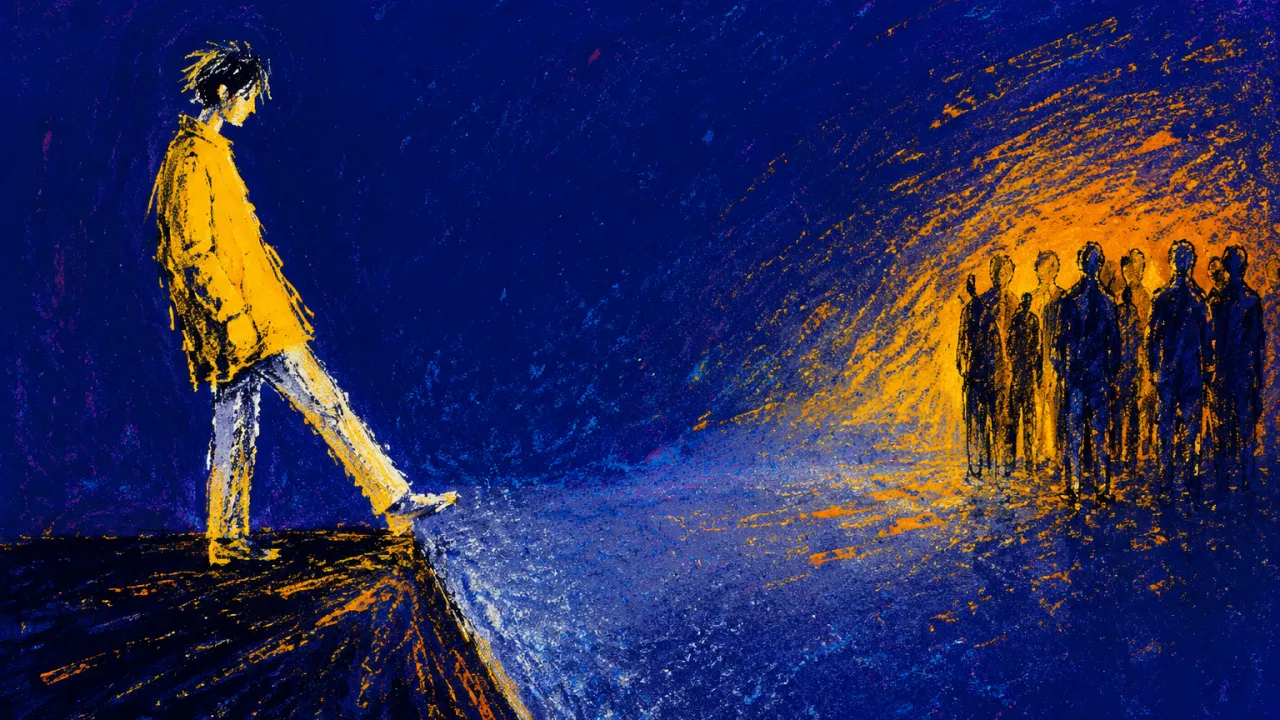
Solo Event Entry begins the moment you walk into a meetup, class, community night, party, or work-adjacent gathering without a familiar person beside you. You arrive at the posted start time, check in, take the name badge or drink offered at the door, and step into a room where small groups already seem to have formed. The host is greeting arrivals, regulars are continuing conversations, and people who came together can turn toward each other whenever the room goes quiet. You have no such buffer, so each practical move becomes public: where to stand, whether to approach a circle, how long to wait near the edge, and what to do after a brief introduction ends. Your shoulders draw slightly inward and your feet slow at the room's edge while you look for a clear opening. Nothing has explicitly excluded you, but the space has not offered belonging either; access depends on testing one interaction at a time, with no companion to translate the room or carry the pause. By the time the event settles into its rhythm, much of your energy has gone into remaining visible without hovering and available without intruding, much like The Fool alone on the high path, with only the dog beside him and a small bundle carrying the support he brought with him.
Why it's not you?
The difficulty is not evidence that you are socially deficient or bad at meeting people. A room already divided into familiar clusters, with a busy host and no clear entry point, places the work of first contact on the person who arrived alone. That pressure belongs to the setup, not to a flaw in you.
Solo Event Entry in Tarot Cards
Solo Event Entry places you in a room where conversation clusters already have their own momentum and no familiar companion is there to bridge the first pause. The slight inward pull of your shoulders marks the bodily cost of staying visible while you search for an opening. This is an environmental and structural dynamic shaped by how the room is populated, how access begins, and who arrives with a built-in social buffer. The Tarot Cards below mirror the exposed threshold before the room has reflected belonging back to you.
The Fool is visibly alone on the high path, with only the dog as a moving point of contact and the bundle as portable support. The scene is not empty; it is under-populated, exposed, and open to first contact. That is the reality texture of entering a room, meetup, class, or work-adjacent event without an inside ally. You have enough mobility to arrive, but the card keeps attention on the lack of a built-in container: belonging has to be tested one interaction at a time.
The Magician stands alone behind a prepared table, facing outward with no companion body in the frame. The table gives him a small operating zone before the wider garden opens around him, so the image starts with a solitary person becoming visible in a public-facing space. In a social setting, that visual structure maps onto walking into an event, meetup, class, or work-adjacent room without a friend buffer. You are not yet inside the group story, but the card shows enough posture, tools, and spatial definition to make the first social claim. The pressure in Solo Event Entry is not simply being alone. It is the moment before a room reflects belonging back to you, when presence has to be established through stance, timing, and a small boundary around your own attention.
The hooded elder stands alone on the snowy ridge, holding a lantern in one hand and a staff in the other. The body is not merged with a crowd; it has just enough light and support to enter a dark field without borrowed confidence. That visual structure maps cleanly onto a solo arrival in social space. You are not reading a room from inside an established group; you are testing whether your own signal can hold long enough to find real points of contact.
The figure enters the water without abandoning the ground. Her body keeps one stable point on land while one foot makes contact with the pool, turning participation into a measured threshold rather than a social plunge. That is the exact architecture of arriving alone to a meetup, creative night, class, community event, or low-stakes networking space. The scene is open, visible, and navigable, but the body still has to cross the first-contact line without borrowed confidence from a companion. For You, the card highlights the practical social courage of entering a room before belonging has been confirmed. The path is not blocked; the real friction sits in the first moment of exposure, when you decide whether the environment is safe enough to let your presence become visible.
The seated man holds the center of the card alone, with his arms crossed over his chest and nine cups arranged behind him like a completed social offering. The scene is not empty; it is stocked, bright, and stable, but there is no second figure entering the frame. That visual structure maps cleanly onto walking into a social room by yourself while carrying enough self-possession to stay. You are not arriving with nothing to offer, yet the card shows that self-contained presence is only the first layer of belonging. Solo Event Entry becomes the stage where autonomy and connection have to coexist. The cups behind the figure show social potential, while the crossed arms mark the boundary that decides whether an event becomes nourishment or another performance of being fine alone.
The Knight rides without an entourage, carrying his own point of contact into an open landscape. Nothing in the scene provides a ready-made group, host, or receiving circle; the social threshold has to be entered from a self-contained position. That makes Solo Event Entry a strong outer context for this card. You are not just deciding whether to attend something; you are facing the moment when a room, meetup, class, or community has not yet offered a bridge, and your first step has to carry both presence and protection.
The woman is visibly alone in a cultivated garden, not hidden in a corner and not absorbed into a group. Her body holds the center of the scene with enough structure around her to make solitude look like a position rather than an absence. In a social setting, this becomes the moment of entering without an entourage. You are not only deciding whether to attend; you are testing whether your presence can remain stable when there is no familiar person beside you to translate the room. The card's social pressure is quiet but specific: the threshold is not the event itself, but the exposure of arriving as one complete person. It gives shape to the kind of belonging that begins before anyone has formally claimed you.
The figure is alone on a wide green field, yet his posture is not collapsed or hidden. He has a reason for being there, a concrete object to focus on, and enough open space to approach the wider world without being swallowed by it. That is the exact social architecture of entering a room alone. You may arrive before connection has formed, but the card shows that solitude at the threshold is not the same as exclusion; it can be the first stable position from which contact becomes possible. The pentacle keeps the scene from becoming vague confidence talk. It gives you a practical anchor: an interest, topic, project, or shared context that lets the first point of contact happen without forcing instant intimacy.
A single figure stands in a wide desert with no companion, doorway, table, or crowd softening the entry. The wand gives him a reason to be there, but the space around him has not yet become socially populated. Solo Event Entry lives in that exposed first step: you have a legitimate reason to enter the room, but no built-in witness or anchor beside you. The image frames the tension as spatial, not personal, because the difficulty comes from approaching a social field before it has offered any familiar foothold.
The solitary rider crosses an open desert with his armor on and no crowd around him. His protection is mobile rather than communal, and his confidence has to be carried on his own body before any group has made room for him. That is the texture of walking into a meetup, party, class, or professional room without a built-in companion. The card frames the pressure as an entry threshold: you are not lacking a social identity, but entering a space where belonging has not yet supplied its usual scaffolding.
No cards available for this filter.
Solo Event Entry in Tarot Card Reading Insights
Others have brought Solo Event Entry into readings after walking into meetups, classes, and work-adjacent rooms without a familiar companion. The Tarot Reading Insights below capture what surfaced around that exposed first-contact threshold.