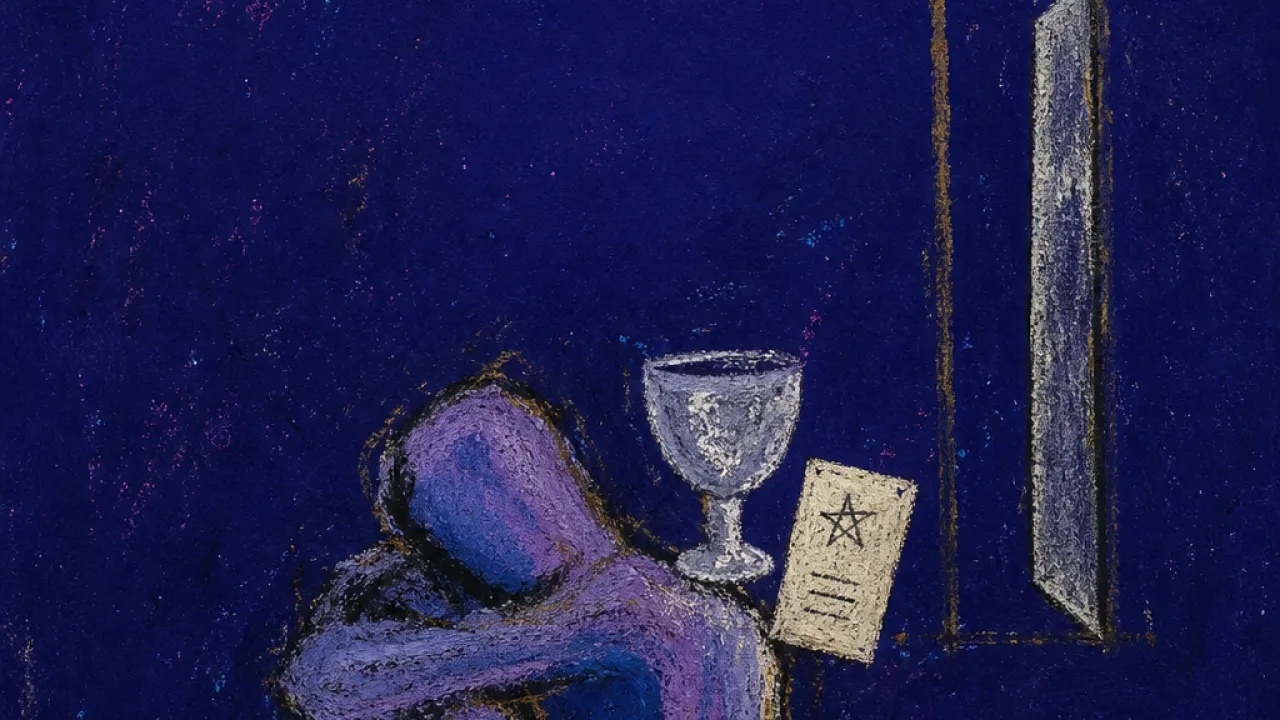
That stomach drop when you see the date, the unread message, or the closed tab belongs to a Missed Opportunity Window, not to some private defect. It is an environmental and structural dynamic: the opening arrives through systems, schedules, and other people's availability, then changes shape when no response meets it. The cards below do not turn the missed window into a verdict; they reflect the outline of the stalled exchange. These Tarot Cards show the patterns that tend to surface when timing, access, and recognition fail to meet.
Four of Cups UprightThe offered cup is physically present, but the seated figure's closed eyes and folded limbs leave no receiving pathway. The three cups at ground level keep the visual field anchored to what has already happened while the new opening waits at the edge. In a social reading, that becomes the moment when a message, invite, collaboration, or reconnection window is real but easy to miss because old relational patterns occupy the foreground. You are not looking at a lack of opportunity; the card isolates the gap between availability and recognition.
ReversedThe fourth cup is close to the seated figure, but his eyes are closed and his arms remain crossed. The offer does not fail to appear; it fails to enter the field of contact. That is the structural reality of a missed opportunity window in personal growth. A challenge, mentor, invitation, project, or renewal point can be present, but You cannot assess it clearly if the body of attention is sealed around familiar ground. The Four of Cups gives the window a concrete shape: timing, receptivity, and physical orientation have to meet. When they do not, the opportunity may remain objectively real while still passing outside usable reach.
Five of Cups UprightThree cups lie overturned in the foreground while two remain upright behind the cloaked figure. The card makes loss and remaining value occupy the same physical field, which is why the missed chance feels so loud even when the whole system has not collapsed. A Missed Opportunity Window forms when the external event has already passed: a conversation ended, a door closed, a chance was not taken, or an emotional investment spilled before it could become stable. You are left standing in the audit zone, where the mind keeps comparing what emptied out with what is still available. The distant bridge and dwelling matter because the scene still contains sequence. The card links this context to the moment when regret must be mapped accurately, so the remaining options are not dismissed just because the most visible cups are on the ground.
ReversedThe figure's head bends toward the three spilled cups while two cups and a bridge sit outside the active line of sight. The card makes a missed opportunity feel like the only visible object in the room, even though the larger scene still contains resources and a way forward. This is the structure of a missed opportunity window in personal growth: the old chance is over-represented, the remaining options are under-registered, and the route to stability is temporarily treated as background noise. The card gives you a clean map of the distortion so the loss can be accounted for without being allowed to define the entire terrain.
Page of Cups ReversedThe page and fish look directly at each other, creating a private circuit that can become too closed. The sea remains behind them, suggesting that a signal may be held inside the cup while the wider opening that could receive it keeps moving. A Missed Opportunity Window forms when attention stays fixed on the signal after the actionable moment has begun to pass. The issue is not that the signal was false; it may have been real, but it needed a route outward before the timing changed. In this timing context, the card helps you examine whether the window is closed, delayed, or still reachable through a different channel. It keeps the focus on structure: signal, container, route, and external tide.
Ace of Pentacles ReversedThe pentacle is valuable, but it is also a disc that must be held carefully. Its shape matters: if the grip loosens, the coin can tilt or roll, which makes the offered resource feel time-sensitive rather than permanently secured. Missed Opportunity Window belongs to the reversed pressure of this card because the route is present without being completed. The path, gate, and garden show that access exists, yet the transfer from offer to lived reality still depends on timing, handling, and threshold movement. For your question, the card makes the window concrete instead of vague. It shows where attention must go: the grip on the resource, the readiness of the receiving ground, and the moment when crossing the gate is still possible.
Four of Pentacles ReversedThe town is visible, but the figure does not enter it. His body remains fixed around the pentacles, and the cost of movement appears immediate: the crown coin could fall before he even reaches the wider field. This context describes the timing risk of protecting the current structure past the point where an opening can still be used. You may be watching a possible window from a safe distance, delaying because the present setup feels too important to disturb. The card’s pressure comes from the gap between visible opportunity and immobilized resources. Missed Opportunity Window names the moment when holding on is no longer neutral; it starts shaping what remains available.
Seven of Pentacles ReversedThe crop is visible, the tool is ready, and the horizon is clear, but the figure remains in assessment. The scene carries a timing tension because pentacles on a vine are not abstract value; they belong to a harvest window. When the tool stays idle too long, the decision risk shifts from impulsive action to delayed conversion. The available path does not disappear in the image, but it can become secondary while attention keeps circling the familiar yield. In a choice context, this card points to the cost of waiting for perfect proof. You are being asked to identify whether the pause is protecting the decision, or whether it is allowing a viable opening to age out of reach.
Nine of Pentacles ReversedThe open sky and distant hills sit beyond the garden, while the hooded falcon remains unable to see the wider field. The image holds a sharp timing tension between capacity and visibility: the equipment for flight exists, but the opening may not be perceived while the system stays covered and contained. In the reversed state, the protected estate can narrow attention until an outside window develops without full awareness. The issue is not a lack of options; it is the risk of being too absorbed in maintaining the current garden to notice when the landscape changes. For timing, this card names the fear of an opening passing by while the body stayed inside what was already built. You are being shown where attention needs to widen before a missed window turns into a repeated timing pattern.
Two of Swords ReversedThe arms holding the swords have a time limit. The body can maintain composure for a while, but the shore, tide, and moon all suggest that the surrounding conditions will keep moving whether the decision is released or not. Missed Opportunity Window fits the reversed image because delay has become materially consequential. The distant shore remains visible, but the figure has not entered the crossing; the moment has a rhythm, and the body is still locked in preparation while the external opening changes shape. This context does not shame caution. It shows the point where caution stops preserving choice and starts letting usable timing drain away, giving you a clearer view of whether the next move is still available or has already shifted into a different kind of decision.
Five of Swords ReversedAcross the water, the opposite bank is still visible, but the figures remain on the shore among scattered weapons. The image holds the trace of a possible crossing that has been delayed by conflict, positioning, and the need to secure the last word. In timing work, the missed window is not simply about lateness. It is about energy being spent on the wrong terrain while the more useful opening quietly moved farther away. Missed Opportunity Window fits this card because the scene shows resources after they have fallen out of formation. You may still be able to move, but the next move requires a colder assessment of what remains available now, not what would have been available before the clash consumed the moment.
Nine of Swords ReversedThe image has the quality of waking after the moment has already crossed the room: the body is upright, the face is hidden, and the directional sword-line has passed across the scene without opening a usable path. The pressure is not ahead on a road; it is already overhead and through the body. For timing work, that configuration maps to a window that feels narrowed, closed, or misread. The incomplete symbols on the quilt add the crucial detail: the timing code was never fully clear, so the aftermath becomes a replay of whether the sign was missed or the path was never stable enough to take. The card gives the missed-window feeling a structure. It separates the real cost of delay from the punishing loop of reviewing a moment with information you did not fully have at the time.
Ten of Swords UprightThe river beside the fallen figure is calm enough to cross, yet the figure is pinned to the bank after the workable moment has passed. The yellow line at the horizon keeps the future visible, but it no longer belongs to the immediate crossing that was missed. Missed Opportunity Window carries that timing texture directly. You can still see the route, the potential, and the other side, but the card forces a distinction between an opening that exists in memory and an opening that still has practical access in the present cycle.
Three of Wands ReversedThe figure stands after the threshold has already been crossed, watching ships that are moving away across open water. The opportunity is visible, but visibility is not the same as access. The image points to the moment when timing has become harder to retrieve. You are not locked out by the delay, but the card names the real cost of a window that may need renegotiation rather than simple pursuit.
No cards available for this filter.