The 6:42 Streetcar and the Adulting Shame Spiral
I recognized the pattern before I touched the cards. Maya sat across from me with the posture I have seen in bright, competent people who have been carrying too much for just a little too long: shoulders a fraction too high, jaw set as if bracing for an impact no one else could see, phone face-down on her knee like it might accuse her if it lit up.
She told me about 6:42 p.m. on a Tuesday on the 504 King streetcar in downtown Toronto. One hand around the pole, the other thumbing from her banking app to unread iMessages to a dentist reminder still buried in notifications. The brakes squealed. Someone nearby was carrying takeout that smelled sharply of fried garlic. Screen glare bounced off the darkened window. She felt her chest tighten, her stomach drop, and then she locked the phone and stared outside as if the city itself might offer a postponement.
"I just need one good night," she said. "One proper catch-up night, and then I'll deal with the missed appointment, the overdraft, all the unread texts. I don't want to reply halfway through a mess." The real dilemma was already sitting between us in plain view: push harder alone and prove she could still manage, or get support and admit the load was too much right now. Her overwhelm had the texture of a browser with twelve tabs open, one of them playing audio, and no way to tell which one had started the panic. A backlog becomes shame when every task starts grading your worth.
I kept my voice gentle. "Then we are not here to build a heroic comeback story," I told her. "We are here to make the pattern visible, and then find one honest path through it. Let's draw a map toward clarity."

Choosing the Bridge: A Situation-Obstacle-Advice-Outcome Spread
I asked Maya to take one slow breath, place both feet flat on the floor, and hold the question as simply as possible: not What is wrong with me? but What restores balance here? Then I shuffled until the rhythm in the room steadied. For me, that opening is never theatre. It is a change of pace, a way to move from panic to attention.
I chose a Situation-Obstacle-Advice-Outcome spread. For anyone who wonders how tarot works in a moment like this, it works best not as a prophecy machine but as a clean diagnostic map. A decision spread would have reduced her problem to a false fork in the road—push harder or ask for help—when the real issue was the shame system underneath the question. This 4-card tarot spread for overwhelm gave us the whole chain: the visible symptom cluster, the hidden blocker, the corrective principle, and the grounded next step.
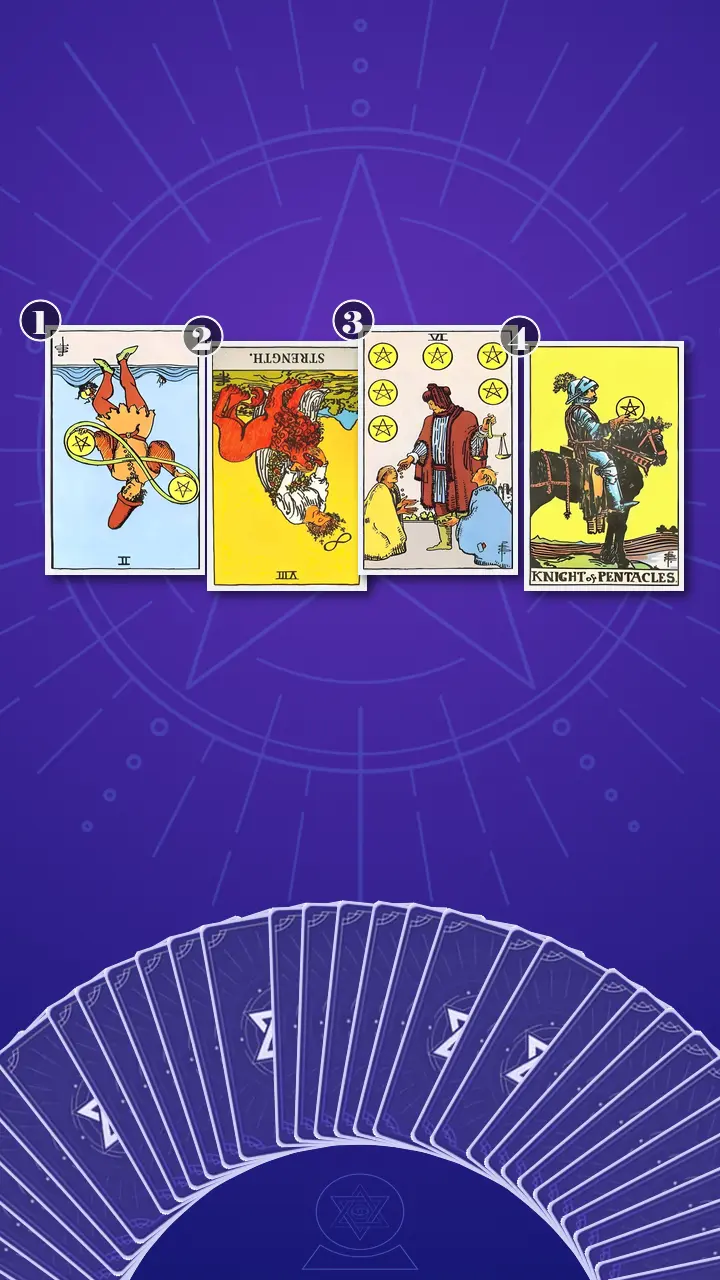
I told her what I was looking for as I laid the cards from left to right. The first position would show the current symptom knot: the missed appointment, overdraft, unread texts, and the feeling of dropping too many balls at once. The second would reveal the underlying blocker, especially the fear that needing help meant losing control. The third—our turning point—would show the medicine. The fourth would tell us what finding clarity looks like when it becomes a real routine rather than a late-night promise.
Reading the Map of the Backlog
Position 1: The Lock-Screen Guilt Collage
I turned over the first card. "Now we are looking at the card for the current symptom knot," I said. "The concrete spillover in daily life." It was the Two of Pentacles, reversed.
I hardly needed to translate it. This was Maya on the ride home toggling between her overdraft, unread messages, and the missed dentist reminder until the overlap itself became paralyzing. Nothing in that triad was individually impossible. But all three landing at once made her feel as if she had already failed the day, so she closed the phone and postponed all of them for a future self who supposedly had more energy, more discipline, and less shame. In energetic terms, this card showed blockage through overload: practical life had tipped from juggling into dropping.
I pointed to the familiar image of the juggler and the rough sea behind him. "This is what happens when ordinary tasks stop being tasks and start acting like a verdict," I said. "It's like your lock screen has become a guilt collage. The brain says, I can fix this later, just not like this. And then later becomes another layer of pressure."
Maya let out one short laugh, sharp at the edges. "That's so accurate it's kind of rude."
"Good," I said, and I smiled. "Better rude than vague. This card doesn't say you're incapable. It says the system is overloaded. And when the system is overloaded, trying to clear your entire life in one Notion-style reset night is exactly the move that keeps the loop alive." Her fingers, which had been pressed around the paper cup beside her, loosened a little. The recognition had landed.
Position 2: When the Inner Manager Starts Escalating
I turned to the second card. "This is the underlying blocker," I said. "The fear and self-management style keeping the backlog alive." The card was Strength, reversed.
On the table, the contrast was immediate. The issue was no longer just outer clutter. It was the harsh private rule beneath it. This showed up as the moment Maya slipped on one basic task and responded by tightening internally, trying to become hyper-competent at speed. Instead of sending one honest message, she turned herself into a project to be managed. In energetic terms, this was fire turned inward and clenched—willpower present, but misused. Not balance. Not softness. White-knuckled control.
"When the mess shows up," I told her, "you don't go tender; you go managerial. Your inner voice starts sounding like a boss escalating in Slack. Come on. This is basic. Why are you making this a whole thing? But pressure is not the same thing as resilience. This is like trying to sprint on 3% battery and then blaming yourself for not being inspirational about it."
She went very still. First her jaw tightened. Then I watched her breath pause high in her chest. Then her gaze unfocused for a second, as if she were replaying her desk on Wednesday morning—the open tab for the dentist office, the client spreadsheet, the tiny two-minute gap she still could not use for herself. Finally she let out a slow exhale through her nose.
"Yes," she said quietly. "When things slip, I basically become my own disappointed manager."
I nodded. "And that is the blind spot. You have been mistaking self-domination for strength. But the card meanings in context are clear here: the missing ingredient is not more force. It is a softer nervous system and one honest next move."
When the Scales Rebalanced: Six of Pentacles as the Antidote
Position 3: The Corrective Principle
When I turned the third card, the room changed. Traffic hissed outside the window, then seemed to fall back. The lamplight caught the edge of the card, and even before I named it, I knew we had reached the hinge of the reading. "This," I said, "is the medicine." The card was the Six of Pentacles, upright.
In modern life, this looks very plain, which is exactly why people miss its power. It is the simple reschedule text. The friend who stays on FaceTime while you open the bank app. The message to the bank before fees turn into a morality play. The card does not ask for oversharing or collapse. It asks for reciprocity, practical exchange, rebalancing. In energetic terms, this was balance restored in the very area where the earlier cards showed constriction. Support entering the system where pride had been hoarding strain.
At moments like this I often feel my old archaeological mind stir. My own inner flash of recognition was not mystical at all. I thought of Bronze Age port towns I had studied years ago—settlements that survived stress not by building ever higher walls, but by keeping their exchange routes open. In my work I call this Historical Case Matching: compare the present choice to older crossroads and watch the pattern clarify. Civilizations rarely endure through private heroics. They endure through circulation—grain, water, labor, trust. People are not so different.
I looked back at Maya. "You've been treating your life like a besieged city," I said. "But this card says the repair does not come from defending your image harder. It comes from opening the road again."
I slowed down deliberately. I wanted the insight to arrive whole. "Think about the streetcar moment," I said. "You open the bank app, swipe to unread texts, notice the dentist reminder still sitting there, and suddenly the whole week collapses into one verdict about who you are."
Stop treating support like a debt to your pride; let the scales rebalance through honest exchange, because stability grows when you receive as well as give.
I let the sentence sit between us.
Her reaction came in layers, exactly as these moments so often do. First there was the brief freeze: fingers suspended above the lid of her cup, shoulders held. Then the cognitive hit: her eyes shifted slightly away from me, not evasive but distant, as if replaying draft after draft of the text she had deleted in her kitchen on Sunday night. Then came the surprise—not relief at first, but resistance. "But doesn't that mean I've been doing this wrong?" she asked, and there was a flash of anger in it, the kind that appears when a person feels both exposed and suddenly free.
I answered her plainly. "No. It means you've been using siege tactics for a plumbing problem. Wrong tools, not a ruined character." That broke something open. Her shoulders dropped. The hand around the cup loosened fully. Her eyes reddened—not dramatically, just enough for the effort of the last few weeks to show itself without disguise. She drew one deeper breath, then another, and gave a small, almost disbelieving shake of the head. The release was visible, but so was the vulnerability that follows it: that slight dizziness people get when the burden lifts and they realize they now have a real choice to make.
"Now," I said, very softly, "with this new angle—was there a moment last week when this would have changed the feeling?"
She nodded almost at once. "My friend asked if I wanted company on FaceTime while I sorted my banking app," she said. "I ignored it because I thought I needed to fix the money thing first. Which is... kind of the whole problem, isn't it?"
"Exactly," I told her. "That is the hinge from shame-fueled solo catch-up sprints to steady self-trust through support and routine. Support is not the opposite of competence; it's how competence stays usable."
The Still Horse and the Boring Repair Rhythm
Position 4: The Embodied Next Step
I turned the final card. "This is the embodied next step," I said. "What happens when the guidance becomes practice." It was the Knight of Pentacles, upright.
I was glad to see him. After the emotional charge of the third card, this knight always feels like a cool hand on a fevered forehead. In modern terms, this is not a glow-up montage. It is the recurring Thursday admin block. One message answered at lunch. One bill checked with a timer. One rescheduled appointment. The still horse and the cultivated field say the same thing very clearly: energy here is balanced through repeatable pace, not intensity. Stability is boring on purpose.
"Stop planning a rescue," I said. "Build a rhythm. This card is like brushing your teeth for your life admin instead of waiting for a cinematic comeback scene. You're not auditioning for a new identity. You're rebuilding trust one ordinary action at a time."
Maya gave me the first unguarded expression I had seen from her that evening. It wasn't a grin. It was better: the quieter look of someone whose nervous system has finally been offered a task small enough to believe in. "I could do fifteen minutes on Thursdays," she said. "Lunch break. Money one week, appointments the next."
"Good," I said. "That is how the Knight works. Not dramatic. Just dependable."
From Rescue Fantasy to Actionable Next Steps
Once all four cards were down, the story was remarkably coherent. The Two of Pentacles reversed showed the visible spillover: too many open tabs, too little margin, everyday tasks turning into a pileup. Strength reversed explained why the pileup persisted: each dropped ball triggered a harsher inner regime, as if self-criticism could somehow manufacture capacity. Then the Six of Pentacles changed the architecture of the whole reading. The path out was not better solo performance but wider circulation—support-first repair, honest before polished, practical reciprocity. Finally, the Knight of Pentacles grounded that shift in a slower, steadier rhythm.
I told Maya the true cognitive blind spot was not laziness, disorganization, or lack of ambition. It was the definition of competence she had been obeying. She had been treating secrecy as maturity and private struggle as the price of being impressive. In my own work I use something I call the Time Stratigraphy Method: I separate the layers, the way I would at a dig. One layer is the actual task—call the dentist, answer the friend, ask about the fee. Another layer is the old story attached to it—If I need help with basic life admin, people will see I am not really together. Once those layers are no longer fused, the task shrinks back to human size.
Then I gave her the next steps. Small enough to survive a Tuesday. Practical enough to interrupt an adulting shame spiral before it becomes another private rescue sprint. I also framed them through my Voyage Log Technique: ancient navigators did not steer by the whole ocean at once. They chose the next harbor, logged the weather, and kept moving.
- One Honest SentenceThis week, choose one person or institution only—the dentist office, the bank, or one trusted friend—and send one unpolished line. For example: "Hi, I missed this and need to reschedule. What are my next options?" Or: "I'm behind and not polished, but I wanted to reply now rather than disappear."Tip: write it in Notes first if you need the buffer, then send it before you edit it into silence. You do not need a comeback story to send one honest text.
- Voyage Log: One-Tab RepairSet a 15-minute timer on your next lunch break or ride home and choose one category only: money, messages, or appointments. No switching tabs until the timer ends. If money is the sharpest stressor, let that be the harbor. If the dentist is the loudest dread, start there.Tip: if 15 minutes feels too large, do 5. Partial steadiness is still steadiness. Say out loud, "One tab only," before you unlock the phone.
- Borrowed Steadiness CallAsk one friend for a low-drama form of support: ten minutes on FaceTime while you open the banking app, call to reschedule, or answer one thread. Keep the ask specific and short. You are not requesting rescue; you are using companionship as load-balancing.Tip: if asking feels too exposed, keep the script plain: "Can you sit with me while I do one boring thing?" Support works better when it is concrete.
Maya read over the notes I wrote for her and nodded. Not with the brittle determination she had walked in with, but with something steadier. The transformation direction was now clear: from proving competence by handling everything alone to restoring stability through timely support and small repeatable actions. Or, more simply: stop planning a rescue. Build a rhythm.

A Week Later: The Quiet Proof
A week later, she sent me a short message. She had used the first script on the dentist's office, asked a friend to stay on FaceTime while she checked her bank balance, and learned the fee problem was smaller than the dread had made it. She had not fixed her life. She had done something harder and better: she had stopped hiding from it.
Her follow-up included one line I liked very much: "I still hate admin, but it feels less like a character verdict now." That, to me, was the real success of the reading. The Situation-Obstacle-Advice-Outcome spread had not handed her certainty; it had restored proportion. It had moved her from shame-fueled solo catch-up sprints toward steady self-trust through support and routine.
She slept through one night without building a ten-step reset list. In the morning, her first thought was still, "What if I fall behind again?" This time she smiled, made coffee, and opened one tab only.
When a dentist reminder, a minus sign in the bank app, or one unread text makes the chest lock up, the pain is rarely just the task. More often, it is the fear that being seen mid-mess will cancel the competent version of you.
If support counted as competence instead of failure, which one tab on your own lock-screen guilt collage would you let become easier this week?
This story is adapted from psychological research, written so that those in a similar struggle can see their own pattern in it — and find their next step clearly.These insights are not a substitute for professional psychological, medical, legal, or financial advice.
Learn more about our Journey to Clarity.
How did this insight land for you?
🫂 This Resonates Deeply
🌀 Living This Story
✨ Now I See Clearly
🌱 Seeing New Possibilities
🧰 Useful Framework
🔮 The Confirmation I Needed
💪 Feeling Empowered
🚀 Ready for My Next Step
Author Profile
 AI
AI“Having spent a lifetime at Cambridge and on archaeological digs, I’ve witnessed the rise and fall of countless civilizations. Please know that your current struggles are not a permanent fate, but merely a necessary fracture before rebuilding. I won't lecture you; instead, I invite you to sit with me in the ruins, using a patient, historical perspective to gently dust off the true, enduring value hidden beneath your temporary doubts.”
In this Choice Tarot Reading :
Core Expertise
- Historical Crossroad Matching: Contextualizing your dilemma by comparing it to macro-historical turning points, providing an objective bird's-eye view.
- Enduring Value Assessment: Evaluating competing options based on what will survive the test of time versus what is merely a short-term impulse.
Service Features
- The Time Stratigraphy Exercise: A mental time-travel protocol evaluating your current dilemma strictly from the perspective of your 10-year future self, instantly dissolving trivial anxieties.
Also specializes in :
Explore Related Patterns:
Competence TheaterMaya says she does not want to reply halfway through a mess, and later names the older story underneath it: if she needs help with basic life admin, people will see she is not really together. That is the exact point where a normal repair task becomes a performance problem. Competence Theater appears when looking capable becomes more urgent than becoming supported. You can still be bright, responsible, and overloaded at the same time, but this pattern makes those states feel incompatible. It pushes you to wait until the scene looks cleaner before anyone gets access to it. In the story, the performance costs her practical relief. The friend's FaceTime offer could have made the banking app easier to open, but accepting it would have revealed the unfinished middle of the process. The pattern breaks when competence is redefined as honest repair, not flawless presentation.
Hyper-IndependenceMaya's central question is whether to push harder alone or get support, and the story shows how quickly support gets translated into exposure. A friend offers to sit on FaceTime while she checks the banking app, but Maya ignores it because she believes she should fix the money issue first. Hyper-Independence fits because the defense is not simple privacy. It is the belief that needing help would subtract from competence, so the system protects pride by hoarding strain. You can see it in the image of life as a besieged city: the roads close, exchange stops, and every problem has to be solved inside the walls. The corrective move is not collapse or oversharing. It is a specific, bounded ask that lets support function as load-balancing. When you let someone sit with you through one boring task, the pattern loses its main argument: that being supported means being less capable.
Peer Co-regulationMaya's friend had already offered a practical form of support: stay on FaceTime while she opened the banking app. Nothing dramatic was required. The support was concrete, time-limited, and attached to one boring task. Peer Co-regulation fits because the stabilizing force is not advice from above or rescue from outside. It is another calm person helping the nervous system stay present long enough to do the next step. You can still own the task while borrowing enough steadiness to start it. The follow-up proves the mechanism inside the story. When Maya asks the friend to stay on FaceTime, the fee problem becomes smaller than the dread had made it. Support does not erase accountability; it makes accountability usable.
Productivity as SafetyWhen Maya misses one basic task, she does not move toward softness or proportion; she tightens and tries to become hyper-competent at speed. Her inner voice starts sounding like a disappointed manager, as if sharper pressure could manufacture capacity. Productivity as Safety fits because effort becomes a nervous-system control strategy. The heroic catch-up night, the reset fantasy, and the self-manager voice all promise the same thing: if you can just become disciplined enough, you will not have to feel exposed, behind, or dependent. The story shows why that strategy backfires. Pressure gives the impression of control, but it also makes the phone harder to unlock and the first honest message harder to send. The repair begins when strength stops meaning self-domination and starts meaning one small action that your actual capacity can sustain.
Self-Judgment LoopMaya's missed dentist reminder, overdraft, and unread texts collapse into one verdict about who she is. The story says it plainly: a backlog becomes shame when every task starts grading your worth. Self-Judgment Loop fits because each unfinished item triggers a harsher internal verdict, and that verdict makes the next action feel more loaded. The fee problem becomes a morality play before she checks the actual details, so dread grows larger than the facts. The loop weakens when the task and the identity story are separated. Calling the dentist is one layer; the belief that needing to call means she is not a real adult is another. Once those layers are no longer fused, you get enough psychological space to open one tab without turning the whole moment into a trial.
Shame-Driven DelayMaya's streetcar moment starts with three manageable tasks sitting on the same screen: a missed dentist reminder, an overdraft, and unread texts. The phone does not just show errands; it becomes a lock-screen guilt collage, and her body reacts as if the admin backlog has become evidence against her. The delay is not laziness or a simple time-management issue. The task has fused with self-worth, so answering one message or checking one balance feels like being seen mid-failure. You can see the defense clearly when she says she needs one proper catch-up night before replying, because the mind is trying to avoid the shame of taking imperfect action. Shame-Driven Delay fits because the postponement is powered by emotional exposure, not by the objective difficulty of the tasks. The pattern starts to loosen only when the task shrinks back to human size: one honest sentence, one tab, one supported check-in before the shame system can turn the whole backlog into a character verdict.
Explore Related Struggles:
Capacity-Identity FusionOn the streetcar, the bank app, unread messages, and buried dentist reminder collapse into one screen, and Maya locks the phone instead of choosing one repair. The pileup is practical on the surface, but the story shows it becoming a verdict about whether the competent version of her is still intact. You are not just facing a dentist call, a money check, or a text thread in this pattern. You are facing the fear that reduced capacity will be read as defective character. That is why one missed appointment can feel bigger than one missed appointment; it appears to threaten the whole identity you have been trying to keep credible. Capacity-Identity Fusion names the weld between bandwidth and self-definition. When capacity drops, identity feels accused. The way back to clarity begins when the task is separated from the trial: one tab can be opened without making your entire worth stand trial beside it.
Competence-Connection SplitThe friend offering to stay on FaceTime while Maya opens the bank app is one of the clearest hinge moments in the story. Help is available, concrete, and low-drama, yet she leaves it unused because she believes the money problem has to be fixed before she can be witnessed inside it. You get placed between two competing definitions of adulthood. One says competence means private control, polished replies, and no visible mess. The other says competence can include circulation: a friend on the call, a reschedule text, a short exchange with the bank before the dread grows larger than the fee. Competence-Connection Split captures that fork. Support starts to feel like evidence against your capability, so connection has to wait until you no longer look like you need it. The repair begins when being supported is allowed to count as part of competence, not a confession that competence has failed.
Catch-Up ParalysisMaya already knows the dentist reminder, overdraft, and unread texts are waiting. On the streetcar she even brings them onto the screen, one after another, but the overlap becomes so charged that she locks the phone and hands the whole mess to a future version of herself. You are not refusing the tasks because they are individually impossible. The freeze comes from the condition placed around them: they must be handled during one proper catch-up night, by a version of you with more energy and less exposure. Until that version arrives, every small task keeps gathering moral weight. Catch-Up Paralysis is the stuck point where repair is always scheduled for a cleaner future and therefore cannot enter the messy present. The path through it is not a heroic comeback. It is the permission to make one honest move before the whole backlog feels ready to be solved.
System Reset OverloadThe imagined solution keeps arriving as a total reset: one good night, one proper catch-up sprint, one clean sweep that will make the missed appointment, bank issue, and unread texts finally manageable. The story keeps pushing against that fantasy until it becomes visible as part of the overload itself. You end up trying to solve scale with more scale. Because everything feels connected to everything else, the repair plan becomes as large as the panic: all tabs, all tasks, all identity repair, all at once. That kind of reset asks an already strained system to perform a comeback before it has been stabilized. System Reset Overload names the collapse that happens when the whole life-admin system is drafted into one rescue event. Maya's shift toward one tab, one timer, and one Thursday rhythm matters because it lets repair become smaller than the backlog for the first time.
Perfect Readiness TrapMaya's line about not wanting to reply halfway through a mess exposes a smaller but sharp threshold inside the larger backlog. She is not only behind on texts; she is waiting for a version of herself who can reply from a cleaner, more composed place. You may recognize the way an honest message turns into a performance gate. The unpolished reply feels too revealing, so the draft gets revised, delayed, or deleted. Silence then starts pretending to be control, even while it makes the next contact feel heavier. Perfect Readiness Trap names the moment when being clear enough to act becomes a condition for acting at all. The story's one honest sentence cuts through that condition: you do not need a comeback story before you can send one human line.
Explore Related Emotions:
Cautious ReceptivityMaya's repair begins with a very plain form of support: a friend staying on FaceTime while she opens the banking app. Nothing dramatic happens, and that is the point; the help is concrete enough to enter the system without turning into a performance. Cautious Receptivity captures the careful opening that follows. She is not collapsing into someone else's hands, and she is not proving she can carry everything alone; she is testing whether support can be part of competence. For you, this emotion has a quiet edge of vulnerability. It is the first believable yes to being accompanied while still staying in your own agency, letting the load become shared without making your dignity disappear.
Dependency ShameMaya's friend offers to stay on FaceTime while she checks the banking app, and she ignores it because she thinks she needs to fix the money thing first. The support is available, but receiving it feels too exposing. Dependency Shame is the emotional charge around that moment. Help does not register as simple companionship; it registers as evidence that the load is too much, and that admission threatens the image of being self-contained and impressive. The story turns when support is reframed as practical exchange rather than rescue. For you, this label points to the tender place where needing someone beside you for one boring task can feel bigger than the task itself.
Life Admin ShameMaya sits with her phone face-down on her knee, shoulders lifted and jaw set, while a missed dentist reminder, an overdraft, and unread texts wait inside the same small screen. The tasks are ordinary on paper, but her body responds as if each notification has become a witness against her. That is the emotional logic of Life Admin Shame: the practical mess stops being about scheduling, money, or replying, and starts behaving like a private measurement of adulthood. You can see how the backlog turns into a character verdict when she says she needs one proper catch-up night before she can deal with anything, because she does not want to answer halfway through the mess. The story points to a feeling many competent people hide well: the fear that being seen behind, unpolished, or mid-repair will make the capable version of you disappear. Naming it gives the pressure a shape, so the issue can shrink back from identity judgment into one honest next move.
Control FatigueWhen Maya slips on one basic task, she does not soften toward herself; she tightens and tries to become hyper-competent at speed. Instead of sending one honest message, she turns herself into a project to be managed. Control Fatigue shows up in that white-knuckled internal regime. The inner voice sounds like a boss escalating in Slack, demanding that she sprint on 3% battery and then blaming her for not looking composed while doing it. This emotion matters because the question asks whether to push harder or get support. The story shows that pushing harder is not neutral for Maya; it comes with a private pressure system that drains the very capacity it is trying to create.
Grounded Self-TrustMaya does not leave with a rescue plan; she leaves with fifteen minutes on Thursdays, one category at a time. The repair becomes one message at lunch, one bill with a timer, one rescheduled appointment. Grounded Self-Trust is the feeling that grows when the next step is small enough to believe in. It is not the brittle confidence of a full reset list, but the steadier confidence of opening one tab and staying with it. The follow-up makes the shift visible. She has not fixed her life, but she has stopped hiding from it, and that is a more durable kind of trust than a dramatic comeback promise.
Shame ReliefAfter the support insight lands, Maya's shoulders drop, her hand loosens around the cup, and her breathing changes. The body registers something before the plan is even complete: the mess is no longer fused to her worth. Shame Relief appears when the task shrinks back to human size. The bank fee is smaller than the dread made it, the dentist office can be contacted, and the unread message can be answered without a comeback story. For you, this relief is not a cheerful erasure of the problem. It is the quieter release that comes when an unfinished task stops acting like a character verdict and becomes something you can meet directly.
Verdict DreadThe lock screen becomes a guilt collage for Maya: a dentist reminder, a minus sign, unread messages, all arranged like evidence. When she looks at them together, the whole week collapses into one verdict about who she is. Verdict Dread names the specific fear underneath the backlog. The problem is not only that something needs to be done; it is that each unfinished task feels able to declare something final about her competence. You can feel this most clearly in the line about being seen mid-mess. The dread is that support, a reply, or a rescheduling call will expose the unfinished version of you and somehow cancel the capable one, even though the story shows those two versions are not actually enemies.
Scattered OverwhelmOn the 504 King streetcar, Maya moves from the banking app to unread iMessages to the dentist reminder, and the switching itself becomes the trap. None of the tasks is described as impossible alone; the pressure comes from their collision, from the way each one pulls focus while the others keep flashing in the background. Scattered Overwhelm fits because her attention has no clean landing place. The story gives it a precise texture: a browser with twelve tabs open, one of them playing audio, and no way to tell which tab started the alarm. For you, this emotion is not just having a lot to do. It is the inner weather of too many small alarms fusing into one system-wide lockup, where choosing one task feels like abandoning the rest and doing nothing briefly feels like the only way to stop the noise.
Performance FreezeMaya does not want to reply halfway through a mess, so the reply waits for a cleaner version of her life. She closes the phone and hands the whole backlog to a future self who is supposed to have more energy, more discipline, and less exposure. Performance Freeze is the suspended feeling created by that standard. Action becomes delayed until it can look polished enough, and the delay quietly makes the mess feel larger. The story shows this in the tiny two-minute gap she still cannot use for herself. You are not looking at a lack of intention; you are looking at the body freezing when the next move feels like it has to prove too much.
Explore Related Contexts:
Adulting Performance PressureMaya names the dilemma as a choice between pushing harder alone and getting support, but the real pressure is the need to prove she can still manage. The missed dentist appointment, overdraft, and unread texts are treated less like practical issues and more like evidence in a private trial about whether she is a functioning adult. That is why the story fits Adulting Performance Pressure. The external demand is not just the dentist office, the bank, or the friend waiting for a reply; it is the cultural scorecard attached to all of them. Mature, competent people are supposed to keep up, respond cleanly, manage quietly, and never be seen mid-mess. You are not only deciding whether to work harder. You are confronting a performance rule that makes support look like failure, even when support is the most efficient way to restore capacity.
Community Supported RoutineThe repair point arrives when support becomes concrete: a friend stays on FaceTime while Maya opens the banking app, and the ask is kept short, specific, and low-drama. No one is being asked to fix her life; another person is simply helping one difficult task stay open long enough to be completed. Community Supported Routine is the constructive external stage that the story builds toward. Stability comes from circulation rather than private force: one honest text, one short call, one friend present while an admin task gets handled. Support becomes a piece of infrastructure, not a confession of incompetence. You are not giving up agency by letting someone sit beside the task with you. You are designing a routine where competence stays usable because the load is distributed before it becomes a private rescue sprint.
Support Access BarrierMaya's friend had already offered to stay on FaceTime while she sorted the banking app, and Maya ignored it because she thought she needed to fix the money issue first. The support was present, specific, and useful, but it could not enter the system while being helped still looked like being exposed. That is the external shape of a Support Access Barrier. The problem is not that no one is available; it is that the available support has to pass through a performance rule before it can be used. The friend, the bank, and the dentist office all become harder to contact because Maya believes she needs to arrive already polished. You are being asked to notice where support is structurally nearby but functionally out of reach. The path forward is not collapse or oversharing; it is one bounded exchange that lets help become practical instead of symbolic.
Catch-Up ParalysisMaya keeps saying she needs one good night, one proper catch-up night, before she can deal with the missed appointment, the overdraft, and the unread texts. That plan sounds organized, but it quietly raises the entry fee for action until every small repair has to wait for a perfect window. Catch-Up Paralysis appears when the external backlog is converted into an all-or-nothing reset project. Instead of rescheduling one appointment or sending one imperfect reply, the whole week has to be redeemed at once. The future self who supposedly has more discipline becomes responsible for everything the current self cannot start. You are dealing with a blocked action path, not a lack of options. The practical opening is the smallest honest move that breaks the fantasy of a total reset.
Life Admin BacklogMaya is standing on the 504 King streetcar moving from her banking app to unread iMessages to a dentist reminder still buried in notifications, and none of those tasks is impossible on its own. The pressure comes from the overlap: money, healthcare admin, and social replies all landing in the same small screen during a commute home. That is the structure of a life admin backlog. The external world has not handed her one clean problem; it has handed her several small obligations with different timelines, different social consequences, and no obvious place to begin. When she locks the phone and postpones everything to a future catch-up night, the backlog stops behaving like a to-do list and starts behaving like a system jam. You are being shown a practical pileup, not a character failure. The useful question is not whether you can force yourself through every tab at once, but which external obligation needs to be brought back down to human size first.
Routine Reset TrialMaya's next step is not a full-life overhaul; it is fifteen minutes on Thursdays, during lunch, with money one week and appointments the next. The story keeps the repair deliberately plain because the old pattern was waiting for a dramatic catch-up night that could carry everything. Routine Reset Trial fits because the new structure is still being tested in real life. One tab, one timer, one category, one ordinary action: those are external boundaries that make the backlog less able to take over the whole day. The routine is small enough to survive a normal week. You are not auditioning for a new identity through productivity. You are rebuilding trust through a repeatable container, where the next admin task has a place to go before it turns into another lock-screen pileup.