Return Bag Guilt at the Front Door Turns Into a Saturday Route
Finding Clarity in the 8:17 a.m. Return Bag
If you have ever stepped over the same return bag by the front door on your way to work, with a printed label hiding under mail and a return-window email glowing in your inbox, you already know the tiny life-admin weather Maya (name changed for privacy) brought into our reading.
She joined our video session from a compact Brooklyn apartment, still in her office sweater, with a pale poly mailer leaning behind her against the shoe rack. She turned the camera for half a second and I saw the narrow entryway: sneakers piled by the mat, a strip of blue painter's tape on one package, cardboard softening at the corners. She told me that at 8:17 that morning she had stood with one hand on the door handle while the radiator clicked, coffee cooled on the counter, her phone buzzed about a subway delay, and the bag made that dry plastic crinkle against her ankle.
'I know it would take fifteen minutes,' she said, rubbing the heel of her hand over one eyebrow, 'which somehow makes it worse. The bag is basically part of the furniture now. I hate that a parcel can make me feel this judged.'
What I felt in the room was not laziness. It was low-grade frustration with a small chest pinch underneath it, like an unread email had learned how to live beside her shoes and light up in her body every time the door opened. It was not just a poly mailer. It was a return bag by the front door, plus money guilt, plus a daily visual reminder of follow-through slipping, sitting exactly where her day was supposed to begin.
I told her, 'We are not going to turn this into a character trial. We are going to let the cards show us where the loop begins, where it gets inflated, and what would make it small enough to finish. Think of this as a Journey to Clarity for one very ordinary threshold.'
Choosing the Compass: The Transformation Path Grid
I asked Maya to put both feet on the floor, unclench her jaw if she could, and name the question in plain language: 'How do I stop letting return bags live by my front door?' I shuffled slowly, not to make the moment mystical, but to give her attention somewhere steady to land.
For this reading, I chose the Transformation Path Grid (6) · Context Edition. This is how tarot works best in a practical problem like adult-admin procrastination: it does not predict whether Maya will become perfectly organized. It gives us a map of the habit loop, with card meanings in context.
I chose this spread because her issue was not a simple yes-or-no choice. A Past-Present-Future spread would be too linear, and a Decision Cross would make it sound as if the problem were one decision. The return bag was part of a system: online choice, purchase regret, front-door clutter, reminder snoozing, and self-judgment. The Transformation Path Grid lets me trace that system from symptom to root to intervention.
I explained the map to her before I turned the cards. The first card would show the visible knot at the doorway. The second would identify the immediate blockage. The third would reveal the root driver behind the pattern. Then the bottom row would show the catalyst, the practical next step, and the integration available when the loop closes. On the table, it looked almost like an apartment floor plan with an exit route.
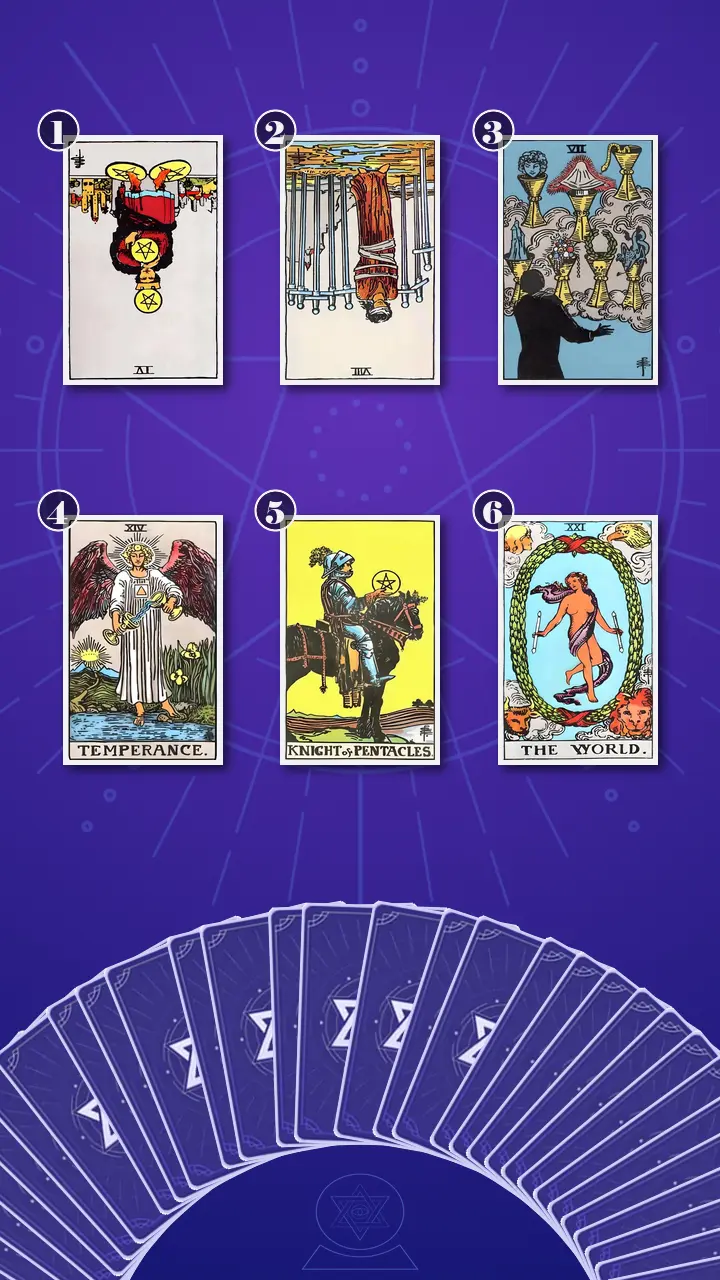
Coins, Swords, and Browser Tabs
Position 1: The Bag Holding the Money Story
Now I turned over the card representing the visible current-state knot: the return bags by the front door, the money guilt attached to them, and the stagnant energy of stepping around the same task. It was the Four of Pentacles, reversed.
In the traditional image, a figure clutches coins so tightly that the body can barely move. Reversed, that grip becomes leaky control: too much effort spent holding the meaning of the purchase, not enough movement toward releasing the object. In Maya's hallway, the coin held to the chest became the receipt she did not want to check. The coins under the feet became the bag literally blocking the threshold.
I said, 'Reversed Four of Pentacles is you keeping the return bag beside the shoe rack because letting the item leave would mean admitting the purchase did not work. The bag is supposed to move out, but it has become a small monument to money guilt, visible control, and the fear that one bad buy means you are careless.'
Maya let out a short laugh with no brightness in it. 'That is too accurate, even kind of rude.'
'A mirror can be blunt without being cruel,' I said. 'The point is not that you are bad with money. The point is that the task feels bigger when it has to carry the meaning of the mistake. That is an energy excess: the object is holding more emotional charge than the errand can bear.'
Position 2: The Doorway Thought Loop
Now I turned over the card representing the immediate blockage: the thought loop that makes a short errand feel exposing, annoying, or bigger than it is. It was the Eight of Swords, reversed.
The blindfold in this card is important, but so are the loose bindings and the open space between the swords. Reversed, the card tells me the enclosure is beginning to loosen. Air energy is still blocked, but not locked. Maya technically could do the return before work, yet her mind kept showing her only the awkward subway ride, the possible missed deadline, the refund delay, and the embarrassment of having waited.
I brought her back to the doorway scene. 'One hand on the handle, subway countdown running, return email half-open. The inner monologue sounds like: I could do it, but then I would have to check the deadline, and if the deadline is bad, then it says something about me. That is the Eight of Swords reversed. The task is not locked; the story around it keeps you still.'
Her fingers stopped moving around the mug. First her breath paused. Then her eyes drifted slightly off-screen, as if she were replaying the exact moment from that morning. Finally, her shoulders dropped a few centimeters. She said, very quietly, 'I do think the missed deadline would prove something.'
'Then we name the real obstacle,' I said. 'Not UPS. Not the subway. Not tape. The real obstacle is the fear that the return window will turn into a verdict. A return bag is not a personality flaw. It is a logistics loop without an ending.'
Position 3: The For You Page of Possible Selves
Now I turned over the card representing the root driver: the online-choice haze, aspirational buying, and emotional promise that happened before the bag existed. It was the Seven of Cups, upright.
The floating cups looked almost too modern to me that evening. They could have been open tabs: Wirecutter, The Strategist, Aritzia, Target, a saved TikTok haul, a Depop search, a cart that promised a cleaner office morning. Upright Seven of Cups is not 'wanting too much' as a moral flaw. It is Water energy scattered through too many imagined selves before logistics has been invited into the room.
I said, 'This is the late-night scroll where each item looks like it will solve a different version of your life: better work mornings, better dates, better apartment energy, better self. When the item arrives and cannot carry that fantasy, the return bag holds the emotional residue of too many promises.'
Maya winced and smiled at the same time. 'The For You Page of possible selves,' she said. 'I hate that I know exactly what you mean.'
I nodded. 'It is a little like the Severance feeling of splitting into shopping-self, work-self, and future-self who is supposed to handle the logistics. The card is asking us to reunite those selves gently. Desire is allowed. Convenience is allowed. But the return system has to be part of the purchase, not the shameful afterthought.'
When Temperance Made the Air Move
Position 4: The Calm Handoff System
Now I turned over the card representing the key trigger for transformation: the shift from self-judgment to a balanced system that links desire, money, space, and timing. It was Temperance, upright.
The angel pouring water between two cups gave the room a different pace. In my old perfumer's mind, Temperance always smells like a formula finally finding proportion: not too sharp, not too sweet, enough air between notes for each one to breathe. Here, the energy was balance. Not a shopping ban. Not a perfect Notion life-admin dashboard. A handoff.
I told Maya, 'Upright Temperance is you choosing a boring, balanced return rhythm. One return tote, one deadline note, one weekly drop-off route. It lets the emotional reason you bought the item and the practical need to release it exist in the same system.'
On my screen, she leaned back and exhaled through her nose. Outside her window, a delivery truck beeped and moved on. It was a small sound, but it made the point for us: the object was supposed to move through the threshold, not settle there as emotional weather.
Position 5: The Route That Is Boring Enough to Work
Now I turned over the card representing the actionable next step: a small, repeatable routine that makes returns easier to complete before they become visual clutter. It was the Knight of Pentacles, upright.
The horse on this card is still, not because nothing is happening, but because the movement is reliable. Earth energy is balanced here: same field, same tool, same patient method. For Maya, this looked like a regular Saturday loop: coffee, the UPS counter, groceries, home. It did not need to be glamorous enough for a Sunday reset video. It needed to be repeatable enough that the bag no longer had to wait for a perfect mood.
I said, 'The Knight of Pentacles says: I do not need to feel motivated; I need the bag to join a route that already exists. Do not build a perfect system for a bag that needs one clear route.'
She glanced toward the entryway again. This time the look was not flinching; it was logistical. 'There is a UPS near the coffee place,' she said. 'I walk past it every Saturday and somehow never connect those two things.'
When The World Turned the Threshold Into a Wreath
Position 6: The Closed Loop, Not the Perfect Life
Before I turned the final card, the room became unusually quiet. Even through the screen I could hear the radiator settle. This card represented the integration available when the loop is closed: a clearer threshold, less guilt, and more trust in small follow-through. It was The World, upright.
The wreath in The World is a completed circle. For Maya, it was not a promise that every corner of her life would become spotless. It was the closed loop from purchase to decision to release: the drop-off receipt photo, the clear entryway, the absence of that tiny body flinch when she opened the door.
This was where I reached for the diagnostic lens I use most naturally after fifteen years as a perfumer. I call it Spatial Boundary Scenting: noticing where atmospheres overlap until the body cannot tell what room it is in anymore. I said, 'Your entryway is carrying three scents at once: the hope from the moment you bought the item, the money guilt from deciding it did not work, and the work-morning pressure of trying to get to the subway. Each one is manageable on its own. Together, they make the front door feel stale, like a waiting room for guilt. The World asks us to give each atmosphere an exit route.'
Maya was caught in that 8:17 a.m. doorway moment: coat on, timing in her head, bag by the shoes, and the quick promise to deal with it later. She had been treating the return as evidence of bad judgment when the card was showing a ten-minute logistics loop waiting for one clean ending.
You are not stuck because the errand is too hard; you become free by stepping through the wreath of completion one small return at a time.
I let the sentence sit between us. First, Maya froze; her hand hovered near her mug, and for a second even her blinking seemed to stop. Then the meaning appeared to move through her face in layers: brow tightening, pupils widening, mouth pressing flat as if she were resisting the kindness of it. Her eyes went a little red, but her voice came out sharper than I expected. 'But does that mean I was making it dramatic for no reason? Like, was I just wrong this whole time?'
'No,' I said. 'It means your system asked one object to carry too many meanings. That is not wrong. It is overloaded.'
Only then did her fist soften on the arm of the chair. Her shoulders dropped, and the exhale sounded less like defeat than like a door unsealing. I watched the relief arrive with a thin edge of vulnerability, the kind of blank space that appears when shame stops doing all the organizing. I asked, 'Now, with this new view, think back to last week. Was there a moment when this insight could have made the return feel different?'
She looked down at the card image on the table, then toward the hallway. 'Thursday,' she said. 'I walked past it with my gym tote. I could have put the package beside the tote the night before. I kept waiting to become the kind of person who just handles things, but maybe I could just make the route handle it.'
That was the crossing I was listening for. Not from chaos to perfection, but from low-grade guilt and task inflation toward calm self-trust through small closed logistics loops. Completion is not a mood. It is a small loop you close with your hands.
The One-Clean-Ending Return Loop
When I looked back across the spread, the story was simple. The Four of Pentacles reversed showed the object holding money guilt at the threshold. The Eight of Swords reversed showed the thought loop that made the errand feel like exposure. The Seven of Cups showed the online-option haze that created the purchase from an imagined future self. Then Temperance offered proportion, the Knight of Pentacles offered a route, and The World offered closure.
I named the blind spot plainly for Maya: 'You have been treating a return as evidence of bad judgment. The shift is to treat it as a ten-minute logistics loop that gets scheduled as soon as the label is made. The front door should be a threshold, not a waiting room for guilt.'
Here is the actionable advice I gave her, built from the Transformation Path Grid tarot spread for resolving small life-admin procrastination and front-door clutter. Nothing here requires becoming a different person.
- The 72-Hour Physical Boundary ProtocolWithin the next 72 hours, put one reusable tote or paper bag in the entryway and label it 'Returns Only.' Give it a sensory trigger your body will recognize: blue tape on the handle, a cedar sachet clipped inside, or a phone tone called 'Return Route.' Any active return gets one sticky note with two facts only: drop-off location and final return date. Anything not actively being returned cannot live in that tote.Tip: keep it plain. The sensory trigger is not decoration; it is the partition between high-pressure output mode and deep recovery mode, so the rest of home can breathe.
- The Boring Weekly Return RoutePick one weekly return window, such as Saturday 10:30 a.m. after coffee or Tuesday on the way to the office. Save the nearest UPS, USPS, Royal Mail, Canada Post, AusPost, Evri, or parcel drop-off location in your maps app. Place the bag beside the shoes or backpack you will actually use for that route.Tip: if the week is overloaded, move the block once, but choose the new day immediately. Motivation is optional; the route is the tool.
- The 10-Minute Clean EndingToday, set a 10-minute timer and do only the next physical step: tape the label, seal the bag, save the QR code, schedule pickup, or walk it to the drop-off counter. When the return leaves, clear the exact floor space where it sat and write one sentence in your notes app: 'This was a logistics loop, not a personality flaw.'Tip: if opening the receipt makes your chest tighten, pause and choose the smallest visible verb. 'Tape label' counts. 'Save QR code' counts. One clean ending is enough.
A Week Later: The Quiet Proof at the Door
A week later, I received a photo from Maya: a UPS receipt on a coffee shop table, her cup still giving off steam at the edge of the frame. Her message was one line: 'It is done. Not because I became a different person, but because I finished the loop.'
She had dropped the bag, taken the receipt photo, and sat alone with coffee for twenty minutes, a little embarrassed by how light the floor felt. When she got home, the entryway smelled like rain on her coat and coffee, not cardboard. The clear space was not dramatic. It was usable.
I thought about that more than the receipt. Tarot had not carried the package to the counter; Maya had. The cards had simply made the pattern visible enough that she could stop fighting her character and start designing a route. That is what finding clarity can look like in real life: not a perfect apartment, but one threshold with less static in the air.
If tonight the same bag is still by your door, and your apartment feels like it is quietly pointing at the gap between the person who meant to handle it and the person who had to get through another day, I want you to hold the gentler truth Maya found: a return bag is not a personality flaw. It is a logistics loop without an ending.
If this return were allowed to be a simple loop instead of a statement about you, what is the next tiny closing gesture you can imagine making today: taping the label, saving the QR code, moving it into the tote, or stepping through your own small wreath of completion?