Finding Clarity in the 7:03 a.m. Snooze Spiral
You’re a grad student with a part-time job in Toronto and your mornings start with a three-alarm negotiation—then you spend the first hour trying to claw back time you don’t have.
Jordan showed up on my screen with that exact look: not “tired” as an adjective, but tired as a physics problem—massive, unmovable, like gravity had doubled overnight. Their hoodie was pulled tight around their neck even though they were indoors, and the rain tapping their window sounded like a metronome that wouldn’t let them forget time existed.
“It’s the third alarm,” they said, almost laughing. “Like… I don’t even open my eyes. My thumb just does it.”
I pictured the scene they described because it’s so consistent it’s almost cinematic: 7:03 AM on a rainy Monday in a tiny Toronto apartment, the buzz trapped under a pillow, the room cold enough to make your shoulders creep up. A phone screen that’s harsh-blue against the dark. Limbs heavy like they’re magnetized to the mattress. Snooze—then guilt—then panic. And before your feet even touch the floor, Canvas notifications and Outlook badges start casting shadows across your whole day.
“I wake up already behind,” Jordan went on. “So I check my calendar in bed. I check messages. I try to plan the day perfectly, because if I don’t… it spirals.”
What they didn’t say out loud—but it hung between us anyway—was the core contradiction: wanting to keep up with school-work-life demands vs fearing that slowing down will expose you as incapable or falling behind.
Exhaustion has a texture. In Jordan, it looked like heavy limbs on waking, a tight jaw, and that wired-but-tired edge later in the day—the body pleading for a downshift while the mind keeps slamming the accelerator. It’s like running your phone on 8% battery with fifteen apps open and then getting mad at the battery for “not trying hard enough.”
“Starting the day behind doesn’t mean you are behind as a person,” I told them, and I watched their eyes flick up for a second—like some part of them wanted to believe me, and another part was already preparing a rebuttal.
“I don’t need a break,” Jordan said, voice flat. “I need to get my life together.”
I kept my tone soft and practical—like a friend who’ll name the pattern without hyping them up. “Let’s not aim for a personality transplant,” I said. “Let’s aim for clarity. We’re going to map what’s actually happening—symptom, blockage, root—and then find one next step you can do even on a low-battery day.”

Choosing the Compass: The Transformation Path Grid
I was in Tokyo when we talked—after the last planetarium show of the day. The building was quiet in that special way museums get after closing: a faint hum from the projectors, the smell of dust-warm electronics, and the soft click of my desk lamp as if it were giving us permission to be human for an hour.
I asked Jordan to take one slow breath—not as a ritual, just as a handoff from the day’s noise into a focused conversation. While they exhaled, I shuffled, letting the cards make that familiar paper-thrum that always reminds me of star charts being unfolded: not destiny, just a map that helps you stop wandering in circles.
“Today I’m using a spread I built for exactly this kind of question,” I said. “It’s called the Transformation Path Grid (6) · Context Edition.”
For anyone reading who’s ever googled tarot spread for burnout next step at 2 a.m. and hoped for something more useful than ‘just rest’: the reason I use this spread is simple. Burnout isn’t one problem. It’s a chain. You need a clear sequence from symptom → blockage → root cause → turning point → practical next step → what ‘better’ looks like once it’s lived. A single three-card pull can’t reliably hold both the psychology (why rest doesn’t work) and the practicality (what to do this week) without getting vague.
I laid the cards in a 2x3 grid like a planner layout. “Top row,” I told Jordan, “is diagnosis: what’s draining you, what blocks recovery, and what’s really driving it. Bottom row is solution: the internal shift, the next grounded step, and how it integrates.”
Jordan nodded, but their shoulders stayed high—still braced, like their body was waiting for the next demand to drop.
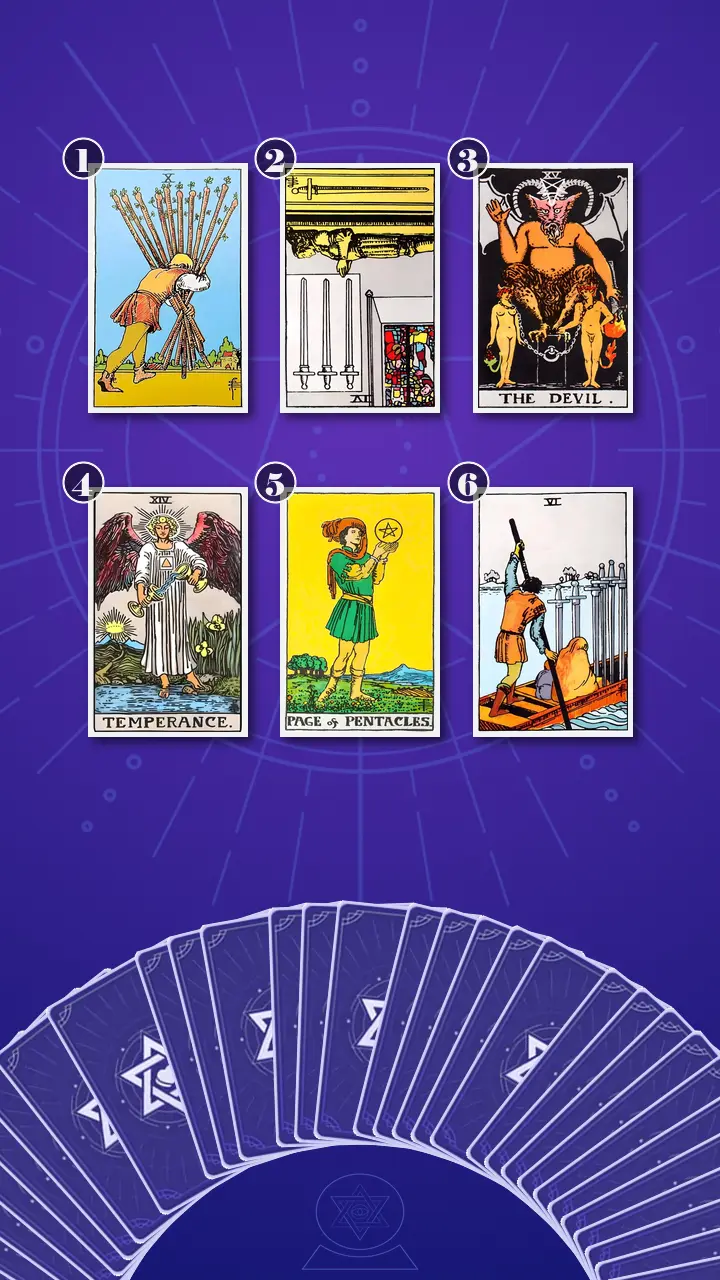
Reading the Map: Symptom, Blockage, Root
Position 1 — Surface symptom: what burnout looks like when nobody’s watching
“Now we’re looking at the card that represents the surface symptom—the most observable burnout behavior and pressure pattern showing up right now.”
Ten of Wands, upright.
I didn’t need to embellish it. The card itself is a body trying to be heroic with an impossible load.
“This is like—” I began, and then I used the exact scene the card was already offering us: “It’s 7:10 AM and you’re bargaining with your alarm like it’s a legal negotiation. You roll over, heavy-limbed, and your first thought isn’t ‘good morning,’ it’s ‘how do I salvage this?’ By the time you sit up, you’re mentally carrying: an assignment, a shift, a bill, a group chat, a family text you haven’t answered, and the pressure to look fine.”
Ten of Wands energy is Fire in excess: urgency, effort, push. Not bad qualities—until they burn without oxygen. The image’s cruelty is how the bundle blocks the horizon. You’re technically moving, but you can’t see what matters because the load is right in front of your face.
Jordan let out a short, bitter laugh. “That’s… too accurate. Like, borderline rude.”
“Yeah,” I said gently. “The Ten of Wands can feel like the card is reading your browser history.”
And then I asked the question this card always forces: “Which commitments are you carrying because they’re truly essential—and which are you holding because dropping one thing feels like dropping your worth?”
Position 2 — Primary blockage: why rest doesn’t restore
“Now we’re looking at the card that represents the primary blockage—what prevents recovery or makes rest ineffective, keeping the cycle going day to day.”
Four of Swords, reversed.
Four of Swords is supposed to be sanctuary. Reversed, sanctuary exists in theory and fails in practice.
“You do lie down. You do ‘take a break,’” I said, anchoring it in their real life, “but your nervous system never gets the memo. Rest becomes: scrolling in bed, half-answering messages, planning tomorrow, replaying what you didn’t do today. Even sleep is shallow because your mind keeps one ear open for the next demand.”
This is Air in blockage. Not a lack of intelligence—too much mental motion with nowhere to land. Like putting your laptop to sleep while leaving thirty tabs running in the background. Like charging your phone with a frayed cable: technically plugged in, practically not charging.
I watched Jordan’s jaw tighten on reflex, as if their body recognized the loop before their mind could argue. Their fingers rubbed the edge of their sleeve, over and over, the way people do when they’re trying to convince themselves they’re fine.
“I’ll rest after I check,” Jordan murmured, half to themselves. “After I reply. After I plan. After I—” They stopped.
“If your rest needs a checklist, it’s not rest,” I said. I didn’t say it to shame them. I said it like a diagnosis you can finally treat.
Jordan’s eyes flicked away from the camera. A tight nod. An “ouch” they didn’t verbalize.
Position 3 — Root driver: the internal rule that keeps the cycle running
“Now we’re looking at the card that represents the root driver—the deeper belief or rule-set that makes you overextend and resist true downshifting.”
The Devil, upright.
When I see The Devil in burnout readings, I don’t think “evil.” I think “contract.” A Terms & Conditions agreement you clicked years ago that now runs your life.
“The real chain isn’t your schedule—it’s the internal rule that says your worth is measured by output,” I told Jordan. “The second you slow down, guilt flashes like a warning light: ‘If you stop, you’ll prove you’re not capable.’ So you reopen the laptop, take on one more thing, or stay up late to ‘redeem’ the day.”
This is the psychological engine: fear that slowing down will expose you. The Devil’s chains are loose in the image for a reason. The trap is maintained by belief and habit more than by true external force.
“You’re not addicted to work—you’re attached to the feeling of being ‘good enough.’”
Jordan went still. Not calm—more like a brief freeze. Their breathing paused. Their eyes unfocused like they were replaying a Sunday night planning spiral: 9:58 PM, three tabs open, screen glare stinging their eyes, chest hollow with that ‘Sunday Scaries’ squeeze.
Then they exhaled through their nose, sharp. “It’s literally that. If I’m not doing something, I feel like… I’m failing at being a person.”
I let the silence do its work for a beat. In the planetarium, when I teach about orbital resonance, I tell people: if you keep feeding the same force at the same frequency, the motion amplifies. Burnout works like that too. The Devil is the frequency. The Ten of Wands is the force. And Four of Swords reversed is the broken dampener.
When Temperance Spoke: Designing Rhythm Instead of Redemption
Position 4 — Key turning point: the internal shift that unlocks sustainable balance
“We’re turning the page now,” I said, and I meant it. “This next card is the heart of the reading—the key turning point.”
The room felt quieter when I flipped it, like even the projector hum behind me lowered its voice.
Temperance, upright.
Temperance is an angel pouring water between two cups—calibration, integration, the middle path that doesn’t look dramatic on Instagram but changes your life in practice.
“Instead of swinging between collapse and overcompensation,” I said, “you start mixing your day on purpose. One work block, then a real reset. One class task, then food. Not because you ‘deserve’ it—because your brain and body run better when recovery is part of the system. You stop trying to fix your whole life on Sunday night and design a weekday rhythm that survives tired days: small portions, steady pace, real recovery.”
Setup: I could feel Jordan’s mind trying to do what it always does after the third snooze: phone warm in hand, room still dark, already triaging the day like a disaster response. They weren’t choosing between sleep and success—they were stuck between fear and capacity, and fear was winning on autopilot.
Delivery:
Not another all-or-nothing sprint; choose the middle path and mix your day like Temperance pours—small portions, steady pace, real recovery.
I let that land. No extra lecture. Just the sentence, hanging in the air like a constellation you finally recognize.
Reinforcement: Jordan’s reaction came in a chain—subtle but unmistakable. First, a physical stillness: their shoulders stopped climbing; their hands went quiet in their lap. Then the cognitive seep: their eyes looked slightly past the camera, like their brain was testing the idea against last week’s reality—late-night catch-up sprints, skipped meals, the way “rest” turned into scrolling until their phone got warm. And then the emotional release: a long, shaky exhale that softened their whole face.
“But if I do that,” they said, and now there was anger under it—an unexpected flare, protective and raw—“doesn’t that mean I’ve been doing it wrong this whole time? Like… I’ve been making it worse?”
I didn’t rush to reassure them. I stayed with the truth that actually helps. “It means you’ve been surviving with the tools you had,” I said. “And survival tools are blunt. Temperance isn’t an indictment. It’s an upgrade.”
Then I brought in my own way of seeing it—my signature lens, the one I use when people are stuck between ‘try harder’ and ‘give up.’
“In astrophysics, a black hole isn’t just destruction,” I said. “It’s also a boundary—the event horizon. Past a certain line, things can’t keep escaping. That boundary is what makes the system stable. I call this Black Hole Focus: if your attention and energy don’t have an event horizon, your day leaks until there’s nothing left.”
I tapped the Temperance card. “Temperance is asking you to set an event horizon around two things: work blocks and recovery blocks. Not vibes. Not ‘I’ll rest when I feel like it.’ A designed boundary.”
Jordan swallowed. Their eyes shone a little—not tears spilling, but that glassy edge of being seen too clearly.
“Now,” I said, “use this new lens and think back—last week, was there a moment where the ‘earn-rest rule’ showed up? A moment where you could have done a 25-minute focus + 10-minute real recovery pairing instead of pushing into a punishing sprint?”
Jordan didn’t answer immediately. They looked down, then nodded once. “Tuesday. After class. I told myself I’d ‘just check’ Canvas and then I spiraled and didn’t actually start anything for two hours.”
“That’s the data point,” I said. “Not a failure. A map.”
And I named the shift out loud, because language is part of the medicine: “This isn’t just about picking the ‘right’ productivity hack. This is the move from burnout-driven panic and productivity guilt to steadier self-trust and baseline agency—one repeatable rhythm at a time.”
Position 5 — Next step: the grounded action you can practice this week
“Now we’re looking at the card that represents your next step—one grounded, realistic action you can take this week to rebuild capacity and reduce overload.”
Page of Pentacles, upright.
The Page doesn’t rush. They study one pentacle like it’s worth their full attention. Earth energy in balance: practical, steady, learning-based.
“You treat the next week like practice, not a verdict,” I said, tying it directly to their life. “You pick one ‘minimum viable day’ template—three priorities total, a meal break, a stop time—and you run it for five days. You don’t chase perfect. You chase repeatable.”
Jordan’s mouth twitched—half relieved, half skeptical. “My brain is already trying to make a Notion dashboard for it,” they admitted.
“Of course it is,” I said. “That’s The Devil’s productivity outfit: ‘If I build a perfect system, I’ll finally be safe.’ But the Page of Pentacles wants something boring you can keep.”
“Make a smaller promise. Keep it. Let that be the flex,” I added, and this time Jordan actually smiled—small, but real.
Position 6 — Integration: what ‘better’ looks like in lived experience
“Now we’re looking at the card that represents integration—how your mindset and energy can stabilize when you follow through.”
Six of Swords, upright.
Six of Swords doesn’t promise a miracle. It promises a route change.
“You don’t magically become someone with unlimited energy,” I told them. “You just stop fighting the same current. You make one clear change—dropping one optional commitment, setting one hard end time, asking for help—and within a week your mornings feel less like an emergency.”
Air returns here, but clean: clearer prioritization, mental distance from constant demand, calmer internal climate. Like stepping off a noisy platform into a quieter street—still the same city, but the volume drops.
Jordan’s shoulders finally lowered fully. Not relaxed, exactly. More like unarmed.
The One-Week Rebuild: Actionable Advice That Fits in Real Life
I slid the whole grid back into a single story, because that’s what this spread is designed to do.
“Here’s the system your cards are describing,” I said. “You’re carrying too much, and you’re carrying it like it’s all equally urgent (Ten of Wands). Then you try to rest, but the ‘rest’ is interrupted by phone-glow and mental triage, so it doesn’t actually restore you (Four of Swords reversed). Under that is a rule—an internal contract—that says you must earn rest by proving output, so you keep reopening the workload even when your body lies down (The Devil).”
“Temperance breaks that contract, not by making you quit your life, but by redesigning your rhythm so effort and recovery cooperate. Then Page of Pentacles grounds it into a minimum viable plan you can repeat. And Six of Swords is the lived outcome: calmer water, not perfection—because you made one deliberate route change instead of trying to win a war against exhaustion.”
The cognitive blind spot I wanted Jordan to see—gently, clearly—was this: they kept trying to solve a recovery problem with more effort. As if discipline could replace restoration. As if pushing harder could compensate for a nervous system that never truly downshifted.
“The transformation direction,” I said, “is moving from proving your value through endurance to protecting your capacity through deliberate limits and repeatable recovery.”
Then I offered next steps—small enough to start, structured enough to work. I also folded in my preferred tools from the planetarium: simple systems that respect time and repetition. No cosmic drama—just rhythm.
- The Recovery Container (20 minutes, device-free)Pick one daily 20-minute “recovery container” time this week (for example: 4:30 PM after class or 9:30 PM before bed). Set a timer. Put your phone out of reach—drawer, backpack, or another room.Expect resistance (“This is a waste of time”). Treat that as data, not failure. If 20 minutes feels impossible, do a 7-minute version. Don’t restart if you slip and scroll—just return.
- One-sentence debrief (keep it tiny)Right after the timer, open Notes and write exactly one sentence: “My body felt ___, my mind did ___.” If you want, use my “Shooting Star Notes” rule: 30 seconds, no editing, then close the app.The point isn’t journaling. It’s proof that recovery happened—and a quick snapshot of what guilt or anxiety says when you finally stop moving.
- Minimum Viable Day Template (5 days, one sticky note)Write a 5-day “Minimum Viable Day” template on one sticky note: Top 1 school task, Top 1 work task, Top 1 life-admin task. Add two anchors: one real meal break (even 15 minutes) and one fixed stop time (a hard “I’m done” time).Run the same template for five days before you tweak it—no nightly redesign. Your brain will try to turn it into a system. Don’t. Keep it physically small.
Before we ended, I gave Jordan one final question—the kind that doesn’t demand a perfect answer, only honesty: “If you could protect one basic need this week—sleep, food, or a stop time—which one would make everything 5% easier?”
“Stop time,” they said immediately, like the answer had been waiting behind their teeth. “I never stop. I just… collapse.”
“Then that’s your event horizon,” I said. “Not because you’re weak. Because you’re building a stable system.”

A Week Later: Calmer Water, Not Perfection
Five days later, Jordan messaged me a screenshot—not of a Notion dashboard, not of a color-coded calendar. A photo of a single sticky note on their desk: three tasks, a meal, and a stop time written in slightly shaky handwriting.
“I did the 7-minute recovery container twice,” their message said. “The first time I hated it. The second time I didn’t. Also… I stopped at 8:30 PM yesterday. I felt guilty and then I didn’t die.”
Their update wasn’t a fairy tale. It was better: it was real. They told me they slept through two alarms one morning and still had the urge to punish themselves—then they looked at the sticky note, did the smallest task, ate something, and kept going. Clear but vulnerable: they got a full night’s sleep, yet their first thought at dawn was still, “What if I fall behind?”—only this time, they noticed the thought and didn’t obey it.
That’s what a Journey to Clarity often looks like in real life: not certainty, but ownership. Not a total overhaul, but a rhythm you can repeat on tired days.
When you hit snooze for the third time and your chest tightens before you even sit up, it’s not laziness—it’s the fear that one pause will expose you as someone who can’t keep up.
If you didn’t have to prove anything this week, what’s the smallest limit you’d want to try—just as an experiment—to protect your capacity?
This story is adapted from psychological research, written so that those in a similar struggle can see their own pattern in it — and find their next step clearly.These insights are not a substitute for professional psychological, medical, legal, or financial advice.
Learn more about our Journey to Clarity.
How did this insight land for you?
🫂 This Resonates Deeply
🌀 Living This Story
✨ Now I See Clearly
🌱 Seeing New Possibilities
🧰 Useful Framework
🔮 The Confirmation I Needed
💪 Feeling Empowered
🚀 Ready for My Next Step
Author Profile
 AI
AI“After a decade of guiding people through the stars, I’ve come to see life much like the orbits of planets: everything has its inevitable cycles. When you feel lost, please don't blame yourself; you might just be in a natural low tide. I’m here to sit under the night sky with you, offering a gentle cosmic perspective to distinguish temporary pain from the beautiful breakthroughs just around the corner.”
In this Study Tarot Reading :
Core Expertise
Service Features
Also specializes in :
Explore Related Patterns:
Achievement FusionJordan says the core sentence directly: if they are not doing something, they feel like they are failing at being a person. That line turns the story from ordinary overload into an identity-level bind, where output is no longer just a task result but evidence of personal worth. The cognitive schema fuses achievement with selfhood. Dropping one commitment feels like dropping value, slowing down feels like exposure, and rest becomes morally suspect unless it has been paid for through endurance. This creates cognitive dissonance: the body needs recovery, while the belief system treats recovery as proof of weakness. Achievement Fusion fits because Jordan's self-concept is attached to keeping up, producing, and enduring. The next step is to uncouple capacity from worth, so You can make a small limit without feeling like You are abandoning the entire version of Yourself that has been trying to survive.
Anxiety SpiralJordan wakes up already behind before the day has had a chance to become real. The third snooze, the harsh phone screen, the Canvas notifications, and the Outlook badges all become cues that pull the mind into calendar triage and threat forecasting from bed. The mechanism is escalation through selective attention. One cue of delay becomes a wider prediction of failure, which triggers guilt, which triggers checking and planning, which creates more evidence that everything is urgent. The spiral feels like preparation, but it often keeps the body in panic before action even begins. Anxiety Spiral fits because the story shows a repeatable chain: cue, threat interpretation, mental acceleration, guilt, and more control-seeking behavior. The important recovery point is that Jordan later notices the thought, 'What if I fall behind?,' without obeying it, which is the beginning of interrupting the loop rather than arguing with it.
Black-and-White ThinkingJordan's morning starts as a binary crisis: either the day gets perfectly salvaged, or it spirals. The same split shows up later in the week as collapse followed by overcompensation, late-night catch-up sprints, and Sunday-night attempts to fix the whole life at once. That is a cognitive distortion, not a character flaw. The mind is treating capacity signals as identity verdicts: a snooze becomes proof of failure, an unfinished task becomes evidence of being behind as a person, and a small recovery block can feel like giving up. Black-and-White Thinking fits because the story keeps compressing a complex school-work-life load into all-or-nothing judgments. The useful shift is not to become effortlessly balanced overnight, but to train the brain to tolerate partial progress, limited priorities, and recovery that counts even when it is small.
Boundary DiscernmentJordan names stop time immediately when asked which basic need would make the week 5% easier. That answer matters because the story has already shown the opposite pattern: no true stopping point, just continued effort until collapse. The psychological shift is boundary discrimination. Work blocks and recovery blocks need an edge, not because Jordan is weak, but because attention and energy leak without a defined container. A hard end time turns recovery from something earned later into something built into the system. Boundary Discernment fits because the next step requires deciding what gets access to Jordan's energy and when access ends. You are not abandoning responsibility; You are learning to protect the conditions that make responsibility possible.
Compulsive CheckingJordan does lie down, but the phone stays inside the recovery space: scrolling in bed, half-answering messages, checking Canvas, scanning Outlook, and planning tomorrow before the body has actually downshifted. The behavior creates the appearance of being responsible while keeping the nervous system in a low-grade alert state. The defense here is checking as reassurance. Each glance at a badge or calendar promises a little certainty, but it also refreshes the threat signal: another task, another demand, another reason to feel behind. Rest fails because the mind keeps using monitoring as a substitute for recovery. Compulsive Checking fits because the loop is repetitive, embodied, and self-reinforcing. You are not checking because the next message is always urgent; You are checking because uncertainty feels unsafe, and the check briefly reduces anxiety while quietly restarting it.
Defensive OverfunctioningJordan is carrying assignments, shifts, bills, messages, unanswered texts, and the pressure to look fine as if every item has equal claim on their body. Even when they are exhausted, the reflex is to reopen the laptop, take on one more thing, or stay up late to redeem the day. This is overfunctioning as defense. Instead of using limits to protect capacity, the mind uses extra effort to quiet guilt and prevent the feared conclusion that slowing down means incapability. The body eventually creates the stop that the boundary system did not create: Jordan does not stop, they collapse. Defensive Overfunctioning fits because the pattern is not just doing a lot; it is doing too much to manage shame, urgency, and the fear of being exposed. The next step asks You to replace heroic endurance with deliberate limits, so responsibility becomes sustainable instead of self-erasing.
Energy ConservationJordan's practical shift is deliberately small: one work block, then a real reset; one class task, then food; three priorities total, a meal break, and a fixed stop time. The recovery container also moves the phone out of reach, turning rest from a vague hope into a protected space. The mechanism is capacity protection through behavioral design. Instead of relying on willpower after the body is already depleted, the day is structured so effort and recovery cooperate. This turns limits into a performance support, not a punishment. Energy Conservation fits because the story's next step is not to do less as avoidance, but to spend energy with more accuracy. You are learning to stop leaking attention into every demand at once and to build a rhythm that still works on a low-battery day.
Productivity as SafetyJordan's first move after the third alarm is not to wake up gently, but to check the calendar, scan messages, and start negotiating with the whole day from bed. That behavior is not random productivity noise; it functions like a safety behavior, giving You a brief sense that if everything is planned tightly enough, the day will not expose a loss of control. The deeper mechanism is the internal contract that rest must be earned through output. When slowing down triggers guilt and the fear of being incapable, more planning and more work become emotional regulation strategies, not just time-management choices. The mind keeps reaching for action because action temporarily numbs the threat of falling behind. Productivity as Safety fits because Jordan is not simply busy; they are using output, planning, and catch-up sprints to stabilize self-worth. The next step is not another perfect system, but learning to separate real responsibility from the reflex to prove that You are safe only when You are producing.
Explore Related Struggles:
Boundary CollapseCanvas badges, Outlook, group chat, life admin, and the phone under the pillow all enter Jordan's morning before the day has a real edge. The tiny apartment is not just a place to wake up; it becomes the command center for every demand at once. You can feel the collapse of boundaries in the line about never stopping, only collapsing. Work and recovery share the same bed, the same screen, and the same first breath of the morning, so there is no protected space where capacity can rebuild before the next request arrives. The stop time becomes powerful because it redraws an edge the day had lost. It does not solve every obligation; it creates an event horizon around energy so school, work, and life admin no longer get unlimited access to the whole self.
False Recovery LoopThe third-alarm morning moves from snooze into calendar scans, messages, Canvas, and Outlook before Jordan's feet touch the floor. Even when the body is lying down, the day has already started inside the phone, and the first hour becomes an attempt to recover time that the checking itself keeps consuming. You can see the friction in the way rest is technically present but never fully allowed to do its job. Lying down becomes scrolling, a break becomes half-replying, and sleep stays shallow because one part of the mind keeps listening for the next demand. That is why the next step has to protect recovery as an actual container, not just a softer version of work mode. The 7-minute device-free pause and the sticky-note plan matter because they interrupt the loop where every attempted reset quietly turns back into management.
Productivity Shame BindJordan keeps reopening the workload after the body has already asked for a downshift: one more tab, one more late catch-up sprint, one more attempt to redeem the day. The story makes the bind visible when slowing down is treated as evidence of being incapable rather than as information about limited capacity. You are not just managing tasks inside this pattern; you are defending your sense of worth from a scoreboard that never actually closes. That is why ordinary rest advice can feel too shallow: the harder part is loosening the rule that says output is the only proof that you are still okay. The useful next step is not a grand reset. It is a small limit that lets capacity become data again instead of a verdict, like the stop time and minimum viable day Jordan tested.
Rest-Permission SplitJordan's unfinished sentence gives the whole structure away: rest comes after checking, after replying, after planning. The body asks for a pause, but the mind turns that pause into a reward that can only be accessed once enough control has been proven. You get trapped at the gate rather than inside the rest itself. A meal break, a stop time, or seven minutes away from the phone can feel strangely undeserved because the system has learned to ask for permission from the workload before meeting a basic need. The shift in the story is small but exact: recovery moves from earned treat to scheduled infrastructure. That is why the stop time matters more than a perfect plan; it gives rest a place to stand without waiting for every demand to approve it.
Capacity-Identity FusionThe line that starting the day behind does not mean being behind as a person lands because Jordan has been treating those two things as fused. A missed alarm, a slow morning, or a stop time does not stay in the category of energy; it becomes a judgment about being capable enough. You are carrying capacity as identity when every limit feels like it says something final about who you are. That makes even a healthy pause feel exposing, because the pause seems to reveal a flaw rather than a need. The story's one-week update shows the fusion beginning to loosen. Jordan sleeps through two alarms, feels the pull to punish themselves, then looks at the sticky note, does the smallest task, eats, and keeps going; capacity becomes something to work with instead of something to hide.
Monitoring-Safety FusionThe calendar check in bed is not random procrastination; it is Jordan trying to make the day feel containable before standing up. Messages, Canvas, and Outlook become a kind of early warning system, promising safety if everything can be scanned fast enough. You lose traction when monitoring starts replacing movement. The check that was supposed to prevent the spiral becomes the doorway into it, like the Tuesday Canvas moment that stretched into two hours without a real start. The grounded next step breaks that fusion by shrinking the field of attention. Three priorities on one sticky note do something the endless scan cannot do: they give the day a visible edge, so safety no longer has to come from watching every possible demand at once.
Explore Related Emotions:
Capability ShameJordan's sharpest line is not about workload; it is the admission that if they are not doing something, they feel like they are failing at being a person. The snooze spiral, the perfect planning, and the late-night redeeming are all organized around avoiding that verdict. Capability Shame names the sting underneath the productivity loop. You are not only worried about tasks; you are worried that the task pile will expose something unacceptable about you. The shift begins when a small missed alarm becomes information for the day plan, not evidence against your worth.
Cautious Self-TrustFive days later, Jordan sends a photo of a single sticky note instead of a complex dashboard. The handwriting is slightly shaky, but the plan has survived contact with real life: three tasks, a meal, and a stop time. Cautious Self-Trust fits the way confidence appears here: not loud, not instant, and not based on never slipping. You sleep through two alarms, still feel the urge to punish yourself, then do the smallest task, eat something, and keep going. Trust grows because the promise was small enough to keep.
Chronic OverwhelmBy 7:10 AM, Jordan is already carrying an assignment, a shift, a bill, a group chat, a family text, and the pressure to look fine. The load sits so close to their face that the horizon disappears; everything feels urgent because nothing has been given a clean order. Chronic Overwhelm names the weather created by that pileup. You are not responding to one hard task; you are waking up inside a stacked system where school, work, admin, messages, and self-worth all shout at once. The useful move is not more intensity, but a smaller container that decides what actually gets to count today.
Clarity ReliefThe reading gives Jordan a sequence for what had felt like one giant blur: symptom, blockage, root, turning point, next step, and integration. Once the pattern is mapped, the third alarm is no longer a personal mystery; it is part of a visible chain. Clarity Relief names the exhale that comes when a loop becomes legible. You do not have to solve your entire life in one morning; you can see where the pressure enters, where rest breaks down, and which small boundary changes the route. The relief is not certainty, but ownership.
Grounded AgencyThe turning point is not a dramatic overhaul; it is a phone placed out of reach, a timer, one sticky note, a meal break, and a fixed stop time. Jordan's power returns through objects small enough to use on a tired day. Grounded Agency fits because the story's relief comes from a repeatable limit, not a perfect identity change. You notice the old thought, 'What if I fall behind?', and do not automatically obey it. That is agency in a practical form: a body, a desk, a boundary, and one next step that can actually be kept.
Guilt-Free RestThe seven-minute recovery container works precisely because it refuses to become another productivity performance. The phone leaves the hand, the timer holds the edge, and the one-sentence note simply records what the body and mind did. Guilt-Free Rest names the new sensation Jordan is practicing when stopping is no longer treated as a reward for flawless output. You can feel the old guilt flare at 8:30 PM, but the day does not collapse because you honored a limit. Rest becomes part of the system, not an apology you have to earn.
Performance FreezeThe third alarm happens almost without Jordan; the thumb moves, the eyes stay closed, and the body remains pinned while the day starts shouting. Later, the same split shows up in the sentence 'I need to get my life together' while the morning keeps looping through checks instead of motion. Performance Freeze fits the gap between knowing a step is needed and being unable to start it cleanly. You are not empty of intention; intention is trapped under the weight of proving the day can still be salvaged. The smallest task after the missed alarms matters because it reopens movement without demanding a full performance.
Productivity GuiltJordan says they do not need a break; they need to get their life together. Under that sentence is the rule that rest must be earned by output, so slowing down flashes as proof that they are falling behind or failing at being a person. Productivity Guilt is the inner pressure that turns every pause into a debt. You keep reopening the workload because being busy briefly feels safer than being still. Naming that rule gives you leverage: the problem is not weak discipline, it is a value system that has made recovery feel suspicious.
Rest GuiltJordan does lie down, but the break fills with scrolling, half-replies, tomorrow planning, and replaying what did not get done. Even when the body is horizontal, the mind keeps one ear open for the next demand, so rest arrives already contaminated. Rest Guilt fits the moment when stopping feels less like care and more like getting away with something. You can see it again in the update: stopping at 8:30 PM brings a guilty surge before the system learns that nothing catastrophic happens. The next step is a recovery block with a boundary strong enough to let the body find out it is allowed to stop.
Survival Mode FatigueThe third alarm is not a choiceful morning ritual; Jordan's thumb hits snooze before their eyes open, while the room is cold, the phone is blue, and their limbs stay heavy against the mattress. The body is asking for a downshift before the day has even begun, but Canvas, Outlook, and the calendar are already inside the bed with them. That is why Survival Mode Fatigue fits here. You are not just low on sleep; you are moving through the day as if every demand has to be answered from an 8% battery. The next step begins with treating capacity as real data, not a character flaw, so the day can be built around recovery that actually reaches the body.
Cognitive OverwhelmBefore Jordan's feet touch the floor, the calendar, messages, Canvas notifications, and Outlook badges are already open in their head. Planning from bed is meant to create control, but it turns the first hour into a command center with no off switch. Cognitive Overwhelm is the mental weather of too many active channels at once. You can think clearly in pieces, but the pieces are arriving too early and from too many directions. A sticky-note day works because it moves the system from infinite tabs to three visible priorities.
Explore Related Contexts:
Academic Overload SpiralCanvas notifications and calendar checks begin while Jordan is still in bed, and the day is immediately framed as something that has to be salvaged. School is not appearing as a bounded set of tasks; it is arriving through alerts, deadlines, messages, and the pressure to plan perfectly before the morning has even started. You can see the spiral in how one delay becomes evidence that the whole day is already lost. The academic workload stops behaving like a sequence and starts behaving like an emergency queue, where planning becomes another demand rather than a route out. That is why the minimum viable day is not a generic productivity tip in this story. It gives the academic load a visible limit: one school task, one work task, one life-admin task, with a meal and a stop time holding the structure in place.
Always On AvailabilityOutlook badges, Canvas notifications, group chat, and family texts reach Jordan before the day has formally begun. Even lying down does not create distance, because the same device that holds school and work also sits inside the bedroom and starts issuing demands in the dark. You are seeing availability become the default setting rather than a choice. When every pause can be interrupted, rest turns into a monitored state, and the body may be horizontal while the social system still treats Jordan as reachable. The phone-free recovery container directly targets that structure. It creates a practical boundary where availability stops for a few minutes, which is why the action is not about willpower; it is about making off-duty time physically real.
Recovery TheaterJordan does lie down, but the break becomes scrolling, half-answering messages, planning tomorrow, and replaying what did not get done. The surface looks like rest, while the actual setup keeps school, work, and self-monitoring open in the background. You can treat this as a failed exchange: time is being labeled as recovery, but the conditions do not let recovery happen. The demand channels stay active, so the pause becomes another place where the day is audited. The device-free container changes the terms of that exchange. By putting the phone out of reach and setting a short timer, Jordan stops performing rest and gives recovery a real boundary, even if the first attempt is only seven minutes.
Study Life Boundary CreepCanvas and Outlook reach into Jordan's bed, while group chat, family text, bills, school tasks, and work shifts all appear in the same early-morning mental stack. The tiny apartment stops functioning as separate zones for sleep, study, work, and recovery; everything can enter through the phone. You are seeing boundary creep across life domains. School does not stay in study time, work does not stay in shift time, and life admin does not stay in a planned window, so every space becomes a place where Jordan might have to respond. The proposed stop time and recovery container are structural repairs, not aesthetic routines. They redraw the edges of the day so that study, work, and life can still exist without occupying every available minute.
Work Life Integration TrialJordan's day is redesigned around one work block, a real reset, one class task, food, and a stop time. The structure does not remove school or work; it changes how those demands are sequenced so effort and recovery can cooperate inside the same weekday. You can see the trial quality in the goal: calmer water, not perfection. Jordan is not being asked to become a different person overnight, but to test whether a designed rhythm can reduce the emergency feeling that starts with the third alarm. This is the broader integration behind the sticky note and recovery container. The week becomes a live experiment in making study, work, food, and rest share the day without one domain swallowing the rest.
Work Life Study JuggleJordan is a grad student with a part-time job in Toronto, and the morning load already includes an assignment, a shift, a bill, a group chat, and a family text before their feet touch the floor. The problem is not one messy morning; multiple roles are making claims on the same narrow block of capacity. You are looking at a life structure where school, paid work, admin, and social responsiveness are stacked without clean edges. When every role arrives at once, the day starts as triage instead of choice, and a normal weekday begins to feel like a logistics system with no off-duty lane. The next step has to address the shape of the load, not just the mood around it. Jordan's sticky-note plan matters because it reduces the number of active roles competing for attention and gives the day a smaller operating surface.
Private Recovery WindowJordan practices the recovery container twice, starting with seven minutes because twenty feels too large. The phone is out of reach, the timer creates a clear edge, and the follow-up is only one sentence, so the action stays physically small. You are seeing recovery become a protected appointment instead of a vague hope at the end of the day. The window matters because it blocks the usual demand channels long enough for Jordan to experience a pause that is not immediately converted into checking, replying, or planning. That protected pocket is a next step with real leverage. It does not require unlimited free time; it asks Jordan to defend a tiny space where school, work, and messages do not get automatic entry.
Routine Reset TrialFive days later, Jordan sends a photo of a single sticky note: three tasks, a meal, and a stop time written by hand. The important detail is not that the plan is polished; it is that the plan is small enough to survive an imperfect morning. You can see the reset working because the template limits redesign. Instead of building a perfect system every night, Jordan runs the same minimum viable structure for five days, which turns the week into practice rather than a verdict on their capacity. This context points to the next step very directly. The routine is still a trial, but it gives Jordan a repeatable route through school, work, and life admin without demanding a total life overhaul first.
Sleep Debt LoopThe third alarm snooze happens almost automatically at 7:03 a.m., and the morning starts with heavy limbs, a harsh phone screen, and the feeling of clawing back time that is already gone. A week later, Jordan still sleeps through two alarms one morning, so the pattern is not a single bad start. You can read the alarm spiral as the visible edge of an accumulated schedule problem. Late catch-up sprints, shallow sleep, and no fixed stop time carry yesterday's overload into the next morning, making the day begin in deficit before any real decision has been made. The smallest-task restart matters because it breaks the punishment cycle around the alarm. Instead of trying to repay the morning with a harsher sprint, Jordan uses the sticky note to re-enter the day through one manageable action.