Why Life Only Feels Real on Weekends: The Sunday Night Grid
If Monday's first Teams ping drains your personality faster than the TTC gets you downtown, I can usually feel the shape of the reading before the cards even touch the table.
Taylor sat across from me and said, "I can get through the week, but I do not feel like myself in it." Then she described 7:42 p.m. on a Sunday at her small kitchen table in Toronto: dragging blocks around Google Calendar while the fridge hummed, streetcar brakes hissed outside, and the screen light made everything look colder than it was. From the outside, the week looked handled. From the inside, it felt like she went missing in it.
Her question - why does my life only feel like mine on weekends? - was really a collision between two forces. She wanted weekdays to feel self-directed and alive, but she was also afraid that if she loosened her grip on obligations even a little, she would fall behind and be the one who looked careless. I told her what I tell a lot of people quietly living for the weekend: a full calendar can still feel like absenteeism from your own life.
The feeling in her was not dramatic. It was more like carrying a bag of wet laundry in her shoulders from Monday to Friday: jaw locked, chest dull, every ordinary task just a little heavier than it should be. I met her there, without trying to clean it up. "That does not sound like laziness or ingratitude," I said. "It sounds like a pattern that has gotten very good at borrowing your life. Let me help you draw a map for it, and see where your weekdays stopped feeling like yours."

Choosing the Five-Card Cross for Work-Life Clarity
I asked her to wrap both hands around her tea, take one slower breath, and hold the question without trying to solve it yet. Then I shuffled. For me, that moment is not mystical theater. It is a focusing tool - the point where spiraling thoughts become observable patterns.
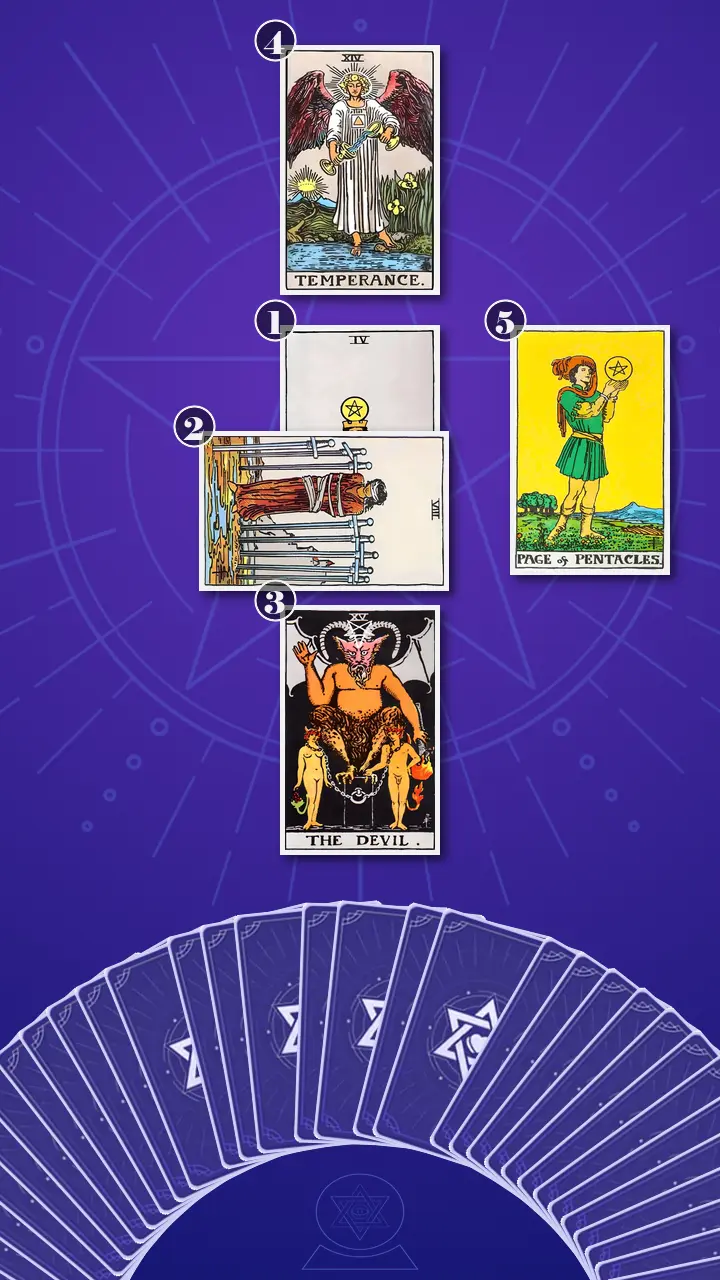
I chose a Five-Card Cross tarot spread for reclaiming weekday ownership. I did not need the full machinery of a Celtic Cross here. This was not ten separate problems. It was one self-reinforcing chain. The Five-Card Cross is ideal when someone feels stuck in Monday-to-Friday autopilot, because it shows the present symptom at the center, the active blockage crossing it, the deeper root underneath, the guiding shift above, and the grounded direction that can follow. This is how tarot works best in my practice: not as fate, but as a clean structure for seeing why weekdays feel like borrowed time and what can make them feel like yours again.
I told her what I would be looking for. The center card would show the visible pattern. The crossing card would reveal the belief making the week feel predetermined. The lower card would show the deeper contract underneath it. The upper card would point to the turning point. And the card to the right would show what ordinary life could start to look like if she practiced the shift in a realistic way.
Reading the Pressure Point
Position 1: The Weekday Life Held Too Tightly
I turned the center card first. This position presents the visible symptom from the diagnosis: why weekday life feels guarded, reduced, and emotionally unavailable. The card was the Four of Pentacles, upright.
It was exact. This is the card of holding so tightly that protection starts to harden into paralysis. I saw her Wednesday night immediately: takeout cooling in the container, Netflix half-playing, work chat still glowing on her phone. In modern life, the Four of Pentacles looks like guarding your time so defensively that even free hours become storage space instead of lived experience. Like keeping every browser tab pinned because you are afraid to lose something, then wondering why the laptop runs hot all day.
Energetically, this was excess earth - too much bracing, too much containment, too much survival mode. She had learned to conserve energy by sealing herself off, but weekday control is not the same thing as weekday ownership. Protecting her capacity had quietly turned into shrinking her life. She kept telling herself, "I just need to get through the week," and the week, obediently, stopped asking who she was inside it.
Taylor gave a short laugh with a bitter edge. "Okay," she said, looking down at the card, "that is so accurate it feels a little rude." Her fingers stayed around the mug like she had forgotten to unclench them.
Position 2: The Calendar That Looks Decided Before You Touch It
I laid the next card across the first. This position reveals the active blockage: the belief or mental stance that makes weekdays feel predetermined and hard to reclaim. The card was the Eight of Swords, upright.
This is what happens when the week becomes a story before it becomes a reality. The modern scene is brutally familiar: opening Monday's calendar and deciding the whole week is already gone before checking what can be renegotiated, delayed, shortened, or done differently. The blindfold on the card is not stupidity. It is habituation. The loose ropes matter. The gaps between the swords matter. There are real constraints, yes - but not every rule she was obeying was an actual law.
Here the energy shifted into blocked air: overthought, fixed, pre-decided. Like living on default settings you never chose but keep obeying. I asked her, "Which weekday rule do you follow automatically before checking whether anyone even asked for it?"
She stared at the spread for a moment, then rubbed her thumb over the paper sleeve of her cup. "Keeping Teams on through dinner," she said. "Also assuming weeknights are useless for anything that matters. I do not even test it. I just... comply." I nodded. That was the point of the card: not blame, but the first clean split between fact and assumption.
Position 3: The Contract Beneath the Green Dot
I turned the card below the center. This position uncovers the root mechanism: the deeper fear and shadow contract tying control, worth, or safety to constant weekday usefulness. The card was The Devil, upright.
I never read The Devil as doom. I read it as the contract nobody remembers signing. In Taylor's life, it looked like answering a non-urgent message from the grocery line before the cashier had scanned the first item, or replying from the TTC platform because being the reliable one felt safer than leaving a pocket of uncertainty untouched. The chains on this card are the crucial symbol. Some obligations are real. But some of the bondage is maintained by fear-based loyalty to approval, predictability, and the idea that usefulness is what keeps you safe.
When I see a work-life reading compress like this, I do not think in moral terms. I think in celestial ones. In my head, I had that quick professional flash I have learned to trust: orbital capture. A smaller body circling a force it mistakes for gravity itself. In a Macro-Orbital Projection, this is the moment I stop asking, "What is wrong with you?" and start asking, "What cycle taught you that constant usefulness was the price of stability?" The moment the pattern becomes cyclical instead of personal, guilt begins to loosen.
"This is very Severance," I told her, and she looked up fast. "Not in the sci-fi way. In the split-self way. The weekday version of you has become so optimized for usefulness that the actual person only feels fully present off the clock."
When I asked, "If you left one message until tomorrow morning, what does your mind predict?" she answered too quickly: "That I am careless."
Her reaction came in three small waves. First, her breath caught and stayed there. Then her eyes lost focus, as if a week of commute platforms and grocery aisles had started replaying behind them. Finally she let out a low, chest-deep, "...damn." Her shoulders dropped maybe half an inch.
When Temperance Poured Between Two Cups
Position 4: The Antidote Above the Pattern
By the time I reached the fourth card, the room had gone very still. Even the spoon beside her tea had stopped making noise. This was the guidance position - the key transformation that could dissolve the weekday-weekend split and restore inner ownership. The card was Temperance, upright.
People often search Temperance tarot meaning for work-life balance and expect a lecture about moderation. That is not how I read it. In context, Temperance is the art of composition. One foot on land, one in water. Two cups passing the same water between them. In Taylor's life, it looked like a 15-minute walk after work, one sketchbook page before Netflix, dinner without her chat app open - small moments where reality and selfhood are allowed in the same weekday instead of being assigned to different planets.
At 9:07 on a Wednesday, when the takeout has gone lukewarm and the show is still playing, the emptiest part is not just the busyness. It is how little of the night carries your signature.
You do not need to keep swinging between weekday depletion and weekend rescue; blend one cup of obligation with one cup of self-authored time, the way Temperance turns separate waters into a livable flow.
She went completely still. Her fingers froze on the mug handle. Then I watched the sentence move through her in real time: first the blank blink of recognition, then a flinch of resistance, then color rising into her face. "But if that's true," she said, and there was anger in it for a second, "doesn't that mean I've been doing this to myself?"
"No," I said, and I made sure I said it plainly. "It means a survival strategy has overstayed its season. That is different." I leaned a little closer to the card. "In my work I call this Void Phase Identification. There is often a stretch between one orbit and the next where the old way still owns your reflexes, but the new way has not built muscle yet. It feels blank. Guilty, even. People think that void means they are failing. Usually it means the old arrangement - be useful first, be a person later - has stopped being livable."
Something in her face softened and wobbled at the same time. Her jaw released. Her shoulders sank. And then there was that other feeling I see so often at the real moment of clarity: not just relief, but the slight dizziness of realizing there may actually be a choice. "Your life starts feeling less borrowed when responsibility stops being your whole personality," I told her. She looked down at Temperance again, eyes bright now, and let out a slow breath that sounded almost disbelieving.
I asked, "With this lens, was there a moment last week when this would have changed how you felt?" She nodded before she answered. "Wednesday," she said. "I answered a message while heating dinner. Nobody asked me to do it that second. If I had seen it this way... I think I would have left it and just eaten."
That was the real crossing point of the reading: not from irresponsibility to discipline, but from numb resentment and weekday self-loss toward the first, fragile sense of ownership returning.
Position 5: The Small Practice That Makes the Week Yours Again
I laid the final card to the right. This position shows the integration path: what daily life begins to look and feel like when self-directed time is practiced in small, practical ways. The card was the Page of Pentacles, upright.
I love seeing the Page here because it refuses drama. This card never says, "Reinvent your life by Monday." It says: learn a new relationship to time the way you would tend herbs on a condo windowsill - small, unglamorous, alive because you keep showing up. In Taylor's life, that meant one concrete midweek ritual that served her life rather than her performance. A recurring block called Mine. Walking shoes by the door. A notebook by the kettle. The pentacle is held with full attention because what changes the week is not grandeur; it is valuation.
This was balanced earth instead of defensive earth. Structure, but now as a container rather than a cage. If rest only counts on weekends, the weekend has to carry your whole personality. The Page offered something gentler and more sustainable than that.
"This does not have to be impressive to count," I said.
She smiled for the first time without that bitter edge. "That," she said, "I can actually do."
From Borrowed Time to a Weekday Ownership Pocket
When I stepped back from the whole Five-Card Cross, the story was clean. The Four of Pentacles showed the symptom: weekdays held so tightly they stopped feeling lived. The Eight of Swords showed the blockage: the week treated as fixed before it was examined. The Devil showed the root contract: usefulness mistaken for safety, availability mistaken for worth. Temperance opened the valve. The Page of Pentacles gave that opening a real shape. This was never just about being busy. It was about renting out her own calendar five days a week and calling the numbness adulthood.
The blind spot was subtle but powerful: she had been mistaking control for ownership, and treating any unclaimed weekday space as morally suspicious. The transformation direction was equally clear. She did not need a dramatic reset, a new personality, or a better life by next quarter. She needed one protected, non-productive, self-directed pocket inside an ordinary weekday, so responsibility and selfhood could finally share the same day. Start smaller than a reset: protect one pocket that does not have to produce anything.
Because vague moods are easy to dismiss, I layered in one of my own practices as well: Cosmic Redshift Observation. For one week, I wanted her to notice what was redshifting - fading, draining, pulling her farther from herself - and what was blueshifting - approaching, warming, quietly feeling more like home. Clarity gets easier when resentment becomes data.
- Protect the Mine BlockBefore Tuesday ends, open Google Calendar and block 5 to 15 minutes on Wednesday or Thursday labeled "Mine." Put Teams or Slack on Do Not Disturb for that exact span. Use it for one non-productive thing with a sensory anchor: sketch one page, walk one block without audio, sit with tea by the window, or listen to one song without multitasking.If 15 minutes feels too exposed, make it 5. The first voice saying "this is too small to matter" is the old pattern, not the truth.
- Test One Invisible RuleWrite down one weekday rule you treat as absolute - "I have to answer immediately," "weeknights are for chores only," or "I cannot do anything meaningful after work" - and run one low-risk experiment this week. Delay one non-urgent reply by 30 minutes, or take one commute home without checking work chat. Then notice what your mind predicted would happen and what actually happened.Keep the stakes low and reversible. One delayed reply is enough. One protected commute is enough.
- Anchor the Transition HomePick one existing transition point - closing the laptop, getting off the TTC, or putting dinner in the microwave - and attach the same 10-minute ritual to it on two weekdays only. Change out of work clothes immediately, take a phone-free lap around the block, light a candle and open the sketchbook, or make tea before any screen. After each ritual, use Cosmic Redshift Observation in Notes: one line for what felt farther away from you, one line for what felt closer.Choose the easiest version, not the most impressive one. You are building contact with your own life, not auditioning for a better personality.

A Week Later, the Quiet Proof
A week later, Taylor sent me a screenshot of her calendar. Between two gray work blocks on Thursday evening was a small lavender square labeled Mine. Twelve minutes.
"I almost deleted it twice," her message said. "Instead I got off the TTC, walked one block without audio, and made tea before opening anything. It was weird. Then good. Then weird again." A minute later she sent another line: "Also, I left one non-urgent message until morning and literally nothing exploded."
That was enough. Not a new life. Not a cinematic breakthrough. Just proof. The week had started carrying her signature again.
That is what this kind of tarot reading can do at its best. It does not rescue anyone from reality. It helps me name the pattern clearly enough that the person sitting across from me can choose differently inside it. Taylor did not need the cards to save her Tuesday. She needed a mirror, a structure, and one doable next step - and then she did the rest.
When every weekday hour has to prove you are responsible, even a quiet Tuesday can make your shoulders rise like you are about to be caught doing life wrong. If that feeling lives anywhere in you tonight, remember: noticing the old contract is already a form of movement.
If one small part of this week did not have to pay rent to usefulness, where would you place it?
This story is adapted from psychological research, written so that those in a similar struggle can see their own pattern in it — and find their next step clearly.These insights are not a substitute for professional psychological, medical, legal, or financial advice.
Learn more about our Journey to Clarity.
How did this insight land for you?
🫂 This Resonates Deeply
🌀 Living This Story
✨ Now I See Clearly
🌱 Seeing New Possibilities
🧰 Useful Framework
🔮 The Confirmation I Needed
💪 Feeling Empowered
🚀 Ready for My Next Step
Author Profile
 AI
AI“After a decade of guiding people through the stars, I’ve come to see life much like the orbits of planets: everything has its inevitable cycles. When you feel lost, please don't blame yourself; you might just be in a natural low tide. I’m here to sit under the night sky with you, offering a gentle cosmic perspective to distinguish temporary pain from the beautiful breakthroughs just around the corner.”
In this Direction Tarot Reading :
Core Expertise
- Macro-Orbital Projection: Mapping your personal confusion and stagnation to inevitable long-term planetary cycles, removing personal guilt.
- Void Phase Identification: Locating the current 'void' or transitional phase in your life, recognizing it as a necessary prelude to the next major trajectory shift.
Service Features
- Cosmic Redshift Observation: A 1-week tracking exercise to log 'fading' interests (redshift) and 'approaching' signals (blueshift), bringing objective clarity to your next orbit.
Also specializes in :
Explore Related Patterns:
Productivity as SafetyTaylor answers from grocery lines, keeps work access alive through dinner, and describes a weekday self that is optimized for usefulness while the actual person only feels fully present off the clock. The pattern is not simply that she has a busy job. It is that usefulness has become the emotional proof that she is safe, responsible, and not at risk of being judged careless. When productivity becomes a safety signal, your calendar can look handled while your inner life goes unattended. You may keep performing reliability because it lowers immediate anxiety, but the cost is that weekdays stop containing enough of your own desire, preference, and sensory presence to feel like yours. The weekend feels real because it is the only time the safety contract loosens. Seeing Productivity as Safety turns the problem from a vague mood into a specific coping loop. The work is not to become irresponsible, but to stop making usefulness the entry fee for having a self.
Workplace HypervigilanceTaylor keeps Teams on through dinner, replies from the grocery line, and lets the green dot travel with her onto the TTC platform. These details show more than conscientiousness. They show a nervous system scanning for the risk of being seen as unavailable, slow, or careless. Workplace Hypervigilance makes ordinary off-hours feel psychologically occupied. You may be sitting at your own kitchen table, but part of your attention is still monitoring the workplace field for signals, judgment, or possible consequences. The body stays braced because delayed response has been coded as danger, even when the message is not urgent. This explains why the week can drain your personality before anything dramatic happens. The constant monitoring keeps you near work even when you are technically away from it, so the weekend becomes the first space where your attention can stop standing guard.
Boundary DiffusionThe work chat glowing beside takeout, the reply from the grocery line, and the commute that still carries workplace access show Taylor's personal time being entered without a clear threshold. The problem is not only that work exists after hours. It is that the boundary between being reachable and being available has become blurred. Boundary Diffusion turns private space into semi-public space. You may be home, commuting, eating, or trying to watch something, but your attention remains open to other people's claims. Over time, this makes weekdays feel borrowed because there is no reliable point where your life becomes yours again. The small "Mine" block matters because it gives the boundary a physical shape. Do Not Disturb, one delayed reply, and one protected walk are not dramatic gestures. They are behavioral proof that access to you is not the same thing as ownership of you.
Conditional Self-WorthTaylor's answer comes too quickly when she imagines leaving a non-urgent message until morning. She says it would mean she is careless. That leap turns a small behavioral delay into a judgment about her character, which is the signature move of Conditional Self-Worth. In this pattern, your value feels secure only when you are proving something. You prove that you are responsible, useful, responsive, low-maintenance, or ahead of the next possible criticism. The mind converts ordinary choices into moral evidence, so even a quiet weekday pocket can feel suspicious if it does not produce anything. That is why her weekdays stop feeling like hers. They are not just full of tasks. They are full of tiny auditions for acceptability. The shift begins when a delayed reply can become just a delayed reply, not a verdict on who you are.
Control CopingThe Sunday night Google Calendar grid, the cold screen light, and the instinct to drag the week into manageable blocks show Taylor trying to make pressure observable before it can overwhelm her. Planning itself is not the issue. The issue is that the calendar becomes a defense mechanism that promises control while quietly narrowing the amount of life she can actually feel. Control Coping often starts as a smart response to overload. You tighten the frame, reduce uncertainty, and keep obligations visible so nothing can catch you off guard. But when that strategy overworks, even free time begins to feel like storage space for recovery, chores, or future pressure rather than a place where you can exist. That is why the weekdays feel guarded but not owned. Taylor is not failing at balance because she lacks discipline. She is using control to prevent collapse, and the same control is making the week feel emotionally unavailable.
Guilt ConditioningTaylor nearly deletes a twelve-minute calendar block labeled "Mine" even after deciding to protect it. That tiny hesitation carries a lot of information. The block is small, harmless, and reversible, yet it still activates the feeling that non-productive time has to justify itself. Guilt Conditioning teaches your nervous system to treat self-directed time as a breach of duty. You may know intellectually that one walk, one quiet tea, or one delayed reply is reasonable, but the body reacts as if you are getting away with something. The guilt is not proof that you are wrong. It is the old rule firing automatically. This pattern is central to why weekdays feel less real. If every unclaimed hour has to pay rent to usefulness, there is no neutral space where your own life can simply happen. Naming the guilt as conditioning gives you room to test it instead of obeying it.
Self-AbandonmentTaylor says she can get through the week, but she does not feel like herself in it. That sentence is the clearest evidence that the issue is not just workload. It is the repeated postponement of her own presence until the weekend can finally hold it. Self-Abandonment can look extremely functional from the outside. You answer, organize, comply, keep moving, and appear fine. Inside, the self-directed parts of you get deferred so often that ordinary weekdays start to feel like a version of life you are maintaining rather than inhabiting. The story's turning point is not a grand reinvention. It is twelve minutes labeled "Mine." That small block matters because it interrupts the reflex to disappear from your own day and proves that selfhood does not have to wait until Friday night to be allowed back in.
Boundary DiscernmentTaylor's protected "Mine" block, Do Not Disturb window, and delayed non-urgent reply show a different kind of response from the one that kept her trapped. She does not abandon responsibility. She starts separating real obligation from automatic access. Boundary Discernment is the skill of checking what actually needs you before handing over your time, attention, or nervous system. You are not building a wall against the week. You are creating a clear enough edge that your own life can exist beside responsibility instead of underneath it. This pattern matters because the solution is not a bigger weekend or a total life reset. It is the repeated practice of noticing where access has been mistaken for duty and choosing one small place where your time belongs to you first.
Explore Related Struggles:
Availability-Worth FusionTaylor keeps Teams on through dinner, replies from the grocery line, and answers from the TTC platform before there is proof that anyone needs her that second. The phone does not just interrupt her evening; it keeps a relationship with work active in places where her own life is trying to resume. Availability-Worth Fusion shows up when being reachable starts to stand in for being responsible. You are not simply choosing to answer a message; you are carrying a hidden equation where delay means carelessness, silence means risk, and usefulness becomes the price of staying safe in other people's eyes. That is why one non-urgent message can feel heavier than it objectively is. The struggle lives in the gap between what the situation actually asks for and what your nervous system has learned to treat as proof that you are still acceptable.
Self-Erasure ReliabilityTaylor says she can get through the week, but she does not feel like herself in it. That sentence carries the whole structure: the weekday version keeps functioning, replying, planning, and complying, while the person who wants texture, choice, and aliveness only seems to come back off the clock. Self-Erasure Reliability forms when dependability becomes so practiced that it starts using your life as its fuel. You keep proving that you can handle the week, but the proof requires you to leave less and less room for the part of you that is not performing usefulness. The split-self feeling is not dramatic because it is built out of ordinary scenes: dinner with chat still open, a commute with work still present, a calendar full enough to look respectable. The struggle is that your reliability remains visible while your own signature gets pushed to the weekend.
Boundary Control StrainTaylor sits at the Sunday kitchen table dragging blocks around Google Calendar, trying to make the coming week feel survivable before it even begins. The calendar becomes a grip point: if every obligation is contained, maybe nothing will spill, but the cost is that the week starts to feel held instead of lived. You can recognize Boundary Control Strain in the way protection quietly hardens into containment. The takeout, half-playing Netflix, and glowing work chat are not just ordinary weekday details; they show how even free time gets treated like storage space for recovery, vigilance, and unfinished responsibility. The struggle is not that structure is bad. It is that control has taken over the role ownership was supposed to play, so the week looks handled from the outside while your actual presence inside it keeps shrinking.
Rest-Permission SplitThe lavender calendar square labeled 'Mine' matters because Taylor almost deletes it twice. A twelve-minute walk without audio should be small enough to feel simple, yet inside this pattern it becomes a real test of whether a weekday can hold anything that does not have to produce. Rest-Permission Split appears when your personal time needs a legal defense before it can exist. You may technically have an evening, but the evening does not feel available until it has been justified, protected, minimized, or placed somewhere no one can accuse it of being too much. That is why the weekend carries so much weight. When rest, pleasure, and self-authored attention are only allowed after the workweek has finished extracting proof from you, Saturday and Sunday become less like free time and more like the only place your life is allowed to recognize you.
Explore Related Emotions:
Autonomy Loss DreadTaylor says she can get through the week, but she does not feel like herself in it. That sentence is the center of the emotional map: the problem is not only busyness, but the dread of realizing her weekdays have become externally shaped before she has touched them. You can feel Autonomy Loss Dread when the weekday version of a person becomes optimized for usefulness while the actual person only feels present off the clock. The dread is sharpened by the fact that the rules are partly invisible; she complies before she checks whether the rule was ever real.
Green Dot GuiltKeeping Teams on through dinner and answering non-urgent messages from grocery lines gives Taylor's guilt a visible interface. The green dot becomes a tiny moral sensor: if she can be reached, she feels she should be useful. You can see how the guilt turns availability into a measure of character. A delayed reply is not experienced as a neutral boundary; it briefly reads as carelessness, so the weekday keeps borrowing her attention before she has had a chance to decide what belongs to her.
Cautious AutonomyTaylor leaves one non-urgent message until morning and discovers that nothing breaks. The act is small, almost boring from the outside, but inside the pattern it becomes a clean test of whether she has to keep obeying every invisible rule. You can feel Cautious Autonomy in the modest scale of the experiment. It does not need to be loud or defiant; it begins as a careful return of choice, one low-risk boundary at a time, until the weekday starts to include her again.
Emotional NumbnessCooling takeout, half-playing Netflix, and a glowing work chat make Taylor's Wednesday night feel physically present but emotionally under-lit. Nothing dramatic is happening, which is exactly why the numbness can hide inside the normal shape of adulthood. You can feel Emotional Numbness in the gap between having free hours and being unable to inhabit them. The night exists, the room exists, the food exists, but very little of it carries her; the weekday becomes a container with the feeling drained out.
Grounded AgencyThe lavender square labeled Mine sits between two gray work blocks, and Taylor keeps it. Twelve minutes, one block without audio, tea before opening anything: the change is grounded enough to survive contact with a real Thursday. You can feel Grounded Agency because the insight turns into evidence. The week does not become perfect; it becomes touchable, adjustable, and partly authored again, which is the exact kind of proof a self-owned life can build on.
Hollow ControlThe week looks handled from the outside: calendar blocks, replies sent, dinner managed, work chat monitored. From the inside, Taylor describes something much emptier, as if she has control over the grid but not ownership of the life inside it. You can feel Hollow Control in that split between order and presence. The structure is doing its job, but it is not carrying her signature; it keeps the week smooth enough to survive while quietly removing the sense that she is the one living it.
Self-Betrayal AcheThe weekday version of Taylor has become so optimized for usefulness that the actual person only feels fully present off the clock. When she says she does not even test whether weeknights can hold anything meaningful, the ache comes from realizing how much of herself has been pre-emptively surrendered. You can feel Self-Betrayal Ache as the private hurt underneath the efficient week. It is not self-blame; it is the moment you notice that your calendar has been rented out in small increments, and some part of you has been waiting for permission to come home.
Sunday ScariesAt 7:42 p.m. on Sunday, Taylor is dragging blocks around Google Calendar while the fridge hums and the screen light makes the kitchen feel colder. The week has not started yet, but her body is already negotiating with it, treating Monday as something that will take her offline from herself. You can recognize Sunday Scaries here as more than a dislike of the workweek. The calendar becomes a preview of disappearance: the next five days look organized, but they do not look inhabited, so the final Sunday hours carry the pressure of a life about to become unavailable.
Survival Mode FatigueFrom Monday to Friday, Taylor's jaw locks, her chest goes dull, and her shoulders carry the week like wet laundry. She is still functioning, still replying, still moving through dinner and transit, but the body language says the week is being endured rather than lived. You can feel Survival Mode Fatigue in the way every ordinary task becomes slightly heavier than it should be. The system is not collapsing; it is conserving, bracing, and narrowing, which is why the weekend feels like the first place where your personality can come back online.
White-Knuckle SecurityTaylor's fingers stay wrapped around the mug as if unclenching would cost her something. The same grip appears in the calendar, the work chat, and the way free hours become storage space instead of lived experience. You can read White-Knuckle Security as the body trying to stay safe by staying tight. The grip does provide structure, but it also makes the weekday smaller, until security is purchased with the very aliveness it was supposed to protect.
Guilt-Free RestTea before screens, a phone-free walk, dinner without the chat app open: Taylor's rest becomes sensory and specific. It is not a vague promise to relax later; it is a small pocket where the body is allowed to stop auditioning for usefulness. You can feel Guilt-Free Rest in the way the weekday begins to hold a non-productive moment without needing to erase it. The relief is quiet because it is still new, but it gives the nervous system a different kind of data: existing without output can still count as part of a responsible life.
Rest GuiltThe small Mine block is only twelve minutes, and Taylor almost deletes it twice. That tiny hesitation shows how charged rest has become: even a short, non-productive pocket has to defend its right to exist. You can hear Rest Guilt in the prediction that one delayed message will make her careless. Rest is not experienced as recovery; it is experienced as evidence that might be used against her, so the first act of ownership has to pass through a wave of moral discomfort.
Explore Related Contexts:
Adulting Performance PressureTaylor's week looks handled from the outside: the calendar is full, the obligations are tracked, the messages are answered, and nothing appears to be falling apart. Inside that same structure, she describes going missing from her own life, as if competent adulthood has become a role that leaves very little room for the person performing it. Adulting Performance Pressure names the social script underneath the schedule. The issue is not ordinary responsibility; it is the demand to keep proving responsibility so continuously that unclaimed personal time starts to feel suspicious. You can end up treating rest, pleasure, and self-directed weekday moments as things that need permission because productivity has become the default evidence of being a proper adult. That pressure explains the weekend split with unusual precision. Weekends feel like hers because they are less saturated with the need to demonstrate competence in real time. The practical shift is not to become less responsible, but to stop letting responsibility occupy the whole identity slot.
Always On AvailabilityTaylor keeps Teams on through dinner, replies from the grocery line before the cashier has scanned the first item, and answers from the TTC platform because delayed availability has started to read as carelessness. The workday is no longer contained by the office, the laptop, or formal hours; it travels through her phone into the places where ordinary life should have room to happen. That constant reachability gives the week its trapped quality. You are not simply managing messages; you are living inside a response-time regime where every small pause can feel like a reputational risk. The external structure is a workplace communication norm that turns reliability into permanent access. This is why weekends feel more like yours: they are the only part of the week where the availability signal loosens enough for selfhood to come back online. Naming the pattern gives you a sharper lever, because the issue is not whether you are disciplined enough. It is whether your weekday has any protected zone where your attention is not being leased back to work by default.
Notification GuiltWhen Taylor is asked what her mind predicts if she leaves one message until tomorrow morning, she answers too quickly: she would be careless. That single word turns the phone into more than a device. It becomes a small public test of whether she is still responsible enough, attentive enough, and safe from being judged. Notification Guilt fits because the pressure is attached to an external communication environment. Teams, work chat, and non-urgent messages are not neutral interruptions here; they carry an implied standard of immediate proof. You are pulled to respond not because the task is objectively urgent, but because the delay feels socially legible as failure. The week starts feeling less like yours when every alert can draft your attention back into performance. Taylor's later experiment, leaving one non-urgent message until morning and watching nothing collapse, matters because it converts guilt into data. It shows where the rule was real, where it was assumed, and where a boundary can be tested without abandoning responsibility.
Protected Rest BlockTaylor's proof arrives as a small lavender square on Thursday evening labeled Mine. It lasts twelve minutes, and she almost deletes it twice, but she gets off the TTC, walks one block without audio, and makes tea before opening anything. Protected Rest Block belongs here because the story does not resolve through a dramatic escape from work. It resolves through a concrete boundary placed inside an ordinary weekday. The block gives personal time a visible location, a start and end point, and enough protection from work chat to become real rather than aspirational. For you, this context points to the smallest unit of reclaimed agency. A weekday can start feeling like yours again when one pocket of time is not required to produce, respond, optimize, or prove. The block works because it is modest enough to survive the pressure around it and specific enough to interrupt the old arrangement.
Rigid Planning Lock-InTaylor opens Monday's calendar and decides the whole week is already gone before checking what can be renegotiated, delayed, shortened, or done differently. She names the rule herself: keeping Teams on through dinner and assuming weeknights are useless for anything that matters, even when nobody has explicitly demanded that level of compliance. Rigid Planning Lock-In is what happens when structure stops supporting choice and starts pre-deciding the range of possible life. You still have a calendar, tasks, and routines, but the planning system has become a closed circuit. It protects against falling behind while quietly removing the ordinary experiments that could make a weekday feel alive. The key pressure is external because the rules are attached to workplace norms, response expectations, and adult competence scripts. Your agency returns through low-risk tests: one delayed non-urgent reply, one protected commute, one small block that proves the calendar can hold more than obligation.
Sunday Scaries LoopTaylor is at her small kitchen table in Toronto at 7:42 p.m. on Sunday, dragging blocks around Google Calendar while the fridge hums and streetcar brakes hiss outside. The week has not started yet, but her body and attention are already inside it, arranging themselves around the first Teams ping before Monday arrives. That is the loop: Sunday becomes the emotional staging area for a week that feels pre-owned by obligations. The calendar looks handled from the outside, but the act of planning has stopped creating agency and started confirming capture. You can see the whole week before you, yet it feels like there is nowhere in it to stand. This context directly answers why life only feels like yours on weekends. The loss begins before the workweek even starts, at the moment the coming days are treated as fixed, joyless, and already spoken for. The useful opening is not to destroy the calendar, but to test which parts of the grid are real constraints and which parts are inherited obedience.
Work Life Boundary CreepTakeout cools in the container, Netflix half-plays, and work chat keeps glowing on Taylor's phone. The scene matters because the problem is not just a busy calendar; it is the way work remains present inside the small domestic rituals that would normally mark the return to private life. Work Life Boundary Creep shows up when the edges of the workday become so porous that dinner, transit, errands, and evenings are all treated as available space. You can technically be off the clock while still organizing your attention around the possibility of being needed. Over time, that makes free time feel less like freedom and more like a waiting room. The weekend feels different because it gives the boundary a shape that weekdays have lost. Taylor's twelve-minute Mine block is powerful precisely because it redraws one small edge inside the week: for that span, the phone is not the center of the room, and her life does not have to justify itself through work responsiveness.
Workplace Identity FreezeTaylor describes getting through the week without feeling like herself in it. The story sharpens that into a split-self pattern: the weekday version is optimized for usefulness, response speed, and contained competence, while the fuller person only feels present off the clock. Workplace Identity Freeze captures the external role pressure in that split. The workplace does not need to be dramatic or openly hostile for its norms to harden into an identity container. When constant usefulness becomes the safest available role, the rest of the self gets postponed until the weekend, when fewer systems are asking for proof. This context is central because it names the social shape of the question, not just the mood around it. Your life feels like yours on weekends because the weekday role has become too narrow to hold your actual range. The way back starts with small weekday practices that let usefulness become one function among others, rather than the whole person.
Self-Defined Weekly RhythmBy the end, Taylor has two pieces of evidence: she protects the Mine block, and she leaves one non-urgent message until morning without anything blowing up. The week does not become cinematic or perfect; it simply starts carrying her signature again. Self-Defined Weekly Rhythm fits because the shift is about authorship, not aesthetics. Taylor begins testing the invisible rules that made weekdays feel fixed: immediate replies, useless weeknights, dinner with chat open, and the idea that personal time has to wait for Saturday. Those tests create a rhythm based on observed reality rather than inherited compliance. For you, the value of this context is its groundedness. It does not ask you to reject responsibility or chase an ideal lifestyle. It asks where one repeatable pocket of choice can live inside the real week, so your calendar becomes a container for your life instead of a record of where your life went missing.