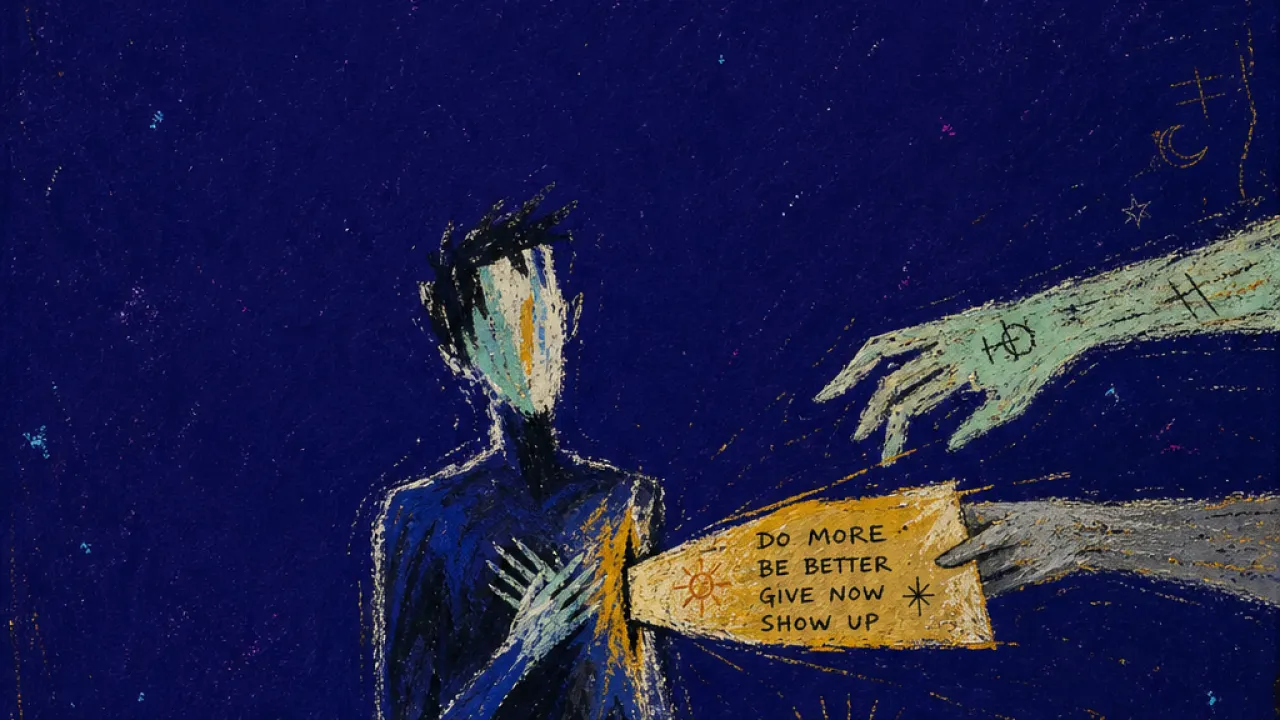
Relationship Boundary Negotiation often shows up when closeness starts arriving faster than the relationship's shared terms can hold it. The tight shoulders, hovering phone, and careful pauses are not random reactions; they point to an environmental and structural dynamic where access, privacy, timing, and consent are still being defined. The Tarot Cards below do not decide who is right or wrong. They mirror the shape of a connection that needs clearer edges before intimacy can keep moving.
Strength UprightThe woman stands close enough to touch the lion's jaw, yet her hands mark a visible limit around its mouth and head. The image is intimate, but not merged; contact is allowed through a clear physical boundary. That is the relational architecture of boundary negotiation. You are looking at a love situation where closeness is increasing, but the structure has to define what can be shared, what needs space, and where desire stops being connection and starts becoming pressure.
Wheel of Fortune UprightThe four winged figures remain in their own corners with open books, while the Sphinx holds position above the wheel instead of being absorbed by its movement. The image is full of motion, but every part also has a defined place. That visual order translates cleanly into boundary negotiation in love. The relationship may be moving, changing, or intensifying, yet both people still need separate positions, readable expectations, and a shared understanding of what belongs inside the connection and what does not. You are not being asked to make the relationship smaller. The card shows that intimacy becomes more stable when each person can stay located while the connection turns, instead of letting every change erase personal limits, privacy, pace, or consent.
Justice UprightThe judge sits between two pillars with arms extended, open enough to receive both sides but contained enough not to dissolve into either one. The robe, throne, curtain, and hall create a protected interior where contact has edges. That physical arrangement mirrors a relationship stage where closeness needs terms. You may be negotiating space, exclusivity, privacy, response time, conflict rules, or how much emotional labor each person can carry without becoming absorbed into the other person's needs. The scales are visible before the sword becomes active, so the image points to boundary work as a process of measurement rather than punishment. The relationship is not asking for a wall; it is asking for a line clear enough that intimacy can stop depending on guessing.
The Hanged Man UprightThe crossed leg forms a deliberate triangle inside a posture that would otherwise look unstable. The body is restricted, but the restriction has shape: one axis, one frame, and one visible limit. That is the relational signature of boundary negotiation. You are not only dealing with distance; you are dealing with the rules that decide how close love can get before someone needs space, definition, or a slower pace to stay present.
Death UprightThe figures before the horse do not share the same posture, power, or distance from the central movement. The card makes boundary visible as spatial fact: some bodies are too close, some are exposed, some are negotiating, and the rider's path draws a hard line through the field. In a relationship, that pattern points to the work of naming access, limits, privacy, repair, and emotional responsibility before the connection can move without trampling someone. You gain agency here by seeing that the problem is not only feeling misunderstood; the relationship may lack a shared map of where each person's boundary actually begins.
Temperance UprightOne foot rests on stone while the other enters water, giving the body two kinds of contact without collapsing them into one surface. The cups repeat that logic: connection is real, but each vessel still has its own edge. You may recognize this as the work of defining closeness without surrendering all private ground. The card links boundary negotiation to a relationship that needs access, tenderness, and space to be held as part of the same system rather than treated as competing demands.
The Star UprightOne knee rests on solid ground while one foot touches the water, and the body stays uncovered without collapsing into the pool. The posture is intimate, but it is not shapeless; it holds contact and separation at the same time. In relationship boundary negotiation, You are not choosing between closeness and distance as total opposites. The Star shows a living edge where privacy, honesty, space, care, and availability have to be distributed deliberately, so the relationship can stay open without leaking into self-erasure.
The Sun UprightUnder the full sun, the child is completely visible, but the stone wall still cuts a firm line across the garden. The image does not treat openness as boundarylessness; the wall is what lets the sunflowers grow without being trampled by the entire outside world. In love, that structure maps onto the stage where closeness has become real enough to require terms. You can be warm, honest, and emotionally available while still naming what stays private, how much access a partner has, and where individual space remains intact.
The World UprightThe nude figure is visible at the center, yet the scarf and wreath create a clear boundary around what is exposed and what remains held. The card makes openness and containment happen in the same image. That is the practical logic of boundary negotiation in love. You can be emotionally present without handing over every private space, and the relationship becomes healthier when its container is consciously shaped instead of silently assumed.
Ace of Cups UprightThe cup is open, but its rim is unmistakable; the hand supports it lightly instead of gripping it shut. The image shows intimacy held through a boundary, not through unlimited access. You may be negotiating how close love can get before it stops feeling chosen. The visual logic of the card makes the boundary itself part of the care structure: without a container, the water cannot remain usable, and without openness, the container cannot become relational.
Two of Cups UprightThe two figures stand close enough for exchange, but their bodies remain distinct. The card does not show fusion; it shows contact across a clear space where each person still has their own footing, posture, and cup. That physical distance is the relationship boundary in visual form. The caduceus rises in the middle as a shared structure, which means the bond has to be held by mutual terms rather than by one person absorbing the other person's needs, pace, or emotional weather. You are looking at a partnership stage where closeness needs architecture. The card connects to boundary negotiation because the relationship can deepen only if connection and separateness are allowed to exist at the same time.
Four of Cups UprightFolded arms, crossed legs, and the shade of the tree form a clear perimeter around the seated figure. The offered cup reaches toward that space, but it does not automatically cross the body's boundary. In love, this image speaks to the negotiation of pace, access, and consent inside emotional exchange. A partner's offer may be genuine, but genuineness does not remove the need for a boundary that defines when contact is welcome, what kind of repair is acceptable, and how much closeness is sustainable. The Four of Cups grounds boundary work in visible structure. You are not obligated to receive every cup just because it is offered; the relationship becomes healthier when access is named instead of assumed.
King of Cups UprightThe throne rests on the sea without sinking into it, and the King's foot reaches toward the water while his body remains supported above the waves. Contact is present, but immersion is measured. That geometry mirrors a relationship where closeness has to be negotiated with real edges. You are not looking at cold distance or total fusion; you are looking at the practical work of staying emotionally available while keeping a boundary strong enough to hold both people.
Two of Pentacles UprightThe arms stretch toward opposite ends of the loop without letting the coins separate completely. That visual tension fits a relationship where closeness is real, but each person still needs a workable radius for friends, work, rest, privacy, and individual identity. The foreground holds a boundary against the moving sea behind it. You are not being asked to choose between love and autonomy; the card shows the practical task of building a container where connection can keep moving without swallowing every other part of life.
Ace of Swords UprightThe hand holds the hilt with a clean grip, close enough to direct the sword but not so close that it touches the blade. That physical spacing is the card's clearest relationship image: contact and separation have to exist at the same time. The double-edged sword gives boundaries their real texture. A boundary is not a mood, a punishment, or a vague wish for better behavior; it is a line that clarifies what can continue and what carries consequence. In love, that line may concern privacy, conflict style, time, sexual pace, ex contact, social media, or emotional availability. The open sky around the sword creates a stripped-down decision field. The relationship is being asked to become more legible, so care does not depend on mind-reading and closeness does not require self-erasure.
Two of Swords UprightWith both swords held across the chest, the image gives boundary a physical form. The woman is not reaching outward, but she is also not unprotected; she has created a perimeter strong enough to stop immediate intrusion while the tide behind her continues to shift. Relationship Boundary Negotiation shows up when love requires a new agreement about access. You may be defining how much space, reassurance, privacy, contact, conflict, or emotional availability the relationship can actually sustain, and the card frames that process as structural calibration rather than rejection.
Four of Swords UprightThe narrow slab, the armor, and the church walls give the resting figure a defined perimeter. The scene does not offer unlimited access to the body; even the swords are held at a distance by the wall, and the only relational image arrives through a separate window. In a romantic context, this points to relationship boundary negotiation where love has to be separated from constant availability. You may be inside a bond that needs clearer rules around space, timing, privacy, and repair, because without those limits every suspended issue can start to feel like a demand for immediate access.
Six of Swords UprightThe boat is small, shared, and clearly edged, while the passengers remain covered and the swords form a visible partition inside the same vessel. The image is intimate without being open; closeness exists, but it is regulated by structure. That is the exact terrain of relationship boundary negotiation. You may still be emotionally connected, but the connection needs clearer rules around access, timing, disclosure, reassurance, or repair. The boundary is not outside the relationship; it is built inside the boat so the crossing can continue without flooding the people inside it. Six of Swords does not make this negotiation theatrical. It shows the quiet mechanics of getting through a difficult passage with enough separation to preserve agency. The relationship becomes workable only when the shared space can hold both connection and limits at the same time.
Eight of Swords UprightThe woman stands within a line of upright swords, but the blades do not touch her and the gaps remain visible. Her white bindings make the limit physical, while her feet still have room to choose a careful next step. In love, that visual structure fits a relationship where closeness cannot mature until boundaries become explicit. You are working inside a perimeter of pace, privacy, access, and emotional responsibility; naming the edge is what turns the enclosure from a silent constraint into a negotiable shape.
Page of Swords UprightThe Page stands alone on a narrow height, open to the wind but not unprotected. His posture keeps a defensible line around the body while still facing the world, which gives the card its sharp boundary intelligence. In love, that visual structure maps onto the moment when access has to be negotiated: how much texting is reasonable, how much privacy is protected, how quickly emotional disclosure should happen, and where reassurance stops being care and starts becoming surveillance. The card does not flatten boundaries into distance; it shows boundaries as the architecture that lets closeness stay workable. Because the terrain is exposed, every boundary choice carries social and emotional visibility. You are not just deciding what to say yes or no to; you are learning whether the relationship can respect a line without treating it as rejection.
Knight of Swords UprightThe knight has no walls around him, so the boundary is carried on the body: armor, reins, posture, and the sword's clean line through the air. Protection is not passive in this image; it is actively maintained while the scene keeps moving. That makes the card especially sharp for romantic boundary negotiation. You may be trying to define what is acceptable around communication, exclusivity, conflict, privacy, sex, time, or emotional availability while the relationship is already in motion. The sword does not create distance for its own sake; it creates a line that can be seen. In this context, the relationship is asking for boundaries that are specific enough to be respected, not implied rules that only become visible after someone crosses them.
Queen of Swords UprightThe Queen's upright sword, extended hand, and sideways throne create a visible threshold: access is possible, but it is not automatic. Her body does not collapse into the other person or turn fully away; it holds a measured distance where speech, consent, and limits can be placed in the open. In a relationship, that image maps onto the stage where affection has to be structured by explicit terms. You may be dealing with questions around privacy, commitment, conflict rules, emotional availability, or what each person is allowed to ask from the other. The card does not frame boundaries as coldness. It shows a relational architecture where closeness becomes safer when the terms of contact are named clearly enough that neither person has to guess their way through the room.
King of Swords UprightThe King’s body stays centered on the stone throne, neither reaching out for approval nor collapsing into the surrounding space. The throne has a high back and a hard edge, making his position feel defined before any exchange begins. That visual structure fits a relationship where love cannot stay healthy without negotiated limits. Privacy, time, access, labels, money, social media, sexual pace, family involvement, or emotional availability may all need clearer terms than the connection has been using. You are being shown the architecture of a boundary rather than a wall. The card points to the part of the relationship that needs definition so closeness can happen without one person quietly losing their position.
Five of Wands UprightFive raised wands occupy the same foreground without giving any body a clean lane through the scene. Each person has enough force to claim space, but not enough shared rhythm to make the field feel settled. In love, that visual pressure maps onto the moment when a relationship needs explicit limits around time, attention, privacy, conflict style, or autonomy. You are not looking at distance for its own sake; you are looking at a shared field that can only stay workable when each person’s position is made visible.
Seven of Wands UprightA lone figure braces one wand against six rising from below, with his feet spread across uneven ground and a narrow stream cutting through the stance. The body is not relaxed or ornamental; it is doing the physical work of keeping a line visible while pressure arrives from more than one direction. That image maps cleanly onto a relationship where a boundary has stopped being theoretical. Privacy, pace, emotional labor, access to time, or the right to say no becomes something that must hold under contact, not something that only exists when everyone already agrees. The higher ground matters because You are not simply reacting from nowhere; there is a position, a value, or a limit already being defended. The card names the negotiation point: whether the relationship can recognize a boundary as part of intimacy rather than treating every limit as rejection.
Nine of Wands UprightThe line of wands behind the figure is not a locked fortress; it is an imperfect boundary with a visible gap. The person standing in that gap shows the physical labor of deciding what can come closer, what must stay outside, and what still needs a clearer agreement. In love, that maps onto the phase where closeness needs rules before it can feel stable. You may be negotiating privacy, pacing, emotional access, ex contact, time alone, repair expectations, or the difference between intimacy and constant availability. The Nine of Wands connects to this context because the boundary is active rather than abstract. The relationship is not defined by distance alone; it is defined by whether both people can respect the line while still choosing connection.
No cards available for this filter.