The Fluorescent Courtroom in the Vitamin Aisle
You walk into Shoppers Drug Mart for a ‘quick’ vitamin run and suddenly it turns into a 20-minute label-reading marathon—with a tight chest, a buzzing stomach, and full-on decision paralysis.
Jordan said it like she was confessing a bad habit—half embarrassed, half exhausted. She was 28, early-career marketing, Toronto. The kind of person whose job trained her to measure everything: engagement rates, campaign lift, what “worked.” Now her nervous system had picked a new dashboard.
She told me about Tuesday night: 8:19 PM, downtown Shoppers. The fluorescent lights had that faint electrical buzz that feels louder when you’re alone. The aisle smelled like shampoo and plastic packaging. Her thumb kept sliding across her phone screen—ingredient list, price compare, a TikTok review, then Reddit, then back to the label like she could brute-force her body into certainty.
“It hits me in my chest,” she said, pressing two fingers lightly right under her collarbone, as if she could find the source code there. “And my stomach gets… buzzy. Like I’m vibrating. And then I’m standing there thinking, If I pick wrong, it means I don’t care about myself.”
Not-enoughness doesn’t always feel like sadness. Sometimes it feels like being stuck under bright lights with a shopping basket in your hand and the sense that you’re taking a pop quiz on adulthood. That aisle can feel like a courtroom: every bottle is evidence, and your worth is the verdict.
I watched her shoulders hover a fraction too high, the way they do when someone is trying to look calm while their body is already in “solve it, solve it, solve it” mode. “I get it,” I told her. “And we’re not going to shame the part of you that wants to take care of yourself. We’re just going to figure out why this moment turns into a trial—and what the next, kinder move is. Let’s draw a map through the fog. Today is about finding clarity, not finding the perfect bottle.”

Choosing the Compass: The Four-Layer Insight Ladder
I’ve spent ten years guiding people through a Tokyo planetarium—teaching them that the sky isn’t chaos, even when it looks like it. Patterns reveal themselves when you stop staring at one star and start tracking the rhythm.
So before we touched the cards, I asked Jordan to take one slow breath with me—nothing mystical, just a nervous-system handoff from “research mode” to “listening mode.” I shuffled while she held her question in plain language: “In the vitamin aisle, why do I feel not-enough—what next?”
“Today, we’ll use a spread I created called the Four-Layer Insight Ladder · Context Edition,” I said. “It’s built for moments like yours—when a specific situation triggers a bigger identity loop. We’ll start with what you do in the aisle, then we’ll trace the trigger, the deeper fear underneath it, the belief that keeps you stuck, and then we’ll find the most stabilizing inner resource—followed by a grounded next step you can actually try this week.”
For anyone reading along, this is how tarot works at its most useful: not as a fortune-telling performance, but as a structured way to name the pattern you’re already living inside—so you can interrupt it. Six cards is enough here. The spiral is fast; the clarity needs to be simple.
“The first card,” I explained, “shows the surface pattern—the observable behavior and felt sense in the aisle. Position three is the underlying fear—the consequence your mind is bracing for. And position five is the pivot—your antidote. That’s where we’ll slow down.”
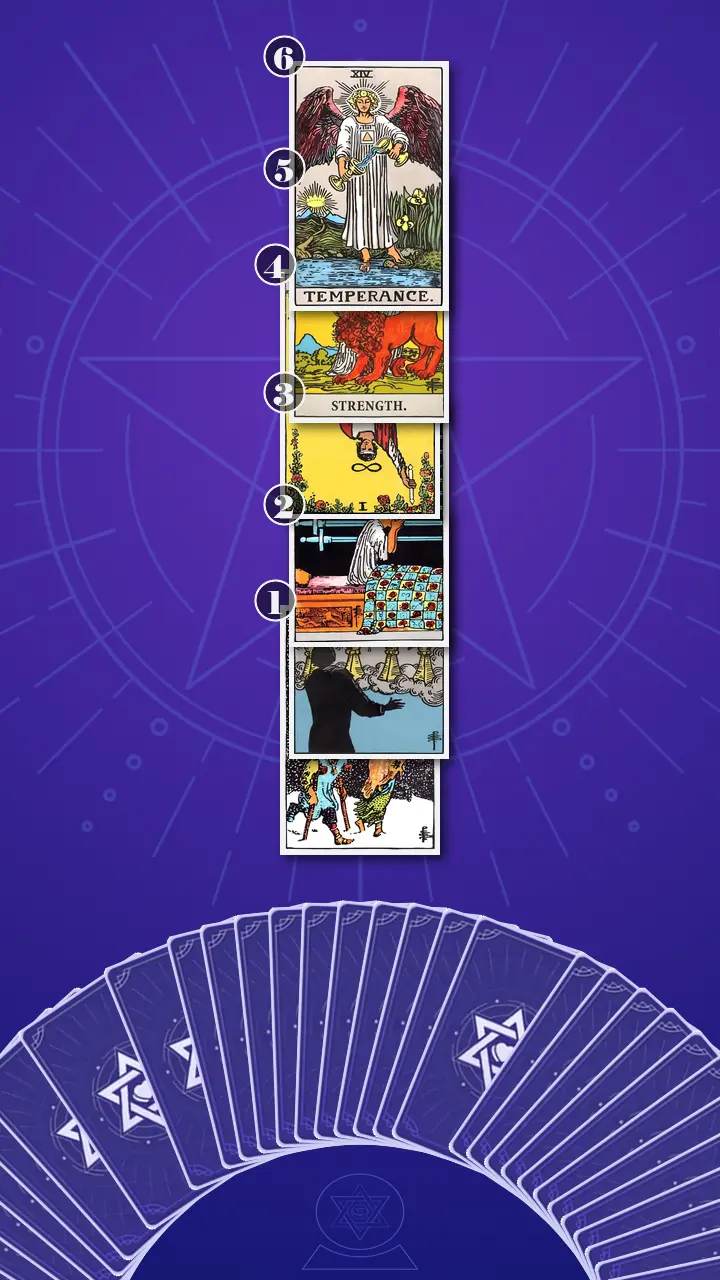
Reading the Map: From Supplement Overwhelm to Self-Trust
Position 1: The “Healthy People Club” Feeling
“Now we’re turning over the card that represents the surface pattern: the specific, observable behavior and felt sense that shows up in the vitamin aisle,” I said.
Five of Pentacles, upright.
I didn’t need to dramatize it; the image did that on its own—two figures limping through snow, a warm stained-glass window nearby, light they can see but somehow can’t enter.
“I’m going to say this in the most modern way I can,” I told her, and I deliberately used the exact language her body already recognized: “You’re in the vitamin aisle and it feels like everyone else got a secret syllabus for ‘being healthy.’ You’re surrounded by options, but inside it’s winter: tight chest, restless stomach, and that quiet thought—‘I’m behind.’ You read labels like you’re trying to earn entry into the ‘healthy people club,’ even though help (a simple plan, a pharmacist, a basic routine) is right nearby—just not emotionally available in that moment.”
Five of Pentacles energy is deficiency—not in vitamins, but in belonging. It’s “I’m on the outside.” And in a store designed to sell solutions, that feeling gets turned into, “I need to buy my way back into safety.”
Jordan let out a short laugh that had no humor in it. “That’s… so accurate it’s kind of mean,” she said, and then immediately looked down at her hands like she’d said too much.
“It’s not mean,” I said gently. “It’s specific. Specific means we can work with it.” I paused. “When the ‘winter’ hits—tight chest, buzzing stomach—what do you think you’re actually needing in that moment? Not the product. The need.”
Her eyes flicked up, then away. “Reassurance,” she said. “Like… permission to not be doing it perfectly.”
Position 2: The Seven Futures That Aren’t Yours
“Now we’re turning over the card that represents the trigger field: what in the environment or messaging activates the spiral,” I said.
Seven of Cups, upright.
“Okay,” I said, and leaned into the echo I knew would land. “The aisle turns into seven different futures at once: sleep gummies, magnesium, probiotics, stress support, collagen—each one pitching a different version of who you could be by next week. Your brain starts scanning like a feed: ‘Maybe THIS is the fix.’ The more you look, the less you can feel what you actually need, because every label is also a mini identity decision.”
Then I gave her the scene the card was already staging in her head: TikTok open, r/Supplements threads, Google snippets, someone confidently saying “this changed my life” with perfect lighting. Each cup a different promise—sleep, glow, calm, productivity—like notifications stacked on top of each other until your brain can’t hear your own body anymore.
Seven of Cups is excess—too much possibility, too much seduction, too many “maybe”s. “This isn’t a personal failure,” I told her. “It’s a designed overload. That’s why you feel like you’re freezing. Your nervous system thinks it’s under threat, not shopping.”
Jordan nodded sharply, like her neck had been holding that sentence back all week. “Oh wow,” she said. “That’s exactly it. It’s like… I’m not even there anymore. I’m in seven imagined timelines.”
Position 3: The 1:13 AM Verdict Loop
“Now we’re turning over the card that represents the underlying fear: the deeper consequence you’re bracing for underneath the shopping decision,” I said.
Nine of Swords, upright.
I felt the room go quieter—not because we were being dramatic, but because this card always pulls the lights down to their truest setting.
“Here’s the modern translation,” I said, keeping my voice plain. “Later that night, you’re in bed with the room dark except for your phone glow, replaying the aisle like a mistake you need to correct. You run worst-case stories: wasting money, messing up your health, proving you’re not disciplined. The decision itself wasn’t the threat—your mind turning it into a moral verdict is.”
Nine of Swords is blockage in the mind—sharp, repetitive thoughts lined up like weapons on a wall. “This card tells me the fear isn’t really, ‘What if I choose the wrong magnesium?’” I said. “It’s, ‘What if this proves I’m careless. What if my body proves I’m falling behind. What if I don’t get a feeling of safety unless I optimize nonstop.’”
Her jaw clenched, then released. That tiny release mattered. “Yes,” she said, quieter. “It’s like… if I’m not constantly doing the best thing, I’m not safe.”
I thought of the planetarium dome—how people panic when they can’t locate true north. In my research life, we look at the Cosmic Microwave Background for a baseline: the background hum that lets you measure everything else. Jordan had no baseline. She was running constant A/B tests on her body with zero control group.
“We’re going to build you a baseline,” I said. “Not a perfect one. A livable one.”
Position 4: When Tools Become a Substitute for Agency
“Now we’re turning over the card that represents the self-sabotaging logic: the belief and coping move that keeps you stuck in analysis instead of care,” I said.
The Magician, reversed.
I exhaled through my nose—not tired, just… recognizing. “This is the card where I’m going to say something blunt,” I told her, because clarity sometimes needs clean edges. “You’re not shopping for vitamins—you’re shopping for certainty.”
I tapped the image: the table of tools—cup, pentacle, sword, wand—everything you could possibly need. But upside down, the posture looked like power misplaced.
“Let’s use the lived version,” I said, and kept it concrete: “You treat supplements like permission slips: ‘Once I get the right stack, I’ll finally feel like I’m taking care of myself.’ So you build mental spreadsheets, chase consensus, and keep moving the goalpost. The aisle becomes a stage where you perform competence—except it never feels like enough proof. You either leave without buying anything (and feel guilty) or buy something fast (and then second-guess it).”
The Magician reversed is deficiency of self-leadership and excess of external authority. It’s outsourcing your nervous system to reviews, brands, and the illusion of consensus.
Jordan’s hand went to her stomach, and I saw the three-step reaction chain land: her breath paused for half a second (freeze), her eyes unfocused like she was replaying a specific aisle moment (cognitive seep), then she swallowed hard and let her shoulders drop a fraction (release). “I literally do the spreadsheet thing,” she said. “Like if I just… pick the correct stack, I’ll finally be the person who has it together.”
“And then it turns into decision fatigue,” I said. “Because you’re asking a bottle to do a job it cannot do: guarantee your worth.”
When Strength Spoke: Meeting the Lion Without Making It a Test
Position 5: The Antidote That Rebuilds Self-Trust
I let my hand hover over the next card for a beat. “We’re about to turn over the most important card in this reading,” I said. “The pivot. The antidote.”
Strength, upright.
For a second, the fluorescent feeling in Jordan’s story—Shoppers, buzzing lights, the sense of being watched—fell away, and the card’s open landscape took over. A woman holding a lion’s jaws, not fighting it, not dominating it. Steadying it.
Setup. I watched Jordan’s face as she tried to fit this into her usual logic. She was still caught in that thought loop: I have to make the right decision. I have to prove I’m responsible. If I don’t optimize, I’m failing. The aisle had become a place where one purchase stood in for her entire relationship with her body.
Delivery.
Stop trying to earn enoughness by picking the perfect bottle; start building enoughness through gentle strength—like the woman who doesn’t fight the lion, she steadies it.
I let the sentence sit between us like a bell tone that keeps vibrating after you’ve struck it.
Reinforcement. Jordan’s reaction came in layers. First, her eyes widened slightly—like she’d been bracing for a harder verdict and got something unexpectedly human. Then her lips parted and she held still, almost too still, as if moving might break the spell. A flush crept up her neck. Her shoulders, which had been perched near her ears, slowly drifted down. Her hands unclenched from an invisible grip.
“But…,” she said, and there it was—an unexpected flash of resistance. Her eyebrows pulled together, and her voice sharpened for a moment. “But doesn’t that mean I’ve been doing it wrong? Like I wasted so much time?”
I nodded. “It can feel like that,” I said. “But I don’t read this as ‘you were wrong.’ I read it as ‘you were trying to create safety with the tools you had.’ The difference now is you get to choose a new method.”
Here’s where my planetarium brain always steps in: “In astronomy, we don’t tell ourselves we’re ‘bad’ because we can’t control the weather. We track cycles. We adjust. Strength isn’t a dramatic overhaul. It’s a steady rhythm.”
Then I brought in my signature framework in the most practical way I know—because Jordan’s issue wasn’t a lack of intelligence; it was a nervous system stuck in chaos.
“I want to offer you something I use with clients who get caught in these fast spirals,” I said. “I call it Pulsar Breathing—syncing your body to a simple, reliable rhythm the way a pulsar keeps time in deep space. When you feel the ‘prove it’ surge in your chest, you do three rounds of: inhale for four, exhale for six. Longer exhale tells your system, we’re not being chased. It’s not spiritual. It’s physiology. And it creates just enough space to lead yourself instead of obeying panic.”
Jordan’s eyes glistened, not in a cinematic way—more like her body was finally allowing water back into a place it had kept dry. She took one long breath, and it looked like a visible exhale through her whole ribcage.
“Now,” I said softly, “use this new lens and look back at last week. Is there a specific moment—on the TTC, in the aisle, in bed at 1:13 AM—where this insight would’ve changed how you treated yourself?”
She stared at the Strength card, then nodded once. “In bed,” she said. “I kept trying to Google my way into calm. I could’ve… just stopped. Put my hand on my chest. Done the breathing. And let the choice be… a choice. Not a verdict.”
“Exactly,” I said. “This is the shift from not-enoughness and fear-driven optimization to grounded self-leadership. Your worth doesn’t rise with optimization; it steadies with self-leadership.”
Position 6: Temperance and the “Good-Enough-for-Now” Protocol
“Now we’re turning over the card that represents next step integration: a grounded action or practice for the next week that makes the shift real,” I said.
Temperance, upright.
“This card is so unsexy,” I told her, and she actually smiled. “It’s the one that works.”
“Here’s the lived translation,” I said: “Instead of swinging between ‘I need a whole new routine’ and ‘forget it,’ you create a balanced plan you can repeat. If you choose a supplement, it’s one choice with a simple time frame (like two weeks) and a check-in—no daily trials, no constant switching. You blend budget reality, actual body feedback, and one steady habit so the aisle stops being a weekly identity crisis.”
Temperance is balance. Measured mixing. One foot on land, one in water. It says: consistency is the flex—not optimization. It also respects the fact that Jordan lives in a high-cost city. Not every caring choice has to be a purchase. And if you do purchase something, it doesn’t get to become your personality.
The Aisle Exit Ramp: Actionable Advice for the Next 7 Days
I stitched the ladder together for her, the way I’d narrate constellations to someone seeing them for the first time: “Here’s the story the spread tells. You walk into a bright place and your body feels like it’s suddenly outside in the cold (Five of Pentacles). The environment throws seven shiny futures at you, like a feed designed to keep you scrolling (Seven of Cups). Underneath, your mind turns a simple decision into a midnight verdict about whether you’re safe or failing (Nine of Swords). The block is that you keep trying to solve self-trust with tools—outsourcing agency to bottles and consensus (Magician reversed). The antidote is Strength: calm, compassionate self-leadership. And the way you make it real is Temperance: one good-enough routine, repeated, not re-decided daily.”
“Your cognitive blind spot,” I added, “is that you’ve been treating research like care. But research is only care when it leads to a livable action. Otherwise it’s just anxiety wearing a lab coat.”
“The transformation direction,” I said, “is exactly what you asked for: shifting from trying to purchase certainty to practicing self-trust through small, consistent care.”
Then I gave her a plan that could survive a real week in Toronto—work, TTC, winter, budget, and all.
- Name the Need (5-minute cap)Before you enter Shoppers (or before you open a new tab), say one sentence out loud: “Today I’m supporting my sleep/stress/energy.” Then give yourself five minutes to look only at that category—no cross-category browsing, no stack-building.If your brain argues “five minutes isn’t enough,” treat that as the Magician reversed talking. Do Pulsar Breathing (inhale 4, exhale 6) once, then start the timer anyway.
- 7-Day Gentle Consistency Rep (no-cost proof of care)Pick one no-cost action you can repeat for seven days: a 10-minute walk after lunch, water before coffee, or a consistent bedtime cue. Check it off once a day—no bonus points for doing extra.If it turns into a perfection test, scale it down to a 2-minute version. Two minutes still counts. The goal is self-trust reps, not performance.
- One Choice + Two-Week Check-In (if you do buy something)If you choose a supplement, choose one (not a stack). Put a two-week check-in on your calendar. Between now and then, you don’t re-decide daily—you only note how you feel.If you want medical guidance, loop in a pharmacist or your doctor. Let a professional handle safety questions so your nervous system doesn’t have to turn it into a moral trial.
Jordan hesitated, then voiced the real-world obstacle—the one that usually kills advice. “But I barely have time,” she said. “I get home, I’m cooked, and then I end up scrolling. Five minutes still turns into thirty.”
“That’s honest,” I said. “So we make it frictionless.” I offered one of my communication strategies, but in her life, not mine: “When you do your seven-day rep at night, put on a neutral background sound—something unglamorous. Even the washing machine. Let it be your ‘cosmic meditation’ track. The point is to give your mind a steady hum so it stops reaching for the next tab.”
She blinked, then laughed—this time with a little warmth. “That’s weirdly doable.”

A Week Later: Ownership, Not Certainty
Six days later, Jordan sent me a message that wasn’t a transformation montage. It was small—and that’s why it mattered.
“Went into Shoppers,” she wrote. “Did the sentence out loud in my car like a dork: ‘Today I’m supporting my sleep.’ Set a five-minute timer. Picked one thing. Left. No Reddit.”
Then: “Still had a moment in bed where my brain tried to put the aisle on trial. But I did the 4/6 breathing, and it got quieter. Slept a full night. Woke up and my first thought was still ‘what if I picked wrong?’—but I kind of smiled. Like… I’m allowed to be a person, not a project.”
That’s the Journey to Clarity I trust: not certainty, but ownership. Not perfect control, but a steadier relationship with yourself—where your body isn’t a problem to debug, and a purchase isn’t a verdict.
We’ve all had that moment under fluorescent lights where your chest tightens, your stomach buzzes, and a simple choice turns into a quiet trial about whether you’re careless—or allowed to be okay.
If you didn’t have to earn ‘enough’ in the aisle, what’s one tiny, steady act of care you’d be willing to try this week—just as an experiment in trusting yourself?
This story is adapted from psychological research, written so that those in a similar struggle can see their own pattern in it — and find their next step clearly.These insights are not a substitute for professional psychological, medical, legal, or financial advice.
Learn more about our Journey to Clarity.
How did this insight land for you?
🫂 This Resonates Deeply
🌀 Living This Story
✨ Now I See Clearly
🌱 Seeing New Possibilities
🧰 Useful Framework
🔮 The Confirmation I Needed
💪 Feeling Empowered
🚀 Ready for My Next Step
Author Profile
 AI
AI“After a decade of guiding people through the stars, I’ve come to see life much like the orbits of planets: everything has its inevitable cycles. When you feel lost, please don't blame yourself; you might just be in a natural low tide. I’m here to sit under the night sky with you, offering a gentle cosmic perspective to distinguish temporary pain from the beautiful breakthroughs just around the corner.”
In this Personal Growth Tarot Reading :
Core Expertise
- Cognitive Spiral Mapping: Validating that feeling 'stuck' is often just a necessary orbital slingshot phase before a major intellectual breakthrough.
- Gravity Well Identification: Diagnosing the obsolete habits or environments exerting a downward pull on your personal evolution.
Service Features
- The Orbit Expansion Strategy: A macro-perspective exercise to map the precise trajectory and momentum needed to escape your current cognitive gravity well.
Also specializes in :
Explore Related Patterns:
Certainty SeekingJordan's thumb cycling from labels to reviews to Reddit and back to the shelf shows a search for a feeling no product can actually provide. You can see the mind trying to brute-force the body into certainty before it allows a simple choice to count as safe. Psychologically, the research ritual functions as a control strategy. It reduces ambiguity for a second, then creates new ambiguity, because every confident review opens another possible timeline and another standard to meet. Certainty Seeking fits because the target keeps shifting from supplement information to guaranteed self-trust. The next move is not less intelligence; it is choosing a small baseline that lets you act without needing total proof.
Emotional RegulationThe moment Jordan uses 4/6 breathing in bed and the aisle trial gets quieter shows the nervous system finding a different lever. You can see her stop trying to Google her way into calm and start creating enough physiological space to lead herself. The mechanism is regulation before evaluation. Longer exhales, a hand on the chest, and a timed decision window do not solve the vitamin question directly; they reduce the threat state that was making the question feel like a verdict. Emotional Regulation fits because the change comes from shifting the body out of "solve it, solve it, solve it" mode before making the next move. The point is not to suppress the fear, but to steady it enough that a choice can be just a choice.
Self-Judgment LoopJordan's sentence, "If I pick wrong, it means I don't care about myself," turns the aisle into a verdict machine. You are not just weighing magnesium against probiotics; you are watching a practical choice get used as evidence against your character. That is the self-judgment loop. A normal uncertainty becomes proof of carelessness, the proof creates anxiety, and the anxiety sends the mind back into more checking, which then confirms that the choice must be dangerous. The week-later line, "I'm allowed to be a person, not a project," matters because it interrupts the loop at the identity level. It lets the decision become a decision again, instead of a trial about whether you deserve to feel okay.
Wellness PerfectionismThe 20-minute vitamin run becomes a courtroom when Jordan treats one bottle as evidence of whether she is taking care of herself well enough. You can see the mechanism in the thought, "If I pick wrong, it means I don't care about myself," because the practical choice is converted into a moral test of worth. The defense strategy is optimization. Reading labels, comparing prices, checking TikTok and Reddit, and building the right stack all promise relief, but they also keep moving the standard for what counts as care. The body is no longer a body to support; it becomes a project that has to prove discipline. Wellness Perfectionism fits because the pressure is not just to buy something healthy. It is the demand to perform being the kind of person who always makes the correct self-care choice. The pattern loosens when care becomes repeatable and good enough, rather than a performance of perfect control.
Analysis ParalysisThe quick vitamin run turning into a 20-minute label-reading marathon makes the freeze visible. You have enough information to make a low-stakes choice, but the nervous system reads the aisle as a threat and keeps demanding one more comparison. Behaviorally, the loop is ingredient list, price compare, TikTok, Reddit, label, repeat. Each pass feels responsible, yet it drains agency until the only outcomes are leaving guilty or buying fast and second-guessing it. Analysis Paralysis fits because thought has stopped serving action. The antidote in the story is not reckless speed; it is a bounded decision container, one need, five minutes, one choice, and a later check-in.
Compulsive CheckingThe phone loop in the aisle is concrete: ingredient list, price compare, TikTok review, Reddit thread, then back to the label. You can feel the checking becoming a ritual, not because Jordan lacks intelligence, but because each source briefly promises relief. The mechanism is a short-term reassurance hit followed by renewed doubt. Checking lowers uncertainty for a moment, then trains the mind to distrust its own baseline unless another source confirms it. Compulsive Checking fits because the behavior repeats across the aisle and the night-time replay, with Google becoming a way to seek calm rather than information. The five-minute cap and no-Reddit follow-up work because they restore a boundary between useful research and anxiety maintenance.
Explore Related Struggles:
Certainty-Safety FusionJordan walks into Shoppers for vitamins, but the choice quickly stops behaving like a normal errand. Her chest tightens, her stomach buzzes, and the question shifts from 'Which supplement fits my needs?' to 'If I choose wrong, does that prove I do not care about myself?' That is the core of Certainty-Safety Fusion: safety is no longer something built through steady care, basic information, and a tolerable choice. It becomes something she tries to earn through total certainty. You can feel the lock in the way she keeps searching for the right answer, because the wrong answer has been loaded with consequences far beyond the bottle. The next move in the story matters because it separates care from certainty. You are not being asked to ignore information; you are being asked to stop making perfect certainty the price of feeling safe enough to act.
Identity Verdict LockThe vitamin aisle becomes a courtroom in Jordan's body. Every label looks like evidence, every review sounds like testimony, and the final choice carries the pressure of a verdict about whether she is responsible, disciplined, and worth trusting. Identity Verdict Lock forms when a practical decision gets converted into a judgment on the self. You can see it in the two bad exits available to her: leave without buying and feel guilty, or buy quickly and spend the night second-guessing. Neither exit releases her because the real trial is not about magnesium, probiotics, or price comparison. The struggle is that one purchase is made to stand in for her entire relationship with her body. The story begins to loosen that lock when she names the choice as a choice again, not a verdict, and allows care to become small, repeatable, and human-sized.
Inner Compass OverloadThe aisle throws too many signals at Jordan at once: sleep gummies, magnesium, probiotics, stress support, collagen, TikTok reviews, Reddit threads, Google snippets, price comparisons, and the buzz of her own body. A quick errand becomes a crowded control room with no single signal trusted enough to guide the next move. Inner Compass Overload is the point where more input stops creating clarity. Every option opens another imagined future, and every future asks her to decide what kind of healthy person she is supposed to become. You can see why she freezes: the task has expanded from buying one thing to selecting an identity under fluorescent lights. The useful shift is narrowing the field before choosing. One need, one category, one short window of attention gives the inner compass room to come back online instead of forcing it to compete with the whole internet.
Internal Authority CollapseJordan keeps moving from label to phone to TikTok to Reddit because each external source seems to offer the authority her own body cannot access in that moment. The right stack is imagined as a permission slip, as if the product can finally confirm that she is taking care of herself correctly. Internal Authority Collapse shows up when agency gets relocated outside the self. Reviews, brands, consensus, and spreadsheets become louder than the simple question of what would be supportive enough for now. You are still trying to care, but the steering wheel has moved into other people's hands. The story's stabilizing move is not anti-research; it is pro-agency. A pharmacist can answer safety questions, a label can give facts, and a timer can contain the search, but none of those tools has to become the owner of your self-trust.
Permission ParalysisWhen asked what she actually needs in the aisle, Jordan does not name a product first. She names reassurance: permission to not be doing it perfectly. That detail changes the whole shape of the scene. Permission Paralysis appears when action is held hostage by the need to feel authorized before moving. The bottle becomes a gatekeeper, the right stack becomes proof, and imperfect care feels like it might not count. You keep waiting for the choice to make you feel allowed to choose. The story interrupts that paralysis by making permission smaller and more direct. A five-minute cap, one stated need, and one good-enough action let care begin before total confidence arrives.
Outsider Identity LockJordan describes the aisle like a place where everyone else has the syllabus for adulthood and health, while she is still trying to decode the first page. The products are physically within reach, but the feeling is exclusion: other people know how to be healthy, and she is outside the room. Outsider Identity Lock turns a consumer choice into a belonging test. The 'healthy people club' is not a real institution, but it organizes the pressure in her body as if entry depends on choosing correctly. You are not just comparing supplements; you are comparing yourself to an imagined group of people who supposedly already know how to live. The story gives her a way out by removing the club from the center. Care becomes one small act she can repeat, not an entry exam she has to pass before she is allowed to belong to herself.
Metric-Compass FusionJordan's marketing brain knows how to measure what worked: engagement rates, campaign lift, performance signals. In the supplement aisle, that same measurement logic moves into her body, turning care into another dashboard to optimize. Metric-Compass Fusion happens when numbers, comparisons, and proof start replacing orientation. The issue is not that data is bad; it is that data becomes the only permitted source of trust. You can see the strain in the constant A/B testing with no baseline, where every new input promises clarity but makes the body feel harder to hear. The repair is a baseline that can survive imperfect information. One need, one choice, one check-in gives measurement a smaller job, so it can support care without taking over the compass.
Explore Related Emotions:
Choice Paralysis OverwhelmHer thumb keeps cycling through ingredient lists, price comparisons, TikTok reviews, Reddit threads, and the label in her hand. Each source seems useful for a second, then becomes another open tab in her head, pulling her farther away from the simple question of what she actually came in for. The aisle offers sleep gummies, magnesium, probiotics, stress support, collagen, and a dozen implied future selves. Instead of creating freedom, the abundance of options becomes a pressure field where every choice feels like it might define who she is becoming. Choice Paralysis Overwhelm names the specific inner weather of having too many possible answers and no felt center. Jordan is not lazy or careless in this moment; she is overloaded by a decision environment that keeps multiplying until her body freezes inside the search for the right move.
Not-Enough PanicA quick vitamin run turns into a 20-minute label-reading marathon, and Jordan’s body reacts before her mind can make a clean decision: tight chest, buzzing stomach, shoulders hovering too high. The scene is small on the outside, but internally it behaves like a high-stakes audit of whether she is taking care of herself correctly. The line “If I pick wrong, it means I don’t care about myself” is where the purchase stops being a purchase. One bottle starts carrying the emotional weight of responsibility, adulthood, discipline, and self-worth, so her nervous system treats uncertainty as evidence against her. Not-Enough Panic fits because the fear is not only that she might choose the wrong supplement. The deeper weather is the sudden sense of being deficient as a person, as if enoughness has to be proven under fluorescent lights before she is allowed to leave the aisle in peace.
Verdict DreadThe vitamin aisle becomes a fluorescent courtroom: every bottle is evidence, and Jordan’s worth feels like the verdict. That image matters because it shows how quickly a consumer choice becomes a moral hearing inside her body. Later, the trial follows her home. In bed, with the phone glow in the dark, she replays the aisle like a mistake she needs to correct and runs stories about wasting money, messing up her health, or proving she is not disciplined enough. Verdict Dread captures the fear of being judged by the outcome of a tiny decision. The dread is not about magnesium on its own; it is the feeling that one imperfect choice could expose something unacceptable about her care, competence, or right to feel safe.
Explore Related Contexts:
Adulting Performance PressureJordan is 28, early in her marketing career in Toronto, and the vitamin aisle lands like a pop quiz on whether she is doing adulthood correctly. The scene is ordinary on the surface, but the task carries the pressure of proving she is disciplined, responsible, and allowed to feel okay. That pressure is social as much as personal. Young adulthood often arrives with invisible benchmarks around health, routines, money, productivity, and self-management, while the actual instructions remain vague and commercially mediated. You are not just choosing between bottles; you are encountering a cultural script that says competent adults should already know how to optimize themselves. Naming that script makes it possible to stop treating one purchase as a final exam and start treating care as a practice you can build in smaller terms.
Algorithmic Self-Help SpiralJordan’s thumb keeps moving from ingredient list to price comparison to TikTok review to Reddit thread, then back to the label. Each source looks like it might finally make the decision clear, but every new tab adds another possible standard she has to satisfy before she can act. The external structure here is an algorithmic advice environment: confident strangers, ranked snippets, product claims, and review culture all compete to become the authority. The result is not better guidance but a wider loop, where care gets delayed because the feed keeps producing one more thing to verify. You are not dealing with a lack of effort. You are dealing with a research system that rewards continued scanning over closure, so the practical path starts with limiting the feed’s authority and restoring one bounded decision rule that can survive real life.
Choice OverloadThe vitamin aisle offers Jordan sleep gummies, magnesium, probiotics, stress support, collagen, and a stack of other plausible answers, each one carrying a different promise about who she could become by next week. The more options she reads, the less the errand resembles a purchase and the more it becomes a set of competing futures. This is a structural decision problem, not a personal weakness. A retail environment designed around abundance turns one need into many categories, many claims, and many identities, so action freezes under the weight of too many defensible choices. You need a smaller field before you need a better answer. Naming one need before entering the store, using a time cap, and refusing cross-category browsing are ways of reducing the external noise enough for a usable choice to reappear.
Wellness Optimization TrapJordan walks into Shoppers for a quick vitamin run, but the errand expands into label-reading, price comparison, TikTok review scanning, Reddit checking, and a repeated return to the bottle as if the right product could settle the whole question of whether she is caring for herself properly. The pressure comes from a wellness market that attaches identity promises to ordinary products. Sleep, calm, glow, discipline, productivity, and responsibility all appear as purchasable routes, so the aisle stops functioning like a store shelf and starts functioning like an assessment system. You are facing a context where self-care has been converted into optimization labor. The next useful move is not to find the perfect bottle, but to draw a boundary around the decision field so care can become small, repeatable, and owned rather than endlessly audited by products and reviews.
Decision ParalysisJordan starts with a quick errand, then spends 20 minutes standing in place while the decision refuses to become simple. The same choice follows her out of the aisle and into bed, where the phone glow keeps the verdict loop alive after the shopping moment has technically ended. The paralysis forms because the decision has been overloaded with meaning. Choosing wrong is no longer just choosing the wrong supplement; it has been made to represent carelessness, failed adulthood, and proof that she is not managing herself well enough. You are caught in a decision structure where action feels dangerous because every option has been turned into evidence. The way out begins by lowering the stakes of the choice itself: one category, one time limit, one check-in point, and no daily retrial.
External Scorecard PressureJordan’s job has trained her to measure engagement rates, campaign lift, and what worked, and that measurement logic follows her into the vitamin aisle. Product labels, prices, reviews, and consensus start acting like metrics she can use to decide whether her care is valid. The aisle becomes a courtroom because the external scorecard keeps expanding. Every bottle can be treated as evidence, every review as expert testimony, and every unresolved question as another reason to withhold permission from herself. You are navigating a context where outside indicators have been given too much authority over an inside decision. The useful shift is to keep the information that supports safety and budget reality, then refuse to let the scoreboard define whether the act of care counts.
Insight Integration WindowSix days later, Jordan goes back into Shoppers, says the sentence out loud in her car, sets the timer, picks one thing, and leaves without Reddit. The change is small enough to be believable and concrete enough to show that the insight has moved into behavior. The window matters because the new structure is still fresh. She still notices the old question in bed, but the decision no longer controls the whole frame; she has a practice, a boundary, and a way to let the choice remain a choice. You are in the phase where clarity needs repetition more than intensity. The opportunity is to keep converting the insight into small acts of ownership until the new pattern becomes less dependent on willpower and more supported by the system you built.
Routine Reset TrialJordan’s next step is deliberately plain: name one need, set a five-minute timer, stay inside one category, and choose either one small no-cost care rep or one supplement with a two-week check-in. The structure turns an open-ended identity test into a bounded experiment. This is a constructive but still active transition. The routine is not fully automatic yet; it has to be rehearsed against real friction like work fatigue, scrolling, TTC life, winter, budget limits, and the habit of re-deciding at night. You are in the trial phase of rebuilding a routine that can hold under pressure. The value of the protocol is that it gives care a repeatable shape, so the next choice does not have to be rebuilt from scratch every time the aisle lights come on.
Quantified Self BurnoutJordan’s work life has trained her to measure what works, and her body becomes the next dashboard. The supplement stack, the research tabs, the check-ins, and the imagined best version of herself all start to resemble a personal analytics project with no stable baseline. The strain comes from living under a culture that treats the self as something to track, test, and improve without a natural endpoint. In that setup, even care can become another performance system, especially when the market keeps offering new variables to adjust. You need a baseline that is livable rather than perfect. A two-week check-in, one chosen category, and one no-cost care rep are not small because they are weak; they are small because they give your agency a stable place to stand.