Moving Without a Felt Yes?

Explore muted inner direction, related tarot cards, and reading examples where this same flatness appears.

Inner Compass Numbness
What does this feel like?

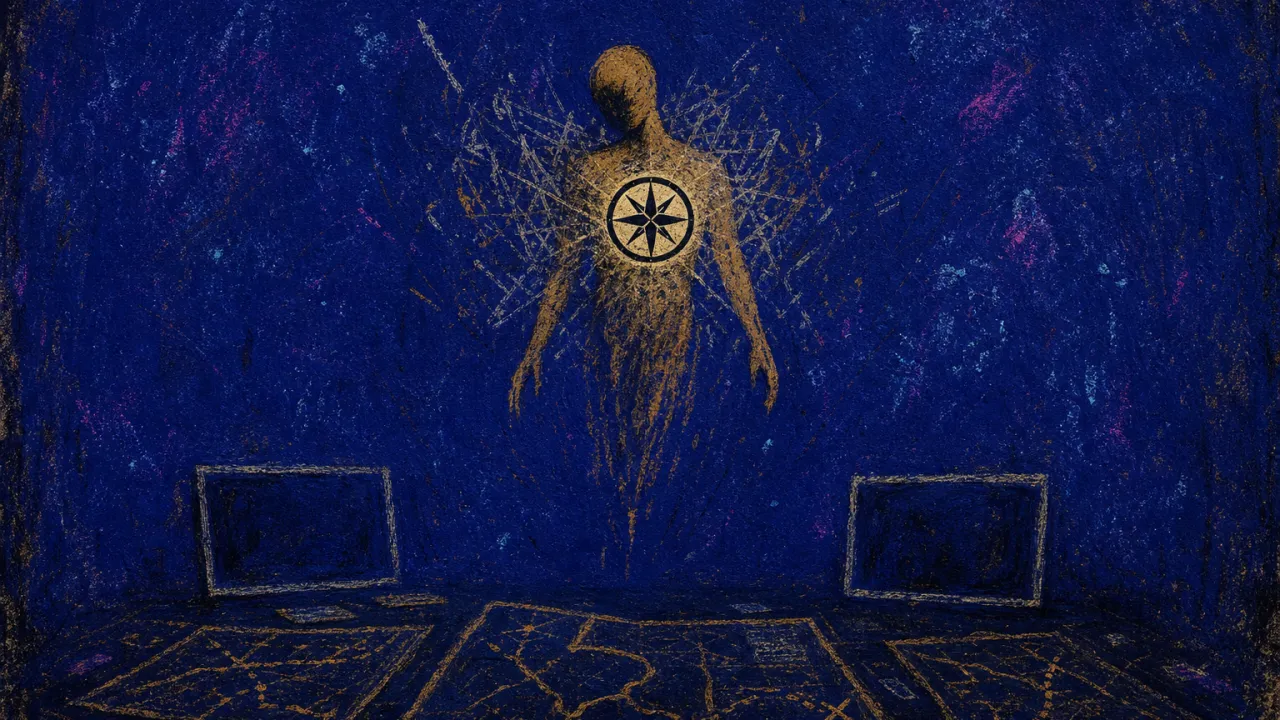
Inner Compass Numbness - you sit with your laptop open, six tabs of jobs, courses, apartments, messages, or possible exits glowing in front of you, and every option looks readable but none of it lands in your body. You can make a list. You can explain the pros and cons so cleanly that someone else might think you know what you want. But when you try to feel for the small internal pull that used to say yes, no, closer, enough, leave, stay, something goes flat, like the room has filled with grey static. Your hand keeps reaching for your phone, then stopping. Your shoulders hover near your ears. There is a dull pressure in the center of your chest, not sharp enough to become a clear emotion and not quiet enough to ignore. People ask what you want next, and you answer in polished maybes: maybe I should wait, maybe I should move, maybe I should be grateful, maybe I should just pick something. The strange part is that you are not frozen from the outside; you still reply, show up, book the appointment, finish the task, keep the calendar moving. Inside, though, the signal that tells you what is alive for you has gone faint under too many old pressures, too many comparisons, too much weather passing through the same small center. After a while, every path starts to feel equally possible and equally distant, and the cost is not that you choose wrong, but that choosing stops feeling connected to you, much like the Three of Swords, where a heart hangs alone in rain, pierced and suspended with no body to translate feeling into movement.

What's pulling at you?

I can help you sort the knot: you are caught between being able to think through every option and not being able to feel which one belongs to you. Movement is still possible, but the quiet body-level yes or no has been muted by too many pressures crowding the center. So every route stays open on paper while none of them gives you a usable signal from the inside.

How It Shows Up?

  • Late at night, you open a notes app and type the question what do I want, then stare at the blinking cursor until the words stop looking like a question and start looking like a wall. Your breath stays shallow, your shoulders creep upward, and the center of your chest feels padded and distant, as if the yes-or-no place has been wrapped in cloth. You can leave the line blank tonight without turning the blank into a verdict.
  • A friend or partner asks where you want to eat, whether you want to come over, or what you need from them, and you scan their face for clues before scanning yourself. Your throat tightens, your stomach dips, and the answer that comes out sounds reasonable but slightly borrowed, like it belongs to whoever asked first. A paused answer is allowed to stay paused.
  • You build a spreadsheet for jobs, schools, projects, or next steps, and the columns look organized enough to convince anyone that the decision is close. Your eyes go dry from staring, your temples feel tight, and every route ends up with the same flat weight, like a map where every road is printed in the same grey ink. The list can hold the options while your body catches up.
  • At drinks, after class, or in a group chat, everyone is talking about moves, breakups, plans, and new starts, and you hear yourself nodding like you have a direction too. Your laugh arrives a half-beat late, your jaw locks around a smile, and the future sounds like a distant shore seen through fog, visible but not reachable through feeling. Stepping outside for air can be enough of a response.
  • In the middle of an ordinary day, your hand drifts to your sternum as if checking whether something is still there. The pressure is dull rather than sharp, your fingers feel cold, and even a simple choice can feel like a map app compass spinning without locking onto north. You can treat that signal as information, not an emergency.

Inner Compass Numbness in Tarot Cards

When every route stays open on paper while none of them gives you a usable signal from inside, Inner Compass Numbness is the shape of the stuck place. You can feel it in the dull pressure behind the sternum, the shallow breath, and the hand hovering over a choice without moving. From an existential perspective, the structural framework here is a gap between outward motion and inner orientation. The Tarot Cards below make that muted signal visible through bodies, weather, blades, boats, and distant horizons.

Three of Swords Reversed
The heart is isolated from any body that could translate sensation into movement. It receives pressure, holds the blades, and remains suspended in weather, but the image shows no channel through which feeling becomes action or direction. When this structure turns inward in a direction reading, the compass does not simply point the wrong way; it stops producing a readable signal. You may still think, compare, plan, and perform, but the felt sense of what is alive or dead for you becomes crowded out by embedded pressure and grey atmospheric noise. The rain-filled background matters because it makes the dullness feel environmental rather than temporary. This struggle names the moment when a long-term path cannot be chosen because the inner signal has been muted by too many unresolved impacts occupying the center.
Four of Swords Reversed
The pale body nearly merges with the slab beneath it, while the brighter window sits apart from the figure's usable space. The scene makes the living signal hard to separate from the stone that holds it. Inner Compass Numbness is the reversed pressure of this image: the pause has become so internalized that wanting, sensing, and choosing lose their edges. In a direction reading, You may not be refusing the future; the inner instrument that usually registers pull, desire, and alignment has gone flat under prolonged stillness. The card's color contrast matters because the horizon is not absent. It is present but distant, showing a struggle where meaning can still be seen abstractly while the body cannot feel which direction is alive.
Five of Swords Reversed
The wind, water, and retreating bodies all move through the scene while the central figure stays anchored by the swords he holds. The landscape is full of signals, but none of them become forward orientation inside his body. Inner Compass Numbness forms when the system has adapted to conflict so completely that the future stops producing a readable pull. You may see options, timelines, and possible routes, yet they arrive without the felt difference between alive, false, urgent, or finished. The grey shore and distant bank make this more than indecision. The card shows a navigation field where the external world remains visible, but the inner instrument that should register direction has gone quiet.
Six of Swords Reversed
The far shore is visible but drained of detail, while the passengers offer no visible gaze, face, or steering gesture. The boat has a direction in the picture, yet the human figures do not show a felt orientation toward that direction. Inner Compass Numbness is carried by that missing sensory reference. You may be moving through inner work, sorting memories, naming patterns, and leaving old states, but the body does not give a clean signal about what is true, complete, or safe to release. In introspection, this card shows a quiet form of disconnection rather than dramatic confusion. The issue is not that nothing is happening; it is that the inner compass has gone muted during the crossing, so progress cannot yet be felt as trust.
Seven of Swords Reversed
The figure can still move, calculate, and carry the swords, but the whole image is built on compromised feedback. The feet advance, the face checks behind, the blades are gripped where they should not be gripped, and the dim horizon makes the route readable only in fragments. Inner Compass Numbness appears here as functional movement without trustworthy inner orientation. You may still be capable, strategic, and quick to adapt, yet the signal that tells you whether a direction is genuinely yours has gone quiet under the pressure to keep moving. The reversed card gives this numbness a precise shape. It is not empty stillness; it is overactive navigation with dulled feeling. The swords show intelligence being carried, but the blade-first grip shows that intelligence no longer guarantees contact with the deeper axis of choice.
Eight of Swords Reversed
The blindfolded body keeps standing by adapting to poor feedback: mud underfoot, water at the edge, bindings around the torso, and no visual horizon to correct the stance. What began as restriction becomes a reference system the body can survive inside. Inner Compass Numbness appears when that adaptation goes inward. In direction work, You may not be lacking a future as much as lacking access to the felt signal that would tell You which future is real for You. The card shows an internal compass dulled by prolonged constraint, where stillness becomes familiar enough to be mistaken for orientation.
Nine of Swords Reversed
The dark field presses around the bed until empty space no longer behaves like openness. The face is covered, the legs are hidden, and the symbolic layers crowd the body so completely that the room offers pressure without usable feedback. For a direction reading, this is not ordinary indecision. It is the muted state that follows too much scanning, too much review, and too many signals arriving as threat; the inner compass stops giving a clear felt yes or no. The card's reversed structure names the numbness as a system response, not a personal failure. You are still inside a map, but the map has become so compressed that orientation can no longer be felt through the body.
Ten of Swords Reversed
The scene contains several possible reference points: ground, river, mountain, horizon, and dawn. Yet the body has lost the vertical axis from which those references could become direction. Inner Compass Numbness appears in a decision reading when the field is full of information but none of it creates a felt yes or no. The neat arrangement of the swords can even make the situation look intellectually organized while the deeper orientation system remains offline. The card witnesses the particular exhaustion of being unable to tell whether You want to stay, leave, wait, quit, risk, or rebuild. It gives that flatness a structure: not emptiness, but a body that has adapted to too much impact by no longer expecting movement from its own signals.
Knight of Swords Reversed
The armor, reins, wind, and raised sword all add competing inputs to a body already moving faster than feedback can land. In the reversed texture, the rider's system can stay functional on the outside while the inner signal gets buried under acceleration. For a direction reading, this is the point where the problem is not lack of movement but loss of felt orientation. You may still be choosing, planning, and reacting, while the quieter signal that tells you what is actually yours has gone difficult to hear.
Queen of Swords Reversed
The clear upper sky is separated from the small signs of life below. Water, trees, and the distant bird are present, but the Queen's fixed seat and raised sword keep her operating from a height where those signals barely reach the body. This is the shape of a compass that has not vanished, but has gone quiet under too much altitude. You may keep thinking clearly about the future while the subtler sense of what is yours, what pulls you, and what restores energy becomes hard to detect. The card contains that numbness inside a visible structure: a mind above the clouds, a body held still, and a living landscape pushed to the edge of the frame. Direction cannot calibrate when the instrument for inner signal has been placed too far from life.
Three of Wands Reversed
The card contains too many coordinates for a single body to use at once: cliff, sea, ships, far hills, planted wands, and layered garments of will, strategy, growth, and composure. In the reversed structure, those coordinates stop clarifying the route and begin to flatten one another. The open water becomes strangely compressive because every path stays possible without becoming personal. You may keep seeing futures, options, and markers of progress, yet none of them reaches the inner place that says, this is mine. Direction is not absent; it has gone quiet under too many competing baselines. This struggle is the numbness that can follow prolonged horizon scanning. The card gives it a shape: a figure with a vast view whose internal compass has stopped responding because the field is too wide, too symbolic, and too unresolved.
Seven of Wands Reversed
The figure is high enough to see, but his feet are split across rough ground and his body is arranged for impact. When that posture becomes normalized, the higher vantage point no longer guarantees orientation; it can become a place where constant pressure is mistaken for proof that the path is meaningful. This is the card’s quieter reversal: not collapse, but sensory adaptation. You can keep reacting, holding, answering, and defending while the inner signal that says yes, no, closer, farther grows faint under the noise of incoming demands. In a direction reading, the struggle is the numbness that follows prolonged defensive clarity. The future may still look open above you, yet the felt sense of what is yours has been flattened by the need to stay ready for whatever rises next.
Ten of Wands Reversed
The carrier's head is lowered into the wands, and the body's reference point becomes the load immediately in front of him. The wider landscape is present, but navigation is filtered through pressure, slope, and the need to keep the bundle intact. You meet Inner Compass Numbness when the path keeps being walked long after the inner signal has gone quiet. The card does not show a lack of movement; it shows a body that has adapted to external direction so thoroughly that its own horizon is no longer the primary guide.
Page of Wands Reversed
The upright wand becomes the strongest coordinate in the image, stronger than the Page's feet, the empty ground, or the distant pyramids. When that axis is over-relied on, the body can appear oriented while its own felt navigation has gone quiet. In reversed direction work, the structure points to a numb compass rather than simple indecision. You may keep using roles, signs, plans, or borrowed milestones to stand upright, while the internal signal that tells you where life still has heat is hard to locate.
Queen of Wands Reversed
The Queen, throne, and desert share the same red-yellow field until body, role, and environment begin to blend. The posture still communicates readiness, but the visual boundaries that would separate inner signal from outer setting become harder to read. Inner Compass Numbness appears when the self has adapted so completely to its visible role or expected future that the directional signal goes quiet. You are not shown as empty; the card shows a live system whose cues have become overfamiliar, muted, and difficult to distinguish from the background.

Inner Compass Numbness in Tarot Card Reading Insights

When the felt yes or no goes quiet while life keeps moving, people often bring Inner Compass Numbness into readings as a question about direction, timing, or whether a path still has heat. The pieces below shift from cards to how this flatness can appear inside readings. Tarot Reading Insights for Inner Compass Numbness.
Psychological struggles related to Inner Compass Numbness