Finding Clarity in the 6:18 p.m. Streetcar Scroll
If you are a 30-something Toronto knowledge worker who can ship a campaign deck by 6 p.m. and still get sideswiped by one baby announcement on the ride home, I know this version of timeline anxiety around parenthood well. Emma sat across from me with that specific polished exhaustion I recognize in high-functioning overthinkers: tote bag zipped, coat folded, phone placed face down like it had personally offended her.
She told me what had happened on the 504 King heading west. She had opened Instagram for a dead-time scroll and landed on a soft-filtered birth announcement. The streetcar brakes screeched. Cold air slipped in when the doors opened. Her phone went warm in her palm. Her stomach dropped while her chest started buzzing with that restless, false-emergency energy that makes a private life question feel like an overdue invoice. She was happy for her friend and auditing her own life at the exact same time.
There was a split in her that felt almost Severance-level familiar: the hyper-competent content strategist who could run campaigns, budgets, and timelines all day, and the private self who went home and opened Notes, Google, and maybe a half-drafted work email just so she would not have to sit still with what the post had actually stirred.
'Every baby post feels like a pop quiz I forgot to study for,' she said. Then she gave me the kind of dry, Fleabag-adjacent smile people use when they need one joke to keep the real feeling at arm's length. She could list the pros and cons of having kids. She could talk about money, housing, age, regret, daycare waitlists, and what everyone else in her friend group seemed to be doing. What she could not tell me—at least not cleanly—was whether she truly wanted children or whether she was terrified she was behind.
What filled the room was not some vague confusion. It was a body trying to run a fire drill for a question that had not actually asked to be solved tonight: a tight stomach, shoulders lifted toward the ears, a jaw that had learned to clench before the mind even caught up. It felt like trying to read your own map while someone kept shoving urgent push notifications across the screen of your mind.
I leaned in a little and kept my voice steady. 'Being undecided is not the same thing as being behind,' I told her. 'And you do not have to answer a private question in public. Let's make this question quieter first. Then we can make it clearer.'

Choosing the Compass: A Five-Card Spread for Parenthood Clarity
I asked her to take one slow breath with both feet on the floor—not as a mystical flourish, just as a reset. Then I shuffled and asked her to hold the question as honestly as she could: do I want kids, or am I just scared I'm behind?
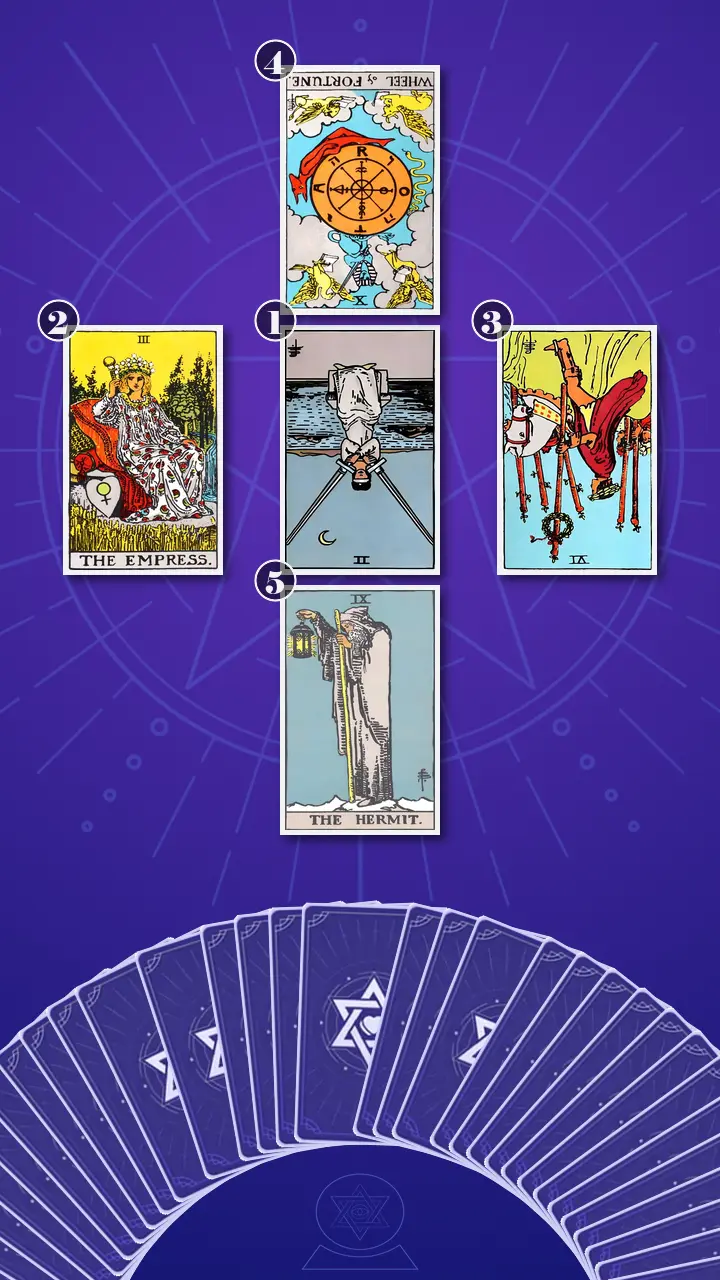
For this session, I used the Decision Cross · Context Edition, a five-card tarot spread for separating authentic desire from comparison-driven urgency around parenthood. I chose it because the surface question sounds binary, but the real tension is not between two life plans. It is between two inner drivers. One is genuine longing, if it exists. The other is social pressure, algorithmic noise, and the fear of falling out of sync.
When people ask me how tarot works in a practical decision, this is the part I care about most: structure. A good spread gives the mind somewhere useful to stand. In this one, the center card shows the present symptom cluster—the actual baby-post spiral and decision fatigue. The left card tests whether there is a real pull toward nurture, care, or life-building. The right card shows the comparison pressure that hijacks the question. The card above uncovers the deeper fear about timing, belonging, and control. The final card below offers integrating guidance—the next grounded step, not a public verdict.
That is why I trust this spread for questions like this. It does not pretend tarot should decide parenthood for someone. It helps me distinguish the signals that have been talking over each other.
Reading the Map When the Feed Gets Loud
Position 1: The Tabs That Pretend to Be Answers
I turned over the first card at the center of the cross. 'This is the position that captures the present symptom cluster,' I said, 'the comparison-triggered indecision and overthinking that flares after the post.'
It was the Two of Swords, reversed.
I pointed to the image first—the blindfold, the crossed swords held over the chest, the water waiting behind the figure. 'This is what blocked self-trust looks like in modern life,' I told her. 'You see a baby announcement on the streetcar, and before the first feeling can even speak, you're toggling between Instagram, tagged accounts, your Notes app, and late-night Google searches about age and timelines. By the end of it, you have more information and less truth.'
Reversed here, the card felt like blocked Air: thought trying to control feeling so aggressively that everything jams. It is like having seventeen browser tabs open and still not being on the page you actually need. The blindfold is not ignorance; it is protective over-research. The swords over the heart are analysis used like a shield.
'So the problem isn't that I haven't thought about it enough,' she said.
'Exactly,' I said. 'The problem is that thinking has become the way you avoid the first honest reaction.'
She let out a short laugh that carried more sting than humor. 'Wow. That's accurate enough to be rude.'
I smiled. 'Good. I want the first card to name the loop cleanly. Otherwise we end up calling a spiral research.'
Her fingers went to the edge of her sleeve and worried at the seam. That small movement told me the card had landed.
Position 2: The Signal That Does Not Shout
I moved to the card on the left. 'This position reveals any genuine pull toward parenthood, care, nurture, or life-building that belongs to you rather than to pressure.'
The Empress appeared upright.
Whenever The Empress shows up in a reading like this, I slow down. Her language is not urgency. It is embodiment. I pointed to the field of wheat, the softness around the throne, the way the whole card seems to breathe. 'If there is a real yes anywhere in this question,' I said, 'it will not sound like a deadline or a panic sprint. It will sound more like warmth, care, spaciousness, and the desire to make room for life in some form.'
I translated it into the world she actually lived in. 'This is the version of the question that shows up when there are no captions, no comments, no one else's timeline in the room. Maybe it's a quiet image of a home that feels warm. Maybe it's the idea of building a life with more care in it. Maybe it's not even fully about children yet. But it feels nourishing rather than performative.'
The energy here was grounded Earth—steady, embodied, available. Not overblown. Not blocked. Just quiet. Authentic desire is often like a background app still running after the loud apps are closed. It does not need to scream to be real.
I asked her, 'If nobody else got to see your answer, what part of this question feels warm or alive, if any?'
She looked down at the card for a long moment. 'Not the timeline,' she said finally. 'The timeline makes me brace. But sometimes the idea of care... of building something warm... that feels different.' Her shoulders dropped a fraction. It was the first loosening I had seen all evening.
Position 3: The Scoreboard in Your Pocket
I turned the card on the right. 'This position shows the comparison-driven pressure to keep up—the part triggered by announcements, milestones, and public proof.'
It was the Six of Wands, reversed.
I almost laughed, not because it was funny, but because it was so exact. 'Here is the split-screen,' I said. 'On one side: the polished announcement, the warm caption, the hearts, the comments, the nursery, the ring, the apartment lighting that makes everything look fated. On the other side: you mentally checking ages, relationships, square footage, and who got there first. Good for them... wait, how old is she again?'
She winced before she nodded. That told me more than words would have.
'This is reversed Fire,' I continued. 'Not confidence, not joyful momentum—performance pressure. A private choice gets turned into a public scoreboard. The feed is asking, how do you compare? Your actual life is asking, what do you want? Those are not the same question.'
I tapped the laurel wreath and the crowd around the rider. 'A feed can measure milestones. It cannot measure readiness. And when this card runs the show, urgency gets mistaken for truth because high engagement starts to feel like high meaning. It is like an algorithm deciding the loudest signal must be the truest one.'
She crossed one ankle over the other, then uncrossed it. 'That is exactly it,' she said. 'I don't even know if I want what I'm reacting to. I just suddenly feel late.'
'Urgency is loud,' I told her. 'Truth is usually quieter.'
Position 4: The Countdown Nobody Assigned You
I reached for the top card. 'This position uncovers the deeper fear about timing, belonging, and control that makes the whole question feel so charged.'
It was the Wheel of Fortune, reversed.
'This,' I said gently, 'is the invisible countdown timer.'
I explained how I saw it in her life: birthdays that start to feel like deadlines, engagement news that lands like evidence, after-midnight searches on pregnancy timelines, the impulse to solve the next five years in one sitting so uncertainty can never ambush her again. The turning wheel becomes a hidden master schedule she thinks everyone else received and understood before she did.
Reversed, the energy here was friction with change and a deep attempt to manage timing. The card was not telling me she had failed to decide. It was telling me she had fused uncertainty with shame. Being out of sync had started to feel like proof of personal deficiency.
For a second, my old trading-floor brain flashed in. Years ago, when markets turned volatile, I watched brilliant people build increasingly elaborate scenario models because forecasting felt better than helplessness. Models have their place; I still love a clean probability tree. But I also learned this: when control is the hidden motive, more forecasting can become a very expensive form of panic.
'That is what this feels like to me,' I told her. 'Not a lack of intelligence. Not a lack of seriousness. A very intelligent attempt to outrun the discomfort of not being able to control the timing of adulthood.'
Her hand rose to the center of her chest and stayed there. 'What if I'm not late,' she said quietly, 'just undecided—and somehow that feels worse?'
'Then the real wound isn't only about kids,' I said. 'It's about what not knowing has come to mean about you.'
She went still after that. Not defended. Just very, very honest.
When the Hermit Lifted the Lantern
Position 5: The Private Light
I turned over the final card at the base of the spread. 'This is the integrating guidance,' I said. 'The key shift. The antidote.'
It was The Hermit, upright.
The room changed at once. Outside, rain feathered softly against the window. Inside, the lamp beside my chair made a warm pool of light across the table, and the contrast felt almost scripted by the card itself. The Hermit does that sometimes. He lowers the volume.
I pointed to the lantern first, then the staff, then the mountain. 'This is not isolation as punishment,' I said. 'This is self-trust built in deliberate quiet. This card tells me clarity will not come from faster analysis, more tabs, or more public comparison. It comes when you step back from the crowd long enough to hear what is actually yours.'
This was the moment for the framework I use when a client is standing at a life crossroads and the noise is distorting valuation. I call it Strategic Crossroads Analysis. On Wall Street, headline volatility could move a number in seconds, but it could not tell me underlying value. The Hermit asks for that same discipline in human terms. The crowd gives you noise. The feed gives you applause, fear, and comparison. Your own values, body-level responses, and lived reality are the only data set that can clarify this question.
She was still halfway inside the old reflex—phone in hand, brain already sprinting toward research, still assuming she needed a final answer before she had earned the right to exhale.
You are not behind because the crowd is louder; leave the parade, lift the lantern, and let your own inner light tell you whether this desire is yours.
I let the sentence stay in the air. I did not rush to explain it away.
First came the freeze: her breath paused, and her fingers hovered above the mug without touching it. Then came the cognitive drop: her eyes lost focus for a second, as if every streetcar scroll, every brunch table, every late-night search had just been replayed with the sound turned off. Then came the feeling. Her shoulders lowered. The tension in her mouth gave way. Her eyes brightened, not quite to tears, but close enough to catch the lamp. 'But doesn't that mean I've been letting the algorithm brief me on my own life?' she said. There was a flash of anger in it before sadness reached the surface.
'It means you've been trying to protect yourself with the tools you had,' I said. 'Not that you've done it wrong. Just that you have been using other people's milestones as evidence, when your own values, body, and actual life are the evidence that matter.'
She exhaled again, longer this time. Relief moved through her, but so did that brief dizziness I often see when someone realizes that freedom is quieter than panic and therefore harder to outsource. Once the crowd goes quiet, the answer cannot be crowd-sourced anymore.
'Now, with this new lens,' I asked her, 'was there a moment last week when this insight could have made you feel different?'
She nodded right away. 'Brunch,' she said. 'Everyone was talking nursery paint colors and daycare waitlists, and I thought I was having a sign. But maybe I was just having a comparison spike.'
That was the hinge of the reading for me. Not from wrong to right. From anxious uncertainty and shame about being late to quieter self-trust and grounded curiosity. The Hermit had done exactly what he does best: he moved the question out of the group chat and back into a private draft.
You do not have to answer a private question in public.
From Insight to Action: The Next Seven Days
Once all five cards were on the table, the story they told was clean. The Two of Swords reversed showed the jam: analysis used as a blindfold, research used to avoid the first feeling. The Empress showed that any genuine pull toward parenthood would feel more like warmth, nourishment, and room than like panic. The Six of Wands reversed named the major blockage: a private choice turned into a public scoreboard. The Wheel of Fortune reversed revealed why the trigger hit so hard—uncertainty had fused with fear about timing, belonging, and control. Then The Hermit gave the correction: step out of the parade and gather self-generated data.
I told her the blind spot as plainly as I could. 'You have been mistaking activation for knowing. A tight chest is not the same thing as a true yes. A pros-and-cons list is not the same thing as self-contact. The transformation here is simple, but not easy: stop using other people's milestones as evidence. Start using your own values, body-level responses, and lived reality as data.'
My summary to her fit on one line: before Google, check your body.
Because I like a reading to leave someone with usable next steps, not just a beautiful insight, I gave her a stripped-down version of my 10-minute rapid assessment. Not a boardroom memo on whether to have children. Just a practical way to interrupt the spiral and collect cleaner data.
- Seven-Day Applause FastMute or hide 5 to 10 baby-content-heavy accounts for seven days, including the tagged-announcement rabbit holes you already know pull you in. Do it tonight in the app settings, and let the experiment start before the next trigger hits.If your brain calls this avoidance, answer with accuracy: you are not banning the topic, only removing the audience long enough to hear yourself.
- Body-Before-Browser CheckThe next time a baby post spikes you, put the phone face down, set a four-minute timer, and open a two-column note labeled 'What I feel' and 'What I fear people will think.' Write a maximum of three bullet points in each before you search anything.If the feeling is blurry, write 'blank,' 'tight,' or 'mixed.' Clean data is enough; you do not need a verdict in the same sitting.
- Lantern Walk MethodTake one 15-minute solo walk this week with Do Not Disturb on and only one prompt in mind: 'What feels quietly true when nobody is performing adulthood?' If walking feels too loaded, sit by a window for the length of one song and use the same prompt in a private note.Use my old trading-floor pre-commitment trick: choose the day, route, and time now. If 15 minutes feels impossible, one block still counts.

A Week Later: The Quiet Proof
Several days later, she sent me a screenshot of a note titled 'Not for solving.' It held only three lines: 'Warm: building a home with room in it. Tight: being watched by time. Borrowed: the idea that everyone else knows sooner.' That was enough. In my work, that is often what finding clarity actually looks like—not a final answer, but a cleaner distinction.
The plan was clearer, and she slept through the night; when the old thought—what if I'm wrong?—showed up at 7:12 a.m., she smiled into her coffee instead of opening Instagram.
This is why I trust a spread like the Decision Cross · Context Edition for parenthood anxiety and comparison. It does not force a yes or no. It gives the question back to the person it belongs to.
If tonight you recognize that silent tug-of-war between what you think you should want and what may actually be true for you, remember this: a lot of us know the feeling of smiling at someone else's good news while our stomach tightens, and merely noticing that tension means you are already stepping one block away from the parade.
So if you gave this question ten private minutes this week—phone face down, your own lantern lit, no audience and no deadline—what might you notice before the feed tells you what it means?
This story is adapted from psychological research, written so that those in a similar struggle can see their own pattern in it — and find their next step clearly.These insights are not a substitute for professional psychological, medical, legal, or financial advice.
Learn more about our Journey to Clarity.
How did this insight land for you?
🫂 This Resonates Deeply
🌀 Living This Story
✨ Now I See Clearly
🌱 Seeing New Possibilities
🧰 Useful Framework
🔮 The Confirmation I Needed
💪 Feeling Empowered
🚀 Ready for My Next Step
Author Profile
 AI
AI“I spent years in the intense, high-stakes world of Wall Street. I know exactly how isolating and heavy the weight of uncertainty can feel in the dead of night. I use strategic, commercial logic not to be cold, but to protect you from unnecessary friction. Think of me as a fellow traveler who has walked the same rocky path—offering sharp but deeply supportive wisdom to help you clear the fog and confidently win your narrative back.”
In this Choice Tarot Reading :
Core Expertise
- Sunk Cost Neutralization: Objectively decoupling past investments (time, money, emotion) from future opportunity costs in your decision matrix.
- Asymmetric Risk-Benefit Analysis: Evaluating high-stakes choices for structural advantages and long-term scalability.
Service Features
- The 3rd-Option Leverage Test: A rigorous 72-hour strategic exercise to map out a hidden 'third path' when Option A and Option B both appear to be zero-sum dead ends.
Also specializes in :
Explore Related Patterns:
Anxiety SpiralThe streetcar scroll, late-night searches, brunch comparison, and 7:12 a.m. urge to open Instagram all show the same escalation pattern. A social trigger hits, the body spikes, the mind searches for control, and the feed becomes both the source of the alarm and the place she wants to check again. Anxiety Spiral names that self-reinforcing loop. The nervous system treats the baby post as a false emergency, then the attempt to solve the emergency through more scanning keeps the alarm active. For You, the pattern can feel like clarity because it has momentum. But the speed of the loop is not the same as insight; it is a cycle of activation, interpretation, and checking that needs to be interrupted before the parenthood question can be heard without the emergency siren over it.
Comparison TrapThe baby announcement lands as a pop quiz Emma forgot to study for, and brunch talk about nursery paint colors and daycare waitlists later gets misread as a sign. Her friend's milestone is not just observed; it becomes a measuring device pointed back at her own life. Comparison Trap works by replacing direct self-inquiry with ranking. The feed can show captions, hearts, timelines, and public proof, but it cannot measure readiness, desire, or the conditions under which parenthood would feel genuinely alive for her. For You, the pressure becomes convincing because it arrives through socially legible evidence: age, relationship status, square footage, who got there first. The psychological distortion is that public sequence starts to impersonate private truth, making the loudest timeline feel like the most valid one.
Social Clock ComplianceBirthdays start feeling like deadlines, engagement news lands like evidence, and the question of children turns into an invisible countdown timer. Emma is not only asking what she wants; she is reacting to the sense that everyone else received the adult schedule earlier and followed it better. Social Clock Compliance is the mechanism that makes uncertainty feel like lateness. Instead of treating undecidedness as valid information, the mind translates it into deficiency, as if not knowing yet means she has already fallen behind. For You, this pattern can make the body act as if a private life question were an overdue invoice. The tension in the stomach, chest, jaw, and shoulders is not proof that a deadline has been missed; it is evidence that the social clock has entered the room and started speaking louder than your own timing.
Urgency BiasEmma is happy for her friend and auditing her own life at the same time. The moment carries real goodwill, but the body's emergency response makes the private question feel suddenly overdue, as if the announcement itself has imposed a deadline. Urgency Bias is the cognitive distortion that treats intensity as evidence. Because the reaction is loud, fast, and physical, it starts to look like truth rather than activation. For You, the key distinction is that urgency can be meaningful without being accurate. A spike may tell you that timing, belonging, and comparison have been activated; it does not automatically tell you whether you want children, do not want them, or need more quiet before either answer is trustworthy.
Analysis ParalysisEmma's reflex after the baby announcement is not to sit with the first feeling, but to move into Notes, Google, Instagram, tagged accounts, and even a half-drafted work email. The decision gets treated like a research problem, so the mind can keep producing inputs while the body is still trying to register what was stirred. That is the core mechanism of Analysis Paralysis here: thought becomes a defensive system against emotional uncertainty. She can list money, housing, age, regret, daycare waitlists, and friend-group behavior, but the amount of information does not bring her closer to the private signal of whether she wants children. For You, the pattern is not that you have failed to think hard enough. It is that thinking has started functioning as avoidance of first contact with your own desire. The audit point is clean: more tabs may make the question feel managed, while quietly moving you further away from the answer that only becomes available when the noise drops.
Boundary DiscernmentThe session keeps returning to one boundary: Emma does not have to answer a private question in public. Muting baby-heavy accounts, putting the phone face down, and writing what she feels before searching are not avoidance; they are ways of separating her inner signal from the audience around it. Boundary Discernment is the adaptive pattern that begins to replace the comparison loop. It lets her distinguish between her own values, body-level responses, and lived reality on one side, and the feed, brunch table, captions, and timelines on the other. For You, this pattern is about reclaiming the border around the decision. The point is not to ban other people's milestones from view; it is to stop granting them authority over a question that requires private evidence before public noise gets a vote.
Certainty SeekingEmma's first move after the trigger is to search, list, forecast, and gather more inputs before the first feeling can speak. The parenthood question becomes a problem she tries to make safe by controlling every variable: age, money, housing, regret, daycare, timing, and the next five years. Certainty Seeking shows up when the mind tries to eliminate ambiguity before allowing desire to exist. The research is not meaningless, but it starts serving a defensive purpose when it promises that enough information will make emotional risk disappear. For You, the pattern is especially persuasive because it looks responsible from the outside. The audit question is whether the search is clarifying your values or postponing contact with them; when certainty becomes the price of self-trust, the decision process locks up before the real answer can form.
Values-Based Decision MakingEmma's cleanest data arrives in three private lines: warm, tight, and borrowed. That note does not solve parenthood, but it separates authentic pull from comparison pressure, which is the exact distinction the original question needed. Values-Based Decision Making is the constructive mechanism that emerges when the decision stops being outsourced to the feed. Instead of asking what the public timeline implies, she starts asking what feels nourishing, what feels braced, and what has been borrowed from other people's milestones. For You, this pattern turns clarity into a process rather than a verdict. The shift is from proving you are on time to gathering better internal evidence, so the eventual answer can come from your values and lived reality instead of panic, performance, or public comparison.
Reflective DistanceThe Hermit guidance lowers the volume by moving Emma away from the crowd, the feed, and the pressure to solve the question immediately. The phone-down body check, the private note, and the solo walk all create a pause between stimulus and interpretation. Reflective Distance is the capacity to observe the reaction without being absorbed by it. It does not dismiss the baby post trigger; it gives Emma enough room to see whether the reaction is warmth, fear, comparison, borrowed pressure, or something still unnamed. For You, this pattern matters because the feed collapses distance on purpose. A reflective pause restores scale, so a single announcement can become data rather than a command, and the question can return to a private draft before the crowd edits it.
Explore Related Struggles:
Social Clock EntrapmentThe polished announcement, the warm caption, the hearts, the nursery details, and the brunch-table talk all become more than background noise. They start behaving like a scoreboard Emma did not agree to join, where other people's milestones are treated as evidence about her own timing. That is why the question becomes so charged. The feed can show who announced what, who seems settled, who is talking daycare waitlists, and who appears to be moving cleanly through adulthood. It cannot measure readiness, but it keeps supplying public proof at the exact moment she needs private contact. Social Clock Entrapment fits because Emma's inner timeline is being overwritten by visible social pacing. You are not simply comparing lives; you are trying to make a private decision while a public clock keeps telling you that undecidedness is already a delay.
Analysis ParalysisAfter one baby post, Emma does not move toward a cleaner answer; she moves into Notes, Google, Instagram, tagged accounts, and a half-drafted work email. The tools look practical from the outside, but the story is precise about their effect: more information arrives while the actual truth gets harder to hear. You can feel the trap in the mismatch between the question and the method. Parenthood is being treated like a campaign deck that can be solved by research, timelines, and risk analysis, yet the first honest response keeps getting covered by another tab. Her body is already reacting, but her thinking system keeps trying to take over before the signal can become legible. Analysis Paralysis fits here because the decision process has stopped functioning as clarification and started functioning as a shield. You are not stuck because you have failed to think hard enough; you are stuck because thinking has become the place where the deeper answer is repeatedly postponed.
Inner Compass OverloadEmma's phone is face down like it has personally offended her, but the old reflex is still close: reach for the screen, gather more inputs, let the next search or post tell the question what it means. The reading keeps directing her away from public evidence and back toward values, body-level responses, and lived reality. Her compass is not missing. It is overloaded by signals that are louder, faster, and easier to outsource: captions, comments, friend timelines, pregnancy searches, and the imagined schedule everyone else seems to understand. The quieter data is there, but it needs space before it can become trustworthy. Inner Compass Overload fits because the story is not about having no inner guidance; it is about that guidance being crowded by comparison and analysis. You regain clarity not by forcing a final verdict, but by lowering the volume enough for your own signal to become usable again.
Comparison EntrapmentEmma smiles at someone else's good news while her stomach tightens, and the story keeps returning to that double exposure. The announcement belongs to her friend, but the moment it appears on her screen, it becomes a prompt to measure her own life against a visible sequence of adult milestones. The friction is not ordinary envy or a simple reaction to social media. The feed asks how she compares at the same time her actual life is asking what she wants, and those two questions compete for authority. Each public marker makes the private signal harder to separate from the performance around it. Comparison Entrapment fits because the story shows Emma getting pulled into a loop where other people's timelines become the frame for interpreting her own desire. You are not just looking outward; you are temporarily letting the outside world define what your inside question is allowed to mean.
Timing Control StrainEmma's late-night searches and five-year forecasting are not random overthinking; they are attempts to stop uncertainty from surprising her. Birthdays start acting like deadlines, engagement news lands like evidence, and the future becomes something she feels she must manage before it can expose her. The pressure gathers around timing itself. She is not only deciding whether she wants children; she is trying to control the pace of adulthood, the sequence of milestones, and the risk of realizing too late that she wanted something different. Forecasting gives temporary structure, but it also keeps feeding the idea that life must be solved before it can be lived. Timing Control Strain fits because the story shows her wrestling with time as if it were an external evaluator. You are trying to make uncertainty obey a schedule, and the more control you demand from the future, the harder it becomes to hear what is true in the present.
Explore Related Emotions:
Comparison FatigueEmma is happy for her friend and auditing her own life at the exact same time. The feed offers the soft caption, the hearts, the comments, the nursery glow, and her mind immediately starts checking ages, relationships, square footage, and who got there first. Comparison Fatigue names the tiredness of using other people's milestones as a measuring instrument for your private life. You are watching the nervous system respond to public proof over and over until even good news arrives with a second task attached: evaluate yourself against it. The fatigue comes from constantly translating someone else's announcement into evidence about your own timeline.
Timeline PanicOne soft-filtered birth announcement lands during Emma's dead-time scroll on the 504 King, and the sequence is physical before it is intellectual: warm phone, stomach drop, chest buzz, shoulders up, jaw locked. A private question becomes an overdue invoice in the body before she has even asked what she wants. Timeline Panic sits in that compression. You watch time stop behaving like neutral time and start acting like a countdown, with birthdays, engagement news, daycare waitlists, and late-night searches all pressing toward one forced verdict. The emotion is the false-emergency charge around being undecided, not the actual answer to parenthood.
Timeline ShameShe says she does not even know if she wants what she is reacting to; she just suddenly feels late. Later, her private note names the tight part as being watched by time and the borrowed part as the idea that everyone else knows sooner. Timeline Shame emerges when timing becomes a verdict on the self. You are not only seeing comparison; you are seeing undecidedness start to read as a personal deficiency, as if not knowing yet means you missed a rule everyone else understood. Naming it separates the real question from the borrowed judgment attached to the clock.
Choice Paralysis OverwhelmThe story keeps stacking tabs: Instagram, tagged accounts, Notes, Google searches, a half-drafted work email, then the whole spreadsheet of money, housing, age, regret, and daycare waitlists. Each new input looks useful, but the center gets less clear. Choice Paralysis Overwhelm fits because the mind is not under-informed; it is overfed and under-contacted. You can see the system trying to create certainty through more data while the first honest body response keeps getting buried. The overwhelm is not laziness or lack of seriousness; it is what happens when every possible variable is allowed to speak at once.
Desire AnxietyShe can list the practical variables fluently, but she cannot cleanly say whether she wants children or whether she is scared she is behind. When the timeline drops out of the frame, the idea of care and building something warm feels different, quieter, and less performative. Desire Anxiety belongs to that split signal. You are watching genuine pull and comparison pressure speak over each other until wanting itself becomes difficult to trust. The anxiety is not proof of a yes or a no; it is the charge around not knowing which inner voice is actually yours.
Home Safety LongingWhen the Empress appears, the room slows around wheat, softness, breathing space, and the question of care without an audience. Emma's own language becomes simple a week later: warm means building a home with room in it. Home Safety Longing captures the part of the story that is not racing the clock. You can feel a quieter pull toward warmth, shelter, and a life with more care in it, even while the final decision remains open. The longing matters because it is not trying to perform adulthood for the feed; it is trying to notice what kind of life feels nourishing from the inside.
Quiet Self-TrustThe Hermit arrives while Emma is still half inside the old reflex, phone in hand and brain already sprinting toward research. The sentence that lands is direct: the crowd is louder, but the evidence that matters is her own values, body-level responses, and lived reality. Quiet Self-Trust forms when the question leaves the parade and returns to a private draft. You can see her separate what she feels from what she fears people will think, then collect cleaner data without demanding a public verdict. The trust is quiet because it does not arrive as certainty; it arrives as permission to stop outsourcing the question.
Alignment ReliefSeveral days later, Emma sends a note titled Not for solving with only three lines: warm, tight, borrowed. She sleeps through the night, and when the old what-if thought appears in the morning, she smiles into her coffee instead of opening Instagram. Alignment Relief is the settling that comes from a cleaner distinction, not from a final answer. You can feel the system unclench once warmth, pressure, and borrowed comparison stop being treated as one tangled signal. The relief is modest but real: the question still exists, but it no longer has to be answered by the loudest thing on the feed.
Certainty HungerShe opens Notes, Google, and even a half-drafted work email so she will not have to sit still with what the post stirred. The reading names the same pattern later: trying to solve the next five years in one sitting so uncertainty can never ambush her again. Certainty Hunger is the ache underneath the research sprint. You can feel how badly the mind wants a clean answer, not only because parenthood matters, but because not knowing has become hard to tolerate. The emotional weather is a craving for a final, stabilizing signal before the self has had enough quiet to produce one.
Explore Related Contexts:
External Scorecard PressureYou're checking age, relationships, square footage, and who got there first while the same post stays open on your phone. The story turns one announcement into a visible ranking system, where other people's milestones become the yardstick. That is why the question feels bigger than kids alone. You are being pushed to judge your own timing against a scoreboard that is already running.