Watching Yourself Live?

Explore Observer-Self Split through grounded description, related tarot cards, and tarot reading insights that reflect this self-watching distance.

Observer-self Split

What does this feel like?

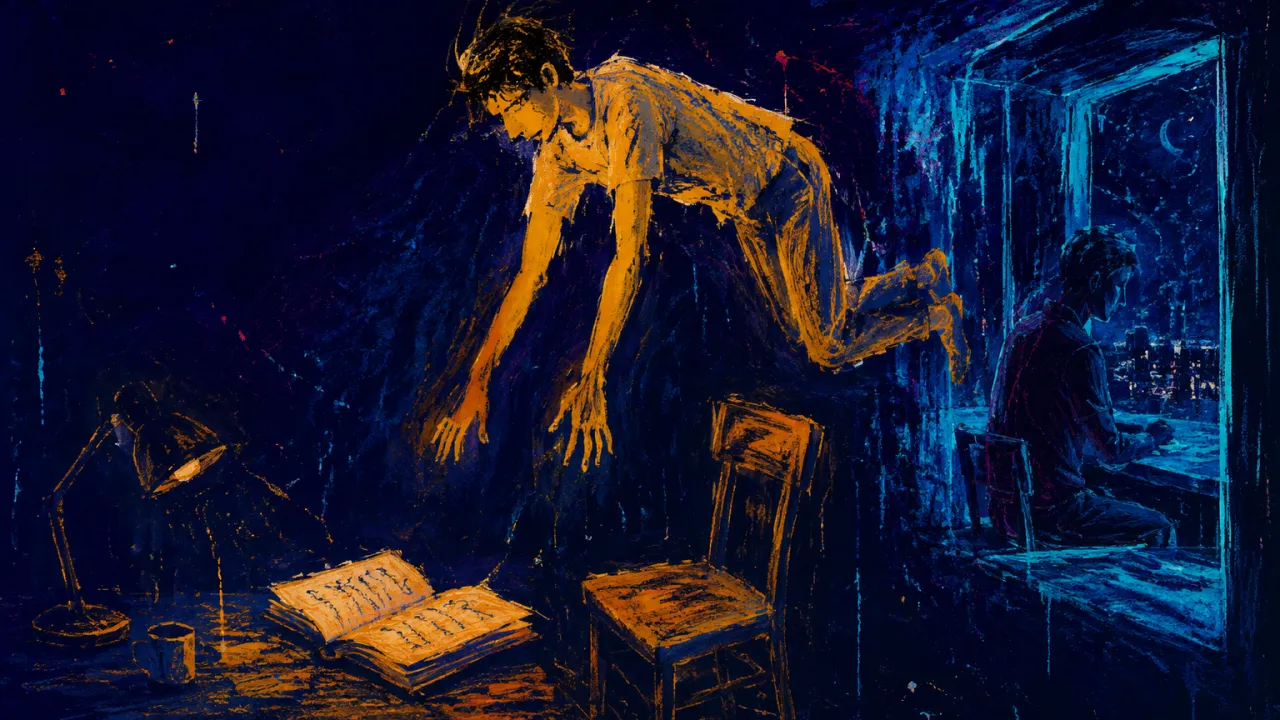
Observer-Self Split — you notice it in the quiet second after something happens, when everyone else seems to be reacting and you are already watching yourself react. You hear your own voice answer a text, laugh in a room, explain what you feel, and at the same time another part of you is standing slightly above it all, taking notes: that was avoidance, that was defensiveness, that was the old pattern, that was the part where you should have felt something. Your body is still there, of course. Your hand is wrapped around a coffee cup, your thumb is hovering over the screen, your shoulders are tight under your jacket, your mouth is forming sentences that sound calm and self-aware. But the center of you feels displaced, as if the person living the moment is downstairs and the person understanding it is upstairs behind glass. You can describe your emotions with almost surgical clarity, but the clarity does not always touch the place that hurts. You can journal for an hour, name the pattern, map the trigger, trace the meaning, and still close the notebook feeling oddly untouched, like you watched a documentary about your own life instead of living inside it. In relationships, this can make intimacy feel strangely delayed: someone reaches for the feeling part of you, and you hand them the analysis instead, not because you are trying to hide, but because analysis is the only doorway that seems open. Alone, it can turn reflection into a high room with no stairs back down. You keep looking inward, hoping attention will restore contact, but sometimes attention becomes another form of distance, another ledge where you can see everything except the ground under your own feet. The cost is subtle: life becomes readable but less inhabitable, full of moments you understand while missing the warmth, mess, and immediacy of being inside them, much like The Hermit standing above the world with his lantern, able to see the path of light but still wrapped in a cloak that keeps his living body apart from the scene below.

What's pulling at you?

You are not distant because you lack awareness; you may have more awareness than you know what to do with. The pull is between the part of you that wants to understand every feeling before it moves, and the part of you that needs to be inside the feeling before it can become yours. That is why clarity can sometimes leave you calmer on the surface but lonelier inside your own life.

How It Shows Up?

  • You are alone in your room after a normal day, sitting on the edge of the bed with one shoe still on, replaying a conversation with strange precision. You can identify the moment your tone changed, the exact pause before you answered, even the sentence you wish you had chosen instead, but your body feels far away from the whole thing: neck stiff, hands cold, chest quiet in a way that does not feel peaceful. The room is still, the phone is face-down, and your mind has climbed somewhere above the scene with The Hermit's lantern, looking down instead of coming back into the body. You can let the replay soften for a minute without needing to solve what it means.
  • Someone you care about asks what you are feeling, and you answer with a clean summary instead of a feeling: "I think I'm just reacting because of the timing," or "I can see why that landed weird." The words are accurate, but your throat tightens as you say them, like the sentence is happening in one place and your body is happening somewhere else. You watch their face for feedback, watch yourself adjust your tone, watch the whole exchange unfold while still not quite arriving in it. It is allowed to pause after the explanation and notice whether anything in you has actually been touched.
  • At work or school, you get feedback, a deadline shift, or a message that should stir something immediate, and instead you open a mental spreadsheet of reactions. You know what a person in your position might feel, you know which response would look composed, and you can almost hear yourself narrating the scene while your shoulders creep upward and your breath stays high in your chest. The task gets done, the email sounds fine, the presentation continues, but a part of you remains behind glass, studying the version of you who is performing competence. You do not have to turn every reaction into usable data before you are allowed to feel it.
  • You are out with friends, standing in the edge-noise of a bar, a kitchen, a birthday dinner, or a group chat moving too fast, and you can read the room almost instantly. You notice who is pulling back, who is trying too hard, who wants rescuing from silence, and where you should place yourself to keep things smooth; meanwhile your stomach feels hollow and your smile lands a half-second after everyone else's. You are present enough to track the social weather, but not present enough to feel included in it, like the figure in the Three of Wands watching movement from the cliff instead of being inside the motion. It is acceptable to be quieter than usual without making your quietness into another performance to monitor.
  • The body signal is small but persistent: a locked jaw while journaling, a tight forehead during meditation, a dull pressure behind the eyes when you try to name what you feel. You keep looking inward with more effort, hoping sharper attention will bring you closer, but sometimes the effort creates more height, more distance, more of that suspended Hanged Man feeling where insight glows and ordinary movement goes missing. You may know the pattern, name the mood, and still feel untouched by your own understanding. For a moment, noticing the pressure in one exact place can be enough contact.

Observer-self Split in Tarot Cards

Observer-Self Split lives in the gap between the part of you that can describe every reaction and the part that still cannot quite inhabit it. You may feel it as a tight throat, a locked jaw, or breath sitting high in the chest while your mind watches from a clean distance. From an existential perspective, the structural framework here is about awareness becoming a vantage point instead of a return to lived contact. The Tarot Cards below mirror that lifted, observing position and the body waiting underneath it.

The Lovers Upright
The angel hovers above the scene while the human bodies remain on the ground, bare, still, and apparently unaware of being witnessed from above. The gaze line rises out of the body instead of completing between the two figures. During introspection, this upper witness can become a separated observing platform. You can track every reaction, read every symbol, and still feel as if the part being studied is somewhere below the place from which you are looking. Observer-Self Split names that vertical separation. The card carries it through the gap between celestial oversight and embodied presence, where seeing the self does not automatically restore contact with the self.
The Hermit Upright
The Hermit is elevated above the ordinary landscape, wrapped in a cloak, looking down through the small radius of his lantern. The pose creates a vantage point, but it also turns the living body into a watcher stationed outside the scene. In introspection, this is the moment when You can observe your reactions with sharp accuracy while feeling strangely absent from them. The mind tracks the pattern, names the trigger, and studies the shadow, while the felt self remains behind the glass of observation. Observer-Self Split is carried by that frozen summit. The card does not reject awareness; it shows the cost of awareness when the observing position becomes so elevated that emotion can be examined more easily than it can be inhabited.
Reversed
The lantern is visible before the person is fully visible. The cloak, lowered head, and surrounding night make the Hermit appear as both the source of light and a body withdrawing from the field that light opens. In personal growth, this reversed structure can turn self-awareness into an observation post. You may become precise at watching your patterns, naming your beliefs, and tracking your inner weather, while the living self stays behind the cloak, untouched by the insight it produces. The card does not treat reflection as false. It shows the strain that appears when the observing part becomes overdeveloped and the embodied part remains under-contacted, leaving you able to study your life without fully entering it.
The Hanged Man Upright
The face of the Hanged Man stays composed while the body hangs in a position no ordinary body can use for daily movement. The image separates witnessing from doing: perception remains illuminated, while embodied participation is suspended. In personal growth, that split appears when self-awareness becomes a place to watch yourself from rather than a force that brings you back into life. You may be able to narrate your patterns with painful accuracy and still feel outside the part of you that has to live them. The card gives that distance a shape. It shows the observer self above the action system, clear enough to see the loop but not yet reconnected to the body that can leave it.
The World Upright
The central figure dances while four clear faces occupy the corners of the card. The body is alive in the middle, but the composition also builds a watching field around it, as if experience and observation have been separated into different zones. That structure mirrors the Observer-Self Split in introspective work. You can be inside an emotion and outside it at the same time, tracking, naming, judging, and analyzing the feeling before it has been fully lived. The card's visual tension is not about being watched by others. It is about the inner gaze becoming so organized that the private self turns into a performance for its own monitoring system.
Four of Cups Reversed
The closed eyes turn the figure away from the cups while the viewer can see every offer clearly. His body stays present in the scene, but his attention has slipped into a separate chamber where life is observed rather than met. In introspection, this split names the distance between noticing your inner world and actually inhabiting it. You can describe the pattern, track the trigger, and understand the symbolism, while the embodied self still does not receive the cup in front of it.
King of Cups Upright
The king looks into the cup while the larger sea moves around him. His attention is precise and contained, but the emotional world he is trying to understand is far bigger than the object in his hand. Observer-Self Split appears when introspection becomes a viewing position instead of an embodied process. You can watch your feelings, name them, and organize them, yet still feel strangely outside the experience, as if the self doing the observing has become separated from the self that needs to be felt. The nearly touching foot sharpens the tension: contact is close, but not complete. This card locates the threshold where self-awareness stops being clarity and starts becoming distance from the living emotional current.
Nine of Pentacles Upright
The woman's right hand touches the pentacle vine while her attention turns toward the falcon, splitting tactile contact from visual focus. The scene is intimate, but it is also staged like a private exhibit of everything she has learned to manage. For inner work, that split maps the Observer-Self Split: one part of you experiences, while another part watches, evaluates, and keeps the experience presentable. The feeling is near, but it reaches you through glove, posture, and display before it reaches the body directly. The card gives this struggle a boundary. Introspection becomes draining when the observing self never steps back from the garden gate, and every emotion has to be inspected before it can be inhabited.
Page of Pentacles Upright
The Page holds the pentacle at eye level, turning a material sign into the object his whole face must answer to. His hands do not build with it, spend it, or carry it forward; they hold it in a viewing frame while his gaze narrows around its surface. That structure mirrors the moment when introspection stops being contact with the inner life and becomes observation of the inner life. You can know the object, name the object, and keep it perfectly centered, while the body that is doing the knowing recedes into the background. Observer-Self Split is the tension between the part of you that watches and the part of you that is trying to be lived from within. The card's quiet precision shows why endless self-analysis can feel clear but strangely unreal: the self has been lifted into view, but not yet returned to embodiment.
Ace of Swords Reversed
A single hand appears from the cloud with no face, torso, eyes, or ground beneath it. The sword is perfectly visible, but the person who would feel its weight is missing from the frame. In introspection, that absence gives form to a split between the part that observes and the part that lives. You can watch your reactions, name your defenses, and track your patterns, yet the observing mind may feel strangely separated from the body and emotion it is studying. The card does not frame this as failure. It shows an instrument of awareness detached from an embodied center, marking the exact place where self-knowledge turns into distance instead of contact.
Page of Swords Reversed
The Page's body is present on the ridge, but his attention is turned back, as if the scene must be watched from a slight remove. In the reversed texture, that watchfulness hardens into a fixed position, where the self becomes both the guard and the thing being guarded. This is the internal split that can make introspection feel strangely disembodied. You keep observing your reactions, naming your patterns, and tracking your inner weather, but the observing part stands so far above the lived self that being inside your own experience starts to feel out of reach.
Queen of Swords Upright
The throne is set high above the cloud layer, giving the Queen a wide view without giving her a path. The sky opens around her, but the body remains seated inside stone, cloak, and ceremony. This structure mirrors the strange distance that can appear in a direction crisis. You can see your life with impressive objectivity, understand the options, and map the external terrain, while still feeling absent from the route you are supposed to choose. The card frames the struggle as separation between the observing self and the living self. Clarity has lifted you above the fog, but the same height can keep the future at a distance from your actual pulse.
Reversed
The Queen sits side-on, elevated above the low clouds, while the lone bird moves freely in a sky she watches from a fixed throne. Her body is grounded in stone, but the field of thought is distant, aerial, and separate from the lower weather around her. Observer-Self Split is the shape of watching your inner life from above instead of inhabiting it. You can describe the pattern with precision, but the card locates the cost: the witnessing position becomes so high and clean that feeling has to remain below the cloud line.
Two of Wands Upright
The figure stands above his own domain with a globe in one hand, turning the wide coastline into an object small enough to inspect. His body has height and control, but the land, sea, and houses remain below him rather than around him. In inner work, that spatial distance mirrors the way self-knowledge can become an observation deck. You can see patterns, name moods, and track the inner weather while still feeling separated from the part of you that has to live it. Observer-Self Split appears where reflection stops being contact and becomes a controlled vantage point. The card holds your struggle at the exact gap between the hand that maps the world and the body that has not stepped into it.
Three of Wands Reversed
The figure is shown from behind, made more available as a vantage point than as a face. The sea receives his gaze, the wands hold his position, and the viewer is left watching someone who is already watching something else. In an introspective state, this can become a split between the self that observes and the self that lives. You can track your reactions with sharp accuracy while still feeling oddly outside the body that is having them. The card's back-facing posture names the cost of turning awareness into distance. It does not erase your agency; it shows where the inner witness has become so dominant that the lived self needs to be found again inside the frame.
Eight of Wands Reversed
The scene contains action without a human figure. There are no eyes to track the movement, no hands to steer it, no body to absorb impact, only instruments already in flight. As an inner image, that absence becomes the experience of thoughts, projections, and self-judgments moving before a witnessing self can take shape. You may notice your mind reacting, racing, assigning meaning, or replaying material while feeling strangely outside the process. The card gives that split a physical form. Inner movement is happening, but the observing position has not arrived, so awareness becomes a field of events rather than a place you can stand inside.

Observer-self Split in Tarot Card Reading Insights

Observer-Self Split often enters readings as the feeling of knowing your inner patterns clearly while still standing outside the life they belong to. The readings below shift from the cards themselves to the ways others have brought this same distance, precision, and disconnection into a session. Tarot Reading Insights for this struggle.

Psychological struggles related to Observer-self Split