Finding Clarity in the Elevator’s Fluorescent Buzz
If you’ve ever treated the elevator mirror like a last-minute confidence audit before walking into the office—welcome to the mirror-as-scoreboard loop.
Taylor said that sentence back to me like I’d just read her Notes app out loud. She was 26, a junior marketing associate in New York City, and she booked our session with a question that sounded almost like a joke—until you could hear the ache under it: “Elevator mirror selfie—what self-worth script am I replaying?”
She described Monday, 8:14 a.m., a Midtown office elevator. The fluorescent light did that faint, sickly flicker. The elevator hum made the whole space feel louder than it should. She angled her phone toward the mirror and took rapid-fire photos while pretending she was “just checking her hair.” The phone was warm in her hand. The air smelled like someone’s citrus perfume and building disinfectant. And her chest felt tight—like a seatbelt locked one notch too high—while her fingers jittered, hovering between “Add to Story” and “Delete.”
“It’s like… if I don’t post it, did it even happen,” she said, then laughed once, dry. “And I hate that I need proof that I’m attractive to feel okay.”
I watched her hands as she talked. Even over video, I could see the buzzy restlessness: the tiny thumb movements, the way her fingers kept rubbing against each other like she was unconsciously refreshing an invisible screen.
“I’m going to say something blunt, but not mean,” I told her. “You’re not taking a selfie—you’re trying to take a temperature reading of your worth.”
Her eyes widened in that specific way that says yes, and I wish you hadn’t noticed.
“That’s… exactly it,” she said. “I can’t tell if I’m being confident or just performing confidence.”
“Okay,” I said, softer. “Then let’s not shame the reflex. Let’s map it. We’re here for clarity—not a perfect angle.”

Choosing the Compass: The Four-Layer Insight Ladder
I asked Taylor to take one slow breath—not as a mystical ritual, but as a nervous-system handshake. A clean transition. Then I shuffled, steady and unhurried, the way I do before a planetarium show when I’m timing the sky to the minute: not because the stars demand it, but because people do better when there’s rhythm.
“For this,” I said, “I’m using a spread I call the Four-Layer Insight Ladder · Context Edition.”
For anyone reading along: the reason I choose it for a question like Taylor’s is simple. This isn’t a prediction problem; it’s a pattern problem. She’s asking what script she’s replaying—so we need a structure that separates (1) the visible behavior, (2) the emotional engine, (3) the root belief, and (4) the shadow payoff that keeps it running. Then we need (5) a transformation key and (6) a grounded integration step. It’s the smallest spread that still gives “why” and “what next,” without drifting into fortune-telling.
I told Taylor I’d lay the cards like an elevator panel: one card per “floor,” descending into the system underneath the mirror moment, then stepping out into a calmer lobby on the other side.
“The first card shows your surface script—what’s most visible in real time,” I explained. “The fourth names the shadow payoff—what you get and what it costs. And the fifth is the transformation key, the medicine.”
Reading the Map: Card Meanings in Context
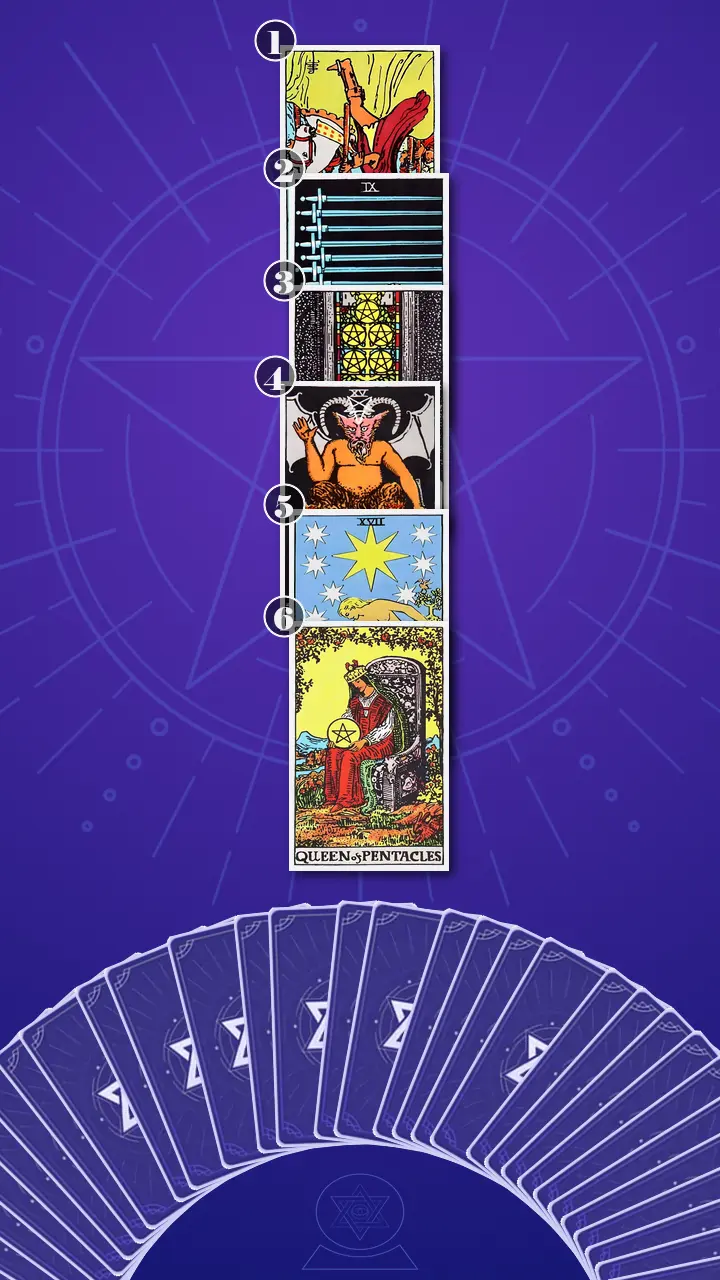
Position 1 — Surface script: how your worth is being measured in real time
“Now turning over,” I said, “is the card representing Surface script: the observable mirror-selfie behavior and how self-worth is being measured in real time.”
Six of Wands, reversed.
In modern life, this card can look exactly like this: you’re in the elevator mirror doing a last-second selfie sprint—not because you’re having fun, but because you want a photo that can land online. The moment you post, you start watching engagement like it’s a performance review for your attractiveness and social value, and your confidence stays on hold until the audience responds.
Reversed, the Six of Wands is Fire energy with the applause turned into a condition. Not “I feel good, therefore I share,” but “I’ll feel good if they approve.” Confidence becomes a lease, not something you own.
“It’s the victory wreath,” I said, tapping the card lightly, “but in 2026 it’s the likes-and-replies crown. And it’s brutal because it pretends to be objective. Like… a KPI.”
Taylor let out a sharp laugh that immediately turned into a wince. “Why do I act like my face is a KPI?”
I didn’t rush past that. “Because your job literally trains you to think in performance dashboards,” I said. “And because somewhere along the way, the mirror got promoted from ‘surface’ to ‘judge.’”
I asked her the question that lives in this position: “In the last elevator-mirror moment, what exactly were you hoping the post would confirm about you—attractive, relevant, doing okay… what?”
She stared at the ceiling for a second. “Safe,” she said. “Like… if I look good, I’ll be safe today.”
Position 2 — Emotional driver: the thought loop that fuels the urge
“Now turning over,” I said, “is the card representing Emotional driver: the immediate feelings and thought patterns that fuel the urge to post or check reactions.”
Nine of Swords, upright.
The Nine of Swords is the post-and-refresh spiral with the volume turned up at night. The swords on the wall are the thoughts you can’t unsee once you start replaying who watched, who didn’t, and what it “means.” It’s lying in bed with your lamp off, blue light dimmed, tapping through your Instagram Stories viewer list like it’s a spreadsheet you can decode.
This is Air energy in excess: hyper-analysis, imagined audience reactions, comparison-scanning. Your body is tired, but your brain is on alert, like you’re defending yourself in a court case that only exists in your head.
“Silence isn’t proof you’re not enough,” I said, and I meant it like a hand on a railing. “It’s just not applause.”
Taylor’s shoulders dropped a millimeter, then lifted again—like her nervous system didn’t fully trust the relief yet. Her jaw flexed. I could almost hear the inner tabs opening: Yes, but… what if it really was cringe?
“When you start checking views or likes,” I asked, “what’s the first sentence that hits—what are you trying not to hear?”
She swallowed. “They saw it and didn’t react… that means it was embarrassing.”
Position 3 — Root belief: the story that makes the mirror high-stakes
“Now turning over,” I said, “is the card representing Root belief: the underlying self-worth story that makes the mirror feel high-stakes.”
Five of Pentacles, upright.
This card is the cold sidewalk outside the warm restaurant window. It’s the feeling of walking past bright East Village patios and suddenly thinking you’re on the outside of something—even if no one actually locked the door. In Taylor’s context, it’s interpreting a quiet post as social exclusion, not neutral scrolling.
Earth energy here is scarcity: “Belonging is limited. If I’m not noticed, I’m not included.” The mirror selfie stops being a photo and becomes a way to buy entry. Like a limited-edition drop you have to earn, except the currency is looking “effortless.”
Taylor’s eyes got glassy for a second, not with tears exactly—more like a memory surfacing. She rubbed her thumb against her index finger again, slower this time.
“If a post is quiet,” I asked, “what do you automatically assume it says about your place in the group—and where do you think you learned that rule?”
“High school,” she said immediately, then grimaced. “And… marketing. Like, if it doesn’t perform, it’s dead.”
“Right,” I said. “And your nervous system doesn’t care that you’re applying a campaign metric to a human being. It just hears: no response equals no worth.”
Position 4 — Shadow payoff: the chain that pretends to be “just checking”
“Now turning over,” I said, “is the card representing Shadow payoff: what the pattern protects you from and what it secretly gives you (and costs you).”
The Devil, upright.
I didn’t dramatize it. I didn’t need to. The Devil shows up in 2026 as automation: you unlock your phone to answer a work notification, and without deciding, your thumb opens Instagram. “Just a quick check,” your mind says—negotiation language. A tiny bargain.
And then the body tells the truth: tight chest, clenched jaw, restless hands. The loop offers short-term certainty—tell me where I stand—and costs you freedom: presence, self-trust, and the ability to feel okay without a receipt.
“This card,” I told her, “isn’t calling you weak. It’s calling the loop addictive. It’s the slot machine lever: refresh, hope, hollow dip. And the wild part is the chains are loose.”
Taylor nodded, but her mouth twisted like she was half-annoyed, half-relieved to have it named. “It really does feel like a chain,” she said quietly.
I felt my own professional flashback—the planetarium dome in Tokyo, the way people look up and ask, Is that star supposed to be there? They want certainty, a fixed point. But celestial motion is a lesson in humility: you don’t control the sky; you learn its rhythm. And you stop confusing “information” with “verdict.”
“Here’s the psychology loop in plain terms,” I said, because I want it to be searchable and usable, not mystical: “Trigger—mirror or scrolling. Belief—‘my value is what people can see and approve.’ Behavior—retake, edit, post, monitor. Short-term relief—a spike of validation. Long-term cost—emptiness, harsher standards, less self-trust. And then the belief strengthens.”
She exhaled through her nose, a tiny frustrated sound. “So what do I do? Delete Instagram?”
“Not unless you want to,” I said. “We’re not doing scorched earth. We’re doing a reframe and an experiment.”
Position 5 — Transformation key: the medicine that restores self-trust
“We’re turning over the most important card now,” I said, and the room felt quieter—like even her laptop fan paused to listen.
“This is the card representing Transformation key: the reframe that directly loosens the self-worth script and restores self-trust.”
The Star, upright.
Setup lived in her face before I even spoke: that tiny elevator pause—phone up, fluorescent buzz overhead, chest tight—where she wasn’t actually asking, “Do I look good?” She was asking, “Will this make me safe today?”
Stop treating the mirror as a judge and start using it like starlight—guidance that helps you navigate, not a spotlight you must earn.
Her reaction came in a chain, not a single beat: first a stillness—her breath stopped mid-inhale, eyes fixed as if the sentence had physically pinned the air. Then her gaze went slightly unfocused, like she was replaying a week of elevator doors opening, subway-window reflections, the Story viewer list at 11:48 p.m. Then her shoulders dropped, heavy, and she let out a long exhale that sounded almost embarrassed. “Oh,” she whispered. “I don’t have to keep proving it.”
I leaned in, keeping it practical. “The Star doesn’t tell you to stop caring about style. It changes the motive. It’s you saying: I can be seen by myself first.”
And this is where I used my own tool—what I call Pulsar Breathing. In astronomy, pulsars are stars that send out incredibly regular pulses. When your mind is a browser with seventeen tabs open—every tab titled What did they think of me?—you need rhythm, not more analysis.
“Try this with me,” I said. “Four counts in, six counts out. Like you’re syncing to a steady signal. Not to force calm—just to give your body a beat that isn’t the app.”
Her shoulders softened further. Her hands, which had been hovering and fidgeting, settled in her lap. Then she frowned, a flash of resistance—an unexpected spark. “But if I stop treating it like a judge,” she said, “doesn’t that mean… I was wrong this whole time? Like I wasted years being obsessed?”
I nodded, because that’s real. “It can feel like that,” I said. “But I don’t see it as ‘wrong.’ I see it as a coping strategy you outgrew. You did what worked to feel safe in a visibility-driven world. Now we’re upgrading the system.”
“Now,” I asked, right on the edge of the insight, “with this new lens—was there a moment last week where this would’ve changed how you felt? A moment where you reached to check, not for information, but for relief?”
She blinked hard. “Wednesday morning. I opened my phone to answer an email and ended up on Instagram. I didn’t even choose it.”
“That’s your data point,” I said. “And The Star is the contrast: expression is a choice, approval is a gamble. This is you moving from borrowed confidence to stable confidence—step by step.”
Position 6 — Integration step: building a life that holds you when metrics don’t
“Now turning over,” I said, “is the card representing Integration step: a practical, embodied next step that stabilizes worth beyond the app.”
Queen of Pentacles, upright.
If The Star is the night sky—wide, honest, unperformative—then the Queen of Pentacles is your kitchen table. She’s worth held close, not broadcast for permission. Earth energy here is balanced: care, consistency, embodied safety.
In Taylor’s world, this looks like: eating a real lunch away from your screen, taking a ten-minute walk without filming it, setting one reversible phone boundary, doing something that tells your body, I’m not on trial today.
“Build a life that holds you when the metrics don’t,” I told her. “Because the opposite of the mirror-selfie validation loop isn’t ‘never post.’ It’s ‘my day doesn’t rise and fall with a number.’”
She nodded slowly. “I think I need… something to do. Like a rule. My brain negotiates.”
“Perfect,” I said. “We’ll make the boundary external.”
The ‘Mirror-to-Starlight’ Reset: Actionable Advice for the Next 48 Hours
I threaded the whole ladder back into one story—so she could feel it as a system, not a personal flaw.
“Here’s what I see,” I said. “At the top, you’re using the elevator mirror like a public scoreboard—waiting for a wreath of engagement to authorize your confidence. Under that, your mind runs a Nine of Swords loop: replay, compare, predict judgment. Under that is a Five of Pentacles belief: belonging feels scarce, like you have to earn entry with presentation. And The Devil is the glue: the checking ritual gives you a hit of certainty—then quietly charges you your self-trust.”
“The cognitive blind spot,” I added, “is that you’re treating silence as evidence in a trial about your worth. Silence is an empty data point. Your nervous system is the one writing the verdict.”
“So the transformation direction is clear,” I said. “We shift from ‘Will they approve of how I look?’ to ‘What am I choosing to express—and why?’ That’s The Star. And we stabilize it with Queen of Pentacles routines.”
- The 60-Second “Mirror as Reflection” CheckIn the elevator, lobby mirror, or bathroom: name 3 neutral facts out loud (“blue shirt,” “tired eyes,” “hair up”), then name 1 choice you’re making today that has nothing to do with looks (“I’m going to speak up once in the meeting”).If it feels cheesy, do the 20-second version. Awkward is a sign you found where the script lives.
- The 10-Minute Edit Rule (Timer Boundary)Pick one photo. Set a 10-minute timer. Edit/crop within that window only. When it goes off: no more edits. You either post or you don’t—both outcomes count as practice.Your brain will argue “one more tweak prevents embarrassment.” Treat that as the loop speaking. Let the timer be the adult in the room.
- The Post + Care Pairing ProtocolIf you post, immediately do one grounding action: drink water, stretch your neck/shoulders for 60 seconds, or step outside for two minutes. If you’re tempted to check views, pair it with Pulsar Breathing (4 counts in, 6 counts out) for two minutes first.Make the environment help you: let a steady background sound (even your building’s laundry room / washing machine hum) be your “cosmic meditation” track while you ride out the urge.
Before we ended, I offered Taylor one more tiny experiment from The Star—something she could actually do on a Tuesday without turning her life into a self-improvement project.
“Before you post,” I said, “write one private line in Notes: ‘I’m sharing this to express ___, not to earn ___.’ Then set a timer for ten minutes where you don’t check. If ten minutes is too edgy, do two. You can stop anytime—this is practice, not punishment.”

A Week Later: The Quiet Proof
A week later, Taylor messaged me a screenshot—not of her Story views, but of her Notes app. One line, exactly as we wrote it: “I’m expressing: sharpness + color. Not earning: being chosen.”
Under it she wrote: “I did the 10-minute rule. I posted. I wanted to check so badly. I did the breathing instead. Two minutes. Then I went to make coffee. It wasn’t magical, but I didn’t spiral.”
Her bittersweet proof came in the smallest detail: she said she slept through the night for the first time in weeks—then admitted her first thought in the morning was still, “What if it flopped?” Only this time, she noticed the thought, exhaled, and didn’t reach for her phone like it was oxygen.
That’s the Journey to Clarity I care about. Not “you never feel insecure again.” But: the mirror stops being a courtroom. The app stops being a verdict. You get your hands back.
When the attention drops off, it can feel like the floor drops with it—like your worth was only real while someone was looking.
If you didn’t need the mirror (or the app) to approve you today, what’s one small thing you’d choose to express—purely because it feels like you?
This story is adapted from psychological research, written so that those in a similar struggle can see their own pattern in it — and find their next step clearly.These insights are not a substitute for professional psychological, medical, legal, or financial advice.
Learn more about our Journey to Clarity.
How did this insight land for you?
🫂 This Resonates Deeply
🌀 Living This Story
✨ Now I See Clearly
🌱 Seeing New Possibilities
🧰 Useful Framework
🔮 The Confirmation I Needed
💪 Feeling Empowered
🚀 Ready for My Next Step
Author Profile
 AI
AI“After a decade of guiding people through the stars, I’ve come to see life much like the orbits of planets: everything has its inevitable cycles. When you feel lost, please don't blame yourself; you might just be in a natural low tide. I’m here to sit under the night sky with you, offering a gentle cosmic perspective to distinguish temporary pain from the beautiful breakthroughs just around the corner.”
In this Personal Growth Tarot Reading :
Core Expertise
- Cognitive Spiral Mapping: Validating that feeling 'stuck' is often just a necessary orbital slingshot phase before a major intellectual breakthrough.
- Gravity Well Identification: Diagnosing the obsolete habits or environments exerting a downward pull on your personal evolution.
Service Features
- The Orbit Expansion Strategy: A macro-perspective exercise to map the precise trajectory and momentum needed to escape your current cognitive gravity well.
Also specializes in :
Explore Related Patterns:
External ValidationTaylor taking rapid-fire photos in the Midtown elevator is framed as a confidence audit, not a casual selfie. The phone becomes a measuring device, and the audience response becomes the data she hopes will confirm that she is attractive, relevant, and safe enough to walk into the day. That is the core mechanism of External Validation: worth is temporarily outsourced to visible feedback. Likes, replies, silence, and Story viewers are treated as emotional evidence, so the self does not get to feel stable until the outside world has responded. You can feel the cost in the line about needing proof to feel okay. The approval is not simply enjoyable; it becomes a receipt for self-worth. Once the app is asked to certify value, every quiet post becomes another audit, and confidence stays rented from the audience instead of held internally.
Appearance PerfectionismTaylor asking why she acts like her face is a KPI captures the pressure point exactly. The elevator mirror, the fluorescent light, the repeated photos, and the concern about whether the image will land all turn appearance into a performance dashboard. Appearance Perfectionism is active when visual presentation is used as a safety strategy. The nervous system is not just asking whether the photo looks good; it is asking whether looking good will protect you from embarrassment, exclusion, or being overlooked. The script becomes exhausting because no angle can fully answer a self-worth question. You can optimize the image and still feel unsafe, because the deeper fear is not bad lighting; it is the belief that being acceptable depends on being visually convincing enough.
Compulsive CheckingTaylor opening her phone to answer an email and landing on Instagram without choosing it shows that the checking has moved from decision into reflex. The viewer list is no longer just information; it has become a place the nervous system goes when it wants relief. Compulsive Checking forms when uncertainty feels intolerable and the mind learns to lower discomfort through repeated monitoring. The problem is that each check answers the fear for only a moment, then trains the body to ask again. The ritual promises clarity but keeps the original question alive. You can see the loop in the body details: tight chest, clenched jaw, restless hands, and the urge to check after posting. The pattern is not a lack of willpower; it is a conditioned relief cycle where the app becomes the fastest available way to regulate doubt.
Rejection SensitivityTaylor's sentence they saw it and did not react, that means it was embarrassing shows the speed of the rejection read. The story does not present direct criticism; the pain comes from silence being converted into a verdict. Rejection Sensitivity turns ambiguous social data into threat data. A quiet Story, a missing reply, or a neutral viewer list becomes evidence that you have been judged, excluded, or exposed, even when the situation itself contains much less information than the nervous system claims. The self-worth script here is subtle but powerful: if they do not respond, I must have done something wrong. Once that rule is running, you are not just checking engagement; you are scanning for social injury before it is even confirmed.
Scarcity MindsetTaylor connects the quiet-post panic to high school and marketing, where performance seemed to decide whether something was alive, noticed, or socially relevant. That history gives the elevator selfie a scarcity charge: attention starts to feel like limited entry into the group. Scarcity Mindset is not just wanting attention. It is the belief that belonging is rationed, that visibility must be earned, and that being overlooked means there may not be enough social space for you. The mirror selfie becomes a bid for inclusion, not merely an expression of style. You can hear the rule underneath the image: if I am not noticed, I am not included. That belief makes ordinary silence feel like exclusion, and it turns every post into a test of whether there is still a place for you.
Anxiety SpiralTaylor lying awake and reading the Stories viewer list like a spreadsheet shows how quickly the selfie turns into a thought loop. The post is over, but the mind keeps reopening the case: who watched, who stayed silent, what that silence means, and whether the whole thing was embarrassing. Anxiety Spiral is the mechanism where one uncertain cue creates another prediction, then another interpretation, then another body alarm. It feels like analysis, but it does not produce clarity because the mind is trying to solve self-worth through imagined audience reactions. You can recognize the spiral by its repetitive shape. The question shifts from did I post something I like to what if they judged me, then what if this proves something about me. That movement turns a small social signal into a full nervous-system event.
Intermittent ReinforcementTaylor wanting to check so badly after posting, even after setting the 10-minute rule, shows how the reward schedule keeps the loop alive. The next view or reply might soothe the fear, so the mind keeps reaching for one more update. Intermittent Reinforcement works because the reward is inconsistent. Sometimes the post gets a response and produces a spike of relief; sometimes it stays quiet and creates a hollow dip. That unpredictability makes the checking more sticky, because the nervous system keeps waiting for the next piece of proof. The pattern matters because it explains why insight alone may not stop the behavior. You can understand the loop and still feel pulled toward the metric, because the variable reward has trained your attention to treat the next refresh as the one that might finally settle your worth.
Secure VisibilityTaylor writing I am expressing sharpness and color, not earning being chosen is the first clean separation between visibility and permission. The post can exist as expression instead of becoming a public exam of whether she deserves to feel okay. Secure Visibility is the adaptive pattern that starts forming when being seen no longer requires surrendering self-trust to the audience. You can still care about style, still post, still feel the pull to check, and still choose a boundary that keeps your worth with you. The week-later detail matters: she wanted to check, did the breathing, made coffee, noticed the what if it flopped thought, and did not reach for the phone like oxygen. That is not perfect confidence; it is a stronger self-system learning to stay present when the metrics do not immediately soothe it.
Explore Related Struggles:
Approval-Safety FusionTaylor's phone rises in the Midtown elevator while her chest tightens and her fingers stall between Add to Story and Delete. The key detail is her own answer: if she looks good, she will be safe today; the post is being asked to regulate the whole day before it starts. That turns approval from a pleasant response into a safety signal. You may recognize the same inner contract when being seen stops feeling optional and starts feeling like evidence that you are allowed to relax. The struggle is not vanity; it is the way external confirmation gets recruited to do the job of inner steadiness. Once approval carries safety, silence becomes disproportionately loud. A quiet Story does not stay neutral; it gets translated into exposure, embarrassment, or exclusion. Clarity begins when you can separate the body's need for a railing from the audience's unreliable reaction cycle.
Metric-Compass FusionTaylor taps through Story viewers at night like the list is a spreadsheet with a hidden answer. The app is no longer just reflecting attention; it is being used as a compass for whether she should trust herself. That is the pressure point: metrics are clean, fast, and visible, while self-trust is slower and harder to quantify. You may reach for numbers because they seem objective, but the story shows how easily the numbers become a verdict when the actual question is about belonging and worth. The struggle forms when empty data points start steering emotional direction. Silence, views, and replies become navigational instruments, even though they cannot tell you what your expression meant or whether your day is allowed to feel stable.
Performance-Worth FusionTaylor jokes that her face has become a KPI, but the story keeps proving the line is not really a joke. The elevator mirror, the office dashboard mindset, and the Story response all merge into one performance surface where attractiveness and social value are treated like measurable output. You can feel the friction in the way the selfie is not simply expression. It has to land, perform, and produce a readable return before confidence is allowed to settle. When worth is fused to performance, the self becomes a campaign that is always being optimized and never fully held. The cost is that every ordinary human signal starts acting like a scorecard. A post that gets quiet engagement can feel less like a post and more like failed proof of being relevant, chosen, or okay.
Monitoring-Safety FusionTaylor opens her phone to answer an email and ends up on Instagram without really choosing it. The same chain appears in the elevator, in bed, and a week later after posting: reach, check, interpret, briefly settle, then feel the urge build again. The monitoring gives her a short hit of certainty, but it also trains the body to seek safety through another scan. You can see the trap in the way checking is framed as information, while the body is actually asking for relief. The clearest shift happens when she notices the thought, 'What if it flopped?' and does not reach for her phone like it is oxygen. That moment matters because the safety signal starts moving from the feed back into her own body and choices.
Status-Belonging FusionTaylor does not read a quiet post as neutral scrolling; she reads it as being outside the room. The story ties that rule to high school and to marketing culture, where not performing can start to sound like not mattering. Belonging becomes scarce under that rule. You are not simply sharing a photo; you are trying to earn entry into a group that seems to admit people through effortless visibility, attractiveness, and response. The struggle is the fusion of social status with relational inclusion. When attention drops, the floor feels like it drops too, because the nervous system has learned to treat being noticed as proof that there is still a place for you.
Explore Related Emotions:
Approval AnxietyTaylor says the ache out loud: if she does not post it, did it even happen, and she hates needing proof that she is attractive to feel okay. Her fingers hovering between Add to Story and Delete show the exact hinge where expression stops being casual and starts waiting for permission. Approval Anxiety names the feeling of confidence being leased to an audience. You can want to be seen without making every response into a referendum, but in this story the body keeps bracing until someone else confirms that the image landed and that you are safe enough to settle.
Conditional Belonging FearTaylor does not read a quiet post as neutral scrolling; she reads it as exclusion. The rule underneath is brutally simple in her own words and in the session's mapping: if she is not noticed, she is not included, and no response starts sounding like no worth. Conditional Belonging Fear fits because belonging feels like something that has to be earned through presentation. You are not only hoping for likes; you are trying to secure your place in the room, and the attention drop feels so physical because the story has made visibility stand in for safety.
Verdict DreadTaylor lies in bed tapping through her Story viewer list like it is a spreadsheet she can decode, replaying who watched, who did not, and what that might mean. Silence becomes evidence in a private trial, even when nothing in the silence can actually prove the case. Verdict Dread captures the moment the app stops being a tool and starts acting like a ruling body. You are not just waiting for feedback; you are bracing for a decision about your worth, and every empty data point feels loaded because the nervous system has started writing the verdict before the world has said anything clear.
Self-Audit AnxietyTaylor takes rapid-fire elevator photos under the fluorescent buzz, pretending she is only checking her hair while her chest tightens and her fingers hover between posting and deleting. The mirror is not just reflecting an outfit; it is being used as a live dashboard for whether you are allowed to feel okay before the office day starts. Self-Audit Anxiety fits because the story keeps turning self-worth into a review process. You are not simply asking whether the photo looks good; you are trying to make an unstable inner feeling produce a clean score, and the body tightens under the pressure of being both the person on camera and the person grading the result.
Cautious Self-TrustA week later, Taylor posts, wants to check badly, breathes for two minutes, and goes to make coffee. The first thought in the morning is still What if it flopped, but this time she notices it, exhales, and does not reach for her phone like oxygen. Cautious Self-Trust fits because the story does not pretend the old script vanishes. You are building trust in small pauses, not in a perfect personality overhaul, and the meaningful shift is that the urge can be present without getting full control of your hands.
Grounded AgencyTaylor's Notes line changes the entire posture of the moment: I am expressing sharpness and color, not earning being chosen. Alongside lunch away from the screen, a walk without filming, and a reversible phone boundary, posting becomes something she can choose rather than something she has to submit to. Grounded Agency fits because the story restores action to the body before it asks the app for anything. You can still care about style, visibility, and expression, while refusing to outsource the reason for showing up to a number on a screen.
Hollow RecognitionTaylor's loop offers short-term certainty: retake, edit, post, monitor, feel the spike, then hit the hollow dip. The story is clear that recognition arrives like a receipt, but the receipt does not keep her steady for long. Hollow Recognition fits because the attention gives proof without nourishment. You can be seen and still feel underfed by the result, especially when each hit of validation quietly raises the next standard and leaves less self-trust behind.
Hypervigilant AnxietyEven over video, Taylor's hands keep moving in tiny restless patterns, as if they are refreshing an invisible screen. At night her body is tired but her brain stays on alert, scanning the viewer list, imagined reactions, and the morning question of whether the post flopped. Hypervigilant Anxiety fits because her attention keeps treating micro-signals as threat data. You are not calmly checking information; you are monitoring the social field for signs that something about you has become embarrassing, unapproved, or unsafe.
Explore Related Contexts:
Algorithmic Comparison LoopTaylor lies in the aftermath of posting by checking who watched, who did not, and what the silence might mean. The viewer list starts functioning like a spreadsheet she is trying to decode, even though the data cannot actually tell her whether she belongs. Algorithmic Comparison Loop is anchored in the way platform signals turn ordinary social ambiguity into ranked evidence. Views, likes, replies, and non-responses appear measurable, but the story shows how quickly those metrics become a distorted comparison field where other people's attention is treated as a verdict. For You, this context points to the external architecture around the self-worth script. The app supplies partial numbers and visible traces, then leaves you to fill in the missing meaning, which keeps your attention circulating through comparison instead of returning to your own choice and perspective.
Conditional Belonging PressureTaylor says that if a post is quiet, she automatically reads it as embarrassing and exclusionary. In her own words, if the image does not perform, it feels dead, and if she is not noticed, she starts questioning whether she is still included. Conditional Belonging Pressure captures the social rule underneath the elevator moment: visibility becomes the price of entry. The selfie is not only about appearance; it becomes a bid for proof that she has a place in the group, and that proof must be renewed through attention. For You, the script being replayed is built around conditional access. The outside world has trained the check to feel urgent because belonging appears scarce, distributed through reactions, and easily withdrawn when the room goes quiet.
Evaluation Pressure LoopTaylor asks why she acts like her face is a KPI, and the story answers through the setting: she is a marketing associate entering an office where performance dashboards are part of the daily language. The elevator mirror becomes the place where that review culture gets applied to her body and image. Evaluation Pressure Loop fits because the external structure is built around repeated assessment. The selfie, the Story views, the imagined audience, and the work-trained metric mindset all turn appearance into something to be checked, scored, and corrected. For You, this context shows why the mirror can feel so high-stakes. The issue is not a single insecure moment; it is an evaluation environment that keeps asking for evidence before it lets confidence feel legitimate.
Personal Brand PerformanceTaylor is a junior marketing associate walking into a Midtown office while treating an elevator selfie like a last-minute audit of whether she looks credible, attractive, and socially safe enough for the day. The story explicitly ties her work environment to dashboard thinking: if a campaign does not perform, it is dead, and that same logic gets transferred onto her face. That is the structure of Personal Brand Performance: the self becomes a public-facing asset that needs to look effortless, land correctly, and generate visible proof of relevance. The elevator is not just a mirror scene; it is a workplace-adjacent checkpoint where office identity, appearance, and platform visibility collapse into the same review system. For You, the pressure is not simply about taking a photo. It is about living in a social economy where being seen can feel like a metric, and where confidence starts depending on whether the audience confirms the version of yourself you tried to package.
Social Performance LoopTaylor takes rapid-fire photos in the elevator, pretends she is just checking her hair, then gets stuck between Add to Story and Delete. Once the image is posted, the attention around it becomes a live readout of whether she is attractive, relevant, and okay. Social Performance Loop fits because the story shows a repeatable circuit rather than a one-off selfie: capture, post, monitor, interpret, then return to the same behavior for another hit of confirmation. The app becomes a stage, the mirror becomes a backstage checkpoint, and every silence or response becomes part of the performance data. For You, this context names the external script wrapped around the behavior. The problem is not vanity; it is a social environment that rewards constant display while giving unstable feedback, keeping your sense of worth tied to whether the performance lands this time.
Safe Visibility TrialTaylor does not delete the app or abandon posting; she writes a private Notes line before sharing, uses the 10-minute rule, and delays checking reactions. A week later, the proof is not a Story view count but a screenshot of the intention she wrote before posting. Safe Visibility Trial names the new external container being tested. The story shows Taylor building a way to be seen that includes boundaries, intention, and a pause between expression and audience feedback, so visibility no longer has to operate as a public verdict. For You, this is the constructive edge of the same mirror script. You are not being asked to disappear; you are experimenting with being visible on terms that protect choice, timing, and self-trust while the old metric reflex is still present.