Finding Clarity in the 8:47 p.m. Birthday Text
When a capable mid-20s daughter can run a client deck, remember everyone else’s birthdays, and still go completely blank when her dad texts, “What do you want for your birthday?” on the TTC ride home, I know I am not looking at indecision. I am looking at a practiced form of self-protection.
Maya brought me exactly that question. Across my screen, she sat in her small Toronto kitchen and told me about 8:47 p.m. on Line 1 southbound after work: the carriage humming, someone’s takeout smelling like garlic and fried onions, her phone throwing cold light over her hands. Her dad’s text was simple. Her body was not. Her throat tightened, her stomach dropped, her thumb hovered over the keyboard, and the real answer never made it past the typing bubble. She sent, “haha honestly nothing.”
Then she said the part that mattered most: “I want him to know me, and I also want the whole moment over before it gets weird.” There was the full contradiction in one sentence: wanting a real answer to what she wanted for her birthday, and saying “nothing” the moment Dad asked.
To me, her vulnerability had the feeling of standing at the subway door and stepping back just before it opens. Movement was already in the body; retreat came even faster. I told her, as gently and plainly as I could, “That makes sense. Your mind is not blank because you want nothing. It goes blank because wanting suddenly feels risky. Let’s make a map for that.”

Choosing the Compass: The Shadow Spread for Family Receiving Patterns
I asked Maya to place both feet on the kitchen floor and take one ordinary breath while I shuffled. I never treat this part as theatre. At its best, tarot is a focusing tool: a way to move from reaction into observation, from blur into pattern.
For her question, I chose The Shadow Spread, a four-card layout I use when a small behavior hides a layered emotional logic. This was not a reading about predicting a gift. It was about understanding why saying “nothing” when asked what you want can become such an automatic response. The Shadow Spread is ideal for that because it stays psychologically coherent: it follows the chain from the visible shutdown, to the vulnerable fear underneath, to the inner resource that can soften the pattern, and finally to the practical relational next step.
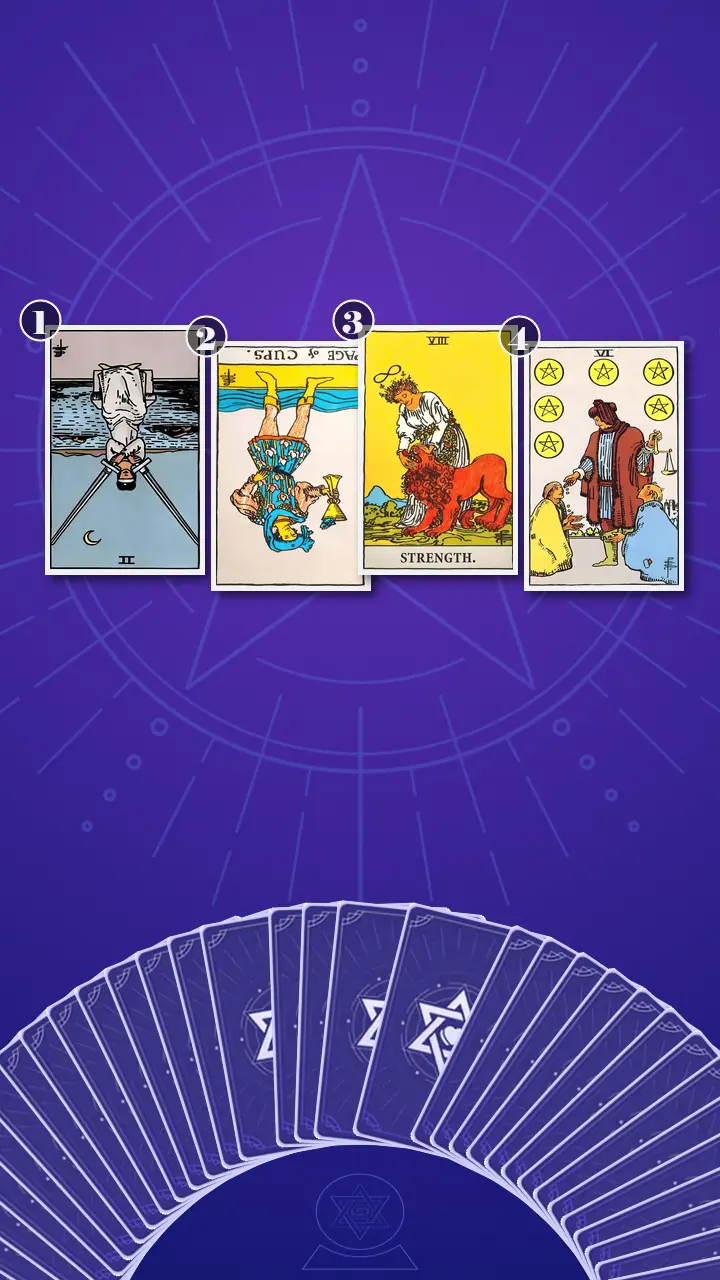
The first card would show the conscious defense in the exact moment her dad asked the birthday question. The second would show the hidden wound under it. The third card, the key turning point of the reading, would reveal the medicine that helps her stay present with desire instead of shutting it down. The fourth would show how to make receiving concrete, balanced, and easier to act on in real life.
Reading the Freeze: Deleted Drafts and Half-Formed Wants
The Card That Says “I’m Good”
The first card I turned over was the one representing the concrete shutdown behavior in the moment Dad asks the birthday question, including the freeze, the self-editing, and the refusal to name a preference. It was the Two of Swords, reversed.
In real life, this card meaning was immediate. Dad asks by text or on a family call, and Maya’s whole system goes into polite buffering mode. She laughs, buys time, says “I don’t know” or “nothing,” and gives the safest possible non-answer before her real preference can fully form. It felt a little Severance-coded to me: the inward self has a preference, but the outward self only knows how to keep the interaction smooth.
Reversed here, the energy is blocked air. Thought is not helping her choose; thought is crossing its swords over her chest and stopping the answer at the throat. The blindfold is that automatic low-maintenance setting. The issue is not a lack of desire. The issue is that direct attention makes desire feel exposing. What looks like maturity is often just a very fast exit.
When I said, “What if ‘nothing’ is not honesty at all, just the fastest exit?” Maya gave a short laugh with a bitter edge. “Okay,” she said, lowering her eyes to her mug, “that’s accurate enough to be a little rude.” I smiled, because that kind of reaction usually means the card has found the nerve beneath the story.
The Wish That Gets Judged Before It Speaks
The second card sat in the position that reveals the vulnerable fear beneath the behavior, especially the expectation that wanting something could lead to dismissal, awkwardness, or disappointment. It was the Page of Cups, reversed.
This is the half-second where a real wish shows up alive: a hardcover novel, silver hoops, AGO tickets, a museum membership. Then the inner commentary lands hard and fast: silly, random, too much, hard to justify. Alone on her lunch break, she can scroll saved tabs and know exactly what she likes. Under direct family attention, that same desire suddenly feels like a pop quiz she did not study for.
Reversed, this is stalled water. Feeling appears, but it is not trusted. The fish rising from the cup is that shy little preference surfacing before it gets judged back underground. This is where the deleted-draft energy lives: the real text forms, and then the inner editor jumps in with don’t be needy, don’t be weird, don’t make it a whole thing. A lot of “I’m fine” is really “I don’t know if it’s safe to be specific with you.”
Her fingers tightened once around the mug handle, then slowly released. Her gaze drifted off-camera, and I could almost see the memory replaying behind her eyes: tabs closing, jokes arriving too quickly, softness getting cut off before anyone else could respond to it. “That’s the worst part,” she said quietly. “Sometimes nobody has even done anything yet. I reject it before they can.”
When Strength Put a Hand on the Lion
The Turning Point in the Kitchen
When I turned the third card, the atmosphere changed. On Maya’s end, the kettle clicked off, and the sudden quiet in her kitchen seemed to outline the moment. This was the card in the position that identifies the inner quality that can interrupt the pattern by helping her stay present with desire instead of shutting it down. It was Strength, upright.
Before I interpreted it, I named what I was seeing. Maya was not actually confused about what she liked. She was caught in a familiar loop of going blank under direct attention, as if the safest answer had to be the smallest one. In my practice, I call this a Family Rhythm Audit: not deciding who is wrong, but noticing the choreography a body learns inside a relationship. Question. Laugh. Fridge door. Subject change. Once I can help someone see the rhythm, we can change one beat.
Stop treating silence as maturity; let Strength's calm hands steady the lion of fear so one honest wish can leave your mouth.
I let the sentence breathe in the quiet between us.
Then I told her what Strength meant in context. Not force. Not becoming demanding. Not a personality makeover. I grew up in the Highlands watching my grandmother approach nervous animals after bad weather, never with more noise, always with more steadiness. Strength has always felt like that to me. Fear does not need humiliating. It needs a handhold. In Maya’s life, that means keeping her feet on the kitchen floor, one hand on the counter, feeling the tight throat and the stomach drop, and still answering with one calm, specific sentence. Nervous-system seatbelts, not a whole new personality.
She moved through the insight in three clear waves. First came stillness: her breath paused halfway in, and even her fingertips stopped against the mug. Then came the mental replay; her eyes unfocused slightly, as if she were back in that Sunday kitchen, opening the fridge for no reason, hearing her dad ask again, feeling the old reflex to joke and disappear. Then the emotion landed. Her shoulders dropped a full inch. Her jaw unclenched. Her eyes took on that startled, almost-annoyed shine people get when relief arrives carrying responsibility with it.
“But if I stay and answer,” she said, and there was a flash of resistance in it, “doesn’t that mean I’ve been doing it wrong this whole time?”
I shook my head. “No. It means your system found a clever way to protect you, and now you’re ready for a better one. Wanting less is not the same as being easier to love. You are not safer because you want less; you become safer when you can stay steady enough to name one real desire.”
I asked her, “Now, with this new angle, can you think of a moment last week when this would have changed how you felt?”
She nodded slowly. “If I’d just said, ‘A bookstore gift card,’ and let the silence happen, I think I would’ve felt awkward for ten seconds. Not… hollow for the rest of the night.”
That was the hinge of the reading for me: the first real step from low-maintenance self-erasure to steady, specific receiving.
The Card That Makes Receiving Workable
The fourth card appeared in the position that shows the practical relational expression of the shift: how to name one real want and allow a more balanced exchange. It was the Six of Pentacles, upright.
This card brought the whole reading down into earth. In modern life, it looks like one clear text: one book title, one link, one dinner spot, one price range. Instead of forcing Dad to guess or pass an emotional mind-reading test, Maya gives him something usable. The scales and open hands on the card matter here. They remind us that a birthday question is not a referendum on whether you are too much. It is an exchange.
Upright, the energy is balance. Not excess. Not burden. Not drama. A clear preference is information, not inconvenience. Giving someone nothing to work with does not create closeness; it creates guesswork.
Maya let out the first real exhale of the session and gave me a small, almost disbelieving smile. “That feels way less emotionally loaded than how I’ve been doing it,” she said. Exactly. The point was never to become easier. The point was to become clearer.
From Guesswork to a Usable Answer
By the time I laid the four cards together, the story was clean. First came the blindfold and crossed swords: the visible freeze, the blank answer, the shutdown that looks polite from the outside. Then came the shy fish from the cup: the real wish that surfaces and gets judged before anyone else can touch it. Then Strength arrived, warm and steady, showing that the pattern changes not through force but through regulated vulnerability. Finally, the open hands of the Six of Pentacles grounded everything into reciprocity: not telepathy, not testing, just usable care moving both ways.
The blind spot was equally clear. Maya had been mistaking the urge to escape discomfort for proof that her preference was unreasonable. She had been treating self-erasure as maturity. But “nothing” was not honesty; it was fear in a low-maintenance outfit. The transformation direction was simple, though not effortless: move from protecting yourself by having no preference to practicing one small, specific request. Do not build a whole identity out of one protective answer.
- The Two-Beat Pause MethodBefore your next family call, stand in your kitchen or bathroom, place both feet on the floor, and say one birthday preference out loud exactly once: “I’d actually love a bookstore gift card,” or “Dinner at ___ would make me happy.” Then, when Dad asks, take one full breath and let two beats of silence exist before you answer.This is my Environmental Regulation approach: use a stable physical spot so your body has less to manage. If the full sentence feels too big, practice just the noun first.
- The No-Disclaimer TextThis week, text Dad one specific option: a book title, AGO tickets, a restaurant, or a link with a price range. If one answer feels too exposed, send two doable options and let him choose between them.Draft the softeners if you need to, then delete “but only if it’s easy” before sending. Clarity is usable; apology is optional.
- The Birthday Wants NoteSpend five minutes making a private Notes app list called “birthday wants.” Write down five things you would genuinely enjoy, from candles to concert tickets to brunch at a specific place. Circle the one that makes you think, “ugh, that’s silly,” and say that one aloud to a trusted friend first if family still feels too charged.Keep the list low-stakes and within a budget your nervous system can tolerate. Honesty lands more easily when it is not also fighting budget panic.

A Week Later, the Quiet Proof
A week later, Maya messaged me. “I sent two options,” she wrote. “AGO tickets or the hardcover. No disclaimer. He picked the book.” Then, after a beat: “It felt weird for like twelve seconds, then surprisingly normal.”
She added one line I loved because it was small and honest: she had slept through the night, but when she woke the next morning, her first thought was still, was that cringe? This time, she laughed, put the kettle on, and let the answer stand.
That is what I trust about a reading like this. The cards did not rescue her by magic. The Shadow Spread simply showed her where the old shutdown lived, where the younger fear hid, and where her next bit of leverage actually was. Clarity began the moment receiving stopped being a test of whether she was too much and became one workable, human exchange.
Sometimes the loneliest part is not that nobody asked, but that someone did—and your throat still closed because wanting anything felt like too much proof you might not be safely held.
If that lands somewhere tender in you, then the next time someone says, “Just send me the link :)”, what is one small, specific thing—a bookstore card, a dinner spot, a hardcover title—you might let yourself want out loud?
This story is adapted from psychological research, written so that those in a similar struggle can see their own pattern in it — and find their next step clearly.These insights are not a substitute for professional psychological, medical, legal, or financial advice.
Learn more about our Journey to Clarity.
How did this insight land for you?
🫂 This Resonates Deeply
🌀 Living This Story
✨ Now I See Clearly
🌱 Seeing New Possibilities
🧰 Useful Framework
🔮 The Confirmation I Needed
💪 Feeling Empowered
🚀 Ready for My Next Step
Author Profile
 AI
AI“As the seventh generation of a Highland healing family, I see modern anxieties as a simple, temporary disconnection from nature's rhythm. I bring 67 years of lived seasons not to instruct you, but to hold space for you. Using tarot as a mirror, I want to gently guide you out of the chaos, helping you breathe deeply and rediscover the organic, steady heartbeat of your own life.”
In this Family Tarot Reading :
Core Expertise
Service Features
Also specializes in :
Explore Related Patterns:
Assertive CommunicationMaya's shift happens when she sends two clear options, AGO tickets or the hardcover, with no disclaimer. The change is concrete: she stops asking her dad to infer the real answer from 'nothing' and gives him usable information. The psychological mechanism is assertive communication at a low, tolerable dose. She is not becoming demanding; she is letting a preference be visible without wrapping it in apology, overexplaining, or emotional camouflage. You can see Assertive Communication in the movement from guesswork to a workable exchange. The sentence is small, but it changes the relational contract: her desire is allowed to be named, and the other person is allowed to respond to something real.
Emotional Self-CensorshipThe real answer stopping at the typing bubble is the central tell. Maya does not simply lack a preference; she edits the preference out before it can enter the relationship, then sends a socially frictionless answer that protects the interaction from becoming emotionally specific. The mechanism underneath is emotional censorship dressed as politeness. Her inner editor gets there before her dad does, labeling the wish as needy, weird, too much, or hard to justify, and the safer outward self performs low-maintenance ease. You can feel Emotional Self-Censorship in the mismatch between wanting to be known and refusing to provide knowable information. The pattern keeps the moment smooth, but it also makes closeness harder because Dad is left with guesswork while Maya is left with the hollow aftertaste of having disappeared her own want.
Family Pattern RecognitionThe story becomes clearer when Maya sees the sequence as a family rhythm: question, laugh, fridge door, subject change. Naming the choreography turns the birthday text from a personal failure into a pattern she can observe. The mechanism is pattern recognition with enough emotional distance to create choice. Instead of collapsing into 'why am I like this,' she can see the learned sequence and identify the exact beat where a new response is possible. You can see Family Pattern Recognition in the move from automatic 'nothing' to two clean options. The insight does not blame the family or excuse the shutdown; it gives Maya a map of where the old response lives and where she can interrupt it.
Family Role RegressionMaya is capable in adult contexts, but the dad birthday text pulls her into a different script. The story names the choreography clearly: question, laugh, fridge door, subject change, with the smallest possible answer stepping in before the adult preference can stay present. The mechanism is not general incompetence; it is role regression inside a familiar family rhythm. Her system returns to an older relational posture where being easy, vague, and quickly redirected feels safer than being specific. You can see Family Role Regression in the contrast between the client-deck version of Maya and the daughter who goes blank under direct family attention. The pattern answers her question because 'nothing' is not a preference; it is the old role taking the microphone.
Freeze ResponseMaya's throat tightening, stomach dropping, and hovering thumb show that the birthday text is not producing ordinary indecision. Her body reacts before her reasoning can organize itself, and the answer 'haha honestly nothing' becomes a shutdown response that gets the interaction over before the vulnerable truth has to be visible. The defensive logic is clean: if wanting feels exposing, going blank creates instant safety. The mind does not need to decide whether a hardcover, AGO tickets, or silver hoops are reasonable; it can cross the whole category of wanting off the page and preserve the smoothness of the moment. You can see the Freeze Response in the gap between her private clarity and her public answer. She knows what she likes when she is alone, but under direct family attention her nervous system treats specificity as risk, so 'nothing' becomes the fastest exit from discomfort rather than an honest preference.
Rejection SensitivityMaya says the most precise line in the story herself: sometimes nobody has done anything yet, and she rejects the wish before they can. A real preference rises, then the imagined judgment arrives so quickly that it feels like evidence. The cognitive mechanism is anticipatory rejection. Her mind runs a fast simulation where the wish becomes silly, random, too much, or cringe, and that imagined response starts controlling the actual behavior before Dad has responded at all. You can see Rejection Sensitivity in the way a simple birthday question becomes a threat of possible dismissal. The pattern is not that she is fragile; it is that her system treats emotional specificity as exposed territory, so it tries to prevent rejection by refusing to offer anything that could be rejected.
Self-AbandonmentMaya can name real birthday wants, but when her dad asks directly, she chooses the version of herself that needs nothing. The visible behavior is small, but the psychological move is large: she protects the relationship by abandoning the part of herself that has a preference. The belief driving the pattern is that wanting less might make her easier to love. That turns receiving into a test of whether she is too much, so self-erasure starts to look like maturity, consideration, or being low-maintenance. You can see Self-Abandonment in the way 'nothing' solves the social discomfort while costing her internal clarity. The answer keeps her from feeling exposed for a few seconds, but it also teaches the relationship that her real desire does not need to be included.
Shame BindingMaya's wish is not treated as ordinary information. The moment it becomes specific, her inner commentary attaches shame language to it: needy, weird, too much, hard to justify, cringe. That is the mechanism of Shame Binding: a normal desire gets fused with a threat to the self-image. Instead of 'I would enjoy this,' the nervous system hears 'this proves something embarrassing about me,' so the preference has to be minimized, apologized for, or deleted. You can see the pattern in the no-disclaimer practice. The work is not just choosing a gift; it is separating desire from shame long enough to let one clean sentence exist without turning it into a case for why she deserves to want it.
Emotional ReciprocityMaya's 'nothing' leaves her dad with guesswork, but her later text gives him something real to respond to: AGO tickets or the hardcover. The exchange becomes less emotionally loaded because it is no longer built around telepathy. The mechanism is emotional reciprocity. Care can move both ways only when one person is allowed to ask and the other person is allowed to answer without decoding a hidden test. You can see Emotional Reciprocity in the simplicity of what happens next: he picks the book, she feels weird for a few seconds, and then it becomes surprisingly normal. The pattern matters because receiving stops being proof that she is too much and becomes a balanced human exchange.
Emotional RegulationMaya's body still reacts: tight throat, stomach drop, the old urge to joke and disappear. The change is that she practices keeping her feet on the floor and letting one specific sentence leave her mouth anyway. The mechanism is emotional regulation rather than emotional suppression. She does not have to prove the fear is irrational or force herself into confidence; she learns to stay steady enough to act while the discomfort is still present. You can see Emotional Regulation in the twelve seconds of weirdness after she sends the options. The goal is not to feel nothing; the goal is to let the feeling move through without handing it control of the answer.
Explore Related Struggles:
Desire-Agency SplitMaya's thumb hovers over the keyboard while the real answer stays trapped behind the typing bubble. She wants her dad to know her, and she also wants the moment to be over before it gets weird. Both impulses are active at once, which is why the blankness is not simple indecision. Desire-Agency Split names the fracture between having a want and being able to act from it. You can feel the preference rise in the body, then watch agency disappear when the preference has to become a sentence someone else can receive. The wish moves toward expression, but the protective exit route moves faster. The birthday text makes this split visible because the stakes are small on paper and large in the body. A book title or museum ticket should be easy to send, yet the act of choosing becomes loaded with exposure. The struggle sits in that gap: wanting is present, but the ability to stand behind the want has not fully caught up.
Desire-Shame BindA hardcover novel, silver hoops, AGO tickets, and a museum membership all appear as real wants in the story, but each one gets cross-examined before it reaches her dad. The wish is not absent; it is intercepted. Maya names the sharpest part herself when she says that sometimes nobody has even done anything yet, and she rejects it before they can. Desire-Shame Bind is the structure underneath that interception. You can know what you like in private and still feel exposed when a close person asks you to say it out loud. The preference becomes less like information and more like evidence that could be judged: silly, random, needy, weird, too much, hard to justify. This bind keeps the birthday exchange from staying ordinary. Instead of "I would like this" being a usable sentence, it becomes a trial she has to win before sending the text. The struggle is not whether the gift is reasonable; it is whether wanting anything specific feels allowed to exist before it is edited down.
Expression-Reception GapDad's birthday question creates a clear receiving channel: he asks what she wants, and she could give him one usable answer. Maya gives him "nothing" instead, even though the story shows that she has preferences. The care is available in outline, but it cannot become concrete without her expression. Expression-Reception Gap names the break between what could be offered and what can actually be received. You may be surrounded by a real invitation and still be unable to let it land because receiving requires participation. Someone else cannot turn care into closeness if the only answer they get is a blank wall with a polite laugh painted on it. This is why the story moves from guesswork to a link, a book title, or two options. The shift is not about becoming demanding. It is about closing the gap between inner preference and outer exchange, so care has something specific enough to hold.
Low-Maintenance Worth LockMaya answers her dad's birthday text with "haha honestly nothing" even though the story names several things she would actually enjoy. The answer works on the surface: it keeps the interaction short, light, and easy for everyone else. At the same time, it removes the only piece of information that would let her be known in the moment. That is the lock inside the low-maintenance performance. You are not simply being polite when the safest answer is always the smallest one; you are making yourself easier to manage at the exact point where receiving would require a little visibility. The cost shows up after the interaction, when the awkwardness has been avoided but the hollow feeling remains. Low-Maintenance Worth Lock fits this story because Maya has learned to treat having fewer needs as a route to relational safety. The birthday question exposes the mechanism cleanly: Dad offers a chance for care to become specific, and her protective reflex turns specificity into inconvenience before the exchange can happen.
Visibility-Safety SplitMaya says the contradiction plainly: she wants him to know her, and she wants the whole moment over before it gets weird. The same question that offers recognition also brings exposure. Her body reacts before she can organize the answer, with the tightened throat, the stomach drop, and the hovering thumb. Visibility-Safety Split fits because being seen is not experienced as automatically safe here. You may want closeness with someone and still feel your system pull back when closeness requires a specific, observable preference. The wish is not just a gift idea; it is a small piece of selfhood entering the room. The story keeps the conflict grounded in one ordinary family exchange. Dad asks, which creates an opening. Maya shrinks the answer, which closes the opening before it can test whether being known might actually be survivable. The struggle is the split between wanting recognition and needing to stay unexposed.
Explore Related Emotions:
Desire AnxietyThe problem is not that you do not know what you like. The problem is that wanting suddenly feels risky, and the body reacts as if a real preference would expose too much at once. The throat tightens, the stomach drops, and the wish gets smaller the moment it becomes visible. That is why the birthday question feels heavier than it should. Desire itself starts to feel like a liability, so the mind tries to keep it low-profile. The emotional weather is not emptiness; it is the tension of wanting under a spotlight.
Exposure DreadYou want him to know you, but the same moment also feels like something that needs to end before it gets weird. The wish for connection and the urge to leave are happening at once, which makes the request feel less like a gift prompt and more like a visibility test. The subway-door image in the story nails the shape of it: movement is already in the body, then the retreat happens right before the opening. Exposure Dread is the pressure of being seen closely enough that you reach for the exit before your real answer gets to stand there.
Low-Maintenance ShameWhen Dad asks what you want for your birthday, the answer gets pared down before it has room to become a real preference. You can run a client deck, remember everyone else's birthdays, and still default to nothing the second the attention turns toward you. The story keeps returning to that move: the quick laugh, the safe reply, the exit before the moment can ask more of you. Low-Maintenance Shame fits because the feeling is not simple indecision; it is the reflex to stay easy by making your own want nearly impossible to ask for.
Self-Betrayal AcheThe real answer is there, then it stalls in the typing bubble and gets replaced by the fastest exit. That is where the ache sits: not in the gift itself, but in watching your own preference get edited out before anyone else has even reacted. The line between wanting and speaking is the whole wound here. A part of you knows exactly what would feel good, and another part decides it should disappear to keep the moment smooth. Self-Betrayal Ache is the sting of doing that to yourself again.
Clarity ReliefThe reading does not turn the scene into a verdict; it makes the pattern legible. Once the birthday question is mapped as a protective reflex rather than a verdict on your wants, the whole exchange becomes easier to hold. That is where the relief comes from: the situation stops being a blur and starts becoming a shape. You can hear the shift at the end of the story when she sends two options and the world does not fall apart. The silence becomes manageable, the answer becomes usable, and the body gets to settle into something more normal. Clarity Relief is the feeling of finally knowing what is happening well enough to answer it.
Explore Related Contexts:
Care Reciprocity TestThe turning point arrives when Maya sends two options, AGO tickets or the hardcover, and removes the disclaimer. Dad picks the book. Nothing dramatic has to happen for the exchange to change; care becomes usable once it has a clear shape. The birthday question had been carrying more weight than a birthday question can hold. It had become a test of whether wanting something made Maya too much, whether Dad would understand without guidance, and whether the moment could stay emotionally manageable. The reciprocity test becomes healthier when both sides get a real role: one person asks, the other names something specific, and the giver can respond without mind-reading. You can use this context to separate intimacy from telepathy. Letting someone care for you does not require them to guess perfectly, and it does not require you to erase the want so the exchange stays easy. A balanced request gives the relationship a workable route for care to move both ways.
Family Script PressureThe family rhythm is described almost like choreography: question, laugh, fridge door, subject change. Maya does not simply make a random choice to say "nothing." She steps into a learned scene where the direct question has a familiar exit route before it has a real answer. The pressure comes from the unspoken rule underneath the exchange. A specific want might become awkward, too much, or hard to justify, so the family script rewards disappearing the preference before anyone else has to respond to it. Silence can then get mislabeled as maturity, even when it is really just the old role doing its job. You can reclaim agency here by noticing the script as a structure rather than treating it as proof that the want is unreasonable. Changing one beat is enough to begin with: pause, let the silence exist, and answer with one ordinary sentence instead of letting the scene complete itself on autopilot.
Low-Maintenance Communication PressureMaya can run a client deck and remember everyone else's birthdays, yet on Line 1 after work her dad's simple text makes the answer disappear into "haha honestly nothing." The outside pressure is not the gift itself. It is the family communication slot where the safest response has become the smallest response, because naming a want would make the exchange more visible and harder to smooth over. You can see the pressure in the speed of the exit. She laughs, buys time, says "I don't know" or "nothing," and keeps the interaction frictionless before her preference can fully arrive. The story is not about lacking taste or failing to choose. It is about a communication pattern where being easy to deal with has become the role that protects the relationship from awkwardness. This context fits because the birthday question turns into a test of how little space a want can take up. The useful audit is to separate actual clarity from low-maintenance performance: one clear preference is not an inconvenience, it is information that lets care move without making anyone guess.