Finding Clarity in the 6:14 p.m. TTC Scroll
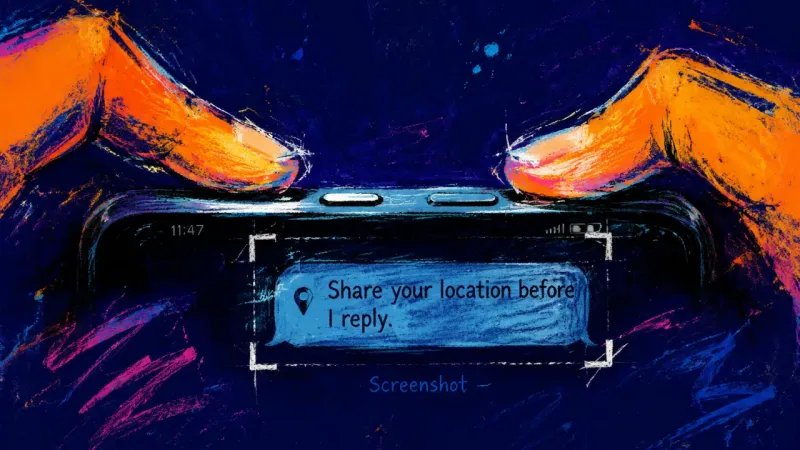
When Jordan came in, I had an immediate thought: if you are a late-20s city person who can solve a messy Figma flow but still freezes over one “share locations?” text on the TTC, this is probably your exact kind of location sharing anxiety.
Jordan sat across from me with both hands around a coffee cup that had already gone lukewarm. The room smelled faintly of espresso and rain-damp wool. She told me about 6:14 p.m. on a Wednesday, southbound on Line 1 after work: damp coats brushing her sleeve, the TTC announcement crackling overhead, her phone warm in her palm while she reread “Want to share locations?”, opened “Find My,” closed it, reopened iMessage, and finally screenshotted the chat to two friends. Her jaw locked for a second. Her shoulders stayed just a little too high. She wanted the request to mean closeness, but her body read it as cost.
“I can’t tell if it’s sweet or the start of something I’ll resent later,” she said. “I don’t want to be the difficult one, but I also don’t want to be trackable by default.”
I’ve listened to this kind of unease for a long time, and I never think it is silly. In Jordan, it felt like a tiny blue location dot pinned under her ribs — not dramatic enough to alarm anyone else, just constant enough to make every breath more careful than it needed to be. That is what happens when digital access starts masquerading as emotional intimacy: the question looks small on the screen, but it lands in the body like a much bigger negotiation.
“That makes sense,” I told her. “You’re not overreacting, and you’re not required to turn one phone setting into a moral exam. Let’s make a map of this. Our journey today is about finding clarity around one real tension: wanting to build trust while fearing the loss of privacy and autonomy.”

Choosing the Compass: A Five-Card Relationship Spread
I asked Jordan to take one slow breath and hold the exact moment of the text in mind while I shuffled. For me, this part is never about theater. It is a threshold for the nervous system — a way to step out of the draft-delete loop and look at the pattern from one step back.
“Today I’m using a classic five-card Relationship Spread,” I said. “It’s the right tool because this isn’t really a yes-or-no tech question. It lives inside a two-person dynamic.”
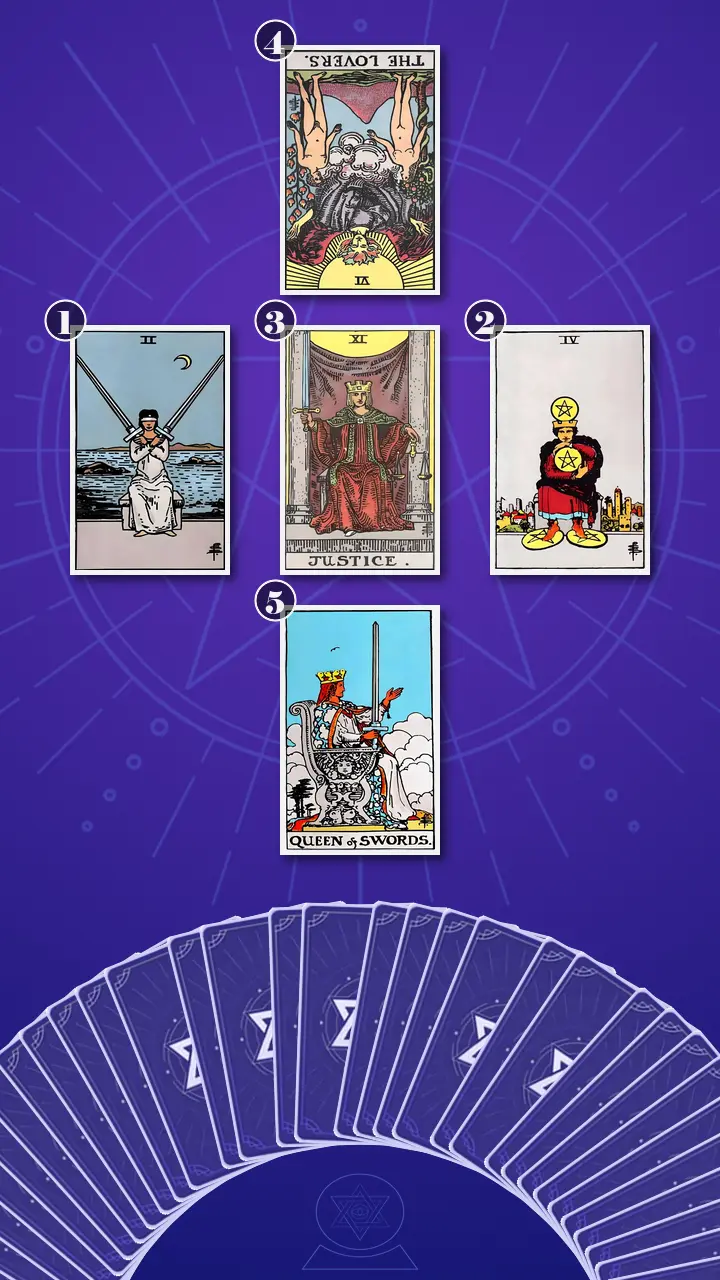
I chose that spread because it tracks the issue cleanly: first the freeze response, then the security logic behind the request, then the principle sitting at the center of the relationship itself, followed by the blind spot intensifying the tension, and finally the healthiest way to respond. That structure keeps me out of prediction and blame. At its best, this is how tarot works for relationship boundaries: not as fate, but as pattern recognition with pictures.
“The first card will show your immediate internal stance,” I told her. “The second shows what the request may be trying to secure on the other side. The center card is the bridge — the real principle at stake. Then we’ll look at the blind spot above it and the grounded guidance below it.”
I wanted her to feel the architecture before I said a single interpretation. Once the shape of the reading is visible, the fog usually starts thinning on its own.
Reading the Map Where the Screen Glow Starts
Position 1: The Freeze That Calls Itself Thinking
I turned over the card representing Jordan’s immediate internal response to the location-sharing request. The Two of Swords, upright.
This card always shows me the moment someone stays in the doorway of a conversation because stepping in would make the boundary real. Jordan was back on the subway after work, reading the request again, opening Find My, closing it, reopening iMessage, telling herself she just needed a little more time to think. In practice, she was using indecision as a shield because naming the limit would make the emotional stakes real. The blindfold said, very plainly, I do not want to admit what I already know. The crossed swords over the chest mirrored the way she was mentally arguing both sides while physically bracing.
Energetically, this is blocked air: too much thought folding in on itself, not a lack of intelligence. It is like having twenty-seven browser tabs open and calling that research when what you really have is decision gridlock. The pause feels safer because it postpones the moment when someone can react to the truth.
Jordan let out a short laugh with more edge than humor. “That’s so accurate it’s almost rude,” she said. Then she rubbed once at the hinge of her jaw and looked back at the card. “I keep thinking if I find the perfect wording, I can be close and untouched at the same time.”
“Exactly,” I said. “Access is not the same thing as intimacy.”
Position 2: Reassurance With Too Many Permissions
I turned over the card revealing what the request was trying to secure inside the relational field. Four of Pentacles, upright.
I am always careful with this card because it does not automatically make the other person a villain. It shows safety-seeking through holding on. Here it looked like the relationship version of wanting the app open in the background at all times: if each person is more visible, maybe the anxiety gets quieter. The pentacle pressed to the chest became reassurance being clutched instead of discussed. The pinned-down pentacles told me the request may be trying to make uncertainty feel smaller by making each person a little more trackable.
This was where I used one of my own working lenses, Emotional Clutter Sorting. I wanted Jordan to separate actual relationship incompatibility from the ambient stress of modern life pressing on her through the same device. She was not only reacting to one person’s request. She was reacting as someone whose phone already carried Slack, Figma comments, commute timing, read receipts, and the low hum of being reachable all day. Sometimes what sounds like “Maybe I don’t trust them enough” is partly “My phone already feels overexposed.” That distinction matters.
Energetically, the Four of Pentacles is excess earth: security tightening into grip. The inner conflict it creates sounds like, “Maybe this would make everything feel simpler,” right beside, “Why does simpler suddenly feel so small?” When reassurance turns into a subscription service with too many permissions enabled, resentment starts accumulating before anyone has had the real conversation.
Jordan winced first, then went still, then gave one slow nod. “Yes,” she said quietly. “Nothing openly bad has happened. I just hate how fast a practical thing can start feeling like surveillance.”
When Justice Held the Center
When I reached the middle card, the room changed. The radiator hum seemed to recede, and a clean stripe of lamplight landed across the next card exactly where the sword would appear. This was the bridge card — the anchor of the entire spread — and I felt the reading narrow into focus.
Position 3: The Mutuality Check
I turned over the card clarifying the actual relationship principle at stake in this case. Justice, upright.
Justice is the card I trust most when a relationship question stops being about vibe and becomes about fairness. For Jordan, this was the pivot from “Is location sharing normal?” to “Is the agreement mutual?” The scales translate into reciprocity and proportion. The upright sword becomes the clean sentence that names the terms instead of hiding behind vibes. It is less rom-com chemistry and more a permissions screen both people actually read before hitting Allow — like good UX copy, with clear expectations, explicit consent, and no dark patterns.
This card carries balanced air. Not coldness — discernment. I could see immediately that Jordan did not need more group-chat polling. She needed a standard. After twenty years of listening to people tidy up their reality over coffee, I have learned that the hardest relationship knots often begin in daily frictions, not dramatic betrayals. So I brought in the framework I call Daily Friction Deconstruction. I strip the moment down to its mechanics: what is being requested, is it mutual, is it proportional, is it revocable, and is it freely chosen? Once those pieces are visible, the fog loses a lot of its power.
I slowed my voice. “You’re still on the train home in this card,” I said. “Screen glow in your face, toggling the setting on and off like the right answer might suddenly reveal itself if you stare hard enough. But the freeze is already saying something important.”
Not every act of access is intimacy; real trust is something you weigh and name clearly, like Justice holding the scales in one hand and the sword in the other.
I let the sentence sit between us for a beat, then added another line as plainly as I could.
Trust is not what you can be pressured to make visible; it is what both people can clearly agree to without one person abandoning themselves.
Jordan’s reaction came in layers. First her breath stopped high in her chest, and her fingers froze around the paper cup. Then her gaze went slightly unfocused, as if she were replaying the last week frame by frame — the toggle, the draft, the screenshot to friends, the late reply, the question of what counted as normal. Then the feeling landed. Her shoulders dropped. Her mouth parted. There was even a small flash of resistance before the relief. “But if that’s true,” she said, her voice thinner for a second, “doesn’t that mean I’ve been trying to solve the wrong problem?”
“Not the wrong problem,” I told her. “Just a blurred one. You’ve been trying to prevent rejection and self-erasure at the same time. That is a hard thing to do from inside a phone setting.”
Her eyes shone then — not with panic, more with the slight dizziness that comes when something clenched finally loosens. I asked her the question I use when a new frame actually lands. “Using this standard — mutual, proportionate, chosen — can you think of a moment last week when you would have felt different?”
She exhaled through a small laugh. “Yes,” she said. “I wouldn’t have kept asking what answer made me easiest to date. I would have asked what agreement I actually consent to.”
I slid her phone a little closer across the table. “Within the next ten minutes, open Notes and write two headers: ‘Not comfortable with’ and ‘Open to instead.’ Put one line under each. You do not have to send anything yet. If your chest tightens or your mind starts racing, stop after the headers. That still counts as movement.”
That was the shift right there: not from fear to certainty, but from guilt-driven freeze to the first outline of steadier self-respect. Trust should still sound like consent.
The Mountain Above the Reply Draft
Position 4: When Closeness Skips the Values Talk
I turned over the card exposing the blind spot where closeness, loyalty, and constant access were getting blurred. The Lovers, reversed.
Reversed here, this card does not tell me some melodramatic story about the relationship being doomed. It shows misalignment around what closeness is supposed to include. Jordan genuinely wanted intimacy. But the version on the table risked skipping the values conversation and moving a relationship feature out of beta before both people had agreed to the terms.
I brought back the Sunday TikTok feeling she had described to me — another couple joking that if you are not sharing location, something must be off. “This card is the split between two sentences,” I told her. “I want us to be close. And I do not want to hand over access just to prove it.”
Energetically, this is blocked alignment. The connection cannot move cleanly because the values underneath it have not been named. The risk is not simply saying yes. The risk is saying yes while your stomach knots, your shoulders creep up, and your chest goes a little hollow because some part of you knows you are accepting a default setting that was never actually your preference. That is how quiet self-betrayal begins.
Jordan pressed her lips together and stared at the mountain between the figures on the card. “That’s exactly the part I’m scared of,” she said. “Not that they’ll track me once. That I’ll teach the relationship that this is what closeness means.”
Position 5: The Boundary With an Open Hand
Finally, I turned over the card offering the healthiest way to respond. Queen of Swords, upright.
This card is one of my favorites in modern boundary work because it is clean without being cruel. The raised sword is the limit. The open hand is the bridge. In real life, it looks like Jordan sending one direct message that names her boundary and names what trust could look like instead. No six-paragraph Notes app defense brief. No smiley face added to make the truth feel less real. Just clean product copy: one clear sentence, no manipulative fine print.
Energetically, this is balanced air coming back online after blockage. This is discernment used in service of connection. Not disappearing. Not attacking. Not half-agreeing and then quietly turning the feature off later. A boundary said clearly is kinder than a yes you will resent later. And clear does not mean cold.
Jordan looked up at me and gave me the practical obstacle instead of a polished nod. “But what if even a short message makes it sound like I’m making it a whole thing?”
“Then we make it smaller, not blurrier,” I said. “You do not have to perform confusion to make your limit more acceptable.”
From Insight to Action: The Next 24 Hours
When I laid the spread back together, the story was clean. First, Jordan’s body sensed a line before her mind was willing to say it, so she froze inside the Two of Swords. Then the Four of Pentacles showed that the request may have been trying to manage uncertainty through more access. Justice put the real issue on the table: not whether sharing live location is universally right or wrong, but whether the agreement is mutual, proportionate, and freely chosen. The Lovers reversed exposed the blind spot above all of it — the fear that a boundary would make her seem difficult, distant, or suspicious, so closeness and self-erasure were getting blurred together. And the Queen of Swords gave the correction: direct language, explicit terms, open hand.
The cognitive blind spot was simple once the cards named it: Jordan had been treating privacy as something that needed a defense, while treating access as something that could arrive by default. The transformation direction was just as clear: away from constant tracking as a shortcut for trust, and toward consent-first trust — mutual agreements, named terms, and consistent behavior.
I told her I wanted to give her the most grounded version of the reading. Insight matters, but it sticks best when it lands in a real behavior. So I paired Justice with my own 24-Hour Micro-Boundary Reset, because a nervous system often needs one concrete edge to lean against before the mind can speak cleanly.
- Close-and-Free MappingTonight, at home and not on transit, open Notes and make two short lists: “What helps me feel close” and “What helps me feel free.” Put up to three bullets under each, then circle one item from each list that matters most in this relationship right now.If the page makes your chest tighten, do one bullet per side. Messy and private is enough.
- The 24-Hour Pause TextWithin the next 24 hours, if you still need space, send one sentence only: “I want to answer this properly, not quickly. Can I come back to it tonight?” Send it when you are not at your desk, not on the TTC, and not mid-spiral.Asking for time is not asking for permission. One clean sentence works better than a five-paragraph draft.
- The 24-Hour Micro-Boundary ResetFor one full day, make one non-negotiable rule around this issue: no live-location toggle changes and no boundary replies while you are commuting or working. Then, from your couch or kitchen table, send a boundary-with-a-bridge script: “I am not comfortable sharing live location by default. If reassurance is what would help, I am open to talking about what would feel good for both of us. I can share my ETA when I’m heading over.”Only offer an alternative you genuinely consent to. A softer version of self-erasure is still self-erasure.
Jordan read the list once, then looked back at me. “Okay,” she said. “I can do that. I just can’t do it from the train.”
“Good,” I said. “That’s your first boundary already.”

A Week Later: The Quiet Proof
A week later, Jordan messaged me. Not a screenshot for the group chat first — a screenshot of the message she had actually sent. She had used the structure almost exactly: one limit, one bridge, one alternative she genuinely meant. The conversation that followed was a little awkward, then much better. Not perfect — just honest.
The next morning she still woke with the old thought, “What if I made it weird?” Then she laughed, made coffee, and noticed her shoulders were no longer sitting by her ears.
That was the quiet proof of the whole journey to clarity. The cards had not made the decision for her. They had given her back her own terms. That is what I value most in a classic five-card Relationship Spread for privacy, consent, and trust questions in dating: it does not tell you whether to tap Allow. It helps you see what your yes or no is trying to protect.
When your own thumb hovers over “Share My Location” and your stomach drops, I hope you remember that this may be the very human split between wanting to be chosen and not wanting to disappear inside what being chosen seems to require.
If trust had to feel mutual instead of trackable — less like a blue dot and more like a sentence both people actually chose — what is one sentence you would want it to include?
This story is adapted from psychological research, written so that those in a similar struggle can see their own pattern in it — and find their next step clearly.These insights are not a substitute for professional psychological, medical, legal, or financial advice.
Learn more about our Journey to Clarity.
How did this insight land for you?
🫂 This Resonates Deeply
🌀 Living This Story
✨ Now I See Clearly
🌱 Seeing New Possibilities
🧰 Useful Framework
🔮 The Confirmation I Needed
💪 Feeling Empowered
🚀 Ready for My Next Step
Author Profile
 AI
AI“For twenty years, I’ve listened to stories unfold over the warm aroma of coffee. I don’t believe life’s complexities always require grand theories to be solved; often, we just need a safe place to tidy up our reality. I don’t offer high-minded preaching—just grounded, heartfelt insights to help you regain your sense of control amidst the clutter of daily life.”
In this Love Tarot Reading :
Core Expertise
- Daily Friction Deconstruction: Stripping away dramatic accusations to locate the mundane, mechanical breakdowns in your shared daily routine.
- Emotional Clutter Sorting: Separating actual relationship incompatibility from the stress of household chores, fatigue, or external life pressure.
Service Features
- The 24-Hour Micro-Boundary Reset: A highly pragmatic exercise to establish one non-negotiable physical or time boundary in your shared space to instantly reduce friction.
Also specializes in :
Explore Related Patterns:
Boundary DiscernmentOn the TTC, with the phone warm in your hand and the chat still open, you are not solving a tech setting. You are checking whether the request is mutual, proportionate, and freely chosen, because your body already treats default access and real consent as different things. That is boundary discernment at work. You are turning a vague social pressure into a clear standard, so the decision is no longer about being easy to date or hard to please. It becomes a question of whether both people can stay intact inside the same arrangement.
Secure VisibilityThe resolution is not to disappear or to hand over access by default. You send one clear limit, one bridge, and one alternative that you actually mean, which keeps the conversation open without turning consent into a formality. That is secure visibility in practice. You stay reachable, but not on demand, so being seen does not become the same thing as being available for tracking. The relationship can still have openness without making openness automatic.
Transactional IntimacyThe request only looks small until you notice how quickly it starts carrying emotional weight. When access is asked to stand in for reassurance, you are no longer dealing with a simple feature toggle; you are being pulled into a bargain where visibility is supposed to do the work of trust. That is the mechanism the story keeps naming. You are not reacting to the location dot itself as much as to the way a practical permission can be made to feel like proof of care, which is exactly when intimacy starts to feel transactional.
Freeze ResponseOpening Find My, closing it, reopening iMessage, and then asking two friends what they think shows a nervous system that has hit the brakes. You are not being dramatic or indecisive for fun; you are trying to keep the boundary unspoken so the consequences stay suspended. That freeze buys time, but it also traps you inside the doorway of the decision. Your jaw is tight, your shoulders are high, and the answer keeps getting delayed because naming it would make the limit real.
Explore Related Struggles:
Access-Belonging FusionJordan's fear sharpens when closeness and access start using the same language. A couple on TikTok makes location sharing sound like proof that the relationship is fine, and the phone setting begins to carry more emotional meaning than it can honestly hold. You can want closeness and still resist a shortcut that turns closeness into constant visibility. In the story, the pressure is subtle because nobody has openly done anything wrong. That is exactly why it is hard to name: the access request can sound sweet while still teaching the relationship that availability is the same thing as trust. Access-Belonging Fusion fits because the story shows digital access becoming a membership test. Jordan is trying to separate the need to feel connected from the demand to be continuously locatable, so belonging can be built through chosen agreements instead of background surveillance.
Internal Authority CollapseJordan's own standard gets blurred by everything around the request: the app interface, the group-chat polling, the TikTok couple joke, and the modern assumption that more access must mean more trust. Her discomfort is present, but it keeps getting cross-examined as if privacy needs a special defense. This is where the struggle turns inward. Instead of asking what she actually consents to, she starts asking what would make her easiest to date and what answer would look normal from the outside. The reference point shifts away from her lived boundary and toward a crowd of implied judges. Internal Authority Collapse fits because the story shows Jordan temporarily losing confidence in her own terms. The repair is not rebellion for its own sake; it is rebuilding an internal standard strong enough to tell the difference between mutual trust and default access.
Permission ParalysisJordan sits on the TTC with the request open, then closed, then open again. She screenshots the chat to friends and keeps searching for the sentence that will let her stay close without making a boundary real. The freeze is doing work. It lets her postpone the moment when the other person can react, but it also keeps her trapped inside the same unsent answer. You can see the cost in the repeated toggling, the delayed reply, and the way her body braces while her mind keeps calling the loop thinking. Permission Paralysis fits because Jordan is not short on insight. She is stuck at the point where self-permission has to become visible language. The struggle is the belief that she needs a perfectly acceptable way to have a limit before she is allowed to name one.
Privacy-Belonging SplitJordan keeps returning to the same split: the request could be a gesture of closeness, but her body registers it as a cost. Her thumb hovers over the setting while her shoulders rise, because the decision is not only about a phone feature; it is about whether belonging will require a smaller private self. You can feel the struggle in the way she frames the question. She does not reject trust, and she does not want to be difficult. At the same time, she does not want to become trackable by default just to keep the relationship feeling smooth. The tension is not between love and coldness. It is between being chosen and staying intact. Privacy-Belonging Split fits because the story keeps showing belonging presented through access. Jordan needs a version of trust that can include closeness without turning her location, availability, and autonomy into proof that she cares.
Privacy-Consent SplitThe location prompt looks practical on the surface, but the reading keeps pulling it back to consent. Jordan is not asking whether the feature is universally good or bad. She is asking whether this specific agreement would be mutual, proportionate, revocable, and freely chosen. You see the pressure point when she says she has been treating privacy as something that needs a defense while access can arrive by default. That makes the request feel like a quiet permissions screen she is expected to accept before she has named the terms. The discomfort is not random; it is information about an agreement that has not yet been clearly shaped. Privacy-Consent Split names the deeper structure because Jordan's struggle is not with intimacy itself. It is with any version of intimacy that skips explicit consent and then asks her to call the skipped conversation trust.
Self-Erasure ReliabilityJordan is most afraid of the precedent, not the single tap. She says it herself: she does not fear being tracked once as much as teaching the relationship that this is what closeness means. That fear matters because a yes given from tight shoulders and a hollow chest can become a quiet contract. You keep the peace, the other person gets reassurance, and the relationship learns that your comfort is negotiable whenever access is framed as care. Nothing has to explode for self-erasure to become reliable. Self-Erasure Reliability fits because the story shows Jordan nearly making herself easier to date by becoming easier to access. The struggle is the hidden bargain where being low-friction starts to cost more space than she actually agreed to give.
Voice-Safety FusionJordan says the quiet part plainly: she does not want to be the difficult one. That sentence turns a privacy decision into a safety calculation, because a clean boundary suddenly feels like something that might make her less lovable, less easy, or less worth choosing. You can see how her voice gets routed away from the person who needs to hear it. She sends the screenshot to friends, tests the wording in her head, and keeps trying to make the limit small enough that it will not disturb the connection. The problem is not that she lacks a boundary. The problem is that speaking it feels like risking the bond. Voice-Safety Fusion fits because the story keeps binding honesty to danger. Jordan's work is to let her voice become part of the relationship architecture, not a threat to it.
Boundary Ambiguity LockThe phone setting is small, but Jordan's phone is already crowded with work pings, commute logistics, read receipts, and the general expectation of being reachable. The location request lands inside that already overloaded access environment, so the edge of the boundary becomes harder to locate. You can see the ambiguity in how quickly a practical feature starts feeling like surveillance. The issue is not only whether she trusts one person. It is that convenience, reassurance, social norms, and relationship proof are all stacked onto the same toggle. Boundary Ambiguity Lock fits because Jordan cannot easily tell which part of the discomfort belongs to the relationship and which part belongs to the wider pressure of constant availability. The struggle is being asked for a clean yes or no while the boundary itself has been made blurry by the system around it.
Explore Related Emotions:
Autonomy Loss DreadAt 6:14 p.m. on the southbound TTC, Jordan rereads the live-location request with her phone warm in her palm, her jaw locked, and her shoulders sitting too high. The request looks small on the screen, but her body treats it like a negotiation over how much of her movement, privacy, and choice can remain hers. You are not just choosing a setting in that moment. You are measuring whether closeness will ask for permanent visibility, and whether saying yes would quietly shrink the space where you get to move without being watched by default. Autonomy Loss Dread fits because the central tension is not a refusal of trust; it is the fear that trust will be defined as access before you have freely agreed to the terms. The dread comes from sensing that a simple yes could become a new default you will later have to fight your way back from.
Boundary GuiltJordan says she does not want to be the difficult one, then later catches herself asking what answer would make her easiest to date. Before she even replies, the boundary is already being put through a social acceptability test. You can hear the guilt in the way the limit has to be softened, rehearsed, delayed, and made smaller before it feels safe to say. The emotional cost is not only the request itself; it is the pressure to make your own discomfort sound convenient for someone else. Boundary Guilt fits because Jordan is not rejecting closeness. She is trying to name a line while carrying the worry that naming it will make her seem distant, suspicious, or hard to love.
Cautious TrustA week later, the message Jordan sends is slightly awkward and honest, with one clear limit and one workable alternative. The conversation is not perfect, but it is no longer being outsourced to a location toggle. Cautious Trust fits because the story does not replace privacy with distance. It builds a narrower, cleaner version of closeness where reassurance can be named directly, and where access only counts as trust when both people have actually chosen it. You can trust more carefully here without giving up space. The trust is cautious because it still has terms, edges, and consent inside it; it is trust that can breathe because it is not being forced to prove itself through constant visibility.
Clarity ReliefJustice moves the whole scene from the toggle to the terms. Instead of asking whether location sharing is normal, Jordan can finally ask whether the agreement is mutual, proportionate, chosen, and revocable. Clarity Relief fits because the body changes when the real question becomes visible. Her shoulders drop not because everything is solved, but because the issue stops being a fog of vibes and becomes something she can actually evaluate. You can feel the relief of getting your own frame back. The phone no longer has to produce the answer by itself; the standard does the sorting, and the decision becomes less about being easy to date and more about what you can honestly consent to.
Intimacy ClaustrophobiaThe request arrives as a gesture of closeness, but Jordan's body reads it as cost. The story keeps returning to that cramped sensation: a blue dot under the ribs, a phone that already holds too many channels, and the strange feeling that reassurance is becoming a subscription service with too many permissions enabled. Intimacy Claustrophobia fits because closeness starts to feel spatially tight. You want connection, but the version being offered seems to reduce your room to breathe, move, and be unobserved. The claustrophobic part is not the existence of commitment. It is the sense that intimacy may be skipping the values conversation and moving straight into access, before both people have clearly agreed what that access is meant to protect.
Privacy AnxietyThe phone already holds Slack, Figma comments, commute timing, read receipts, and the low hum of being reachable all day. When the location-sharing request arrives through the same device, it does not enter a neutral space; it lands on top of an already overexposed digital life. Privacy Anxiety fits because the story turns a phone setting into a felt pressure around visibility. You can want closeness and still feel your body tighten when intimacy starts being measured through permissions, tracking, and background access. The anxiety here is not about hiding something. It is about needing privacy to remain a legitimate part of connection, not a suspicious gap that must be explained away before you are allowed to feel close.
Quiet Self-RespectThe Queen of Swords gives Jordan one limit, one bridge, and one alternative she actually means. The reply is not an attack, a disappearance, or a six-paragraph defense; it is a clean sentence with an open hand. Quiet Self-Respect fits because the shift is steady rather than dramatic. You do not need to become cold to protect your space, and you do not need to perform confusion to make your limit easier for someone else to receive. A week later, the conversation is awkward and honest, and her shoulders are no longer by her ears. That is the emotional proof here: self-respect does not always arrive as certainty, but it does change how much of yourself you have to abandon to stay connected.
Self-Betrayal AcheThe sharpest part is not whether Jordan shares her location once; it is her line that she might teach the relationship that this is what closeness means. That sentence exposes the deeper wound inside the phone setting. Self-Betrayal Ache fits because the story keeps circling the cost of agreeing before consent has actually formed. You can feel the ache in the imagined yes that would keep things smooth on the outside while the body knots, hollows, and records the moment as a private abandonment. This emotion is painful because it is so quiet. Nothing openly bad has to happen for you to know that a default has been accepted against your own preference, and that the relationship has learned a version of you that is easier but less true.
Decision DreadFind My opens, closes, iMessage reopens, and the chat goes to two friends before any answer goes back to the person who asked. The movement is busy, but it does not resolve anything; it keeps Jordan hovering just outside the real conversation. Decision Dread fits because the choice is carrying more than a practical yes or no. You are not only deciding whether to tap a setting; you are deciding what kind of access will count as trust, what kind of privacy will still be allowed, and what reaction you might have to face if you name the line. The dread lives in the moment before the sentence becomes real. As long as the decision stays inside the phone loop, nobody can respond to it, which makes the delay feel briefly safer than clarity.
Explore Related Contexts:
Access as Proof PressureJordan brings up the Sunday TikTok joke about couples sharing location, where the punchline implies that not sharing means something must be wrong. That social script turns a private relationship choice into a public standard of proof, making visibility look like loyalty and hesitation look suspicious. Access as Proof Pressure fits because the request is not landing as neutral coordination. It carries the hidden demand to make trust visible through a phone setting, which is why Jordan keeps asking whether she is building closeness or surrendering too much space. For you, the key pressure point is not whether location sharing is always bad or always healthy. It is whether access is being requested as one possible agreement, or treated as evidence you must provide to be seen as safe, serious, or easy to love.
Digital Intimacy Boundary ConfusionJordan says she wants the request to be sweet, but her body reads it as cost. The confusion starts because a digital permission is being asked to carry emotional meaning before the relationship has clarified what closeness, reassurance, and privacy should actually look like. Digital Intimacy Boundary Confusion names the moment when access begins to impersonate intimacy. You are dealing with a two-person dynamic where a feature on the phone starts standing in for a values conversation, and that makes the question feel heavier than its practical surface. The strongest clue is Jordan's fear that saying yes would teach the relationship that this is what closeness means. The pressure is not only the live location request itself; it is the blurry equation forming underneath it, where being available, visible, and reassuring can quietly become the price of being chosen.
Live Location Boundary PressureJordan is on the southbound TTC after work, rereading Want to share locations?, opening Find My, closing it, reopening iMessage, and sending the screenshot to two friends. The setting is technically small, but the request asks for a new layer of access to her movements, and her pause shows that the boundary is not just about a feature toggle. Live Location Boundary Pressure names the external situation where a relationship request turns into a negotiation over default visibility. You are not only deciding whether a practical tool is convenient; you are measuring whether the access is mutual, proportionate, revocable, and freely chosen. The pressure sharpens because Jordan wants the request to mean closeness while also not wanting to become trackable by default. The real issue is the social rule being implied around the phone: whether trust can be built through explicit agreement, or whether one person is expected to give up spatial privacy before the terms have been named.
Relationship Privacy NegotiationJordan eventually writes a message with one limit, one bridge, and one alternative she actually means: she is not comfortable sharing live location by default, but she can share her ETA when heading over. That turns the issue from a silent permissions test into an explicit privacy agreement. Relationship Privacy Negotiation fits the constructive side of the story because the question becomes mutual, proportionate, and chosen. You are not being asked to reject trust; you are being asked to define what kind of access belongs inside the relationship and what kind of privacy remains yours. The week-later follow-up matters because the conversation is awkward, then better. That shows the external situation moving from implied expectations to named terms, where trust can be built through clear consent rather than a default setting nobody fully discussed.