Leaving Self-Conscious Overexplaining for a Headline-First VP Update

Finding Clarity When You Keep Burying the Point at 11:40 p.m.
If you are the late-20s product manager in Toronto still rewriting slide one at 11:40 p.m. because tomorrow's VP update needs to sound strategic, not too exposed, I know exactly the pattern you are in.
When Maya (name changed for privacy) sat down with me, she did not look confused. She looked like someone whose mind had been running laps for hours. I could almost see the blue Google Slides glow still living behind her eyes: the laptop heat against her wrist, the dishwasher humming in the condo, the little Slack ping snapping her attention sideways while she dragged one bullet down and softened one headline into something safer. Her jaw was tight enough to make the rest of her face look polite. Her shoulders were half an inch too high. Even her breath had that thin, buzzy rhythm I hear so often the night before leadership updates.
She said, "I know the point. I just don't know how to say it without sounding undercooked."
I nodded. "So the real conflict isn't whether you have the thinking. It's this: you want to sound strategic and competent in front of leadership, but part of you is scared that one blunt sentence will expose a gap or invite criticism."
She gave me the kind of look people give when they feel a little too accurately seen. In my mind, the feeling had a shape already: like carrying a stack of folders so high you cannot see the doorway, then blaming yourself for bumping into the frame. The point exists. It is just buried under self-protection.
"That makes sense," I told her. "And it isn't a character flaw. It's a protection strategy. Tonight, let's not chase a perfect script. Let's make a map through the fog and find the clarity that's already there."

Choosing the Compass: The Four-Layer Insight Ladder
I asked Maya to take one slower breath and hold the question in simple language: not How do I become a different person by tomorrow? but Why does clarity collapse when the stakes go up? Then I shuffled. For me, tarot works best here not as fortune-telling, but as a structured mirror. It lets the subconscious stop hiding behind polished work language for a minute.
For this reading, I chose the Four-Layer Insight Ladder, a spread I use when a visible workplace habit is being powered by something deeper. It is especially useful for executive communication clarity because it does not wander. It moves in a clean sequence: symptom, root mechanism, breakthrough, applied action. When someone asks, "Why do I always start with context instead of the headline at work?" this spread gives me the smallest honest structure that can still hold the whole answer.
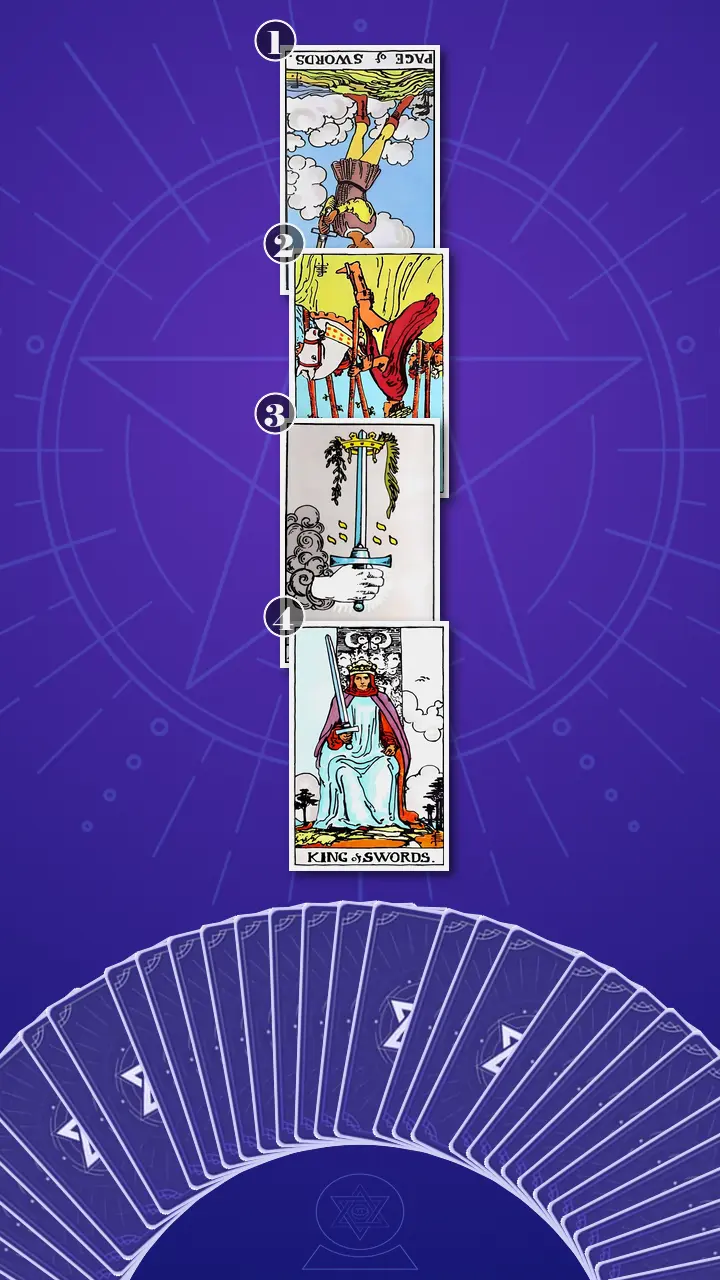
I showed her the ladder as I laid the cards vertically. The top position would reveal the surface communication pattern, the part everyone can hear in the room. The second would show the root driver, the fear underneath the habit. The third would be the transforming insight, the clean truth that could reorganize tomorrow's VP update. The fourth would ground it into behavior: what her next sentence structure actually needed to sound like.
Reading the Noise Before the Point
The Cursor Between Headline and Caveat
"Now we're looking at the card that represents your surface communication pattern," I said. "Page of Swords, reversed."
I always pay attention to the body language of this card. The Page is sharp, alert, brilliant even—but reversed, that sharpness becomes restless vigilance. The energy is not missing. It is blocked. Too many tabs are open. Too much scanning. It is like opening ten browser tabs so you never have to trust the one tab with the actual answer.
In real life, this is exactly the late-night scene you described: toggling between slide titles, speaker notes, and Slack drafts, trying to word the opening so perfectly that no single sentence can be challenged. The result is that the actual headline gets demoted, softened, or hidden behind context. You want to sound strategic, but the more the pressure rises, the more cautious the message sounds.
"You are not unclear," I told her. "You are over-protecting the clear thing."
I watched that land. First her mouth pressed into a line. Then she gave one short laugh, dry and almost annoyed. "Okay," she said, "that's accurate enough to be rude."
I smiled. "Good. Then we're close to the truth. This card shows overactive Air—thought serving defense instead of direction. You keep rewriting the first thirty seconds because part of you believes safety lives in extra context. But detail can inform, or it can hide."
When the Room Becomes a Stage
"Under that, in the root-driver position, we have the Six of Wands, reversed."
This is where the reading stopped being about presentation technique and became psychological. In a glass meeting room, with a badge tap at the door and one neutral senior-leader expression across the table, the room can suddenly feel a little Succession-coded. Not dramatic on the surface. Just charged enough that every sentence feels like evidence.
The Six of Wands reversed tells me the problem is not simply overexplaining under pressure. It is visibility tied to worth. Maya walks into the VP update already measuring success by whether the room looks impressed. A neutral face reads as danger. So she over-explains to keep any one sentence from carrying too much personal exposure.
From a Jungian lens, this is the moment the outer stage wakes up an older inner script: if authority is watching, I must prove I deserve to be here before I can speak plainly. Concise is risky only when worth is on trial.
Her reaction came in a sequence I have seen many times. First, a tiny physical freeze—her breathing paused and her fingers stopped moving altogether. Then the cognitive drop: her eyes unfocused for a second, as if she were replaying a room with glass walls and a VP face gone neutral. Then the release came out as a low exhale. "So this stopped being about clarity the second the room became a stage," she said quietly.
"Exactly," I said. "And that matters, because if you misdiagnose this as a communication flaw, you'll keep trying to solve it with more polish. But if the real issue is approval pressure, then what you need is not more padding. It's a different relationship to your own judgment."
When the Ace of Swords Cut Through the Stack
One Document on the Table
When I reached for the third card, the room changed in the subtle way it sometimes does when a reading is about to stop circling and start naming. Even the street noise outside seemed to flatten for a moment. This was the turning point in the Four-Layer Insight Ladder tarot spread for executive communication clarity—the antidote card, the one that tells the mind what it has been needing all along.
"This position is your transforming insight," I said, turning it over. "Ace of Swords, upright."
Its message was immediately cleaner than the first two cards. One upright blade. One line above the clutter. One document on the table before the folder stack gets opened. In practical terms, it is the exact opposite of leading with context instead of the headline. Maya says the actual conclusion first, in one clean line, and then uses only the evidence that directly serves it. Not colder delivery. Cleaner thinking made audible.
When it is late, the deck is technically done, and you are still softening slide one so nothing sounds too exposed, it can feel safer to keep polishing than to let the real point arrive first.
You do not need a wall of caveats to earn credibility; raise one clean sword of truth first, then let the supporting facts stand behind it.
She went very still.
First came the physical freeze: her jaw unlocked, but only after a visible pause, like a door handle finally turning. Then came the cognitive shift: her eyes flicked down and left, the way they do when someone is replaying a dozen recent moments at once—slide one, the Notes app on Line 1, the urge to say "just to give some context" before she had said anything real. Then the emotional reaction arrived in a more complicated form than relief. Her brows pulled together. "But if that's true," she said, and there was a flash of anger in it, "doesn't that mean I've been making it worse?"
"Not on purpose," I said gently. "It means you've been protecting yourself with the best tool you had. But the tool is outdated for the room you're in now."
This is where I brought in one of the frameworks I use often: Imposter Syndrome Auditing. I asked her to separate two files in her mind. File one: objective professional competence—her analysis, her preparation, the fact that she already knew the point. File two: subconscious fear of exposure—the part that assumes one direct sentence might reveal she has somehow not earned the right to be concise. "Those are not the same file," I told her. "And your nervous system keeps stapling them together."
I have watched this split happen across cultures and industries: bright people confusing the tremor of exposure with evidence of incompetence. It is never the same surface story, but it is often the same inner bracing. Here, the Ace was cutting that staple. What if the point is not the risky part? What if hiding it is?
Her shoulders lowered so gradually it was almost imperceptible, then all at once. She took a fuller breath. Some of the heat went out of her voice. The release was real, but so was the slight dizziness that can come when a long-carried burden suddenly shifts; clarity has weight too, because now you can no longer pretend the next move is mysterious. I asked her, "Using this new angle, can you think of a moment last week when saying the headline first would have changed the whole feel of the room?"
She nodded immediately. "My roadmap check-in," she said. "I spent two minutes earning the recommendation before I said it. And the second I finally got there, everyone relaxed."
"There it is," I said. "That is the first real step from defensive overexplaining to grounded executive clarity. Not perfection. Just a cleaner center of gravity."
The Throne at the Bottom of the Ladder
"And now the embodied next step," I said, turning the final card. "King of Swords, upright."
I love this ending for a case like hers because the suit of Swords does not disappear; it matures. The problem was never that Maya thought too much. It was that her intelligence had been working overtime as a bodyguard. The King shows mature Air: authority, structure, and boundaries in communication. He does not narrate every thought he has had just to prove he had them.
In real life, this looks almost boring—which is exactly why it works. Tomorrow, Maya sounds more senior not by becoming a different personality, but by using an executive frame: headline, implication, ask. She names the evidence in two or three lines, pauses, and lets the update stand without over-parenting the room through every step of her reasoning.
I called this her Authority Archetype Integration moment. "You are not being asked to become colder," I told her. "You are being asked to let your judgment sit in the chair before your anxiety does."
That landed with a smaller, steadier response than the Ace. No dramatic breakthrough. Just a visible settling. She sat back. Her hands unclasped. "That I can do," she said. And I believed her.
From Insight to Action: Your Next 48 Hours
By the time I gathered the spread into one story, the pattern was clean. The Page of Swords reversed showed the habit everyone can hear: the buried point, the rewritten opener, the defensive detail. The Six of Wands reversed showed why it happens: the room stops being a room and becomes a test of worth. The Ace of Swords named the shift: lead with one clear headline and let evidence serve the point, not protect the ego. The King of Swords turned that into behavior: headline, implication, ask.
The blind spot was not that Maya lacked clarity. It was that she had been mistaking self-protection for strategic communication. Her mind believed context earned her the right to be direct. In truth, clarity is not less thoughtful. It is better ordered. The transformation direction was simple and demanding at the same time: move from using context to prevent criticism to using structure to support understanding.
I gave her three practical next steps—small enough for tonight, concrete enough for tomorrow:
- 12-Word Headline Sticky NoteBefore bed, write one headline for tomorrow's VP update on a sticky note in 12 words or fewer, then place it on your laptop so the first thing you see in the meeting is the point, not the deck.If the sentence suddenly feels too blunt, treat that as activation of the old protection strategy, not proof the line is wrong. Clear enough is enough.
- Proof-Not-Padding FilterChoose the two or three facts that directly support your headline, label them proof, not padding, and move every other contextual detail into backup slides or speaker notes before tomorrow morning.If dropping a third or fourth point feels scary, keep it as a private safety net. The goal is not fewer thoughts; it is better selection.
- The Competence Anchoring ExerciseIn your Notes app on the subway or at your desk, spend three minutes listing three verifiable decisions, outcomes, or pieces of analysis that prove you already know this material, then say your structure out loud once: headline, implication, ask.Use facts, not affirmations. This exercise anchors self-worth to evidence so your first sentence does not have to audition for permission.
"Say the point before your fear writes the intro," I told her. "That's the whole practice."

A Week Later: The Quiet Proof
A few days later, Maya messaged me. "Led with the point," she wrote. "My heart was going insane for about five seconds. Then the room just... followed." She added that she still felt the old jolt on the commute downtown, but this time it lasted one subway stop instead of the whole ride.
That was the quiet gift of the Four-Layer Insight Ladder. Not magic. Not a personality transplant. Just a shift from bracing to choosing—from detail as armor to one clean sentence first. The cards did not hand Maya authority. They helped her stop hiding from the authority she already had.
When the room carries more power, a lot of us start speaking like we have to prove we deserve to be there, and you can feel that bracing in your jaw before the first real sentence even comes out. If tomorrow's update began with the one line on your own sticky note instead of the fear-written intro, what might that make easier for you in the room?