The 5:41 p.m. Scroll and the Evening on Standby
I meet a lot of mid-20s London creatives who can plan a campaign launch down to the hour but still leave Friday night blank because someone texted ‘soon’; Jordan was one of them.
When she sat across from me, she described 5:41 p.m. at her desk near Liverpool Street with the kind of specificity that only comes from living the same spiral too many times. Google Calendar was open. The fluorescent lights were buzzing overhead. Yesterday’s coffee had gone slightly stale in the mug by her keyboard. Her phone felt warm in her palm from checking WhatsApp, then OpenTable, then WhatsApp again. She had two evening blocks sitting there, suspiciously blank.
“I know ‘soon’ is vague,” she told me, “but I still treat it like a promise. I keep my calendar open just in case, and then I resent it.”
What she was really naming was the core contradiction at the heart of this whole reading: moving her own plans forward versus waiting for someone else’s ‘soon’ to become real. At work, she respected deadlines, briefs, and deliverables. In her personal life, one soft maybe could hijack an entire weekend. The uncertainty sat in her body like a Tube train held between stations: lights on, doors closed, everything technically functioning, nothing actually moving. Her stomach tightened. Her breath stayed parked high in her chest. Hope and irritation were sharing the same seat.
I nodded and said the thing I most wanted her to hear without shame: you are not overreacting to clarity; you are underfed by ambiguity. Then I leaned in a little and added, “We’re not here to decode someone else’s mystery wording into a destiny. We’re here to make a map, so your life stops going on standby.”

Choosing the Compass: The Five-Card Cross for Vague Promises
I asked Jordan to take one slow breath and hold the exact question in mind: when someone says ‘soon,’ how do I stop putting my plans on hold? Then I shuffled the deck slowly, not as theatre, but as a way of letting the nervous system cross a threshold. In my practice, that pause matters. It turns mental static into something we can actually listen to.
For her reading, I chose the Five-Card Cross. When people ask me how tarot works in a situation like this, this is one of the clearest answers I can give: a good spread separates symptom from structure. This one is small enough to stay focused, but deep enough to show the full chain—current behavior, immediate block, underlying fear, corrective perspective, and the next self-led step.
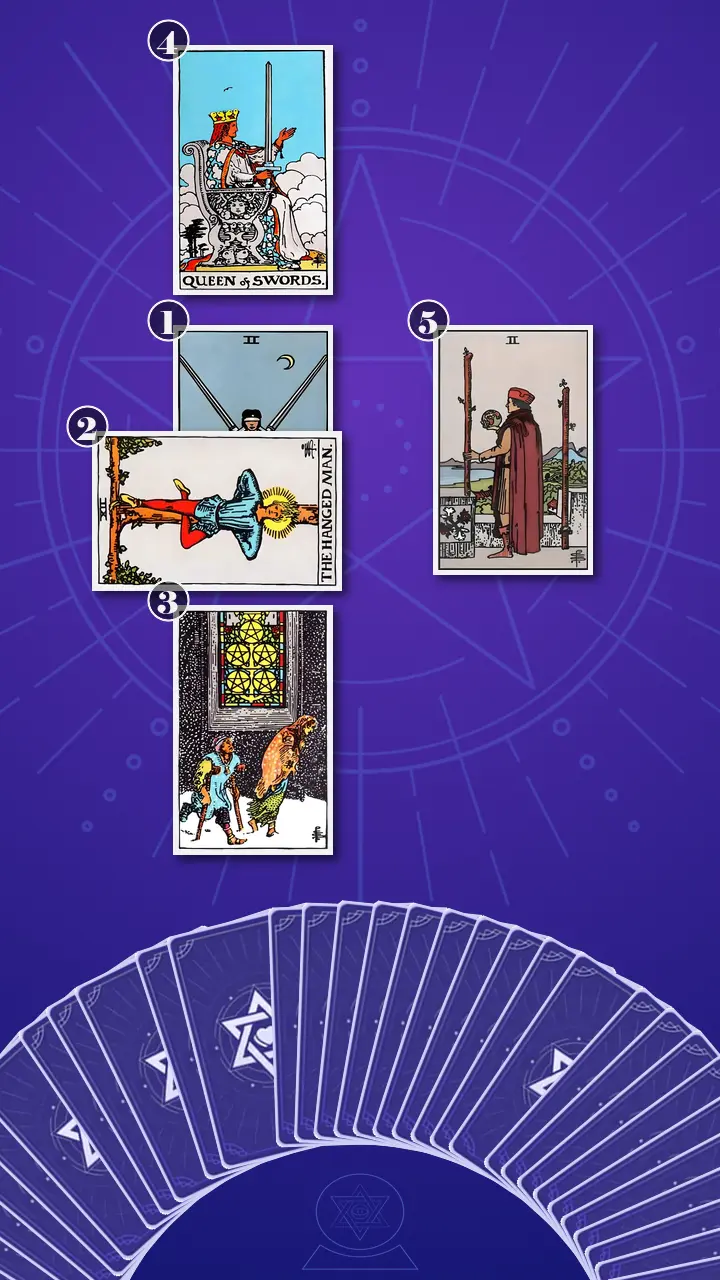
I explained the shape to her the way I would explain a city intersection to someone rerouting mid-journey. The center card would show the visible pattern: freezing her plans the moment vague timing entered the conversation. The crossing card would reveal the habit complicating everything: mistaking suspension for patience. The card below would uncover the deeper worth wound underneath the waiting. Above it, we would look for the clarifying boundary—the higher perspective that could cut through the fog. And to the right, the last card would show the path forward: how to plan from confirmed reality instead of borrowed hope.
That is why I like this spread for relationship ambiguity. It does not ask, “What do they mean?” It asks, “What is this doing to your rhythm, your choices, and your self-trust?”
Reading the Frozen Center
Position 1: The Evening Held Open
I turned over the first card and said, “This is the position that shows the observable pattern from the diagnosis: freezing your plans the moment vague timing enters the conversation.” The card was Two of Swords, upright.
I always pay attention to the body language of this card: the blindfold, the crossed swords over the chest, the still water under the moon. In Jordan’s life, it looked almost embarrassingly modern. Friday afternoon in London. A real chance to book dinner, a class, or a catch-up with a friend. A message that says ‘soon’ with no day, no time, no confirmation. And suddenly possibility is being treated like a live reservation.
The energy here was blocked Air: overthinking, mental stalemate, information not actually missing so much as emotionally overloaded. I told her it was like standing on a train platform with her bag packed while waiting for someone else to tell her whether the train was actually leaving. Or like hovering over ‘confirm booking’ with six tabs open because closing the maybe feels riskier than making a decision. The protection strategy is obvious: if she does not choose, she cannot miss out. But the cost is just as obvious: her whole evening gets organized around a word that has not earned that power.
Jordan gave a short laugh that landed with more salt than humor. “That’s… painfully accurate,” she said. Her thumb brushed the edge of her phone case, then stopped. That was the first little crack in the loop: the moment when being seen feels annoying because it is true.
Position 2: When ‘Chill’ Becomes Suspension
I placed my fingers on the crossing card. “This position reveals the immediate block: the habit of mistaking suspension for patience when someone says ‘soon.’” The card was The Hanged Man, reversed.
Reversed here, this card did not speak of meaningful pause. It spoke of drift that had gone on too long. Jordan’s modern-life version was painfully familiar: telling herself she was being low-pressure and understanding while her entire weekend quietly hung from one vague message. Checking her phone between tasks. Delaying bookings that would actually make her happy. Calling buffering ‘patience’ when the page was not loading.
This was blocked surrender. Not rest. Not wisdom. Not elegant nonchalance. A tied foot and no forward motion. I told her, “Keeping the calendar open can feel like staying connected, but sometimes it is just keeping yourself on standby.” The hard part was that this pattern let her avoid a sharper truth. If she never asked for specifics and never made other plans, then reality never had to fully declare itself.
She let out a heavier exhale at that. “I always say I’m being chill,” she murmured, looking at the card, “but I’m actually just suspended.” Her shoulders dropped about half an inch, the kind of tiny physical honesty I never ignore.
Under the Surface, Where Worth Gets Involved
Position 3: The Cold Outside the Lit Window
I turned the third card. “This position uncovers the deeper fear: the worth-based wound that makes waiting feel safer than moving first.” The card was Five of Pentacles, upright.
This is the card people often think is about lack in the obvious sense, but in readings like this, it is more intimate than that. I described the image for her: snow outside a lit church window, visible warmth, no secure entry. In Jordan’s life, it looked like the Central line at 8:47 p.m., stale carriage air, Instagram Stories full of rooftop drinks and birthday dinners, while her own week was still being bent around one vague message. The question underneath was no longer, Will they reply? It was: If I stop waiting and they never follow up, what does that say about how much I mattered?
The energy here was scarcity in its most personal form. Not a shortage of options, but a shortage of felt inclusion. I told her that this card often appears when someone starts reading another person’s ambiguity like a private performance review on their worth. That is why moving on feels so charged. It is not just changing a plan. It is risking the story that she was never clearly chosen.
Her reaction happened in three beats. First, a small freeze: her breath paused and two fingers stayed suspended around the handle of her mug. Then the recognition: her eyes lost focus for a second, as if an old Friday night was replaying behind them. Then the release: she blinked hard, swallowed, and said very quietly, “So it’s not really about dinner, is it?”
“Not really,” I said. “The logistics are the doorway. The wound underneath is the part that whispers that clarity might hurt more than limbo.”
When the Queen Lifted Her Sword
Position 4: The Clear-Eyed Reply
When I reached for the fourth card, the room changed in that subtle way it sometimes does during a reading. The rain against the window had softened. A strip of late light moved across the table as the clouds shifted. I have spent ten years studying how pressure throws people out of rhythm, and whenever a card like this appears, I feel the same inner click I feel when I remove background hiss from a recording and the true melody finally comes forward. We were at the antidote now.
“This position identifies the key transformation,” I told her, “the mental boundary and perspective that cut through ambiguity and restore self-trust.” The card was Queen of Swords, upright.
In ordinary life, this is not dramatic. It is deeply practical. It is the moment Jordan stops negotiating with vagueness and says what reality requires: a day, a time, or a clear reply-by point. Warmth with terms. Openness without self-abandonment. The energy here was balance—clean discernment instead of hopeful interpretation.
This was exactly where I brought in one of my own tools. “When I see this card,” I said, “I run what I call a Tempo Misalignment Audit. I listen for whose beat has taken over the room. Your life has its own rhythm—commute, work, friends, gym, rest, actual needs. But one vague text has been hijacking your psychological BPM and your executive BPM. You’ve been trying to sync your whole week to a beat that never dropped. That’s why it feels like pushing against a wall.”
Friday at 5:41 p.m., the office lights are still buzzing, the phone is warm in her hand, and the evening is half-empty because one message said ‘soon.’ Her body is already braced, even though nothing concrete has actually been offered. That is the exact moment this Queen enters.
Stop treating a foggy "soon" like a contract, and let the Queen's raised sword favor facts, boundaries, and a date on the calendar.
A vague promise is not a plan. “Soon” is missing information, not a commitment your life has to orbit.
Jordan did not melt into instant relief. First came resistance. Her jaw tightened, and she sat back like the sentence had physically reached her before her mind could catch up. “But if I do that,” she said, a flash of anger crossing her face, “doesn’t that basically mean I was wrong to wait?”
I shook my head. “No. It means you were trying to stay connected with the tools you had. We’re just replacing a tool that keeps hurting you.”
That was when the reaction changed. Her fingers loosened from the mug. Her eyes dropped to the Queen’s upright blade, then lifted again. She took one deeper breath than any she had taken since the session began, and I watched the tension leave her shoulders so fast it almost looked disorienting, like setting down a backpack you forgot was heavy. There was relief in it, but also that slight dizzy vulnerability that comes when the path gets clearer and the responsibility becomes yours again.
I asked her, “With this in mind, was there a moment last week when this would have changed how you felt?”
She nodded slowly. “Thursday. My friend asked me to come for dinner in Soho, and I said maybe because I was waiting on someone who never actually confirmed.” She paused, then gave a softer, steadier exhale. “If I’d treated it as unconfirmed, I would’ve just gone.”
That was the true shift. Not from caring to not caring. From suspended hope and standby mode to the first real flicker of self-trust and steadier calm.
Position 5: The Life That Keeps Moving
I turned the final card to the right. “This position translates insight into an embodied next step: how to plan from confirmed reality instead of borrowed hope.” The card was Two of Wands, upright.
I love the symmetry here. The reading began with a Two and ended with a Two. Same complexity, different stance. The first Two was stalemate. This one was authorship. In Jordan’s life, it looked like building her weekend from confirmed tabs only and closing the ones that kept spinning. Booking the class. Reserving the dinner. Letting her calendar reflect what was real now, not what she hoped vague wording secretly meant.
The energy had shifted into balanced Fire—direction, planning, movement. I pointed to the image of the globe in the figure’s hand and told her, “This is the part where planning becomes something you hold, not something you wait to be granted.”
She looked at that card and gave me the first nod of the session that had no bitterness in it. Same uncertainty, different stance. That was the whole medicine.
From Insight to Action: The Confirmation-First Map
When I stepped back and looked at the full spread, the story was clean. Jordan’s surface problem was not simply bad scheduling. The center showed a freeze response: she stopped her own life the moment possibility appeared. The crossing card showed how she romanticized that freeze as patience. The root revealed why it felt so hard to stop—because waiting protected her from the sharper ache of feeling unchosen. And the Queen of Swords answered all of it with a standard that was neither cold nor dramatic: facts first, hope second. From there, the Two of Wands reopened forward motion.
The cognitive blind spot was this: she kept asking what the vague wording meant instead of asking what had actually been confirmed. She was giving ambiguity more authority than her own plans. The transformation direction was simple, though not always easy: confirmation-first planning. Unconfirmed is still unconfirmed. Her time did not need to orbit someone else’s maybe.
She looked at me then and asked the most human follow-up possible: “What if I send the text or make the booking and spend the whole commute panicking?”
I smiled. “Then we make the beat smaller. Clarity doesn’t have to arrive like a dramatic drop. It can come in one clean note at a time.”
- Date-or-Release TextThe next time someone says ‘soon,’ send one sentence with concrete options and a reply-by point: ‘I can do Thursday at 7 or Sunday afternoon. Let me know by tomorrow at 6, otherwise I’ll make other plans.’ I told her to send it on the train home or after work, not while spiralling at her desk.If the full version feels intense, start smaller: one option plus one deadline. Clarity is information, not punishment.
- Standby Calendar ResetWithin 10 minutes of noticing herself waiting, I asked her to book one real plan anyway—a friend dinner, a solo film, a workout class, even a grocery run that anchors the evening. In Google Calendar, she could label the open slot ‘available unless confirmed’ so her brain stopped reading it as already taken.Keep it low-stakes and reversible if needed. The point is not to become a different person overnight; the point is to teach the nervous system that movement is safe.
- The Syncopation ResetFor the next 3 days, I gave her my signature experiment: morning—claim one block of time for herself before any maybe-plan arrives; afternoon—do a 30-second body check before reopening the message thread; evening—if nothing is confirmed, act on the facts and let the rest go quiet. This is how I do execution rhythm calibration: not by forcing more effort, but by restoring a tempo her real life can actually hold.Think smaller beats, not a personality overhaul. One clear reply, one booked plan, one evening no longer organized by borrowed hope is enough proof to begin.

A Week Later: The Quiet Proof
A week later, Jordan messaged me. She had drafted the text in Notes on her commute, sent it before she could over-edit it, and booked Friday dinner with a friend when no real confirmation came back. She slept a full night after filling the slot, though her first thought the next morning was still, What if I got it wrong? This time she smiled, put her trainers on, and kept the plan.
That is what a real Journey to Clarity usually looks like in my room. Not a cinematic ending. Not a personality transplant. Just the quiet return of authorship. Tarot did not make her important; it helped her stop handing her importance away. The cards gave us the pattern. She gave herself the next step.
When a maybe lands in the body like a held breath, freezing your own evening can feel easier than letting ambiguity harden into proof that you were never really being chosen. I never see that as weakness. I see it as a human nervous system trying, imperfectly, to protect something tender.
If you treated ‘soon’ as unfinished information tonight, what small plan would you want to confirm for yourself first?
This story is adapted from psychological research, written so that those in a similar struggle can see their own pattern in it — and find their next step clearly.These insights are not a substitute for professional psychological, medical, legal, or financial advice.
Learn more about our Journey to Clarity.
How did this insight land for you?
🫂 This Resonates Deeply
🌀 Living This Story
✨ Now I See Clearly
🌱 Seeing New Possibilities
🧰 Useful Framework
🔮 The Confirmation I Needed
💪 Feeling Empowered
🚀 Ready for My Next Step
Author Profile
 AI
AI“Through ten years of sound energy research, I’ve found that when we struggle, it's usually just our internal rhythm falling out of sync under pressure. I know firsthand the frustrating helplessness of wanting to move forward but feeling paralyzed. Without overwhelming theories, I want to be the soothing background track that helps you recalibrate, turning your heavy burdens back into a light, effortless, and harmonious melody.”
In this Timing Tarot Reading :
Core Expertise
- Tempo Misalignment Audit: Decoding the feeling of 'pushing against a wall' as a fundamental disruption in your psychological and executive BPM.
- Execution Rhythm Calibration: Identifying the specific friction points where your ambition is out of sync with your daily capacity.
Service Features
- The Syncopation Reset: A 3-day tempo adjustment experiment, breaking a forced routine into smaller, harmonious beats to restore effortless momentum.
Also specializes in :
Explore Related Patterns:
Certainty SeekingWhatsApp, OpenTable, then WhatsApp again becomes more than ordinary phone use. Each check is a small attempt to convert ambiguity into certainty, as if the next refresh might finally give the nervous system permission to move. Certainty Seeking keeps you locked to the source of uncertainty because it mistakes more monitoring for more control. The story shows the trap clearly: the more Jordan checks, the less she acts from confirmed reality. The shift is not to stop caring; it is to stop making your life wait for a level of certainty that the other person has not actually provided.
Freeze ResponseAt 5:41 p.m., Google Calendar is open, two evening blocks are blank, and your phone is warm from moving between WhatsApp and booking tabs. The body is already acting as if a decision is risky, so the safest move becomes no move at all: keep the slot open, keep the possibility alive, and delay the moment when reality has to become specific. That is why Freeze Response fits the story better than a simple scheduling problem. The nervous system uses stillness as protection from missing out and from the sharper feeling of not being chosen, but the cost is that your own evening becomes organized around someone else's unfinished sentence. The pattern starts to loosen when 'unconfirmed' is treated as data rather than a command to stop moving.
Potential ProjectionJordan says she knows 'soon' is vague, but still treats it like a promise. That single sentence is the cognitive hinge of the story: unfinished information gets promoted into imagined commitment, and possibility starts acting like proof before it has earned that status. Potential Projection is the mind filling a blank space with the most emotionally charged version of what could happen. In this case, the projection is not fantasy for its own sake; it is a way to keep connection alive without asking reality to clarify itself. You stop putting plans on hold when you separate what has been offered from what you hope it might become.
Self-AbandonmentOne vague text hijacks Jordan's psychological BPM and makes a real Soho dinner with a friend turn into a maybe. Her commute, work, rest, friendships, and actual needs are still there, but they lose authority the moment someone else's timing becomes the main beat in the room. Self-Abandonment does not always look dramatic. Here it looks like keeping space available for a person who has not made space for you in return. The pattern breaks when you stop treating your own plans as placeholders and start letting your calendar reflect what is real now, not what someone else's ambiguity might someday become.
Timing DiscernmentA week later, Jordan drafts the text in Notes, sends it before over-editing, and books Friday dinner with a friend when no confirmation comes back. The proof is quiet but decisive: the same uncertainty exists, yet her life no longer pauses inside it. Timing Discernment is the shift from borrowed hope to confirmed reality. It does not require you to become colder, faster, or less interested; it asks you to assign different weight to different kinds of information. A vague 'soon' can remain possible, but only a confirmed time gets to shape the calendar.
Boundary DiscernmentJordan's friend asked her to come for dinner in Soho, and she said maybe because she was waiting on someone who never actually confirmed. The corrective boundary is not to punish the vague person or perform indifference; it is to ask reality for a day, a time, or a clear reply-by point. Boundary Discernment is the ability to stay warm without self-abandoning. You can leave room for connection while refusing to let unclear language occupy confirmed space in your life. In the story, the boundary turns 'soon' back into unfinished information, which means your evening is allowed to keep belonging to you until a real plan exists.
Conditional Self-WorthThe question under dinner changes from 'Will they reply?' to 'If they never follow up, what does that say about how much I mattered?' The plan is no longer just a plan; it becomes a referendum on being wanted, included, or clearly chosen. Conditional Self-Worth appears when another person's confirmation starts carrying too much evidence about your value. Waiting can then feel safer than moving, because moving might reveal that the other person was never going to choose clearly. The audit point is simple and uncomfortable: your calendar can respond to confirmed facts without letting someone else's vagueness grade your worth.
Explore Related Struggles:
Ambiguity DependenceKeeping the calendar open gives Jordan a thin thread of connection. As long as the evening is unclaimed, the possibility stays alive, and the other person's vague timing still has somewhere to land. You can see the cost in the repeated loop: checking the phone, delaying bookings, calling the delay "chill," then feeling resentment build around the empty space. Ambiguity is not resolving anything, but it is doing a job. It keeps the hope intact while blocking the disappointment from arriving cleanly. Ambiguity Dependence is the struggle of relying on unclear signals because clarity would force the situation to become real. It keeps you close enough to imagine being chosen, but not grounded enough to choose your own evening with confidence.
Emotional Contract DriftJordan says the contradiction plainly: she knows "soon" is vague, but she still treats it like a promise. In practical terms, one word with no date, no time, and no confirmation starts behaving like a reservation on her evening. You are not seeing a simple scheduling mistake here. The emotional terms of the interaction have drifted beyond the factual terms. Nothing concrete has been offered, but her body and calendar respond as if an agreement already exists. Emotional Contract Drift captures that slide from possibility into obligation. It is the strain of living under an agreement that was never actually made, then resenting the cost when your time has been quietly pledged to someone else's unfinished sentence.
Internal Authority CollapseJordan can manage work deadlines, briefs, and deliverables, but one vague personal message takes over the rhythm of her weekend. Her own calendar is open, yet it is no longer fully under her command. You can see the authority shift in the way her evening starts orbiting a maybe. The message has no concrete plan inside it, but it still outranks dinner with a friend, a class, rest, and the simple right to decide what happens next. Internal Authority Collapse names that handover of command. It is the moment your inner yes, no, and not yet stop leading, and an external signal begins setting the pace of your life. Reclaiming authority does not require coldness; it requires treating confirmed reality as the stronger source of direction.
Permission ParalysisJordan has real options in front of her: dinner, a class, a friend catch-up, a blank slot in Google Calendar that could become an actual evening. The moment someone says "soon," those options lose their status as available choices and start waiting for outside clearance. You can feel the lock in the way her hand moves between WhatsApp and OpenTable without landing anywhere. The problem is not that she has no plan; it is that her plan requires permission from a message that has not earned that authority. Permission Paralysis names the moment your agency is still technically intact, but your next move feels suspended until someone else confirms whether you are allowed to proceed. The way out begins when unconfirmed information stops functioning like a gate, and your own confirmed life becomes enough ground to move from.
Clarity-Exposure SplitJordan keeps circling the meaning of "soon" instead of asking what has actually been confirmed. As long as the message stays interpretable, the situation can remain emotionally open. You can feel the exposure point in the line that clarity might hurt more than limbo. A clear reply would help her plan, but it would also remove the protective fog around whether the other person is truly showing up. Clarity-Exposure Split is the tension between wanting facts and fearing what facts might reveal. It is why a simple boundary can feel strangely intense: the request for a day and time is also a request for reality to stop buffering.
Chosen-Worth BindUnder the calendar problem, Jordan reaches the sharper question: if she stops waiting and they never follow up, what would that say about how much she mattered? That is why the decision feels heavier than booking dinner. You can hear the bind when moving on becomes charged with meaning. Making another plan is not just reclaiming an evening; it risks turning uncertainty into evidence that she was not clearly chosen. Waiting protects the hope that her importance might still be confirmed later. Chosen-Worth Bind names the structure where another person's explicit selection starts to feel like the verdict on your value. The work is not to care less, but to stop letting delayed confirmation decide whether your time, presence, and plans count.
Explore Related Emotions:
Ambiguity DreadThe word 'soon' lands without a day, a time, or a clear commitment, but Jordan's body treats it as if it contains a hidden verdict. The missing information becomes heavier than the actual facts on the table. Ambiguity Dread shows up when the absence of clarity starts feeling like a threat you have to manage. You are not reacting to a confirmed rejection or a confirmed plan; you are reacting to the blank space where either one could appear, and that blank space begins to govern your choices. For Jordan, the dread is intensified because the vague wording seems to ask her to keep hoping without giving her anything solid to stand on. The emotional weather is not just confusion; it is the pressure of waiting for an unclear message to decide how much room her own life is allowed to take up.
Cautious Self-TrustAfter the boundary is named, Jordan does not become instantly fearless. Her jaw tightens first, then her fingers loosen from the mug, and eventually one deeper breath arrives before the next step becomes possible. Cautious Self-Trust lives in that sequence. You can still feel the aftershock of old waiting habits and still choose a clearer action. The trust is not loud; it is the willingness to ask for a reply-by point, make another plan when no confirmation comes, and let your own standard hold. The week-later detail is the proof. She wakes up thinking, 'What if I got it wrong?' and still puts her trainers on and keeps the plan, which shows self-trust becoming something embodied rather than merely understood.
Certainty HungerThe phrase 'a vague promise is not a plan' matters because it gives shape to what Jordan has been missing. She is not asking for emotional theatre; she is asking for enough information to know whether Thursday at 7, Sunday afternoon, or a different plan is actually real. Certainty Hunger is the craving for a clean floor under your feet when the relational ground keeps shifting. You can still be open, warm, and flexible, but your body cannot build an evening around wording that refuses to become a date, a time, or a clear no. For Jordan, the hunger for certainty has been disguised as overchecking and overholding. Once the standard becomes concrete, the emotional demand gets simpler: confirmed plans get space, unconfirmed maybes do not get to take the whole calendar hostage.
Clarity ReliefJordan's shoulders drop when the sentence finally lands: a vague promise is not a plan. The body responds because the rule is clean enough to stop the endless private decoding. Clarity Relief arrives when the mind no longer has to treat missing information as a puzzle about personal worth. The vague message can remain vague without becoming the center of the evening, and a clear reply-by point can become a practical standard rather than a confrontation. The relief is not a fantasy of total control. It is the release that comes from sorting reality into what has been confirmed and what has not, so your next move can be based on facts instead of the emotional noise around a maybe.
Rejection ChillThe image of snow outside a lit window fits Jordan's experience because the pain is not only that a plan is unclear. Warmth is visible elsewhere: rooftop drinks, birthday dinners, a friend's invitation in Soho, and still her own week is bent around one vague message. Rejection Chill names the cold edge underneath the logistics. If she stops waiting and the person never follows up, the silence might harden into proof she was not clearly chosen, and that possibility makes moving on feel sharper than staying suspended. This emotion turns a calendar decision into a question of worth. You are not just choosing dinner or no dinner; you are facing the possibility that the other person's ambiguity may not resolve in your favor, and the body braces against that colder information before it has even arrived.
Resentful WaitingJordan says the clearest line herself: she keeps her calendar open just in case, and then she resents it. That sentence carries the whole loop: the hope of being available, the cost of staying available, and the bitterness that arrives when the evening has been quietly spent before it begins. Resentful Waiting is not calm patience. It is the inner friction that builds when you keep making room for someone who has not made anything concrete with you. The wait still looks generous from the outside, but inside it starts to feel like your own needs have been asked to stand in the hallway. The resentment matters because it is not random anger. It is a signal that her time has been placed under someone else's vague authority, and some part of her knows the arrangement is unfair even while another part keeps holding the slot open.
Self-Betrayal AcheJordan's friend asked her to dinner in Soho, and she said maybe because she was waiting on someone who never actually confirmed. That is the moment the ache becomes visible: a real invitation is softened to protect an unconfirmed possibility. Self-Betrayal Ache appears when your choices keep moving away from what would nourish you, even while you can see what is happening. You are not being careless with your life; you are trying to preserve a connection, but the method asks you to abandon the plans that are already real. The pain comes from recognizing that ambiguity has been given more authority than your own needs. Her later sentence, 'If I'd treated it as unconfirmed, I would've just gone,' carries the sting of hindsight and the first outline of a different relationship with her time.
Standby Mode AnxietyAt 5:41 p.m., Jordan is not simply deciding where to go. Google Calendar is open, the phone is warm from checking WhatsApp and OpenTable, and two evening blocks sit blank because one word, 'soon,' has been allowed to occupy the room. That is the body signature of Standby Mode Anxiety: everything is technically available, yet nothing feels free to move. You can see the split between her competent working self, who understands deadlines and deliverables, and the part of her personal life that treats a soft maybe as a live reservation. The emotional charge comes from the way uncertainty freezes choice before anything has actually happened. Her evening is not held by a confirmed plan; it is held by the possibility of one, and that possibility keeps her nervous system braced as if making her own plans would cost her the connection.
Grounded AgencyA week later, Jordan drafts the text, sends it before over-editing, and books Friday dinner with a friend when no real confirmation comes back. The important detail is not that uncertainty disappears; it is that her life keeps moving anyway. Grounded Agency is the emotional steadiness that returns when planning becomes something you hold rather than something you wait to be granted. The calendar starts reflecting confirmed reality, not imagined obligation, and the open slot becomes available unless confirmed instead of silently claimed. This is why the ending feels quiet rather than dramatic. You are not watching a personality overhaul; you are watching authorship return through one clean reply, one booked plan, and one evening no longer organized by borrowed hope.
Explore Related Contexts:
Always On AvailabilityOne soft maybe can hijack Jordan's entire weekend. The phone stays close, the calendar stays open, and her plans remain adjustable for someone who has not actually confirmed anything. Always On Availability is the external setup where your time stays permanently reachable because another person's timing might suddenly become real. You are not being asked directly to wait, but the lack of clear timing places you in a responsive posture anyway. The pressure is that your evening loses its own boundary. Without a reply-by point or a rule for what counts as confirmed, your availability becomes easier for ambiguity to occupy than for your own plans to claim.
Mixed Signal LimboJordan is sitting at her desk near Liverpool Street with Google Calendar open, two evening blocks blank, and WhatsApp checked again after OpenTable. The message says "soon," but it gives no day, no time, and no confirmation, so the plan exists only as a signal strong enough to interrupt her evening and weak enough to leave her with nothing concrete to act on. That is the structure of Mixed Signal Limbo: possibility is kept alive without becoming accountable. You are not dealing with a clean invitation or a clean absence; you are dealing with a half-signal that asks your calendar to make room while giving your life no usable information in return. The practical pressure lands in the gap between what is technically possible and what is actually confirmed. Until the signal becomes a date, a time, or a clear reply-by point, your plans are being organized around ambiguity rather than reality.
Relationship Scheduling PressureFriday night is left blank because one person has said "soon" and nothing more. Jordan has real alternatives available: dinner, a class, a catch-up with a friend. Those options stay unbooked because the unconfirmed plan has been allowed to occupy the same space as a real commitment. Relationship Scheduling Pressure appears when access, timing, and attention start being negotiated through vague availability rather than clear coordination. You are not simply choosing between plans; you are trying to protect a possible connection while also needing your own time to remain livable. The external pressure is concrete: someone else's loose timing begins setting the terms for your evening. A calendar slot becomes vulnerable when it has no rule for what counts as confirmed, what counts as pending, and when your life is allowed to move on.
Situationship AmbiguityJordan is not reacting to a clear plan, and she is not reacting to a clear refusal. She is reacting to the blurred middle: a message that keeps the door open, gives her something to wait for, and avoids the clarity that would let her decide what to do with her Friday night. Situationship Ambiguity fits because the relationship field is operating through undefined signals rather than agreed expectations. You are left translating tone, timing, and possibility because the practical terms of the connection have not been made explicit. That ambiguity takes over more than the conversation. It starts shaping your calendar, your availability, and your sense of whether moving ahead with your own life will cost you the connection. The pressure eases when undefined interest stops receiving the same authority as confirmed commitment.
Strategic Dating BoundaryJordan's shift begins when "soon" is no longer treated as a contract. The proposed reply gives two concrete options and a reply-by point, then releases the slot if nothing has been confirmed. Strategic Dating Boundary describes a practical social structure, not a cold withdrawal. You are still allowed to be open, warm, and interested, but your calendar starts responding to confirmed information instead of implied possibility. This gives your plans a working rule: a vague promise can stay in conversation, but it cannot automatically control your evening. The boundary restores agency by making commitment visible enough to plan around.
Bounded Commitment TrialJordan already knows how to work with deadlines, briefs, and deliverables. The same clarity is brought into her personal life when a plan is required to have a day, a time, or a reply-by point before it receives calendar authority. Bounded Commitment Trial names the moment where openness is tested against structure. You do not have to shut down possibility; you have to define what level of commitment is strong enough to hold space in your life. The trial is practical: build the weekend from confirmed tabs, keep unconfirmed possibilities in their proper category, and let your plans move from information that is real now. That makes commitment observable instead of guessed.
Charm Without Follow-ThroughThe word "soon" gives Jordan enough warmth to keep the evening open, but it does not give her the basic logistics that would make a plan real. She treats it like a promise, checks the thread, checks booking options, and leaves the slot blank even though the other person has not supplied the follow-through required to hold that time. Charm Without Follow-Through is the social pressure created by soft interest that never becomes practical commitment. You are offered a sense of possibility, but the exchange does not complete itself through a date, a time, or a reliable next step. The cost is not abstract. Your evening becomes organized around someone else's pleasant vagueness, and your own available choices are delayed while you wait for their signal to become concrete. The clean boundary is to let warmth remain welcome while refusing to let it function as a reservation.
Self-Defined Weekly RhythmJordan names the rhythm that already belongs to her life: commute, work, friends, gym, rest, and actual needs. The repair is small and concrete: book the friend dinner, the solo film, the workout class, or even the low-stakes errand that anchors the evening. Self-Defined Weekly Rhythm captures the supportive external structure she is rebuilding. You are giving your time a visible shape so it is no longer treated as an empty waiting room for someone else's maybe. The calendar label "available unless confirmed" matters because it protects the slot without closing every door. Your week can remain flexible, but flexibility stops meaning that unconfirmed plans get to outrank your real life.