Finding Clarity in the “Don’t Take Sides” Group Text
If you got the “we’re getting divorced, please don’t take sides” group text… and then immediately got two separate private messages that quietly asked you to take sides anyway.
That’s how Taylor began, and even through the screen I could see the way the words still sat in their body—like a dropped plate you keep hearing shatter, long after you’ve cleaned it up.
They described 8:47 p.m. on a Tuesday in their Toronto condo: the kitchen light too bright, the laptop fan doing that steady little whir, the condo HVAC humming like it’s trying to be helpful. Their dinner was untouched on the counter, cooling into something unappetizing. Two text threads were open—one with each parent—and Taylor kept rewriting a single “neutral” sentence the way you’d polish a legal document, thumb warming the screen, shoulders creeping up toward their ears.
“I’m trying not to take sides,” they said. “But it feels like just existing is a side.”
I watched their hands hover near their phone like it might buzz any second. The shock in them wasn’t dramatic; it was mechanical. A stomach-drop jolt, then a wired, restless urge to fix something immediately—as if speed could turn pain into safety.
Underneath it, I heard the core tug-of-war clearly: wanting to support both parents without losing yourself, while fearing that setting boundaries will make you the ‘bad child’—like boundaries would prove you don’t truly belong.
“We can hold all of that,” I told them, keeping my voice gentle and plain. “And we’re not going to rush to solve the whole family tonight. Let’s do what tarot does best: make a map in the fog. We’ll use it to find your first rebalance—what stabilizes you first—so your support comes from steadiness, not pressure.”

Choosing the Compass: The Horseshoe Spread for a Family Earthquake
I asked Taylor to put their phone face down for just a moment and take one slow breath in, one slow breath out—nothing mystical, just a clean transition from “incident channel” to “I’m here.” I shuffled slowly, the way I was taught in my family: not as an omen, but as a focusing tool, like clearing a table before you lay out a plan.
“For this,” I said, “I’m going to use a Horseshoe Spread.”
For a question like My parents announced a late-life divorce—what do I rebalance first? the Horseshoe is one of the most practical layouts. It’s a small card count, but it still shows the full arc: what your nervous system is standing on (Past), what hit it (Present), what’s pulling from underneath (Hidden influences), what’s blocking you (Obstacle), what’s pressuring you from the outside (External influences), what to do first (Advice), and what kind of clarity becomes available if you practice that advice (Integration direction). It’s also ethical—because the “outcome” isn’t fate; it’s a direction based on choices.
I told Taylor what I wanted us to pay special attention to: the Present impact (how the shock is landing day-to-day), the Core obstacle (the exact mental bind that keeps boundaries feeling impossible), and the Advice position—because that’s where “what do I do first?” gets answered in a grounded way.
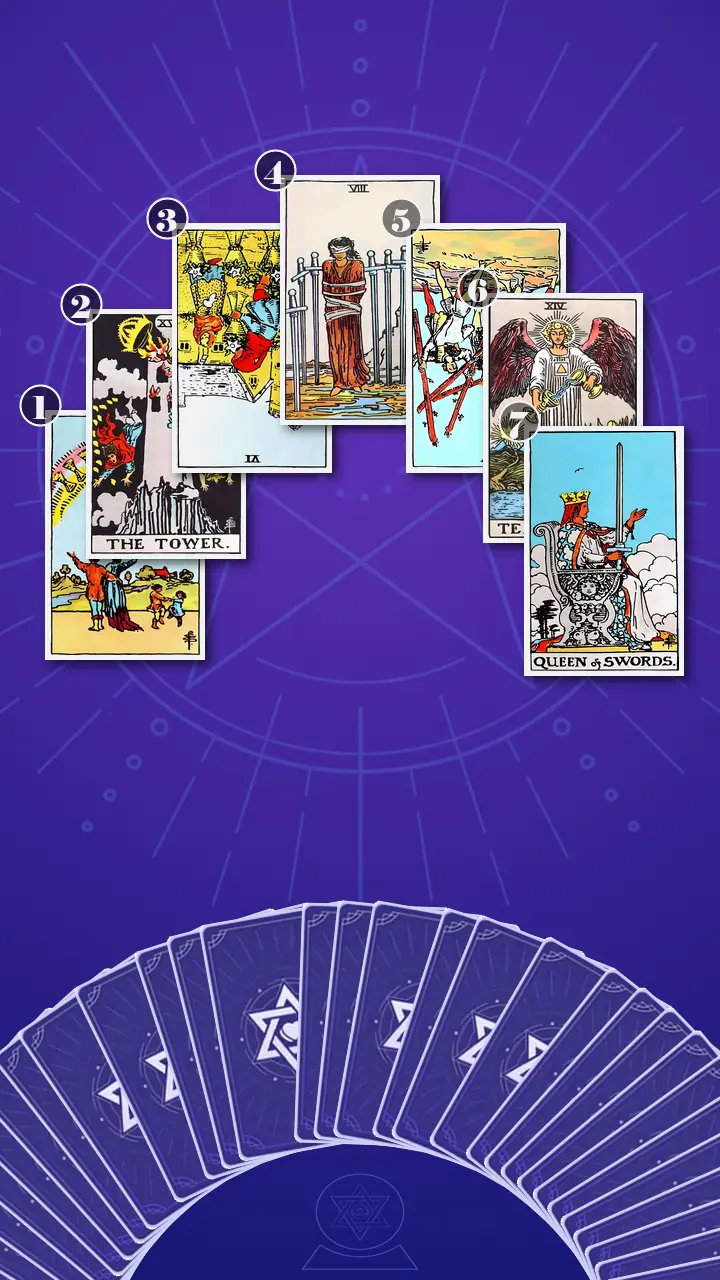
Reading the Arc: Card Meanings in Context, Not in the Clouds
Position 1 — Past emotional blueprint: the family script and stability assumptions
“Now we turn over the card that represents your past emotional blueprint—the family script that shaped your expectations and the guilt you’re feeling now.”
Ten of Cups, upright.
In modern life, this card can feel like the “default wallpaper” of your inner world: the quiet assumption that home is solid, that your parents are a reliable anchor, that the holidays will basically run on rails even when life gets busy.
For Taylor, the Ten of Cups translated immediately into something they didn’t know they’d been leaning on: ‘My parents are solid’ as an invisible safety net. Not something they announced. Just something that held up a lot—how they define home, how they imagine their future, how they feel they belong.
“This is why the divorce announcement doesn’t only feel sad,” I said. “It feels destabilizing. Like someone changed the map app mid-route.”
The Ten of Cups energy here is balance—but it’s also a blueprint. And when the blueprint cracks, your body can react like the whole building is coming down, even if you’re standing in your own apartment, paying your own bills, living your own adult life.
Taylor gave a short, almost disbelieving laugh—sharp around the edges. “That’s… cruelly accurate,” they said. “I didn’t realize how much I used them as… like, proof that things can stay good.”
“It’s not cruel,” I answered, softly. “It’s human. A stable home story becomes a nervous system resource. And when it shifts, the grief isn’t only about them—it’s about you losing a background sense of safety.”
Position 2 — Present impact: how the announcement is landing in your nervous system right now
“Now we turn over the card that represents the present impact—how this is landing in your day-to-day functioning and nervous system right now.”
The Tower, upright.
The Tower is not subtle. It’s the card of abrupt upheaval—information that doesn’t just inform you, it reorganizes you.
And the modern-life scenario is exactly what Taylor described: one message hits your phone and your entire week reorganizes around it. Group text. Then separate DMs. Then the calendar anxiety. Then the impulse to become ‘neutral’ like it’s a job title.
I said it in the short, clipped rhythm The Tower demands: “You’re trying to cook. You’re trying to work. You’re trying to be a person. And then—boom—your body reacts like an emergency. Stomach drop. Heart up. Shoulders tight. And your brain goes straight to control: manage everyone’s feelings immediately.”
The Tower’s energy here is excess—too much, too fast. Not because you’re weak. Because the structure you relied on got struck. And your system is trying to rebuild stability by force of will.
“If you answer every ping,” I added, “your life becomes the incident channel.”
Taylor nodded once, tight. Their eyes flicked to their phone even though it was face down, like muscle memory.
Position 3 — Hidden influence: childhood roles, nostalgia, and loyalty rules running in the background
“Now we turn over the card that represents the hidden influence—the quieter pull from childhood roles, nostalgia, and unspoken loyalty rules.”
Six of Cups, reversed.
Upright, the Six of Cups is sweetness and memory. Reversed, it’s the past coming back not as comfort, but as gravity. It can look like nostalgia that turns into bargaining. Or childhood roles resurfacing at the exact moment you most need your adult footing.
This is the card that says: even though you’re an adult with your own place, you catch yourself texting like you’re sixteen again—careful, pleasing, smoothing. Not because you want to be small, but because that role once kept the emotional weather calm.
I leaned into my Generational Pattern Reading here—not to blame anyone, but to name the inheritance. “In some families,” I said, “the peacekeeper role is passed down like a coat you’re expected to wear when the temperature drops. Nobody formally hands it to you. You just find it on your shoulders.”
Taylor’s throat moved as they swallowed. “That’s… exactly it. When I’m not replying, I feel like I’m failing. Like I’m letting the whole vibe collapse.”
“That’s the reversed Six of Cups,” I said. “Not missing the marriage only—missing the feeling of being safely held by something stable. And then trying to recreate that safety by being agreeable and useful.”
The energy here is blockage: the past is blocking the present from being processed. Grief shows up, and the mind turns it into logistics. Anger shows up, and the fingers start drafting the next neutral reply.
Position 4 — Core obstacle: the mental bind and role-trap
“Now we turn over the card that represents the core obstacle—the exact bind that keeps you from knowing what to rebalance first.”
Eight of Swords, upright.
This is the trap-card. Not because you have no choices, but because fear narrows your view until every choice looks like it costs belonging.
The modern-life translation is painfully specific: your schedule becomes reactive to pings and calls. You think, I can’t say no. I can’t disappoint either of them. So you draft perfect responses, offer balanced advice, and keep yourself available like an emotional help desk.
In my mind, I could see the scene Taylor described without them even saying it again: standing in a Toronto condo hallway, keys in hand, rereading a message three times before pressing send. Shoulders up to ears. That familiar stomach-drop. The blindfold feeling—like you’re walking through your own life by touch alone.
So I named the internal OS out loud, like reading a script off a screen:
“I can’t say no.”
“I can’t choose.”
“I can’t make it worse.”
Then I offered the micro-reframe, because with the Eight of Swords, we don’t need a philosophy—we need a door handle. “You can do one clean boundary,” I said. “And that boundary can be about triangulation, not about love.”
Taylor nodded again—still tight, but this time with recognition that looked like relief’s first cousin. And I gave them a sentence I wanted them to keep:
Neutral isn’t the same as on-call.
In the Eight of Swords, the energy is deficiency of perceived agency. You are an adult, with a job, with a home, with a whole life—and yet the old role makes you feel like you’re not allowed to choose your pace.
Position 5 — External pressures: conflict style and expectations that recruit you into peacekeeping
“Now we turn over the card that represents external pressures—family dynamics and social expectations that quietly recruit you into conflict management.”
Five of Wands, reversed.
Upright, the Five of Wands is loud conflict. Reversed, it’s conflict that goes underground: passive comments, tense silence, carefully worded requests, and a lot of unspoken expectation that the most responsible person will ‘help smooth things over.’
In modern terms, it’s group project conflict where nobody says the issue out loud, so the conscientious person ends up doing invisible coordination work. Except now it’s your parents, and the stakes feel personal. It’s being asked to translate tone between two people who refuse to speak directly.
“This card tells me something important,” I said. “You didn’t create the conflict. But the environment is shaped in a way that makes you feel responsible for managing it.”
The reversed energy is blockage again—conflict isn’t being handled directly between the adults who own it, so it leaks sideways into you.
“You’re being pulled into referee work,” I said. “And it’s dressed up as ‘keeping the peace.’”
Taylor’s mouth pressed into a line. “I hate that I’m good at it,” they admitted. “Like… I can literally hear myself editing.”
“Of course you can,” I said. “You learned it. It’s a skill. But a skill isn’t always a job you should keep.”
Position 6 — Advice / first rebalance: what stabilizes you first
“Now we turn over the card that represents advice—your first rebalance. The stabilizing priority that comes first so you can support without self-erasure.”
The air in the room changed the way it does right before a storm breaks—quiet, attentive. Even Taylor stopped fidgeting with the edge of their sleeve.
Temperance, upright.
This is the antidote card. Temperance isn’t about forcing harmony. It’s about measured mixing: empathy with structure, love with limits, feeling with pacing. One foot on land, one in water. A path to the horizon that’s slow by design.
Setup. I described the exact loop Taylor had been stuck in, because this is where the advice has to land in real life, not as a poster quote. “You’re at your kitchen table,” I said, “laptop open, Slack pings coming in. You’re rewriting a ‘neutral’ text to Parent A while Parent B’s typing bubble pops up again. Your brain is saying, If I don’t answer now, I’m failing. But another part of you is whispering, If I answer now, I’m abandoning myself.”
Delivery.
Not “hold it all together” but “pour it in measured doses,” letting Temperance turn chaos into a sustainable rhythm.
I let that sentence sit between us. No extra commentary. Just room for it to become true.
Reinforcement. Taylor’s reaction came in layers—the way real permission does. First: their breath caught, a half-second freeze, eyes fixed on the card as if it had said their name. Second: their focus went slightly unfocused, like they were replaying the last week on fast-forward—two threads, a dozen drafts, the missed dinner, the clenched jaw in work meetings. Third: the exhale arrived, long and uneven, as their shoulders dropped a fraction they hadn’t known they were holding. Their eyes glossed, not with drama, but with the tenderness of being accurately seen.
“I feel… mad,” they said, surprising themselves. “Because it’s like—if I do this, it proves I could have done it earlier.”
“That’s such an honest reaction,” I replied. “And it doesn’t mean you were wrong before. It means you were in a Tower moment. Temperance doesn’t shame the shock. It just asks: can we stop turning shock into a 24/7 job?”
I brought in my Home Energy Diagnosis gently, because Taylor’s question was about “what to rebalance first,” and the body and home are where rebalance shows up fastest. “Think of your condo like a bowl,” I said. “Right now, every message is sloshing the water over the rim. Temperance is you giving the water a container again. Not by being cold. By being scheduled.”
I used the scene analogy that makes this card click for a modern nervous system: “Temperance is the difference between an always-on customer support inbox and a scheduled office-hours calendar. When you’re always-on, every ping feels urgent. When you have office hours, you can be fully present—without disappearing.”
Then I asked the question that turns insight into lived memory: “Now, with this new lens—can you think back to last week? Was there a moment when you answered immediately, but you were flooded? A moment when this idea—measured doses—could have helped you feel different?”
Taylor swallowed. “Yesterday. Dad started venting, and I stayed on the phone while my pasta boiled over. I felt… stupid. Like I couldn’t even make dinner.”
“That’s the moment,” I said. “Temperance is not spiritual perfection. It’s pasta that doesn’t burn because you put the phone down for ten minutes.”
I taught them a practical pacing tool, the way I’d teach someone to read changing weather: “Stoplight pacing,” I said. “Red: don’t respond while you’re flooded. Yellow: draft, but don’t send. Green: send one sentence and a boundary. You can do this with a cold glass of water in your hand, feet on the floor, phone facedown. You’re telling your nervous system: we’re not in a fire.”
And I gave them the simplest version of Temperance they could do in real life: the Two-Cups Reset—one cup for their stability, one for family support. Not infinite pouring. Measured doses.
Position 7 — Integration direction: what becomes available if you practice the advice
“Now we turn over the card that represents the integration direction—what becomes available internally and relationally if you practice Temperance.”
Queen of Swords, upright.
When Temperance steadies your inner world, the Queen of Swords gives you language. She is the ‘short email’ energy: clear subject line, two sentences, no apology paragraph, and you hit send anyway.
I pointed to her open hand and upright sword. “This is warmth without self-abandonment,” I said. “Truth plus discernment. You can love them both and refuse triangulation.”
And because this is where people often spiral into over-explaining, I said the line I’ve watched save relationships again and again: “Over-explaining is just guilt trying to negotiate.”
Taylor’s face did that complicated thing—nerves and relief in the same expression. “So it can be… one sentence?”
“A boundary can be one sentence you’re willing to repeat,” I said. “Clear is kind.”
The First Rebalance: A Steady Center Protocol (Before You Rebalance the Family)
When I looked at the whole arc of the Horseshoe Spread, the story was remarkably coherent: a deep emotional blueprint of family stability (Ten of Cups) gets struck by abrupt reality (The Tower). That shock reactivates older roles and loyalty rules (Six of Cups reversed), which tightens into a mental bind—I have to be neutral, available, perfect, or I’ll lose belonging (Eight of Swords). Outside of you, conflict goes underground and quietly recruits you into invisible labor (Five of Wands reversed). The way through isn’t choosing a parent. It’s choosing pacing and limits first (Temperance), so you can speak clearly without becoming cruel or disappearing (Queen of Swords).
Your cognitive blind spot—completely understandable, and completely exhausting—is this: you’ve been treating “support” as the same thing as “constant availability.” That’s why you don’t know what to rebalance first. Because if support equals 24/7 responsiveness, then your own stability always loses.
The transformation direction the cards pushed toward was clear: shift from being the family mediator to being a supportive adult child with defined limits and a plan for your own emotional regulation first. In other words: you can care without carrying.
Here are the first, low-drama next steps I gave Taylor—actionable advice designed to work in the real world, not a perfect world:
- Schedule a “Family check-in window”Open Google Calendar and create one recurring block this week labeled “Family check-in window” (20–30 minutes). During that window, you can call/respond. Outside it, you’re not on duty—even if you feel the itch to be.Tip: Expect guilt at first. Name it as the old belonging fear, then follow the schedule anyway. Neutral isn’t the same as on-call.
- Do the 10-minute Two-Cups Reset (3 days only)Set a 10-minute timer. In Notes, make two columns: “My stability today” and “Family support today.” Choose ONE stability action you can do in the next 24 hours (eat something, 20-minute walk, lights-out time, 45-minute focus block). Choose ONE family-support container (one check-in text or one 20-minute call).Tip: If your chest tightens while writing, pause and take three slow breaths with a hand on your chest. You’re building a container, not a perfect plan.
- Save a no-triangulation sentence as a keyboard shortcutPick one boundary sentence and save it in your phone keyboard shortcuts, e.g., “I’m not able to talk about Mom/Dad with you, but I can talk about how you’re doing.” Use it the first time a parent starts venting about the other parent.Tip: Repeat it verbatim up to three times. If it turns into debate, end the call politely. A boundary can be one sentence you’re willing to repeat.
- Try my 3-minute family energy check (with a houseplant)Before you reply to any charged message, stand near one living thing in your home—a plant, even a small one. Check: Is it dry? Does it need light? Then check yourself: “Am I dry (hungry/tired)? Do I need light (a walk/air)?” Do ONE tiny care action before you respond.Tip: This isn’t about being ‘zen.’ It’s a nervous system interrupt. Temperance begins with water, light, and timing.
I added one final note—because I’ve watched the Queen of Swords get misused when people are scared: “Make it clear, not cold. If you’re tempted to write a paragraph, shrink it to two sentences: care + boundary.”

A Week Later: The Quiet Proof of Finding Clarity
A week later, Taylor messaged me a screenshot: a calendar invite that simply read Family check-in (20 min)—sitting right beside another invite that read Dinner. Two cups, side by side. Measured doses.
“I did the thing,” they wrote. “I put my phone on Do Not Disturb for 45 minutes at work and nothing exploded. Then I called my mom in the window. When she started talking about my dad, I used the shortcut sentence. My hands were shaking, but I didn’t add an essay.”
They told me the bittersweet part too, because real clarity doesn’t erase complexity: they ate pasta alone that night, phone in the other room, feeling both lighter and strangely tender—like making room for yourself can feel unfamiliar at first. In the morning, their first thought was still what if I’m doing this wrong?—but this time, they breathed, and the question didn’t hijack the day.
That’s what a Journey to Clarity often looks like in real life: not a dramatic resolution, but a steadier center. Temperance first. Then the Queen of Swords voice. Care without carrying.
When your parents’ marriage shifts overnight, it can feel like you’re supposed to hold two people steady while your own stomach drops—like love means staying available 24/7, even if you’re quietly disappearing.
If you let “support” mean steadiness instead of urgency for one week, what’s the smallest boundary or pacing change you’d be curious to try first?
This story is adapted from psychological research, written so that those in a similar struggle can see their own pattern in it — and find their next step clearly.These insights are not a substitute for professional psychological, medical, legal, or financial advice.
Learn more about our Journey to Clarity.
How did this insight land for you?
🫂 This Resonates Deeply
🌀 Living This Story
✨ Now I See Clearly
🌱 Seeing New Possibilities
🧰 Useful Framework
🔮 The Confirmation I Needed
💪 Feeling Empowered
🚀 Ready for My Next Step
Author Profile
 AI
AI“As the seventh generation of a Highland healing family, I see modern anxieties as a simple, temporary disconnection from nature's rhythm. I bring 67 years of lived seasons not to instruct you, but to hold space for you. Using tarot as a mirror, I want to gently guide you out of the chaos, helping you breathe deeply and rediscover the organic, steady heartbeat of your own life.”
In this Family Tarot Reading :
Core Expertise
Service Features
Also specializes in :
Explore Related Patterns:
Boundary DiffusionTaylor's line, that just existing feels like taking a side, captures the collapse of a clean you-me boundary. The separate parent threads blur the difference between being a loving adult child and becoming a participant in the divorce conflict. Boundary Diffusion is the pattern where care, access, responsibility, and identity start blending into one obligation. For Taylor, this shows up as the belief that saying no, delaying a reply, or refusing to discuss one parent with the other could make them the bad child. The repair begins when You stop treating every limit as a loyalty test. A boundary about pacing or triangulation does not withdraw love; it defines the conditions under which love can stay steady without self-erasure.
Defensive OverfunctioningTaylor's repeated drafting, balanced advice, and emotional help desk availability show a coping strategy built around doing more when the family system feels unstable. The behavior is not random productivity; it is an attempt to reduce relational danger by absorbing extra emotional labor before anyone has to ask for it directly. That is the core mechanism of Defensive Overfunctioning: You try to create safety by becoming hyper-useful, hyper-responsive, and emotionally managerial. The private messages, the underground conflict, and the fear of letting the whole vibe collapse all push Taylor toward solving a problem that is not fully theirs to solve. The first rebalance is therefore not choosing a parent. It is interrupting the reflex that turns care into constant repair work. When You can support from a scheduled, bounded place instead of an on-call role, the family crisis stops consuming your entire nervous system as its operating room.
Emotional RegulationTaylor's later screenshot shows the first real evidence of change: a family check-in window sitting beside dinner, the phone on Do Not Disturb, and a no-triangulation sentence used without an added essay. The behavior becomes paced instead of reactive. Emotional Regulation here is not about suppressing the shock or pretending the divorce does not hurt. It is the practical mechanism of giving the nervous system a container: red means do not respond while flooded, yellow means draft without sending, green means one sentence and a boundary. That is why this pattern directly answers the question of what to rebalance first. You stabilize the channel through which support flows, so your care comes from steadiness rather than urgency.
Family Role RegressionTaylor is an adult in their own Toronto condo, but the divorce announcement pulls their texting style back into an older family script: careful, pleasing, smoothing, and monitoring the emotional weather. The body is in the present, while the coping role behaves as if Taylor is sixteen again. Family Role Regression is the mechanism where stress reactivates an old position in the family system. The peacekeeper role once may have helped Taylor keep the atmosphere calmer, but under the divorce pressure it becomes a trap: not replying feels like failing, and being useful starts to feel like the only way to belong. The first rebalance asks You to return to adult footing before responding. Scheduling a check-in window, using one boundary sentence, and putting the phone down for ten minutes are not small because the conflict is small; they are small because old roles loosen through repeated, concrete acts of differentiation.
ParentificationTaylor's immediate urge is to manage everyone's feelings, even though the divorce conflict belongs to the parents. The private messages and indirect expectations turn an adult child's support role into something closer to emotional management. Parentification is the pattern where a person takes on responsibility for adult emotional stability inside the family system. Here it is visible in Taylor's fear that if they do not reply, smooth, mediate, or keep the atmosphere from collapsing, they are failing as a child. The shift is not toward detachment; it is toward role correction. You can be a caring adult child without becoming the emotional infrastructure for two adults' separation, and that role boundary is central to deciding what to rebalance first.
People-PleasingTaylor's careful editing and smoothing are attempts to keep both parents emotionally intact while avoiding any signal that could be read as rejection. The behavior looks like diplomacy on the surface, but the pressure underneath is much more personal: if Taylor is agreeable enough, maybe the family atmosphere will not collapse. People-Pleasing is not just being nice. It is a protective strategy where You trade directness for temporary safety, especially when conflict has been trained to feel dangerous. In this story, the strategy gets activated by private messages, indirect expectations, and the fear that neutrality must be performed perfectly. The rebalance is to let care become specific instead of unlimited. One warm sentence plus one clear limit gives Taylor a way to remain connected without using self-silencing as the price of connection.
TriangulationThe group text says not to take sides, but the two separate private messages immediately create a second, quieter assignment: carry each parent's emotional position into the space between them. Taylor is not simply being updated about the divorce; they are being placed inside the communication circuit. Triangulation shows up when conflict between two people gets routed through a third person instead of being handled directly. In Taylor's case, the pressure is subtle rather than explosive, which makes it harder to name: private threads, tone translation, referee work, and the feeling that just existing has become a side. The no-triangulation sentence is the psychological pivot because it separates love from messenger duty. You can care about both parents without becoming the bridge they use to avoid direct contact, and that distinction is exactly what needs rebalancing first.
Explore Related Struggles:
Autonomy Guilt BindTaylor keeps trying to write the cleanest possible neutral sentence, as if exact wording could protect everyone from disappointment. Beneath that careful editing is a sharper pressure: saying no, slowing down, or refusing to discuss one parent with the other might make them feel like the bad child. You are trying to claim adult pacing inside a family script that still treats availability as proof of loyalty. That is why a simple boundary does not feel simple. It carries the weight of belonging, even when the actual boundary is only about timing, topic, or triangulation. Autonomy Guilt Bind names the collision between your right to self-direction and the guilt that appears when family roles ask you to stay endlessly available. Rebalancing starts by separating a limit from a rejection, so your autonomy is no longer automatically translated into abandonment.
Caretaker Role LockTaylor describes the old peacekeeper role resurfacing the moment the divorce announcement lands. They are an adult with their own home and workday, but the family system still places the familiar coat on their shoulders: smooth the tone, keep the vibe from collapsing, translate between people who are not speaking directly. You may be good at this kind of emotional coordination because you learned it early, but skill can quietly harden into assignment. The lock forms when usefulness starts to feel like belonging, and stepping out of the role feels like letting the whole family structure drop. Caretaker Role Lock points to the inherited position that keeps pulling you back into management mode. The first rebalance is noticing that being capable of holding the conflict does not mean you are responsible for carrying it.
Real-Time Care BindTaylor sits in the Toronto condo with two text threads open, dinner cooling on the counter, and a single neutral sentence being rewritten again and again. The phone is not just a device in the scene; it becomes the timing system for their care, deciding when their body tenses, when work loses focus, and when dinner stops mattering. You can want to be supportive and still get trapped when support becomes real-time responsiveness. In this bind, the speed of a reply starts to feel like the measure of your love, so waiting ten minutes can feel more dangerous than abandoning your own body. Real-Time Care Bind captures the moment care loses its container. The work is not to care less, but to stop letting urgency set the terms of care, so your support can come from steadiness instead of constant availability.
Triangulated BelongingTaylor receives a public instruction not to take sides, then immediately gets two private messages that quietly ask for exactly that. The contradiction turns their phone into a loyalty test: every reply, delay, and carefully neutral sentence starts to feel like evidence for one parent or against the other. You are not simply watching two adults separate; you are being positioned inside the space between them. The struggle is that belonging no longer feels like a stable family fact. It feels conditional on your ability to hold both sides without making either side feel abandoned. Triangulated Belonging names the bind where love becomes routed through a triangle instead of a direct relationship. The first rebalance is not choosing a parent; it is seeing that the triangle itself is the pressure point, and that stepping out of referee work is not the same as withdrawing care.
Relational Pacing StrainTaylor's practical turning point is not a grand family resolution. It is a calendar window, a phone placed face down, one boundary sentence, and the recognition that neutral does not mean on-call. You are trying to keep care alive while changing its rhythm. That creates strain because the old rhythm was immediate, reactive, and guilt-driven, while the new rhythm asks for measured contact, scheduled support, and enough space for your own body to settle. Relational Pacing Strain captures the difficult middle ground where love is still present, but urgency is no longer allowed to run the whole system. The first rebalance is pacing: the container that lets you stay connected without disappearing into the conflict.
Family System OveridentificationTaylor realizes they had been using their parents' marriage as quiet proof that things can stay good. The divorce announcement does not only change the family calendar; it cracks a background structure that helped them imagine home, continuity, and their own future safety. You can be independent on paper and still have part of your nervous system organized around the family's stability. When that structure shifts, the body may react as if your own ground has moved, even while you are standing in your own apartment, paying your own bills, and living your own adult life. Family System Overidentification names the fusion between the family's intact image and your internal sense of steadiness. The rebalance begins when you can grieve the changed family blueprint without making yourself responsible for restoring it.
Explore Related Emotions:
Adult Child PanicTaylor is standing in their own condo, with dinner cooling on the counter and two parent text threads open, but their body responds as if the family system has become an emergency room. The adult setting matters because nothing about their actual life has vanished, yet the old emotional blueprint is hit so hard that their shoulders rise, their stomach drops, and every reply starts to feel consequential. Adult Child Panic names that sudden regression in the nervous system without making it a character flaw. You are not simply reacting to a divorce announcement; you are reacting to the collapse of a background safety story that helped organize home, belonging, and your sense of what stays reliable. The first rebalance begins where the panic is loudest: the urge to fix everything immediately. When you can notice that speed is trying to manufacture safety, you can start separating real care from emergency availability.
Boundary GuiltTaylor keeps polishing one neutral sentence like a legal document because a simple reply no longer feels simple. Saying less, waiting longer, or refusing to discuss one parent with the other all seem to carry the same hidden accusation: that a boundary means they are becoming cold, selfish, or disloyal. Boundary Guilt is the emotional weight that lands when self-protection gets mistaken for betrayal. You can see it in the way grief and anger are converted into logistics, and in the way Taylor becomes available like an emotional help desk even while dinner, work, and their own body are being interrupted. This feeling is central to the question of what to rebalance first because it makes stability feel morally suspicious. The first repair is not choosing a parent; it is allowing a limit to exist without treating that limit as evidence that you love anyone less.
Conditional Belonging FearThe group text asks Taylor not to take sides, and the private messages immediately ask for a quieter version of the opposite. That double bind turns ordinary communication into a belonging test, where even existing with a boundary can feel like choosing against someone. Conditional Belonging Fear captures the specific pressure underneath the neutrality performance. You are not only afraid of conflict; you are afraid that love in this family now depends on being perfectly balanced, endlessly available, and useful enough to keep the atmosphere from collapsing. This is why the question feels larger than scheduling calls or wording a text. Rebalancing starts with seeing that belonging cannot be earned through 24/7 responsiveness, because that bargain slowly trains you to disappear from your own life.
Contained OverwhelmTaylor does not need to feel instantly fine for the first rebalance to work. The shift begins when the phone goes face down, the breath slows, and the family crisis is placed inside a time window instead of being allowed to spill across every surface of the day. Contained Overwhelm describes a state where the intensity remains, but it finally has edges. You can still care, still feel shaken, and still need to answer hard messages, while also refusing to make your entire life the container for everyone else's conflict. This is why the two-cups image lands so clearly. One cup holds your stability, one cup holds family support, and the point is not infinite pouring; it is learning that measured care is more sustainable than emotional overflow.
Emotional FloodingTaylor's kitchen scene is full of overflow: dinner cooling, laptop fan whirring, parent threads open, Slack pings arriving, and a typing bubble threatening to pull them back in. The body reacts before the mind can sort the meaning, pushing them toward immediate repair as if speed could turn pain into safety. Emotional Flooding fits because the issue is not one isolated feeling; it is the whole system being hit by too much, too fast. You can still be articulate and capable while your inner bandwidth is being swallowed by message alerts, loyalty calculations, and the pressure to remain neutral. The rebalance therefore has to begin with containment. A check-in window, a phone facedown, and one sentence repeated are not small because the situation is small; they are small because flooding needs a container before clarity can come back online.
Grounded AgencyThe line Taylor is given is simple: neutral is not the same as on-call. That sentence gives shape to a choice they could not feel before, because it separates love from instant responsiveness and makes pacing available as a form of care. Grounded Agency is the felt return of choice inside a situation Taylor cannot control. You are not deciding the divorce, managing the parents' feelings, or forcing harmony; you are deciding when you are available, what topics you will not carry, and how much of yourself stays intact while you support them. The agency is grounded because it lives in concrete acts: Do Not Disturb for 45 minutes, a 20-minute check-in window, a saved no-triangulation sentence. Each one teaches the body that steadiness can lead before urgency does.
Cautious AutonomyTaylor asks whether a boundary can really be one sentence, and the answer is yes: care plus boundary, repeated without an apology essay. That small language shift lets them stay warm without giving up their own position. Cautious Autonomy names the tender first stage of separating love from compliance. You are not cutting yourself off from your parents; you are learning that connection can survive a limit, and that refusing triangulation does not cancel care. The caution is important because this freedom is still unfamiliar. It arrives with shaking hands, second thoughts, and a morning question about whether you did it wrong, but it also gives you a self to return to after the family check-in ends.
Hard-Won ComposureA week later, Taylor's hands are still shaking when they use the shortcut sentence, but they do not add the essay. Dinner returns to the calendar beside the family check-in window, and the phone can be in another room without the whole day collapsing around it. Hard-Won Composure fits because the steadiness is not smooth or effortless. You can feel lighter and strangely tender at the same time, still wonder whether you are doing it wrong, and still keep the question from hijacking the day. This composure matters because it shows the first rebalance becoming real in the body. Taylor is not escaping complexity; they are building enough inner steadiness to stay caring without becoming constantly available.
Hypervigilant AnxietyTaylor's phone is face down, but their eyes still flick toward it. Their hands hover near it, their body waits for the next buzz, and the condo's ordinary sounds become part of an alert system rather than a background of home. Hypervigilant Anxiety names that braced attention state where silence is not restful because the next interruption already feels present. You are not choosing to obsess over messages; your body has learned that a single ping can rearrange the whole evening. This matters for the first rebalance because constant scanning makes every boundary harder to hold. Before Taylor can decide what to say, they need enough space from the incident channel to feel that not every message is a fire.
Suppressed ResentmentTaylor admits they hate being good at the smoothing work. That sentence carries more than frustration; it reveals the bite of having a skill turned into an expectation, especially when the conflict belongs to two people who could speak directly to each other. Suppressed Resentment gathers under the neutral drafts, careful edits, and tone translation. You can keep sounding reasonable while a quieter part of you registers that this invisible labor is costing dinner, focus, rest, and self-respect. The emotion becomes useful once it is named without shame. It points to the exact place where support has become extraction, and it helps Taylor understand why a no-triangulation boundary may feel less like rejection and more like returning responsibility to its rightful owners.
Explore Related Contexts:
Always On AvailabilityTaylor is trying to cook, work, and be in their own condo, but the phone keeps operating like an emergency channel. Dinner cools, pasta boils over, Slack pings compete with parent messages, and every typing bubble threatens to reset the whole evening. The pressure is structural because availability has become confused with care. If every message must be answered in real time, Taylor's own schedule stops belonging to them, and family support becomes an always-open customer service desk. Always On Availability captures the first thing that needs rebalancing. You do not have to decide the entire emotional future of the family tonight; you have to separate support from instant access, so your care can come from a stable rhythm instead of a permanent alert state.
Conditional Family BelongingTaylor says that trying not to take sides still feels like taking a side, and the deeper pressure is that a boundary might make them the bad child. The family system is not just asking for support; it is making belonging feel dependent on neutrality, usefulness, and emotional availability. That condition changes the meaning of ordinary adult limits. A delayed reply, a shorter call, or a refusal to discuss one parent with the other can start to feel like proof of disloyalty, even when it is simply a boundary around triangulation. Conditional Family Belonging is the outer pressure underneath the question of what to rebalance first. You need a structure that lets you stay connected without having your place in the family depend on being endlessly reachable, endlessly fair, or endlessly useful.
Designated Peacekeeper BurdenTaylor keeps rewriting a single neutral sentence while both parent threads stay open, as if the right wording could keep the family atmosphere from breaking further. The story shows a specific kind of invisible labor: editing tone, absorbing tension, and trying to make everyone feel held without becoming the person who chooses a side. The burden comes from the way conflict is handled around them. The parents' tension is not staying between the parents; it arrives as private requests, venting, and unspoken expectations that the responsible child will smooth the edges. Designated Peacekeeper Burden names the external role being placed on you. The first rebalance is not about becoming less caring; it is about recognizing that being good at calming a room does not make you responsible for carrying a divorce process that is not yours to manage.
Family Boundary NegotiationTaylor's first concrete shift is small but structural: a scheduled family check-in window, the phone on Do Not Disturb, and one saved sentence refusing to discuss one parent with the other. The change is not a dramatic confrontation; it is a new operating agreement for how family contact can happen. That gives the relationship a usable boundary instead of leaving it to impulse, guilt, and incoming notifications. Support becomes something Taylor can plan and offer with presence, not something extracted by every ping. Family Boundary Negotiation fits the constructive side of the story because Taylor is not cutting off care; they are redesigning access. The first rebalance is the move from open-ended emotional availability to clear, repeatable terms that both protect the adult child and preserve the possibility of connection.
Parent Phone Boundary PressureTaylor's hands hover near the phone as if it might buzz at any second, and later the story returns to the same pattern through typing bubbles, calls, draft texts, and Do Not Disturb. The phone is not neutral technology here; it is the channel through which the family crisis keeps entering Taylor's day. Because the messages come from parents, response time starts carrying emotional weight. A call during dinner or a DM during work can feel less like an interruption and more like a loyalty test. Parent Phone Boundary Pressure identifies the practical surface of the larger family dynamic. The first rebalance can begin with response windows, phone-down intervals, and one repeatable sentence because the pressure is arriving through a device that needs rules, not through a demand that must be obeyed every time it appears.
Parentified Adult Child RoleTaylor is living independently, working, paying bills, and standing in their own adult life, yet the divorce dynamic pulls them into caretaking both parents' emotional reactions. Dad vents while dinner boils over; two parent threads sit open; support starts to look like containment. The role pressure is external because the parents' conflict is being handled in a way that asks the child to function like an emotional stabilizer for the older generation. Taylor's adulthood is recognized in practical terms but overridden in relational terms. Parentified Adult Child Role fits when the first rebalance is about returning responsibility to the right place. You can care about both parents without becoming the container for the divorce, and you can offer support without being drafted into the role of the more regulated adult in the room.
Triangulated Family MediatorTaylor receives a group text asking them not to take sides, then immediately gets two separate private messages that quietly ask for exactly that. The pressure is not just that the parents are divorcing; it is that the conflict is being routed through Taylor as a third point in the triangle. That structure turns ordinary support into mediation work. Taylor starts drafting neutral sentences like legal copy, tracking two text threads at once, and trying to prevent either parent from feeling abandoned or betrayed. This is why Triangulated Family Mediator fits the story. You are not simply being informed about a family change; you are being recruited into managing communication between adults who should be holding the conflict directly with each other. Naming that structure gives you a cleaner first move: step out of the referee position before deciding how much support you can sustainably offer.