Finding Clarity in the 11:47 p.m. Ring-Tab Glow
If you’ve ever kept a ring tab open for hours in your Toronto condo, then immediately switched to “am I repeating my parents?” content like it’s the same shopping cart—yeah, this is that kind of night.
Jordan settled into the edge of our video call like she was trying not to take up too much space—even though she was the only one in her living room. The laptop was balanced on her knees. The light on her face wasn’t a lamp; it was the bluish glow of a ring page and the tiny, stubborn LED on her router. Somewhere behind her mic, I could hear that faint Toronto hush: distant cars, a building’s ventilation, the aftertaste of a commute that never fully leaves your nervous system.
“I keep doing this thing,” she said, and I watched her lower lip press against her teeth like she was holding back a confession. “I’ll have the ring tab open… and I’ll even draft proposal ideas in my Notes app. And then I’ll flip to articles about attachment styles, or like… ‘signs you’re ready,’ and suddenly I’m convinced I’m not allowed to move forward until I’ve unpacked everything about my parents’ marriage.”
She swallowed, and her jaw tightened so visibly it looked like a muscle memory. “So it’s like… propose now, or unpack my parents’ marriage script first. And I can’t tell if I’m being careful or just stalling.”
The anxiety wasn’t an abstract feeling in her voice. It was more like watching someone try to breathe through a scarf pulled just a little too tight—shallow inhale, quick exhale, the restless urgency of needing an answer tonight so sleep could finally happen.
“We can work with that,” I told her, keeping my tone warm and plain. “Not to force a timeline, and not to psychoanalyze you into another midnight spiral. Our goal tonight is simpler: we’re going to turn the fog into a map. We’re going on a small Journey to Clarity—one where you get a next step you can actually do in real life.”
Choosing the Compass: The Decision Cross Tarot Spread
I asked Jordan to place one hand gently along her jaw—no drama, just noticing—then to inhale as if she were pulling air down into her ribs. “Three minutes,” I said. “Cosmic breathing. Not because the universe demands it, but because your body deserves a signal: we’re not in emergency mode.”
As she breathed, I shuffled. The sound of cards has a steadiness I’ve always loved—maybe because I spent ten years guiding people through a planetarium dome, teaching them that the sky isn’t chaos. It’s motion with pattern. Rhythm. Timing.
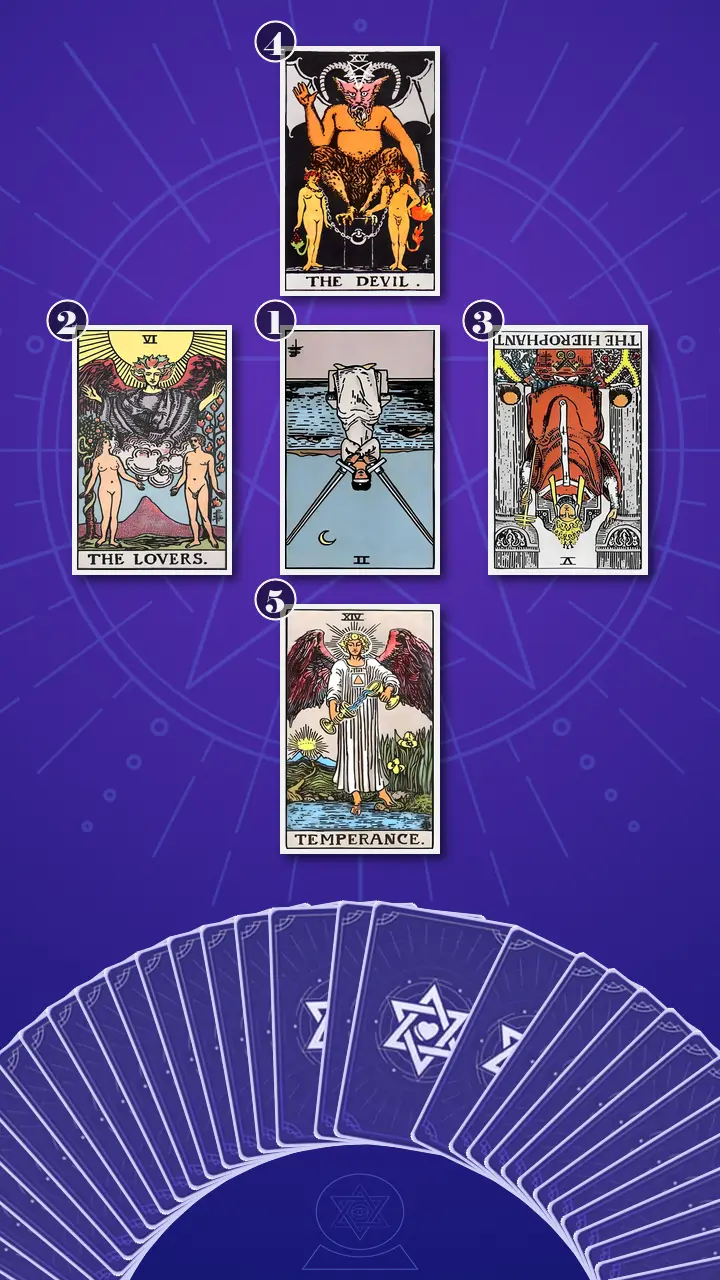
“Today I’m using a five-card spread called the Decision Cross,” I explained, speaking as much to you as to Jordan. “It’s perfect for a relationship crossroads—especially the ‘propose now vs wait and unpack’ tension—because it holds both poles without pretending there’s one correct timeline. We’ll look at: the current stuck loop, what each path is really trying to serve, the hidden driver underneath both urges, and then the most grounded integration step.”
I pointed to the layout on my table. “Card 1 sits at the center: your real-life loop, not your ideal self. Cards 2 and 3 compare the two impulses—‘propose now’ versus ‘unpack the script.’ Card 4 reveals what’s been steering the whole thing beneath the surface. Card 5 is guidance: the next step that blends love and self-protection into a workable process.”
Reading the Map: When a Choice Stops Being Theoretical
Position 1 — The Loop That Feels Like “Research”
“Now we’re turning over the card that represents the current stuck point in the commitment decision, shown as a concrete behavior loop,” I said.
Two of Swords, reversed.
I angled the card toward the camera. “This is the late-night toggling card,” I told her. “It’s late, you’re in bed with your laptop, and you’ve got one ring tab open plus three articles about ‘how to know you’re ready.’ You keep switching because ‘undecided’ feels like the only position where you can’t be wrong.”
Jordan let out a small, sharp laugh—more bitter than amused. “That’s… kind of brutal,” she said. Then, quieter: “But yeah. That’s exactly what I do.”
“Reversed here,” I continued, “the energy isn’t balance. It’s blockage breaking. The stalemate is starting to crack, which is why it feels urgent and messy. The blindfold isn’t just ‘confused.’ It’s ‘I can’t look directly at this, so I hold everything in a tense stalemate.’ And the crossed swords? That’s your body doing conflict management before you’ve even spoken. Jaw tight. Shoulders up. Breath shallow.”
I mirrored back the inner monologue I could almost hear under her words: “If I pick A, I’m reckless. If I pick B, I’m stalling. If I pick nothing, I’m ‘safe’… for tonight.”
She nodded—quietly embarrassed, then exhaled like her ribs finally remembered they could move. The loop had been named, and naming it took away some of its power.
“And here’s the thing,” I said gently. “If it has to be perfect to be safe, it’ll stay hypothetical.”
Position 2 — The Values Behind ‘Propose Now’
“Now we’re turning over the card that represents Path A: what ‘propose now’ is really trying to serve,” I said.
The Lovers, upright.
“This isn’t just romance,” I told her. “In context, it’s a values-based choice. You’re imagining a proposal moment, but what keeps interrupting the fantasy is the quieter question: ‘What are we actually choosing?’ Not the ring—the shared values, your definition of partnership, the meaning you both want marriage to hold.”
Her eyes flicked away from the camera, like she was watching a memory replay on the far wall. “I do want it,” she said. “It’s not like I’m trying to escape the relationship.”
“Exactly,” I replied. “This card is balance when it’s lived consciously. It says the healthiest version of proposing is preceded by honest dialogue, not a perfect moment. Let me give you a phrase to hold onto: A proposal isn’t a guarantee—it’s a conversation made visible.”
Jordan’s shoulders dropped a millimeter. She didn’t look instantly healed. She looked… less alone in the decision.
Position 3 — The Script You Never Agreed To
“Now we’re turning over the card that represents Path B: what ‘unpacking my parents’ marriage script’ is really trying to protect or heal,” I said.
The Hierophant, reversed.
“This one is big,” I said, and I kept my voice steady. “It’s the institutional marriage card—but reversed, it’s you questioning inherited rules. In real life, it’s: you come back from a family visit and suddenly your brain treats marriage like a strict template you either have to follow perfectly or reject entirely.”
Jordan’s mouth went slightly open. Not dramatic—just a sharp, involuntary oh, like something clicked into place.
“This,” I said, “is where I want you to hear me clearly: Your parents’ marriage is context, not a contract.”
Her eyes went glossy for a second, then she blinked hard. “When I’m at their house,” she admitted, “it’s like I’m fifteen again. And then my relationship feels… on trial.”
“That’s the card,” I said. “And the invitation here is tangible: ‘Their rules / Our agreements.’ Not vague ‘trauma work’ at midnight. A rewrite you can actually live.”
Reversed Hierophant can be liberating—a refusal to run default settings. But it can also become a stealth delay tactic if it turns into: “I must fix everything first.” This card doesn’t require that. It asks you to choose structure on purpose.
Position 4 — The Hidden Terms & Conditions
“Now we’re turning over the card that represents the hidden factor: the core fear/bind that makes both options feel risky,” I said.
The Devil, upright.
Jordan’s throat bobbed when she swallowed. She started to say something, stopped, then tried again: “But I’m just being practical.”
“I hear you,” I said. “And I’m not here to shame practicality. The Devil isn’t ‘bad.’ It’s what happens when fear grabs the steering wheel.”
I leaned in a little, because this is where people often get defensive and then—if they’re lucky—relieved. “In modern terms, this card looks like your brain treating engagement like clicking ‘Accept’ on a massive Terms & Conditions page you’re not allowed to renegotiate. It starts feeling like a trapdoor: once you step through, you believe you lose your exits, your autonomy, your ability to change your mind.”
Her breathing went shallow just hearing it described.
“That’s the energy state,” I said. “Bondage through belief. And notice the detail on the card: the chains are loose. Not imaginary, not trivial—but not welded shut, either.”
I let a beat of quiet happen, like I do under a planetarium dome when the lights fade and people can suddenly see how many stars were there all along. “Fear loves the ‘not yet’ zone because it feels like control,” I said softly. “Ring tabs. Proposal drafts. No agreements. Postponing feels powerful—but it slowly reduces intimacy, because your partner can feel the waiting.”
Jordan’s eyes narrowed, then softened. “I hate that you’re right,” she whispered. “I keep thinking if I delay, I’m safer. But I also feel… lonelier.”
“That’s the bind,” I said. “Freedom versus safety, treated like you can only have one.”
When Temperance Poured Between Two Cups
Position 5 — The Third Path That Actually Fits a Real Life
I took a slow breath before turning the final card. In my work—both with telescopes and with tarot—I’ve learned that the most important shift often isn’t louder. It’s steadier. The room gets quiet in a different way.
“Now we’re turning over the card that represents integration guidance: the most grounded next step that blends love and self-protection into a workable process,” I said.
Temperance, upright.
“Okay,” I said, and I felt my own shoulders drop. “This is the integrator. The pacing card. The ‘third path’ card.”
I described it the way I’d describe an orbit: not as fate, but as a pattern you can work with. “Instead of ‘propose immediately’ or ‘wait until I’m 100% healed,’ you pick a third path. You and your partner sit down like you’re co-designing a life, and you draft a few real agreements that make commitment feel safer—conflict repair, money cadence, boundaries with family, alone time.”
Jordan stared at the card on her screen, then at me. I could see her trying to turn it into a rule she could follow perfectly—and failing, because it was offering something more human than that.
Here’s the moment she was used to: you know that moment when it’s 11:43 PM, the ring tab is still open, and you’re switching between diamond cuts and “am I repeating my parents?” articles like it’s the same decision.
Stop treating the proposal like a pass/fail test, start blending love and fear into honest agreements—Temperance pours a third path from two cups.
I let the sentence sit there. No extra explanation for a breath.
Jordan’s reaction came in a chain—three small, honest steps. First: her body froze. Her breath caught, and her fingers hovered in front of her laptop trackpad as if she’d been caught mid-scroll. Second: the thought landed. Her eyes unfocused for a second, like she was replaying every “timeline?” question from her partner, every holiday comment from her parents, every late-night tab-switch that felt like safety. Third: the release. Her shoulders sank. Her jaw unclenched without her forcing it. She exhaled with a slight tremor and said, “Okay… that feels doable. Like I don’t have to solve my entire childhood before I’m allowed to love someone.”
“Exactly,” I said. “This is the card that turns commitment from a courtroom verdict into a workshop table. Two people drafting agreements together.”
And this is where I brought in the lens that makes my readings uniquely mine—the way I think in trajectories. “When I guide people through the night sky, I teach them a concept from spaceflight called a gravity assist,” I told her. “You don’t fight gravity head-on. You use it—intentionally—to change course. Here, your history is the gravity. Temperance isn’t asking you to erase it. It’s asking you to use it as information so you can choose a better trajectory.”
“So… like… I can move forward without pretending I’m fearless?” she asked.
“Yes,” I said. “You don’t need perfect certainty to move forward—you need a shared process that lets your history exist without letting it run the relationship.”
I watched her eyes shine again, but this time it wasn’t panic. It was the strange vulnerability of clarity: when you realize you can do something, and now you have to decide if you will.
“Now,” I added, “use this new lens and look back at last week. Was there a moment when your partner asked something normal—‘Where is this going?’ or ‘Do you see us getting married?’—and this insight could have helped you respond differently?”
Jordan nodded slowly. “Thursday,” she said. “I joked. I made it small. But inside I was… bracing.”
“That’s your data,” I said. “And Temperance says: we can work with data.”
What I was seeing in her wasn’t just a decision about proposing. It was an emotional shift: from late-night commitment anxiety and research-mode stalling toward grounded self-trust—built through shared agreements and paced clarity.
The One-Page Agreement-First Plan for Your Next 48 Hours
I summarized the story the cards had told us, because coherence is a form of care.
“Here’s the arc,” I said. “Two of Swords reversed is your current loop: the ring tab open, the research spiral, the body tension, the ‘if I decide I can be blamed’ fear. The Lovers is the real desire underneath: values, love, alignment—the part of you that genuinely wants to choose your person. The Hierophant reversed shows the inherited script: rules you absorbed without consenting to them. The Devil is the hidden driver: the belief that commitment equals a trap and control equals safety. Temperance is the bridge: not extremes, but integration—small agreements that create safety inside the commitment.”
“Your blind spot,” I told her, “is thinking you need certainty before you can move. But what you actually need is an agreement. Certainty is a feeling you can’t force. Agreements are structures you can build.”
Then I gave Jordan next steps that were small enough to be real. “Small agreements build big safety,” I said, and I meant it as a practice, not a slogan.
- 20-minute decision windowSet a timer for 20 minutes once this week. Choose ONE task: either write your non-negotiables for marriage or draft 3 concrete questions to ask your partner. When the timer ends, stop—even if it feels unfinished.If it starts becoming a High-Stakes Talk™ in your head, rename it on purpose: “20-minute clarity check.” Keeping it small is the point.
- Fear inventory (propose vs wait)Set a 10-minute timer. Open your Notes app and write two headings: “If we get engaged, I’m afraid…” and “If we don’t, I’m afraid…”. Under each, write exactly 3 bullet points—no editing. Then circle one fear that’s actually negotiable through an agreement.If you feel flooded (tight jaw, shallow breathing), put your phone down for 30 seconds. This is information-gathering, not self-interrogation.
- Send the low-pressure heads-up textText your partner: “I’ve been in my head about engagement stuff. Could we do a 20-minute check-in this week about what would make marriage feel safe and good for both of us?”Bring 3 sentences, not 15 screenshots. You can always share more later—after you’ve connected.

A Week Later: The Quiet Proof
A week after our session, Jordan messaged me a screenshot—not of a ring, but of a calendar invite. “20-minute clarity check,” it read. She added, “We did it. I didn’t spiral. I said I’m scared of repeating my parents, and we made one agreement about conflict repair within 24 hours.”
There was a bittersweet softness in her follow-up: “I still feel nervous. But I slept. And the ring tab… I closed it without feeling like I was failing.”
That’s the thing I wish more people understood about finding clarity in a relationship crossroads: it’s rarely a thunderbolt. It’s often the first honest agreement—a small, co-written sentence—that changes your nervous system’s forecast.
When you’re holding a ring tab open with one hand and your parents’ marriage in the other, it can feel like you have to choose between love and control—because the fear isn’t the commitment, it’s the possibility of getting trapped in a life you didn’t consciously choose.
If commitment didn’t have to be a verdict—if it could be a process you co-write—what’s one small agreement you’d actually want to name out loud this week?
This story is adapted from psychological research, written so that those in a similar struggle can see their own pattern in it — and find their next step clearly.These insights are not a substitute for professional psychological, medical, legal, or financial advice.
Learn more about our Journey to Clarity.
How did this insight land for you?
🫂 This Resonates Deeply
🌀 Living This Story
✨ Now I See Clearly
🌱 Seeing New Possibilities
🧰 Useful Framework
🔮 The Confirmation I Needed
💪 Feeling Empowered
🚀 Ready for My Next Step
Author Profile
 AI
AI“After a decade of guiding people through the stars, I’ve come to see life much like the orbits of planets: everything has its inevitable cycles. When you feel lost, please don't blame yourself; you might just be in a natural low tide. I’m here to sit under the night sky with you, offering a gentle cosmic perspective to distinguish temporary pain from the beautiful breakthroughs just around the corner.”
In this Choice Tarot Reading :
Core Expertise
- Decision Timing Calibration: Assessing whether your current cyclical environment is structurally optimal for making a high-stakes crossroads choice.
- Cyclical Variable Filtering: Stripping away temporary situational friction to lock in the critical variables that will actually impact your long-term orbit.
Service Features
- The Orbital Pause Strategy: A calculated 72-hour delay tactic to prevent impulsive choices driven by temporary macro-friction, allowing the true optimal path to naturally emerge.
Also specializes in :
Explore Related Patterns:
Analysis ParalysisJordan’s ring tab, proposal drafts, attachment-style articles, and readiness searches all sit inside the same late-night loop. The behavior looks productive on the surface because it involves research, planning, and self-reflection, but its function is to keep the decision suspended where nothing can be confirmed, rejected, or exposed to another person. That is the mechanism of Analysis Paralysis: the mind keeps requesting one more piece of information before it will tolerate action. In Jordan’s case, the research is not random curiosity; it becomes a defense against the vulnerability of moving from private certainty-seeking into a shared conversation with her partner. You can see the pattern most clearly in the way postponing feels like control while also making her lonelier. The more she tries to think her way into perfect readiness, the more the relationship decision stays hypothetical, which is why the real shift comes when she moves from more tabs to one bounded agreement.
Black-and-White ThinkingJordan’s question is built as a split: propose now, or unpack the parents’ marriage script first. The story keeps showing how that split tightens around her, turning a complex relationship process into a pass-fail test where every option seems to accuse her of something. Black-and-White Thinking shows up when the mind compresses uncertainty into two extreme categories: reckless action or endless stalling, freedom or safety, love or control. This cognitive distortion makes the middle path hard to see, even when the middle path is the most realistic one. You can see the pattern soften when Temperance introduces a third option: move forward without pretending to be fearless, and build agreements that make commitment safer. The decision stops being a verdict and becomes a workshop table, which is exactly what binary thinking had been blocking.
Certainty SeekingJordan’s inner logic is brutally precise: if she proposes now, she might be reckless; if she waits, she might be stalling; if she chooses nothing, she is safe for tonight. That temporary safety is the emotional payoff of staying undecided, even though it keeps the larger decision unresolved. Certainty Seeking shows up when the mind treats a feeling of total readiness as the price of admission for action. Instead of asking what agreement would make commitment safer, Jordan keeps searching for a state where doubt has disappeared, which no real relationship milestone can fully provide. You can see the trap in the story’s main correction: certainty is a feeling she cannot force, while agreements are structures she can build. The pattern begins to loosen when she stops waiting for perfect internal permission and starts creating a shared process that can hold fear without letting fear run the timeline.
Commitment AvoidanceJordan describes engagement as if it were a massive Terms & Conditions page she is not allowed to renegotiate. That image matters because it turns a proposal from a conversation into a trapdoor, where moving forward seems to mean losing exits, autonomy, and the right to change her mind. Commitment Avoidance is not presented here as a lack of love. Jordan says she does want the relationship, which makes the mechanism more specific: the avoidance is attached to the threshold, not to the person. Her mind treats commitment as a point of no return, so delay starts to feel like self-protection. You can see why the pattern is so sticky: postponing gives Jordan a short-term sense of control, but it also reduces intimacy because her partner can feel the waiting. The shift comes when commitment is reframed as a co-written process, where safety is built through agreements rather than preserved through indefinite distance.
Insight HoardingJordan keeps moving from the ring tab into attachment-style content, readiness articles, and inherited-script analysis. The material is psychologically relevant, but the story shows how it can become another holding pattern when insight keeps replacing contact. Insight Hoarding is the defensive use of self-knowledge: collecting frameworks, labels, and explanations without converting them into a concrete relational step. It can feel mature because it sounds reflective, but in Jordan’s case it risks becoming a way to delay the one conversation that would actually test and build safety. You can see the intervention target in the shift from midnight unpacking to a 20-minute clarity check. The goal is not less self-awareness; it is metabolized self-awareness, where one piece of insight becomes one spoken fear, one agreement, and one real change in the relationship system.
Relational Baggage LoopJordan comes back from family contact and her own relationship suddenly feels on trial, as if engagement has to answer for her parents’ marriage before it can belong to her. The story makes the distinction explicit: her parents’ marriage is context, not a contract, but her nervous system has not fully absorbed that difference yet. Relational Baggage Loop describes the way an old relationship template keeps getting pulled into a current relationship decision. The past is not being ignored here; it is being over-consulted, until Jordan feels she must resolve the whole inherited script before she is allowed to choose her own partnership. You can feel the pattern in the phrase “I’m scared of repeating my parents.” That fear contains useful data, but when it becomes the main decision-maker, it turns love into a courtroom. The healthier move is not to erase the family script, but to translate it into conscious agreements that Jordan and her partner actually choose.
Assertive CommunicationJordan’s turning point is not a grand declaration; it is a low-pressure text asking for a 20-minute check-in about what would make marriage feel safe and good for both partners. That small structure gives her a way to stop managing the engagement question alone and bring it into the relationship without flooding it. Assertive Communication appears here as clear, bounded self-disclosure. Jordan does not need to overexplain her entire childhood, perform certainty, or hide behind a joke. She names one real fear, keeps the conversation contained, and invites her partner into a mutual agreement. You can see the outcome a week later when she says she was scared of repeating her parents and they create a conflict-repair agreement within 24 hours. The pattern is upright because the behavior protects both intimacy and autonomy: she speaks from her own experience without making her partner responsible for solving the whole past.
Values-Based Decision MakingJordan’s decision begins to change when the proposal stops being treated as a ring purchase or a perfect-timing problem and becomes a values conversation. The story names the deeper question underneath the fantasy: what are both people actually choosing, and what does partnership need to mean for them? Values-Based Decision Making is the shift from urgency to alignment. Instead of letting anxiety demand a yes-or-no answer tonight, Jordan starts using values as a compass: honest dialogue, shared agreements, conflict repair, boundaries with family, and room for both love and self-protection. You can see why this pattern directly answers the consultation question. She does not have to propose impulsively or wait until every inherited fear has been fully processed. She can make the next move values-first, using her history as information while building the relationship she consciously wants.
Explore Related Struggles:
Agreement-Agency SplitEngagement starts to feel, for Jordan, like clicking accept on a massive terms and conditions page she is not allowed to renegotiate. The fear is not simply marriage itself; it is the idea that once she steps through the proposal threshold, she loses exits, autonomy, and the right to change her mind. Agreement-Agency Split names the pressure point where commitment sounds like surrender instead of collaboration. You may want the relationship and still resist any structure that feels pre-written, because the structure seems to take your voice away. In that state, even a loving milestone can feel like being absorbed by rules instead of joining another person by choice. The story becomes workable when agreements are treated as agency, not as restriction. Conflict repair, money cadence, family boundaries, and alone time give the commitment handles you can actually hold. The proposal stops being an irreversible acceptance screen and becomes a visible conversation between two people who can keep co-authoring the terms.
Binary Choice LockJordan keeps the ring page open while flipping to 'am I repeating my parents?' content, as if buying a ring and auditing an inherited marriage script belong in the same checkout flow. She even has proposal ideas in Notes, but the moment the decision starts to become real, the screen turns into a debate chamber: propose now and risk being reckless, wait and risk stalling, choose nothing and get one more night of temporary safety. The lock forms because each option is made to carry an accusation against the other. The part of you that wants to choose love gets treated as naive, while the part of you that wants to slow down gets treated as avoidance, so the decision stops being a relationship step and becomes a trial about whether you are allowed to trust yourself. The struggle is not a lack of love; Jordan says she is not trying to escape the relationship. It is the pressure of a binary frame that makes every movement feel like proof against you. Clarity begins when the decision is allowed to become a shared process instead of a private verdict between two impossible doors.
Certainty-Safety FusionJordan's safest position at midnight is not a yes or a no; it is the suspended state where nothing has been chosen yet. Her inner monologue turns every option into danger: propose and be reckless, wait and be stalling, stay undecided and at least survive the night without being wrong. That is where certainty and safety fuse together. You start needing a level of certainty no real relationship can provide before you allow yourself to move, so the absence of a decision begins to feel like protection. The cost is visible in the story: postponing feels powerful, but it also reduces intimacy, and Jordan admits that the safer delay leaves her lonelier. This struggle does not make caution irrational. It shows how caution can become overburdened when it is asked to guarantee that commitment will never change, hurt, or require renegotiation. The clearer path is not forced certainty; it is building structures that let you move while still having room to revise, speak, and stay in contact with yourself.
Milestone-Foundation SplitThe ring tab is the brightest object in the room, but the reading keeps pulling attention toward quieter infrastructure: shared values, conflict repair, money cadence, family boundaries, and alone time. Jordan starts with the visible milestone, yet the actual safety question lives underneath it. Milestone-Foundation Split shows up when the symbol of commitment is asked to do the work of the foundation. You can keep editing the proposal moment, comparing timelines, and imagining the ring, while the relationship still lacks the concrete agreements that would make the milestone feel grounded. The milestone then becomes a pass/fail test because the foundation has not been named clearly enough to hold it. The shift in the story is subtle but decisive: a proposal is reframed as a conversation made visible. That gives you a way to honor the milestone without letting it swallow the relationship. The ring can matter, but it does not have to carry every unanswered question by itself.
Perfect Readiness TrapJordan names the rule plainly: she feels like she is not allowed to move forward until she has unpacked everything about her parents' marriage. The ring tab is open, the proposal ideas are drafted, and still the next step keeps getting postponed until one more layer has been researched, processed, or made safe. Perfect readiness becomes a trap because the finish line keeps moving. You are not just asking whether the relationship is right; you are asking whether every inherited fear has been resolved enough to give you permission to act. That turns clarity into a gate you can never fully unlock, because real commitment always contains some unfinished information. The pressure here is especially sharp because Jordan genuinely wants the relationship. The stuck point is the belief that love must wait until fear has been completely cleaned up. The story loosens that belief by showing a smaller truth: you do not need to solve an entire history before naming one honest agreement with the person in front of you.
Family System OveridentificationAfter family visits, Jordan's present relationship starts being judged through an older template. She says that at her parents' house it feels like she is fifteen again, and then her own relationship goes on trial, as if her parents' marriage has become the courtroom her engagement must answer to. Family System Overidentification appears when inherited material stops being useful context and starts acting like the default operating system. You are no longer simply learning from what you saw; you are trying to make a current partnership prove it will not become the old one. That makes even a loving proposal feel contaminated by rules you never agreed to. The story draws an important boundary without dismissing the past. Her parents' marriage matters, but it is not a contract. Once that distinction becomes visible, the old script can become data instead of destiny, and your relationship can be evaluated by chosen agreements rather than inherited surveillance.
Explore Related Emotions:
Adult Child PanicWhen you say it is like being fifteen again at your parents' house, the engagement question stops being an adult conversation and becomes a return to an older room. Holiday comments, family visits, and the old marriage template make your present relationship feel watched and judged. Adult Child Panic is the body's sudden time slip: you are an adult considering a proposal, but the old household still feels like it gets a vote. That is why the decision feels larger than the ring. It carries the pressure of proving you will not repeat what you came from. The label fits because the story keeps linking the current commitment decision to a younger version of you who learned marriage through someone else's example. Naming that regression does not hand control to the past; it gives you a clearer place to draw the line between family context and your own agreements.
Commitment ClaustrophobiaThe ring tab sits open while proposal drafts wait in Notes, but the choice starts feeling less like a loving next step and more like clicking "Accept" on a huge terms page. Your body shows the bind before the decision becomes language: jaw locked, shoulders high, breath shallow, every option treated like it could close a door behind you. Under that pressure, engagement stops being a shared process and becomes a room with too few exits. You are not rejecting love; the story shows real desire for the relationship. The tightness comes from the belief that commitment might erase autonomy, so postponing briefly feels like control even as it leaves you alone with the tabs. Commitment Claustrophobia names that inner squeeze: wanting to move toward someone while your system scans the doorway for escape routes. The useful signal is not "do not commit"; it is that commitment needs explicit agreements around repair, family boundaries, alone time, and change, so your agency remains visible inside the relationship.
Integration ReliefThe third path appears when the choice stops being split into propose immediately or wait until everything is resolved. Sitting with your partner to name conflict repair, family boundaries, money cadence, and alone time turns the proposal from a test into a co-written process. Integration Relief is the release that comes when love and self-protection are allowed to sit at the same table. You do not have to pretend the tightness is gone, and you do not have to let it run the relationship. The relief comes from finding a structure that can hold both. The follow-up makes the emotion concrete: you did the 20-minute check-in, said you were scared of repeating your parents, made one agreement, slept, and closed the tab without feeling like you failed. That is not abstract closure; it is your system registering that movement can be paced and shared.
Rulebook ShameAfter a family visit, marriage stops feeling like a choice you are designing and starts feeling like a template you either have to follow perfectly or reject completely. At your parents' house, you describe feeling fifteen again, with your current relationship suddenly placed on trial. That inherited rulebook creates a private sense of being "not allowed" to move forward until every old pattern has been audited. The pressure is not only about the proposal; it is about whether choosing love would somehow make you complicit in a script you never agreed to. Rulebook Shame names the sting of measuring your adult relationship against rules that were absorbed before you had language for them. The story's corrective line is precise: your parents' marriage is context, not a contract, which gives you room to separate useful history from rules you do not want to keep.
Certainty HungerThe late-night research does not look casual: ring page, readiness articles, attachment content, Notes app drafts, all orbiting the same demand for a clean answer before sleep. The problem is not a lack of care; it is the body trying to squeeze certainty out of tabs that can only offer more questions. Certainty Hunger shows up when a feeling is expected to do the work of a structure. You keep reaching for the sensation of being fully ready, while the session keeps redirecting toward something more buildable: agreements, timed check-ins, conflict repair, and a small next step. This label belongs because the story names the blind spot directly: believing you need certainty before you can move. The shift comes when certainty stops being the gatekeeper and becomes one signal among others, while shared agreements give your choice somewhere practical to land.
Wrong Choice PanicAt 11:47 p.m., the screen keeps splitting the same question into two punishments: propose now and risk being reckless, wait and risk being a staller. Even doing nothing gets framed as the only way to avoid being wrong for one more night. That loop turns choice into a courtroom, where every path needs proof before you are allowed to take it. The ring, the articles, the proposal notes, and the parent-script research all become evidence files instead of usable information. Wrong Choice Panic is the inner weather of treating a life decision as a verdict rather than a process. It fits here because the story keeps showing the same physical and digital loop: toggling, bracing, searching, postponing, then needing a map that can hold uncertainty without freezing the whole relationship.
Cautious Self-TrustWhen the final shift lands, nothing becomes clean or instant. Your body simply changes: shoulders drop, jaw releases, and the sentence "I do not have to solve my entire childhood before I am allowed to love someone" gives the choice a scale your real life can hold. Cautious Self-Trust is not grand confidence. It is the quieter capacity to take one honest step while still feeling nervous. The calendar invite, the 20-minute clarity check, and the conflict-repair agreement show trust becoming a practice rather than a mood you have to wait for. This emotion fits the end of the story because agency returns through something small and repeatable. You close the ring tab without reading it as failure, which means the decision no longer has to be controlled by midnight urgency or inherited rules.
Explore Related Contexts:
Commitment Cliff EdgeJordan describes engagement like accepting a massive terms-and-conditions page she is not allowed to renegotiate, and the image turns the proposal into a trapdoor rather than a step. The pressure is structured around exits, autonomy, and the ability to change course after a public commitment. Commitment Cliff Edge fits because the milestone is being staged as a one-way threshold. You can see how the social script around engagement makes the choice feel larger than the actual next action, so the ring becomes less a symbol of partnership and more a boundary line she is afraid will lock behind her.
Commitment Delay LoopJordan keeps the ring page open for hours, drafts proposal ideas in Notes, then moves to readiness articles when the decision begins to feel too final. The loop gives her a temporary position where no one can accuse her of choosing wrong, but it also keeps the proposal in a private holding pattern instead of moving into a shared conversation. You are not looking at ordinary indecision here. The external structure is a commitment milestone being managed through tabs, drafts, and postponement while a partner is already asking where the relationship is going. That is why Commitment Delay Loop fits: the delay has become the stage where safety, control, and intimacy are all competing for the same space.
False Binary TrapJordan frames the night as propose now or unpack my parents' marriage script first, and every part of the reading keeps returning to that forced split. If she chooses the ring, she risks feeling reckless; if she chooses more unpacking, she risks turning delay into a permanent safety strategy. False Binary Trap fits because the conflict is organized by a decision architecture that erases the middle route. You can see the pressure lift only when the choice is rebuilt as a third process: agreements first, proposal timing second, history used as information rather than as a veto.
Family Script PressureJordan comes back from family context and her own relationship starts to feel on trial, as if her parents' marriage has become the template she must either copy perfectly or reject completely. She names the experience directly: at their house, she feels like she is fifteen again. That pressure is not just memory; it functions like an external rulebook entering the current relationship. You can see Family Script Pressure in the way the proposal stops being about the partner in front of her and starts being measured against an inherited model she never formally chose.
Shared Future NegotiationJordan eventually sends the conversation into real life through a 20-minute clarity check, then tells her partner she is scared of repeating her parents and co-writes one conflict repair agreement. The ring tab closes only after the future stops being an abstract verdict and becomes something two people can draft together. Shared Future Negotiation fits because the story's strongest movement is from private certainty-seeking into concrete agreement-making. You can see commitment becoming a workshop table: family boundaries, money cadence, alone time, and repair rules are not background details; they are the social infrastructure that lets the relationship move.
Values Alignment CrossroadsJordan says she does want the relationship and is not trying to escape it, which keeps the proposal question from collapsing into a simple yes-or-no test. The real issue becomes what the ring is meant to represent: shared values, partnership expectations, and a definition of marriage that both people can stand inside. Values Alignment Crossroads fits because the decision is not only about timing. You are seeing a couple-level threshold where love has to be translated into explicit priorities, so moving forward depends on clarifying what is being chosen before the proposal becomes visible.