Finding Clarity in the 11:38 p.m. Home-Video Scroll
If you’re the one who can feel a mood shift in your family group chat before anyone even uses an exclamation point—and your first instinct is to fix the vibe—then you already understand what Jordan said to me the moment our call connected.
It was 11:38 p.m. in their Toronto apartment, the kind of shoebox place where the couch, the kitchen counter, and your whole nervous system are basically in the same room. One lamp was on. The radiator clicked like it was trying to speak in Morse code. Jordan had AirPods in, watching a grainy holiday camcorder clip on their laptop. Laughter—tinny and distant—filled the space. And then, on-screen, someone’s tone went sharp for half a second.
I watched Jordan’s body react before their mind could explain it: jaw tightening like a vise, throat going narrow, breath held just a little too long—as if the video could somehow spill into the room and start a fight in real time.
“It’s weird,” they said, eyes still on the paused clip. “I’m watching this like it’s supposed to be comforting. But I’m tracking everyone’s faces like I’m on duty. And then I open the group chat and start drafting the most neutral message… even though nobody asked me to.”
Under the words, the contradiction was painfully clean: wanting to be emotionally honest and taken seriously vs fearing that conflict will cost you belonging.
I could almost hear the internal script behind their careful phrasing: If I say what I really think, it’ll turn into a whole thing. I should be the mature one. If they’re upset, it will somehow be my fault.
Jordan’s anxiety didn’t look like panic. It looked like a permanent, invisible job: their nervous system running an always-on tone-detection algorithm—flagging risk before the words even landed. Like trying to swim through grey syrup while still smiling politely.
“You’re not dramatic for noticing this,” I told them, keeping my voice soft and steady. “You’re observant. And you learned something very specific about what keeps you safe. Tonight, let’s make it practical: let’s turn this into a map—so you can find clarity without having to keep disappearing to stay connected.”
Then I asked the question that was already hovering between us, like a blindfold being tugged loose: “What truth are you already holding that you keep editing into silence?”
Choosing the Compass: The Celtic Cross · Context Edition
I invited Jordan to take one slow inhale with me—not as a mystical ritual, but as a nervous-system handrail. The kind of small reset I used to teach travelers on long transoceanic voyages when the sea got choppy: breathe, orient, name what’s actually happening.
I shuffled slowly, letting the sound be simple and ordinary. “For this,” I said, “I want to use the Celtic Cross · Context Edition.”
For anyone reading along who’s curious about how tarot works in a grounded way: I choose a spread like I’d choose a framework in therapy. The Celtic Cross is useful when a pattern has both a symptom (what you do in the moment) and a system (the old rules, the family dynamics, the fears underneath). This Context Edition keeps the classic structure, but it makes two positions explicit: one for the family imprint (the unwritten rulebook), and one for the environment (the dynamics that recruit you back into the role).
“We’ll start with the center,” I told Jordan, “because that’s your present reflex. Then we’ll look at what complicates change—what kind of conflict your body treats like an emergency. We’ll go down to the root—what you learned early. And we’ll build toward the realistic next step.”
I paused on purpose. “There will be a card that acts like a bridge,” I added. “Not a personality transplant. A believable pivot.”
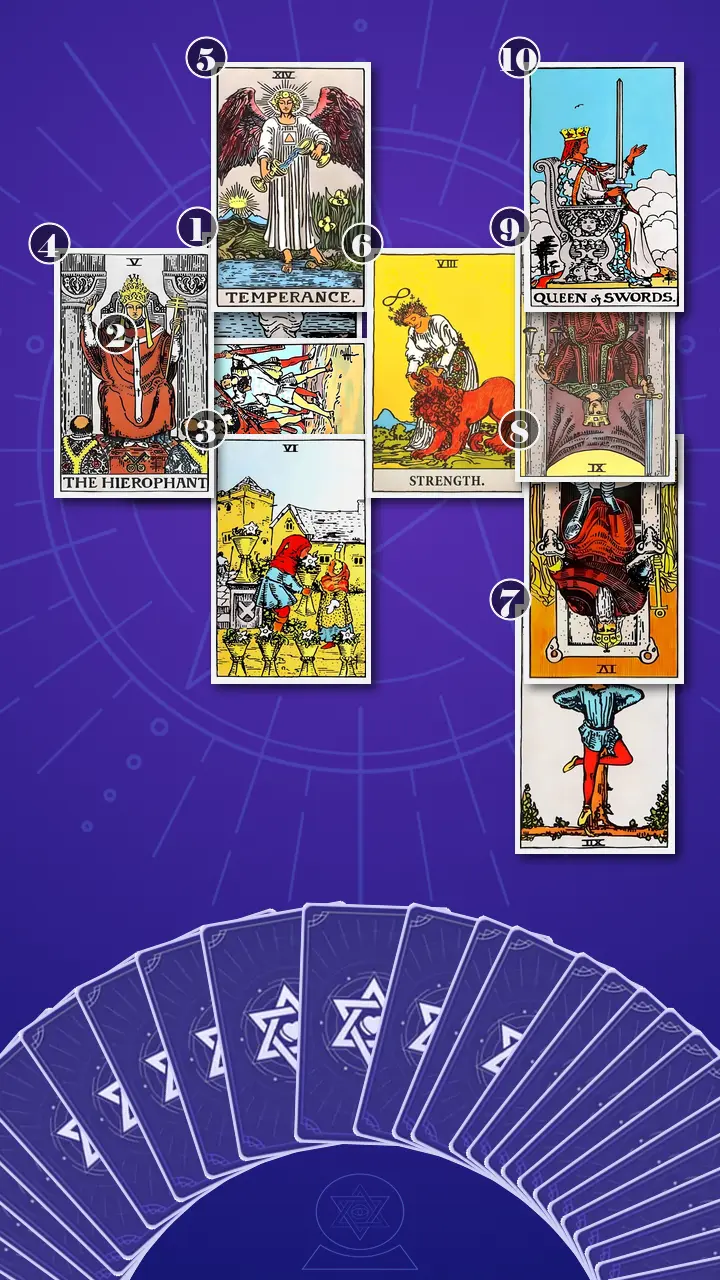
Reading the Map: Card Meanings in Context
Position 1 — The reflex you can feel in your jaw
“Now we turn over the card representing the current peacemaking reflex as it shows up right now,” I said.
Two of Swords, reversed.
I pointed gently to the image—even though Jordan was on a screen, I knew they could picture it: the blindfold, the crossed blades over the heart, the calm water behind. “This,” I told them, “is like rewriting the ‘perfectly neutral’ group chat reply so nobody gets mad—even though your chest feels tight because you do have an opinion.”
Reversed, the energy isn’t balance. It’s blockage. It’s the strain of holding the blindfold in place while the truth presses through anyway. The Two of Swords can look like maturity from the outside—quiet, measured, reasonable—but on the inside it’s a stalemate made of muscle tension.
I described it as a split-screen, because that’s how Jordan lives it:
(A) The visible action: you type a sentence five different ways, swapping “I need” for “Just wondering if…”, turning a boundary into customer-service copy.
(B) The hidden body: jaw locked, breath held, stomach dropping the moment a typing bubble appears—like you’re about to be put on trial.
“That courtroom feeling matters,” I added. “Because you’re not communicating. You’re pre-defending yourself.”
Jordan let out a short laugh—bitter, almost impressed. “That’s… kind of brutal,” they said. Then, quieter: “But yeah. That’s me.” Their fingers tightened around their mug, then loosened again, like they didn’t want to be caught needing warmth.
“And I want to name something clearly,” I said. “Calm isn’t proof you’re safe—sometimes it’s proof you went silent.”
Position 2 — The conflict you treat like an emergency
“Now we turn over the card representing what actively complicates change: the type of conflict energy you reflexively try to suppress,” I continued.
Five of Wands, reversed.
“This is peace as performance instead of process,” I said. “It’s like hearing two relatives talk past each other and immediately turning it into a ‘both of you are right’ speech—before anyone can actually say what they mean.”
Reversed, the Five of Wands isn’t healthy debate; it’s conflict being dampened—smothered before it can turn into clarity. The energy is deficiency of honest friction. Not because your family doesn’t have strong feelings, but because the system has trained everyone that strong feelings are dangerous.
“This is why you jump in within the first thirty seconds,” I told Jordan. “Your body believes that if the clash happens, something bad follows. So you become the translator, the mediator, the emotional customer support agent.”
Jordan nodded, but the nod had weight in it—like agreeing to something that also makes you tired.
“You can be kind without being the mediator,” I said, letting the sentence land as a permission slip rather than a command.
Position 3 — The root that gets activated by old footage
“Now we turn over the card representing the deep root: the childhood learning that formed the peacekeeper role,” I said.
Six of Cups, upright.
The Six of Cups is the memory card—the courtyard, the flowers in the cups, the sweetness that can feel like a warm blanket and a trap at the same time.
“This is like watching a birthday video and realizing Kid-You was scanning faces more than looking at the cake,” I told them. “The sweetness is real. But so is the job you were quietly doing.”
In my work, I often call this a role you earned with your nervous system. Not because you were manipulative. Because you were smart. Children learn what keeps closeness intact.
I felt a familiar ache in my chest—an internal flashback to nights on a cruise ship when a couple would come to me after a public argument, desperate to make the discomfort disappear before dinner. The sea outside could be calm while the emotional weather inside the cabin was a storm. Humans do this everywhere: we learn to manage what we think will sink us.
Jordan’s eyes flicked away from the screen for the first time, like the card made the room feel too honest. “I can actually see it in the videos,” they said. “Like… I’m smiling, but I’m also watching.”
Position 4 — The family rulebook you still follow
“Now we turn over the card representing the family imprint: the unwritten rules and roles the system rewarded,” I said.
The Hierophant, upright.
“This card isn’t here to villainize anyone,” I said immediately, because The Hierophant can trigger defensiveness. “It’s here to name the code.”
The Hierophant is tradition—the ‘right way’ to behave. It’s the tone that says: We don’t talk like that. Keep it respectful. Don’t make a scene. It can be beautiful when it protects values. It becomes heavy when it protects image at the expense of truth.
“Home videos can act like proof of the script everyone wants to remember,” I told Jordan. “A highlight reel of unity. And your role was: keep the script clean.”
Jordan swallowed. Their throat moved like it hurt to acknowledge how early this got installed.
Position 5 — The identity you’re trying to preserve
“Now we turn over the card representing your conscious intention—what you think you’re trying to achieve when you keep the peace,” I said.
Temperance, upright.
I almost smiled, because Temperance is so often a genuinely kind person’s card. “You actually value harmony,” I told Jordan. “You value healing. You can feel when things could be better—and you want to be the one who helps.”
But Temperance can also show where compassion becomes self-dilution. “This is like phrasing a boundary so gently it becomes negotiable,” I said. “Because you’re trying to keep everyone comfortable while still saying something true.”
The energy here is balance—but balance that you’ve been using like a moral obligation. Like: If I can keep it calm, I’m good. If I can mix everyone’s feelings into something drinkable, I belong.
“So the question Temperance asks you,” I said, “isn’t ‘Do you care?’ You clearly do. It’s: Am I creating balance, or am I diluting myself?”
When Strength Held the Lion, Not the Room
Position 6 — The bridge: gentle courage in real time
I could feel the reading tightening into its hinge point. Even through video, the air between us changed—quieter, like the radiator had paused to listen.
“Now we turn over the card representing the next growth edge—the most realistic near-term shift,” I said. “This is the bridge.”
Strength, upright.
Jordan exhaled, but it came out shaky—like their body recognized the concept before their mind trusted it.
“Strength is not ‘be tougher,’” I told them. “It’s regulated courage. It’s staying present with discomfort without controlling it.”
Setup. I brought us right back to the scene their body already knew: Jordan on the couch, AirPods in, rewatching a ‘happy’ holiday clip—smiles on-screen, but their stomach dropping when a tone shifts. Then pausing the video to draft the most neutral group-chat message like belonging depends on it.
Delivery.
Stop mistaking control for safety, practice gentle courage, and let Strength hold the lion instead of you holding everyone’s feelings.
I let it hang there. No extra explaining. Just a clean sentence in the space.
Reinforcement. Jordan’s reaction came in a three-part wave I’ve learned to watch for—the body’s version of a truth landing. First: a brief freeze. Their eyes went still, like the video on their laptop wasn’t the only thing paused. Second: the recognition seeped in—their gaze unfocused for a beat, as if replaying ten different family moments at once: the typing bubble dread, the polite “let’s not fight,” the private DMs to calm everyone down. Third: the release—an exhale from deeper in the chest, shoulders dropping a few millimeters, their jaw unclenching like it had been holding a secret.
“I hate that it’s true,” they said, voice tight but clearer. “Because it makes me feel like… if I stop managing it, I’m selfish.”
“That’s the old code talking,” I said. And then I reached for my own way of seeing family dynamics—an image from home. “Where I’m from, in Venice, you learn quickly that water doesn’t become safe because you stare at it harder. You learn how to stand on a moving surface.”
“And in Murano glass workshops,” I continued, bringing in my Glass Workshop Metaphor, “you don’t get a stable form by panicking at the heat. The heat is part of the process. The craft is: steady hands, measured breath, and not over-correcting every time the glass softens. Your family conflict is like that heat. You keep trying to cool it instantly—because cooling feels like safety. Strength says: you can hold the heat for one breath without the whole thing collapsing.”
I leaned in. “Now, with this new lens—Strength as steady hands—think back to last week. Was there a moment when you sensed the mood shift and your throat tightened? Where this could have changed how you felt, even slightly?”
Jordan blinked fast. “Yeah,” they said. “My aunt said something passive-aggressive. I was already typing. I could’ve… paused.”
“Exactly,” I said. “This is the shift from managed neutrality to grounded honesty—from earning belonging by smoothing things over to staying connected while letting other adults hold their own feelings.”
Then I used the ‘rewrite the scene’ device, because Strength is a bridge into a new script. “Picture the same flare-up,” I said. “But this time you don’t translate. You don’t compromise. You say one calm truth—your phone warm in your hand, throat still tight but loosening—and then you stop talking. You let the silence do some of the work.”
The Thermostat in the Room: Climbing Out of the Old Role
Position 7 — How you keep yourself suspended
“Now we turn over the card representing how you position yourself in the story—your internal stance,” I said.
The Hanged Man, reversed.
“This is where self-sacrifice turns into stuckness,” I told Jordan. “It’s like telling yourself ‘it’s not worth it’ and swallowing the truth again—then feeling that heavy annoyance all evening.”
Reversed, the energy is excess of waiting. Waiting to be asked. Waiting for permission. Waiting for the perfect moment when everyone is calm enough that your truth won’t ‘cause a thing.’
“The cost shows up as quiet resentment,” I said. “Not because you’re mean. Because you’re human.”
Jordan’s mouth pulled into a half-smile that wasn’t happy. Their foot bounced under the frame of the camera.
Position 8 — The system that recruits you
“Now we turn over the card representing the family system dynamics around you—tone-setters, control, emotional leadership,” I said.
The Emperor, reversed.
This one is classic in families with an unstable center. Not necessarily abusive—just unpredictable. “Here’s the dynamic,” I said, keeping it clean: “one person’s mood becomes the thermostat. Everyone else becomes a human space heater.”
Jordan nodded immediately—recognition without debate. “That’s exactly it.”
“And that’s why I want you to drop the self-blame,” I said. “You didn’t become the peacekeeper out of nowhere. You adapted to emotional leadership that didn’t feel safely held.”
I named it in one of my favorite phrases, because Jordan needed the reframe like oxygen: You’re not the family’s emotional thermostat.
They exhaled again, slower this time, like their body was finally allowed to consider that possibility.
Position 9 — The fairness trial in your head
“Now we turn over the card representing the emotional bind—hopes and fears,” I said.
Justice, reversed.
“This,” I told them, “is the fairness spreadsheet. The court brief. Turning every boundary into a Terms & Conditions page.”
Reversed, Justice becomes skewed judgment—not because you lack morals, but because your inner judge is working overtime, trying to prove you’re ‘fair enough’ to deserve connection.
“You want accountability,” I said. “You want truth. But you fear being blamed, labeled difficult, accused of being selfish. So you over-explain until the boundary becomes negotiable.”
Jordan’s face did that thing people do when they feel seen too accurately—eyes narrowing, then softening. “I literally write paragraphs,” they admitted. “And then I hate myself for it.”
“No hating,” I said. “Only noticing. Because this is where we stop turning self-advocacy into a courtroom.”
Position 10 — The direction: clean truth, steady presence
“Now we turn over the card representing integration—the most empowering way to relate to family conflict and your own voice,” I said.
Queen of Swords, upright.
I love the Queen of Swords for people like Jordan because she’s often misunderstood. She isn’t cruel. She’s clean. She’s the part of you that can say one true sentence and then stop—without managing the room’s reaction like it’s your job.
“This is you saying, ‘I’m not going to mediate this,’” I told them. “Or, ‘That doesn’t work for me.’ And then letting other adults react without rushing to repair it.”
The energy here is balance again—but a different kind than Temperance. Not mixing everyone’s feelings into something safe. Instead: discernment. Boundaries. Self-respect. Love that doesn’t require self-erasure.
“A boundary isn’t a debate invite,” I said, and Jordan’s eyes flicked up like they wanted to write it down.
From Insight to Action: The Bollard Lines and One Clean Sentence
I took a moment to weave the whole story the spread had told—because tarot is most useful when it becomes coherent, not just accurate.
“Here’s the pattern,” I said. “At the surface (Two of Swords reversed), you self-edit into neutrality the second tension rises. The challenge (Five of Wands reversed) is that conflict gets treated like an emergency, so nobody learns how to do honest repair. Underneath, the root is sweet and sad (Six of Cups): you learned early that keeping things ‘nice’ protected closeness. The family code (Hierophant) rewarded that role. And your conscious identity (Temperance) made it feel morally urgent: you became the healer.”
“But then Strength arrives,” I continued, “and says: your next step isn’t more control—it’s steadiness. And the Queen of Swords shows where this is going: clean truth, boundaries, and self-respect without cruelty.”
I named the blind spot plainly: “Your cognitive blind spot is believing harmony depends on you. That if you don’t manage the emotional climate, you’ll lose belonging.”
“The transformation direction,” I said, “is the key shift: from keeping the peace to telling the truth calmly and letting other adults hold their own feelings. Not disconnecting. Not exploding. Just stepping out of the unpaid moderator job.”
Then I offered Jordan something I’ve seen work in real families—small experiments that don’t require you to become fearless overnight. And I integrated my Bollard Marking Method, because boundaries in family systems are like docking lines: you don’t tie the whole ship to every post. You choose one solid point and you hold it, repeatably.
- The 10-Second Lion Hold (before you reply)When a family text lands and your throat tightens, pause for 10 seconds. One inhale. Drop your shoulders. Unclench your jaw. Then send one sentence that starts with “I notice…” or “I feel…”—with no solution attached.If your brain screams “dramatic,” lower the difficulty: draft it in Notes first. Practice counts even if you don’t send.
- Pick one “bollard line” you can repeatChoose one recurring flare-up topic and save a single repeatable line in your Notes app: “I’m not going to mediate this.” The moment you feel yourself getting pulled into the middle, use the line once—then stop talking.A repeatable line is a boundary without improvisation. It’s you refusing the mediator job description.
- The Say-It-and-Stop Boundary (Queen of Swords practice)Write a clean truth text that is 1–2 sentences, no justifications. Example: “I’m not okay with being spoken to like that. I’ll talk when it’s calmer.” After you send it, do not add a second paragraph to manage the reaction.If you feel the urge to over-explain, whisper: “A boundary isn’t a debate invite.” Then put the phone face down for five minutes.
Jordan hesitated, and I saw the practical obstacle rise—one more layer of honesty. “But I can’t always take five minutes,” they said. “Work pings, family pings… it’s like I’m never off-duty.”
“Then we keep it real,” I answered. “Start with ten seconds. Ten seconds is still a nervous system choice. And if you can’t step away physically, do the micro-version: mute the chat for five minutes. Put the phone down. Let your body learn: discomfort doesn’t mean danger.”

A Week Later: Ownership, Not Perfection
Five days later, Jordan messaged me—one of those short texts that feels like a tiny flag planted in new ground.
“It happened,” they wrote. “A tone shift. I did the 10-second pause. I sent: ‘I notice I’m getting tense reading this. I’m going to step back.’ And I didn’t follow it with an essay.”
Then they added: “I felt shaky. But also… taller?”
They didn’t report a magically healed family. The group chat still had weather. But Jordan had stopped being the meteorologist.
The bittersweet part—because change is rarely pure dopamine—came the next morning: they told me they slept a full night for the first time in weeks, then woke up with the first thought, What if I’m wrong? And after a beat, they laughed softly at themselves. Not mean. Just human. Clear, but still tender.
That’s what I mean by a Journey to Clarity: not certainty, but ownership. Strength holding the lion. The Queen of Swords holding the line. Belonging that doesn’t require you to disappear.
When you’ve been trained to earn belonging by keeping the vibe calm, even a simple truth can feel like a throat-tightening risk—like you’re about to be labeled ‘difficult’ for finally taking up space.
If you didn’t have to fix the emotional climate to stay connected, what’s one calm, clean sentence you’d let yourself say this week—and then let the silence hold?
This story is adapted from psychological research, written so that those in a similar struggle can see their own pattern in it — and find their next step clearly.These insights are not a substitute for professional psychological, medical, legal, or financial advice.
Learn more about our Journey to Clarity.
How did this insight land for you?
🫂 This Resonates Deeply
🌀 Living This Story
✨ Now I See Clearly
🌱 Seeing New Possibilities
🧰 Useful Framework
🔮 The Confirmation I Needed
💪 Feeling Empowered
🚀 Ready for My Next Step
Author Profile
 AI
AI“Having traveled across cultures... I've learned that what we often lack isn't a simple answer, but a moment of being truly understood. I use a Jungian psychological lens to help you deconstruct your subconscious patterns—not to prove anything, but to be the gentle companion who helps you unravel your knots, free of judgment, so you can reconnect with your inner wisdom.”
In this Family Tarot Reading :
Core Expertise
- Adult-Child Regression Auditing: Decrypting the specific environmental triggers that force you to regress into an anxious, defensive teenager around your parents.
- Emotional Blackmail Deconstruction: Identifying guilt-trips, silent treatments, and subconscious manipulation tactics used to enforce family loyalty.
Service Features
- The Regression Circuit Breaker: A cognitive grounding protocol to maintain your adult psychological sovereignty and objective reasoning during high-stress family interactions.
Also specializes in :
Explore Related Patterns:
Boundary DiffusionJordan's boundaries blur the moment family tension rises. A clear need becomes a softened suggestion, a clean truth becomes a neutral draft, and other people's possible reactions start determining what Jordan feels allowed to say. Boundary Diffusion fits because the line between Jordan's responsibility and the family's emotional responsibility has become unstable. The story keeps returning to the same fusion: if someone is upset, Jordan feels implicated; if the room is uncomfortable, Jordan feels assigned to fix it; if a boundary lands badly, Jordan worries it means they were selfish. This pattern keeps peacemaking alive by making self-advocacy feel like relational harm. The corrective move is not emotional coldness. It is a sharper division between “I can be kind” and “I am not in charge of metabolizing everyone else's reaction.”
Conflict AvoidanceJordan jumps in within the first thirty seconds of tension, trying to turn sharpness into neutrality before anyone can say what they actually mean. The story repeats this through the home-video reaction, the group-chat drafting, the private calming messages, and the urge to make a “both of you are right” speech. Conflict Avoidance fits because the goal is not real repair; it is rapid dampening. Jordan's body treats disagreement like an emergency, so conflict gets smothered before it can become information. The family may stay superficially calm, but the emotional truth never gets enough oxygen to become clear. This is the family pattern that keeps peacemaking alive: friction is mistaken for danger. You do not have to escalate conflict to leave this pattern; the growth edge is tolerating one breath of honest discomfort without rushing to cool the room.
Defensive OverfunctioningJordan repeatedly does extra emotional labor before the family system has asked for it or earned it. They translate, mediate, soften, explain, and cool the heat, all while their own body is tightening around the pressure of staying acceptable. Defensive Overfunctioning fits because the excess effort is protective. By doing more, Jordan creates a temporary feeling of control: if they can phrase it well enough, calm everyone down fast enough, or hold the room gently enough, maybe conflict will not threaten belonging. The cost is that overfunctioning prevents the system from revealing who can actually hold their own feelings. You can care deeply and still stop doing the emotional work of three people; that pause is where the old peacekeeper role starts losing its grip.
Fawning ResponseJordan's body reacts to a tiny tone shift before their mind has time to explain it: the locked jaw, narrowed throat, held breath, and immediate urge to draft a neutral family message all show a nervous system trained to appease tension fast. The behavior is not just being nice; it is pre-emptive emotional management, where smoothing the room becomes a way to prevent blame, conflict, or disconnection. That is why Fawning Response fits the story. Jordan moves toward the perceived threat with softness, translation, and emotional labor instead of naming their own position. You can see the mechanism in the way they become the mediator, the customer support agent, the person trying to make everybody sound reasonable before anyone has actually repaired anything. The pattern keeps peacemaking in place because belonging has been wired to appeasement. You are not being asked to become harsh or detached; the audit point is cleaner than that. The moment you notice yourself fixing the vibe before anyone has asked, you are at the exact point where fawning can be interrupted and replaced with one calm, honest sentence.
HypervigilanceJordan watches old footage like a security feed, tracking faces more than the birthday cake and reacting to a half-second shift in tone as if the past could spill into the room. The same scanning appears in the family group chat, where a typing bubble or mood change pulls their whole body on duty. Hypervigilance is the pattern because Jordan's attention has narrowed around threat detection. The nervous system is not waiting for clear conflict; it is scanning for pre-conflict, trying to catch risk before words fully land. That makes peacemaking feel urgent, because the body believes early detection equals safety. The problem is not that you notice too much. The problem is that noticing has been fused with responsibility. Once you can separate perception from duty, a mood shift can become information instead of an automatic order to manage the room.
Illusion of ControlJordan keeps trying to control the emotional climate through tiny interventions: neutral wording, tone monitoring, quick mediation, and careful repair before anyone has fully reacted. The story names the blind spot directly: harmony feels as if it depends on Jordan. Illusion of Control fits because the strategy promises safety through precision. If Jordan can read the room accurately enough and respond gently enough, it seems possible to prevent conflict from becoming painful. But the family system remains bigger than Jordan's management. This pattern keeps peacemaking in place because control feels kinder than uncertainty. The shift is letting discomfort exist without treating it as evidence that you failed to manage the room correctly.
ParentificationJordan can see Kid-You in the videos smiling while also watching, scanning faces more than enjoying the moment. The story makes the old role explicit: closeness stayed safer when Jordan monitored the emotional weather and helped keep the family script clean. Parentification fits because the child learned to perform an adult emotional function. Jordan was not just being sensitive; they were quietly recruited into regulating the room, preserving the image of harmony, and making strong feelings easier for everyone else to digest. That early role explains why peacemaking still feels automatic in adulthood. You are not failing to be independent; an old job description is being reactivated by familiar family cues. The exit is not abandoning care, but returning emotional responsibility to the adults who own it.
Self-SilencingJordan does not simply choose careful wording; they edit direct truth until it becomes almost invisible. The story names this through the group-chat drafts, the replacement of “I need” with “Just wondering if,” and the repeated fear that honesty will turn into a whole thing. Self-Silencing is the mechanism underneath that editing. It protects connection in the short term by lowering the volume on the self, but the cost is that the boundary becomes negotiable before anyone else has even challenged it. You can still look calm from the outside while the body carries the pressure of everything unsaid. This pattern keeps Jordan peacemaking because silence starts to feel like maturity. The clearer move is not explosive honesty; it is letting a clean sentence remain clean, without shrinking it into customer-service language to make other adults more comfortable.
Guilt ConditioningJordan names the old code clearly: if they stop managing the room, they feel selfish. The family rulebook around being respectful, not making a scene, and keeping the script clean has trained self-advocacy to register as moral danger. Guilt Conditioning fits because guilt appears before Jordan has done anything harmful. It attaches to the act of taking up space, saying a direct sentence, or letting other adults react without rushing to repair them. The guilt is not proof of wrongdoing; it is evidence of an old learning pattern. This keeps peacemaking in place because guilt becomes the leash on honesty. The audit question is not “Am I bad for having a boundary?” but “Whose comfort did I learn to protect before my own truth was allowed to exist?”
Approval SeekingJordan's truth has to pass an internal approval board before it can be spoken. The story shows this in the fear of being labeled difficult, the need to sound fair enough, and the habit of softening direct statements until they become socially acceptable rather than emotionally accurate. Approval Seeking fits because connection is being pursued through acceptability. Jordan is not only trying to communicate; they are trying to prove they are mature, reasonable, kind, and non-selfish enough to deserve a place in the family system. This keeps peacemaking in place because every boundary becomes a reputation-management task. The stronger move is letting one true sentence stand without first making it lovable, persuasive, or impossible to criticize.
Defensive OverexplainingJordan describes writing paragraphs, turning boundaries into Terms and Conditions, and trying to prove they are fair enough before they can ask for anything. The boundary does not stay simple; it becomes a court brief designed to prevent accusation. Defensive Overexplaining fits because the extra language is a shield. Jordan is not adding detail for clarity alone; they are trying to pre-defend against blame, selfishness, or being misunderstood. The more they explain, the more the actual boundary becomes negotiable. This pattern keeps peacemaking active by making self-advocacy depend on a perfect argument. A clean boundary does not need to win a trial to be valid; the practice is saying the true sentence and stopping before fear turns it into evidence.
Family Role RegressionJordan is in their Toronto apartment, but the old home video and family chat pull them back into the same role their younger self played: watching faces, tracking tone, and preparing to smooth things over. The setting is adult, but the nervous-system script is old. Family Role Regression fits because familiar family cues reactivate a previous identity position. Jordan is not responding only to the present message; they are responding from the old peacekeeper seat, where belonging depended on staying alert and useful. This pattern keeps peacemaking alive because the family system can make adulthood temporarily disappear. The work is not to deny the old role, but to notice when it has taken over and let the adult self choose a smaller, cleaner action.
Rescuer IdentityJordan does not just keep the peace; they identify with being the one who heals, balances, translates, and makes the family emotionally drinkable. The story shows that harmony has become tied to goodness, maturity, and belonging. Rescuer Identity fits because the role has moved from behavior into self-definition. Jordan feels responsible for rescuing the family from discomfort, and stopping that rescue immediately raises the fear of being selfish. This pattern keeps peacemaking in place by making non-rescue feel like moral failure. The clearer identity is not “the person who lets everyone burn,” but “the person who can care without becoming the emotional emergency service.”
Explore Related Struggles:
Family System OveridentificationIn Jordan's family map, one person's mood becomes the thermostat and everyone else starts adjusting around it. Even alone in a Toronto apartment, an old video and a group chat can pull the whole emotional climate into the room. You start treating the system's temperature as information about what you must do next. If someone sounds sharp, you regulate; if someone might react, you soften; if the atmosphere shifts, your body moves as if the family balance belongs to you. The core lock is the collapse between the family's state and your responsibility. The way out begins when you can notice the weather without becoming the person assigned to change it.
Inherited Repair BurdenJordan looks at the old footage and sees Kid-You smiling while also scanning faces, as if the real assignment was not enjoying the birthday or holiday but keeping the room from tipping. The adult version of the same role shows up when a family chat tightens and they start mediating before anyone asks. You learned that closeness stayed intact when someone caught the emotional heat early, softened it, and made the family script look clean again. Over time, repair stopped feeling like a generous choice and started feeling like a job your body had already accepted. Naming the burden matters because it separates care from inherited labor. You can love people without being the person who absorbs every flare-up first.
Inherited Vigilance LoadJordan's jaw tightens before their mind has a story for it; the old camcorder clip shifts tone for half a second, and the body is already on duty. A video that was supposed to feel comforting becomes another room to scan. You learned to read faces, pauses, typing bubbles, and tone changes as early warning signals for belonging risk. That attention once helped you navigate the family system, but now it makes ordinary connection feel like a monitoring shift. The load is inherited because the body reacts before the present moment has fully arrived. Clarity comes from seeing the scanner as a learned role, not as proof that every tense silence is yours to solve.
Performative HarmonyJordan hears two relatives talking past each other and can already feel the speech forming: both of you are right, let's not fight, let's keep this respectful. The gesture looks kind from the outside, but it arrives before anyone has actually said the thing that needs to be said. You are not preserving peace as a living process; you are preserving the appearance of peace as a family surface. That keeps the room smooth, but it also keeps truth from doing its clarifying work. The struggle is the exhaustion of maintaining calm as a performance. Real harmony asks for honest friction, while performative harmony asks you to keep polishing the room until your own voice disappears into the shine.
Self-Erasure ReliabilityJordan turns a boundary into customer-service copy, swaps a direct need for something softer, and waits for the safest version of the sentence. The room gets a more manageable Jordan, but the real Jordan has to shrink first. You become reliable by becoming less disruptive, less direct, less available to your own truth. People may experience you as calm, reasonable, or easy to deal with, while the cost is paid in the parts of you that never make it into the conversation. This struggle is not about being too kind. It is about the old bargain where staying connected requires you to be smaller than you are.
Truth-Connection SplitJordan is watching a holiday clip when one sharp tone makes their body brace, and the same split appears in the group chat: they have a real opinion, but the sentence gets rewritten into the safest possible version. You are pulled between wanting to be emotionally honest and fearing that honesty will threaten belonging. The struggle is not a lack of communication skill; it is the moment truth starts to feel socially expensive, so your voice gets edited before it can arrive as yours. Seeing this split gives you a cleaner choice point: connection does not have to be purchased by making every sentence harmless.
Inner Tribunal LockJordan does not just set a boundary; they build a case for it. A simple limit becomes a court brief, a fairness spreadsheet, a paragraph designed to prove they are not selfish before anyone has accused them. You are trying to make self-advocacy legally airtight inside your own mind. The boundary cannot simply exist; it has to survive cross-examination from an inner judge trained by family blame, respectability rules, and the fear of being labeled difficult. The lock loosens when a clean truth no longer has to win a trial before it can be spoken. One sentence can be enough, even when the room does not immediately approve.
Explore Related Emotions:
Boundary GuiltJordan says that if they stop managing the conflict, it makes them feel selfish. That sentence exposes the old code clearly: other adults can have reactions, but your space is treated as something that must be justified, softened, or surrendered before it is allowed to exist. Boundary Guilt is the emotional hook that keeps the peacekeeping role sticky. You can intellectually know that other people should hold their own feelings, while still feeling a sharp internal penalty the moment you stop translating, smoothing, or repairing on their behalf.
Control FatigueJordan describes the pattern as a permanent invisible job, with family pings, work pings, old videos, and group-chat weather all pulling them back on duty. They are not just participating in family communication; they are trying to regulate the emotional climate before it overheats. Control Fatigue names the exhaustion of believing safety depends on constant correction. You keep peacemaking because conflict has been coded as something that must be cooled immediately, but the cost is living as the translator, mediator, and human space heater instead of a person with limits.
Hypervigilant AnxietyJordan's jaw tightens at a half-second tone shift in a grainy holiday clip, and their breath holds as if the laptop could pull the old family scene into the Toronto apartment. The same scanning continues in the group chat, where faces, punctuation, typing bubbles, and silence all become data you have to read before anyone names the conflict. Hypervigilant Anxiety fits because the peacemaking is not presented as a choice made after calm deliberation. It is a body-level watch system that tries to prevent disconnection before it happens. You are not just noticing tension; you are being recruited into forecasting it, softening it, and absorbing it before it reaches the room.
Nostalgia AcheThe holiday clip is supposed to be comforting, but one sharp tone turns it into evidence. Jordan can see Kid-You smiling in the footage while also watching faces, scanning the room, and doing a quiet job that no child should have had to name at the time. Nostalgia Ache captures the mixed pain of loving the memory and recognizing the role inside it. You are not rejecting the sweetness of the past; you are noticing that the sweetness came with a task, and that task trained you to keep closeness intact by monitoring everyone else.
Performative CalmJordan types a sentence five different ways, swapping direct need for softer wording until the boundary starts to sound like customer-service copy. On the outside, the reply looks measured and kind. Inside, the body is locked, the breath is held, and the truth is being trimmed to keep the room smooth. Performative Calm names the pressure to appear reasonable while your actual position gets flattened. The family pattern keeping the peacemaking alive is not simply a love of harmony; it is the learned belief that visible calm protects belonging, even when that calm is built out of silence.
Rulebook ShameThe family code is named through lines like 'We don't talk like that,' 'Keep it respectful,' and 'Don't make a scene.' The home videos become a highlight reel of the version everyone wants preserved, and Jordan's old role is to keep that script looking clean. Rulebook Shame fits because the pressure is not only to avoid conflict; it is to feel wrong for wanting a voice that breaks the approved tone. You keep peacemaking when the old rulebook turns honesty into disrespect and makes self-advocacy feel like a failure of character.
Self-Betrayal AcheThe clean contradiction in the story is wanting to be emotionally honest and taken seriously while fearing that conflict will cost belonging. Jordan already knows there is a truth in the room, but the truth keeps getting edited into a quieter, safer version before it can be heard. Self-Betrayal Ache names the hurt that follows when you abandon your own clarity in order to keep the family temperature stable. The pain is not only that others might misunderstand you; it is that you keep having to make yourself smaller before anyone else even gets the chance.
Verdict DreadJordan's stomach drops when a typing bubble appears, and the story names the sensation as being put on trial. Even before anyone has accused them of anything, the message is already being written like a defense brief, with every word edited to prove fairness in advance. Verdict Dread captures the fear that a simple boundary will be judged as selfish, dramatic, or wrong. You keep peacemaking because the family conflict does not feel like a conversation; it feels like a pending ruling on whether you still deserve connection.
Grounded AgencyFive days later, Jordan pauses for ten seconds, sends one clean sentence, and does not follow it with an essay. The family chat still has its own weather, but Jordan no longer has to become the meteorologist every time the air shifts. Grounded Agency names the emerging sense that you can stay connected without taking over the whole emotional climate. It is not certainty or instant confidence. It is the practical inner shift from automatic peacekeeping to chosen presence, one small pause at a time.
Hidden ResentmentJordan swallows the truth again, tells themselves it is not worth it, and then carries heavy annoyance through the evening. The resentment does not arrive loudly; it gathers under politeness, waiting, and the familiar decision to keep things smooth one more time. Hidden Resentment names the feeling that builds when your honesty keeps getting postponed for other people's comfort. It matters here because peacemaking is not emotionally neutral. Every unsaid sentence leaves residue, and that residue becomes the private signal that self-erasure has gone on too long.
Clarity ReliefAfter the pattern is named, Jordan's body responds before their analysis catches up: a freeze, a deeper exhale, shoulders dropping a few millimeters, and the jaw unclenching like it had been holding a secret. Later, one text without an essay leaves them shaky but taller. Clarity Relief fits because the story turns a vague lifelong role into something visible enough to interrupt. You do not need the whole family to change before relief becomes possible; the relief begins when the pattern has a shape, and your next move no longer has to be automatic.
Explore Related Contexts:
Conditional Family BelongingJordan names the clean contradiction directly: wanting to be emotionally honest and taken seriously while fearing that conflict will cost belonging. The old footage sharpens that contradiction because it shows a family memory wrapped in sweetness, but Jordan remembers the role underneath it: smiling, watching, and keeping things nice so closeness stays intact. Conditional Family Belonging fits because the family connection is presented as something that must be maintained through acceptable tone, careful wording, and non-disruption. The rule is not spoken as a formal demand, but it operates through phrases like keep it respectful, do not make a scene, and do not be difficult. You stay connected by editing yourself into a version the system can tolerate. This context matters because peacemaking becomes less about generosity and more about access. If belonging feels conditional on staying calm enough, fair enough, and useful enough, then every honest sentence can start to look like a membership risk. Naming that condition helps You separate real care from the pressure to earn connection by disappearing.
Designated Peacekeeper BurdenJordan watches a holiday clip, catches a half-second shift in someone’s tone, and immediately starts drafting the most neutral possible group chat message even though nobody asked them to intervene. The same pattern repeats across the reading: they jump in within the first thirty seconds, translate people’s feelings, soften their own boundaries, and become the emotional customer support agent for the family system. That makes Designated Peacekeeper Burden the clearest external context here. The pressure is not simply that Jordan dislikes conflict; the family structure has created a role where their belonging is protected through emotional maintenance work. You are being shown a social position, not a personality flaw: the person expected to keep the room workable when other adults generate tension. The burden becomes visible because Jordan’s body and phone habits are organized around the same unpaid job. The throat tightens, the jaw locks, the draft gets rewritten, and the mediator role activates before anyone has formally assigned it. Seeing that role as a role gives You room to question whether the family climate truly needs You to manage it, or whether the system has learned to outsource discomfort to You.
Emotional Suppression CultureJordan’s family conflict is described as something that gets dampened before it can turn into clarity. Strong feelings are not absent; they are treated as dangerous, so the system trains people to lower the volume, smooth the edge, and keep disagreement from becoming fully visible. Emotional Suppression Culture names the external climate that makes peacemaking feel necessary. In this setting, calmness is treated as proof that the family is functioning, while direct feeling is treated as a problem to contain. You learn to over-explain, pre-defend, and phrase a boundary so gently that it becomes negotiable. This context keeps Jordan in the role because suppression rewards the person who can make discomfort disappear fastest. The cost is that honest repair never gets a real chance to happen. Naming the culture lets You see why a simple truthful sentence can feel so disruptive: it introduces oxygen into a system built around keeping the air still.
Family Script PressureThe home videos do not simply bring nostalgia into the room; they replay the family script in a visible form. The laughter, the holiday setting, and the highlight-reel version of unity sit beside Jordan’s real memory of scanning faces, monitoring tone, and knowing when the clean version of the scene needed protection. Family Script Pressure describes the external rulebook that keeps Jordan peacemaking. The script says the family should look respectful, composed, and united, even when strong feelings are present underneath. In that structure, honest friction becomes a threat to the approved story, and Jordan’s role is to keep the visible surface from cracking. The pressure is powerful because it is attached to memory, tradition, and family image rather than one single argument. You are not only responding to a current group chat; You are being recruited by an older script that taught You which versions of truth were allowed in the room. Once that script is visible, it becomes possible to choose a cleaner sentence instead of another performance of neutrality.
Tone PolicingJordan’s wording changes before the message is even sent: I need becomes just wondering if, and a boundary turns into customer-service copy. The family rulebook behind that editing is clear enough to quote: keep it respectful, do not make a scene, do not talk like that. Tone Policing names the environment where delivery becomes the gatekeeper for whether truth is allowed to enter the room. The issue is not ordinary politeness; it is a family structure where the emotional risk of sounding too direct can overshadow the content of what You are actually saying. The safest sentence becomes the softest sentence, even when it no longer protects Your meaning. This keeps peacemaking in place because every boundary has to survive a fairness trial before it can be spoken. You are not only deciding what is true; You are calculating how to make it acceptable enough not to threaten belonging. Naming the tone rules gives You a concrete place to reclaim agency: fewer disclaimers, one clean sentence, and no automatic return to managing the reaction.
Triangulated Family MediatorJordan describes hearing two relatives talk past each other and immediately turning it into a both-of-you-are-right speech before either person can say what they mean. Later, the family system is named through the thermostat image: one person’s mood sets the climate, and everyone else adjusts around it. Triangulated Family Mediator captures the social geometry of that pressure. Jordan is not just trying to be nice from the sidelines; they are pulled into the space between other people’s tension and made responsible for translating, softening, and preventing direct collision. The family conflict does not stay between the people generating it; it gets routed through Jordan. That routing is what keeps peacemaking alive. When You become the middle channel, every disagreement can feel like a task assigned to Your phone, Your wording, and Your timing. The practical pivot in the story works because it changes the geometry: one clean sentence, then a refusal to keep serving as the bridge other adults should be building themselves.
Family Boundary NegotiationJordan’s week-later message shows a small but concrete change: a tone shift happens, they pause for ten seconds, send one sentence, and do not follow it with an essay. The family chat still has weather, but Jordan no longer accepts the automatic job of becoming the meteorologist. Family Boundary Negotiation is the constructive external context emerging inside the same family system. The boundary is not a dramatic exit or a total rupture; it is a repeatable edge in communication. You name what is happening, step back from mediation, and allow other adults to hold their own feelings without turning Your phone into a repair station. This belongs in the map because the question is not only what keeps Jordan peacemaking, but what realistic structure can interrupt it. The new boundary gives You a way to stay connected without staying available for every emotional cleanup task. It turns belonging from a reward for smoothing things over into a relationship that can survive one calm, clean sentence.
Happy Family PerformanceThe holiday footage is supposed to be comforting: laughter, family togetherness, a grainy record of a good memory. Jordan’s actual experience is different. They watch the same clip like they are on duty, scanning faces and catching the half-second tone shift that threatens the polished version of the scene. Happy Family Performance fits because the family image carries social force. The visible story is unity, but the maintenance work underneath is Jordan’s monitoring, smoothing, and silence. The performance does not need to be fake in every detail; its pressure comes from requiring the clean version to stay clean. That is why old home videos are such a sharp trigger in this story. They preserve the version everyone can point to, while Jordan’s body remembers the labor required to keep that version intact. Seeing the performance layer helps You stop confusing loyalty with stage management.