The Hallway Laugh That Followed Her to the Streetcar
Jordan slid into the back booth of my café just after the dinner rush, still wearing her office badge, and before I even set down her cappuccino I told her, "If you're the mid-20s office person who can survive the whole meeting and then spiral only after you hear coworkers laugh once you've stepped into the hallway, you're not weird. You're in a very specific rejection sensitivity loop."
She gave me the kind of smile people wear when they feel caught and relieved at the same time. "I know it sounds self-centered," she said, wrapping both hands around the cup, "but it never feels self-centered in the moment. I leave the room once and suddenly my brain acts like I am evidence."
Then she handed me the scene. It was 6:18 p.m. on a Wednesday outside a glass meeting room near King Street Station. She had her laptop tucked against her ribs, the fluorescent hum still in her ears, the stale office coffee smell hanging in the hall. She pushed the door open, heard laughter break out before it clicked shut, and froze for half a second by the elevator while her face went hot and her stomach dropped. By the time the 504 streetcar rattled her east, cold air slipping in at every stop, she had her Notes app open like a private evidence locker, typing fragments of her own sentences as if she were taking witness statements against herself.
What hurt was painfully specific. She wanted to feel relaxed and accepted in social spaces, but the second laughter followed her exit, she treated it like proof that she had been judged or quietly pushed outside the circle. Shame moved through her like an espresso shot pulled too fast and served too hot—bitter before she had even had time to ask what was actually in the cup.
I leaned in and said the first thing I needed her to hear. "Ambiguity is not a verdict." Then I set the cards between us. "Tonight, let's figure out why hearing laughter after you leave the room turns into a case file, and let's find a cleaner way back to clarity."

Choosing the Compass: A Five-Card Cross for Rejection Sensitivity
I asked Jordan for one slow breath in, one slower breath out, and for a few seconds I let the only sounds be the steam wand hissing at the bar and the soft drag of cardstock under my hands. In my café, tarot is never theater for its own sake. It is a way of helping a nervous system stop doom-scrolling its own interpretations long enough to look straight at them.
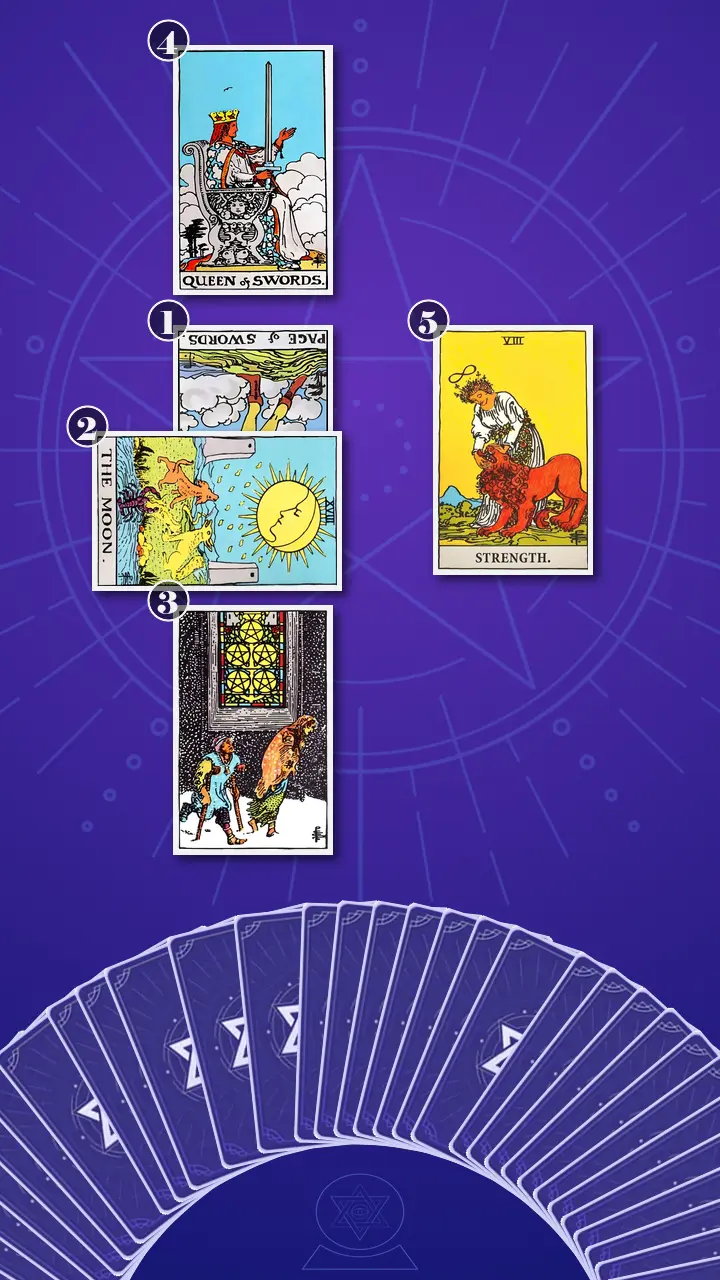
For the question she asked in plain language—"Why do I think people are laughing about me after I leave the room?"—I chose the Five-Card Cross · Context Edition, a five-card cross tarot spread for social overthinking and fear of being judged by others. I like it because five positions are the smallest structure that can still hold the whole chain: the visible symptom, the distortion complicating it, the older root underneath it, the corrective perspective, and the next grounded move.
I laid the cards in a cross because this issue behaves like a thought pinned open for inspection. The center would show the habit currently running the show. The crossing card would reveal how incomplete information becomes threatening in real time. The card below would uncover the older belonging wound carrying extra charge. The card above would offer the clearest Queen of Swords guidance for overthinking social situations. And the card to the right would translate all of it into something Jordan could actually do the next time a hallway laugh tried to become a personal verdict.
Reading the Map of a Half-Heard Laugh
Position 1: The Loop That Feels Like Research
The first card I turned over was for the immediate social trigger and the observable habit of personalizing laughter after leaving a room. It was the Page of Swords, reversed.
I told Jordan this card could not be more literal for her. It is the moment you leave a meeting, hear coworkers laugh before the door shuts, and instantly become your own surveillance team. The raised sword and sideways stare look like a mind still glancing over its shoulder. In modern life, it is reopening the same Slack thread five times looking for subtext that is not actually on the screen. It is the elevator ride where participation ends and self-monitoring begins.
Reversed, the Page is distorted Air: quick thought with nowhere safe to land. The intelligence is real, but it is scanning instead of clarifying. So the mind jumps from "I heard laughter" to "I need to figure out exactly what I did before I do it again." That leap creates a tiny burst of control, but it also teaches the body that every vague cue deserves a full investigation.
Jordan let out a short laugh with a bitter edge. "That is so accurate it feels rude," she said.
"Only because the pattern is familiar," I answered. "Your fear is fast; that does not make it factual." Her thumb kept circling the paper sleeve of her cup, slower now, as if being recognized had loosened one knot of shame.
Position 2: The Night Corridor of Missing Context
The next card represented how uncertainty and incomplete information get turned into a threatening story in real time. It was The Moon, upright.
This is the hallway-laugh moment in tarot form. You hear half a sound through a door, or you catch one side glance on a crowded patio, and your brain would rather invent a dangerous explanation than sit inside a blank space for even thirty seconds. The Moon is like getting a weak Wi-Fi signal from the room and buffering it into the worst possible story. It has that Severance-style office-hallway dread: clean surfaces, missing context, and menace supplied by the mind.
In energetic terms, this is unstable Water moving through an already overactive mind. The social cue is small; the felt danger is old and huge. The room gives you three pixels, and your fear instantly renders a whole movie. The laugh may be real. The verdict is the part shame writes.
As I said that, a streetcar passed outside the café window and the reflected lights smeared across the glass, doubling the room for a second. Jordan watched the reflection instead of the street, and I could feel the card land. Her shoulders lifted, then lowered. "Yes," she said quietly. "The worst part is not knowing whether I imagined it."
Position 3: The Cold Story Under the Hot Face
The third card was the one beneath the surface, the older belonging wound and the deeper fear of exclusion that gives the trigger its charge. It was the Five of Pentacles, upright.
I always take this card seriously when someone asks why one ordinary social moment can ruin an entire evening. The Five of Pentacles is emotional winter. It is not merely "maybe that joke landed weird." It is "maybe this proves I am outside warmth, outside ease, outside the circle." In Jordan's life, it looked exactly like sitting on the 504 with a warm phone in her hand and a weird chill in her body, treating one half-heard laugh as proof that other people belonged more easily than she did.
Here the energy is cold Earth: old, heavy, convincing. The blind spot is built right into the image. There is a lit window nearby, but the nervous system notices rejection faster than it notices available support. So a smart mind gets hired by an older wound, and together they build a much bigger story than the facts can justify.
I asked her, "If it really were about you, what would that seem to prove?"
She went still in three stages. First her breath paused. Then her eyes dropped to the ring of foam left inside her cup as if she were reading something there. Then her jaw shifted once before she said, very softly, "That I'm easy to dismiss."
There it was. Not the laugh itself, but the fear beneath it: wanting to stay included, and preemptively shrinking so no one could reject the version of her that took up too much room.
When the Queen Lifted Her Sword
Position 4: The Perspective That Restores Self-Respect
When I turned over the fourth card, the whole room seemed to exhale with me. The grinder had gone quiet. A spoon touched a saucer at the front counter and then stopped. This was the position that offers the clearest antidote to mind-reading by naming the perspective that restores discernment and self-respect. The card was the Queen of Swords, upright.
The Queen is not cold. She is clean. Her sword is vertical, not searching sideways like the Page. Her open hand says, "Stay receptive," while her posture says, "But do not hand every passing cue the authority to define you." In ordinary life, she is the version of Jordan who pauses long enough to ask: What did I actually hear? What was actually said? What meaning did shame add? What am I handing away?
Whenever this card appears for social overthinking, my mind flashes to one of the first things I teach a new barista. If you keep a shot running too long, you over-extract it. The cup goes bitter, and people blame the beans, when really it was too much pressure for too much time. In my own work, I call that a Stress Flavor Profile. Jordan was doing the same thing with social cues: keeping one burst of laughter under pressure until it tasted like truth.
I told her what I saw. On the streetcar home, screen glow on her face, Notes app open, she was not actually collecting evidence. She was sentencing herself on incomplete data and calling it preparation.
Not every laugh is a blade against you; lift the Queen's sword, cut fact away from fear, and let ambiguity stay unclaimed.
Jordan froze first. Her fingers stopped against the ceramic. Then her gaze went slightly unfocused, as if last Wednesday's meeting room had opened behind her eyes and a dozen older rooms had opened with it. When she looked back at me, the first thing that surfaced was not relief but resistance. "But if I do that," she asked, voice low and a little sharp, "doesn't that mean I've been sentencing myself on bad evidence for years?"
"Sometimes, yes," I said, and I kept my tone warm because clarity can sting on first contact. "But that is not a moral failure. It is a habit built to protect belonging, and now it is ready to mature." I watched the next part happen in layers: her jaw unclenched, her shoulders dropped half an inch, and then a fuller breath finally reached the bottom of her lungs. The release was real, but so was the wobble after it—the little empty feeling that comes when you set down a heavy bag and realize you were used to carrying it.
I asked her, "Using this new lens, can you remember a moment last week when the laugh was real but the verdict was the part fear attached?"
She nodded slowly. "Team drinks," she said. "I heard it when I went to order, and I spent the whole streetcar ride acting like it was a court case." That was the breakthrough. Not from sensitivity to numbness, but from shame-driven self-surveillance to reality-based self-trust. Self-respect starts where mind-reading stops.
Position 5: The Lion in the Chest
The final card represented the grounded response Jordan could practice the next time ambiguity appeared. It was Strength, upright.
I told her this card does not offer better mind-reading. It offers better companionship with the body. The hot face, the dropped stomach, the tightness across the chest—that is the lion. Strength is the steady hand that says, "I do not have to solve this room before I return to myself." It is the move from control to regulation.
Energetically, this was warm Fire arriving after cold Earth and distorted Air. The answer was not harder social strategy. It was gentler self-command. Like staying on the train through one rough jolt instead of jumping off at the wrong stop, Jordan's next step was to let the surge move through her body before turning it into a biography about her worth. The goal is not to feel nothing. The goal is to stop turning sensation into proof.
When I said she could start with thirty seconds, she gave me an immediate, practical objection. "But I do not always have thirty seconds," she said. "Sometimes I leave a meeting and I am already in the next hallway, the next Slack ping, the next thing."
"Then we make it smaller," I told her. "One elevator ride. One hand on your bag strap. One longer exhale before Notes, before reassurance, before the inner prosecutor clocks back in." She laughed again, this time with more air in it. Not because the pattern had disappeared, but because the next step finally sounded possible.
The Next 48 Seconds of Clarity
When I looked at the full spread together, the story was strikingly coherent. A sharp mind had been turned inward into self-surveillance. Uncertainty kept feeding it missing information. Underneath both lived an older fear that one awkward beat could mean exclusion. So Jordan kept doing what many rejection-sensitive people do in ordinary social moments: replaying, shrinking, or fishing for reassurance in order to feel safer, even though those moves quietly made her feel less secure next time. The blind spot was not that she cared too much. It was that she treated ambiguity as if it had already delivered a verdict.
The direction of change was equally clear: separate evidence from interpretation, test other explanations before claiming rejection, and regulate the shame spike before handing the room your self-worth. I gave her three very practical next steps.
- Borrow the Queen's SwordPin a note at the top of your phone called "Fact Before Story." The next time you hear laughter after leaving a meeting, a friend group, or a group chat thread, write three lines only: "What I know," "What my fear is adding," and "Two other explanations." Keep the note boring on purpose and keep it under 60 seconds.If your brain starts turning the note into a courtroom brief, stop after the first line. You do not need the happiest explanation. You only need to stop claiming the harshest one as fact.
- Do the Body-Before-Biography PauseFor the first 30 seconds after the shame spike, put both feet on the floor, let one exhale run longer than the inhale, and notice one physical anchor: the streetcar seat under your legs, the pole in your hand, your bag on your shoulder, or the warmth leaving a coffee cup at your desk.If 30 seconds feels impossible, make it 10. I sometimes use a Cup Temperature Scan here: notice how quickly your energy drains instead of automatically following the story your fear is writing.
- Ask for One Clean Data PointIf the moment is still bothering you 24 hours later and the relationship is genuinely safe, ask once and plainly: "Hey, random check—did that joke land okay yesterday?" Use this with a trusted friend or close coworker, never with a boss and never as a weekly ritual.After you get the answer, close the file. One question is reality-testing. Reopening the case in three different phrasings is the old loop wearing better shoes.
That is what this five-card cross reading for rejection sensitivity offered her: a map from social trigger to grounded response. None of these steps asked her to become less sensitive. They asked her to become less extractable—to stop letting every half-heard laugh pull bitterness from her for the rest of the night.

A Week Later, the Laugh Stayed a Laugh
A week later, just after six, I got a message from Jordan while I was stacking espresso cups for the evening close. "Hallway laugh after brainstorm," it said. "Did the Fact Before Story note in the elevator. Hot face, yes. No reassurance text. I spoke again in the next meeting anyway."
That is the kind of proof I trust most in tarot. Not a dramatic reinvention. Not a promise that every room will suddenly feel easy. Just a smaller, steadier change in the exact place the old loop used to take over. In the language of this five-card cross reading, Jordan had moved one honest step from feeling judged to feeling grounded, from private shame spiral to reality-based self-trust.
The shift was bright but not perfect. She told me she slept a full night after team drinks, and the next morning her first thought was still, What if I missed something? Only this time she smiled into her coffee, opened her note instead of her case file, and let the question stay a question.
If laughter lands behind your back and your body makes that first cruel leap—the hot face, the dropped stomach, the instant sense that you might already be outside the circle—I want you to know I have seen how ordinary and how piercing that moment can be. Noticing that leap is already the beginning of clarity.
So if the next blurry social moment did not need to become a verdict—or a courtroom in your Notes app—what else might become possible in those first thirty seconds before the story hardens?
This story is adapted from psychological research, written so that those in a similar struggle can see their own pattern in it — and find their next step clearly.These insights are not a substitute for professional psychological, medical, legal, or financial advice.
Learn more about our Journey to Clarity.
How did this insight land for you?
🫂 This Resonates Deeply
🌀 Living This Story
✨ Now I See Clearly
🌱 Seeing New Possibilities
🧰 Useful Framework
🔮 The Confirmation I Needed
💪 Feeling Empowered
🚀 Ready for My Next Step
Author Profile
 AI
AI“For twenty years, I’ve listened to stories unfold over the warm aroma of coffee. I don’t believe life’s complexities always require grand theories to be solved; often, we just need a safe place to tidy up our reality. I don’t offer high-minded preaching—just grounded, heartfelt insights to help you regain your sense of control amidst the clutter of daily life.”
In this Introspection Tarot Reading :
Core Expertise
Service Features
Also specializes in :
Explore Related Patterns:
Mind ReadingJordan hears laughter after she leaves and immediately starts reconstructing what the room must be thinking. No one tells her she was judged, but the missing information gets filled in as if she has access to the group's private verdict. Mind Reading is the pattern underneath that leap. Your mind treats silence, laughter, timing, or a side glance as readable evidence of someone else's thoughts, then starts preparing a defense against something that may not have happened. The Notes app case file shows why this pattern feels useful in the moment. It looks like preparation, but it is actually self-surveillance on incomplete data, and it teaches your nervous system that every unclear social cue requires an investigation.
Personalization BiasJordan says that once she leaves the room, her brain acts like she is evidence. That sentence captures the whole move from neutral ambiguity to self-referential meaning, where a laugh behind a door stops being a sound and becomes a claim about her. Personalization Bias is the cognitive habit of making an unclear event about you before the evidence supports that conclusion. It gives a quick sense of control because a vague cue suddenly has a target, but the target becomes your own worth, your own performance, and your own place in the group. The cleaner move is not to force a positive interpretation. It is to reopen the gap between "laughter happened" and "laughter was about me," because that gap is where your self-trust has room to return.
Rejection SensitivityJordan hears laughter break out after the meeting-room door starts closing, and her body reacts before the facts arrive. The hot face, dropped stomach, and half-second freeze show how a small social cue can get processed as immediate evidence of exclusion, even when the room has not actually delivered a verdict. Rejection Sensitivity fits because the trigger is not confirmed rejection, but the possibility of being dismissed. The line "That I'm easy to dismiss" shows the deeper belief that gives the moment its charge, so your mind tries to protect belonging by scanning, replaying, and solving the cue before anyone can reject you again. The cost is that ambiguity starts behaving like proof. You are not being irrational for caring about belonging, but the pattern turns every vague laugh into a social alarm, which makes clarity harder to access exactly when you need it most.
Spotlight EffectJordan leaves the meeting room, but psychologically she stays under the room's attention. The laugh becomes so bright in her awareness that other possibilities fade out, including the simple possibility that the group moved on to something unrelated. Spotlight Effect fits because the pattern overestimates how much other people are tracking, evaluating, or discussing you. In Jordan's case, it is not vanity; it is threat perception, where the mind puts you at the center of the room because being overlooked, mocked, or excluded would hurt too much to miss. That spotlight makes ordinary ambiguity feel personal. You are not trying to be the center of attention, but your nervous system is acting as if the safest strategy is to assume you are being watched until proven otherwise.
Certainty SeekingJordan's hardest moment is not only the laugh, but the blank space around it. The room gives her incomplete information, and her mind tries to close the gap by building the most threatening explanation first. Certainty Seeking fits because the investigation is trying to end ambiguity, not simply understand the event. The Notes app, the imagined court case, and the pull toward repeated reassurance all offer a tiny burst of control while teaching the mind that not knowing is unsafe. The shift comes from letting the laugh remain unclaimed long enough to test it cleanly. You do not need the happiest explanation; you only need to stop treating the harshest one as the price of being prepared.
Emotional ReasoningJordan's face gets hot and her stomach drops before she has any clean evidence about the laugh. The body alarm is real, but the meaning attached to it arrives too fast, turning shame into a verdict before the facts can catch up. Emotional Reasoning is the habit of treating an intense feeling as proof that the feared story is true. In this case, the logic becomes "I feel exposed, so I must have been judged," even though the sensation only proves that her nervous system has been activated. The Body-Before-Biography pause matters because it protects the gap between feeling and fact. You do not have to argue with the body, but you also do not have to let a shame spike write a biography about your worth.
Emotional RegulationJordan's final card does not give her a sharper way to decode the room. It gives her a steadier way to stay with the hot face, dropped stomach, and tight chest before those sensations become a story about her worth. Emotional Regulation fits because the change happens in the first few seconds after activation. One longer exhale, one hand on the bag strap, or one physical anchor gives the nervous system time to come down before the mind starts building a verdict. The follow-up message shows the pattern beginning to work. Her face still gets hot, but she does not send the reassurance text, and she speaks again in the next meeting anyway, which means the body surge no longer gets to decide the whole social script.
Reality TestingJordan's Fact Before Story note gives her mind a cleaner job than prosecuting herself. Instead of asking what the room secretly meant, she writes what she knows, what fear is adding, and two other explanations. Reality Testing is the corrective pattern because it separates observation from interpretation without pretending the trigger did not hurt. You are not forcing yourself into fake positivity; you are checking whether the evidence actually supports the social verdict your shame has already drafted. The one clean data point rule keeps this grounded. Asking once in a safe relationship can restore context, while closing the file afterward protects you from turning clarity into another loop.
RuminationJordan does not just notice the hallway laugh and move on. She carries it onto the streetcar, opens Notes, and starts typing fragments of her own sentences as if the right review could reveal what the room secretly meant. Rumination fits because the mind keeps circling the same ambiguous moment under the promise of clarity. It feels like research, but the loop keeps the body in the event and turns one social cue into an extended internal trial. The pattern is not simply thinking too much. It is repeated threat review, where each pass seems to offer protection but actually deepens the groove that says ambiguity must be solved before you can feel safe.
Explore Related Struggles:
Evidence DisconnectionJordan hears laughter after leaving the meeting room, and the sound itself is real. The leap happens in the space after that: her hot face, dropped stomach, and racing interpretation start acting like evidence before the room has offered any actual verdict. That is why Evidence Disconnection fits the story so closely. The problem is not that Jordan notices too much; it is that her evidence system gets overloaded by sensation, ambiguity, and old belonging fear until a half-heard cue becomes a conclusion about her social worth. You can feel the struggle in the streetcar scene, where the Notes app opens like a private evidence locker. A clearer path begins when the laugh is allowed to stay a laugh long enough for fact, fear, and interpretation to separate again.
Inner Tribunal LockThe hallway laugh follows Jordan into the elevator, onto the streetcar, and into her phone. By the time she is typing fragments of her own sentences into Notes, the room has stopped being a room and has become a courtroom where she is building the case against herself. Inner Tribunal Lock names that closed internal trial. Jordan is not just overthinking a social cue; she is trapped inside a structure where ambiguity becomes accusation, memory becomes testimony, and self-protection quietly turns into self-sentencing. You can see the lock loosen when she asks whether she has been sentencing herself on bad evidence for years. The painful clarity is that the judge was never the coworkers' laughter alone; it was the internal system that kept giving incomplete data the authority to define her.
Rumination EntrapmentJordan does not leave the meeting and simply move on with her evening. The laugh keeps replaying, her own sentences get pulled into Notes, and the streetcar ride becomes a second room where the same social cue keeps running under pressure. Rumination Entrapment captures the looped mechanics of that scene. The reviewing is meant to create safety, but it keeps the threat active; every pass through the memory feels like research while quietly deepening the sense that something must be wrong. You can see the shift a week later when she uses the Fact Before Story note and does not send the reassurance text. The point is not to erase sensitivity, but to stop the review process from turning one unclear moment into the emotional headline of the whole night.
All-or-Nothing BelongingJordan's fear beneath the laugh is painfully specific: if it really is about her, it seems to prove she is easy to dismiss. That turns an ordinary social moment into a binary map, with warmth and ease on one side and exclusion on the other. All-or-Nothing Belonging fits because the story keeps showing belonging as something that can collapse around a single cue. A laugh behind her back does not stay one possible data point; it threatens to redraw the whole room into inside versus outside. You can feel how exhausting that binary becomes when she shrinks before anyone has actually rejected her. The work of clarity is not pretending the laugh means nothing, but allowing belonging to be larger than one ambiguous sound in a hallway.
Dignity-Belonging SplitJordan names the deeper fear in one quiet sentence: if the laughter is about her, it proves she is easy to dismiss. From there, the social problem becomes more than being liked; it becomes whether she can stay fully present without feeling that her presence makes her disposable. Dignity-Belonging Split lives in that tension. Jordan wants acceptance, but the cost of chasing it is preemptive shrinking, as if taking up less room could protect her from being pushed out of the circle. You can see a different structure appear when she speaks again in the next meeting anyway. The repair is not louder performance or forced confidence; it is the slow return of self-respect inside the same social spaces that used to make her disappear.
Explore Related Emotions:
Ambiguity DreadA laugh slips through a closing door, and the story gives Jordan only three pixels of information: a sound, a hallway, and the fact that she is no longer in the room. In that blank space, her mind supplies menace with the speed of a bad signal buffering into the worst possible image. Ambiguity Dread is the pressure that arrives when not knowing feels less bearable than believing the harshest explanation. You are not reacting to a clear insult; you are reacting to the empty middle where context should be, and that emptiness starts to feel like danger before it becomes data.
Belonging ShameWhen Jordan is asked what it would prove if the laugh were really about her, she does not say it would prove the meeting went badly. She says, very softly, that she is easy to dismiss, which moves the pain from the hallway into the deeper question of whether she gets to take up space. Belonging Shame is the feeling that inclusion has to be protected by shrinking yourself first. You are not only scared of being left out; you are carrying the sting that being left out would confirm something personal about your worth in the room.
Shame SpiralJordan's face goes hot, her stomach drops, and the hallway laugh follows her all the way to the streetcar. The story's espresso image matters because the feeling arrives too fast and too bitter, before she has time to check what was actually in the cup. Shame Spiral names the way a single cue becomes a moving collapse of self-meaning. You are not simply embarrassed for a second; the body surge, the replay, and the private case file start feeding one another until the laugh feels like proof of something wrong with you.
Social Exclusion DreadThe Five of Pentacles moment is not only about a joke possibly landing wrong. Jordan hears laughter after she leaves and the social room turns into a warm place she imagines herself standing outside of, with everyone else belonging more easily than she does. Social Exclusion Dread is the ache of feeling pushed out before anyone has actually closed the door. You are trying to stay included, but the half-heard laugh becomes a signal that the circle may have continued without you and that your place inside it is less secure than it looked.
Verdict DreadJordan hears coworkers laugh before the meeting-room door shuts, and the half-second freeze by the elevator becomes more than a body reaction. The sound is treated as if the room has already reached a conclusion about her, even though the only confirmed fact is that laughter happened after she left. Verdict Dread names the inner weather of being tried by missing context. You are not just worrying that people laughed; you are feeling the pressure of an imagined judgment harden faster than your ability to separate fact from fear.
Evidence AnxietyOn the 504 streetcar, Jordan opens her Notes app and starts typing fragments of her own sentences as if she is collecting witness statements. The phone gives the moment a controlled shape, but it also turns an ordinary social cue into a private investigation where she has to prove whether she is safe. Evidence Anxiety lives in that urgent need to gather enough data to silence the body. You may feel briefly organized while making the case file, but the deeper pressure is the belief that clarity has to be earned through self-interrogation before you are allowed to relax.
Cautious Self-TrustA week later, Jordan still gets the hot face after a hallway laugh, but she opens the Fact Before Story note in the elevator instead of sending a reassurance text. The old question is still there the next morning, yet it does not get to become the whole room. Cautious Self-Trust is not instant ease or a total personality rewrite. It is the quieter confidence of letting one ambiguous moment remain unresolved while you keep your place in your own life, speak again in the next meeting, and stop treating every cue as stronger than your own judgment.
Quiet Self-RespectThe Queen of Swords enters when Jordan is asked to separate what she actually heard from what the story added. The clean blade is not used against other people; it is used to stop handing every passing cue the authority to define her. Quiet Self-Respect is the inner boundary that says a laugh can remain a laugh until better information appears. You do not have to make the room innocent or guilty in order to keep your dignity; you only have to stop surrendering your self-definition to incomplete data.
Regulated CourageThe practical move Jordan receives is deliberately small: one elevator ride, one hand on the bag strap, one longer exhale before the Notes app opens. The goal is not to outthink the room but to stay with the body long enough that sensation does not have to become a biography about her worth. Regulated Courage is the steadiness required to remain present while the surge is still moving through you. You are not waiting to feel perfectly calm before re-entering connection; you are practicing the braver act of letting the body settle first, then choosing your next step from a clearer place.
Rejection ChillBefore Jordan can reason with the laugh, her body has already answered it: a freeze by the elevator, a hot face, a stomach drop, and then the odd coldness of the streetcar ride home. The reaction is physical first, as if the hallway has touched a bruise she has not named yet. Rejection Chill captures that split-second drop where the body treats possible exclusion as already happening. You may know, intellectually, that laughter has many explanations, but the sensation arrives as a small internal weather change: heat, cold, contraction, and the urge to protect yourself before context catches up.
Explore Related Contexts:
Soft ExclusionYou step out of a glass meeting room near King Street Station, hear laughter break out before the door clicks shut, and carry that fragment through the hallway, the elevator, and the streetcar. The scene never gives you the missing sentence that would make the sound harmless, so the exit starts to feel like a move from inside the room to outside the circle. That is why Soft Exclusion fits. The laugh is not treated as neutral office noise; it becomes a quiet signal that your place in the group may have narrowed the moment you left. The pressure here is the lack of a clean read, not a spoken rejection.