Finding Clarity When Date Night Becomes a Group Hang
If your version of people-pleasing in relationships is replying “yeah that’s fine” to a last-minute roommate add-on and then mentally litigating it all the way home, I knew you would recognize Maya the moment she sat across from me.
She was twenty-eight, a marketing coordinator in London, and she still seemed to be carrying Friday evening in her shoulders. As she told it, I could see the whole scene as clearly as if I had stood beside her desk: 5:41 p.m., fluorescent office light near Liverpool Street, Slack still pinging, cold coffee gone bitter on the edge of the keyboard, WhatsApp lit up with, “My flatmate might join later if that’s okay?” Her phone felt warm in her palm. Her throat tightened before she had even decided what she thought. She typed, deleted, typed again, and sent back something easygoing anyway.
“I don’t want to be the person who makes everything a thing,” she told me, with that careful half-smile I so often see in people who spend all day communicating for a living and still cannot bear to sound difficult in love.
What she wanted was simple: one-on-one time that actually felt like couple time. What she feared was just as strong: that asking for it would make her seem clingy, controlling, high-maintenance. The frustration in her did not feel abstract. It felt like a train braking too hard inside the body—a clamp in the throat, then that hollow drop in the stomach when a private plan quietly turns social. She kept agreeing in the moment, then replaying the whole night on the Tube home, opening Notes in bed, sending WhatsApp screenshots to friends with some version of, “Am I overreacting?” She had practically Googled every modern variation of the same ache: am I clingy for wanting one-on-one date night, why does date night turning into a group hang upset me so much, how do I ask without sounding controlling?
I wrapped both hands around my tea and let my voice stay soft. “That makes sense to me,” I said. “Going along with it is not the same as being okay with it. We don’t have to argue your feeling out of existence tonight. Let’s draw a map through the fog and find the cleanest boundary in it.”

Choosing the Compass: A Five-Card Relationship Spread for Dating Boundaries
I asked Maya to take one slow breath, hold the real question in mind, and cut the deck when the moment felt honest. I never use that pause as theatre. It is simply the point where the nervous system stops sprinting long enough for the truth to come forward.
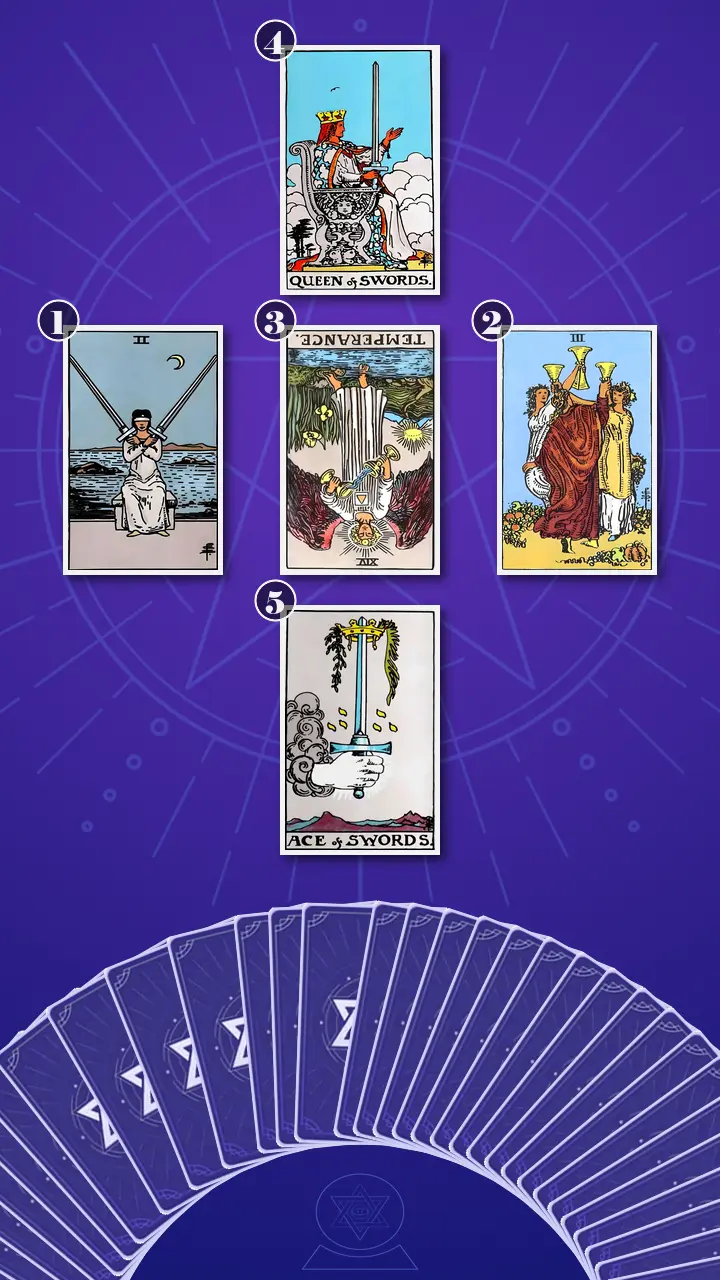
For this session, I chose a five-card Relationship Spread. When people ask me how tarot works for dating boundaries and communication, this is exactly the kind of question where it becomes practical. The issue was not prediction. It was a relationship boundary problem shaped by house-share dating logistics: two people working from different assumptions about closeness, and one woman exhausted by overthinking whether she was overreacting. A larger spread would only have fed the spiral. This one gave us exactly what we needed—her stance, their stance, the shared pattern, the core lesson, and the next move.
I explained it plainly. The card on the left would show what she already knew felt off but kept neutralizing so nobody could call her difficult. The card on the right would show how the other person might be defining togetherness. The center card would name the shared dynamic that kept date night porous. The card above would reveal the boundary principle that could protect closeness without turning the conversation into blame. The card below would give the clearest next communication step. Small map. Clear road.
Reading the Map in House-Share Dating
Position 1: The Loop That Calls Itself Research
The first card I turned was the one showing the querent’s current inner split between wanting intimacy and staying silent to avoid seeming difficult. Two of Swords, upright.
I pointed to the blindfold and the crossed blades held against the chest. “This is you at 5:40 on a Friday,” I said. “You’re still at your desk, you see the message that a flatmate may join, and instead of naming disappointment, you start doing mental admin. Maybe it’s fine. Maybe you’re overreacting. Maybe you need a better moment. Outwardly, calm. Inwardly, seventeen tabs open.”
Energetically, this is Air in blockage. Not lack of thought—far from it. It is thought frozen into self-protection. Your body already knows something changed; your mind keeps putting that feeling on trial. As I spoke, I could almost see the whole commute-home loop the card carried in it: headphones in, Tube window reflecting your face back at you, Notes app open again, the cursor blinking where a boundary message should be.
Maya let out a sharp little laugh, the kind with a bruise underneath it. “That’s so accurate it’s almost rude,” she said. Then her thumb started rubbing the edge of her phone case. I smiled a little. The best opening cards do that. They make a person feel seen before they feel solved.
Position 2: Warmth Without a Private Lane
The next card represented how the other person’s social habits and assumptions shape the pattern around date night. Three of Cups, upright.
I showed her the three figures raising their cups together in celebration. “This does not read to me as bad intent,” I said. “It reads as someone who genuinely experiences closeness through inclusion. More people, more warmth, more fun. In their nervous system, inviting a roommate may feel like making the night friendlier, not less connected.”
This is Water in balance for them, but it creates a mismatch with what you are seeking. They may be reaching for atmosphere while you are reaching for focus. Those are not the same thing. A group thread can feel warm and still swallow a conversation that needed to stay in the direct messages.
Maya nodded slowly. “Yeah,” she said. “That actually feels fair. I don’t think they’re trying to hurt me. I think they just… don’t clock the difference.” I watched some of the moral heat leave her face. That mattered. Boundaries become cleaner when we stop turning every mismatch into a villain story.
Position 3: When Convenience Rewrites the Night
The third card went at the center, the position mapping the shared dynamic that keeps couple time porous and emotionally unsatisfying. Temperance, reversed.
The moment I saw the angel pouring between the cups upside down, I thought of winter burns back home in the Highlands when the banks overflow after thaw. The water is still good water, still alive, still moving—but once it loses the channel, it spreads too thin to carry anything well. “This,” I told her, “is not a lack of feeling. It is over-mixing.”
I translated the card into the life she had described. Pasta for two turns into an open-door flat kitchen. A roommate wanders through with a bottle of wine. Music gets louder. Somebody else sits down. Nobody makes a villain move. Nobody is technically rude. And that is exactly why the disappointment becomes so easy to gaslight. It was not bad enough to call out, but it was not what the night was supposed to be.
Energetically, Temperance reversed is excess blending and lack of container. Ease keeps beating intention. Convenience keeps rewriting intimacy. Like a shared Google Doc with no title, everyone keeps dropping things into the space because nobody named what the space was for. “If it’s date night,” I said, “it needs a door. Do not let convenience define intimacy.”
Her body answered before her words did. First her breath caught. Then her eyes dropped to the center card as if it had spoken aloud. Then came the long exhale. “This is exactly it,” she said. “Nothing is technically wrong, and that’s what makes me doubt myself.”
When the Queen’s Sword Caught the Light
Position 4: The Boundary That Protects Closeness
The fourth card is the one I most wanted for her. It sits above the center and identifies the boundary principle that protects closeness without turning the conversation into blame. When I turned it, the late light at the window caught the blade on the card so cleanly that even Maya looked up. Queen of Swords, upright.
The Queen of Swords always reminds me of the first hard frost on Highland grass. Nothing has died; the edges have simply become visible. I pointed to the upright sword and the open hand. “This is one clean sentence,” I said. “Not a courtroom case. Not a six-paragraph explanation. One direct truth, offered respectfully.”
This Queen brings calm discernment, self-respect, and direct speech into a space that has been running on vagueness. In modern life, she sounds like this: “I love hanging with your roommates sometimes, but if we’re calling it date night, I want it to be just us unless we both decide otherwise.” The boundary is not ‘never include other people.’ The boundary is ‘please do not redefine couple time without me.’ That is balance, not harshness.”
This is also where I brought in what I call my Relationship Pattern Recognition. I am never only reading one awkward night. I am looking for the recurring emotional script underneath it: invitation shifts, you override yourself, resentment ferments, Notes app becomes your courtroom, then the same script runs again next week. The problem is not simply that a roommate joined once. The problem is that you keep pre-rejecting your need before the relationship ever has to respond to it.
I slowed the room down before I went further. “When you spend all week looking forward to one quiet night together,” I said, “then get the ‘my roommate might join’ text and hear yourself reply ‘yeah that’s fine,’ your body usually clocks the disappointment before your mind lets you admit it.”
You do not have to keep the peace by blurring the line; lift the Queen’s sword, separate date night from roommate night, and let clarity do the caring.
I let the sentence remain in the air for a beat. For a second she went very still. Her fingers froze halfway around her mug. Then her eyes unfocused—not dissociation exactly, but the look people get when memory starts replaying in the background: the group chat, the Victoria line, the tiny Notes cursor blinking at 11:13 p.m. After that came the release. Her shoulders lowered a full inch. Her mouth parted. The next breath left her with a tremor in it.
“But if I say it that plainly,” she said, and now I heard resistance in it, almost anger, almost grief, “doesn’t that mean I’ve been teaching them the wrong thing this whole time?”
“It means you were adapting before you were defining,” I answered. “Most of us do that. A boundary is not you making date night heavy; it is you giving closeness a shape clear enough to actually exist. Clarity is not control. The shift starts when you stop trying to sound impossible to dislike and start sounding clear enough to understand. Date night is the direct message. Roommate night is the group thread. They are both allowed. They just cannot be mislabeled without a cost.”
I asked her, “With that in mind, can you think of a moment last week when this would have changed how you felt?”
She gave one smaller laugh, softer this time. “Friday,” she said immediately. “If I’d just said it then, I wouldn’t have spent the whole Central line ride building a legal brief in my head.” She looked back down at the Queen. “I don’t need a legal brief. I need one clean sentence.”
That was the crossing point. Not perfection. Not certainty. Just the first move from people-pleasing frustration and post-date self-doubt toward calm self-respect and explicit one-on-one boundaries. In plainer language: from acting chill to being honest.
I had her anchor it straight away. “Within the next ten minutes,” I told her, “open Notes and write one sentence only: ‘If we’re calling it date night, I’d love it to be just us unless we both want to make it social.’ Read it out loud once. If your throat tightens past a seven out of ten, stop there, take three slower breaths, and shorten the sentence instead of forcing yourself to send it today.”
Position 5: The Message Before the Night Exists
The final card offered the clearest next communication move and the relational experiment for the next date plan. Ace of Swords, upright.
I smiled when it appeared. “Good,” I said. “The deck is being mercifully practical.” I pointed to the single sword rising from the cloud. “This is the message you send before anyone has put shoes on. Before the night exists, say what kind of night it is.”
In modern terms, it is as simple as confirming reservation details before leaving the house. If you do not define the plan, the plan defaults to whatever is easiest. This Ace is fresh Air in balance: not hinting harder, not waiting for mind-reading, but naming earlier. It is the train announcement that cuts through station noise and tells you exactly which platform you are on.
“So something like,” I said, “‘Are we doing date night-date night or more of a group hang this time?’ Or, ‘If we’re calling it date night, I’d love it to be just us.’”
Maya sat up straighter. “Oh,” she said, and this time the word carried relief instead of dread. “I can actually do that.”
From Insight to Action: The Date-Night Container Rule
By the time I looked across the whole spread, the story was clean. Maya was not confused because her need was irrational. She was confused because she kept treating her need like it required prosecution. On one side sat her Two of Swords habit: smiling, delaying, overthinking. On the other sat a Three of Cups person who likely equated inclusion with warmth. At the center, Temperance reversed showed the real thief: convenience, flatshare logistics, and vague planning all blending together until intimacy lost its shape. Above it, the Queen of Swords gave the antidote. Below it, the Ace of Swords gave the timing.
The cognitive blind spot was this: she thought she needed more proof, better wording, or permission to want protected one-on-one time. In truth, she was pre-rejecting herself. The transformation direction was simpler and braver—stop hoping they infer the need for closeness, define what counts as a date, and let the other person respond to something real. That is why I trust a five-card Relationship Spread for dating boundaries and roommate-related date night questions: it turns a foggy ache into one visible next step.
I gave her actionable advice the way I prefer it: small enough to use this week, clear enough to test, and kind enough not to turn one conversation into a full relationship audit.
- Before-the-Plan Clarity CheckOn WhatsApp, before the next plan is locked in, send: ‘Are we doing date night-date night or more of a group hang this time?’ It takes twenty seconds and it belongs before logistics, not after disappointment.Expect a flicker of awkwardness. That is the feeling of replacing a fuzzy default with a visible standard, not proof that you are doing something wrong.
- The 20-Word BoundaryOpen Notes tonight and save one line capped at about twenty words: ‘If we’re calling it date night, I’d love it to be just us unless we both want to make it social.’ Read it out loud once while making tea or walking to the station.If your throat tightens past a seven out of ten, shorten the sentence instead of abandoning it. You do not need a courtroom case to ask for one clear thing.
- One Shared-Meal ResetUse what I call a shared-meal bonding reset: suggest one roommate-free dinner this week, even if it is just Tesco pasta at someone’s flat, and one group night another time. That lets you separate preference from accusation and test a clear date-night container in real life.Keep the tone simple: ‘I like hanging with your people too; I just want one dedicated us-night this week.’ One protected meal tells you more than another week of guessing.
None of these steps are punishment. They are naming. In relationships, just as in the turning of seasons, things grow better when they have the right boundaries around them. A walled garden is not less alive. It is simply protected enough to bloom.

A Week Later, the Quiet Proof
Five days later, I received a message from Maya. She had sent the line before the next plan formed. The reply had not been cinematic; it had been simple. They said they had not realized how much the difference mattered to her, and yes, they could do dinner just the two of them on Thursday and see friends on Saturday.
Afterward she wrote, “It was a bit awkward for about four minutes, then weirdly a massive relief.” That was the proof I had hoped for. Not that every future boundary would be effortless, but that the conversation had finally happened inside the relationship instead of everywhere around it.
She told me she slept properly that night, though the first thought the next morning was still, “What if I sounded intense?” Then, she said, she laughed, put the kettle on, and remembered that the evening had actually felt like a date.
That is the journey to clarity as I understand it. Not becoming fearless. Not never feeling that throat-tightening again. Simply moving from self-doubt to self-respect, from blurred couple-time boundaries to a clear one-on-one meaning that can actually hold closeness.
Sometimes the loneliest part is not the extra person at the table; it is the moment I watch someone feel their throat tighten, their stomach drop, and begin editing their own need for closeness before anyone else has even answered. If that is where you are tonight, please know that noticing the edit is already a kind of return to yourself.
If you stopped pre-rejecting yourself for one second, what would you want ‘date night’ to mean in one clean sentence before the next plan slips from the direct messages into the group chat?
This story is adapted from psychological research, written so that those in a similar struggle can see their own pattern in it — and find their next step clearly.These insights are not a substitute for professional psychological, medical, legal, or financial advice.
Learn more about our Journey to Clarity.
How did this insight land for you?
🫂 This Resonates Deeply
🌀 Living This Story
✨ Now I See Clearly
🌱 Seeing New Possibilities
🧰 Useful Framework
🔮 The Confirmation I Needed
💪 Feeling Empowered
🚀 Ready for My Next Step
Author Profile
 AI
AI“As the seventh generation of a Highland healing family, I see modern anxieties as a simple, temporary disconnection from nature's rhythm. I bring 67 years of lived seasons not to instruct you, but to hold space for you. Using tarot as a mirror, I want to gently guide you out of the chaos, helping you breathe deeply and rediscover the organic, steady heartbeat of your own life.”
In this Love Tarot Reading :
Core Expertise
Service Features
Also specializes in :
Explore Related Patterns:
Assertive CommunicationMaya’s shift begins when the boundary becomes one respectful sentence instead of a case she has to prosecute. She can recognize that the other person may experience roommates as warmth while still naming that she is seeking focus, privacy, and couple time. Assertive Communication is the mechanism that converts private discomfort into usable relational data. It does not attack the other person’s social style, and it does not hide her own preference to stay liked. It gives both people a clearer object to respond to: what kind of night are we planning? The week-later outcome shows why this matters. Once the sentence was sent before the next plan formed, the conversation happened inside the relationship rather than around it. The awkwardness lasted a few minutes; the relief came from finally letting the relationship meet the real request.
Boundary DiffusionThe story keeps returning to the same leak in the container: a plan that sounded like date night becomes a group hang, and nobody has technically done anything rude enough to make the problem easy to name. That ambiguity is exactly what keeps Maya doubting herself. Boundary Diffusion is the deeper pattern behind the recurring frustration. Couple time, roommate time, convenience, warmth, and logistics all blend together until the original purpose of the night disappears. Because the boundary is fuzzy, Maya starts questioning the legitimacy of her own disappointment instead of naming the category error. The repair is not to make the relationship less social. It is to make the categories visible. When you define date night before the plan slides into a group thread, you stop asking your nervous system to absorb a boundary leak that language could have prevented.
Boundary DiscernmentThe central mismatch is not that roommates exist around the relationship; it is that the relationship has no agreed label for when a plan is private and when it is social. Pasta for two can become an open-door kitchen, a bottle of wine, louder music, and another person at the table because the space was never clearly named. Boundary Discernment is the adaptive mechanism Maya is practicing when she separates date night from roommate night without making either one wrong. The point is not rigid exclusion. The point is cognitive and relational differentiation: two different kinds of closeness need two different containers. That is why the best boundary is simple and specific. You can say that you enjoy group time and still want date night to mean one-on-one time unless both of you decide otherwise. The clarity protects intimacy by making the plan legible before convenience rewrites it.
People-PleasingMaya keeps responding as if the safest version of herself is the one who causes the least friction. The last-minute roommate add-on does not get met with her real preference; it gets met with an easygoing reply that preserves the vibe in the moment and transfers the conflict into her own body afterward. People-Pleasing shows up here as a conflict-avoidant coping mechanism, not as kindness. The adaptive aim is understandable: she wants to avoid seeming demanding, high-maintenance, or controlling. But the cost is that the relationship receives a false signal. The other person hears consent while Maya privately experiences disappointment, resentment, and a need for repair that was never named. The boundary she needs is therefore not punishment or a demand for total control. It is a correction to the false signal. You are allowed to like their roommates and still say that a date night needs a private lane unless both people agree to open it up.
Rejection SensitivityMaya does not only worry about what boundary to set; she worries about what the boundary will make her seem like. Wanting one-on-one date night gets filtered through labels such as clingy, controlling, and high-maintenance before the other person has actually judged her. Rejection Sensitivity is the anticipatory threat system underneath that hesitation. The feared rejection is not just “they might say no.” It is “they might see me as too much.” That projected judgment makes her pre-reject the need herself, which keeps the relationship from giving her real information about whether the request can be held. The boundary becomes clearer when it is detached from identity threat. You are not asking to control their friendships; you are asking to define the container of a date. The clean line is about shared meaning, not personal worth: date night means us, group night means everyone.
Self-SilencingMaya’s reflexive “yeah that’s fine” lands before her actual preference has been allowed into the room. Her body registers the shift first through the tight throat and stomach drop, but the visible behavior is accommodation: she makes the plan easy for everyone else while privately losing the version of date night she wanted. That is the core mechanism of Self-Silencing here. The boundary is not absent because she has no need; it is absent because the need gets edited before it can become speech. You can see the defense working through anticipatory self-monitoring: if asking for one-on-one time might sound clingy or controlling, the safer move becomes sounding chill, even when that creates resentment later. The pattern matters because it answers the practical question directly. The boundary is not a long explanation proving that roommates are wrong to join. It is the unsilencing of one clean preference: if it is called date night, you want it to be just the two of you unless both people choose to make it social.
Analysis ParalysisMaya’s Friday message freezes in the tiny sequence of typing, deleting, typing again, and then choosing the easiest reply. The issue is not that she has no idea what she wants. The issue is that the moment of expression gets overloaded with imagined consequences before the sentence can leave her phone. Analysis Paralysis appears when thinking stops serving clarity and starts functioning as avoidance. Better wording, more proof, and a perfect moment all sound reasonable, but in the story they keep delaying the same direct request. The mind builds a legal brief because one clean sentence feels emotionally risky. This pattern points to the exact boundary format that helps. You do not need to solve every possible interpretation before speaking. You need a short, testable sentence that defines the plan early: if it is date night, you would like it to be just the two of you unless you both decide otherwise.
RuminationMaya’s commute-home loop is highly specific: Tube window, Notes app, screenshots to friends, and the repeated question of whether she is overreacting. The event has already happened, but her mind keeps reopening it as if enough review will finally produce permission to want what she wants. Rumination turns the boundary into an internal court case. Instead of using thought to clarify the next action, thought becomes a self-protective loop that delays exposure to the real relational moment. You can see the cognitive narrowing in the way every path returns to the same fear: maybe the need is too much, maybe the wording is wrong, maybe she needs more evidence before she speaks. The useful insight is that more analysis is not the missing ingredient. The boundary becomes possible when the loop is interrupted by a simple behavioral move before the next plan forms: name whether this is date night-date night or a group hang, then let the relationship respond to something real.
Reassurance SeekingMaya’s screenshots to friends are not random venting; they are part of the same permission loop. After the date-night shift, she looks for someone else to confirm that her disappointment is reasonable before she risks naming it to the person involved. Reassurance Seeking works as a short-term anxiety regulator. It can temporarily soften the fear of overreacting, but it also keeps the authority for her boundary outside herself. The more she asks whether the feeling is allowed, the longer the actual relational conversation is delayed. The boundary becomes stronger when external checking is replaced by direct testing. Instead of asking the group chat to validate the need, you can ask the person you are dating to respond to the need: if we are calling it date night, can we keep it just us unless we both choose otherwise?
Explore Related Struggles:
Boundary Ambiguity LockMaya watches a private plan quietly turn social: the flatmate might join, the kitchen stays open, someone sits down, and nobody does anything obviously cruel. That is what makes the disappointment hard to defend. The night is not ruined by a dramatic breach; it loses shape because the container was never named. You get stuck where convenience starts acting as the relationship's default setting. When the plan stays porous, your need for focused closeness has to compete with house-share ease, vague logistics, and the awkwardness of naming a standard after the room has already filled up. Boundary Ambiguity Lock captures the struggle of needing a clean line while the existing setup keeps treating the line as optional. The boundary is not 'never include roommates'; it is 'do not relabel couple time without both people agreeing to make it social.'
Low-Maintenance Worth LockMaya says she does not want to be the person who makes everything a thing, so she lets the roommate add-on pass through as if it costs her nothing. The cost shows up later: the Tube ride, the Notes app, the legal brief in her head, the question of whether wanting a real date made her too intense. You are asked to keep proving that you are easy to be with by needing less than you actually need. The performance looks chill from the outside, but inside it quietly turns one normal preference into a character trial. Low-Maintenance Worth Lock names the point where being wanted starts to feel dependent on being undemanding. A clean boundary interrupts that bargain: you can enjoy group nights and still let date night mean direct, protected time together.
Voice-Safety FusionMaya is still at her desk when the message arrives, and her body reacts before her words do: throat tight, phone warm, reply half-written and deleted. The sentence she needs is simple, but the risk attached to saying it makes the request feel bigger than the date-night plan itself. You get caught at the point where voice becomes a safety calculation. Asking for one-on-one time is not just a preference in that moment; it starts to sound like evidence that you might be clingy, controlling, or too much. So the easygoing reply goes out, and the real need stays behind. Voice-Safety Fusion names the struggle of treating clear speech as a threat to connection. The boundary does not require you to become harsher; it asks you to separate being understandable from being impossible to dislike.
Unspoken Expectation LoadMaya has a clear private meaning for date night: one-on-one time that feels like couple time. The other person may be using a different map, where adding a flatmate makes the night warmer rather than less intimate, and the gap stays invisible until the plan has already changed. You end up carrying an expectation that has no spoken job description. Because it was never named, every roommate add-on has to be interpreted after the fact: was this casual, careless, inclusive, dismissive, or just unclear? Unspoken Expectation Load names the strain of letting a real need travel without language. The boundary turns the hidden expectation into a shared reference point: if we are calling it date night, I want it to be just us unless we both decide otherwise.
Self-Editing ExhaustionAfter Maya replies 'yeah that's fine,' the conversation does not end; it relocates. It moves to the Tube window, the Notes app, the screenshots to friends, and the repeated search for proof that her disappointment is allowed to exist. You carry the labor of the boundary everywhere except the place where the boundary could actually be received. The more you edit the sentence in private, the more the relationship is spared from responding to the real request, and the heavier the unsent version becomes. Self-Editing Exhaustion captures that drain: the constant trimming, testing, and prosecuting of a need that was clear enough from the start. The relief in the story comes when the work shrinks back down to one clean sentence before the next plan forms.
Explore Related Emotions:
Approval AnxietyThe easygoing reply is written for an audience before it is written for the relationship. Even after the clear sentence works, the next morning still brings the thought that maybe you sounded intense. Approval Anxiety lives in the way the boundary keeps being filtered through an imagined verdict. You are not only deciding what you want; you are trying to predict whether wanting it will cost you warmth, desirability, or the right to be seen as chill.
Boundary GuiltAt 5:41 p.m., the flatmate add-on lands while Slack is still pinging, and you answer with something easygoing before your body has caught up with what it wants. The throat clamp and the hollow drop make the boundary feel less like a preference and more like a charge you have to defend. You are not guilty because you want one-on-one time; the guilt grows from treating a normal relational limit as if it might harm the connection. Boundary Guilt names that tight inner weather where asking for a clear date-night container feels heavier than silently absorbing the change.
Low-Maintenance ShameYou say you do not want to be the person who makes everything a thing, even though the plan has already changed from couple time into something public. The careful half-smile, the typed-and-deleted reply, and the effort to stay easy to like all show how much energy goes into not taking up space. Low-Maintenance Shame is the sting of believing your needs must stay small to keep you lovable. In this story, the wish is not dramatic; it is just protected one-on-one time, but the body reacts as if wanting that much clarity could make you difficult.
Mutuality HungerWhat you keep asking for is simple: one-on-one time that actually feels like couple time. The direct message and the group thread can both exist, but they need different names and different agreements. Mutuality Hunger is the ache for a relationship where your version of closeness is not silently overwritten by someone else's. It points toward the part of you that wants the other person to meet a real preference, not a softened version edited for maximum acceptability.
Quiet Self-RespectThe Queen of Swords moment turns the boundary into one clean sentence: if it is date night, you want it to be just you two unless you both decide otherwise. The line is clear without turning roommates into the enemy. Quiet Self-Respect is the steadier feeling that appears when you stop trying to sound impossible to dislike and start sounding clear enough to understand. It does not need a courtroom case; it lets the relationship respond to something real.
Relational FogThe plan keeps losing its title: date night, group hang, flatshare convenience, friendly inclusion. Because nobody technically does anything awful, you start doubting the signal from your own body. Relational Fog is the blurred inner weather that appears when the relationship has no shared label for the space you are in. You are left trying to navigate closeness without a map, unsure whether you are asking for too much or simply asking for the night to mean what it was called.
Scope Creep DreadThe private plan expands by degrees: a possible flatmate, then an open kitchen, then wine, louder music, another person at the table. Your body reacts before the social script catches up, like the night has started sliding out of your hands. Scope Creep Dread names the sinking feeling when a simple one-on-one container keeps widening without your consent. In this story, the dread is not about hating other people; it is about watching intimacy get diluted by convenience before you have had a chance to protect it.
Self-Audit AnxietyOn the Tube home, the night keeps replaying through Notes, screenshots, Google searches, and the blinking cursor where a boundary could have been. Instead of one direct conversation, you build a legal brief against your own reaction. Self-Audit Anxiety names the exhausting feeling of putting your need on trial before anyone else has responded to it. The mind keeps asking for more evidence, but the body has already registered that date night stopped feeling like a date.
Clarity ReliefFive days later, the message is sent before the next plan forms, and the reply is simple: dinner for two on Thursday, friends on Saturday. The awkwardness lasts a few minutes, then the evening finally feels like a date. Clarity Relief arrives because the question has moved out of screenshots, Notes, and mental replay and into the relationship itself. The relief is not a guarantee that every boundary will feel easy; it is proof that naming the container can reduce the fog.
Hidden ResentmentPasta for two becomes an open-door kitchen, a roommate wanders in, the music gets louder, and nothing is obvious enough to call rude. You keep going along with it, then carry the unsaid no into the ride home. Hidden Resentment gathers in the gap between being outwardly agreeable and inwardly aware that the plan was quietly overwritten. It is not about making the other person a villain; it is the stored charge that builds when your preference never gets a clean place to stand.
Explore Related Contexts:
Strategic Dating BoundaryMaya's turning point comes when the boundary is reduced to one clean sentence rather than a courtroom case. The proposed line does not attack the roommate or accuse the other person of bad intent; it defines the container before the night gets rewritten by logistics. Strategic Dating Boundary fits because the answer is not simply 'be more honest' in a vague emotional sense. The story shows a specific timing problem and a specific format problem: the plan needs to be named before people arrive, before shoes are on, before the easiest option becomes the default. You are setting the boundary at the planning layer, where it can actually shape the evening. That makes the boundary both firm and low-drama. 'Are we doing date night-date night or more of a group hang?' gives the other person a real choice and gives you clean information. If they can respect the distinction, closeness gets a usable shape; if they keep blurring it, the pattern becomes visible enough to evaluate.
Low-Maintenance Dating PressureMaya keeps describing the request through the language of dating self-policing: clingy, controlling, high-maintenance, overreacting. Before the other person even has to respond to her need, she is already measuring it against the pressure to sound relaxed, low-demand, and easy to include in whatever plan is most convenient. Low-Maintenance Dating Pressure names the social script sitting underneath the roommate issue. The external dating culture around being 'chill' can make a normal request for protected time feel like a character flaw, so the person with the boundary starts editing themselves instead of describing the actual terms of closeness they want. You can see that in the Tube ride, the Notes app, the screenshots to friends, and the search history around whether wanting one-on-one date night is too much. The practical boundary works because it refuses that false choice. You do not have to perform effortless flexibility to be reasonable, and you do not have to turn the other person into a villain to ask for focus. The cleaner frame is simple: group warmth is welcome in the right container, and date night needs a separate container.