Finding Clarity in the 8:47 PM Scroll
When Maya came onto my screen from Toronto, she asked me a question I hear in different forms from a lot of late-20s professionals: “Why can’t I just be happy for my friend who got the job I wanted?” Whenever I hear that exact blend of guilt, envy, and embarrassment, I do not hear pettiness. I hear career grief. I hear LinkedIn comparison fatigue. I hear a comparison-triggered self-worth crash that has not been named yet.
She told me about 8:47 p.m. on a Tuesday, on the TTC heading north after work. The train brakes were shrieking into the station, fluorescent lights buzzing overhead, and her phone felt warm in her hand as she toggled between a drafted “So happy for you!!” text, the saved job posting, and her friend’s new LinkedIn title. She said, “I did mean the congratulations. That’s the worst part.” Her chest tightened anyway. Her face went hot anyway. Her stomach dropped anyway. The contradiction was brutal: she cared about her friend, and her body still reacted like she had just gotten rejected all over again.
As she spoke, I could feel the real shape of the pain. It was not clean jealousy. It was the kind of feeling that smiles politely in the group chat while dragging a suitcase full of wet cement through your ribs. Or, more simply, like having twenty-seven tabs open and still only being able to see the three that went wrong. In my work, I call that an attention lock. In ordinary life, it feels like shame with a Wi-Fi connection.
“I know she deserves it,” Maya told me, rubbing the side of her thumb against the edge of her mug. “And I still hate that it wasn’t me. I sent the congrats text, and then I immediately felt worse.”
I nodded. “That makes sense to me,” I said. “Envy can be grief before it learns how to speak. We are not here to make you into a nicer version of yourself on command. We’re here to figure out what actually got hurt, and then let’s draw a map through that fog.”
Why I Chose the Shadow Spread for Career Grief
I asked Maya to put both feet on the floor, take one slow breath, and hold the question without polishing it. Then I shuffled slowly on camera. I do not treat that moment as theater. It is simply a way to help the nervous system cross a threshold—from reacting to observing.
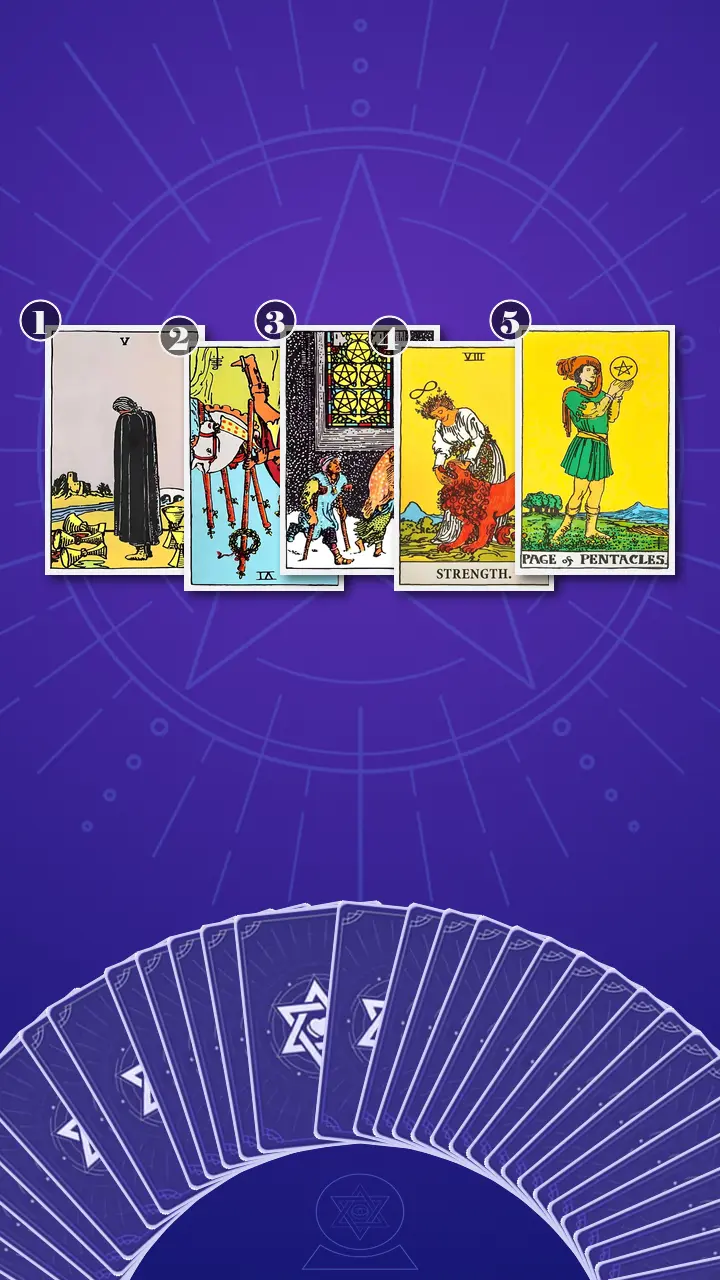
For her reading, I chose a five-card spread I use often in cases like this: The Shadow Spread · Context Edition. This is how tarot works best for me in moments of job envy and self-worth repair: not as a fortune machine, and not as a verdict, but as a clean pattern map. Maya was not trying to decide between two offers or asking me to predict her future. She was trying to understand why her friend’s success felt so personal, and why one rejection had started acting like proof that she was less valuable.
The Shadow Spread is useful because it separates things that usually get tangled together. The first card shows the visible symptom—the behavior you can actually catch yourself doing in the ten minutes after the trigger. The middle of the spread reveals the defensive story and the deeper wound underneath it. Then the fourth card gives the medicine, the inner quality that can hold the feeling without collapsing into shame, and the fifth card brings us back down to earth with one grounded next step.
I laid the cards in a straight line from left to right. I always like that layout for this kind of question. It reads like walking through a narrow tunnel and out onto open ground.
The Cups, the Crowd, and the Cold Street
Position 1: The Commute Loop That Called Itself Strategy
Now I turned the card that represents the concrete comparison behavior and grief response activated by losing the role to a friend. It was the Five of Cups, upright.
“This card is your TTC ride,” I told her. “This is you sending the warm congratulations text and then immediately reopening the saved job description, the rejection email, and your friend’s profile until the whole commute turns into a loop around what you didn’t get.”
The Five of Cups is grief in visible form. In energetic terms, it is water that has gone from healthy feeling into fixation. Not because the feeling is wrong, but because the attention has narrowed so hard that only loss stays lit. On the card, the figure faces the three spilled cups and misses the two still standing behind them. In Maya’s life, those three spilled cups were almost literal: the tabs she kept reopening, the interview answers she kept rescoring, the alternate versions of herself she kept cross-examining.
I asked her, “What are you actually mourning besides the title?”
She looked down almost immediately. “Creative ownership,” she said. “Momentum. The feeling of finally being chosen for the kind of work I actually want.”
That was the card doing its job. The Five of Cups was not accusing her of being dramatic. It was asking her to stop calling grief ‘just data.’
Maya let out a quick laugh, the kind with no real amusement in it. “Okay,” she said, “that’s almost rude.” Her shoulders lifted toward her ears and then dropped. The laugh told me her defenses were loosening. The exhale told me the recognition had landed.
Position 2: When LinkedIn Became a Leaderboard
The next card was the one revealing the self-judging storyline that turns one hiring outcome into a status ranking. It was the Six of Wands, reversed.
“This,” I said, “is the moment disappointment turns public in your head. Your friend posts the new title. The reactions stack up. Mutuals comment. Maybe someone says she’s crushing it. And suddenly you’re not reading a job update—you’re reading a scoreboard.”
The Six of Wands normally carries recognition, visibility, and earned success. Reversed, that fire distorts. It becomes validation hunger, performance panic, and the habit of treating visibility like value. Maya was not only upset about not getting the role. She was upset because the role had become a public ranking event. Very Black Mirror, very social-score, very modern white-collar brain.
“Your friend’s offer is not your performance review,” I told her. “Visibility is not value.”
I saw the sentence hit. She gave me a tight nod and a small wince at the same time, which I have learned is often the body’s way of saying, unfortunately, yes. Then she admitted the sentence that flashed through her mind every time she saw her friend’s update: “Everyone can probably tell who was chosen and who wasn’t.”
That was the defensive story right there. In energetic language, her fire was not absent. It was over-aimed outward. Ambition had been hijacked by optics. Instead of asking, “What do I want to build next?” she had been asking, “What does this make me in comparison?”
Position 3: The Keycard Story Beneath the Comparison
The third card sits at the center of this spread for a reason. It uncovers the underlying worth wound and fear of being the one not chosen. I turned it over and found the Five of Pentacles, upright.
I felt myself slow down. “This is no longer just about LinkedIn,” I said. “This is the part that gets triggered late at night, when the apartment is quiet, rent is humming in the back of your mind, and one rejection stops feeling like one outcome. It starts feeling like everybody else has a keycard to the next room and you somehow don’t.”
The Five of Pentacles is earth under scarcity pressure. It is not just disappointment; it is exclusion. The story becomes: maybe I am the one who gets left outside. On the card, the figures pass a lit window without being able to take in its warmth. In Maya’s life, that lit window was still there too—mentors, skills, friendships, existing work experience, transferable talent—but her pain was louder than her access to any of it.
At the planetarium, I spend a lot of time explaining that the darkest patch of sky is not necessarily empty space. Often, it is structure your eyes have not adjusted enough to see. Looking at this card, I had the same thought. Shame narrows the aperture. It makes support feel further away than it is.
“Not chosen is not the same as not worthy,” I said quietly.
Maya did not answer right away. Her eyes went wet, but not dramatically; just that quick brightening that happens when somebody has been carrying a sentence for a long time and finally hears its opposite. She folded one arm across her stomach and took a long, uneven breath. The defensiveness was gone now. What remained was sadness, which was progress.
When Strength Put a Hand on the Lion
Position 4: The Medicine That Did Not Ask Her to Be Nicer
When I turned the fourth card, the atmosphere changed. Even through a screen, I felt it. Behind Maya, the hum of the fridge clicked off, and the sudden quiet in her kitchen seemed to lean toward us. This was the position that names the inner quality able to hold disappointment without collapsing into shame, resentment, or fake niceness. The card was Strength, upright.
“Good,” I said before I could stop myself. “This is the antidote.”
Strength is not forced positivity. It is regulated fire. It is emotional steadiness. It is the part of you that can say, “I am hurt, and I care about her,” without trying to make one of those truths cancel the other. The woman on the card does not beat the lion into obedience and she does not let it run the road. She meets it. She holds it. I often explain this card with a city image: like walking a strong dog through a busy intersection—not yanking it, not letting it drag you into traffic, just keeping contact.
Then I gave Maya the astronomy version, because it was the clearest thing in my mind. “In my own shorthand,” I told her, “this is a Binary Star System problem. Your attention has become tidally locked to your friend’s win. One face of you keeps turning toward the same bright event, over and over, until it starts to seem like her orbit is the only thing defining the sky. Strength breaks that tidal lock. It gives you your own gravity back.”
The sentence that changed the room
Envy is sometimes grief with nowhere honest to go. The moment you stop turning it into a verdict on your worth, it stops running the whole story.
Stop treating the lion of disappointment like proof that something is wrong with you; hold it gently, and it becomes strength that carries you back to your own path.
For a second, Maya went completely still. First came the physical freeze: her fingers stopped halfway around the mug, and even her blinking slowed. Then I watched the thought move through her. Her eyes slid past me and unfocused, as if she were back on that subway platform replaying the same interview answers again, but from slightly outside herself this time. Then the resistance showed up. “But if that’s true,” she said, and there was heat in her voice now, “doesn’t that mean I’ve been doing this to myself?”
“No,” I said. “It means you’ve been trying to turn pain into data because data felt safer than grief.”
That landed differently. Her jaw loosened. One hand came up to her chest almost automatically, like her body had reached the insight before her mind finished catching up. She let out a shaky breath that broke into half a laugh, half a near-tear sound, and her shoulders dropped in a way that made her look briefly lighter and also a little unsteady—the way people do when they set down a heavy bag and realize how much effort it took to carry it. I asked her, “If you had held it this way last Tuesday, on the train, what might have changed?” She looked at the card and whispered, “I think I would’ve said I was hurt instead of opening LinkedIn again.”
That was the hinge of the whole reading: not from jealousy to sainthood, but from guilt-soaked envy and comparison loops to honest grief and grounded self-trust. A small shift in language, yes. A huge shift in orbit.
Back to Your Own Lane
Position 5: One Clean Tab, One Real Step
The final card points to one grounded career-facing action that rebuilds self-trust without forcing fake positivity. It was the Page of Pentacles, upright.
“Perfect,” I said. “Because this reading does not end with a personality improvement project. It ends with one real move.”
The Page of Pentacles is grounded earth. Focused earth. Apprentice energy. This is Maya closing the comparison tabs and spending one focused block of time updating a portfolio case study, rewriting one résumé bullet, booking one coffee chat, or honestly reviewing one skill the role required. Not six panic applications. Not a dramatic reinvention by Friday. Just one clean checklist. One tab. One step.
I told her, “This card brings you back to your lane. The question now is not whether you can win the entire race by tomorrow. It’s whether you can give steady attention to one small thing that is actually yours.”
Maya finally looked relieved. “I can do thirty minutes,” she said. “Forty-five sounds like I’m pretending to be a better person than I am this week.”
I smiled. “Then thirty minutes it is. No spiritual bonus points for suffering. The smallest version still counts.”
That is the Page of Pentacles exactly: ambition made usable again. The emotional weather had shifted enough for practical effort to come back online.
From Insight to Action: The One-Lane Rebuild
When I stitched the spread together for Maya, the pattern was clean. First came the real loss: the Five of Cups showed grief so fresh it kept disguising itself as analysis. Then the Six of Wands reversed turned that grief into a public ranking system, where LinkedIn reactions and career optics started acting like evidence in a case about her worth. The Five of Pentacles revealed why it cut so deep: this was not only about a job. It landed on an older wound around belonging, being chosen, and fearing that other people had already entered a room she was still trying to prove she deserved. Strength interrupted the whole chain by teaching her to hold the feeling without handing it the steering wheel. And the Page of Pentacles translated that emotional repair into something lived.
I told her the blind spot was not that she felt too much. It was that she had mistaken comparison for clarity. She kept treating one hiring outcome as if it were objective proof of her status, when it was actually a painful event she had not let herself grieve. The transformation direction was simple, though not easy: name the loss directly, separate rejection from worth, and take one self-chosen next step.
Then I gave her the practical framework.
- Three-Line Worth ResetOn your next commute or walk home after a trigger, open your Notes app and set a 10-minute timer. Write exactly three lines: ‘What I lost,’ ‘What this does not prove about me,’ and ‘What hurts most right now.’ If typing feels too exposed, make it a 90-second voice memo instead.Start tiny. If the full three lines feel like too much, write only one sentence: ‘I am disappointed, and that is not the same as being less valuable.’ Name the loss before you open the tabs.
- 72-Hour Social Star MapI asked her to use my Social Star Map for the next three days: send one clean, boundaried congratulations message, mute the friend’s LinkedIn or stories for 72 hours, and direct social energy toward one safe person instead—a mentor, sibling, coworker, or friend who can hold nuance without turning it into gossip.A temporary mute can be care, not cruelty. Keep the boundary private and clean; it is for nervous-system regulation, not punishment.
- One-Lane Career HourBook one 25- to 45-minute block this week with the most boring tools possible: calendar invite, timer, laptop open, one tab only. Use it for exactly one task that belongs to your actual path—update one portfolio case study, rewrite one résumé bullet, or send one coffee-chat request.Lower the bar on purpose. If you freeze, the minimum version is opening the document and renaming it with today’s date. One lane is enough.

A Week Later, the Quiet Proof
A week later, Maya sent me a screenshot of her calendar. In the middle of an otherwise ordinary Thursday was a 30-minute block titled mine. She had muted LinkedIn for three days, written the three-line note on her commute, rewritten one portfolio case study, and sent one coffee-chat email she had been avoiding for months.
She also added, “I still had the stomach-drop thing when her name came up in the group chat. But I didn’t open her profile after. I just noticed it and kept chopping vegetables.”
That may sound small to somebody who has never been caught in this kind of loop. To me, it was the whole reading made visible. Clear but still tender. Better, but not magically unhuman. She slept through one full night, woke with the brief old thought—what if I’m behind?—and then laughed softly and opened her laptop anyway.
That is the kind of clarity I trust. Not certainty. Not instant virtue. Just enough space between feeling and verdict for choice to re-enter. That is what this Shadow Spread gave her: symptom, story, wound, medicine, and one step back into her own orbit.
If you are reading this and your chest tightened because some part of the story felt uncomfortably familiar, I want to say this clearly: there is a very specific ache in watching someone you love walk through a door you were reaching for, then feeling your mind try to turn that moment into evidence that you were never enough. I never read that ache as proof of bad character. I read it as pain asking not to be sentenced.
If the next notification lights up your screen before you’ve had time to process, which quiet anchor will you choose first—the hand on the lion, the bridge behind the spilled cups, or one small next move that belongs only to your own orbit?
This story is adapted from psychological research, written so that those in a similar struggle can see their own pattern in it — and find their next step clearly.These insights are not a substitute for professional psychological, medical, legal, or financial advice.
Learn more about our Journey to Clarity.
How did this insight land for you?
🫂 This Resonates Deeply
🌀 Living This Story
✨ Now I See Clearly
🌱 Seeing New Possibilities
🧰 Useful Framework
🔮 The Confirmation I Needed
💪 Feeling Empowered
🚀 Ready for My Next Step
Author Profile
 AI
AI“After a decade of guiding people through the stars, I’ve come to see life much like the orbits of planets: everything has its inevitable cycles. When you feel lost, please don't blame yourself; you might just be in a natural low tide. I’m here to sit under the night sky with you, offering a gentle cosmic perspective to distinguish temporary pain from the beautiful breakthroughs just around the corner.”
In this Friendship Tarot Reading :
Core Expertise
- Orbital Drift Recognition: Objectively mapping how personal cognitive upgrades naturally lead to mismatched frequencies with old friends, removing the guilt of outgrowing them.
- Gravity De-linking Analysis: Identifying the painful friction that occurs when two friends try to force an alignment despite moving into completely different life phases.
Service Features
- The Constellation Release Protocol: A psychological closure technique to peacefully accept the natural fading of a friendship, leaving them in their orbit while you transition to your next.
Also specializes in :
Explore Related Patterns:
Comparison TrapMaya's commute turns into a tight digital loop: the congratulations draft, the saved job posting, the rejection email, and her friend's new LinkedIn title all sit on the same screen, asking to be compared. The pain is not just that she lost a role. It is that her mind keeps using her friend's visible win as the measuring stick for her own value. That is the mechanism of a comparison trap: attention narrows until someone else's progress becomes the reference point for your entire self-assessment. The story makes this especially clear when LinkedIn stops functioning like a career update and starts feeling like a scoreboard, with reactions and mutual comments acting like public evidence about who is ahead. You are not failing at friendship because envy showed up. The pattern is that your nervous system is trying to make a painful outcome understandable by ranking it, replaying it, and placing yourself against another person. Once that mechanism is visible, the real work becomes separating your grief from the false verdict that her success defines your position.
External ValidationMaya does not only react to the job itself; she reacts to the public visibility around it. The new LinkedIn title, the reactions stacking up, and the mutual comments make the hiring outcome feel socially displayed, as if recognition has become proof of value. External validation shows up here as the habit of outsourcing self-worth to visible signals: titles, reactions, optics, and who appears to be chosen in front of other people. In the story, that mechanism turns a private disappointment into a public ranking system, so the friend's success starts to feel like a performance review of Maya. You can care about achievement and still refuse to let visibility become the final authority on your worth. The core shift is not pretending the title did not matter. It is seeing how quickly public recognition became the courtroom where your value was being judged.
Achievement FusionMaya is not only grieving a title. She names creative ownership, momentum, and the feeling of finally being chosen for the kind of work she wants. The role has become a container for identity, future direction, and proof that she is moving. Achievement fusion happens when a milestone stops being one meaningful goal and starts carrying the weight of self-worth. In that state, a friend's success can feel like a personal diminishment because the achievement field has become fused with identity. The job is no longer just a job; it becomes evidence about who is legitimate, chosen, and on track. You can want the role deeply without making it the sole proof of your value. The repair begins by separating the real grief of losing an opportunity from the heavier story that your whole professional self was rejected with it.
Cognitive DissonanceMaya means the congratulations, and her body still drops as if the rejection has happened again. That contradiction is the emotional center of the story: she cares about her friend, and she also hates that the job was not hers. Cognitive dissonance appears when two true internal positions feel impossible to hold at the same time. Maya's mind tries to resolve the tension by turning it into guilt: if she is hurt, maybe the congratulations were fake; if she loves her friend, maybe she should not feel envy. The pattern is not the envy itself, but the pressure to make one truth erase the other. You do not have to choose between being a good friend and being honest about disappointment. The more accurate frame is that two truths are present at once. Holding both reduces the shame charge and makes room for a cleaner response.
Deficit FixationMaya's attention keeps returning to the same three losses: the role she did not get, the rejection email, and the friend's visible title. Even when the story names mentors, skills, friendships, existing experience, and transferable talent, those resources cannot compete with the brightness of what went missing. Deficit fixation is the cognitive narrowing that makes absence feel more real than access. It does not mean the loss is imaginary. It means the mind has locked onto the deficit so intensely that remaining options, support, and evidence of competence become psychologically harder to reach. You can be genuinely disappointed and still notice when grief has narrowed the frame. The pattern becomes workable when the question changes from 'Why didn't I get this?' to 'What else is still here that my shame is filtering out?'
IntellectualizationMaya keeps making the pain look like research: saved job posting, rejection email, profile, interview answers, comparison tabs. The story names the mechanism directly when it says she had been trying to turn pain into data because data felt safer than grief. Intellectualization is a defense that moves emotion into analysis so the feeling becomes easier to control. It can be adaptive when it creates reflective distance, but here it starts to overfunction. The more Maya audits the facts, the less space she has to simply say, 'I am hurt.' You do not need to abandon analysis. You need to notice when analysis becomes a hiding place from grief. Once the feeling is named directly, information can become useful again instead of serving as a loop that keeps reopening the wound.
RuminationMaya keeps returning to the same evidence trail: the saved job posting, the rejection email, the friend's profile, and the interview answers she keeps rescoring. The movement looks like analysis from the outside, but emotionally it keeps circling the same wound. Rumination works by making repetition feel productive. It promises that if you review the details one more time, you might finally get relief, but the loop often keeps the nervous system inside the original rejection. In Maya's case, replaying the hiring outcome does not create new clarity; it turns grief into an endless audit. You are not wrong for wanting to understand what happened. The issue is when understanding becomes a ritual that postpones feeling. The moment Maya says she would have named the hurt instead of opening LinkedIn again, the loop loses some of its control.
Compulsive CheckingMaya's hand keeps going back to the same places: the saved job description, the rejection email, and her friend's LinkedIn profile. The repeated opening matters because it turns the trigger into a behavioral loop, not just a passing thought. Compulsive checking uses short-term information seeking to regulate uncertainty, shame, or emotional shock. The check promises control, but the relief is thin and temporary, so the same evidence trail has to be reopened again. In Maya's case, every return to the profile reactivates the comparison instead of settling it. You can see the pattern shift later when her friend's name comes up in the group chat and she does not open the profile. The feeling is still there, but the checking ritual no longer gets to drive the next action.
Rejection SensitivityMaya's body reacts to her friend's job update as if the rejection is happening all over again. The title on LinkedIn is not processed as a separate event; it lands on the older sentence, 'maybe I am the one who gets left outside.' Rejection sensitivity appears when a specific disappointment becomes charged with a broader fear of not being chosen, not belonging, or being less worthy. The mechanism does not invent the pain. It intensifies the meaning of the pain until one hiring outcome starts speaking for the whole self. You are allowed to feel the sting of not being selected. The shift is learning to catch the moment when a rejection becomes a verdict. 'Not chosen for this role' and 'not worthy' may arrive together in the nervous system, but they are not the same statement.
Spotlight EffectMaya's most revealing thought is not simply 'She got it and I didn't.' It is 'Everyone can probably tell who was chosen and who wasn't.' The pain becomes sharper because she imagines the outcome being visible to a watching social field. The spotlight effect is the cognitive bias that makes other people's attention feel more focused on us than it likely is. In this story, LinkedIn reactions and mutual comments are real, but Maya's mind turns them into imagined scrutiny of her own status. The public update starts to feel like a public exposure. You can validate the embarrassment without treating it as evidence that everyone is evaluating you. Once the imagined audience is named, the job loss can return to its actual scale: painful, personal, and meaningful, but not a public verdict on who you are.
Explore Related Struggles:
Care-Competition SplitMaya means the congratulations text, and that detail matters. The ache is not proof that she secretly wants her friend to fail; it is the collision of care and competition inside a friendship where both people were close enough to want good things for each other and close enough for one person's win to touch the other's wound. Care-Competition Split holds the two truths without forcing a fake moral cleanup. She cares about her friend, and she is hurt that the same opportunity did not choose her. The problem begins when one truth is treated as a betrayal of the other. You can care cleanly without abandoning yourself. In this story, the healthier movement is not from envy to instant niceness, but from guilt-soaked comparison to honest grief, private boundaries, and a congrats message that does not require her to keep staring at the trigger afterward.
Chosen-Worth BindMaya is not only reacting to a friend getting a role. The moment lands like a door closing in front of her while someone she loves walks through it, and the story keeps returning to the same sentence underneath the envy: not chosen is starting to feel like not worthy. That is why the congratulations text does not resolve the pain. She can mean the kindness and still feel the rejection in her body, because the hiring outcome has become loaded with belonging, creative ownership, momentum, and the hope of finally being selected for work that feels like hers. Chosen-Worth Bind names the way one external selection starts carrying the weight of personal value. You are not being asked to pretend the friend's win does not hurt; the clearer move is separating the real loss from the verdict your mind tries to attach to it, so a missed role can become an event again rather than a sentence about who you are.
Pain-Logic FusionMaya keeps moving between the saved job description, the rejection email, the friend's profile, and her own interview answers as if enough reviewing could make the pain become useful information. The scroll calls itself strategy, but it keeps bringing her back to the same bruise. Pain-Logic Fusion captures that specific trap: hurt gets converted into evidence because evidence feels safer than grief. The mind can rescore, compare, and build a case, but none of those actions answer the quieter question of what was actually lost. The story shifts when Maya recognizes that she could have said, "I was hurt," instead of opening LinkedIn again. You regain leverage here by noticing when analysis has stopped serving clarity and started keeping the wound open, then naming the loss before the data loop takes over.
Social Self-Judgment LockThe friend's LinkedIn update does not stay a job update in Maya's head. The reactions stack up, mutuals comment, someone says her friend is crushing it, and suddenly Maya is reading the post like a public scoreboard where everyone can tell who was chosen and who was not. Social Self-Judgment Lock names the moment private disappointment becomes an imagined audience. The hurt gets sharper because she is no longer only grieving a missed role; she is also picturing other people silently ranking her from the outside. This is why the sentence "visibility is not value" matters. You get room back when you separate the social display of someone else's success from the private truth of your own worth, skill, and next move.
Single Outcome LockOne hiring decision starts carrying too many meanings at once for Maya. The role is no longer only a role; it becomes creative ownership, momentum, public proof, the feeling of being chosen, and the fear that everyone else has already moved into the next room. Single Outcome Lock appears when one result is forced to answer questions it cannot answer fairly. A job offer can reveal timing, fit, competition, or a hiring team's decision, but Maya's mind makes it speak for her entire trajectory and value. The repair in the story is deliberately modest: one note, one mute, one portfolio case study, one coffee chat. You loosen the lock by returning weight to multiple points of evidence, so one missed role stops becoming the whole case file on your future.
Explore Related Emotions:
Career GriefMaya does not only lose a job title; when asked what she is mourning, she names creative ownership, momentum, and the feeling of finally being chosen for the work she wants. That detail turns the reaction from petty comparison into a real loss with a specific shape. Career Grief fits because the missed role carried a version of her future self, not just another line on a profile. You can read the ache as the mind trying to process a door that seemed personal, meaningful, and close enough to touch, while still needing enough steadiness to build the next step from her own lane.
Comparative JealousyMaya drafts the congratulations text, keeps the saved job posting open, and stares at her friend's new title while her body reacts as if the rejection has happened again. The friendship is real, and the comparison is real; neither one cancels the other. Comparative Jealousy fits because the sharpness is not a wish for the friend to fail. It is the impact of watching someone close receive the exact recognition your own body was still reaching for, which makes the emotion feel morally messy even before anyone has done anything cruel.
Hard-Won ComposureMaya's jaw loosens, one hand comes to her chest, and her shaky breath breaks into a sound that is half laugh and half near-tear. The shift does not erase the reaction; it changes how tightly the reaction is allowed to steer. Hard-Won Composure fits because the steadiness is earned in direct contact with the difficult feeling. You can hold I am hurt and I care about her in the same body, without forcing yourself into fake niceness or letting the disappointment run the whole road.
Hollow CelebrationMaya sends the warm congratulations text and means it, then immediately feels worse. The gesture is socially clean, but the private impact has nowhere to land, so the celebration becomes a surface act stretched over an unprocessed loss. Hollow Celebration fits because the conflict is not between kindness and cruelty. It is the gap between what you can sincerely offer someone else and what your own body can honestly absorb in that moment, especially when the win you are applauding is the same door you wanted to walk through.
Clarity ReliefMaya whispers that if she had held the feeling differently on the train, she might have said she was hurt instead of opening LinkedIn again. That sentence gives the whole loop a cleaner map: hurt first, verdict later, choice after that. Clarity Relief fits because the body softens when the pattern becomes visible. The relief is not instant certainty or instant virtue; it is the first real space between the feeling and the story that had been sentencing her with it.
Not-Enough PanicMaya's chest tightens, her face goes hot, and her stomach drops when the friend's new title pulls the rejection back into the present. Later, the keycard image gives the body reaction a shape: everyone else seems to have access to the next room while she is still outside. Not-Enough Panic fits because the inner jump is brutally fast. One hiring decision becomes not chosen, then not chosen becomes not valuable, and the whole system reacts before the slower part of the mind can separate outcome from worth.
Shame SpiralMaya reopens the saved job description, the rejection email, and her friend's profile until the commute becomes a loop around what she did not get. The checking looks like analysis, but it keeps converting one painful outcome into a running case about her value. Shame Spiral fits because the hurt keeps feeding on its own evidence. You can see the mind trying to make the rejection measurable, rankable, and explainable, while the body absorbs each tab as another small verdict.
Status AnxietyMaya sees the new title, the reactions, the mutual comments, and the imagined audience that can supposedly tell who was chosen and who was not. The job update stops being a private disappointment and becomes public in her head. Status Anxiety fits because the pain is amplified by perceived ranking. You can feel how visibility turns into value under pressure: the friend did not just get a role, she became visible in a way Maya's mind reads as proof of position, progress, and social standing.
Comparison FatigueMaya toggles between the congratulations draft, the job posting, the rejection email, the friend's profile, and the interview answers she keeps rescoring. Every screen gives her another angle on the same wound, but none of them gives the wound enough room to settle. Comparison Fatigue fits because the exhaustion comes from repeated self-measurement. You can feel how the feed keeps reopening the question before she has finished processing the last answer, leaving her mentally crowded by tabs, reactions, and imagined rankings.
Grounded Self-TrustA week later, Maya still gets the stomach-drop when her friend's name appears in the group chat, but she does not open the profile. She notices the reaction and keeps chopping vegetables, which makes the change ordinary enough to be believable. Grounded Self-Trust fits because the repair shows up as a small choice made under real conditions. You do not need the trigger to vanish before agency returns; the evidence is the private pause, the muted feed, the calendar block titled mine, and the next step she actually takes.
Explore Related Contexts:
Access as Proof PressureWhen Maya says it feels like everyone else has a keycard to the next room, the job has become more than an opening. The friend's offer, the title update, the reactions, and the quiet apartment with rent in the background all make access feel like evidence of who belongs in the next professional tier. You are not simply comparing two people; you are confronting a gatekeeping moment that has started acting like a verdict. The hiring decision becomes a proof system, as if one organization's choice can certify whether you deserve creative ownership, momentum, or entry into the room you have been working toward. That pressure becomes workable when the access point is treated as a structure rather than a sentence about you. Mentors, skills, friendships, work experience, and transferable talent are still part of the map, even if the most visible door did not open this time.
LinkedIn Performance LoopAt 8:47 p.m. on the TTC, Maya is toggling between the drafted congratulations text, the saved job posting, and her friend's new LinkedIn title. Later, the reactions and mutual comments make a job update read like a scoreboard, so the platform is no longer neutral background; it keeps replaying the hiring result as visible ranking. That is why the congratulation does not settle the situation. You are not only responding to a friend's good news; you are sitting inside a public career display system where titles, likes, and comments compress achievement into optics. The loop keeps handing your mind fresh material to compare, even when the underlying hiring decision has already happened. The useful move is not to shame the comparison, but to see the stage clearly. Once the platform becomes part of the pressure, muting, leaving the profile unopened, and returning to one career task are ways of taking your attention back from a scoreboard that was never built to measure your actual path.
Zero-Sum Friendship ConflictMaya means the congratulations text, sends it, and still feels worse immediately afterward. The friend's new title then moves through LinkedIn, mutual comments, and the group chat, turning one person's win into a shared social scene where Maya feels marked as the one who did not get picked. That is the structure of a friendship being pulled into a zero-sum career frame. You can care about the friend and still be stuck inside an external setup where the same role cannot belong to both of you, and where public celebration makes the comparison harder to process privately. The goal is not to force a cleaner emotion on demand. Seeing the conflict as a social stage lets you separate love for the friend from the career gate you both stood near, so the friendship does not have to carry the whole weight of the rejection.