Finding Clarity in the Sunday-Night Three Tabs
When someone comes to me saying, “I have options,” while their browser history is basically apartment listings, city comparison notes, and unsent group-chat drafts, I already know the flavor of panic they are bringing me.
That was Jordan, a 29-year-old remote product marketer in Toronto, who sat down with me and asked, “My lease is up, my job’s remote, my people are here—what am I choosing?” I hear this kind of analysis paralysis around renewing a lease or relocating when remote-work freedom collides with belonging more often than people think, but hers had a particularly familiar ache to it.
As she spoke, I could see the scene she described as clearly as if I had been standing in her kitchen: 11:26 on a Sunday night, three browser windows open side by side, the fridge humming, cold tea abandoned by her elbow, the blue laptop light drying out her eyes. One tab held the lease-renewal email, one held apartment listings in a city she kept calling a “casual option,” and the third held a half-written message to the group chat where Thursday drinks, birthday brunches, and ordinary weeknight life kept reminding her what she might be leaving.
She told herself it was a housing decision, but I could hear what her body already knew: it was also about whether freedom would cost closeness. Her uncertainty had the feeling of a live charger pressed against the ribs—a low electrical buzz in the chest, nowhere for the current to go.
I told her gently what I tell many people in a belonging-versus-freedom dilemma: she was not failing a simple adult task. She was trying to make one lease decision carry grief, identity, longing, guilt, and possibility all at once. “You’re not weak for feeling the cost of a real choice,” I said. “Let me help you draw a map through the fog. We don’t need perfect certainty tonight. We need clarity about what this decision is actually asking of you.”

The Compass I Chose: A Decision Cross for a Stay-or-Move Question
I asked Jordan to put both feet on the floor, take one slow breath, and say her question once without editing it for anyone else. Then I shuffled slowly. For me, that pause is not theatre. It is simply a bridge: a way to help the nervous system step out of scroll mode and into attention.
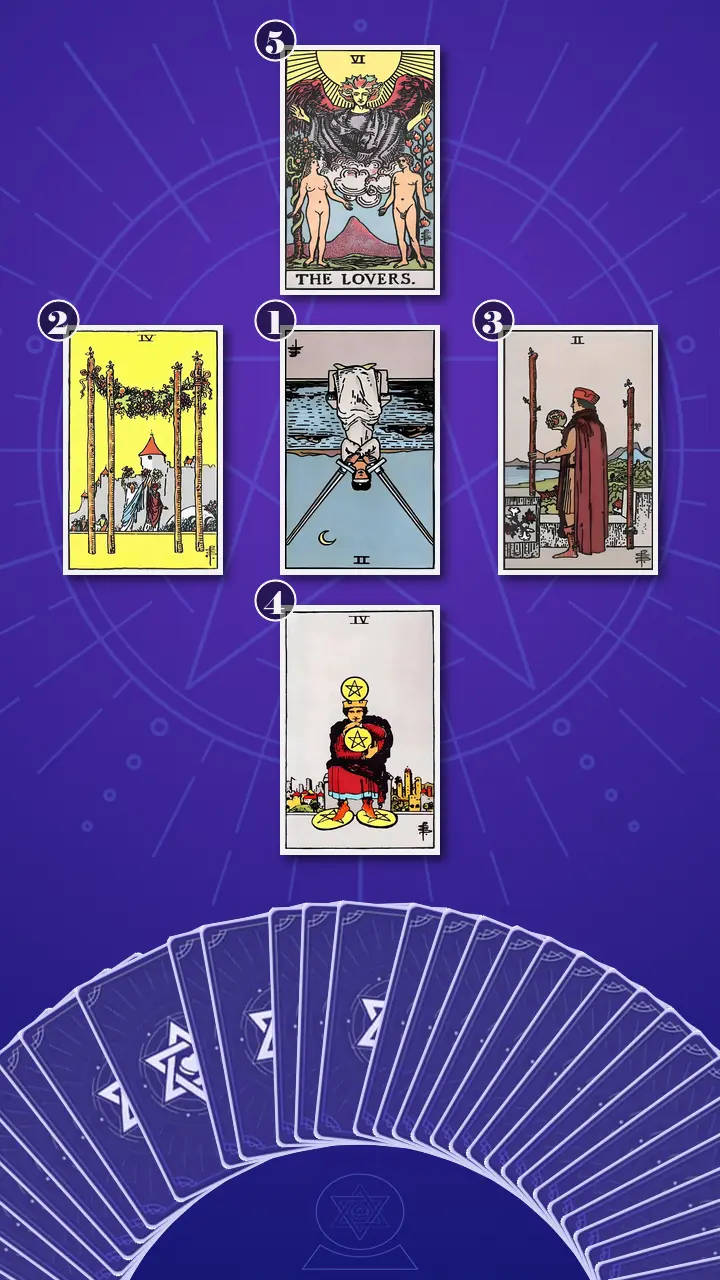
I used a five-card Decision Cross, one of the clearest tarot spreads I know for a stay-or-move question. For readers who wonder how tarot works in a practical decision like this, this Decision Cross tarot spread for a lease-renewal versus relocation choice is useful because it separates the visible housing choice from the deeper psychological choice underneath it.
Five cards are enough to track the whole arc cleanly: the present knot, what staying genuinely offers, what moving genuinely opens, the hidden fear weighting both paths, and the guidance card that brings the decision back to values instead of panic. I was not asking the cards to hand down a postcode from the heavens. I was using them the way I always do—as a mirror with structure, so card meanings stay in context and the logic remains tight.
I told her I would pay close attention to three places in particular: the center card, because it would show the decision exactly as she was living it; the lower card, because that is often where the real fear sits in the body; and the upper card, because clarity usually arrives when the question is lifted above reactivity.
Reading the Crossroads Before the Deadline
Position 1: The Loop That Calls Itself Research
I turned the card representing the present knot: the observable indecision around whether to renew the lease or use remote-work flexibility to relocate. It was the Two of Swords, reversed.
I almost nodded before I spoke, because it was exact. This was Jordan at the kitchen table with a lease email in one tab, a city roundup in the second, and a half-written “What would you do?” text in the third. Every time she got close to setting actual decision criteria, she opened a new note, added another column to the comparison doc, or asked one more friend for input. It looked responsible from the outside. In truth, it was the mind protecting the heart from the fact that either path carried loss.
Reversed, the Two of Swords gives me Air energy in excess and in blockage at the same time: lots of thinking, very little clarifying. The blindfold becomes emotional self-editing. The crossed swords over the chest become using analysis to keep feeling out of the room. It is like having 27 tabs open and calling it a decision-making process when what is really happening is an emotional firewall. More information is not always more truth.
Jordan let out one short laugh that had more ache than humor in it. “Okay,” she said, rubbing one thumb against the edge of her mug. “That’s accurate enough to be a little mean.”
“Not mean,” I told her, “just precise. I’m not interested in mocking the part of you that built this strategy. It has been trying to protect you. But protection can harden into gridlock. What I’m seeing here is not missing data. It’s a nervous system hoping one more tab will spare it from feeling the finality built into a real choice.”
Position 2: The Life That Already Knows Your Name
I turned the card revealing what staying in her current city genuinely protects and nourishes, especially community, familiarity, and everyday belonging. It was the Four of Wands, upright.
This card is the decorated threshold, the welcoming archway, the life you can walk into without explaining yourself first. In Jordan’s world, it looked like texting three people on a Wednesday and having dinner plans within the hour. It looked like familiar streets, a neighborhood that remembered her back, birthday tables, casual weeknight hangs, and the soft social scaffolding that makes a city feel less like an address and more like a living container.
This is Fire in balance, but rooted Fire. A hearth, not a flare-up. That mattered. Staying was not automatically fear, inertia, or playing small. This path held real warmth and real structure. It preserved a form of belonging that already existed in the week-to-week fabric of her life.
I watched her face soften as I said it. Her jaw unclenched for the first time. “That’s the part people skip,” she said quietly. “Everyone talks about freedom like it’s obviously better. Nobody talks about what it means to already be in the middle of a life.”
Position 3: The Horizon That Isn’t a Betrayal
I turned the card showing what leaving or relocating opens up, especially freedom, expansion, and the self that wants to test a wider horizon. It was the Two of Wands, upright.
I was glad to see it. This is not my card for reckless escape. It is my card for authorship. Jordan’s fully remote job gave her the rare gift and burden of true flexibility, and remote work can create a strange modern problem: freedom without enough structure, so every next move starts feeling existential. The Two of Wands named the part of her that wanted a broader horizon on purpose—a different daily rhythm, a life not organized around one familiar radius, the chance to choose rather than simply inherit the next chapter by momentum.
This is Fire reaching forward in balance. Not reinvention for the aesthetic of a TikTok montage. Not moving just because other people’s Close Friends stories make starting over look cinematic. More like zooming out on Google Maps and realizing your life does not have to stay inside one saved cluster of coffee shops, transit routes, and local habits forever.
Jordan exhaled through her nose, slow and steady. Her fingers, which had been curled inward most of the reading, opened flat against her notebook. “That’s it,” she said. “I don’t want to leave just because I can. I also don’t want to stay just because I’m scared.”
Position 4: The Grip Beneath the Logistics
I turned the card below the center, the position that uncovers the deeper fear or attachment turning a practical decision into a test of safety, belonging, and self-trust. It was the Four of Pentacles, upright.
This was where the reading dropped out of the head and into the body. I could hear it all at once: renew so I do not have to test whether closeness survives distance; keep the apartment half-settled so nothing feels final; talk fast about rent increases, moving costs, and market timing while my shoulders creep up and my chest locks down. The pentacles in the image pin the figure at head, heart, and feet. Thinking locks. Feeling locks. Movement locks.
One of my own diagnostic lenses is what I call a Home Energy Diagnosis. When someone is stuck, I listen to the space they are inhabiting almost as carefully as I listen to the cards. Jordan had already told me her apartment was still slightly provisional—no proper rug, art never hung, corners undecided, a life kept on standby in case she needed to bolt. To me, that was Four of Pentacles all over: not freedom, not minimalism, but a grip response. Choosing from clench instead of clarity.
And at that moment the missing element in the spread became obvious. We had Swords, Wands, Pentacles—but not a single Cup. No Water anywhere. She had translated grief, longing, and guilt into logistics. Sometimes the spreadsheet is just grief in business casual.
Her reaction came in a clear little chain. First, her breath stopped for a beat. Then her eyes went slightly unfocused, as if she were replaying every dinner where someone had casually asked, “So are you renewing or leaving?” Finally, her shoulders dropped and her palm went straight to the center of her chest. “Yes,” she said, almost under her breath. “That’s why it feels so much bigger than housing. It’s the fear that if I loosen one thing, everything else comes loose too.”
“Exactly,” I said. “And you are not weak for feeling the cost of a real choice. Caution is protecting something precious. But when it is overused, it turns into self-confinement.”
When The Lovers Stood Under One Sky
Position 5: The Choice Beneath the Choice
When I turned the final card, the room went quiet enough that I could hear the rain thinning against my window. I have spent a lifetime with Highland weather, and I know this much: mist is not the absence of landscape. It is only a condition of seeing. This was the card that changed the visibility of the whole question.
The card clarifying what she was actually choosing beneath the logistics—the internal compass for a values-aligned next step—was The Lovers, upright.
Jordan was still holding the old split so many people bring to me: if I stay, maybe I am playing small; if I go, maybe I am leaving the good part behind. She was trying to make one lease decision behave like a verdict on identity. That is exhausting, and it guarantees that no option ever feels clean enough to trust.
The Sentence That Changed the Room
Not the old split of "love or freedom," but a choice that lets head and heart stand under one sky, like The Lovers.
I let that sit between us for a moment. Then I said the plainer version. “You are not only choosing a city. You are choosing what gets to lead: fear or values.”
This is where the whole reading turned toward making a values-first city choice instead of waiting for one location to guarantee belonging. One of the ways I read The Lovers through my own practice is with that same Home Energy Diagnosis lens. I do not begin with square footage or the smartest-looking neighborhood. I begin with climate. What kind of inner weather is this life being built under? The Lovers told me Jordan did not need a magical city that could promise she would always feel central, connected, and brave. She needed the option in which her work rhythm, relationships, and sense of aliveness could stand together without splitting her in two.
Her reaction came in three waves. First, stillness: even her fingers stopped moving, suspended over the notebook. Then recognition: her gaze drifted slightly past me in that faraway way people get when memory starts re-sorting itself in real time. Then release: she exhaled so slowly it almost sounded like a laugh, and the tightness around her mouth gave way. Relief came first—but right behind it was that strange, lightheaded vulnerability that sometimes follows clarity, when the burden lifts and the responsibility of choosing returns to your own hands.
“So I’ve been asking the wrong question,” she said at last, voice quieter now. “I’ve been asking which city proves something about me, instead of which life actually matches what matters right now.”
“Yes,” I said. “Now use that lens. Think back to last week. Was there a moment when this insight would have made you feel different?”
She nodded slowly. “Thursday,” she said. “The group chat was planning drinks, and I felt my whole body tense. I thought I was panicking about whether to move. But really I was grieving the idea of becoming less local to the people I love. That’s different. I can work with that.”
That was the real turning point: from chest-tight lease renewal panic to steadier self-trust about building home intentionally. Not total certainty. Something better. Honest alignment.
From Clench to Clarity: The Next 7 Days
By then, the story the cards were telling was beautifully coherent. The reversed Two of Swords showed the surface problem: a mind looping hard enough to look productive while emotion stayed edited out. The Four of Wands showed that staying preserved something real—community, rhythm, ordinary belonging. The Two of Wands showed that moving was not disloyalty but a genuine invitation toward authorship and expansion. The Four of Pentacles showed the hidden weight beneath both paths: the wish to keep access, safety, and possibility perfectly intact, as if no real choice should require grief.
The blind spot was equally clear. Jordan had been treating one housing decision like a verdict on her identity, while hoping one city might guarantee belonging forever. It cannot. No postcode can do that. The transformation direction was simpler and braver: stop asking which option removes loss, and start choosing the one that best matches current values—then build the relationships and routines that make that choice feel like home. Belonging is not guaranteed by a postcode; it is maintained by attention.
I did not tell her where to live. I gave her a values-first framework and a few practical next steps that could move her from insight into action without forcing a dramatic leap.
- The Next 12 Months NoteOpen a fresh note called “Next 12 Months.” Write exactly two values that matter most in this season—something like “weekly in-person community” and “more intentional space and pace.” Score only your real options against those two values from 1 to 5, then say out loud to one trusted friend, “I do not need you to choose for me. I just want to hear myself name what matters.”This is a clarity tool, not a committee process. If you feel the urge to add eight more criteria, stop at two and leave it there for one night.
- The 20-Minute Fear-vs-Information CheckFor the next seven days, set one 20-minute decision session and stop when the timer ends. At the end, write one feeling word and one loss word. If your chest starts buzzing while you research, put both feet on the floor and ask: is this fear, grief, guilt, or actual missing information?Before you open a tab, borrow my three-minute home-energy check: look at a houseplant, a windowsill herb, or the most neglected corner of your flat and ask what in your life is being watered—and what is being kept on standby.
- The One-City-at-a-Time RulePick one destination city for this week only. Give it a 30-minute reality check: one neighborhood, one rent range, one coworking setup, and one realistic route back to Toronto. If it still feels alive after that, plan one low-stakes expansion experiment instead of a whole new identity.Do not research five cities at once. One live option is information. Five is self-abandonment dressed up as diligence.
I wanted her next week to be structured, not dramatic. Clarity often arrives that way—through boundaries that are small enough to keep the truth from getting buried under performance.

A Week Later, the Jaw Was Looser
A week later, Jordan sent me a photo of a notes app page titled “Next 12 Months.” Under it were only two lines: “weekly in-person community” and “breathable pace.” She had stopped polling the group chat. She had stopped opening five city tabs at midnight. She chose to renew her Toronto lease for another year—not as surrender, not as default, but as a decision she could actually stand inside—and she booked a three-day summer scouting trip to the other city so her horizon did not have to vanish just because it was not chosen first.
Her message ended with a sentence I have not forgotten: “I still felt sad when I hit send, but I didn’t feel split.” To me, that is the quiet proof. She sent the renewal, then sat alone in a café with sunlight on the table and let herself miss the unlived version of the other city for one honest hour.
That is what a real Journey to Clarity often looks like in my work. Not a perfect ending. A truer beginning. From outsourced certainty to honest alignment. From deadline anxiety to a steadier trust that home can be built intentionally, wherever life is being asked to root next.
Sometimes the tightest part of the decision is not the rent or the map—it is the sick, chest-tight fear that one choice could turn you from part of the picture into a visitor in the lives you love.
If tonight you are in your own three-tabs moment, and this stay-or-move decision does not have to prove where you belong forever, what next small under-one-sky step would feel most honest to your values right now?
This story is adapted from psychological research, written so that those in a similar struggle can see their own pattern in it — and find their next step clearly.These insights are not a substitute for professional psychological, medical, legal, or financial advice.
Learn more about our Journey to Clarity.
How did this insight land for you?
🫂 This Resonates Deeply
🌀 Living This Story
✨ Now I See Clearly
🌱 Seeing New Possibilities
🧰 Useful Framework
🔮 The Confirmation I Needed
💪 Feeling Empowered
🚀 Ready for My Next Step
Author Profile
 AI
AI“As the seventh generation of a Highland healing family, I see modern anxieties as a simple, temporary disconnection from nature's rhythm. I bring 67 years of lived seasons not to instruct you, but to hold space for you. Using tarot as a mirror, I want to gently guide you out of the chaos, helping you breathe deeply and rediscover the organic, steady heartbeat of your own life.”
In this Family Tarot Reading :
Core Expertise
Service Features
Also specializes in :
Explore Related Patterns:
Certainty SeekingJordan keeps circling the lease email, city listings, comparison notes, and timing questions as if the right combination of facts could remove the ache from the decision. The story is explicit that this is not missing data; it is a nervous system hoping one more tab will spare it from finality. The mechanism is Certainty Seeking. Instead of using information to support a choice, information becomes a way to search for a guarantee: a city that will not cost closeness, a lease decision that will not produce grief, a next chapter that will not require leaving any version of life behind. You can feel the trap in the hope that one postcode might guarantee belonging forever. The clearer move is not to find the risk-free option, but to separate actual missing information from fear, grief, and guilt so the decision can be made from values rather than the impossible demand for total certainty.
Analysis ParalysisJordan's three browser windows, abandoned tea, lease email, city listings, and half-written group chat draft show a mind working hard while the actual choice stays untouched. The repeated move is not random indecision; every time decision criteria start to form, another column, note, tab, or outside opinion appears. That pattern functions as a cognitive defense against emotional finality. The research loop keeps grief, longing, guilt, and loss at a manageable distance, so the nervous system can stay busy instead of having to admit that both staying and leaving cost something. You are not looking at a lack of intelligence or adulthood here. You are looking at Analysis Paralysis: the moment when thinking becomes a holding pattern, and more information stops creating clarity because the missing piece is not data but emotional permission to choose with imperfect certainty.
IntellectualizationJordan talks quickly about rent increases, moving costs, market timing, city comparisons, and remote-work flexibility while her shoulders creep up and her chest locks down. The logistics are real, but the story makes clear that the logistics are carrying more than practical information. The psychological mechanism is emotional translation: grief, longing, guilt, and fear of distance get converted into spreadsheet language because numbers feel safer than loss. This is Intellectualization, where the mind builds a clean explanatory system around a messy emotional truth so the heart does not have to enter the room too soon. You can see the pattern most sharply in the line that the spreadsheet is grief in business casual. The issue is not that thinking is wrong; it is that thinking has been over-employed as an emotional firewall, keeping the decision technically active while the real feeling remains unprocessed.
Values-Based Decision MakingJordan's final movement is concrete: she stops opening five city tabs at midnight, renews the Toronto lease for another year, and books a three-day scouting trip so the wider horizon does not disappear. The choice becomes bounded, intentional, and livable rather than dramatic. The mechanism is Values-Based Decision Making. Instead of asking which city proves something about her, she asks which life matches what matters right now: weekly in-person community and breathable pace. Those values become decision criteria strong enough to hold both belonging and expansion. You can see the difference in her final sentence: she still feels sad, but she does not feel split. That is the psychological shift from panic control to honest alignment, where a choice no longer has to erase grief in order to be trusted.
Reassurance SeekingJordan's half-written group chat message and repeated requests for one more friend's input show how the decision keeps moving outward whenever it starts to become personal. The group chat is not just a social detail; it becomes a place where the pressure of choosing can be temporarily distributed. The defense underneath is a search for borrowed steadiness. By asking other people what they would do, Jordan can delay the exposed feeling of trusting her own criteria, especially when every option carries loss. This is Reassurance Seeking: not healthy consultation, but a loop where outside input briefly lowers anxiety without building internal authority. You can see the repair when she stops polling the group chat and tells one trusted friend, "I do not need you to choose for me. I just want to hear myself name what matters." The shift is from outsourced certainty to self-witnessing, which gives support a role without letting it replace self-trust.
Black-and-White ThinkingJordan's inner split is stated plainly: if she stays, maybe she is playing small; if she goes, maybe she is leaving the good part behind. That framing turns a lease renewal into a symbolic verdict, where each option has to prove something total about her identity. The cognitive mechanism is all-or-nothing categorization. Staying and moving stop being complex life choices and become opposing moral-emotional meanings: love versus freedom, belonging versus authorship, safety versus aliveness. This is Black-and-White Thinking, because nuance collapses under the pressure to make one city carry the whole truth. You can feel the pattern loosen when the decision becomes an "under one sky" question. The clearer frame is not which option makes her fearless or perfectly loyal, but which choice allows work rhythm, relationships, and aliveness to coexist without splitting her in two.
Loss AversionJordan's current city is not abstract comfort; it is Thursday drinks, birthday brunches, familiar streets, ordinary weeknight life, and people who can become dinner plans within the hour. That makes the possible loss of proximity emotionally vivid before the possible gains of relocation can even become real. The cognitive bias at work is Loss Aversion. The mind weighs what might be lost more heavily than what might be gained, especially when the loss involves belonging, routine, and being woven into other people's everyday lives. The fear is not simply moving; it is becoming less local to the people she loves. You can see the healthy edge of the pattern too. It helps Jordan recognize that staying is not automatically fear or inertia, because the life she already has contains real attachment value. The work is to honor the loss signal without letting it become the only vote in the room.
Control CopingJordan's apartment is still slightly provisional: no proper rug, art never hung, corners undecided, a life kept on standby in case she needs to bolt. The space itself mirrors the way the decision is being held, with enough attachment to stay but not enough commitment to fully land. The coping mechanism is grip as safety. By keeping the home unfinished and the choice not fully finalized, Jordan preserves a sense of control over loss, access, and possibility. This is Control Coping, where containment becomes a way to manage uncertainty before uncertainty can be felt directly. You can see why it once made sense. Caution is protecting something precious: community, freedom, and the fear that loosening one part of life could loosen everything else. But when the grip becomes the whole strategy, the protective structure starts to feel like self-confinement rather than clarity.
Explore Related Struggles:
Opportunity-Belonging SplitJordan keeps a lease email, a relocation tab, and a half-written group-chat message open at the same time, and none of those tabs is just practical. The city she is in holds Thursday drinks, birthday brunches, familiar streets, and people who can become dinner plans within an hour, while the remote job opens a wider map that is genuinely alive to her. You can feel the friction because both paths protect something real. Moving is not framed as escape, and staying is not dismissed as fear; the pressure comes from trying to choose between authorship and everyday belonging as if one must cancel the other. Opportunity-Belonging Split fits because the real choice is not simply where to live, but how to let growth and connection share the same life without making one prove the other wrong.
Binary Choice LockJordan names the old split when staying starts to look like playing small and leaving starts to look like abandoning the good part of her life. That framing makes the lease feel like a two-door test where each answer seems to betray one value she still wants to keep. You see the lock tighten whenever the question demands a clean winner between love and freedom. The decision only starts to loosen when she can ask which life matches what matters now, not which city erases loss. Binary Choice Lock fits because the pain is carried by the false demand that a complex life must be reduced to one pure, consequence-free option.
Security-Choice SplitJordan's body gives this away before her spreadsheet does. Renewing would mean she does not have to test whether closeness survives distance, and loosening one thing feels as if everything else might come loose too. You can feel the choice getting smaller under that grip. The wish is not for luxury or perfection; it is for a decision that keeps access, safety, possibility, and belonging intact with no grief attached. Security-Choice Split fits because the decision becomes frightening not only for what it opens, but for what it might fail to hold.
Identity Verdict LockJordan is not only comparing Toronto with another city; she is asking which city proves something about her. The story says she has been making one lease decision behave like a verdict on identity, so every option becomes too symbolically loaded to feel trustworthy. You can feel how heavy that gets in the moment she realizes she was asking the wrong question. A housing choice can guide the next year, but it cannot certify whether you are brave, loyal, grown, or alive enough. Identity Verdict Lock fits because the decision stalls when a practical threshold is forced to carry a full self-definition.
Panic Productivity TrapJordan looks busy in the most recognizable modern way, with apartment listings, city notes, group-chat drafts, new columns, extra criteria, and one more friend to ask. From the outside, it resembles due diligence, but the story keeps showing that every added input delays the moment when she has to feel the cost of choosing. You can see the trap because the research produces motion without contact. The tabs multiply, but the inner question stays untouched until she stops treating panic as a data problem. Panic Productivity Trap fits because the productivity is real enough to be convincing, while its function is to keep finality and grief outside the room.
Explore Related Emotions:
Belonging AmbivalenceThe current city holds dinner within the hour, familiar streets, birthday tables, and a neighborhood that remembers her back. At the same time, the wider horizon keeps calling because the remote job has made another life materially possible. Belonging Ambivalence is the divided weather of wanting closeness without surrendering authorship. You are not confused because one path is fake; the split hurts because both belonging and expansion are real needs asking to be honored.
Finality DreadThe tight chest, raised shoulders, and breath-stopping pause show up before Jordan even knows what the final answer will be. The body reacts as if clicking one button could make every other version of life disappear at once. Finality Dread fits because the fear is not only about rent or logistics. You are watching a real choice become heavy with irreversible loss, and the mind keeps searching for one more fact that might let you choose without closing anything.
Friendship Drift GriefThe group chat is not background noise here. Thursday drinks, birthday brunches, and ordinary weeknight life keep reminding Jordan that leaving could make her less local to the people she loves. Friendship Drift Grief names the ache of imagining closeness becoming harder to reach through distance and changed routines. You are not just comparing cities; you are registering the possible thinning of casual access, the small everyday contact that makes a place feel inhabited.
Grounded BelongingTexting three people on a Wednesday and having dinner plans within the hour gives Jordan's current city a physical texture. It is not abstract comfort; it is a week-to-week social structure that already knows how to hold her. Grounded Belonging fits because staying is shown as an existing container, not a failure of imagination. You can feel the difference between clinging to the familiar and recognizing a life where connection has already become part of the floor.
Verdict DreadJordan keeps trying to make one lease decision answer a much larger question about who she is. Staying starts to look like playing small; leaving starts to look like abandoning the good part of her life. Verdict Dread names the pressure that appears when a practical choice is treated like a public ruling on the self. You are not simply choosing an address; you are trying not to let one year of housing become proof of courage, loyalty, maturity, or failure.
Alignment ReliefWhen Jordan says she had been asking which city proves something about her instead of which life matches what matters, the whole room changes. Her body moves from stillness to recognition to a slow exhale that lets responsibility return without the old clench. Alignment Relief names that lighter state after the inner structure finally clicks into place. You still have to choose, but the choice is no longer built on panic; it is anchored in values that can be named and acted on.
Cautious Self-TrustA week later, the note has only two lines, and Jordan has stopped polling the group chat or opening five city tabs at midnight. She renews the lease and books a short scouting trip, choosing a pace her body can actually stand inside. Cautious Self-Trust fits because the clarity is not loud or absolute. You are seeing a person take the decision back from the crowd, keep the horizon alive, and move with enough honesty to feel sad without feeling split.
Choice Paralysis OverwhelmAt 11:26 on a Sunday night, the lease email, city listings, and half-written group-chat message sit side by side while the tea goes cold. Every added note or comparison column gives the mind something to do, but it keeps the actual choice at arm's length. That is the shape of Choice Paralysis Overwhelm, not a lack of intelligence but too many meanings loaded onto one decision. You end up trying to solve belonging, freedom, identity, and loss through research, so the browser keeps expanding while the body stays braced.
Horizon HungerThe broader-horizon part of the story is concrete: a remote job, another city worth checking, and the wish for a different daily rhythm. Jordan does not want to move just for the image of starting over; she wants to test whether life can open wider on purpose. Horizon Hunger names the pull toward expansion that survives even after the lease is renewed. You can choose a current base and still feel the clean ache of a map that has not finished speaking.
Standby Mode AnxietyThe half-written message and the apartment with no proper rug, no hung art, and undecided corners create the same posture: stay ready to bolt, but never fully arrive. Even the home space is kept provisional so the choice can remain technically open. Standby Mode Anxiety names that suspended state where possibility stops feeling spacious and starts feeling like a held breath. You keep every exit available, but the cost is living in a room that never quite becomes yours.
Hollow FreedomRemote work gives Jordan a real opening, and the other city is not treated as a reckless escape. Still, the map gets strange when flexibility has no emotional container; every option starts to ask what kind of person she is becoming. Hollow Freedom fits the moment when choice expands faster than inner steadiness can catch up. You can have genuine mobility and still feel a gap under it when freedom threatens to detach you from the people, rhythms, and routines that make movement meaningful.
Bittersweet ReleaseJordan hits send on the lease renewal and still feels the sadness of the unchosen city. She then sits in a café with sunlight on the table and lets herself miss that possible life for one honest hour. Bittersweet Release fits because the relief does not erase the loss. You can let one option become real while giving the unlived version a clean, human goodbye, which makes the decision feel integrated instead of emotionally amputated.
Explore Related Contexts:
Lease Renewal Decision ParalysisJordan is sitting at the kitchen table with the lease-renewal email, apartment listings, city notes, and a half-written group-chat message all competing for authority. The setup looks like practical research, but the story shows the decision process getting wider every time it needs to get narrower. The external structure matters: a lease deadline requires a concrete answer, while remote work removes the old geographic constraint that would have made the answer easier. You are watching a real housing timeline collide with an overexpanded choice field, where more data does not create more agency unless the criteria are defined. Lease Renewal Decision Paralysis fits because the block is not simple indecision. It is a rental deadline, a possible relocation, a social support network, and a remote-work lifestyle question all compressed into one decision screen, forcing You to separate useful information from the loop that keeps postponing commitment.
Values Alignment CrossroadsJordan keeps framing the question as Toronto versus another city, but the reading shows a deeper structure underneath: one option protects weekly in-person community, while the other tests a wider horizon and a different pace. The decision becomes clearer only when she stops asking which city proves something about her and starts asking which life matches what matters now. That is the shape of a Values Alignment Crossroads. The external facts are concrete, but none of them can carry the whole answer alone: the remote job, the lease email, the group chat, the apartment, and the scouting trip all need to be organized by a smaller set of lived priorities. This context gives You a practical frame without pretending the tradeoff disappears. It names the moment when a logistics decision has to be audited against real values, so the next move can be chosen from alignment rather than from pressure to make one location solve belonging, freedom, and identity all at once.