Finding Clarity in the 2:41 Library Floor
If you're a master's student in Toronto who can survive a packed TTC ride but freeze in a crowded library the second you step onto a full floor and everyone else already looks locked in, I know that pattern well enough to name it: performance freeze, not laziness.
When Maya sat down with me, she didn't start with theory. She started with a scene. It was 2:41 on a Wednesday on the fourth floor of her campus library downtown. She had slid into a desk, pulled out her laptop, highlighters, and water bottle like a ritual, and then heard the wall of keyboard clicks under the HVAC hum. The air felt dry. Her phone was warm in her palm. Her shoulders climbed so high they nearly met her ears.
"I come in because I want the room's momentum," she told me. "And then the second it's busy, it feels like walking into witnesses."
She looked composed saying it. That was the part that got me. The neat tote bag, the careful tone, the face of someone who probably gets called organized a lot. But I could see the held breath in her throat. The dread she described wasn't abstract. It sounded like trying to swallow around a fist. Like grey static filling the body so completely that even opening the first PDF felt too loud.
"I know it's just a library," she said. "But my body does not act like it's just a library."
I nodded. "That makes sense to me," I said. "What you're describing sounds a lot more like study paralysis in public than a motivation problem. So let's not bully it. Let's map it. Today, our whole job is to find clarity inside the freeze, not shame you for having it."

Choosing the Shadow Spread for Library Anxiety
I asked Maya to take one slow breath with both feet on the floor while I shuffled. I always treat this part as a practical transition, not a mystical performance. It gives the nervous system a handrail. It says: we're moving from bracing to observing.
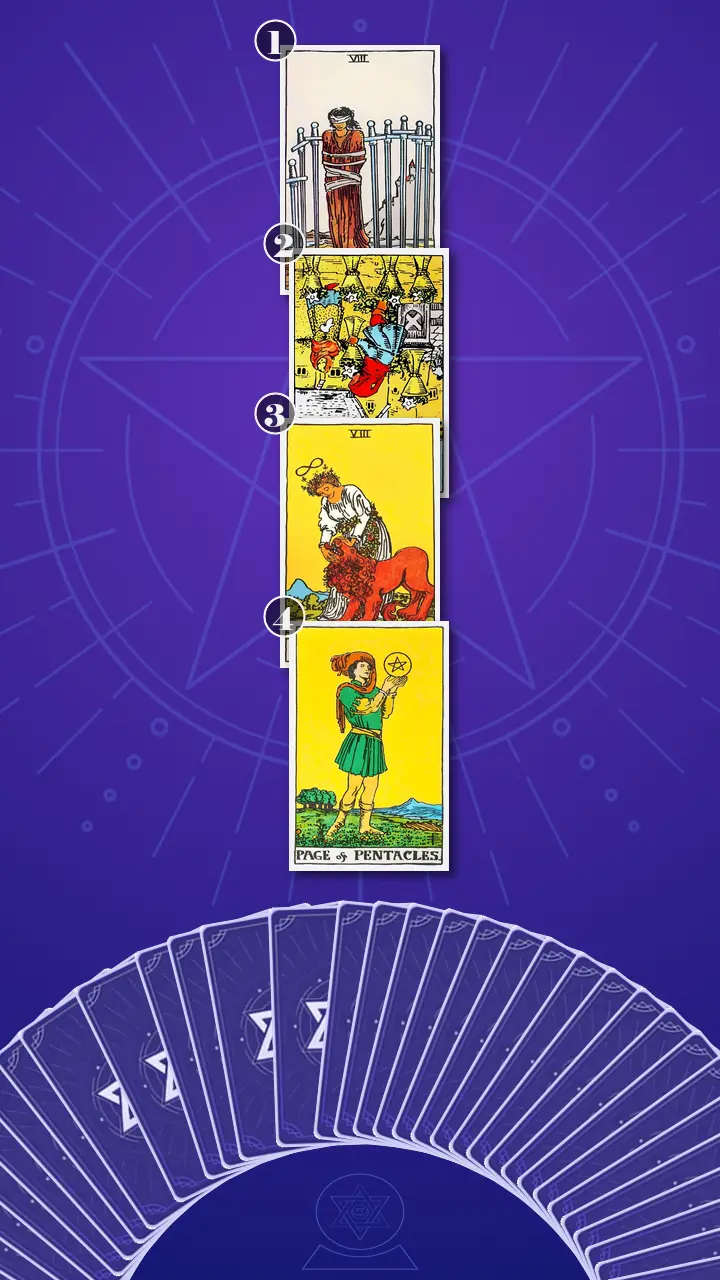
For her question, I chose The Shadow Spread. When people ask me how tarot works in a real-life decision or emotional pattern, this is one of the cleanest examples. A crowded library freeze is not a ten-variable forecasting problem. It is a symptom-to-root pattern. The Shadow Spread uses only four cards, which made it a precise fit for library anxiety, child-state activation, and study paralysis in public. It traces the chain without clutter: what happens, what older script gets activated, what energy interrupts it, and what grounded next step makes the insight usable.
I told her what I tell readers whenever I use this spread: the first card shows the visible coping pattern in the present. The second reveals the older emotional script beneath it. The third is the integrating force — the antidote, the part of you that can bring choice back online. And the fourth turns insight into a low-pressure ritual you can actually try this week, because a reading only matters if it changes what happens next time you sit down.
Reading the Map of Public Study Paralysis
The Silent Audience: Position 1
I turned over the first card. "This is the position that presents the visible freeze response on the busy library floor — the self-monitoring, the delayed start, the body going still before the work begins."
It was the Eight of Swords, upright.
I let Maya look at it for a moment before I spoke. "This is exactly the card I would expect for someone who sits down in a crowded library and feels the room turn from helpful background energy into a silent audience. You adjust the pencil case, the water bottle, your posture, the browser tabs. Not because those things are the task, but because any visible hesitation feels risky — like one awkward first move could trap you in embarrassment for the rest of the session."
In tarot terms, this was constricted Air: thought turned inward until it became a cage. In everyday language, it was like her laptop using all its battery on background surveillance instead of the document she had actually opened. The blindfold on the card matched the way her field of choice narrowed. The loose bindings mattered, too. They told me the body felt trapped before the adult mind remembered it still had options.
"Your body isn't being dramatic," I said. "It's running an old safety drill."
Then I asked the question this position always asks: "In those first two minutes on the library floor, what choice still exists, even if it's tiny?"
Maya gave a short, almost bitter laugh. "Wow. That's accurate enough to be rude." She pressed her thumb into the side of her water bottle, then released it. "It's like: don't look weird, just start, wait — not like that."
I nodded. "Exactly. The freeze isn't empty. It's full of self-instructions. And the more visible the room feels, the more your attention leaves the assignment and goes toward managing how exposed you seem."
The Room That Felt Older Than It Was: Position 2
I turned the second card. "Now we're looking at what older, home-linked emotional script the library is activating beneath the surface reaction."
The card was the Six of Cups, reversed.
"This is where the reading gets very specific," I told her. "Because this isn't saying the library is dangerous. It's saying the room feels older than it is. Your adult study plan walks in, but some younger, careful part of your body gets there first. The room becomes emotionally enclosed. Not objectively — emotionally. Like an old operating system auto-boots because the environment hit the exact cue that used to mean, be careful, be quiet, don't do it wrong where people can see."
The child imagery in the card mattered here, as did the enclosed courtyard. Reversed, the card showed Water pulling backward — feeling-memory dragging the present out of alignment. I didn't need to invent a backstory to recognize the pattern. I only had to follow the sequence she had already described: a chair scrapes, backpacks land beside her, someone else looks settled, and suddenly her body gets younger before her mind catches up.
"Public focus can feel unsafe without meaning you're bad at being an adult," I said. "What if 'I need to feel perfectly settled first' is not a truth, but an old safety rule wearing a very reasonable outfit?"
Maya went still in a different way this time. First her breath paused. Then her eyes lost focus for a second, as if she were replaying a memory she couldn't quite title. Then her hand, which had been tucked tight against her sleeve, slowly opened on her lap.
"That is so annoying," she said softly. "Because that's exactly it. Nothing happens, but my body is already like, be small, be quiet, wait."
"Right," I said. "And that matters because it means the problem isn't that you don't know how to study. It's that a quiet public space can make your body act like it's being evaluated before you've even started."
When Strength Put a Hand on the Lion
The Antidote of Adult Self-Leadership: Position 3
By the time I reached the third card, the room itself seemed to cooperate with the reading. Rain tapped once against the window. Somewhere in the hall a chair leg dragged and stopped. The air went quiet in the way it does right before something lands.
"This," I said, turning the card, "is the position that shows the inner quality that can interrupt regression, regulate the trigger, and restore adult agency in the moment."
It was Strength, upright.
"The goal is not to feel invisible enough to start," I told her. "It's to feel accompanied enough to start."
Strength is balanced Fire. Not force. Not hype. Not push through it. It is calm courage, self-trust, and the ability to stay with intense sensation without letting it drive the car. The card's image — the gentle hand on the lion — mapped perfectly onto her life. Jaw softens. Feet press into the floor. Breath returns. The win is not becoming fearless. The win is staying in relationship with yourself until choice comes back online.
This was the moment I brought in one of my own diagnostic tools, something I call the Potential Mapping System. I built it years ago because on trading floors, in boardrooms, and now in readings, I kept seeing the same mistake: people confuse misdirected energy with lack of ability. In that system, I look for whether someone learns and acts more like a Sprinter or a Deep Thinker. Maya read immediately as a Deep Thinker — sensitive, precise, capable of sustained focus when she feels safe. Under exposure, though, that same intelligence gets hijacked into surveillance. Same battery, different use of power. The attention that could enter the article gets spent reading the room.
For a second I flashed back to my old Wall Street life: brilliant junior analysts staring at a screen, mouse in hand, hesitating half a second too long because being visibly uncertain in a crowded room felt socially expensive. Different setting, same mechanism. Restriction is not always weakness. Often, it's strength trapped inside defense.
I looked back at Maya. "You know that moment when you've made it all the way to the library, set everything out perfectly, and your body still will not let the first sentence happen? That is the moment this card wants to reinterpret."
You do not have to become smaller or tougher to survive this room; place a steady hand on the lion, let your body know it is here and now, and begin from there.
She didn't relax immediately. First came the freeze: her fingers hovered over the edge of her notebook and stopped. Then came the cognitive hit: her gaze drifted past me toward the rain-dark glass, as though the sentence had opened a file she had been avoiding. Then came the reaction I hadn't been waiting for but recognized the second it surfaced.
"But doesn't that mean," she said, and there was real resistance in it now, "that I've been trying to win the room this whole time?"
"Yes," I said gently. "And it also means you've been trying to survive it with the tools you had. Those are not the same thing as failure."
Her throat moved. One shoulder dropped before the other. She pulled in a breath that sounded snagged at first, then let it out longer. The color around her eyes changed — not tears exactly, but that slight reddening that appears when someone's body stops holding the entire structure up by force.
"I don't need to win this room," she said, almost to herself. "I just need to stay with myself in it."
"Exactly." I gave her a beat, then asked, "Now, with that new lens, think back to last week. Was there a moment when this would have changed how the room felt?"
She nodded slowly. "Yeah. On Tuesday. I kept pretending I was getting settled, but really I was trying to look unbothered. If I'd just admitted I was activated and done something small, I probably could have started."
That was the breakthrough. Not perfect confidence. Not a personality transplant. A shift from feeling watched, childlike, and frozen on a busy library floor to feeling grounded, adult, and able to begin one small task in public. From child-state activation to adult presence. From treating being perceived as danger to treating it as discomfort she could ground through while staying in choice.
The One-Pentacle Start: Position 4
I turned the final card. "This last position turns the insight into a practical, low-pressure library ritual you can try this week."
It was the Page of Pentacles, upright.
I smiled a little when I saw it. "Good. This is exactly where I wanted the reading to land. The Page of Pentacles is beginner-minded focus. One article. One page. One timer. One small target. Not because you're incapable of more, but because the task needs a doorway. This card is the opposite of making the whole session a big public performance test."
The energy here was Earth — grounded, contained, repeatable. After the blindfold of the Eight and the old emotional echo of the reversed Six, the Page brought the gaze back to one pentacle held at eye level. In modern life, that means one document in full-screen mode and every other tab closed. Very Duolingo-streak energy for grad school: low ego, small reps, built by repetition.
"One real step beats twenty minutes of looking ready," I said.
Maya actually smiled at that. Not a huge breakthrough smile. More like the kind people make when something finally sounds doable. She tapped the table once with a finger, looked down at the card again, and said, "That I can picture."
From Old Alarm to One-Pentacle Start
When I pulled the whole reading together for her, the story became simple in the best possible way. She goes to the library for structure and borrowed momentum. But the busy room activates a much older rule: if I am seen hesitating, I am not safe. So her attention abandons the task and gets redirected into looking calm, small, and prepared. The blind spot is not a lack of discipline. It is the belief that perfect safety must arrive before beginning is allowed.
If I were writing this as a SWOT note, I would put it like this: the threat is not the library itself but the misread signal that visibility equals danger. The strength is still there. The opportunity is reclaiming that strength as self-leadership instead of self-surveillance. And the shift — the one this entire Shadow Spread tarot reading pointed toward — is to stop treating discomfort as proof and start treating it as a cue for grounding.
I gave Maya a version of my 5-Minute Decision Tool, which I normally use to help clients move from insight to action without overcomplicating it. We kept it to three axes: Advantage — more adult presence in the room; Risk — the old alarm may still spike; Breakthrough — you begin anyway, in a contained way. Then I translated that into three actions she could use on her next library visit.
- Adult-in-the-Room ResetBefore opening the real task, place both feet flat on the library floor, press your toes into your shoes for one full exhale, unclench your jaw, lower your shoulders, and silently name four present-tense facts: "Library. Afternoon. Adult body. I can choose my next step." Do it privately at your desk before you read the first line.If your brain says this is dramatic or pointless, let it complain. The goal is not to feel amazing — only 5% more here.
- The One-Pentacle StartSet a 5-minute timer on your phone labeled "one page only" or "first paragraph only," and keep just one document, one article, or one notebook open for that first block. Count the session as a win if you make real contact with the work, even if all you do is annotate one section or write one rough sentence.If five minutes feels too big, make it two. The practice is startable, not heroic.
- The 10% Calmer Seat RuleWhen the child-at-home feeling hits, write "Old alarm, current room" at the top of the page or in your phone, and give yourself one allowed reseat in the first 10 minutes. Choose a spot with a wall behind you, less foot traffic, or more distance from the main aisle — then stop optimizing.A calmer seat is support, not cheating. Choose calibration, not punishment.

A Week Later: The Quiet Proof
A week later, Maya sent me a message from campus. Not a dramatic testimony. Just this: "Did the old alarm/current room check-in, moved once, put one article in full screen, and actually started before I could spiral. It wasn't pretty, but it happened."
That was enough. In my work, I trust micro-proof more than grand declarations. She didn't solve her whole nervous system in one study block. She rebuilt a thread of self-trust exactly where it had been fraying.
She told me later that she slept properly after that session, though the next morning her first thought was still, What if I freeze again? This time, she smiled, packed one pen, and went anyway.
That's what a real Journey to Clarity often looks like. Not certainty. Ownership. The Shadow Spread tarot reading for library freeze, child-state activation, and study paralysis in public did not make her invulnerable. It returned choice to the moment she used to lose it.
Sometimes the hardest part isn't the assignment at all, but the split second a quiet room makes your throat close up and some older part of you decides being noticeable means being unsafe. If that moment lives in you too, simply recognizing it may already be the first break in the loop.
So the next time a busy room starts to feel like an audience, if being seen there didn't have to equal danger, what would your one-pentacle first move be?
This story is adapted from psychological research, written so that those in a similar struggle can see their own pattern in it — and find their next step clearly.These insights are not a substitute for professional psychological, medical, legal, or financial advice.
Learn more about our Journey to Clarity.
How did this insight land for you?
🫂 This Resonates Deeply
🌀 Living This Story
✨ Now I See Clearly
🌱 Seeing New Possibilities
🧰 Useful Framework
🔮 The Confirmation I Needed
💪 Feeling Empowered
🚀 Ready for My Next Step
Author Profile
 AI
AI“I spent years in the intense, high-stakes world of Wall Street. I know exactly how isolating and heavy the weight of uncertainty can feel in the dead of night. I use strategic, commercial logic not to be cold, but to protect you from unnecessary friction. Think of me as a fellow traveler who has walked the same rocky path—offering sharp but deeply supportive wisdom to help you clear the fog and confidently win your narrative back.”
In this Study Tarot Reading :
Core Expertise
- Academic ROI Auditing: Objectively evaluating the strategic yield of a specific degree, major pivot, or high-investment research direction.
- Institutional Resource Leverage: Treating mentor relationships and university networks as strategic assets requiring proactive upward management.
Service Features
- The Research Sunk-Cost Audit: A rigorous decision framework to calculate whether to strategically pivot or persevere in a stalled academic project.
Also specializes in :
Explore Related Patterns:
Freeze ResponseMaya's shoulders rise almost to her ears on the fourth floor, her breath gets held, and the first PDF feels too loud before she has even started. The freeze is not empty space; the story shows it packed with self-instructions, desk adjustments, and scanning for how exposed she seems. That points to a body-level defensive shutdown: the room is read as evaluation, so movement becomes risk. You can understand the pattern as Freeze Response because the nervous system pauses action to prevent a socially dangerous first move, even while the adult mind knows the library itself is not the threat.
Spotlight EffectMaya walks into the busy floor wanting momentum, then experiences the room as witnesses. Other students are simply typing, settling in, and looking focused, but her attention treats their presence as if it is pointed toward her first move. That is the Spotlight Effect operating as a cognitive filter. You can see the bias in how neutral public cues become imagined scrutiny, pulling attention away from the assignment and toward how visible, awkward, or unprepared she might appear.
Visibility Shame LoopMaya keeps trying to look calm, small, and prepared because visible hesitation feels risky. The story names the loop directly: twenty minutes of looking ready can replace one real step, and the silent crowd gets treated as if it has authority over whether beginning is allowed. Visibility Shame Loop fits because the discomfort is not only about being seen; it is about being seen while imperfect, uncertain, or slow. You can feel how shame turns visibility into danger, then uses delay and impression management to avoid the exposure that would actually break the cycle.
Emotional RegressionThe moment Maya says the room feels older than it is, the library stops being just a study setting and becomes a cue for an earlier safety rule. Chair scrapes, backpacks, and settled-looking peers make her body go into 'be small, be quiet, wait' before her adult study plan can take the lead. That is why Emotional Regression fits without inventing any backstory. The present scene activates a younger state of caution, so You are not only dealing with a crowded floor; You are dealing with a time-shift in the body where current visibility gets processed through an older script.
Social MaskingMaya looks composed while her throat holds breath and her body fills with static. Later she recognizes that she was pretending to get settled when she was really trying to look unbothered. That is Social Masking as a coping strategy, not a character flaw. You can see the effort spent maintaining an acceptable surface while the real task waits, because looking fine becomes a way to manage imagined evaluation in the room.
Perfectionism-Driven AvoidanceMaya adjusts the pencil case, water bottle, posture, and browser tabs before touching the work, not because those details are the assignment but because the first visible move feels like it has to be correct. The line 'I need to feel perfectly settled first' functions like a safety rule dressed up as organization. Perfectionism-Driven Avoidance fits because the avoidance is not random procrastination. You can see a defense mechanism where the mind demands perfect internal readiness before action, then uses setup rituals to postpone the imperfect first sentence.
Secure VisibilityMaya's key sentence is not that she becomes fearless; it is that she does not need to win the room and only needs to stay with herself in it. The story moves from treating being perceived as danger to treating it as discomfort she can ground through while beginning one small task. Secure Visibility fits because the repair happens inside the public setting, not by escaping it completely. You can see a new relational boundary forming: other people may be present, focused, or typing nearby, but their presence no longer gets to decide whether You are allowed to start.
Self-SoothingMaya's shift begins with concrete body cues: feet on the floor, jaw unclenched, shoulders lowered, present-tense facts named quietly at the desk. A week later, she uses the old alarm/current room check-in, moves once, opens one article in full screen, and starts before the spiral takes over. Self-Soothing fits because the intervention does not demand confidence or invisibility. It gives You a way to stay with the activated body long enough for choice to come back online, turning the freeze into a cue for regulation rather than a verdict on ability.
Explore Related Struggles:
Visibility-Safety SplitMaya steps onto the fourth floor because she wants the room's momentum, but the moment the floor is full, that momentum turns into witnesses. The library is not just a place to work anymore; it becomes a field where every first move feels visible before the work has even begun. That is the core of Visibility-Safety Split. You are not simply avoiding the assignment. Your system is treating visibility as a safety event, so the act of beginning in public becomes loaded with the risk of being seen hesitating, fumbling, or not already looking composed. The struggle lives in the split between the adult part that knows a library is a normal study space and the body that reads being perceived as danger. Clarity starts when you can name that the room is not asking you to disappear; it is asking you to begin while being visible, one contained step at a time.
Vigilance-Execution SplitMaya sets out the laptop, highlighters, water bottle, tabs, and posture with the precision of someone who knows how to prepare. Yet the more crowded the floor feels, the more her attention leaves the document and starts managing the optics of her own presence. Vigilance-Execution Split names the moment when the mental battery needed for the article gets spent on room-scanning instead. You can be capable of sustained focus and still lose access to that focus when the environment pulls your attention into surveillance, self-editing, and making sure you do not look affected. The stuck point is not a lack of ability. It is a rerouting of ability. The same intelligence that could annotate the first page is being used to monitor chairs scraping, keyboards clicking, settled peers, posture, breath, and whether you look unbothered enough to be allowed to start.
Inherited Vigilance LoadThe library scene gets strange because the room feels older than it is. Maya knows she is a master's student in a campus library, yet a chair scrape, a full floor, and the sight of everyone already settled make her body move as if an older home rule has entered the room first. Inherited Vigilance Load is the burden of carrying a learned watchfulness into present-day spaces where it no longer fits cleanly. You may not need to invent a dramatic explanation for the reaction; the story already shows the chain: public quiet, visible hesitation, the instruction to be small, be careful, wait, do not do it wrong where people can see. The struggle is that the current room has to compete with an older map. Adult choice is still available, but it arrives after the body has already started obeying the old cue. Naming the cue gives you a way to return to the present without blaming yourself for the speed of the reaction.
Perfect Readiness TrapMaya can make the desk look ready long before her body lets the work begin. The bag is neat, the materials are out, the tabs are adjusted, and the outside picture says organized student, while the first real contact with the assignment keeps getting delayed. Perfect Readiness Trap forms when readiness becomes a gate you must pass before action is allowed. You keep trying to create the exact conditions that would make starting feel safe enough, but the act of preparing begins to replace the act of beginning. The library scene shows how reasonable this can look from the outside. You are not doing nothing; you are setting up, calibrating, reseating, composing yourself, and waiting for the internal green light. The shift comes from letting one small imperfect action count before the whole room feels settled.
Explore Related Emotions:
Adult Child PanicMaya describes the library as ordinary, but her body does not respond to it as ordinary. A chair scrapes, backpacks land, other students already look settled, and suddenly the adult study plan is interrupted by the command to be small, be quiet, and wait. Adult Child Panic names that split between the present room and the younger state that arrives first. The story does not need to prove a detailed backstory for this feeling to be visible; it shows the timing clearly. The body reacts before the adult mind can remind itself that this is a campus library, not a place where one wrong move has to be hidden. You are not just seeing nervousness about studying in public. You are seeing a younger safety rule become active inside an adult context, shrinking the sense of permission to move, choose, and begin.
Grounded AgencyMaya's shift begins through very small physical choices: feet on the floor, jaw unclenched, shoulders lowered, one document open, one allowed reseat, one article in full screen. These actions do not erase the spike, but they return her attention to something she can actually choose. Grounded Agency is the clearest name for that return of choice. It appears when she stops trying to defeat the room and starts orienting herself inside it, using the body as an anchor rather than treating the body as the problem. You can see the proof a week later. The room is still imperfect, the old alarm still exists, but she starts before spiraling. The emotional center has moved from being watched by the room to acting from inside her own body.
Performance FreezeMaya steps onto the fourth floor with a clear study intention, lays out her laptop, highlighters, and water bottle, then hears the keyboard clicks and feels her shoulders climb toward her ears. The scene shows a body that has arrived for work but is suddenly using its energy to hold still, monitor itself, and avoid making the first visible move. That is why Performance Freeze fits the story so directly. The freeze is not empty; it is packed with instructions about how to sit, when to open the PDF, whether the tabs look right, and how not to appear awkward in front of a room that suddenly feels like an audience. You are watching the task become secondary to the fear of being visibly in process. The inner weather is a public-start lockup: the work is available, the tools are out, and choice technically exists, but the body treats beginning as the riskiest part of the room.
Social Exposure DreadThe line that gives this emotion its shape is Maya saying the busy library feels like walking into witnesses. She is not simply overwhelmed by a crowd; she is entering a room where other people's focus makes her own hesitation feel exposed. Social Exposure Dread sits in the gap between wanting borrowed momentum and feeling watched by it. The same full floor that should help her focus becomes a social field where the first awkward movement seems like it could define the whole session. You can feel how quickly the assignment loses center stage. Her attention leaves the article and starts managing visibility, posture, timing, and the risk of being seen not yet ready.
Regulated CourageThe reading does not ask Maya to become fearless or invisible. It asks her to place a steady hand on the part of her that reacts, stay with the sensation, and begin from there. Regulated Courage fits because the bravery here is not dramatic. It is the capacity to remain in a busy room while the body spikes, to lower the shoulders, feel the floor, and take one contained step without demanding total ease first. You are seeing courage translated into regulation rather than force. The room can still feel intense, but it no longer has to decide whether she gets to begin.
Hypervigilant AnxietyOnce Maya sits down, her attention does not move cleanly into the article. It starts reading the room: who looks settled, what her posture communicates, whether her hesitation is noticeable, and how to avoid seeming bothered. Hypervigilant Anxiety fits because her focus is not absent; it is over-deployed in the wrong direction. The mental battery that could enter the document is spent scanning the social field for possible judgment. You can feel the cost of that surveillance. It makes the room look more dangerous than it is, and it makes the first academic step feel like a public test rather than a private beginning.
Cautious Self-TrustAfter the session, Maya does not become certain that freezing will never happen again. Her first thought the next morning is still, what if I freeze again, and she goes anyway with one pen and a smaller plan. Cautious Self-Trust captures the fragile but real confidence being rebuilt through micro-proof. It is not a sweeping transformation; it is the experience of discovering that she can return to the same kind of room and still make one grounded move. You can feel why this matters. Trust is no longer based on never freezing; it is based on knowing she has a way to meet the freeze without abandoning herself.
Micro-Performance ShameMaya keeps adjusting the pencil case, water bottle, posture, and browser tabs, not because those objects matter, but because every tiny action has started to feel visible. Even opening the first PDF carries the weight of looking wrong in a room full of people who seem already locked in. Micro-Performance Shame captures the embarrassment attached to small, ordinary moves. It is not a grand fear of public failure; it is the burn of being seen taking too long, starting clumsily, or needing a second to orient yourself. You can see why pretending to get settled becomes so tempting. It gives the appearance of control while protecting the more vulnerable truth: the first imperfect move feels emotionally louder than the work itself.
Performative CalmMaya arrives with the markers of being fine: the neat tote bag, the careful tone, the organized setup. At the same time, her breath is held, her shoulders are high, and she later recognizes that getting settled was partly an attempt to look unbothered. Performative Calm names the emotional labor of appearing composed while the body is bracing. The calm is not fake in a moral sense; it is a public-facing cover that helps her avoid being visibly activated. You can see how exhausting that cover becomes. The energy that could support focus is diverted into maintaining an image of readiness, even before any real studying has begun.
Inner StaticMaya's description is intensely physical: dry air, warm phone, raised shoulders, held breath, and grey static filling the body. The room is quiet enough for studying, yet inside her, the signal is crowded and noisy. Inner Static names the way her attention becomes grainy before she can make contact with the task. The body is not simply refusing to work; it is flooded with background monitoring, leaving the PDF, the article, and the next sentence strangely hard to reach. You are looking at a moment where the external room is organized, but the internal channel is full of interference. The work has not disappeared, but the path to it is jammed by bodily noise.
Explore Related Contexts:
Academic Performance PersonaMaya looks composed when she describes the freeze: neat tote bag, careful tone, and the kind of presentation that often gets read as organized. On the library floor, that same composed student role becomes another assignment, because the desk setup, posture, browser tabs, and water bottle all become part of looking ready. The pressure is not simply to study; it is to appear like someone who studies effortlessly in public. You can see the external academic code at work here: the room rewards the image of being locked in, so visible uncertainty starts to feel like a failure of the role before any real work has happened. Academic Performance Persona names that extra burden. The freeze is tied to the demand to perform competence, not just produce it, and the cost is that energy meant for the article gets rerouted into maintaining the appearance of calm readiness.
Academic Spotlight MomentAt 2:41 on the fourth floor, Maya has the ordinary study setup in place: laptop out, highlighters ready, water bottle beside her, and a desk already claimed. The problem starts when the full floor, the keyboard clicks, and the sight of everyone else already locked in turn that study space into something that feels like witnesses. The external structure is a public academic room where the first visible move starts to feel socially exposed. You are not just opening a PDF; you are opening it while imagining that hesitation, awkwardness, or a slow start can be seen and judged by the room. That is why Academic Spotlight Moment fits the story. The library becomes a stage before it becomes a workspace, and the freeze protects against being visibly uncertain in a setting that seems to reward seamless competence.
Unscaffolded Learning EnvironmentMaya can get to the campus library, claim a desk, open her laptop, and bring every visible study resource with her, yet the first PDF still feels too loud to enter. The environment has materials, seating, and shared academic momentum, but it does not automatically provide a usable doorway into the task. That gap is the structure of an Unscaffolded Learning Environment. The room offers resources at the surface level while leaving the transition into action unsupported, especially when the space is crowded and socially visible. You can see why the later interventions are so concrete: one page, one timer, one document, one allowed reseat. Those are not productivity hacks for their own sake; they supply the missing scaffold between arriving at the work and actually beginning it.