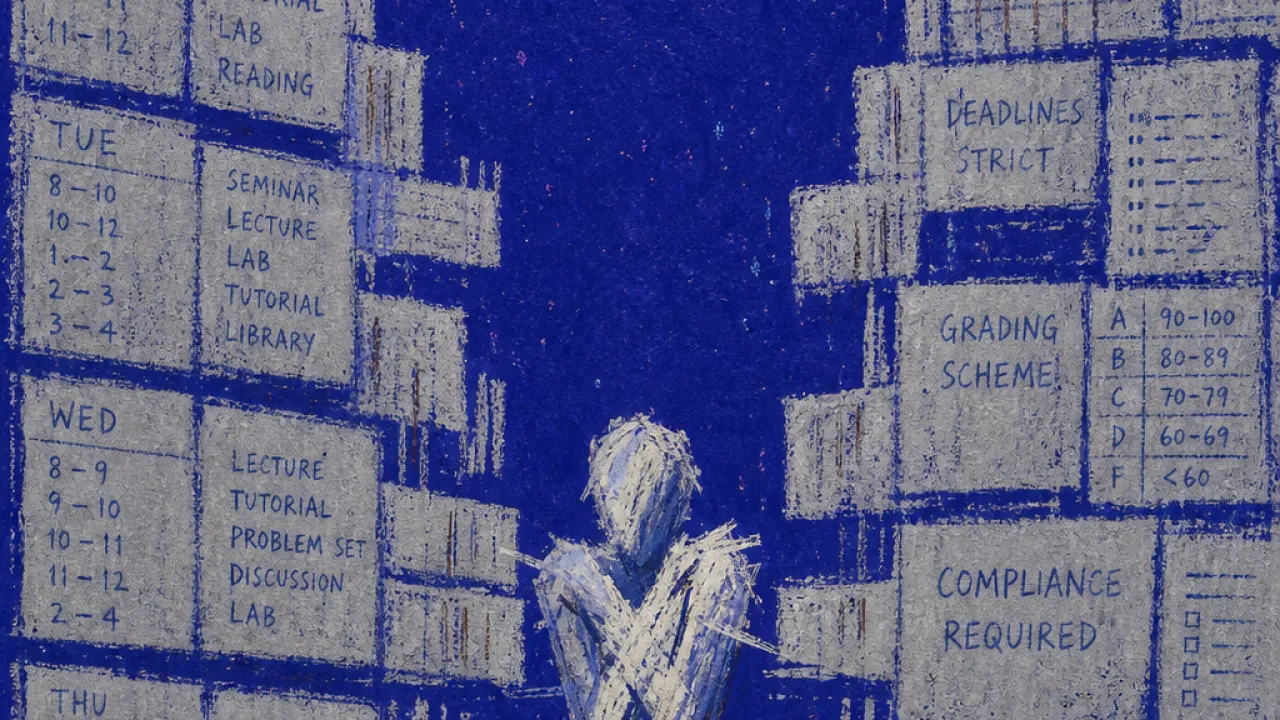
Rigid Curriculum Lock-In shows up in the body as the tightness of trying to move while every route is routed back through prerequisites, required modules, and approval gates. That pressure is environmental, structural, and dynamic: the curriculum is not just a list of classes, but a built pathway that decides which changes are easy and which ones carry delay, cost, or permission. The cards below do not tell you whether to stay, switch, or push through; they reflect the shape of the constraint. Here are the Tarot Cards that tend to mirror this kind of academic lock-in.
The Emperor ReversedThe square stone throne, hard backrest, and mountain ridge behind The Emperor create a world of fixed lines and durable hierarchy. Nothing in the image suggests improvisation; the body is supported by a structure that also restricts movement. In academic planning, that becomes a degree path shaped by prerequisites, required modules, cohort timelines, and departmental rules that make changing direction costly. You are not simply being indecisive; you are negotiating with a built environment that rewards staying in sequence, and clarity begins by separating real constraints from inherited expectations.
The Hierophant ReversedThe repeated threes, crosses, checkerboard bands, throne, steps, and ritual hand sign make the Hierophant's world highly ordered. The scene does not present open exploration; it presents an established route, a sanctioned posture, and a clear script for how learning is supposed to unfold. In personal growth, that order becomes restrictive when a method, course, challenge, or framework continues to define progress after it has stopped matching your real developmental edge. You may be moving through the approved sequence while your actual life is asking for a different kind of experiment. The card exposes how structure can become a lock without becoming useless. It asks the system-level question: is this curriculum still scaffolding growth, or has it become a ritual you complete to avoid the uncertainty of building your own path?
The Chariot ReversedThe cube-like chariot, armor, canopy, river, moat, and city walls create a layered architecture of protection and constraint. The driver appears ready to move, but the scene is full of formal boundaries that decide where movement is permitted. In academic life, this becomes the degree plan that only allows one sequence, the major requirement that blocks exploration, or the departmental rule that keeps a student moving through a route that no longer fits their learning needs. The structure may be legitimate, but it can still narrow the field of possible motion. The reversed Chariot connects this context to blocked agency. You are not simply hesitating at the wheel; the academic vehicle is built inside a system of gates, prerequisites, and authorized paths that shape what steering can realistically do.
Wheel of Fortune ReversedThe main road in the image is not a road at all; it is a closed circular track. The spokes are precise, the rim is marked, and the motion is measurable, but the path still keeps returning to the same points. A rigid curriculum lock-in works the same way. You may be completing modules, prerequisites, credits, or required sequences, yet the structure can keep You inside a program logic that no longer fits the direction of your learning, making progress visible without making freedom of movement available.
Justice ReversedThe stone chair, straight sword, and high pillars make Justice feel less like a person in motion and more like a fixed institutional structure. The body is centered, but the architecture around it is heavy, vertical, and difficult to bend. Within academic planning, that rigidity becomes prerequisite chains, major requirements, course sequencing, credit limits, and transfer rules that narrow the student's options. The problem is not a lack of curiosity; it is a curriculum path that has turned previous choices into gates, costs, and timing constraints. Reversed Justice makes the lock-in visible as a structure rather than a personal mistake. When the route is seen as built from rules, sequence, and institutional timing, the question shifts from blaming the past to locating the real points where flexibility still exists.
Death ReversedBlack armor, iron hooves, and the raised standard make the card's foreground feel like a hard procedural gate. The surrounding figures are not simply reacting to change; their physical positions are compressed around a single force that defines where movement is allowed. In study life, this resembles a curriculum that has become too rigid for the student's actual learning process. Prerequisite chains, mandatory modules, fixed assessment formats, lab sequences, cohort pacing, or degree rules can turn academic progress into a narrow corridor with little room for repair. The card links to this context because the obstacle is not laziness or vague confusion. It is a mismatch between a hard external structure and the body's need for a workable learning route, and clarity begins by locating exactly which rule, sequence, or format is locking the system.
The Devil ReversedNo road opens behind the figures, and no horizon competes with the black block. The only visible route is the chain path that begins and ends at the same central structure, allowing movement without real transition. In a degree path, that becomes the curriculum sequence that still holds you even when your learning fit has changed. You may be capable, standing, and aware, while credits, prerequisites, transfer rules, and approval systems keep routing every option back through the same locked structure.
The Tower ReversedThe tower stands isolated on a high place, sealed by stone, with no visible door or navigable path out. Once pressure arrives, the only movement shown is drastic because the structure has not allowed gradual adjustment. A rigid curriculum can work the same way. Requirements, prerequisites, major sequences, and cohort timelines may keep you inside a program shape even after the evidence shows misalignment, overload, or a need for a different route. The card does not reduce the problem to indecision. It shows a structure that has become too narrow for recalibration, which makes the real task more precise: identify whether the lock-in comes from rules, sunk coursework, approval gates, timing, or the image of staying on the approved academic path.
The World ReversedThe wreath surrounds the central figure as a complete frame, but there is no road, floor, doorway, or horizon leading out of it. The composition is elegant and ordered, yet the same order can become a sealed track when the next route is not visible. In academic life, that looks like being caught inside a major, required sequence, prerequisite chain, or degree plan that once looked coherent but now limits movement. The structure is not just dislike of a class; it is an institutional path dependency where changing direction carries real cost, delay, and identity pressure.
Eight of Cups ReversedThe cup stack forms a neat wall at the edge of dark water. Its order is real, but the fixed arrangement also makes the gap more pronounced, as if the structure can display progress without offering a flexible route through it. In academic life, this connects to a curriculum that keeps you moving through prerequisites, required classes, grading sequences, or program rules even when the track no longer fits the work you need to do. The lock-in is external: the institution has a map, but the map may not contain the missing cup. The marsh and moonlit terrain show why the next option feels hard to access. You are not only choosing between classes; you are negotiating a structure where credits, timelines, and approval gates can make academic movement feel narrower than your actual learning direction.
Four of Pentacles ReversedThe square seat, fixed limbs, and non-intersecting pentacle pattern create a layout where stability depends on staying exactly where the structure has placed the body. The image is orderly, but its order leaves almost no room for adjustment. In an academic path, that can become the module plan, major, thesis direction, prerequisite chain, or graduate route that was originally chosen for safety and legibility. The structure may still look respectable from the outside, while internally it restricts the student’s ability to follow evidence, curiosity, capacity, or a changed professional aim. You can use this card as a map of constraint rather than a verdict. It reveals where an approved academic route has become too expensive to maintain unchanged, and where the real question is not whether the path is legitimate, but whether it still allows learning to move.
Knight of Pentacles ReversedReins, armor, saddle, and furrowed land turn the scene into a grid of controlled movement. When that structure hardens, the horse can only stand inside the track that has already been laid out. In study settings, this points to syllabi, assessment formats, prerequisite chains, or departmental rules that force your learning into a pace or method that no longer fits the task. The issue is not simple resistance; it is a learning system where the official route may be blocking the kind of understanding the work actually requires.
King of Pentacles ReversedThe wall behind the throne closes the horizon into a managed estate, while the bull-headed black marble seat gives order a heavy, immovable form. In academic life, that visual rigidity maps onto degree maps, prerequisites, mandatory modules, and program rules that determine where movement is allowed. You may still be working hard inside the system, but the card points to the architecture shaping your options. The pressure is not only about motivation; it is about whether the learning path has enough flexibility to match the way your work is actually developing.
King of Swords ReversedThe King holds one clean sword line while the body stays fixed to the throne. Distant growth exists in the landscape, but no visible road connects the rigid seat of judgment to the wider field. That is the academic texture of a locked curriculum: prerequisites, program rules, exam formats or required modules create a narrow route that may be legible but not adaptive. Learning becomes organized around compliance with the path rather than movement toward the most alive intellectual direction. The card does not dismiss structure; it shows when structure has become too narrow for the work it claims to support. You can see which rule is providing necessary form and which rule is now freezing your academic development in place.
No cards available for this filter.