Finding Clarity in the Transcript Tab at 8:47 p.m.
If opening your college transcript still makes you feel like you owe the world a ‘responsible outcome,’ even at 26 in Toronto, you’re not alone.
Alex said that sentence back to me like she was checking whether it was allowed to be true. We were meeting on a rainy Tuesday evening—her camera angled at a Toronto rental kitchen counter, my own desk lamp pooling warm light over a well-worn Rider–Waite deck and a stack of student papers I never quite stop grading out of habit.
“It was literally 8:47,” she told me, rubbing her thumb along the edge of her laptop as if it could sand down the feeling. “Overhead light buzzing. Dark window. I opened my transcript just to check something—and then I saw the GPA line and it was like… a scoreboard. My jaw locked. And suddenly I’m applying for coordinator roles again.”
The way she said again had weight in it—like a drawer she keeps finding herself back in, even after she swears she’s moved on.
Alex worked as an early-career corporate coordinator and was “exploring next steps,” which sounded neat and reasonable until she described what it looked like in real life: LinkedIn filters set to “Analyst” and “Coordinator,” recognizable companies, clear ladders, benefits. Ten postings saved. One resume bullet rewritten for an hour. The tab with the role she actually liked left unopened, like contraband.
“I don’t even like these jobs,” she said, then laughed once—small and sharp. “I just like that they make sense on paper.”
I watched her shoulders brace when she said paper, as if the transcript itself were a hand on the back of her neck. Her anxiety wasn’t abstract; it was physical. A tight chest. A held breath. A jaw that seemed to be trying to bite the uncertainty into a shape she could defend.
“It sounds,” I said gently, “like your transcript becomes a kind of courtroom exhibit. Not just evidence of what you did—but a verdict you’re scared you’ll fail to live up to. Let’s try something different tonight. Let’s give the fog a map. Not a prophecy. A map.”

Choosing the Compass: The Horseshoe Spread for Career Decision Paralysis
I asked Alex to take one breath that was purely functional—not spiritual, not performative. Just a nervous system gear shift. In through the nose, longer out through the mouth. Then I shuffled slowly, the way I used to handle fragile pottery fragments at a dig: steady hands, no drama, attention as a form of care.
“For this,” I told her, “I want to use a Horseshoe spread.”
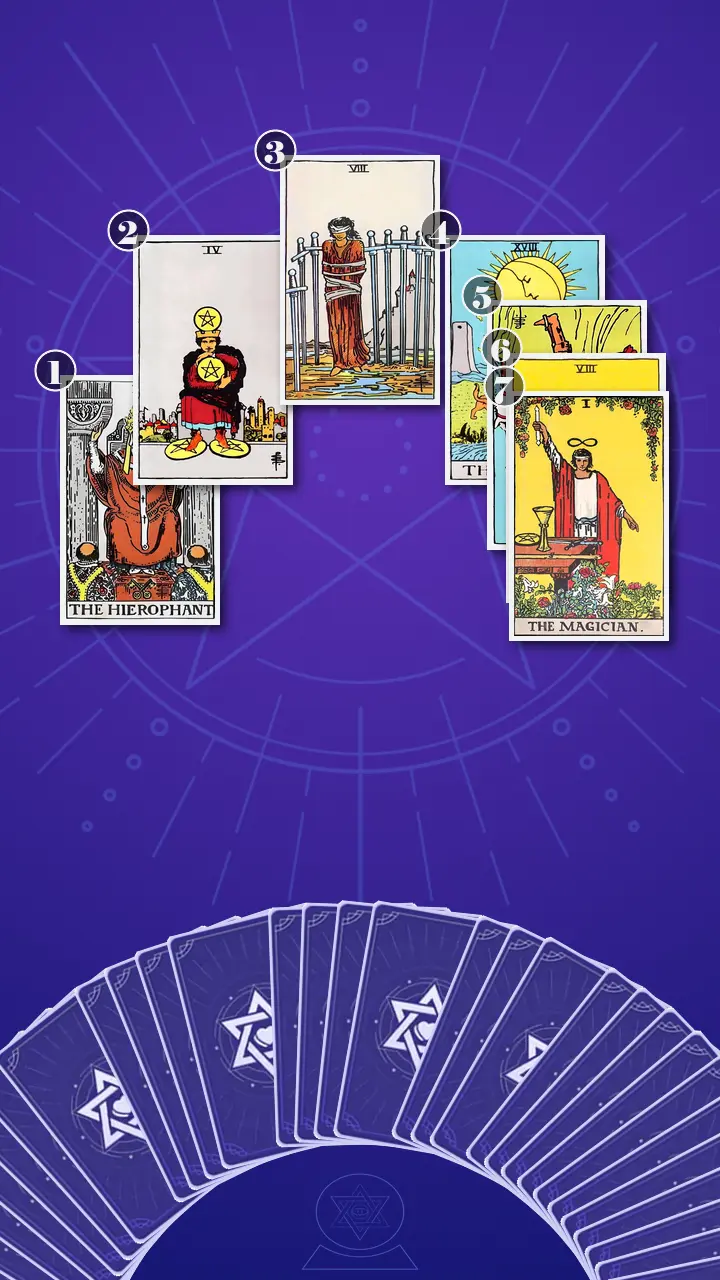
For anyone reading this who’s curious about how tarot works in a modern, practical way: I chose the Horseshoe because it’s a compact diagnostic arc. It doesn’t turn your career into a fixed prediction. It shows a sequence—past imprint, present coping, hidden belief, the core obstacle, external pressure, grounded advice, and then the direction that opens if you actually work the advice. It’s particularly useful for job search anxiety and that specific kind of analysis paralysis where you keep asking for certainty before you take a single real-world step.
“We’ll read it like a path,” I said. “First: what your transcript reactivates. Then: what you do on autopilot. Then: the quieter belief under the surface. We’ll name the obstacle, separate social pressure from your own inner guidance, and land on next steps you can actually do this week.”
Reading the Arc: When “Safe” Becomes a Shield
Position 1 — Past conditioning: what the transcript reactivates
“Now flipped open,” I said, “is the card that represents past conditioning: what the transcript reactivates—the inherited rulebook about success and legitimacy.”
The Hierophant, upright.
In plain language, The Hierophant is the part of us that learned: there is a correct path. There are approved doors and unapproved doors. In Alex’s life, it translated almost too cleanly into a modern scene: you open your transcript and instantly feel like you’re back in school; there’s a ‘right answer’ career and a ‘wrong answer’ career. You draft your life like a cover letter to an invisible admissions committee.
“Your transcript,” I told her, “is acting like an authority figure. Not a document—an audience.”
As a professor, I’ve sat on enough committees to recognize the internalized version of one. The fear isn’t that you’ll choose wrong. The fear is that you’ll be judged as someone who never deserved to be chosen in the first place. My mind flashed, briefly, to stone tablets and inscriptions: records meant to preserve truth that people later treat as law.
“Your transcript is evidence of effort—not a contract for one life path,” I said, and watched Alex’s eyes flick down, as if she’d been caught holding the paper like a shield.
“When you opened it,” I asked, borrowing the question the spread itself was designed to ask, “what was the very first ‘rule’ that popped into your head about what you’re allowed to do next?”
She didn’t answer right away. She swallowed, and I could almost hear the word forming before she said it: “Responsible.”
Position 2 — Present pattern: the concrete “safe job” behaviors right now
“Now flipped open,” I said, “is the card that represents your present pattern—the ‘safe job’ behaviors and control strategies happening right now.”
Four of Pentacles, upright.
The modern translation landed with that uncomfortable accuracy tarot is known for: after dinner you open LinkedIn and only save postings that feel safe—big-name companies, familiar titles, clear ladders. You keep control by filtering, bookmarking, and spreadsheeting. The job you actually want sits in a tab you don’t open because you’d rather feel briefly in control than risk feeling exposed.
“This card is pure grip,” I told her. “Security held so tightly it starts to choke the air out of curiosity.”
Energetically, Four of Pentacles is an excess of control—so much holding on that movement becomes dangerous. It’s not laziness. It’s bracing.
Alex made an unexpected sound: a quick, bitter laugh that didn’t reach her eyes. “That’s… that’s literally my Tuesday night,” she said. “It’s almost rude.”
She did a three-part micro-reaction I’ve learned to pay attention to: first a tiny freeze—breath held; then her gaze slipped off-camera like she was replaying the scene; then a slow exhale, the kind that admits the truth without liking it.
“A job can be safe to explain and still unsafe to live in,” I said, letting that sentence sit between us like a small lamp.
Position 3 — Hidden influence: the self-story keeping the safety chase running
“Now flipped open,” I said, “is the card that represents the hidden influence—the belief underneath your choices that you rarely say out loud.”
Eight of Swords, upright.
In modern life, this card is brutally familiar: you tell yourself you’re stuck because the job market is brutal and you need to be practical—but what really traps you is the rule that your next move must be perfectly safe and instantly defensible. You edit your ambition down before anyone else can respond.
Eight of Swords is a blockage of mental freedom. The bindings are loose in the picture for a reason: the trap is maintained by belief more than by reality.
“This,” I told her, “is what I’d call a self-made geo-fence. It feels like the job market put it there, but the fence is mostly story: ‘If I can’t explain my career move in one sentence, it proves I don’t know what I’m doing.’”
Alex’s hand went to her collarbone without her noticing. Her fingertips pressed lightly as if checking whether the tightness was still there.
“What’s the quiet belief underneath it?” I asked. “The one that starts with: ‘If I don’t pick the safest option, it proves…’”
She spoke so softly I almost missed it. “It proves my degree—and me—weren’t worth it.”
Position 4 — Obstacle: what makes uncertainty feel intolerable
“Now flipped open,” I said, “is the card that represents the obstacle—what turns uncertainty into paralysis.”
The Moon, upright.
The Moon isn’t a ‘bad’ card. It’s a visibility card. It shows what happens when you’re walking in dim light and your brain insists on filling the darkness with certainty—usually the worst kind.
The modern-life scenario was almost word-for-word what Alex had already described: when you consider a less linear role, your mind becomes a horror-movie trailer—regret, instability, wasted degree, disappointing everyone, falling behind forever. Nothing has happened yet, but your body reacts like it already has—tight chest, braced shoulders—so you retreat to ‘safe job = safety.’
Outside Alex’s window, rain turned the streetlights into halos. It made the night look like it was wearing fog. The environment, as it often does, quietly conspired with the card.
“Uncertainty,” I said, “is like walking home in Toronto fog with your phone battery at 9%. Your brain doesn’t just say, ‘I can’t see.’ It starts producing details. It writes plot.”
The Moon’s energy here is a blockage created by projection—fear-stories taking up all the oxygen. So I asked the question The Moon always wants asked, because it shifts the goal from impossible certainty to workable clarity:
“What part of not-knowing hits you hardest—money, identity, timing, looking inexperienced? And what information would reduce that fear by 10%, not 100%?”
Alex blinked, slower this time. “Ten percent feels… doable,” she said. “If I could just know what a day in the role actually looks like. Like, what they do all day.”
That was the first loosening. Not confidence. Not answers. Just a smaller, smarter question.
Position 5 — External influence: peer comparison and the LinkedIn scoreboard
“Now flipped open,” I said, “is the card that represents external influence—the social proof pressures reinforcing the ‘safe’ default.”
Six of Wands, reversed.
Reversed, Six of Wands often shows the shaky underside of recognition: when the crowd’s applause becomes a mood regulator. The modern translation was painfully current: you can’t tell if you want the role or the relief of announcing it. You refresh LinkedIn after submitting applications, and other people’s promotions rewrite your confidence in real time.
Here the energy is a deficiency of internal orientation—your compass outsourced to the public scoreboard.
Alex winced so hard her nose crinkled. “I hate that I do that,” she said. “I’ll apply and then immediately check LinkedIn. It’s like… I need to know if my choice is allowed.”
“No moralizing from me,” I said. “This is a system. Platforms are designed to make the crowd feel like a jury. But we can measure what’s really happening.”
I offered her a simple counter-metric—one week only, no personality change required: “When you read a job description, rate two numbers from 1 to 10: how calm your body feels after reading it, and how curious you feel about learning the work. Just collect data. Don’t argue with the numbers.”
She nodded, but it was a cautious nod—the kind that says, Part of me wants this; part of me is terrified it’s too simple.
Position 6 — Advice (Key Card): the grounded inner shift that builds self-trust this week
I slowed my hands before turning the next card. “We’re coming to the heart of the reading,” I told her. “The advice position—what you can do this week that actually shifts the loop.”
“Now flipped open,” I said, “is the card that represents the most grounded inner shift and micro-action that builds self-trust.”
Strength, upright.
The room—two rooms, really, separated by a screen—felt quieter. Strength is not loud courage. It’s the kind of courage that doesn’t need witnesses.
Setup. The story Alex had been living was clear now: she opens her transcript and suddenly it feels like she’s standing in front of an invisible committee—like every next step has to be defensible, impressive, and future-proof, or it “doesn’t count.” That’s the trap: treating a life choice like a verdict you must justify.
Delivery.
Stop gripping your career like a pentacle you can’t drop; start practicing calm courage—Strength is the gentle hand that opens the path.
I let the silence do its work for a beat. Then I watched Alex’s face move through the moment in layers: first her eyes widened slightly, like the sentence had touched a nerve; then her mouth tightened—an almost-angry line; then her shoulders dropped in a way that looked like surrender, but wasn’t. It looked like relief that didn’t require self-hate.
“But if I stop gripping,” she said, and her voice cracked on the last word, “doesn’t that mean I was wrong? Like… I wasted time?”
There it was—an unexpected flare of resistance, so human it made me trust her more. I didn’t rush to soothe it.
“Not wrong,” I said. “Protective. The Four of Pentacles grip kept you feeling controlled. It reduced shame in the short term. That mattered. Strength isn’t here to shame the coping. It’s here to lead it.”
This is where my own framework clicks in—what I call Crossroad Adaptation. In the archaeological record, traders rarely committed to one route with perfect certainty. They moved by safe-enough legs: short crossings, known harbors, recalibration. Their success wasn’t built on having a flawless map. It was built on being steady enough to keep moving and adjust when new information arrived. That’s Strength: nervous-system leadership in motion.
“You don’t have to be fearless,” I told her. “You just have to stop letting fear drive the steering wheel.”
Her breath hitched—then released. A three-step reaction chain unfolded again: a tiny pause like her mind was rebooting, then her gaze went unfocused as if she replayed last week’s LinkedIn spiral, then a longer exhale that softened her jaw.
“Now,” I said, “use this new lens and look back: was there a moment last week—closing the tab, rewriting the bullet, filtering for ‘recession-proof’—when this idea could have made you feel even slightly different?”
She nodded slowly. “Sunday. I closed the tab with the role I liked. I didn’t even read it. I just… assumed it was risky.”
And because Strength loves practice more than promises, I gave her a single, contained experiment—something she could do once, not forever:
“This week, do a 10-minute Strength Check one time. Open one job posting you actually like—the one you usually leave unopened. Set a 10-minute timer. Spend two minutes noticing your body like a dashboard—jaw, chest, shoulders. Name what’s there. No fixing. Then write three lines: ‘The story my fear is telling is…’; ‘The smallest real-world evidence I could gather is…’; and ‘A safe-enough version of this is…’. Then spend the last three minutes doing one micro-step immediately—draft the message, save a calendar slot, outline a tiny portfolio proof.”
“Practice,” I reminded her. “Not a test you have to pass.”
Position 7 — Integration: the direction that opens when you act from self-trust
“Now flipped open,” I said, “is the card that represents integration—the direction you grow into when you act from self-trust instead of defensibility.”
The Magician, upright.
The Magician is the opposite of transcript-as-verdict. It’s transcript-as-toolkit. The modern-life scenario was bright, practical, almost tactile: your transcript stops being a judge and starts being raw material. You translate classes and achievements into tangible proof—a small case study, a writing sample, a mini analysis deck. You stop asking ‘Which job is safest?’ and start asking ‘What can I build this month that proves I can do the work and adapt?’
Here the energy is balance—agency aligned with reality. Not fantasy. Not panic. Tools on a table.
This is where my other signature lens, Skill Archaeology, becomes more than a clever phrase. As an archaeologist, I’ve spent years learning that the most valuable information is often in what people overlook because it doesn’t look like treasure yet. “Your transcript,” I told Alex, “is full of artifacts—skills you stopped seeing because you treated them like grades.”
Her eyebrows lifted. “Like what?”
“Like synthesis,” I said. “Like writing under constraint. Like finding patterns in messy information. Those are not just academic. Those are modern career tools. The Magician doesn’t ask permission. He organizes what’s already there and makes proof.”
Alex’s shoulders didn’t brace this time. They stayed level. “That sounds… doable,” she said. “Not easy. But doable.”
From Verdict to Evidence: Actionable Advice That Builds Real Self-Trust
When I stitched the Horseshoe arc together for Alex, the story was coherent in the way a good diagnosis always is: her transcript (Hierophant) reactivated an inherited rulebook; she coped by gripping stability (Four of Pentacles); a hidden belief kept tightening the loop (Eight of Swords); uncertainty turned into fear-stories (The Moon); LinkedIn and peer timelines acted like a public jury (Six of Wands reversed). The turning point wasn’t a perfect plan. It was Strength—inner steadiness—and then The Magician—evidence through doing.
The cognitive blind spot was subtle but powerful: Alex kept mistaking “I feel calmer after choosing it” for “it’s the right fit.” Calm can be a relief response. It can also be a cage.
The transformation direction was equally clear: shift from “I must justify my career like a verdict” to “I can run small, low-risk experiments that build real evidence and self-trust.” In my language, it’s a move from worshipping the institution to working the tools.
I offered her a plan using my Megalith Transport strategy—because you don’t move a stone circle in one heroic lift. You move it with rollers, levers, and small coordinated effort.
- The 5-Sentence Informational DMSend one low-stakes informational interview message (LinkedIn DM or email) to a person in a field you’re curious about. Keep it to 5 sentences. Ask for 15 minutes max. Do it in a calm window—ideally midweek, not at peak Sunday Scaries.Expect your brain to protest: “This is pointless unless it guarantees a job.” Treat that as the old verdict mindset. Your goal is evidence, not certainty. Stop after you hit ‘send.’
- A “Safe-Enough Experiment” Calendar BlockCreate a 20-minute calendar block titled: “One small proof.” Use it once to draft a tiny artifact: a one-page case study, a short writing sample, a mini analysis, or a mock project outline connected to the kind of role you actually want.Define “done” before you start (one page, six bullets, one slide). If anxiety spikes, reduce it to a 2-minute version or close it. This is practice, not punishment.
- Build Your Magician Table (10 minutes only)Open a Notion page or Google Doc and make four columns: Skills | Proof (what I’ve done) | Next tiny proof | Person to ask. Fill it in for 10 minutes, no polishing. This turns your transcript into a working bench, not a shrine.If you start over-researching, set a timer and switch from reading to making. Clarity isn’t something you find. It’s something you earn through small proofs.
And because my caution has always been academic as much as spiritual, I added a light touch of my Relic Authentication strategy: “Before you commit to any opportunity,” I said, “ask three questions: What do I actually do day-to-day? Who am I learning from? What would ‘safe enough’ look like here? We assess before we worship.”

A Week Later: The Tab Stayed Open
Alex messaged me the following week. Not an essay—just a screenshot and one line.
She’d sent the five-sentence DM. Someone responded. They didn’t offer her a job; they offered a 15-minute call. Alex booked it anyway.
She also did the 20-minute “One small proof” block in a quiet café after work—alone, a little wired, but committed. She made a one-page mini case study. Her celebration wasn’t loud. It was just the fact that she didn’t close the tab this time. She let the interesting thing stay open long enough to become real.
That’s the kind of proof I trust: small, embodied, repeatable. A journey to clarity that doesn’t require certainty—only a gentler grip and a steadier hand.
When your transcript feels like a verdict, it’s easy to clamp down on “safe” titles—not because you don’t want more, but because you’re terrified a messy path will expose that being a “good student” was the only proof you ever had.
If you didn’t have to justify your next step to an imaginary committee, what’s one small, safe-enough experiment you’d be curious to run this week—just to gather real evidence about what fits?
This story is adapted from psychological research, written so that those in a similar struggle can see their own pattern in it — and find their next step clearly.These insights are not a substitute for professional psychological, medical, legal, or financial advice.
Learn more about our Journey to Clarity.
How did this insight land for you?
🫂 This Resonates Deeply
🌀 Living This Story
✨ Now I See Clearly
🌱 Seeing New Possibilities
🧰 Useful Framework
🔮 The Confirmation I Needed
💪 Feeling Empowered
🚀 Ready for My Next Step
Author Profile
 AI
AI“Having spent a lifetime at Cambridge and on archaeological digs, I’ve witnessed the rise and fall of countless civilizations. Please know that your current struggles are not a permanent fate, but merely a necessary fracture before rebuilding. I won't lecture you; instead, I invite you to sit with me in the ruins, using a patient, historical perspective to gently dust off the true, enduring value hidden beneath your temporary doubts.”
In this Career Tarot Reading :
Core Expertise
- Core Competency Excavation: Digging through the 'strata' of your past roles to uncover undervalued, highly transferable foundational skills.
- Career Epoch Analogies: Contextualizing your career plateau as the end of one professional era and the necessary foundation for the next.
Service Features
- The Resume Stratigraphy Review: A structured framework to rewrite your professional narrative, highlighting immutable assets over obsolete job titles.
Also specializes in :
Explore Related Patterns:
Achievement FusionAlex opening the transcript at 8:47 p.m. and watching the GPA line turn into a scoreboard shows how an academic record becomes fused with personal legitimacy. The document is no longer just evidence of past effort; it starts acting like a verdict on whether the next career move will prove she was worth the investment. That fusion explains why the safer jobs feel so magnetic even when she says she does not like them. You are not only comparing job descriptions; you are trying to protect an old identity built around being legible, responsible, and academically validated. Achievement Fusion shows up when past performance becomes the proof you keep trying to defend in the present. The safe job chase is not a lack of ambition; it is a defense against the fear that choosing something messier might expose the degree, and the self attached to it, as not enough.
Avoidance CopingThe tab with the role Alex actually likes staying unopened is the clearest behavioral anchor in the story. She does not reject the role after evaluating it; she avoids the moment of contact because the contact itself would make uncertainty real. Avoidance Coping works by choosing immediate emotional relief over longer-term clarity. You go back to Coordinator roles not because they fit better, but because they protect you from exposure, ambiguity, and the possibility that your desire may not be instantly defensible. This pattern is not laziness. It is a defensive shortcut that says, 'If I do not look at the risky thing, I do not have to feel what it asks of me.' The shift happens when the goal becomes opening the tab long enough to collect evidence, not forcing yourself to be fearless.
Certainty SeekingAlex leaving the interesting role unopened while searching for choices that are safe, defensible, and easy to explain shows certainty becoming a gatekeeper. Before she allows herself to act, the option has to pass an impossible test of future-proof legitimacy. Certainty Seeking turns decision-making into a demand for complete emotional safety. You try to remove the risk before gathering the evidence, which means the job search becomes less about discovering fit and more about escaping the discomfort of not knowing. The pattern is especially strong here because the next step is treated like a verdict. A safe-enough experiment breaks the loop by lowering the demand from total certainty to usable data, which is exactly why the 10-minute role review and informational DM matter.
Control CopingAlex filtering LinkedIn for familiar titles, saving ten postings, and rewriting one resume bullet for an hour shows control becoming the first response to uncertainty. The ritual creates a sense of movement without forcing contact with the role she actually wants. Control Coping is protective before it becomes restrictive. You create structure, polish details, and choose options with clear ladders because those actions reduce exposure in the short term and make the situation feel measurable. The cost is that control starts replacing curiosity. The safe jobs are not only options; they are emotional containers that keep the body from feeling the risk of a less linear path. Clarity starts when control becomes a tool again, not the whole operating system.
Identity ForeclosureThe transcript reactivating a rulebook of approved and unapproved doors explains why Analyst and Coordinator roles start looking like the only sensible options. Those titles offer a ready-made identity: recognizable, explainable, and easy to defend on paper. Identity Foreclosure is the mind's way of closing the identity question too early because exploration feels dangerous. You narrow the field before the field has had a chance to answer back, not because you have clear preference data, but because ambiguity threatens the version of yourself that was trained to succeed by choosing the approved path. In Alex's case, the safe-job chase is a premature commitment to an externally legible career self. The work of clarity begins when the transcript stops being the author of the identity and becomes one piece of evidence among many.
Sunk Cost FallacyAlex asking whether stopping the grip would mean she was wrong, or that she wasted time, gives the safe-job chase its sunk-cost logic. The past investment in school starts demanding a career outcome that can justify it. Sunk Cost Fallacy shows up when earlier effort becomes a reason to keep choosing the familiar path, even when the present evidence says the fit is weak. You are trying to make the degree feel worth it by selecting roles that look like a clean continuation of the investment. The trap is that honoring past effort and repeating its safest script are not the same thing. The transcript can become evidence of tools you built, rather than a contract that forces you to keep paying for one approved future.
External ValidationAlex refreshing LinkedIn after applications and saying she needs to know whether her choice is allowed shows the crowd becoming a regulator for confidence. The peer timeline does not just inform her; it starts authorizing or discrediting her direction. External Validation makes public legibility feel like internal safety. You chase roles that will be easy to announce, easy to defend, and easy for other people to recognize because recognition temporarily quiets the fear of choosing wrong. The pattern matters because it turns the job search into a performance for an imagined jury. When Alex starts rating body calm and curiosity instead of only public approval, she begins moving the compass back inside.
Emotional ReasoningAlex feeling calmer around safe, explainable roles and then treating that calm as evidence of fit captures the cognitive blind spot directly. The body relaxes because exposure has been reduced, not necessarily because the choice is aligned. Emotional Reasoning turns an internal state into a conclusion. You feel relief, so the mind says the safe role must be right; you feel tightness, so the mind says the interesting role must be wrong or dangerous. In this story, that distinction is the hinge. Calm is useful data, but it is not the whole verdict. Once relief is separated from genuine fit, Alex can ask better questions about curiosity, day-to-day work, and evidence instead of letting nervous-system relief make the decision alone.
CatastrophizingAlex imagining regret, instability, a wasted degree, disappointing everyone, and falling behind forever before anything has happened shows uncertainty being filled with threat. The body then reacts as if the feared future has already arrived. Catastrophizing compresses possibility into disaster. You are not simply weighing risk; your mind is producing a high-intensity prediction that makes the unexplored path feel unsafe before it has been tested. That is why the safe job starts to feel like shelter. It lowers the imagined disaster fast, but it also prevents reality testing. The smaller question Alex lands on, what a day in the role actually looks like, is powerful because it interrupts the horror-trailer loop with concrete information.
Explore Related Struggles:
Identity Verdict LockAlex opens a college transcript to check something small, but the GPA line immediately becomes larger than the document itself. Her jaw locks, her body braces, and the next move in her career starts to feel like it has to answer for everything that came before it. That is the pressure point behind Identity Verdict Lock: a record of past effort turns into a present-day tribunal. You are no longer just choosing a job; you are trying to prove that the degree, the grades, the time, and the version of yourself that followed the rules were all worth it. The struggle is not that you lack ambition or clarity. It is that every possible next step gets dragged into a courtroom where it must be responsible, impressive, linear, and defensible before it is allowed to be real. Once the transcript becomes a verdict instead of evidence, even curiosity can feel like a liability.
Permission ParalysisThe role Alex actually likes is not rejected after careful review; it sits unopened. Meanwhile, safer applications get polished, filtered, saved, and made presentable, as if motion is only permitted when it can be justified in advance. Permission Paralysis forms around that unopened tab. You wait for an external yes before you let your own interest become actionable: a recognizable title, a clear ladder, a LinkedIn signal, a one-sentence explanation that would satisfy the invisible committee. The paralysis is not empty hesitation. It is a permissions system that has moved inside you. The next step has to feel allowed before it can be explored, so curiosity gets treated like a risk exposure instead of a data point.
Safety-Identity FusionAlex says she does not even like the coordinator and analyst roles she keeps saving; she likes that they make sense on paper. The recognizable title, the clean ladder, the known company, and the benefits package become a kind of identity armor. Safety-Identity Fusion shows up when the safest-looking option starts carrying more than practical stability. It has to protect the image of being responsible, employable, and coherent to other people. You are not only asking whether the job can support your life; you are asking whether the job can defend your self-image. That fusion is what makes the interesting role feel almost illegal to open. A path can be safe to explain and still quietly unsafe to inhabit, because the safety is being measured by how well it preserves an approved story rather than how well it fits the person who has to live inside it.
Metric-Compass FusionAlex encounters two scoreboards in the story: the GPA line on the transcript and the moving scoreboard of LinkedIn promotions. One belongs to school, one belongs to work culture, but both start acting like navigation systems. Metric-Compass Fusion is the reversed state where visible measurements stop being information and start becoming orientation. You look to grades, titles, company names, timelines, and peer announcements to tell you whether your path is real enough to trust. The cost is subtle but heavy: your inner compass goes quiet because the public scoreboard keeps updating faster. A choice that does not produce immediate legibility can feel like failure before it has even had time to become evidence.
Control LockAlex's job search is full of activity: filters, bookmarks, spreadsheets, resume edits, and saved postings. On the surface, it looks productive. Underneath, the most alive question remains untouched: what would actually fit? Control Lock appears when the system for managing risk becomes stronger than the relationship to desire. You keep tightening the search around safe parameters because the act of controlling the process gives brief relief, even when the process is no longer moving you toward a better answer. This is why the loop can feel so convincing. It produces order, but not contact. It gives you something to hold, but it also keeps the more honest option sealed behind the tab you keep avoiding.
Evidence DisconnectionAlex does not need a complete life plan to loosen the grip; she needs to know what a day in the role actually looks like. The missing piece is not cosmic certainty. It is ordinary evidence that has not been gathered because the feared story arrives first. Evidence Disconnection takes shape when inherited proof and imagined outcomes crowd out real-world contact. The transcript proves past performance, LinkedIn proves public legibility, and the body reacts to a projected future before the actual role has been investigated. The way through is not to force confidence. It is to rebuild the bridge between curiosity and evidence: one message, one call, one small proof, one ten percent reduction in the fog. You start reclaiming direction when proof comes from lived contact instead of inherited verdicts.
Explore Related Emotions:
Rulebook ShameThe first word Alex finds under the transcript is not excitement, curiosity, or fit. It is “responsible.” That word lands like a rule she has to obey before she is allowed to want anything else. The role she actually likes stays unopened like contraband, while the safe postings stack up neatly in saved tabs. You can feel the split there: one part of you knows what sparks interest, while another part checks whether that interest would look legitimate on paper. Rulebook Shame fits because the shame is not loud self-attack; it is the quiet shrinking that happens when desire has to pass through an old approval system before it can be taken seriously. The safe job chase becomes a way to stay inside the rules, even when the rules no longer describe the life you are trying to build.
Verdict DreadOpening the transcript at 8:47 p.m. makes Alex's jaw lock, her breath hold, and her attention snap to the GPA line as if it were a scoreboard. The document is no longer just a record; it becomes a silent room where every career move feels like it might be entered as evidence. That is why the chase for safe jobs has such force. You are not simply looking for stability; you are trying to avoid the private sensation of being judged by a version of success that still speaks in grades, ladders, and defensible outcomes. The safe coordinator role becomes emotionally useful because it can be explained before anyone questions it. Verdict Dread names the inner weather of treating a life choice like a ruling. It captures the tightening that happens when uncertainty feels less like exploration and more like a final assessment of whether your degree, your effort, and your younger self were worth it.
Career Catastrophe DreadWhen Alex considers a less linear role, nothing concrete has gone wrong yet, but her body reacts as if the consequences have already arrived. The chest tightens, the shoulders brace, and the mind starts producing a trailer of regret, instability, wasted degree, disappointing everyone, and falling behind forever. That escalation turns curiosity into threat. A role that could simply be investigated becomes emotionally inflated into a test of whether her whole academic and early-career path will hold together. Career Catastrophe Dread names the storm that makes safe jobs feel so compelling. You chase the roles that make sense on paper because the alternative does not register as “uncertain but learnable”; it registers as a future collapse that must be prevented before it can even be examined.
Cautious Self-TrustAlex does not leave the reading with total confidence. She leaves with a smaller question: what would reduce the fear by ten percent? That scale matters because it lets her move without pretending uncertainty has disappeared. A week later, she sends the five-sentence DM, books the short call, makes a one-page mini case study, and keeps the tab open. The proof is quiet, but it is embodied: she acts while still a little wired, and the action does not need to become a grand identity announcement. Cautious Self-Trust names that fragile but real shift. You begin to trust yourself not because you can guarantee the outcome, but because you can stay with the interesting thing long enough to gather evidence, make a small move, and return to your own signal.
Choice Paralysis OverwhelmAlex saves ten postings, rewrites one resume bullet for an hour, and keeps circling the same safe titles while the role she wants remains untouched. On the surface, there is motion; underneath it, the choice itself has become too charged to approach directly. The overload comes from trying to make one career move answer every fear at once: money, identity, timing, wasted effort, public judgment, and the possibility of falling behind. A job search that could be a sequence of small tests starts to feel like a single irreversible decision. Choice Paralysis Overwhelm captures that crowded inner state. You are not frozen because you have no options; you are frozen because every option has been loaded with the demand to prove safety, worth, and future certainty before you are allowed to take one step.
Exposure DreadThe most revealing tab in the story is the one Alex does not open. The role she actually likes sits there untouched, while the safer postings get filtered, saved, and organized into something that looks controlled. That unopened tab carries more emotional risk than the roles she dislikes. It would make her interest visible to herself before she has a perfect defense for it, which means the danger is not only rejection from others; it is the exposure of wanting something that cannot be instantly justified. Exposure Dread names the feeling of staying near desire without letting it become fully real. You keep the safer options close because they protect you from the vulnerability of admitting what you might actually want, especially when wanting it could reopen the fear that you are not prepared, practical, or legitimate enough.
Grounded AgencyThe transcript changes shape when Alex stops treating it as a verdict and starts treating it as a toolkit. Classes, grades, and achievements become raw material for proof rather than a shrine she has to keep defending. That shift gives her a more grounded kind of agency. Instead of asking which job title will look safest, she starts asking what she can build, test, ask, or observe this week that would make the next step more real. Grounded Agency fits because the energy is practical rather than performative. You are not escaping fear through a fantasy of certainty; you are reclaiming movement through small evidence, body data, and choices that answer to your own curiosity as well as reality.
Status AnxietyAfter submitting applications, Alex refreshes LinkedIn and lets other people's promotions rewrite her confidence in real time. The platform turns career movement into a visible ranking system, and her own decision starts to feel unstable unless the crowd seems to validate it. This is not just comparison for its own sake. The public scoreboard becomes a substitute compass when her internal orientation is shaky, making safe and recognizable roles feel easier to trust because they are legible to other people. Status Anxiety fits the emotional texture of needing a choice to look acceptable before it feels safe. You are not only asking what job you want; you are tracking whether the move will keep you recognizable, impressive, and protected from the sting of seeming behind.
Explore Related Contexts:
Career ROI ReckoningAlex's transcript stops functioning as a record and starts functioning as a public accounting device for her next career move. The GPA line becomes a scoreboard, and the hidden question underneath the search is whether the degree, and the person who earned it, were worth it. That makes every job option carry more weight than a job posting should. A safer title promises to convert years of study into visible proof, while a less linear path risks looking like a poor return on the academic investment. You are not dealing with a simple preference for practical work. The story shows a career decision being pulled into an ROI frame, where legitimacy, education, and employability are forced into one public calculation.
Career Stability Lock-InAlex opens the transcript, sees the GPA line as a scoreboard, and then starts applying for coordinator roles again. The LinkedIn filters narrow to Analyst and Coordinator roles at recognizable companies with clear ladders and benefits, while the role she actually likes remains unopened. The outer pressure here is not simply a preference for stability; it is a labor-market script where legible titles become a shield against being judged. Safety is being measured by how easily the job can be explained on paper, not by whether the work fits. For you, this names the trap of choosing options that look defensible to an outside audience. It gives the safe job chase a structure: stability has become the container that keeps uncertainty manageable, even when it also keeps curiosity out of reach.
Rigid Life Script Lock-InAlex names the first rule that appears after opening the transcript: responsible. From there, the career field splits into approved doors and unapproved doors, with the invisible admissions committee still sitting in judgment long after college is over. The pressure comes from an institutional script that rewards clean explanations, recognizable companies, and future-proof choices. It turns a next step into a performance of being the kind of person who followed the right path. For you, this points to the social rulebook behind the safe job chase. The question is not only which role is practical; it is why practicality has been made the entry fee for feeling allowed to move.
Career Transition FogAlex says she is exploring next steps, but the real scene is narrower: ten safe postings saved, one resume bullet rewritten for an hour, and the job she actually likes left unopened. When asked what would reduce the pressure, she does not need a perfect plan; she needs to know what the day-to-day work actually looks like. That is a transition field without enough concrete visibility. The next chapter exists, but it has not yet been broken into tasks, people, proof, and small tests, so familiar categories become easier to use than the unknown path. For you, this explains why the safe jobs keep pulling focus. A vague transition makes old labels feel solid, while a desired but unclear option feels exposed before it has been properly researched.
LinkedIn Performance LoopAfter submitting applications, Alex refreshes LinkedIn, and other people's promotions rewrite her confidence in real time. She cannot always tell whether she wants the role or wants the relief of announcing something that will make sense to the crowd. The platform turns career movement into a visible scoreboard. Peer timelines, job titles, and public recognition create a feedback system where a choice feels more legitimate when it can be displayed. For you, this names the external pressure that keeps the safe default alive. The issue is not weak willpower; it is a social environment that rewards legible wins and makes quieter, exploratory moves harder to trust.