Moved, But Not Arrived

A grounded look at post-move disorientation, matching tarot cards, and tarot reading insights from similar relocation readings.

Post-move Limbo
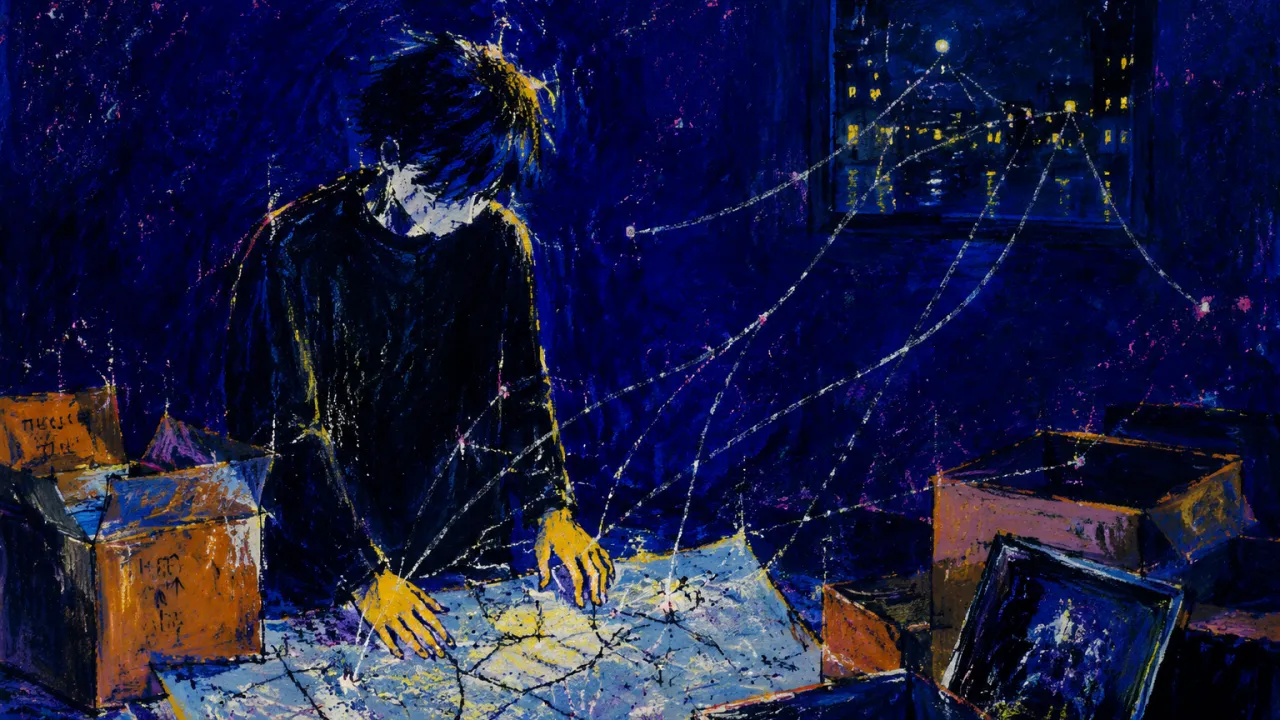
A solitary figure among half-unpacked boxes, map lines pulling away as cold window lights surround the room

What is this situation?

Post-Move Limbo — you have changed your address, unpacked enough to function, and learned the route to the grocery store, but the place around you still feels like it has not made room for you yet. The first few days had tasks: keys, Wi-Fi, furniture, address updates, finding the nearest pharmacy, pretending the stack of cardboard boxes was temporary. Then the admin quiets down and the empty space gets louder. Your old people are still in your phone, but now their replies arrive from another time zone, during work hours, or after your day has already gone flat. In the new place, everyone else seems to have their regular coffee shop, their group chats, their inside jokes, their Friday plans, their favorite shortcut through the neighborhood. You keep walking past windows full of other people's routines while trying to build your own from scratch. Small things start taking more effort than they should: choosing a doctor, finding a laundromat, knowing which bus stop is safe to wait at late, figuring out whether a casual invite was polite or sincere. You are not a tourist, but you are not local either; you are paying rent in a life that has not fully recognized you. The move may have been necessary, exciting, strategic, or overdue, but the after-part is quieter than people warned you about: the nights where your apartment sounds too new, the weekends with no default plan, the moment you realize no one nearby automatically knows what kind of day you had. It is not just missing home; it is being caught between systems of belonging, much like the small boat on the Six of Swords, already pushed away from one shore while the next one is still silent in the distance.

Why it's not you?

The problem is not that you are failing to adapt fast enough; the problem is that a move removes your built-in support, routines, shortcuts, and social signals all at once. Post-Move Limbo has a shape: the old map no longer works, and the new one has not been drawn yet. That gap is created by the transition itself, not by a lack of effort on your part.

Post-move Limbo in Tarot Cards

Post-Move Limbo is the strange in-between where the move has technically happened, but the city still treats you like a temporary visitor. The tight chest you feel while walking home past unfamiliar windows is not random; it belongs to an environmental, structural, and dynamic shift where your old reference points have been removed before new ones have formed. The cards below do not tell you whether the move was right or wrong; they reflect the outline of being physically relocated while socially and emotionally unlanded. Here are the Tarot Cards that tend to mirror this kind of situation.

The Hermit
Reversed
Turned upside down, the solitary figure and small lantern occupy a landscape with no external point of reference. That visual confinement mirrors the post-move nights when your apartment becomes the main container for every doubt about whether the relocation was worthwhile. The silence can make temporary uncertainty sound like a final verdict. The reversed Hermit identifies the missing counterweight: local routines and relationships have not yet supplied enough lived evidence to put your private conclusions in proportion.
The Hanged Man
Upright
The bound ankle, inverted body, and illuminated head show development occurring without conventional forward motion. Post-move growth often takes this form because old measures of progress, such as instant confidence or a full social calendar, cannot accurately measure early integration. The living wood indicates that the structure around you is still developing rather than permanently closed. You gain a more realistic model of adaptation when the gap itself becomes visible as a stage, not a personal defect to overcome on command.
Temperance
Upright
Temperance stands across two elements while transferring water without losing either cup. The image reflects an identity stretched between an old home that shaped you and a new place that has not yet supplied an equally coherent sense of self. The exchange creates a third composition rather than choosing one side as the only legitimate life. You can recognize development in the capacity to carry continuity forward while allowing the new environment to change how that continuity is expressed.
The Moon
Upright
The Moon reflects borrowed light over a landscape where familiar and unfamiliar creatures react at once. The image captures the psychological noise created when a new city supplies too few stable cues to separate practical caution, homesickness, and broader doubt about the move. The visible path keeps uncertainty connected to an external environment rather than letting it become an identity judgment. You can sort specific unknowns from generalized fear while acknowledging that the new setting has not yet become predictable.
The World
Reversed
The World reversed places a complete set of symbols around a figure whose orientation remains unresolved. The image reflects the pressure to describe relocation as a successful reinvention before its practical and relational components have actually joined together. The whole framework remains available, but completion needs a broader definition than visible independence. You can reconstruct progress to include partial routines, emerging local knowledge, and relationships that are still too new to carry weight.
Three of Cups
Reversed
Turned upside down, the three friends remain physically close but their raised cups no longer create a stable shared center. That disrupted circuit reflects new friendships that are pleasant in person yet fail to develop into check-ins, private trust, or spontaneous plans. The image separates social exposure from friendship infrastructure. You can meet people repeatedly and still lack the mutual investment that makes someone a reliable part of your private support network.
Five of Cups
Upright
The dark cloak and spilled cups dominate the foreground while a bridge toward shelter remains outside the figure's immediate gaze. This arrangement mirrors how the quiet after moving can concentrate attention on everything that no longer happens automatically. The loss is concrete, but it is not the whole field. You can hold grief for the old life alongside evidence that connection and shelter still exist, preventing temporary deprivation from becoming a total story about the relocation.
Six of Cups
Upright
In a sheltered old courtyard, one figure offers another a cup filled with flowers while familiar buildings enclose the exchange. The scene represents the ease of friendships formed inside shared history, where context, trust, and ordinary routines do not need to be rebuilt from zero. Those established relationships remain accessible as continuity, but their familiar setting also clarifies what the new city lacks. You are comparing mature friendships with connections still in their earliest stage, two resources operating on fundamentally different timelines.
Two of Pentacles
Upright
The figure loops two pentacles between his hands while ships rise and fall on rough water behind him. The juggling reflects a post-move daily system in which groceries, laundry, healthcare, transport, work, and unpacking all require active coordination because no local shortcut is automatic yet. The infinity loop shows that movement between tasks is possible, but constant improvisation consumes capacity. You are not struggling with inherently complex errands; you are carrying the coordination cost created when an entire routine loses its defaults at once.
Five of Pentacles
Upright
Two figures move through snow outside a brightly lit stained-glass window, placing visible shelter and shared warmth just beyond their current access. The scene closely mirrors walking past cafés, homes, and neighborhood gatherings full of routines that appear established for everyone except the newcomer. The illuminated window proves that community infrastructure exists, but visibility does not guarantee an entry route. You are confronting an access gap created by weak local ties and unfamiliar social channels, not evidence that you are inherently excluded from community.
Six of Swords
Upright
The six swords stand inside the boat, showing that the mental material of the old life travels with the passengers rather than disappearing at departure. The arrangement mirrors how memories, expectations, and familiar social measurements continue to shape your interpretation of an environment that operates differently. The calm crossing gives those thoughts a container without allowing them to define the destination. You can examine what belongs to the old map and what is genuine information about the new place while the transition remains unfinished.
Three of Wands
Upright
Standing above the water, the Three of Wands figure watches ships that are already underway but have not returned to shore. The image fits the period after relocation action has been taken, when local familiarity and relationships still depend on developments that cannot appear immediately. The elevated view provides evidence of movement even without arrival. You can distinguish latency from failure by noticing that the new environment is beginning to answer through repeated routes, recognizable places, and early connections, although none is mature yet.
Four of Wands
Reversed
Turned upside down, the Four of Wands' public garland and welcoming crowd become a threshold whose invitation is difficult to access. The scene reflects a neighborhood full of visible gatherings where you can observe belonging without yet being routinely included in it. The canopy remains communal rather than sealed, preserving the possibility of entry while showing why proximity is insufficient. You can live beside a social ecosystem for some time before its recurring plans and informal invitations begin to recognize you.

Post-move Limbo in Tarot Card Reading Insights

Post-Move Limbo often shows up when people bring the half-arrived feeling of a new city, new apartment, or new routine into a reading. The shift from cards to readings lets you see how this unsettled terrain can appear in different spreads. Tarot Reading Insights from sessions connected to this situation.
Psychological Contexts Related to Post-move Limbo