Decided Before You Were Asked

Explore how choices get settled without your input, the Tarot Cards linked to that dynamic, and related reading insights.

Shared Decision Exclusion
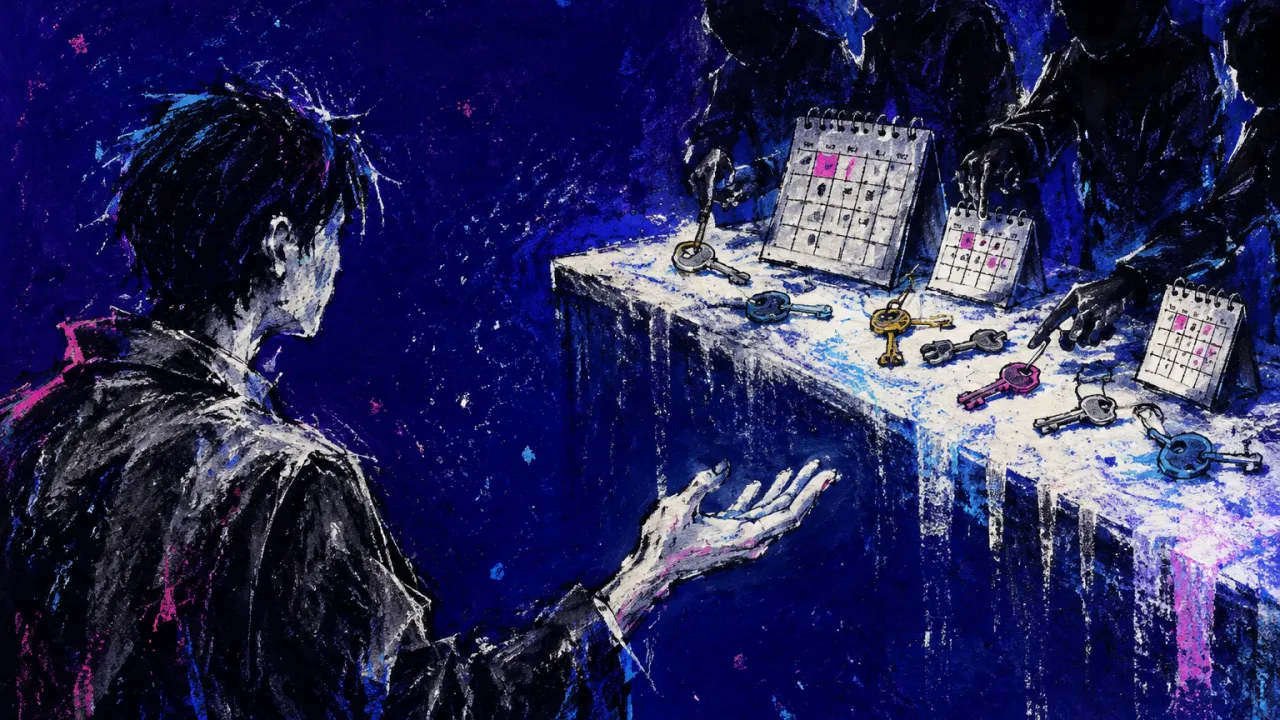
A solitary figure extends an open palm across a bright gap while silhouettes arrange calendars and keys on a distant table.

What is this situation?

Shared Decision Exclusion is what happens when choices that affect you and other people are made around you rather than with you. It may start with something small: a calendar invite arrives after the date is fixed, a purchase is announced after payment, or a weekend plan is presented as a done deal. Soon, decisions about shared time, household routines, money, travel, or future commitments follow the same sequence: someone else discusses the options, reaches an agreement, and then tells you what is happening. When you ask why you were not included, the conversation shifts to speed, convenience, or the claim that the choice was obvious; your input is requested only for details that cannot change the outcome. You begin checking messages and shared calendars for decisions already in motion, and your shoulders stay slightly braced whenever someone says, "We need to talk," because the talking often begins after the deciding has ended. The power sits with whoever controls when information arrives, which options remain available, and whether your objection counts as part of the decision or merely a reaction to it. You leave each conversation carrying frustration that has nowhere to go because objecting to the result is recast as objecting to cooperation. Day by day, you are expected to adapt your schedule, resources, or plans while still treating the result as mutual. The cost is not one disagreement but the repeated absence of a seat at decisions that carry your name, time, and consequences, much like the Five of Pentacles, where two figures move past a lit window while access remains on the other side.

Why it's not you?

This is not a failure to communicate clearly enough. When other people control the timing, options, and final call while presenting the result as shared, the exclusion is built into the decision process itself; your input cannot shape an outcome that has already been closed.

Shared Decision Exclusion in Tarot Cards

Shared Decision Exclusion appears in the repeated sequence where other people settle choices about your time, resources, or future before asking for your input. The slight bracing in your shoulders is one bodily trace of an environmental, structural dynamic in which information and options are controlled elsewhere. The Tarot Cards below mirror the visible contours of being kept outside decisions that still carry your consequences.

The Emperor
Reversed
The parent-like ruler sits on a stone throne with armor, ram heads, an orb, and a scepter organized around command. Reversed, the domestic authority structure becomes rigid and unilateral: one person's position determines the family plan before other adults are treated as decision-makers. A parent may fix holidays, household routines, money, travel, or care arrangements and call the result the obvious family choice. You are expected to respect the hierarchy even when the decision carries your time, labor, or resources as directly as anyone else's.
The Lovers
Reversed
The two figures stand beneath an angel, with the trees and open landscape placing intimacy inside a consequential choice. Reversed, the shared scene shows a relationship whose visible bond remains intact while the act of choosing has been pulled to one side. Your partner may announce a move, purchase, commitment, or future plan as something the relationship has already decided. You are then asked to supply logistics and emotional cooperation to a choice that never passed through mutual alignment.
The Chariot
Reversed
The charioteer sits between opposing sphinxes with the city behind and no visible reins in hand. Reversed, the vehicle becomes a picture of direction being claimed without a workable mechanism for shared steering; the route has momentum, but control is not distributed. A relocation, travel plan, or future commitment can therefore move under one person's agenda while you are expected to keep pace. Your objection arrives as friction against the vehicle rather than as information that should have shaped its course.
Justice
Reversed
The seated figure holds a sword upright and scales that should balance two sides, but the reversed posture turns the courtroom into an image of procedural imbalance. The sword, scales, and rigid seat make the decision visible as an official act whose fairness depends on who was allowed into the weighing process. When your input is requested only after the scales have been set, objection can be reframed as resistance to the result. The structure leaves you carrying the consequences of a ruling while the people who controlled the evidence and timing retain the appearance of neutrality.
The Hanged Man
Upright
A figure hangs upside down from one foot on a living tree, hands bound behind the back and a halo bright around the head. The suspended body, tied hands, and altered viewpoint create a precise image of agency placed on hold while the surrounding decision has moved outside the figure's reach. When others finalize a shared plan and then ask you to wait, adjust, or see it differently, your pause is treated as the natural cost of their certainty. The structure separates reflective perspective from imposed suspension: one can gain insight from a changed view while still being objectively denied a timely place in the decision.
Two of Cups
Reversed
Two people face each other with cups raised beneath a winged symbol, creating a compact image of direct reciprocity. Reversed, the cups lose their exchange and the relationship becomes a one-way channel in which a close friend decides the plan before bringing it to the other person. You may still be treated as the trusted friend who will understand, attend, or help, but the trust does not extend to the moment where the plan could change. The social cost is a friendship bond used to secure cooperation after the decision rather than to build it together.
Three of Cups
Reversed
Three women lift their cups in a bright, closed circle, with the shared gesture making group belonging visible. Reversed, the circle closes before the absent friend can enter, so the plan remains social while the affected person's ability to shape it disappears. Weekend plans, trips, and shared celebrations may be announced after the date, venue, and cost are already fixed. You can still attend, contribute, or smooth the logistics, but your friendship role becomes participation in someone else's finished arrangement.
Three of Pentacles
Reversed
The blueprint, cathedral, and three working figures show knowledge being built through coordinated roles. Reversed, the design table no longer connects the people doing the work; academic collaboration becomes a plan delivered to one contributor after the group has already set its terms. A study group or research project may assign you deadlines, sections, or presentation duties without including you in the choices that determine the workload. Your academic contribution is recognized as output, while your judgment about the process is left outside the plan.
Four of Pentacles
Upright
A seated figure clamps one pentacle to the chest, balances another on the head, and pins two beneath the feet. The body forms a closed perimeter around money and position, making control over shared resources more visible than any invitation to participate. When household spending, purchases, or routines are managed through that posture, you receive a settled arrangement rather than a negotiable one. You may still be asked to live with the budget or maintain the routine, but the person holding the pentacles has already decided what can move. The physical system therefore carries a power map. The issue is not a preference for planning; it is the conversion of shared resources into private control.
Five of Pentacles
Upright
The two figures pass beneath a lit window, wrapped in cold and visible need while warmth remains on the other side of the wall. The window, narrow path, and turned bodies create the exact spatial fact of a support network that can be seen but not entered when decisions are being made. A friendship may still rely on your time, money, transport, or emotional availability while plans are settled without your participation. The exclusion becomes especially clear when your practical help is expected after the group has already decided what the shared arrangement will cost you.
Six of Pentacles
Reversed
One figure stands above two kneeling recipients, distributing coins while a scale hangs from the other hand. Reversed, the vertical arrangement shows family support and family authority moving through the same narrow channel, with the person who controls resources also controlling the terms of the decision. You may be told where to live, how money will be used, or which obligation you must take on because assistance has already been allocated. The family relationship is then described as cooperative even though your role is to receive the plan and absorb its practical effects.
Ten of Pentacles
Reversed
The family, elder, child, dogs, archway, and many pentacles create a complete household and inheritance system. Reversed, the arrangement shows the family structure losing its shared foundation: some members stand close to the resources and legacy while another is expected to accept the consequences from outside the decision path. A family may set housing, money, travel, caregiving, or future commitments and announce the result as a settled family matter. Your name may be attached to the schedule or obligation even though the family conversation that defined it happened without you.
Seven of Swords
Upright
The figure leaves a camp carrying five swords, looking back while the remaining two stay behind. The divided camp and concealed route turn family secrecy into a practical sequence: the decision travels through a private channel before the wider family is told what has happened. A family plan may be announced only after the date, expense, travel route, or responsibility has become difficult to reverse. You are then asked to cooperate with the family outcome while any concern about the hidden process is treated as disloyalty.
Eight of Swords
Upright
A blindfolded figure stands bound among eight swords, with a visible path and water nearby but no usable access to either. The ropes, blindfold, and enclosing blades show how repeated external restrictions can become an internal map in which every available response feels already narrowed. After enough decisions are made around you, you may replay messages, scan calendars, and question whether your objection is legitimate before speaking. The mental residue is not proof that the problem originated inside you; it is the cognitive imprint of being repeatedly asked to respond after the options have closed.
Page of Swords
Reversed
The page stands ready with a sword while wind moves across the open hill, a visual of alert attention waiting for reliable information. Reversed, the posture becomes an academic communication gap in which course changes, advisor decisions, or study requirements reach you as fragments after the relevant choice has been made. You are expected to adjust your coursework or research plan quickly, even though the information channel was controlled by someone else. The study cost is being made responsible for staying current without being given timely access to the conversation that set the conditions.
Knight of Swords
Reversed
The knight charges forward with a raised sword, rushing horse, blown cloak, and trees bent by the wind. Reversed, the speed becomes the rationale for skipping consultation: momentum is treated as proof that the decision must be made now and that anyone asking for a pause is creating the problem. You receive the outcome at the point when reversing it would be expensive, embarrassing, or practically impossible. The charge preserves the appearance of efficiency while transferring the coordination cost to the person who was not given time to shape the choice.
King of Swords
Reversed
The king sits upright on a stone throne with a sword held vertically and a clear, exposed posture. Reversed, the same symbols form a managerial ruling system in which the sword ends discussion, the throne supplies legitimacy, and information flows outward only after the judgment is complete. A manager can call a workplace decision efficient or obvious while treating your questions as resistance. You remain responsible for delivery, scheduling, and downstream risk, but the authority to define the options stays concentrated in the person holding the organizational seat.
Two of Wands
Upright
At the wall, one figure holds a globe while the second wand marks a chosen horizon beyond the parapet. The globe, enclosed stance, and single planner turn a future that may affect two people into a private planning surface. When relocation, travel, or a major commitment is settled from that vantage point, you encounter the route as an already-selected world rather than a field of options. You are invited to manage details after the horizon has been claimed, while the person holding the globe retains the authority to define what the future is.
Eight of Wands
Reversed
Eight wands streak across an open sky with no person holding them and no visible hand controlling their flight. Reversed, the motion becomes a communication system that stalls, scatters, or arrives after the landscape below has already changed. A group message, calendar notice, or deadline can reach you only after the plan has gathered momentum. The timing pressure is structural: the information appears to be shared, but its late arrival removes the window in which it could have changed the decision.
Nine of Wands
Upright
A bandaged figure leans on a staff before a wall of eight upright wands, looking outward as though another demand may arrive. The bandage, guarded posture, and defensive line make the body a record of repeated boundary pressure rather than a single disagreement. When someone says there is something to discuss, you may brace because previous conversations began after the decision was already made. The inner work is to identify the accumulated readiness for impact without mistaking that readiness for evidence that your voice should remain outside the process.

Shared Decision Exclusion in Tarot Card Reading Insights

When choices affecting your life are repeatedly settled without you, others have brought the same decision exclusion into their readings. The articles below gather Tarot Reading Insights from those sessions.

Psychological Contexts Related to Shared Decision Exclusion