Saying “It’s Fine” by the Dishwasher—Then Coming Back at 8:30

When Anger Turns Into Silence at 8:42 p.m.
If you can give calm, precise feedback in a Figma critique but drop to one-word answers when your partner asks, “What’s wrong?”, I have learned that the problem is rarely a lack of words. More often, it is fear of what honest words might cost.
Jordan, a 28-year-old product designer in Toronto, brought me one Tuesday evening they could not stop replaying. At 8:42 p.m., in the narrow kitchen of the apartment they shared with their partner, they had said, “It’s fine,” while pressing a warm ceramic plate into the dishwasher rack. Lemon detergent hung in the air, the fridge motor hummed behind them, and their movements became so exact that every fork looked as though it were being placed for inspection.
Their jaw had locked. Pressure crowded the space behind their sternum, their throat felt cinched, and their shoulders stayed unnaturally still. They wanted to say, “That comment felt dismissive.” They predicted that their partner would deny it, become defensive, or turn one tense exchange into a relationship-threatening argument. So they said nothing and kept loading the dishwasher.
“I need to calm down before I say anything,” Jordan told me during our video consultation. “But I never know when calm enough actually arrives. By the time I can talk, I feel ridiculous for still caring.”
Contained anger, as Jordan described it, felt like holding a pressure valve shut with their jaw while heat kept building behind their ribs. The kitchen became quieter, but the argument did not end. It moved inside, where five possible replies collided without anywhere to go.
“Why do I keep turning anger into silence with my partner?” they asked. “And am I shutting down, or am I giving them the silent treatment without meaning to?”
I told Jordan I would not force a moral label onto one pattern without understanding intent, context, and relationship safety. Emotional shutdown and punitive withdrawal can look similar from the outside, and either can leave a partner confused, but they are not automatically the same psychological act. I wanted us to examine the sequence with care: what triggered the silence, what it protected, what it cost, and where Jordan still had a choice.
“We are not going to ask the cards whether you are a bad partner,” I said. “We are going to use them to draw a map of the moment between the first flash of anger and the sentence that never gets spoken. The aim is clarity, not a verdict.”

Choosing a Map for the Silence-Safety Loop
I asked Jordan to place both feet on the floor, let their shoulders move instead of holding them rigid, and bring the kitchen exchange to mind without trying to solve it. I shuffled slowly while they focused on one question: “What happens inside me when anger becomes silence?” The pause was a way to narrow our attention, not a performance of mystery.
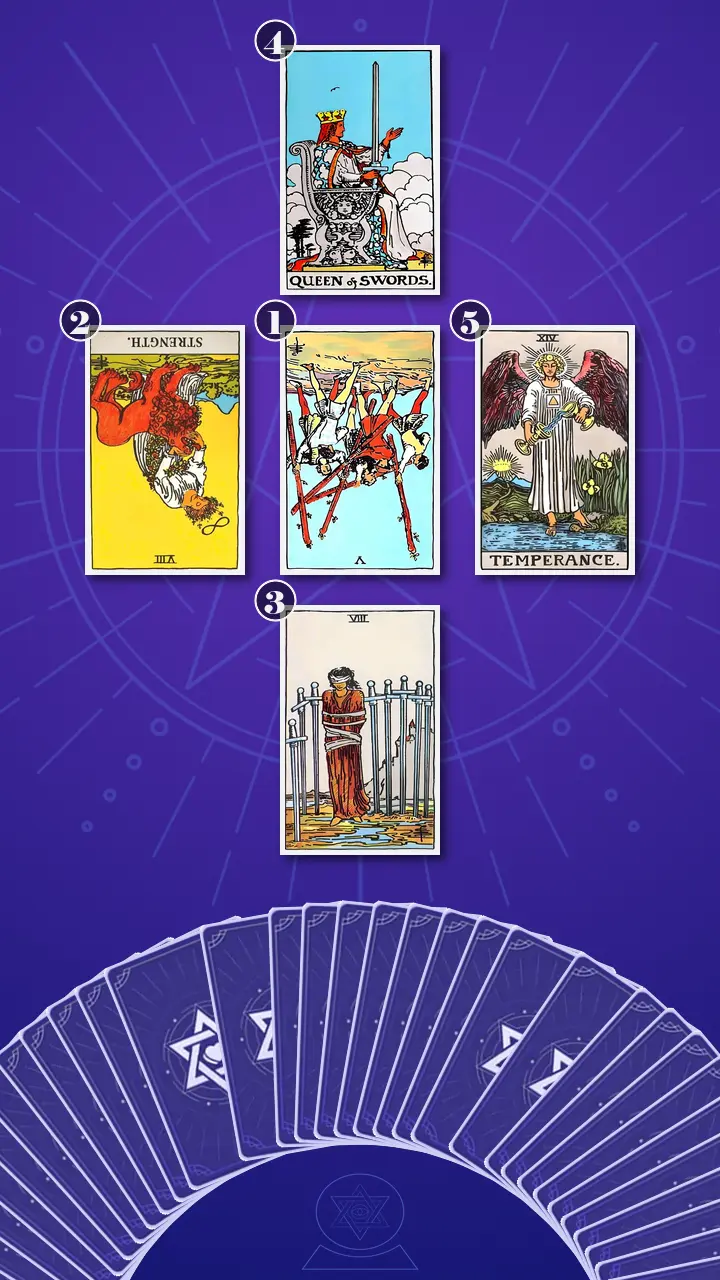
I chose the Five-Card Cross: Context Edition. For anyone wondering how tarot works in a psychological consultation, I treat each position as a focused question and each card as an image that makes an otherwise hidden pattern easier to observe. Tarot cannot prove another person’s intentions, diagnose an attachment style, or predict whether a relationship will survive. It can help externalise a pattern so the person living it can examine their assumptions and decide what to do next.
This five-card relationship tarot spread suited Jordan’s question because the issue was not simply, “What does my partner feel?” It was, “Why does my own emotional response disappear from the conversation?” A larger predictive spread would have introduced future claims and outside influences we did not need. The Five-Card Cross gave us the smallest complete chain: visible shutdown, immediate fear, restrictive belief, available guidance, and a developing form of integration.
I placed the first card at the centre to show the diagnostic symptom: anger turning inward while visible conflict disappears. The card to its left would reveal the fear that makes speaking feel dangerous. The card below would expose the rule beneath that fear. Above the centre, the key card would show the constructive bridge from anger to language. The final card on the right would describe a practice Jordan could develop, not a fixed relationship outcome.
The shape resembled a closed pressure valve beginning to open into a channel. I reminded Jordan that the cards would describe possibilities and patterns; Jordan would remain the person deciding which interpretation fit, which boundary mattered, and whether any conversation was safe enough to resume.
The Argument That Moved Off-Screen
Position 1: Five of Wands Reversed and the Quiet Kitchen
I began with the card representing the diagnostic symptom: turning anger inward, becoming quiet, and removing visible conflict without resolving the disagreement. I turned over the Five of Wands, reversed.
I pointed to the five staves colliding without a shared direction. Reversed, I read their Fire as a Blockage. The energy of disagreement had not vanished; it had been redirected inward. Jordan’s face could remain still beside their partner while rebuttals, explanations, and imagined counterarguments continued competing beneath the surface.
“This is your kitchen scene,” I said. “You say nothing is wrong and keep loading the dishwasher, but internally it sounds like: ‘I could say this—no, that sounds harsh. Maybe this—no, that will start another fight. Maybe I should explain the whole context—no, then I’ll sound dramatic.’ The visible argument stops, but the Five of Wands keeps happening inside you.”
For Jordan, it was the emotional equivalent of a Figma file full of unresolved comments being marked “done” because nobody wanted another review meeting. Closing the file changed what was visible. It did not resolve a single comment.
Jordan’s inhale caught. Their fingers stopped against the rim of their mug, their gaze shifted toward the kitchen behind the laptop, and then they gave a brief, bitter laugh.
“That’s so accurate it feels slightly brutal,” they said. “I’m usually having a much bigger argument in my head than the one we were actually having.”
“Silence can lower the volume without resolving the conflict,” I replied. “That does not make your silence malicious. It does mean the short-term relief has a longer-term cost. Your partner has to guess whether you need space, reassurance, an apology, or a changed decision, while you carry the full argument alone.”
I asked Jordan what they had done during the first five minutes after saying “I’m fine.” They listed the dishwasher, an already-clean counter, the recycling, and then their phone. The card had made the pattern concrete: chores and scrolling were not random habits. They were exits that did not include a stated pause or a path back.
Position 2: Strength Reversed and the Fear of Visible Heat
I moved to the card representing Jordan’s immediate challenge: the fear that acknowledging anger would lead to loss of control, escalation, or damage to the relationship. I turned over Strength, reversed.
Upright, Strength often shows a calm, trusting relationship with instinct. The figure does not destroy the lion or pretend it is not there; she meets its force without surrendering her judgment. Reversed, that trust becomes interrupted. I read Jordan’s card as a Deficiency of confidence in their ability to feel anger and remain compassionate, paired with an Excess of self-monitoring.
Jordan had described the exact modern-life version of this card. The moment they heard a firmer edge enter their own voice, heat crossed their face. They shortened the sentence, lowered their gaze, and monitored every movement around their mouth. Ordinary emotional intensity became evidence that they might turn unfair, cruel, or impossible to love.
“It is like setting a smoke detector so sensitively that making toast triggers the same alarm as an actual fire,” I said. “Your system notices heat and orders a total shutdown before checking whether you are actually losing control.”
Jordan pressed their tongue against the inside of their cheek. Their shoulders rose, stayed there, and then lowered by less than an inch.
“The second my partner looks defensive, I assume I’ve already gone too far,” they said. “Even if I’ve barely said anything.”
I asked, “When your voice becomes firmer, what do you predict will happen next?”
“They’ll think I’m attacking them,” Jordan said. “Then I’ll have to prove I’m not. Then we’ll be arguing about my tone instead of what happened. And somewhere in there, I’ll become the problem.”
I heard the hidden equation clearly: emotional control had become emotional disappearance. Jordan was trying so hard not to discharge anger onto their partner that they were erasing the information inside it. The result could still feel cold or punishing from the other side, even though Jordan’s intention was to prevent harm.
“Measured strength does not require you to become expressionless,” I said. “It means noticing the lion without handing it the steering wheel. Anger and aggression are not synonyms. A firm voice is not proof that cruelty has begun.”
Position 3: Eight of Swords and the Perfect-Sentence Trap
I next turned over the card representing the psychological root: Jordan’s restrictive belief that no available sentence could be both honest and relationally safe. It was the Eight of Swords, upright.
I showed Jordan the blindfolded figure, the loose bindings, and the swords forming an incomplete enclosure. The image did not suggest unlimited freedom; the figure was genuinely constrained and uncomfortable. But the enclosure was not sealed. I read the card as Excess Air becoming cognitive restriction: too many predictions, too much editing, and too many imagined rebuttals narrowing perception until silence looked like the only enabled option.
Jordan told me about 12:18 a.m. after the kitchen disagreement. Their partner had been facing the other wall while the Notes app lit Jordan’s face blue. The radiator ticked, tyres hissed over wet pavement below the window, and Jordan drafted several responses. One sounded too harsh. One felt too vulnerable. One seemed too late. One might restart the argument. None survived review.
“It’s like I’m waiting for a relationship sentence to pass legal, brand, and stakeholder approval before I let it into an ordinary conversation,” they said.
“Exactly,” I replied. “You are not out of words; you are overloaded with possible consequences.”
I brought in my Attachment Loop Diagnosis here, using it as a sequence map rather than a fixed label for either partner. I traced the loop aloud: a dismissive or ambiguous moment activates Jordan’s fear of losing connection; Jordan predicts escalation and withdraws; the room becomes quieter, providing immediate relief; the unresolved issue leaves their partner guessing; distance and resentment accumulate; that distance then appears to prove that anger threatens belonging.
I did not tell Jordan they had a permanent anxious or avoidant attachment style. One tarot reading could not establish that, and reducing a person to an internet label would not help. What mattered was the observable loop. A protection strategy was recreating the disconnection it had been designed to prevent.
The shared apartment added real weight to that loop. Toronto rent, shared bills, and limited space made relationship stability emotionally and practically significant. I could respect why Jordan wanted to protect the home without treating self-erasure as the necessary price of keeping it.
Jordan went very still. First their breathing became shallow. Then their eyes lost focus, as though several mornings of careful coffee-making and unmentioned arguments were replaying at once. Finally, they exhaled through their nose and rubbed a thumb across the edge of the card.
“If I cannot guarantee it will land well, I decide I should not say it at all,” they said. “But I can’t guarantee that. So I just keep waiting.”
“The Eight of Swords asks for a smaller standard,” I said. “Not a risk-free conversation. Not a flawless explanation. The smallest truthful sentence you can stand behind.”
When the Queen of Swords Gave Anger One Sentence
Position 4: The Bridge from Prediction to Clear Speech
The fridge motor behind Jordan clicked off just before I reached for the fourth card. A pipe in the apartment tapped once, and the sudden quiet felt different from the earlier silence: attentive rather than sealed. I told Jordan we were turning over the key card of the reading, the position that offered the constructive bridge from emotional withdrawal to measured expression.
I revealed the Queen of Swords, upright.
I centred the contrast immediately. The Eight of Swords had shown multiple blades surrounding a blindfolded person. The Queen held one sword upright by choice. Her other hand remained open toward another person. I read her Air as Balance: discernment that could organise many competing thoughts into one accurate statement without turning that statement into a prosecution.
In Jordan’s actual life, this card looked like saying, “I am angry and need twenty minutes; I will come back at 8:30.” Then, at 8:30, it looked like returning and saying, “I felt dismissed when that decision was made without me, and I need us to discuss shared decisions before they are final.” Direct, limited, and open to response.
I used my Shadow Projection Analysis as the interpretive lens. In Jungian work, the shadow is not a hidden villain; it is often a capacity, fear, or need that has become difficult to acknowledge as part of the acceptable self. Jordan had placed assertive anger in that shadow. As a result, any firmness in their voice could be interpreted as emerging cruelty, while an ambiguous reaction from their partner could become a screen for the feared story, “They will reject me if I am fully visible.”
I was careful with the distinction. Projection did not mean Jordan had imagined the dismissive comment or that their partner’s behaviour was automatically harmless. The actual behaviour still needed examination. The Queen’s sword separated observation from forecast: “A decision was made without me” belonged on one side; “If I object, I will become unlovable and the relationship will collapse” belonged on the other. Her open hand left room to ask what the partner meant without surrendering the impact or the boundary.
I asked Jordan to return mentally to the dishwasher: a warm plate in hand, one-syllable answers, five replies colliding internally. The room had gone quiet, yet their jaw, chest, and unfinished Notes draft were still carrying the conversation.
Silence is not the same as safety; choose one clean, honest sentence and hold it as deliberately as the Queen holds her upright sword.
I let the sentence remain between us for several seconds. Then I translated the card’s bridge into the most direct form I could give it.
You do not have to become un-angry enough to deserve a voice. Give the anger one accurate sentence, a defined pause if needed, and one clear boundary or request.
Jordan’s breath stopped halfway in. Their fingers remained suspended above the mug, their pupils widened slightly, and their mouth opened before any sound came. Then their gaze moved past the screen toward the dishwasher, as though the kitchen exchange were replaying with a new line available inside it. Their jaw loosened first. Their fists followed, opening slowly against the table. Their shoulders dropped on a long, unsteady exhale, but relief did not arrive alone.
“But doesn’t that mean I’ve been doing it wrong this whole time?” they asked, with a quick flash of anger under the hurt. “I thought I was being responsible.”
“It means silence has been protecting you from one kind of risk while exposing you to another,” I said. “That was a strategy, not a character flaw. You do not have to shame the version of you that learned it. You do get to notice that the strategy is no longer producing the connection it promised.”
Jordan looked down again. “What if I say the clean sentence and they still react badly?”
“Then their response becomes real information,” I said. “The Queen gives you authorship over your language, not control over another person. Being clear is not the same as being cruel, and clarity does not obligate you to remain in a conversation that becomes insulting, coercive, or unsafe.”
I then asked, “Now, with this new view, think back to last week. Was there a moment when this insight could have changed how it felt?”
Jordan answered without their usual long edit. “When they asked what was wrong, I could have said, ‘I am angry, but I don’t want to say this carelessly. Give me twenty minutes and I’ll come back.’ I didn’t have to explain everything beside the dishwasher.”
“That is the shift,” I said. “Anger does not need a perfect brief. It needs an accurate sentence.”
I named the emotional movement we had reached: from contained anger and silent withdrawal toward candid, boundaried communication in which anger and connection could coexist. This was not proof that every conversation would go well. It was the first move from trying to control every possible consequence to trusting Jordan’s ability to make one deliberate choice.
Temperance and the Route Back
Position 5: Integration Without a Perfect Ending
I finished with the card representing Jordan’s target state of cognitive and emotional integration, not a prediction about the relationship. I turned over Temperance, upright.
I traced the stream moving between the two cups and the figure’s simultaneous contact with water and land. I read this as active Balance, not passive calm. The emotion remained in motion. Practical structure kept it from flooding the conversation or disappearing underground.
In Jordan’s daily life, Temperance looked like noticing anger, naming it, taking a defined pause, returning as promised, stating one concern, listening to the partner’s response, and adjusting the conversation without withdrawing the original request. The exchange could remain awkward. Neither person had to perform perfect regulation. The essential movement was “pause, speak, listen, adjust,” instead of “silence or escalation.”
“Temperance is an audio mixer, not a mute button,” I said. “You are adjusting the intensity without deleting the emotional track.”
The spread contained little Earth, so I translated the missing grounding into practical containers: feet on the floor, a phone timer, an exact return time, and one observable request. A pause protects connection only when it contains a path back. Without that path, “I need space” can quietly become another evening of disappearance.
As I followed the water between the cups, I remembered how often, while travelling between languages and cultures, I had mistaken a pause for an ending until someone told me what the pause meant. Silence has no universal translation. An agreement gives it context.
Jordan looked at the card for a long moment. Their shoulders loosened another fraction, and their voice became quieter without becoming smaller.
“So the goal isn’t to stay calm forever,” they said. “It’s to know how I’m coming back.”
“Yes,” I replied. “The pause is part of the route, not an indefinite disappearance. Temperance does not promise that your partner will agree with you. It shows a practice through which you can remain present to your anger, your boundary, and the other person’s response without abandoning yourself.”
The Pressure Valve Gets a Path Back
When I read the full cross as one story, the logic became clear. The Five of Wands reversed showed anger pushed off-screen but still active. Strength reversed revealed Jordan’s fear that visible heat would become harm. The Eight of Swords showed that fear hardening into the Perfect-Sentence Trap, where every possible response was rejected before the partner could hear it. The Queen of Swords restored thought to its clarifying function, and Temperance gave that clarity a repeatable rhythm of pausing, returning, speaking, and listening.
The core blind spot was the belief that an absence of visible conflict meant safety. Jordan had also been treating their partner’s discomfort as proof that the conversation was dangerous and treating perfect calm as the admission price for having a voice. But temporary quiet was not the same as repair. It was like holding a pressure valve shut to preserve the room while resentment continued to build behind it.
The transformation was specific: Jordan would move from waiting for anger to disappear to naming it, setting a time-limited pause, and returning with one feeling, boundary, or request. The Five-Card Cross had not selected a future for them. It had made the existing loop visible enough for Jordan to choose different next steps.
The One Clean Sentence and the Reliable Return Loop
I gave Jordan three small practices. I wanted each one to work in an actual Toronto apartment, during an ordinary week, without requiring a perfectly regulated mood or a two-hour relationship summit.
- The Projection Detachment ExerciseDuring a neutral five-minute window, open a phone note and create two headings: “What actually happened” and “What my fear predicts.” Under the first, write only observable behaviour, such as “The decision was made before I was asked.” Under the second, write the triggered narrative, such as “If I object, they will reject me.” Then complete three lines: “When X happened…,” “I felt angry because…,” and “What I need now is….”Keep both columns honest. Separating a prediction from an event does not excuse genuinely dismissive behaviour; it prevents the feared future from being mistaken for an established fact.
- Rehearse the Time-Boxed PauseOnce this week, while alone in the kitchen or walking around the block, say aloud: “I am angry and I do want to talk about it. I need twenty minutes, and I will come back at 8:30.” In a real disagreement, set a timer immediately. If twenty minutes is not enough, send one update with a new specific time instead of disappearing.Use the minimum version if the full script feels impossible: “I am angry. I need ten minutes. I will come back.” A return agreement applies only where dialogue is reasonably safe; no timer obligates you to re-enter an insulting, coercive, threatening, or physically unsafe exchange.
- Make One Open-Hand BoundaryDuring one low-stakes disagreement, offer one observation, one feeling, and one request, then stop. For example: “When the plan changed without checking with me, I felt angry and left out. I need us to discuss shared decisions before they are final.” Allow your partner to respond without adding every supporting argument at once.Measure completion by the action you controlled: anger named, pause stated, return kept, or request expressed. Do not grade the attempt by whether the conversation felt perfectly calm or produced immediate agreement.
I asked Jordan to begin with the five-minute Notes exercise, not the most emotionally charged disagreement in the relationship. Small steps would let them test whether a measured sentence was survivable and useful. The aim was not instant resolution. It was one truthful signal and one reliable next step.

A Week Later: The Quiet Proof at 8:30
Six days later, I received a message from Jordan. A disagreement had started beside the same dishwasher after a shared plan changed without warning. Their jaw tightened, and “nothing” was already forming in their mouth. This time, they noticed it before it became the whole evening.
They said, “I’m angry, and I do want to talk about it. I need twenty minutes. I’ll come back at 8:30.” Then they set a timer, walked around the block, and used the three-line note instead of drafting a complete case for the prosecution.
At 8:30, they returned. Their partner looked defensive, and Jordan’s throat tightened again. Jordan still gave the one clean sentence. Their partner did not immediately agree, but the conversation remained open, and Jordan did not erase the request to make the discomfort disappear.
Jordan told me they slept through the night, then woke with the thought, “What if I said it wrong?” The doubt was still there. For once, they smiled at it before making coffee. Clarity had not made them fearless; it had made the next choice visible.
I thought again of the Queen’s upright sword and open hand. The cards had not performed the change. Jordan had: by noticing the old loop, choosing a time-limited pause, returning as promised, and allowing anger to carry information rather than shame.
When someone you love asks what is wrong and your jaw locks while five answers collide behind “I’m fine,” silence can feel like the only way to protect both your belonging and the part of you that knows something was not okay. Simply recognising that conflict already means the argument is no longer completely hidden from you.
If your anger did not have to disappear before it was allowed into the room, what is the smallest honest sentence you could let it carry—one clean sword in one hand, an open palm in the other?