Whose Choice Is This?

Explore the pressure of family-triangulated decisions, matching tarot cards, and reading insights shaped by crowded choices.

Triangulated Family Decision Pressure
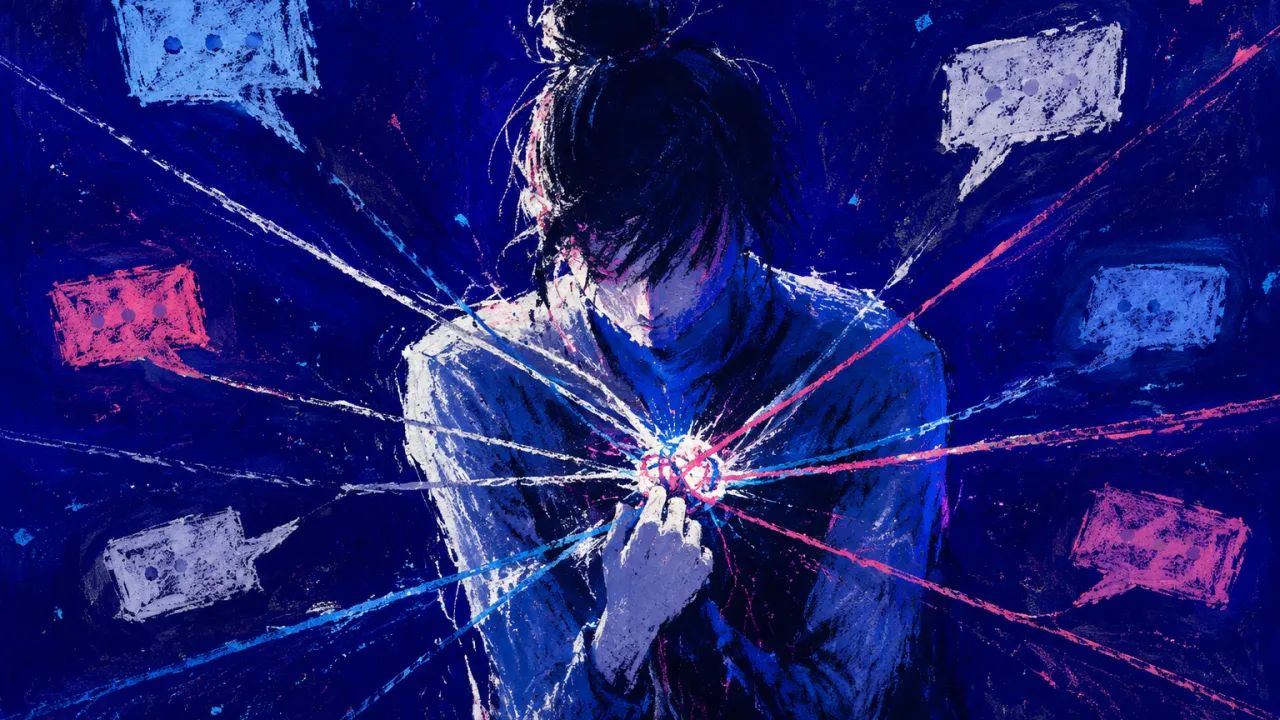
A solitary figure pulled by several glowing message threads, shoulders drawn inward around a knotted choice in deep indigo

What is this situation?

Triangulated Family Decision Pressure — you try to make one clear choice about your life, and suddenly it is no longer just your choice. It might start with a call from one parent after dinner, a text from a sibling before work, or a family group chat that turns your moving plans, relationship, school, job, housing, or holiday decision into a shared agenda. Someone says they are “just checking in,” but they already know what another person thinks; someone else asks whether you have spoken to your dad, your mum, your step-parent, your grandparents, or the sibling who “will take it personally.” Instead of one direct conversation, the decision gets split into side conversations, screenshots, hints, updates, and emotional weather reports: who sounded disappointed, who felt left out, who thinks you are rushing, who thinks you are being selfish, who says they are only worried about you. You find yourself answering the same question in slightly different ways, editing your tone depending on who is asking, and carrying messages between people who could speak to each other but keep using you as the middle point. The power dynamic is subtle because no one has to give an order; they just keep adding consequence to your answer until your own preference has to compete with everyone else's reaction. By the end of the day, your phone is quiet for five minutes and your body still acts like another message is coming, shoulders tight, chest held in, mind rehearsing how to make a decision without setting off a second round of conversations. The exhaustion comes from being asked to choose while also managing the room around the choice, much like the figure on the Two of Swords, seated still with two crossed blades held in place while the water behind them refuses to settle.

Why it's not you?

The issue is not that you are bad at making decisions; the setup around the decision has been made crowded, indirect, and loaded with other people's reactions. Side conversations, pressure disguised as concern, and relatives speaking through you are not neutral forms of support. They create a decision space where clarity has to fight through noise that should not all be yours to carry.

Triangulated Family Decision Pressure in Tarot Cards

Triangulated Family Decision Pressure turns a personal choice into a crowded room, where every answer seems to travel through someone else's version of the conversation. The tightness in your chest after another family message is not random; it tracks an environmental, structural dynamic where access, approval, and information are routed through side channels. These Tarot Cards do not decide for you or rank your relatives' opinions; they mirror the pressure pattern around the decision. Here are the Tarot Cards that tend to reflect this kind of family decision pressure.

The Hierophant
Reversed
A seated authority, two followers, paired pillars, and crossed keys create a complete system for transmitting legitimate knowledge; reversed, the system's claim to final authority becomes available for review. The image mirrors inherited family beliefs about what a good child, responsible adult, successful worker, or loyal relative is supposed to choose. The inversion does not erase tradition; it reveals the difference between consciously retained values and rules enforced through distributed family pressure. You can identify which decision criteria still belong in your adult life and which survive mainly because several relatives keep repeating them through one another.
The Lovers
Reversed
A couple stands beneath an overseeing angel while a mountain divides the landscape behind them; reversed, the relationship's own line of alignment is disrupted by a larger authority above it. The composition mirrors a partnership decision that stops being dyadic once parents, siblings, or extended family begin exchanging opinions about commitment, cohabitation, separation, or relocation. The pair remain separate from the overseeing figure, so the image preserves a boundary between the relationship and the audience around it. You can identify when family concern is supplying relevant information and when it is replacing the couple's actual values, consent, and shared decision process.
The Chariot
Reversed
An armoured driver stands above two differently coloured sphinxes, yet the vehicle has no visible reins; reversed, the opposing pulls no longer organise themselves into forward motion. The scene reflects a life direction stalled by relatives pulling toward incompatible outcomes while expecting you to convert their preferences into one coherent route. The city and road still exist within the image, but movement is blocked by a divided control system rather than by an absence of destinations. You can separate the question of where your life is going from the family demand that every stakeholder feel equally comfortable with the route.
The Devil
Upright
Two people remain linked by loose chains beneath a larger figure, making the mechanism of attachment both restrictive and physically visible. The arrangement reveals how an internal rule such as keeping everyone happy can develop inside a family system that repeatedly attaches guilt, approval, and belonging to personal decisions. The looseness of the chains keeps the structure open to examination rather than presenting it as permanent. You can identify the inherited equation between disagreement and disloyalty, then see how that equation has been doing decision-making work on the family's behalf.
Judgement
Reversed
An angel sounds a trumpet above a group rising together in response; reversed, the collective call loses its clarifying quality and begins to function like a verdict that cannot be answered cleanly. The scene resembles a family group convening around your choice until every relative's reaction feels like part of one final judgment on your maturity, loyalty, or character. The figures are responding to a call rather than originating the decision, which exposes the power of collective framing. You can distinguish accountability for the real consequences of your choice from a family tribunal that turns disagreement into a global assessment of who you are.
Three of Cups
Reversed
Three figures raise their cups in a tight circle, their shared exchange enclosed within a small social formation; reversed, the circle becomes vulnerable to gossip, exclusion, and third-party interference. The image reflects relatives privately comparing your answers, circulating screenshots, and returning a side conversation as if it were established family consensus. The three distinct figures make the relay visible, so the pressure does not have to be interpreted as a single unified voice. You can identify where mutual support has shifted into coalition-building around a choice that one person must ultimately live with.
Ten of Pentacles
Reversed
An elder, a couple, a child, and two dogs occupy a shared archway beneath ten pentacles, presenting several generations inside one material and social structure; reversed, that structure no longer converts legacy into dependable security. The image reflects a personal decision being reviewed through family history, inherited expectations, and predictions about what parents, grandparents, or siblings will consider acceptable. The generations remain individually visible despite the inversion, allowing inherited interests to be separated from the person who must live with the outcome. You can recognise when family continuity is a relevant resource and when it has become a distributed veto over housing, work, education, partnership, or location.
Two of Swords
Upright
A blindfold covers the seated figure's eyes while crossed swords require sustained effort and restless water remains behind her. The image mirrors the internal bandwidth consumed by rehearsing different explanations, predicting each relative's response, and trying to keep incompatible family reactions from colliding. The seat and balanced posture preserve a point of stillness inside that cognitive load. You can separate your own uncertainty from the mental work of simulating the family's emotional weather, making the hidden source of the stalemate more visible.
Seven of Swords
Upright
A figure removes five swords from an encampment while glancing back, leaving two behind as distant people remain outside the immediate exchange. The scene maps closely onto selective updates, partial quotations, screenshots, and relatives carrying one version of your answer into another conversation without keeping the full context intact. The separation between the carried swords and those left behind makes information loss visible. You can recognise that the family response may be organised around edited or strategically routed material, rather than around a transparent account of your decision.
Eight of Swords
Upright
A blindfolded figure stands bound within separate swords, unable to see that the enclosure contains space between its edges. The scene mirrors an internal model built from repeated family predictions: every route appears to cause rejection, conflict, or irreversible disappointment, even when those outcomes have not all been tested. The visible gaps preserve a way to distinguish internalised consequences from verified external limits. You can audit which feared reactions are based on actual dependencies and which have become automatic assumptions through repeated family messaging.
Page of Swords
Reversed
A Page grips an upright sword while turning his head into a landscape of wind-driven clouds and trees; reversed, alert information gathering loses stability and becomes reactive monitoring, gossip, or poorly handled messages. The scene resembles relatives checking what you told someone else, forwarding updates, and reading shifts in tone as evidence about the decision. The visible sword still identifies communication as the operative tool, even when its use has become unreliable. You can locate the pressure in the family's surveillance-like message habits and distinguish those habits from genuine new information about the choice.
Five of Wands
Upright
Five people occupy the same ground with staffs crossing in multiple directions, but no shared rule organises the encounter. The scene reflects a family network in which each relative introduces a different concern, loyalty claim, or preferred outcome while you are left to translate the noise into one decision. The disagreement is visible enough to be mapped, which prevents it from masquerading as unanimous concern. You can identify the separate agendas inside the pile-on and recognise that repeated family input is not automatically a coherent collective judgment.
Seven of Wands
Upright
A lone figure occupies higher ground while six staffs rise from below, requiring him to maintain a position under repeated challenge. The image presents differentiation as a visible social task: your choice has to remain identifiable while several relatives project competing fears, scripts, and loyalty demands onto it. The elevated ground does not erase opposition, but it preserves a stable reference point from which the pattern can be read. You can reconstruct autonomy as the ability to know which position is yours without needing every family participant to withdraw their objection.
Eight of Wands
Upright
Eight staffs cross the sky in quick succession above a river and settled homes, presenting movement that is fast, simultaneous, and difficult to interrupt. The scene closely matches a family network activating around your choice through calls, group-chat messages, screenshots, and rapid updates about who said what. The messages share a visible flight path, allowing the family communication system to be seen as infrastructure rather than as eight separate emergencies. You can identify how speed and repetition create the appearance of consensus before any direct, accountable conversation has occurred.
Nine of Wands
Upright
A tired guard watches sideways from behind a wand, with a row of earlier defences visible at his back. The posture captures the internal after-effect of repeated family questioning: even during a quiet interval, part of your attention continues scanning for another message, call, or emotional update. The established row behind the figure makes the pattern traceable across previous interactions. You can recognise that the ongoing alertness is linked to repeated boundary testing around this decision, rather than treating every new contact as an isolated event requiring fresh analysis.
Ten of Wands
Upright
A single carrier bends under ten staffs while everyone else remains absent from the road. The scene mirrors a family system that places the decision, the explanations, the message carrying, the reassurance, and the responsibility for everyone's reaction onto one person. The destination remains ahead, making it possible to separate the life choice from the extra load attached to it. You can recognise that being the family's central communication point does not make every concern, conflict, or emotional consequence yours to transport.

Triangulated Family Decision Pressure in Tarot Card Reading Insights

When Triangulated Family Decision Pressure follows people into a reading, the question is rarely just what to choose; it is how many voices have been attached to the choice. Others have brought this same crowded decision space into readings, looking for a clearer view of the pressure around them. Tarot Reading Insights from sessions where family pressure shaped the question.
Psychological Contexts Related to Triangulated Family Decision Pressure