Optional, But Not Really

Explore the pressure to keep showing up, related tarot cards, and reading insights from sessions around conditional participation.

Conditional Participation Pressure
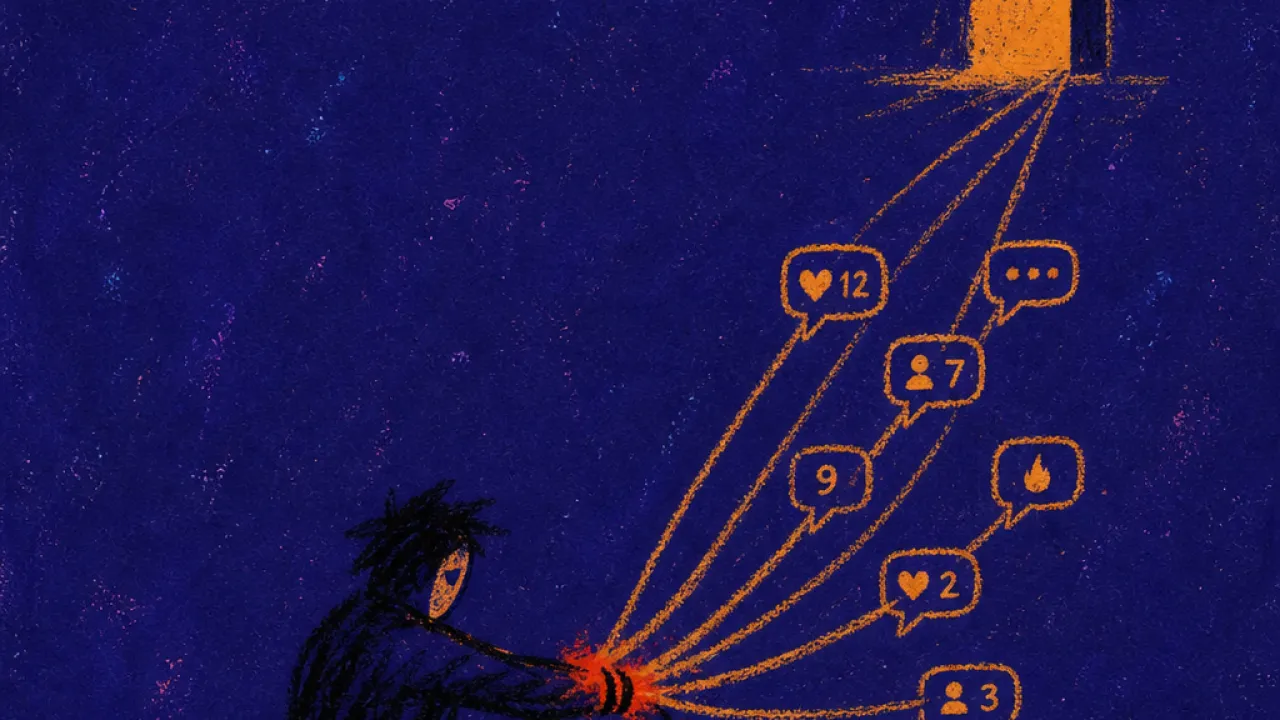
A solitary figure with wrists looped by glowing message threads, shoulders pulled toward a doorway, red marks on the skin.

What is this situation?

Conditional Participation Pressure — you enter a friend group, workplace, campus society, creator circle, or online community thinking participation is voluntary, and then the rules start showing up in the gaps between what people say and what happens after you say no. The invite says 'no pressure,' the calendar event is marked optional, the group chat drops a casual 'who's coming?' at 9 PM, but you notice how the people who always show up get the inside jokes, the quick replies, the warm introductions, the first heads-up about plans, projects, shifts, rooms, trips, or opportunities. When you skip the after-work drinks, mute the Discord, miss the volunteer shift, leave the party early, or take a weekend back for yourself, the tone changes just enough to be hard to name: fewer tags, shorter replies, a delayed 'all good,' a joke about you never being around. Nobody openly blocks you; they just make access, visibility, and warmth depend on continuous proof that you are available. Your shoulders lift before you even answer, your thumb hovers over the message, and the decision stops being 'Do I want to go?' and becomes 'What will it cost me if I don't?' Over time, your calendar stops belonging to you, because every decline feels like it might shrink your place in the room, much like the Five of Wands, where raised staffs crowd the frame and staying visible means stepping into a struggle you never agreed to join.

Why it's not you?

The issue is not that you are bad at friendship, unreliable, or too sensitive; the issue is that the setting turns access into a reward for constant showing up. When warmth, information, visibility, or opportunity are quietly reserved for people who keep saying yes, the pressure is built into the arrangement. This is participation being treated as proof of belonging.

Conditional Participation Pressure in Tarot Cards

Conditional Participation Pressure turns every invite, group chat, and optional event into a test of whether you still count in the room. The lifted shoulders and hovering thumb from that moment before you answer show how the pressure lands on the body before any decision is made. This is an environmental, structural dynamic: access and warmth are being organized around constant visible participation. Here are the Tarot Cards that reflect the shape of that pressure.

The Hierophant
Upright
The teacher on the raised seat, the two students below, and the crossed keys organise learning around sanctioned participation. A campus society, lab, cohort, or study community may place useful notes, recommendations, collaboration offers, and social legitimacy behind attendance at events that are technically extracurricular. The upright arrangement makes the hidden curriculum concrete because the gatekeeper and the route to recognition occupy the same frame. You can see when knowledge access is being attached to ritual presence rather than to your actual engagement with the course or subject.
Justice
Reversed
The scales, upright sword, and formal throne lose their stable authority when the image is inverted. The group still uses the language of free choice, but there is no reliable balance between the stated rule and the consequence: you can decline in theory while paying through reduced warmth, information, or visibility in practice. The reversed structure exposes a missing appeals process rather than merely depicting personal indecision. You can name the gap between policy and outcome even when nobody admits to imposing a penalty, which separates an authentic invitation from a choice whose social costs have been concealed.
The Devil
Upright
The loose collars, shared chain, and looming authority show how an external bond can become an internal rule. Repeated social penalties teach you to equate attendance with worthiness, until protecting one evening feels less like scheduling and more like risking your entire claim to belonging. The upright card reveals the attachment mechanism and the belief sustaining it in the same frame. You can separate the group's conditional distribution of access from the broader conclusion that every absence makes you disposable.
The Moon
Upright
The dog and wolf answer the same moon from opposite sides while a narrow path runs between two watchful towers. That ambiguous landscape mirrors the delayed reply, altered joke, or missing tag that may be harmless in isolation but starts to look patterned after you decline several group events. The upright path remains visible even though certainty is unavailable, preserving a route through observation rather than forced reassurance. You can hold both the ambiguity of any single interaction and the reality of repeated access changes without turning every notification into a verdict.
Three of Cups
Reversed
The raised cups and closely linked figures lose their open celebratory quality when inverted, creating the image of a circle whose warmth does not travel beyond the gathering. Friends who attend every party or group hangout build shared context and receive faster support, while your missed evening can become evidence that you are no longer fully invested. The reversed scene blocks friendship from remaining portable across different levels of availability. You are left managing a bond whose closeness depends less on mutual understanding than on continuous physical or digital presence.
Two of Pentacles
Reversed
The juggler, infinity loop, and ships rising on uneven water lose their workable rhythm when the image is inverted. Optional gatherings keep entering the loop as socially consequential obligations, leaving you to reorganise work, sleep, errands, and recovery around demands that the group refuses to classify as demands. The reversed orientation shows a daily system with no protected baseline and no stable way to absorb one more request. Your calendar becomes the site where the group's hidden participation rule consumes resources that were meant to support the rest of your life.
Three of Pentacles
Reversed
The maker, observers, and shared architectural plan lose their functional alignment when the scene is inverted. A study group or campus society may claim to reward academic contribution while circulating notes, collaboration invitations, and recommendations mainly among people who attend every social or extracurricular gathering. The reversed structure blocks a dependable route from actual work to group recognition. You can be prepared and engaged yet find that access is controlled by visibility in spaces unrelated to the learning task itself.
Five of Pentacles
Upright
The pair outside the illuminated window embodies proximity without entry: warmth is present, but it is not reaching the people in the street. In friendship, you may still see the shared jokes, plans, and mutual support continuing while your own access thins after you cancel, leave early, or become less constantly available. The upright light makes the relational resource concrete and therefore auditable. You can distinguish an ordinary scheduling gap from a friendship system that withdraws closeness to make future attendance more likely.
Six of Pentacles
Reversed
The unequal heights of the giver and recipients, together with the scales and coins, become more precarious when inverted. In a friend group, one part of the circle may control invitations, emotional support, and introductions, then make those resources more available to friends who consistently attend or respond. The reversed exchange deprives friendship of a stable reciprocity standard because access depends on satisfying the gatekeeper's attendance expectations. You can see how warmth becomes a behavioural reward rather than a freely mutual feature of the relationship.
Two of Swords
Upright
The blindfolded figure holds two swords in exact tension while rocks interrupt the water behind her. Your RSVP carries the same suspended structure: attending costs time and capacity, while declining carries consequences that remain obscured until the group changes its behaviour. The upright balance preserves a pause in which neither option has yet been forced and the blindfold is not permanent. You can identify which information is missing, especially whether access survives a respectful no, before treating the group's preferred answer as the only viable choice.
Eight of Swords
Upright
The blindfold, loose ropes, and surrounding blades turn uncertainty into a full-body state of restricted movement. After enough delayed replies or missing invitations, you may begin rehearsing excuses, monitoring every tone shift, and treating a casual RSVP as a test whose wrong answer could close the group around you. The upright gaps between the swords preserve a distinction between internalised restriction and the external pattern that taught it. You can locate which parts of the pressure come from observable group behaviour and which parts now continue automatically before anyone has responded.
Five of Wands
Upright
The overlapping staffs and tightly packed figures show attention being produced through continual participation in the same crowded space. A friend group can recreate this contest when inside jokes, loyalty, and future invitations accumulate around whoever appears most often, leaving every absence to feel like surrendered ground. The upright field makes the rivalry visible without declaring that friendship itself must operate this way. You can see when the circle has replaced durable connection with a live ranking system based on attendance and responsiveness.
Seven of Wands
Upright
The elevated figure meets six incoming staffs with one staff of his own, turning a single position into something that must be defended repeatedly. Friends may question each cancellation, mock your absence, or demand reassurance that you still care, shifting the burden from their disappointment to your right to control your time. The upright high ground keeps your position available even while it is contested. You can see that the recurring argument is not only about one missed plan; it is about whether the friendship circle accepts boundaries without downgrading closeness.
Nine of Wands
Upright
The bandaged figure grips one staff while eight more form a guarded line behind him. Repeated small penalties after missed events can create the same posture: your body prepares for negotiation before the message is opened because prior declines have produced cold replies, teasing, or reduced access. The upright figure remains standing and the staffs create a visible perimeter rather than a sealed prison. You can recognise accumulated social wear without treating every new invitation as identical, separating present evidence from the defensive readiness built by the pattern.
Ten of Wands
Upright
The bundled staffs fill the carrier's arms and block his forward view even though the town remains visible ahead. Each optional dinner, volunteer shift, late-night chat, and weekend event becomes another obligation carried to prevent social access from shrinking, until the group's hidden membership fee occupies the whole calendar. The upright card keeps the load concrete, countable, and physically held rather than presenting it as a vague personal defect. You can see where participation has become infrastructure-level burden and where the destination of a workable daily life is being obscured by commitments that were never openly required.

Conditional Participation Pressure in Tarot Card Reading Insights

When Conditional Participation Pressure makes every decline feel like it might shrink your place in the room, other people have brought that same bind into readings. The shift here is from the card list to the ways readings hold the pressure to show up, answer, attend, and prove belonging. Tarot Reading Insights from sessions.

Psychological Contexts Related to Conditional Participation Pressure