Deleting "What I actually want is..." Then Letting One Answer Stay

The 11:40 p.m. Delete Behind Relationship Decision Paralysis
I have met the pattern often: someone can build a flawless Notion board for moving dates, rent, commutes, and contingencies, yet the sentence “My current honest preference is...” never makes it into the document. That is relationship decision paralysis in spreadsheet form.
At 11:40 p.m. Toronto time, Maya, a 29-year-old product designer, appeared on my screen from the narrow desk in her condo. The radiator clicked behind her. Peppermint tea had gone cold beside the laptop, and its fan pushed warm air over her hands while her phone rested hot against her palm.
She shared the planning document she and her partner had been using. Three polished timelines filled the screen. Housing costs, commute times, and possible move dates sat in tidy columns. At the bottom, a cursor blinked after the words “What I actually want is...”
Maya highlighted the sentence and deleted it.
“Sorry,” she said. “That is literally why I booked this. I keep saying I could make either option work. Then I spend the rest of the night feeling like I have swallowed the actual answer.”
I watched her fingers tighten around the phone. Whenever her partner asked a direct question about their shared future, something inside her seemed to raise a drawbridge across her throat. Her mind could keep sending evidence, alternate routes, and carefully balanced arguments around the walls, but no first-person sentence could cross.
“I don't know whether I'm confused or just afraid of what I know,” she said. “I want us to choose together. I'm just scared one truthful sentence could change what ‘we’ means.”
There was the central fracture: Maya wanted an honest, jointly chosen future, but feared that admitting a private preference might alter the relationship she was trying to protect. Her flexibility kept the room calm in the short term. Afterwards, it left her chest braced and her thoughts circling like traffic denied an exit.
“I am not going to ask the cards whether the relationship will last,” I told her. “They cannot make a voluntary decision for either of you, and they cannot tell me what your partner privately thinks. What they can do is separate observation from projection, preference from ultimatum, and uncertainty from self-erasure. Let us give this fog a map, then decide which part of the map is actually yours to draw.”
Choosing the Bridge Map
I invited Maya to put the shared document behind the video window, place both feet on the floor, and take one comfortable breath. I shuffled slowly while she held a single question in mind: “What am I not admitting while we decide what our future looks like?” The pause was not mystical theatre. It was a psychological threshold between managing every scenario and examining the one she was already living.
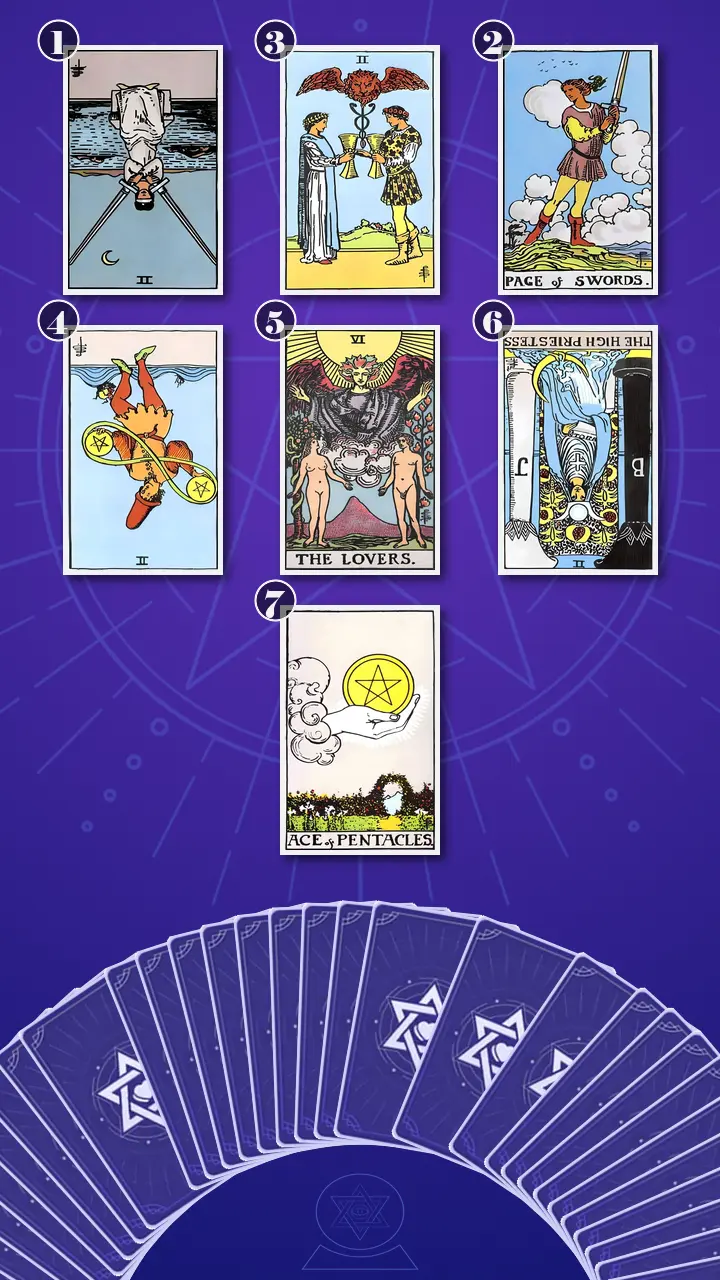
I chose the Relationship Spread · Context Edition, a seven-card relationship tarot spread designed for a shared-future conversation. I use it when a broad life reading would create unnecessary noise. A Celtic Cross could have surveyed Maya's entire world, but this question required a more exact structure: her visible stance, her partner's observable stance, the bond between them, the current pattern, an underused strength, the unadmitted challenge, and one grounded next step.
I arranged the cards in a three-column grid. The top row placed two perspectives on opposite sides of their relational foundation. The middle row held the overloaded dynamic, the strength available to them, and the truth being withheld. The final card sat below like one stepping stone rather than a promised destination.
This is how tarot works in my practice. The spread externalises categories that anxiety tends to merge. It lets me ask what is known, what is assumed, what is felt, and what can be tested. Card meanings in context are not verdicts. They are prompts for cleaner thinking and more informed choice.
The Blindfold That Had Started to Slip
Position 1: The Sentence Behind the Crossed Swords
I began with the position representing Maya's conscious stance and observable decision behaviour: qualifying her preferences, comparing more scenarios, and withholding a clear first-person answer. The card was the Two of Swords, reversed.
The blindfolded figure and crossed blades immediately echoed the document on Maya's screen. At 11:40 p.m., she had built a third future timeline even though the same preference had appeared in her private notes for weeks. She had deleted “What I actually want is,” labelled both main options workable, and postponed the conversation again.
Upright, the card can hold a temporary pause while genuine information is gathered. Reversed here, the Air energy was blocked and becoming unstable. Maya was no longer using analysis to understand the decision. She was using symmetrical arguments to brace against an answer that kept pressing beneath the blindfold.
“More information cannot recover an answer you keep deleting from the data,” I said. “The question is not whether you should stop researching practical consequences. It is whether research has become a respectable way to exclude your own input.”
Maya gave a short laugh with a bitter edge. “That is so accurate it feels a bit brutal. I've turned our relationship into one of Chidi's ethics seminars in The Good Place. If I identify every consequence, maybe I never have to be responsible for wanting anything.”
I did not treat the recognition as an accusation. “That strategy protected you from immediate conflict,” I said. “It makes sense that you learned to use it. We are only noticing that the protection now costs more than it saves. Being flexible stops being generous when it requires you to disappear.”
Her hand loosened around the phone, although her thumb continued tracing its edge.
Position 2: Evidence Before Interpretation
I next turned to the position representing the other person's visible stance as Maya currently perceived it, limited to observable questions, statements, and follow-through rather than guesses about private thoughts. The card was the Page of Swords, upright.
The Page held a raised sword while looking sideways into fast-moving weather. I saw clean curiosity mixed with constant readiness. Maya described rereading message threads, studying response times, and treating a short pause as evidence that disagreement would go badly. It was like holding a phone ready for breaking news from a crisis that had not actually been declared.
The upright Page offered alert Air in a potentially balanced form, but Maya was carrying part of that alertness in excess. Observation had blurred into projection. The remedy was not to ignore her partner's reactions. It was to distinguish what had literally happened from what apprehension had added.
“What did your partner actually ask?” I said.
“Would I want to move next year?”
“And what did you add?”
She looked away from the screen. “That there was a correct answer. That if I said no, they would hear it as no to everything.”
I suggested a neutral Page of Swords question: “When you say next year, are you asking about my readiness, my preference, or the logistics?” One direct clarification could produce cleaner evidence than ten minutes of tone analysis.
Maya's jaw shifted as though she had been preparing to defend a conclusion and had discovered there was only a question in front of her.
Position 3: Two Separate Cups at the Same Table
I then read the position representing the relationship's foundation: why Maya wanted to protect the bond, and what kind of reciprocity was already available for a more honest conversation. The card was the Two of Cups, upright.
I directed her attention to the two figures standing at equal height, each holding a separate cup. Neither person emptied their answer into the other's vessel. The Water energy here was balanced: connection through exchange, not fusion through automatic agreement.
In contemporary terms, I saw Maya and her partner sitting at the kitchen table and describing their current answers before discussing compromise. One person might say, “I want this.” The other might say, “I am not there yet.” The health of the exchange would not be measured by matching sentences, but by whether both people could remain present long enough to understand the difference.
“Can you remember a smaller disagreement the two of you handled without punishment, pressure, or withdrawal?” I asked.
Maya recalled a work opportunity that had disrupted a holiday plan. Her partner had been disappointed, but they had asked questions, adjusted the dates, and resisted turning the difference into a referendum on the relationship.
“That does not guarantee an easy response now,” I said. “It does show that reciprocity is not imaginary. The Two of Cups is a resource, not a promise.”
Her shoulders descended by a fraction. She was not being asked to gamble on a fantasy of perfect understanding. She was being invited to recognise a capacity the relationship had already demonstrated in a smaller room.
When the Notion Board Ate the Question
Position 4: The Infinity Loop of Logistics
I moved to the position representing the present relationship dynamic: the way future-planning logistics and multiplying scenarios kept the core contradiction active. The card was the Two of Pentacles, reversed.
The infinity-shaped ribbon around the pentacles resembled the loop in Maya's shared planning document. Rent projections led to neighbourhood rankings. Neighbourhood rankings led to commute calculations, alternate dates, mortgage tabs, and new dependencies. Each time the conversation approached “Do you want this?”, another practical variable entered the project board.
Pentacles usually help turn ideas into workable reality. Here, that Earth energy had moved into excess and overload. Coordination had become an unsustainable juggling act. Practical competence was keeping the emotional question off the agenda.
“The private logic sounds something like this,” I said. “If I keep every variable open, I never have to reveal which outcome I am hoping for.”
Maya exhaled through her nose and glanced at the document behind our call. “There are twenty-seven rows,” she said. “Not one of them says whether I want the life attached to the apartment.”
Her fingers flattened against the desk, then lifted. For a moment, she looked less like someone failing to solve a complicated future and more like someone noticing that the central task had never been assigned.
“Do not solve the five-year plan inside a thirty-minute conversation,” I said. “Complexity is real, especially with Toronto housing costs. But complexity should inform a preference, not impersonate one.”
When The Lovers Chose Consent Over Compatibility
Position 5: Two Complete Answers
I turned to the position representing the relationship's underused strength: the capacity to move from immediate harmony towards informed, values-aligned mutual choice. The card was The Lovers, upright.
I made the distinction carefully. The Lovers did not promise compatibility, matching futures, marriage, or any predetermined outcome. The card showed two uncovered figures standing separately beneath the angel, with a mountain visible between their landscapes. Openness did not remove difference from the picture. It made conscious choice possible in the presence of difference.
The energy was balanced but underused. Maya and her partner could agree on the values governing the process before trying to agree on an outcome: no forced certainty, no punishment for “not yet,” no compromise before both original preferences were understood, and no assumption that honesty must be an ultimatum.
“Imagine two complete answers arriving at the same kitchen table,” I said. “Maybe the relationship is not protected by matching answers. Maybe it is protected by both answers being real.”
Maya's reaction came in three small movements. Her breath paused. Her eyes settled on the separate figures as though the image were revising an old memory. Then the muscles around her mouth softened, although a faint sadness remained.
“I've been treating my flexibility as the loving answer,” she said. “But if they are making choices based on a version of me that always says yes, that isn't fully informed, is it?”
“No,” I said. “A shared future needs two complete answers, not one answer and one carefully edited echo. Informed consent requires a genuine option to say yes, no, not yet, or I do not know. That principle protects both of you. It does not guarantee that the answers will be painless.”
I could see the relief in her lowered shoulders, but also the new vulnerability that came with it. If honest difference was part of love rather than a failure of it, Maya could no longer use perfect agreement as the only proof that the bond was safe.
When The High Priestess Let the Hidden Sentence Speak
Position 6: The Truth Behind the Veil
The radiator in Maya's condo stopped ticking as I reached the position representing the unadmitted need, limit, preference, or genuine uncertainty at the centre of the challenge. The sudden quiet seemed to gather around the card. It was The High Priestess, reversed.
The veil and partly concealed scroll showed information held at a threshold. Reversed, the receptive energy of the High Priestess had become blocked. Inner authority was not absent; it was being mistrusted and suppressed. Maya felt her throat tighten when one timeline was mentioned, received the sentence “I do not want that yet,” and immediately opened Notes, a spreadsheet, or a group chat until the signal could be rewritten as “we need more data.”
“You are treating a recurring body notification as though it were a software bug because the message is inconvenient,” I said. “You felt the answer for half a second, then cross-examined it until it sounded inconclusive.”
I asked her to hold the 11:40 p.m. scene still: three polished timelines, a warm phone, the cursor after a deleted sentence, and her throat tight in the quiet. She had been demanding certainty about the whole relationship before granting herself permission to report one current preference.
At that point, I reached for one of my most reliable analytical lenses, Historical Crossroad Matching. On archaeological digs and in archives, I have often seen how a turning point later described as inevitable was anything but inevitable to the people living through it. Up close, the decisive issue was frequently which evidence could enter the room before a choice became irreversible.
For a moment, I was back at a trench edge, brushing soil from an old threshold. A buried object is not the same thing as a missing object. Its concealment is part of the evidence.
I told Maya that durable systems do not survive by excluding every disruptive fact. They survive by allowing inconvenient information to arrive while there is still room to negotiate with it. Her relationship was not a civilisation, and I would not inflate a private conversation into one. The useful historical match was procedural: a preference voiced early is negotiable information; a preference buried until resentment hardens may eventually require rupture just to become visible.
“You do not need certainty about the relationship to be honest about what you want from this conversation,” I said. “A current preference is information, not a final verdict.”
Stop calling every inner signal insufficient evidence; name the preference you keep behind The High Priestess's veil, then test it in the open.
I let the sentence remain between us without adding an explanation.
Her breath stopped first. Her fingers froze above the keyboard, and for a moment the blue screen light flattened her expression. Then her pupils widened and her gaze moved past me, unfocused. I could almost see the replay: the kitchen, the kettle, wet traffic below the window, the answer arriving and being replaced. Her lips parted, closed, then pressed into a line. A flush rose along her cheekbones. The third movement was not neat relief. Her shoulders dropped and her clenched hand opened, but her eyes filled as if losing an old protection had left her briefly without balance. She released a low, shaking breath. “But doesn't that mean I've been wrong this whole time?” she said, sharper than before. “That I've been pretending?” Beneath the anger, I heard grief for every calm conversation that had cost her a little visibility, and fear of the responsibility that clarity might return to her.
I did not hurry to turn that anger into gratitude. “No,” I said. “It means a protective strategy outlived its usefulness. You were trying to preserve something you valued. We can respect why you did that without asking you to keep doing it. Honesty today does not require condemning the person who was frightened yesterday.”
I waited until her breathing steadied. “Now, with this new perspective, think back to last week. Was there a moment when this insight might have made you feel different?”
“Sunday,” she said. “The kettle had just clicked off. They asked whether I actually wanted to move next year. The first answer was no.” She swallowed, but continued. “Not no forever. Not no to us. I didn't want to move next year, and I wasn't ready to say when I would.”
She looked startled after speaking, as though the ceiling had remained in place despite the sentence.
“This may not be your forever answer,” I said. “It is your honest answer today. Your current preference is information, not a life sentence.”
That distinction marked the first movement from guarded apprehension and self-silencing to grounded trust in an honest, consent-based negotiation process. It did not resolve the relationship's future. It made uncertainty discussable by returning one missing participant, Maya herself, to the conversation.
I asked her to open a private note rather than the shared plan. She created three lines: “My current honest preference is...” “A limit I do not want to negotiate away is...” and “What I genuinely do not know yet is...” I told her she could stop after one line, revise it later, keep it private, or pause if her body became overwhelmed. The purpose was to notice the unedited signal, not force a disclosure.
Position 7: One Stone on the Open Path
I finished with the position representing the smallest grounded action that could place one honest preference into the relationship and gather real information without demanding a final outcome. The card was the Ace of Pentacles, upright.
A single pentacle rested in an offered hand. Beyond it, a cultivated garden opened onto a path through an arch, with mountains still in the distance. The destination had not vanished, but the card did not demand that Maya reach it in one leap.
This was balanced Earth energy: one tangible, bounded beginning. In Maya's life, it looked like bringing one sentence from her private note to a thirty-minute conversation about one topic. Instead of deciding the entire five-year future, she and her partner could create a temporary agreement or limited experiment, define each person's boundaries, and set a date to review what the experience had taught them.
“We can learn from one honest, reversible step,” I said. “Experience may produce evidence that another round of speculation cannot.”
Maya opened her calendar. Her hand hovered over Saturday afternoon, then relaxed. She did not schedule anything yet. I considered that restraint part of the card's wisdom. A grounded beginning is chosen, not performed to prove that a reading worked.
The Missing Fire in the Shared Map
I drew the seven cards into one story. Maya's work had taught her to identify every stakeholder perspective and produce language everyone could accept. That skill, combined with Toronto housing pressure and a stream of other people's visible milestones, had followed her home. The Two of Swords reversed showed analytical balance becoming a defensive stalemate. The Page separated evidence from threat-monitoring. The Two of Cups revealed genuine reciprocity. The Two of Pentacles reversed showed logistics swallowing the emotional agenda. The Lovers restored consent and values. The High Priestess reversed identified the first-person information being withheld. The Ace of Pentacles turned that information into a testable next step.
The elemental pattern sharpened the diagnosis. Air was busy, Water cared deeply, and Earth was overloaded before becoming practical again. No Wands appeared. The missing Fire was not drama or a sudden ultimatum. It was the simple heat of personal desire: “I want,” “I cannot,” and “I do not know.” Maya had been helping to draw a shared map while quietly erasing the destination that mattered to her.
Her cognitive blind spot was the belief that a calm conversation was necessarily a successful one. Immediate harmony could coexist with self-silencing. The transformation was therefore not from uncertainty to total certainty. It was from endless scenario comparison to naming one honest preference, one non-negotiable, and one genuine unknown before negotiation began.
I applied my second lens, the Enduring Value Assessment. Ten years from now, the exact apartment, timeline, or spreadsheet might be forgotten. The decision-making structure would endure. What mattered was whether both people had been able to enter the choice as distinct, informed, voluntary participants. That process had lasting value whether their current answers eventually matched, changed, or revealed a difficult difference.
The Time Stratigraphy Exercise: Two Grounded Next Steps
I translated the reading into my Time Stratigraphy Exercise. I asked Maya to imagine standing ten years ahead and looking back at the present as one visible layer in her life. Her future self was not allowed to reveal which relationship outcome occurred. She could assess only which habits had survived the test of time: preserving one quiet evening through self-erasure, or building a process in which truth could be spoken before compromise.
- Ten-Minute Time Stratigraphy For seven days, after one future-related thought or conversation and before opening the shared planning document, Maya would set a timer for no more than ten minutes. She would picture her ten-year future self observing the decision process, then complete three private lines: “My current honest preference is...”, “A limit I do not want to negotiate away is...”, and “What I genuinely do not know yet is...” At the end of the week, she would circle any repeated words. Keep the note private unless sharing feels chosen. If ten minutes feels activating, write three words or complete only the preference line, then stop. The note records information; it proves nothing and commits her to nothing.
- One-Question Planning Conversation Maya would invite her partner to one thirty-minute conversation at home about location only, leaving housing costs, timing, finances, and every other connected topic on a visible parking list. She would begin by asking, “Are you open to hearing my current answer without treating it as a final decision, and then telling me your current answer?” She would read one Preference-Limit-Unknown sentence before either person proposed a compromise. Either person may pause and neither owes an immediate answer. The minimum version is ten minutes, one preference sentence, and a date for the next conversation. When a new variable appears, park it instead of opening another tab.
I made the boundary explicit: these actions were not techniques for securing agreement. They were ways to produce honest relational information while preserving both people's autonomy. The result might be reassuring, complicated, or mixed. Maya's power lay in participating visibly, not in controlling her partner's response.

Six Days Later, One Sentence Stayed
Six days later, I received a message from Maya. She had held the location-only conversation and read from her note: “My current preference is not to move next year. My limit is that I don't want to sign a lease just to end the uncertainty. I genuinely don't know how I will feel in six months.”
Her partner's answer was not identical. They asked for time to think, and the larger plan remained unresolved. Still, neither person opened the housing spreadsheet. They scheduled another conversation for the following weekend and left the other questions on the parking list.
That night, Maya slept through until morning. Her first thought was still, “What if I got it wrong?” This time she smiled, put both feet on the floor, and let the question remain unanswered.
I did not regard that small change as evidence that the cards had predicted or repaired her future. The spread had provided an objective structure for separating facts, projections, values, inner information, and next steps. Maya supplied the courage, the boundary, and the sentence. She remained the author of every choice that followed.
That was her Journey to Clarity: not certainty about what “we” would become, but a grounded trust that she no longer had to remove herself in order to protect it.
If your throat closes around the one sentence you most want to say, I know it can feel as though protecting a shared future requires quietly erasing your destination from the map. Simply noticing that deletion means you are no longer standing at the beginning.
If your current preference were allowed to enter the shared map as information rather than a verdict, what few words might you finally let emerge from behind the veil?