If You Stop, Are You Enough?

Explore how output becomes self-worth, the tarot cards reflecting that bind, and reading insights from others who brought it to a spread.

Productivity-worth Fusion
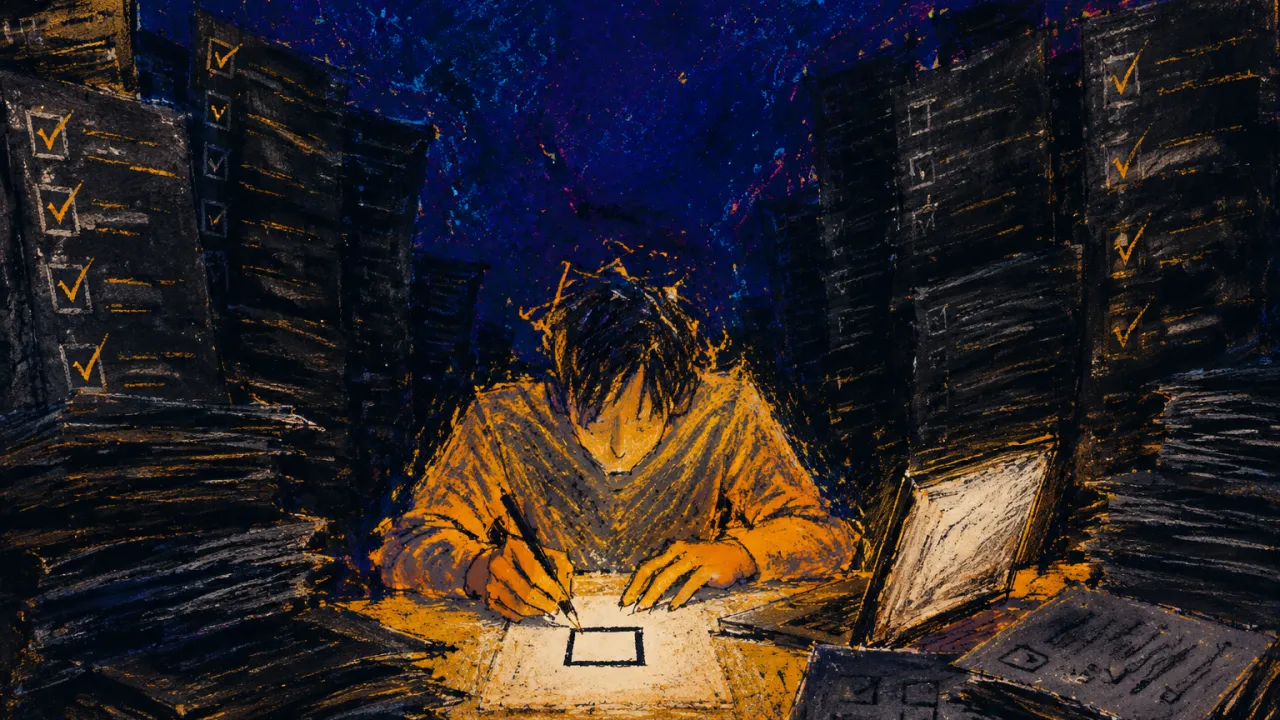
Figure at a desk enclosed by doorless checklist walls, amber-lit shoulders and hands frozen above a white checkbox

What does this feel like?

Productivity-Worth Fusion is what it feels like when a to-do list stops being a list and starts reading like a verdict on whether you deserve to feel okay. You wake on a Saturday and reach for your phone before your eyes have adjusted, checking email, deadlines, and the small red numbers beside unfinished tasks; within seconds, your shoulders have lifted and the day already feels behind. When you finish something, there is a brief drop in pressure, but satisfaction barely lands before your mind asks what is next, what was missed, or whether the work was impressive enough to count. Rest does not feel neutral. Sitting on the couch while laundry waits can make your chest buzz; hearing someone ask what you did today can send you searching for an answer that sounds useful. Even praise can slide past unless it names an outcome, because being liked, wanted, or present feels less solid than being needed for what you deliver. You may plan breaks as another performance, track hobbies, turn sleep into a score, and call an evening wasted because nothing measurable came from it. The strange part is that you can know this equation is unfair and still feel your stomach sink when your output slows. One side of you wants space, play, and time that does not have to lead anywhere; the other treats every pause as missing evidence in the proof you are always assembling for your own value. Over time, the cost is not only tiredness; it is the shrinking of a life until your hands are busy but your presence feels conditional, as if stopping would make you harder to locate even to yourself, much like the figure on the Eight of Pentacles, bent over one more pentacle while the finished ones hang beside him and the distant town remains behind his back.

What's pulling at you?

Part of you needs achievement to provide direction and a solid sense that you matter; another part knows that a life spent constantly proving your value never lets that value feel settled. You are stuck because slowing down threatens the only evidence you trust, while continuing to produce keeps moving the point at which you are finally allowed to feel enough.

How It Shows Up?

  • You wake up on a Saturday and, before your eyes fully focus, open your task app to see what can be crossed off. The blue light catches your dry eyes, your shoulders rise toward your ears, and the thought arrives: if I get enough done early, I can relax later. The first ten minutes of the day can remain unscored, even while the urge to measure them is present.
  • You submit a report, assignment, or application, then reopen it minutes later to check for mistakes and refresh for a response. Your hand hovers over the mouse, your jaw stays firm, and the finished files line up like pentacles on a wall without giving you the settled feeling you expected. The file can stay sent even when relief has not arrived with it.
  • A friend or partner asks how your day was, and you mentally edit out the nap, the scrolling, or the hour spent doing nothing so your answer sounds more useful. Your stomach dips, your palm presses into the edge of the table, and a quiet voice starts building a list of errands to justify the time. You can leave a pause in the answer without filling it with proof.
  • At drinks, lunch, or a group hangout, someone mentions a promotion, a new project, or a packed week, and you immediately search your own life for something equally measurable to offer. Your smile holds while your breathing becomes shallow, as though an invisible set of scales has appeared between you. You can notice the comparison without turning the conversation into a ranking.
  • At 11:47 PM, one unchecked box keeps you at the laptop even though the words on the screen have started to blur. Your shoulders carry the weight of the Ten of Wands, there is a dull pressure behind your eyes, and closing the lid feels less like stopping work than losing the day's evidence that you mattered. The unchecked box can remain visible without deciding what the night meant.

Productivity-worth Fusion in Tarot Cards

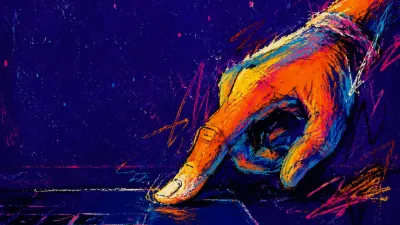
Productivity-Worth Fusion takes shape when unfinished work feels like a verdict and completed work grants only a brief reprieve. It can be felt in shoulders held high over a laptop and a hand hovering above one last checkbox. From an existential view, its structural framework is the bind between needing output to prove value and never producing enough to make that value feel settled. The Tarot Cards below mirror the visible contours of that bind.

Wheel of Fortune
Upright
A large wheel turns above figures climbing, falling, and clinging to different sides, while a sphinx watches from the top and four creatures hold their positions around the frame. The scene places productivity inside changing cycles, yet your metric tries to make worth constant by demanding the same visible output in every phase. When energy, opportunity, or workload shifts, you may read the change as a drop in personal value. The wheel gives the fluctuation a structural shape: the distress comes from treating a moving system as though it were a permanent test.
The Hanged Man
Upright
A figure hangs from a living branch by one bent leg, with a halo around the lowered head and the body held outside ordinary orientation. The visual interruption challenges a cognitive system that recognizes only forward motion; you encounter growth as a pause in which no new output can immediately confirm that you are evolving. The living wood keeps the suspended figure connected rather than erased. You may resist that altered perspective because slowing down threatens the identity built through achievement, yet the image makes the belief structure visible without declaring that your value has stopped.
Temperance
Reversed
An angel pours liquid between two cups while standing with one foot on land and one in water, visibly combining different conditions. Reversed, the flow loses its regulating rhythm: personal growth is reduced to another optimization project, and recovery is judged by how efficiently it restores output. You may try to balance ambition, sleep, play, and reflection through increasingly precise systems. The two vessels show the cognitive split clearly: one part wants a sustainable whole, while another refuses to recognize any practice unless it produces measurable improvement.
The Devil
Upright
A horned figure sits above two chained bodies, with the chains loose enough to show that the bond is reinforced by perception and structure as well as force. The elevated figure turns usefulness into an inner authority; you keep feeding it completed tasks because the bargain promises a temporary location for your worth. The flames and dark pedestal make the emotional economy visible. You may understand that the equation is unfair and still feel pulled toward the next task, because output reduces uncertainty for a moment while making the inner world increasingly dependent on proof.
The Tower
Upright
A lightning-struck tower loses its crown as figures fall through a dark sky, with fire breaking the structure from inside and out. The image gives form to the fear that stopping will not merely delay work but expose the collapse of the identity built around being productive. You may cling to the tower because its height has organized your sense of direction and importance. The falling architecture is a model of a belief system under pressure, making room to examine which parts of value were structural support and which were only a crown placed on output.
Judgement
Upright
An angel raises a trumpet above figures emerging from open coffins, their arms lifted toward a summons that reaches across the entire scene. The upright call separates a life review from a work report; you can hear a demand for fuller recognition of who you are beyond the outcomes you have delivered. The open graves make an old identity available for examination without reducing the person to its history. You may still want achievement to provide direction, but the trumpet locates growth at the point where output is evidence of activity rather than the final ruling on worth.
Reversed
An angel sounds a trumpet above figures rising from open coffins, but reversed the summons cannot become a clear release. The scene turns self-reflection into a verdict process: each unfinished task calls the witness stand, while ordinary presence struggles to count as evidence. You may inspect your day repeatedly and still find no final ruling that permits you to stop. The rising figures show a demand for reckoning, while the reversed orientation locates the lock in self-judgment that cannot convert review into integration.
The World
Reversed
A dancing figure moves inside a wreath while the four fixed creatures occupy the corners, presenting a completed whole held in a single frame. Reversed, the loop becomes difficult to inhabit: you can accumulate milestones without integrating them into a stable sense of self, so each achievement remains an isolated piece of evidence. The wreath shows that completion is structurally possible, but the reversed orientation keeps the threshold from being felt as complete. You may continue optimizing because the cognitive system has learned to recognize progress only as preparation for another test, leaving the wider life outside the circle.
Four of Cups
Upright
A seated figure rests beneath a tree while three cups sit before him and a fourth is offered from outside the frame. The closed posture and untouched offer give satisfaction a precise shape: completed work is visible, but your attention remains fixed on what has not yet arrived. You may receive praise or finish a goal and still feel emotionally unavailable to the moment because the next task occupies the foreground. The offered cup represents unmeasured presence, while the withdrawn figure shows how the productivity metric filters out any reward it cannot score.
Eight of Cups
Upright
A cloaked figure walks away from eight stacked cups under a moon, leaving the visible record of past effort behind while a mountain path recedes into darkness. The departure gives personal growth a concrete conflict: you may recognize that achievement no longer provides meaning, yet leaving its evidence feels like admitting that the old measure defined you. The empty path holds uncertainty without promising an immediate replacement. You can feel drawn toward play, presence, and a less measurable life while still grieving the identity that productivity supplied, and the scene keeps both movements visible at once.
Two of Pentacles
Upright
A young figure keeps two pentacles circling inside an infinity loop, while ships pitch across the water behind him. The scene makes daily life look manageable only while motion continues; you use each email, errand, and scheduled break as another object to keep airborne, so a quiet Saturday can feel like a dropped ball rather than a neutral choice. The rough sea supplies the pressure underneath the routine. You may organize time with impressive flexibility, yet the loop quietly converts maintenance into evidence that you are coping well enough to deserve rest. The friction is not a lack of planning; it is a system that never lets balance become stillness.
Three of Pentacles
Upright
A craftsman works beneath a cathedral arch while two robed figures study the plans and the carved forms around him. The shared architecture makes competence visible and socially legible, yet it also shows how your place at work can start depending on constant proof that your contribution is useful. You may accept feedback, praise, and collaboration only when they certify an outcome, not when they acknowledge your presence or learning. The stonework holds a real skill system, while the evaluators reveal the relational cost of turning professional recognition into a condition of worth.
Seven of Pentacles
Upright
A student-like worker leans on a hoe while seven pentacles remain attached to a growing plant, visible but not yet harvested. The image captures the academic interval after study and before grades, feedback, or admission outcomes; you inspect the evidence of effort and ask whether it is enough to justify your place. The cultivated soil shows that learning takes time, but the pause does not feel neutral when results are treated as a personal verdict. You may add hours of study to quiet the uncertainty, even though the unresolved harvest is a timing issue rather than proof that you have failed.
Eight of Pentacles
Upright
An artisan bends over one pentacle at a bench while completed pentacles line the wall and a town remains behind him. The repeated craft mirrors study organized around submissions, practice sets, and revision; you can finish an assignment and immediately return to the bench because the next result feels like the next piece of evidence. The wall confirms that work has already been done, but it does not draw the figure away from the task. You may confuse sustained learning with the obligation to keep producing, leaving curiosity and rest outside the narrow frame of academic adequacy.
Two of Swords
Upright
A blindfolded figure holds two crossed swords against the chest, with a dark sea and a rising moon behind the balanced posture. The visual stalemate turns the choice between working and stopping into a guarded negotiation; you hold both options still because each seems to threaten the evidence that makes you feel secure. The blindfold does not remove the alternatives, only blocks a wider view of their costs. You may call the pause a decision problem when the deeper lock is that rest and productivity have been assigned opposite verdicts.
Four of Swords
Reversed
A stone figure lies beneath three swords, with a fourth sword placed below the body inside a quiet architectural recess. With the card reversed, the protected chamber becomes an inner room that cannot fully receive rest; you remain mentally braced against the next obligation even when the outer day has ended. The swords frame a psychological cache filled with pending judgments. You may replay the morning's missed tasks or plan tomorrow from the couch, because stillness feels like unprocessed evidence rather than a neutral state in which your worth can remain intact.
Eight of Swords
Upright
A blindfolded, loosely bound figure stands inside a ring of swords, with a castle visible across the muddy ground. The enclosure maps a self-imposed rule set: you can move in theory, but only along the narrow route where effort keeps producing evidence. You may experience an unproductive hour as entrapment because the surrounding judgment has become internal architecture. The loose bindings matter; the structure is powerful without being permanent, and seeing its edges separates the demand to work from the fact of who you are.
Nine of Swords
Upright
Nine swords hang in a strict row above a figure sitting up in bed with their face covered. The arrangement turns a private night into a display wall for unfinished tasks, imagined criticism, and every small error you believe could expose you as less valuable than your output suggests. You may review the day long after the work has stopped, searching for a conclusion that would finally authorize rest. The enclosed bedroom shows the cost of carrying an external metric into the inner world, where productivity becomes an ongoing verdict rather than one limited part of experience.
Five of Wands
Upright
Five figures raise and cross their wands in a crowded field, each body angled toward the others without a settled winner. At a group lunch or drinks, the image becomes a social arena where promotions, packed weeks, and projects are exchanged as proof of rank, and you search for a comparable achievement before you can simply participate. The crossed staffs show friction without a clear finish line. You can notice the comparison impulse as a group dynamic rather than a fact about your worth, but the scene still captures how belonging becomes conditional on having useful evidence to add.
Six of Wands
Reversed
A rider moves through a crowd with a laurel-topped wand and a visible banner, but reversed the public victory cannot hold its shape for long. The workplace symbols of promotion, praise, and recognition become unstable signals; you keep scanning for the next result that might finally make the achievement feel real. The crowd supplies an external audience, yet its attention cannot settle the rider's inner accounting. You may perform confidence around a success while privately reopening the evaluation, because professional visibility has become fused with permission to feel worthy.
Ten of Wands
Upright
A worker bends beneath a bundle of ten wands, his face hidden and his destination partly obscured by what he carries. In a career system, every deadline, late-night revision, and unchecked box joins the same load, so you experience the burden as evidence that you are indispensable and stopping as a threat to that identity. The town ahead gives the labor a legitimate destination, but the posture shows the cost of reaching it without a clear limit. You can be highly reliable and still lose access to satisfaction when professional responsibility has fused with the need to prove that you matter.

Productivity-worth Fusion in Tarot Card Reading Insights

When worth rises and falls with what gets finished, others have brought the same bind into readings about rest, output, and the need for proof. The Tarot Reading Insights below collect what emerged in those sessions.