Fourteen Tasks Before Lunch, Then Two More Minutes With the Draft

The 8:40 A.M. Slack Red Dot
You can complete fourteen tasks before lunch and still know, with uncomfortable precision, that none of them was the task you meant to do. I have come to recognise this as the instant-gratification productivity trap in ordinary office clothes.
Casey (name changed for privacy) joined my midday video consultation from the small desk beside their Toronto apartment window. The radiator clicked behind them. A mug of coffee had gone cold beside the keyboard, and the opening paragraph of a portfolio case study remained visible beneath a flashing Slack badge.
They told me that at 8:40 that morning, they had opened the draft with every intention of making progress. Fifteen minutes later, their fingers had started tapping against the trackpad and their breathing had climbed into the top of their chest.
"I thought, 'I need one thing finished before stand-up,'" they said. "So I answered three messages, fixed a tiny UI issue, reorganised the sprint board, and cleared some Figma comments. I did a lot today, but none of it was the thing I meant to do."
I watched their hand hover near the laptop as if another notification might arrive and acquit them. Their restlessness felt less like ordinary distraction and more like standing on a subway platform while every arriving train promised immediate movement, even when none of them went toward the chosen destination.
"Busy is not the same as aligned," I said. "And I don't think you are lazy or incapable of commitment. I think the smaller tasks are doing something important for you in the exact moment the meaningful work stops providing proof. Let us map that moment before we try to change it."
Casey looked down at the unchanged sentence. "Why do I keep choosing quick wins over the goals I actually care about?"
"That is the question I want us to stay with," I said. "Not so the cards can issue a verdict, but so we can find where choice disappears from view and gently bring it back. Our journey today is about finding clarity inside the pattern, not predicting your fate."
Choosing the Switchback Map
I asked Casey to place their phone face down, rest both feet on the floor, and take one unforced breath while holding the question in mind. I shuffled slowly. I use this brief pause as a psychological threshold: a way of leaving the noise of the problem long enough to observe its structure.
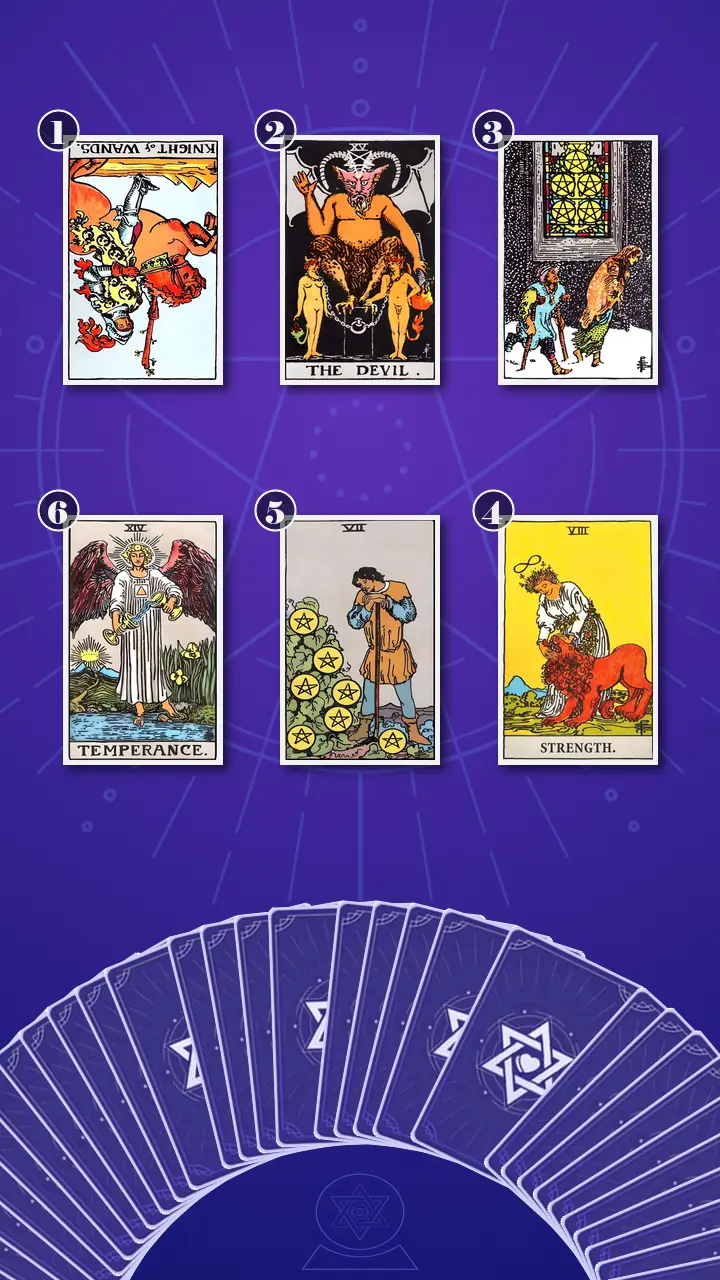
I chose the Transformation Path Grid - Context Edition, a six-card tarot spread arranged as a two-row switchback. For anyone wondering how tarot works in a consultation like this, I do not use the cards as decision-making authorities. I use their symbols and positions as a structured cognitive map, allowing us to examine card meanings in context rather than reducing a complicated behaviour to poor discipline.
This spread was precise enough for Casey's question because it follows the entire cycle: the visible task-switching symptom, the reward loop that maintains it, the fear beneath it, the inner capacity that interrupts it, the behavioural experiment that makes change observable, and the sustainable rhythm that follows. A simple decision spread would have implied that Casey merely needed to choose between important and unimportant tasks. Their experience was more systemic than that.
I placed the first three cards across the top row. The first would reveal why Casey abandoned meaningful work when novelty faded. The second would identify what made the quick reward feel compulsory. The third would expose the personal verdict they feared slow progress might deliver.
From that deepest point, the reading would turn. The fourth position would show the inner capacity capable of interrupting the loop. The fifth would translate that capacity into a practical delayed-reward discipline. The sixth would describe a workable balance between long-term priorities and the real responsive tasks of an ordinary workweek.
From above, the spread resembled a route that reached the far edge before doubling back. I thought of the paths I have traced through excavated settlements: a civilisation's true logic often becomes visible not in its monuments, but in the repeated routes worn into the ground.
Fire That Kept Changing Lanes
Position 1: The Restless Initiator
"The card I am turning over now represents the observable problem: the moment a meaningful task loses novelty and your energy redirects toward fast, visible completion," I said.
It was the Knight of Wands, reversed.
I pointed to the rearing horse and the wand still held toward the horizon. "Your ambition is real. The reversed energy here is not a deficiency of desire. It is an excess of activation without enough stable direction. You begin with genuine fire, but the fire interprets every reduction in excitement as a reason to change lanes."
I returned to the scene still open on Casey's screen. At 8:40, they had approached the portfolio case study with energy. When the opening paragraph became awkward, they had told themselves, "I was motivated ten minutes ago, so maybe this resistance means I chose the wrong task." Within minutes, Slack, a minor UI detail, and a fresh side-project idea had supplied movement again. The movement was real, but it carried attention away from the destination Casey had consciously selected.
I compared it to the frantic ticket-printer energy in The Bear: rapid motion can look competent while making sustained direction almost impossible to hold. The Knight's blockage was not starting. It was remaining after the emotional reward of starting had gone.
"Think about yesterday," I said. "What was open at the exact moment the work stopped feeling rewarding, and what did you open next?"
Casey's tapping fingers stopped. Their eyes shifted toward the Slack badge, then back to the card. A short laugh escaped them, dry at first and then unexpectedly bitter.
"That is a bit too accurate," they said. "Kind of brutal. I keep acting as if a better system will make the middle feel like the beginning."
"It will not," I replied, keeping my voice even. "But the middle does not have to feel exciting in order to be meaningful. This card is describing unstable momentum, not a defective character."
Position 2: The Notification Bargain
"The next card represents the maintaining mechanism: what turns a momentary preference for relief into a quick-win productivity loop that can feel like a lack of choice."
I turned over The Devil, upright.
The card can sound alarming when taken out of context, so I addressed that directly. "I am not reading this as danger, punishment, or addiction. Here, The Devil shows a blockage created by attachment to immediate relief, visible completion, and the familiar feeling of being useful."
I asked Casey to look closely at the loose chains around the two figures. On archaeological digs, I have seen objects appear permanently fused to the earth until patient cleaning reveals where soil ends and structure begins. The same distinction mattered here. Casey's responsiveness habit was powerful, but it was not absolute.
I described the office version of the card: one difficult minute in Figma, one almost automatic Slack check, three low-risk requests closed, two quick thank-yous, and an immediate loosening in the stomach. Later came the sentence, "I had to respond; there was no real choice." The loose chain asked a more precise question: had the task truly been urgent, or had relief simply arrived faster there?
"It is a notification slot machine," I said. "Each completed request pays out a small hit of certainty. That does not make the tasks fake. It means your personal task algorithm is quietly sorting by easiest-to-close rather than most important."
The Devil showed the energy as a blockage: discomfort triggered a switch, the switch produced competence and relief, and that relief reinforced the next switch. Meanwhile, the untouched case study grew more intimidating, which made the bargain even more persuasive the following day.
Casey's shoulders tightened. Their hand curled around the cold mug, their gaze unfocused as if replaying a sequence of recent workdays, and then their fingers slowly loosened.
"When I say 'urgent,'" they said, "sometimes I mean, 'This can make me feel useful within five minutes.'"
"That distinction is where agency begins," I said. "The urge to switch is a feeling, not a command. We are not pretending the notification does not exist. We are noticing that it is offering an emotional reward as well as a work request."
Position 3: Outside the Lit Window
"This position exposes the underlying fear: what slow or uncertain progress might seem to prove about your ability, worth, or right to belong."
The card was the Five of Pentacles, upright.
Two figures crossed snow beneath an illuminated window. The card held an energy of deficiency and perceived scarcity: value appeared visible nearby, but not personally accessible. I saw Casey's jaw tighten before I spoke.
"I think this is the Line 1 train at 6:17 p.m.," I said. "The brakes are shrieking into the station. Your phone is warm in your hand. A former classmate posts about a senior design role, and you open your unfinished portfolio. Their public result looks like proof that they belong. Your private draft begins to feel like proof that you do not."
Casey went very still.
I continued carefully. "That comparison places your private beta beside someone else's launch-day homepage and calls the difference a verdict. The card is not saying you lack value. It is showing how unfinished work becomes emotionally translated into exclusion."
The deeper fear was not merely that the case study might take months. It was that Casey could invest those months honestly, produce nothing impressive enough to share, and lose the protective explanation that they had never really given the project a fair chance.
"Are you avoiding the difficult paragraph," I asked, "or the verdict you fear it could deliver if you gave it sustained attention?"
First, Casey's breath paused. Then their eyes dropped to the glowing pentacle window as a memory seemed to move across their face. Finally, they exhaled from deep in the chest and rubbed one thumb across the other palm.
"If I never stay with it," they said quietly, "I can keep believing I might have been good enough under better circumstances."
"Yes," I said. "That strategy protects possibility, but it also prevents evidence of growth. The fear deserves kindness because it is trying to protect your worth. It does not deserve control over the calendar."
When Strength Put a Hand on Urgency
Position 4: The Choice Hidden Inside the Urge
The radiator on Casey's side stopped clicking. In the unexpected quiet, I turned over the card representing the catalyst: the inner capacity that could help them feel the appetite for immediate reward without automatically obeying it.
It was Strength, upright, the key card of the reading.
I centred the image between us: the lion's power, the woman's white robe, the infinity symbol, and the gentle hands resting where force might have been expected. Strength showed balanced power through compassionate self-command. It did not ask Casey to suppress restlessness or overpower themselves with another heroic work sprint. It offered relationship instead of combat.
I slowed the familiar scene down. The draft had stopped rewarding Casey. Slack flashed. Their fingers started tapping, their breathing became shallow, and a two-minute request suddenly felt more responsible than the work they had chosen. The switch could happen before they had even named what they were trying not to feel.
A meaningful goal does not need perfect motivation; it needs one more chosen interval after the urge to escape arrives.
I let the sentence settle. Then I turned the card slightly toward Casey and gave them the image I wanted them to carry back into the next difficult paragraph.
You are not powerless before the next quick reward; place a gentle hand on the lion of urgency and keep your attention on the task you consciously chose.
For a second, Casey's face emptied. Their pupils widened, and their lips parted without sound. Their shoulders remained lifted, but the hand gripping the mug opened one finger at a time. Their eyes reddened slightly, not with dramatic tears, but with the strain of recognising something that removed an old excuse without condemning the person who had needed it.
"But doesn't that mean I chose this?" they asked, their voice suddenly sharper. "Doesn't that mean all those wasted weeks are on me?"
I did not rush to turn their anger into reassurance. "It means a learned bargain has been operating inside moments that felt automatic," I said. "Responsibility is not the same as blame. Blame stares backward and asks whom to punish. Responsibility looks for the smallest point where a different action is possible."
Their gaze drifted back to the lion. Their jaw trembled once, then softened. A long breath left them, and their shoulders descended as if they had set down something heavy. The relief was followed by a brief, almost dizzy blankness: if the urge was not a command, the next interval belonged to them. That freedom carried responsibility as well as hope.
"Now, with this new perspective, think back to last week," I said. "Was there a moment when this insight could have made the experience feel different?"
Casey remembered Wednesday afternoon in the office collaboration area. They had been mapping messy interview notes when a teammate requested a tiny icon adjustment. The mouse had felt slick beneath their restless hand, and their stomach had loosened the instant they opened the easy ticket.
"I could have said, 'I want the thank-you because this research feels uncertain,'" they said. "Then I could have stayed for two minutes. Not forever. Just two minutes."
"Exactly. You can want relief and still choose the interval."
This was where I introduced what I call Cognitive Paradigm Excavation. I treat a persistent growth bottleneck as the necessary collapse of an obsolete intellectual era. Casey's old era had been governed by one law: Only visible completion proves that I am competent.
That law had once helped them become quick, responsive, and publicly dependable. It had built something useful. But it could no longer bear the weight of a life that included research, writing, creative development, and goals whose results arrived slowly. The fracture in Casey's productivity system was not proof that they were broken. It was evidence that an old structure had reached its historical limit.
Strength supplied the first law of the next era: discomfort could be acknowledged without being crowned. The lion did not vanish, and the woman did not humiliate it. Her hand made contact, creating a pause in which power could be guided.
I named the emotional crossing clearly. This was the first step from restless urgency and shame-driven task-switching toward patient commitment and grounded self-trust. Casey did not need to feel certain. They needed one believable experience of remaining present after certainty disappeared.
The Harvest Before the Proof
Position 5: Four Appointments With the Unfinished
"The fifth position translates Strength into ordinary behaviour," I said. "It shows the practice that can replace the automatic reward loop."
I turned over the Seven of Pentacles, upright.
The card's Earth energy was balanced and patient: seven pentacles were already visible on the vine, although nothing was ready to harvest. The worker's pause was not abandonment. It was assessment held at the correct distance from the work.
I translated the image into Casey's real week. They would schedule four 20-minute sessions for the same portfolio case study. After each session, they would record only the minutes spent, what moved, and the exact next physical action. They would wait until Friday to judge the method instead of treating every difficult paragraph as a fresh verdict.
"Right now, you ask, 'What did I finish today?'" I said. "This card asks two different questions: 'Did I keep the appointment, and what is the next physical step?'"
The Seven transformed Pentacles from the scarcity of the Five into cultivation. Both cards dealt with time, effort, value, and visible results, but they gave unfinished work opposite meanings. In the Five, unfinished meant deprived, excluded, and behind. In the Seven, unfinished meant invested in, growing, and not yet ready.
"Unfinished can mean cultivated, not failed," I said. "Measure the interval before you measure the outcome."
Casey looked toward the calendar tab on their screen. Their eyebrows drew together, not in resistance but in calculation.
"I can already feel myself wanting to build a whole Notion dashboard for this," they said.
"Then the dashboard would become another quick win," I replied. "One line per session. No icons, no quality score, no streak counter. I want evidence of attendance, not a new performance system."
They smiled, with recognition and mild disappointment at being denied a particularly attractive detour. "Fine. A boring note."
"A boring note can carry more truth than an impressive dashboard," I said. "Think of each session as a commit in a larger build. No single commit has to look launch-ready in order to prove that construction is happening."
Position 6: Two Cups, One Real Calendar
"The final position describes integration: a sustainable relationship between long-term goals and the quick tasks that remain part of your actual job."
I revealed Temperance, upright.
The angel poured water continuously between two cups, with one foot on land and one in water. This was balanced energy through proportion, adjustment, and boundaries. Temperance did not ask Casey to become unreachable or eliminate the satisfaction of small completions. It asked them to stop pursuing responsive work and meaningful work in alternating extremes.
I pictured their hybrid calendar with the first workable 20-minute block on three mornings protected for the portfolio. Slack, email, and minor requests would move into a later named window, with one clearly communicated channel reserved for genuinely time-sensitive issues. After the meaningful block, Casey could intentionally choose up to three quick wins.
"Quick wins work best as support acts, not stand-ins," I said. "They can restore energy and keep your workday functional. They simply cannot be allowed to impersonate the goal you say matters most."
Temperance replaced the on-off switch with an audio mixer. Meaningful work and responsive work both remained in the system, but the loudest notification no longer controlled the entire track. The daily question became, "Did today's structure reflect what I value, even if the day was imperfect?"
Casey's shoulders softened. "That feels less like becoming a different person," they said. "It feels like giving different parts of the day different jobs."
"That is the point," I said. "One imperfect day does not require a total reset. You adjust the balance at a planned review point. You do not punish yourself with a six-hour Sunday sprint and teach your body that meaningful work is where guilt goes to become exhaustion."
I also noted the absence of Swords in the spread. I did not think Casey needed another theory, productivity podcast, or elaborate explanation. Fire had to become steerable, Earth had to become trustworthy, and Water had to move within stable vessels. The next insight would have to be lived, not merely understood.
The New Laws Beneath the Old Ones
I gathered the six cards into one coherent history. The Knight of Wands reversed showed genuine ambition losing direction when novelty faded. The Devil revealed the maintaining bargain: uncertainty was exchanged for immediate relief and visible competence. The Five of Pentacles exposed why that bargain felt necessary: slow progress had become emotionally confused with exclusion, inadequacy, and falling behind.
Strength interrupted the history without shaming it. The Seven of Pentacles replaced instant completion with protected cultivation. Temperance gave quick tasks a deliberate place so they no longer rerouted every journey. Casey had been repeatedly taking the nearest subway exit because the destination was not visible from the current platform. The answer was not to ban every exit. It was to stay aboard for one more chosen stop.
The cognitive blind spot was now clear: Casey had treated the loss of immediate feedback as evidence that the goal was wrong, the process was failing, or their motivation was insufficient. In reality, the loss of novelty marked the entrance to the ordinary middle, the place where sustained work actually begins.
I used my second archaeological lens, Core Philosophy Stratigraphy, to sort the beliefs by layer. Casey did not need to discard responsiveness, ambition, generosity, or the pleasure of finishing things. Those were sound foundations worth carrying forward. They did need to leave behind the belief that effort counted only when it produced something polished, praised, or complete within the same day.
From that distinction, I helped them draft a compact version of The Paradigm Shift Manifesto. I do not use this as a motivational affirmation. I use it as an operating constitution for a new chapter.
Old governing law: If I cannot see progress quickly, I am probably doing the work badly, and I should switch to something I can finish.
New governing law: I measure commitment by time deliberately spent on the goal I chose. I review outcomes at planned intervals, not whenever discomfort demands reassurance.
Then I reduced the manifesto to two field tests. They were deliberately small. Casey was not being asked to solve their career, finish the case study, or become perfectly focused. They were being asked to gather new evidence about how attention could work.
- The One-More-Interval Practice Before opening Slack on three mornings this week, Casey would place the exact next case-study action on a sticky note, open the relevant document or Figma file, activate Focus mode with a genuine emergency channel available, and run a 20-minute timer. When the switch urge appeared, they would type: "Switch urge at [time]: I want to open [app or task] because I want to feel [relief, certainty, usefulness, or completion]." After one unforced breath, they would remain for two more minutes before deciding again. If 20 minutes felt too activating, the minimum version was two minutes and one visible motion: a rough sentence, a labelled research theme, or a written next step. Stopping after the agreed interval was allowed.
- The Effort-Before-Evidence Review Casey would schedule four 20-minute appointments with the same project and keep a one-line log after each: minutes spent, what moved, and the next physical action. They would hold one 10-minute review on Friday afternoon, judging the sessions together rather than redesigning the process midweek. Slack, email, and up to three intentional quick wins would sit in a later support window. The log could not contain quality scores, decorative tracking, or punishment sessions. If Casey missed a block, they could move one appointment or use a five-minute version. The experiment would be evaluated only at the Friday review.
"But I honestly may not have even twenty minutes before someone needs something," Casey said. Their concern was practical, not evasive. "My team knows me as the responsive one."
"Then we test that belief with a real boundary rather than an ideal schedule," I replied. "Choose the least interrupted part of your actual day. Set a visible status: 'Focus block until 9:30; call for anything time-sensitive.' Keep the interval limited. If a genuine interruption comes, reopen the meaningful file for five minutes later and leave one rough note. The purpose is not perfect control. It is returning without turning disruption into abandonment."
I reminded Casey that the cards had not granted discipline or issued instructions they were obliged to follow. The reading had made the pattern observable. The next evidence would come from Casey's own choices, their own calendar, and their willingness to count effort before it became shareable.

A Week Later: The Quiet Proof
Six days later, I received a message from Casey. It contained no triumphant launch screenshot and no claim that the pattern had disappeared.
"I did three blocks," they wrote. "During the second one, I wanted Slack so badly that I actually laughed. I wrote down 'I want to feel useful,' stayed two more minutes, and finished a rough version of the paragraph. It is not good yet, but it exists."
They had also waited until Friday to review the sessions. The case study was still unfinished, but it no longer looked untouched. Three rough paragraphs, a grouped set of interview notes, and an exact next step now stood where one frozen sentence had been.
On the following Monday, their first thought was still, "What if this never becomes good enough?" Casey told me they had felt the familiar drop in their chest. Then they smiled, set the timer, and began anyway.
I considered that the quiet proof of our Journey to Clarity. The transformation was not from uncertainty to certainty. It was from restless urgency and shame-driven task-switching toward patient commitment and grounded self-trust, demonstrated through one interval that counted before the outcome was ready.
When work stops giving us proof, many of us feel our hands reach for the next notification before we can admit the deeper fear: staying with the thing we care about and still falling short might hurt more than another visibly busy day. I do not believe that reflex makes us weak. I believe it marks the edge of an old governing law, one that can be examined, thanked for what it once protected, and left among the foundations that no longer need to carry us.
If one quiet interval of effort could count as a surviving foundation stone before it produced anything shareable, where might you lay it this week?