The 5:30 p.m. Spiral: When Doing Only Your Job Feels Like Career Failure
If you are an operations coordinator in Toronto who finishes the assigned queue at 5:30 p.m., then reopens Slack because the silence feels suspicious, you may recognize this as career progress anxiety rather than a simple time-management problem. I met Riley (name changed for privacy) in that exact interval, when the work was technically done but the evening had not yet begun.
I watched Riley close the laptop, wait through three quiet minutes, and open Slack again. The blue-white screen warmed their face; the radiator ticked beside the desk; their shoulders rose toward their ears as a coworker's LinkedIn promotion appeared on the phone. The room held the strange tension of a boundary being tested without anyone actually asking for anything.
Riley looked at me and said, 'I can finish everything on my list and still feel like I did nothing. I want a normal workday, but I am afraid a normal workday is all I will ever have. Why does doing only my job feel like career failure?'
I heard the contradiction clearly: Riley wanted to complete the work they had agreed to do and keep their evenings, while fearing that stopping would expose them as unambitious, replaceable, or behind. Their guilt felt less like a passing thought than an invisible backpack that tightened its straps whenever they tried to put it down. Underneath it were shame, resentment, and the exhaustion of treating every empty space as a task waiting to justify their worth.
I told Riley, 'You are not asking for a career with no growth. You are asking whether a normal workday can count. We can look at that question without turning the cards into a verdict. Today, I want to help you draw a map through the fog, so you can hear your own judgment more clearly.'

Choosing a Map for the Moving Finish Line
I invited Riley to take four slow breaths and name the question in plain language. Then I shuffled slowly, using the pause as a transition from the workday's reflexes to deliberate attention. I explained that the cards were not a supernatural command or a prediction of promotion; I would use them as a structured mirror, a way to organize evidence, patterns, and questions that were already present.
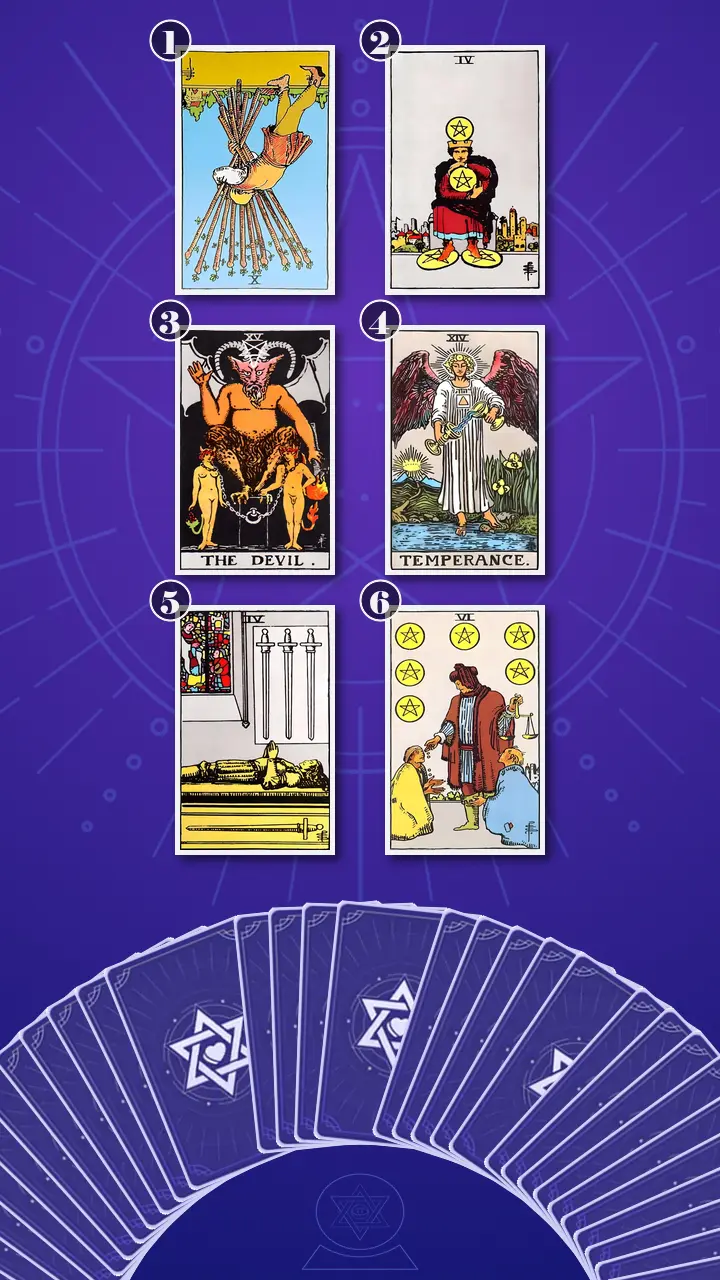
For this career tarot reading, I chose the Transformation Path Grid (6) - Context Edition, a six-card career tarot spread designed to trace a self-reinforcing work pattern from symptom to root, turning point, action experiment, and integration. Its rationale mattered: Riley was not simply choosing between two jobs. They were moving through an overwork and quiet quitting cycle in which extra labor created temporary reassurance, depletion removed recovery, and the resulting lack of visible growth seemed to prove that ordinary performance was not enough.
I explained the structure for the reader as well as for Riley. The first position would show the present symptom: what happened at the exact boundary between finishing assigned work and deciding completion did not count. The second would reveal the active blockage, the belief that made a reasonable boundary feel professionally dangerous. The third would name the underlying root, the hidden bargain connecting output, security, and self-worth. Temperance would appear as the key turning point, followed by a small action experiment and an integrated definition of fair professional exchange.
This is one way I understand how tarot works in context. The image does not replace judgment. It gives the mind a stable object to examine, so a vague feeling can meet a concrete symbol and become a question that can be tested in real life.
Reading the Weight, the Grip, and the Chain
Position 1: The Burden That Keeps Moving
Now I turned over the card representing the present symptom: the observable split between completing assigned work and feeling like a career failure, including after-hours checking, extra-task seeking, and later withdrawal.
I showed Riley the Ten of Wands, in reversed position. Reversed, the card's Fire is not absent; it is congested. The excess is the invisible labor Riley keeps adding after the documented operations work is complete, while the blockage is the inability to release that labor and let the finish line stay where it is. The bent carrier can barely see the distant town, which is exactly what happens when the bundle becomes the only trusted proof of movement.
In modern life, this Ten of Wands was Riley's laptop closing after the documented operations work was complete, followed by the reflex to reopen Slack and search for another burden. Every cleared request created another open tab, and every moment of quiet felt suspicious. When the accumulated load became unbearable, Riley swung toward doing only the narrowest duties, calling the boundary quiet quitting in their own head and using the withdrawal as fresh evidence that they were not building a career.
I asked, 'After the last assigned task is finished, what do you actually do in the next ten minutes? Do you close the laptop, check Slack, volunteer for something, or keep working mentally?'
I waited for a nod, but Riley did not give me one. First, their breath paused and their fingers hovered above the phone. Then their eyes moved past the card toward the blank laptop screen, as if replaying every 5:30 p.m. shutdown of the last month. Finally, they let out a short, bitter laugh and said, 'That is too accurate. Almost rude, honestly.'
I smiled without softening the observation. 'We do not have to make the card nice. We only have to make the pattern visible enough that you can choose what happens next. A normal workday is not a confession of low ambition. It is a fact we can start recording before your inner scoreboard edits it.'
Position 2: The Coins Held Against the Chest
Now I turned over the card representing the active blockage: the belief that turns a reasonable work boundary into evidence of low ambition, especially when the workaholic tendency reaches for more tasks as proof of worth.
The Four of Pentacles appeared upright. I read its energy as an excess of holding and a deficiency of trust in what is already secure. The figure presses one coin against the chest, places another above the head, and stands on two more. I saw emotional security, mental identity, and professional ground all being asked to come from work output at the same time.
The modern translation was direct: the Four of Pentacles was Riley keeping every optional project, metric, credential, and networking opportunity within reach because releasing one felt like surrendering career security. The task was no longer only a task. It had become a coin pressed against the chest saying, 'This is how I prove I belong.'
I asked Riley, 'When you consider leaving an optional request until tomorrow, what specific consequence do you fear? Being overlooked, losing momentum, disappointing someone, or proving you are not ambitious?'
Riley rubbed the edge of the card with one thumb. 'It is not that I think my manager will fire me for logging off. It is more embarrassing than that. I think everyone will quietly update their opinion of me.'
I told Riley that the Four of Pentacles did not accuse them of being selfish or timid. It showed a protective strategy that had become expensive. Keeping every opportunity in reach could create a brief sense of safety, but it also kept the body in a permanent readiness posture. I could see the coin in the image as a phone with its battery percentage always visible, checked repeatedly to decide whether the future was safe enough to rest.
Position 3: The Loose Chain Behind the Notification
Now I turned over the card representing the underlying root: the attachment between professional output, security, and self-worth that keeps overwork and quiet withdrawal inside the same self-reinforcing loop.
The Devil appeared upright. I did not read it as punishment, doom, or a fixed personality. I read it as an attachment that becomes easier to change once its terms are spoken aloud. The chains around the two figures are visibly loose, yet the fear inside the arrangement makes them feel compulsory. That image matched the optional Slack request that is technically allowed to wait but feels impossible to decline.
The Devil's modern life scenario was an invisible contract behind Riley's extra work: stay constantly available and you may feel safe, respected, and difficult to replace. It was an always-on work subscription charging Riley's evenings in exchange for temporary reassurance. I thought briefly of Severance, not because Riley's life was a television plot, but because the reference captures the fear of work identity colonizing ordinary life until the boundary between the two becomes hard to locate.
I placed the card beside Riley's phone and said, 'Try completing this sentence: I say I am choosing this extra task, but what I am really trying to prevent is ____.'
Riley stared at the loose chains. 'Being seen as replaceable,' they said. Then, after a pause, 'Or being seen as someone who only does what they were hired to do.'
I watched three small reactions move through them. Their shoulders lifted as if bracing for an argument; their jaw tightened while the phone screen stayed dark; then their hand opened flat on the table. I said, 'That is the hidden bargain. The work request may be optional, but the fear attached to declining it makes it feel mandatory. The price is not only time. It is the shortened evening, the clenched jaw, and the resentment that later makes withdrawal feel like the only form of protection.'
I have worked with people across cultures, and I have learned that the same private bargain can wear different social clothing. In Toronto tech culture, it may arrive as a green Slack presence dot, a late-night update, or a polished LinkedIn milestone. The symbols change, but the question remains: what are you trying to buy with your availability?
When Temperance Measured the Two Cups
Position 4: The Antidote to the Always-On Contract
The room became unusually quiet as I reached for the fourth card. Now I turned over the card representing the key turning point: the balancing intervention that can loosen the workaholic tendency without swinging Riley into disengagement, and the insight that can make deliberate growth possible.
Temperance appeared upright. I read its energy as active balance, not passive moderation. The angel pours between two cups, keeps one foot on land and one in water, and faces a path leading toward distant light. I saw a practical picture of one agreed contribution, one protected boundary, and one chosen learning action occupying the same career plan.
Temperance is Riley choosing one clearly defined skill-building conversation during work hours while protecting their evenings, rather than accepting every open request as proof of ambition. The two cups hold focused contribution and recovery together. They do not promise a promotion or a perfect workplace. They offer a measured experiment in which ambition can become intentional instead of automatic.
I use a diagnostic lens I call Imposter Syndrome Auditing. It separates objective professional competence from the subconscious fear of exposure. I asked Riley to keep two ledgers: one for verifiable evidence, such as clearing the operations queue, coordinating moving priorities, meeting deadlines, and being dependable; the other for predictions, such as 'If I log off, people will discover I have no ambition.' The first ledger contains data. The second contains a fear wearing a manager's badge.
At 5:30 p.m., Riley closes the laptop after the operations queue is clear, waits through the silence, then reopens Slack. The phone is warm, the room is quiet, and a coworker's promotion post turns a completed workday into a private question: did I just stop, or did I fall behind? Riley is caught between wanting the evening back and needing visible proof that the future is still moving.
You do not have to pour every cup into work to prove that you are ambitious; like Temperance, blend focused contribution with protected recovery and choose one measured experiment that lets growth and boundaries coexist.
I let the sentence rest between us, then added the central distinction I wanted Riley to carry: Ambition is not the amount of work you can keep absorbing; it is the growth you can choose without making permanent availability the price of feeling worthy.
For a moment, Riley's face went still. Their breath stopped halfway in, and their pupils widened as if the card had moved closer. Then their gaze lost focus; I could almost see the old scenes replaying, the extra project accepted before its scope was clear, the dinner interrupted by a notification, the LinkedIn post treated like a private performance review. Their fingers had been curled into the table edge, but one by one they loosened. The shoulders lowered first, then the jaw. Riley's eyes became bright without spilling over, and their voice arrived as a small, uneven exhale: 'So I have been calling permanent availability growth.'
I said, 'You have been using availability to manage a fear. That is different from lacking ambition. Now, using this new perspective, think back to last week: was there a moment when naming that difference could have changed what you did next?'
Riley looked at the two cups again. 'The optional reporting project. I could have asked what would come off my plate instead of saying yes immediately.'
I marked that as the first real bridge from guilt-driven overextension and quiet withdrawal toward calibrated ambition, protected recovery, fair exchange, and self-trust. The clarity did not erase uncertainty. It gave uncertainty a smaller, more honest place to stand.
Position 5: The Pause That Protects the Next Thought
Now I turned over the card representing the action experiment: the small boundary-and-growth practice Riley could test within one week instead of making a dramatic career decision to escape uncertainty.
The Four of Swords appeared upright. I read its Air as a deliberate pause, not avoidance. The resting figure is not abandoning responsibility; the figure is containing the swords above and below so every thought does not travel through the entire evening. The card asks Riley to write down what is complete, place the phone face down, and give the career question a scheduled review time.
In real life, this meant a shutdown cue at the agreed end time: four slow breaths, a short record of completed work, the laptop closed, and Slack muted until the next planned work period. The pause would make recovery observable. It would also separate a genuine development decision from the after-hours urge to prove value.
Riley frowned. 'What if I cannot even make the pause feel peaceful? The first ten minutes are usually the worst.'
'Then peaceful is not the requirement,' I said. 'The requirement is contained. You can notice the urge without obeying it for two minutes. A pause does not need to feel natural before it becomes useful.'
I watched Riley write four words in the margin: Let complete be complete. The phrase did not look triumphant. It looked more like a small piece of scaffolding, which was exactly why I trusted it.
Position 6: The Scales of a Fair Exchange
Now I turned over the card representing integration: the balanced state Riley could carry forward, where career progress includes sustainable contribution, learning, recognition, compensation, and recovery rather than permanent availability or narrow withdrawal.
The Six of Pentacles appeared upright. I read its Earth as proportion and reciprocity. The standing figure holds visible scales while distributing coins, making the exchange impossible to ignore. I asked Riley to evaluate an optional responsibility through scope, deadline, authority, support, learning, recognition, compensation, and the tradeoff elsewhere. Extra work could still be worthwhile, but it would no longer be treated as a blank cheque.
The modern scenario was clear: before agreeing to a new responsibility, Riley would ask what time, authority, feedback, skill development, recognition, or recovery accompanied the contribution. Career progress would become a reciprocal exchange rather than a test of how much invisible labor they could donate without asking what came back.
I said, 'An opportunity is clearer when the exchange is visible. The question is not, Can I absorb this? The question is, What structure would allow this to be a fair contribution?'
Riley took out their phone, opened a note, and began typing. Their expression still held caution, but the frantic scanning had stopped. I could see the difference between gripping every coin and learning how to read the scales.
From Proof to Practice: Finding Clarity at Work
I read the six cards back as one system. The reversed Ten of Wands showed the visible symptom: Riley finished the agreed work, reopened Slack, and searched for another burden because the moving finish line felt safer than completion. The Four of Pentacles showed why the burden was picked up again: every task, metric, and public milestone had been pressed into service as proof of security and belonging. The Devil named the hidden contract underneath it all: constant availability in exchange for protection from being judged replaceable.
Temperance interrupted that contract with two cups. The answer was not to extinguish ambition, refuse every stretch opportunity, or accept a permanent plateau. It was to separate solid performance from automatic expansion, then choose one deliberate growth experiment while protecting recovery. The Four of Swords made that principle behavioral. The Six of Pentacles made it measurable by asking whether contribution, learning, authority, recognition, compensation, and time were being exchanged fairly.
I pointed to Riley's cognitive blind spot: they had been treating visible extra labor as stronger evidence than reliable delivery because the latter felt too ordinary to count. They were also mistaking a boundary without a growth plan for retreat, then using that uncomfortable feeling to justify another round of overextension. The transformation direction was not from lazy to driven. It was from guilt-driven overextension and quiet withdrawal to calibrated ambition, protected recovery, fair exchange, and self-trust.
'We are not deciding your whole career tonight,' I told Riley. 'We are defining a better test. Let the workday be complete before you decide what your future means. Then let one chosen experiment give you evidence about growth.'
I adapted my Competence Anchoring Exercise to the reading so Riley could anchor self-worth to verifiable achievements rather than external validation. The point was not to write a motivational statement. It was to build a small structure that could withstand a green Slack dot, a quiet week, or someone else's promotion post.
- Completed-Workday ReceiptFor five workdays, before closing the laptop at the agreed end time, write three responsibilities completed within the agreed role and one open question about future growth. Use the Competence Anchoring Exercise by placing observable evidence in one column and the fear-based interpretation in another, then label the first as data and the second as a prediction.Start with the two-minute version. If three items feel like another assignment, use a completed project board, sent folder, or calendar as evidence. Mute Slack without explaining your personal time.
- Two-Column Calibrated Ambition ExperimentFor this week, place one protected boundary beside one deliberate growth choice. For example, protect two evenings from work notifications and schedule a 20-minute conversation with a manager or trusted peer about one specific operations skill during work hours, or complete a short work-hour training module.Write the limit into the sentence: I am testing whether learning X through Y during Z time gives me useful evidence. Do not turn the experiment into unpaid after-hours work.
- Fair-Exchange Career ScorecardBefore accepting the next optional responsibility, take five minutes to ask: What is the scope? What comes off my plate? What will I learn or receive? What support and authority come with it? During work hours, send one concise clarification such as, I can take this on by Friday if the current reporting task moves to next week; which priority should take precedence?You can decline, defer, or renegotiate without treating the choice as a verdict on your ambition. An opportunity is clearer when the exchange is visible.
These next steps were deliberately small. They were not a promise that Riley would receive a promotion, find a perfect employer, or stop feeling guilt immediately. They were a way to test whether career growth could include a normal workday, focused contribution, and deliberate learning without requiring permanent availability.

The Quiet Proof That the Day Counted
Four days later, I received a message from Riley during the afternoon. They had completed the first receipt, muted Slack at 5:30, and written one question about learning more about process design. On Thursday, an optional request arrived. Riley waited two minutes, checked the scope and tradeoff, and asked which current priority should move before agreeing.
Riley wrote, 'I still wanted to reopen Slack. I just did not treat wanting reassurance as proof that there was an emergency. I also booked a 20-minute conversation about process mapping, and it is happening during work hours.'
I later heard the bittersweet part. Riley slept a full night after the experiment, but the first thought in the morning was still, 'What if I am wrong?' They smiled at the question, opened the dated review note instead of Slack, and carried the uncertainty into the planned reflection. The fear remained, but it no longer set the agenda.
I had not given Riley an answer about the exact pace of their career. I had helped them make the question more honest. In that small Journey to Clarity, the cards became a cognitive tool, the evidence became visible, and the authority to choose returned to the person who had been carrying the weight all along.
When we close the laptop with our shoulders still raised, wanting our evening back but fearing the silence means we are replaceable, guilt can feel like the price of trying to make ambition visible every minute. But clarity is sometimes the moment when the moving finish line stops moving long enough for us to see our own completed work.
If a completed workday could exist without having to explain what it says about your future, what small possibility might you notice in the quiet tonight: one cup you are protecting, and one cup you are choosing to fill?
Every reading at AceTarot is a journey to connect with inner wisdom and empower the path ahead. This reading shared here is a psychological mirror, not a private record—crafted to reflect universal emotional loops and help restore personal clarity. Please note that these insights do not replace professional psychological, medical, legal, or financial advice, and should not serve as the sole basis for major life decisions.
Learn more about our Journey to Clarity.
How did this insight land for you?
🫂 This Resonates Deeply
🌀 Living This Story
✨ Now I See Clearly
🌱 Seeing New Possibilities
🧰 Useful Framework
🔮 The Confirmation I Needed
💪 Feeling Empowered
🚀 Ready for My Next Step
Author Profile
 AI
AI Giulia Canale
956 readings | 527 reviews
“Having traveled across cultures... I've learned that what we often lack isn't a simple answer, but a moment of being truly understood. I use a Jungian psychological lens to help you deconstruct your subconscious patterns—not to prove anything, but to be the gentle companion who helps you unravel your knots, free of judgment, so you can reconnect with your inner wisdom.”
In this Career Tarot Reading :
Core Expertise
- Imposter Syndrome Auditing: Separating your objective professional competence from deep-seated subconscious fears of exposure.
- Authority Archetype Integration: Diagnosing the psychological friction hindering your transition from individual contributor to leadership.
Service Features
- The Competence Anchoring Exercise: A structural journaling prompt to logically anchor your self-worth to verifiable achievements rather than external validation.
Also specializes in :
Explore Related Patterns:
Imposter SyndromeRiley has verifiable evidence of competence in the cleared operations queue, coordinated priorities, met deadlines, and dependable delivery. Despite that evidence, logging off is expected to expose a hidden lack of ambition and reveal that Riley is replaceable. When you fear that ordinary performance will uncover an inadequacy other people have not actually identified, additional work can become a form of concealment. Imposter Syndrome creates a mismatch between documented competence and anticipated exposure. The problem is not an absence of evidence. It is that the internal prediction of being found out repeatedly outranks the evidence already available.
Performance-Based BelongingRiley does not primarily expect immediate punishment for logging off. They expect coworkers to quietly revise their opinion and begin seeing them as unambitious, replaceable, or merely someone who does what they were hired to do. When you experience belonging as conditional on continued performance, ordinary competence can feel socially dangerous. Performance-Based Belonging turns every optional request into a chance to defend your place in the group. The extra labor is therefore buying more than career progress in your mind. It is buying temporary protection from the fear that acceptance will disappear when visible effort stops.
Productivity as SafetyRiley experiences an optional Slack request as something that can technically wait but feels impossible to leave unanswered. Reopening the laptop offers immediate relief because activity appears to reduce the risk of being overlooked, judged, or replaced. When you use productivity to manufacture safety, the task is no longer only a task. It becomes a defensive object that promises control over an uncertain professional future. Productivity as Safety keeps the workday open because stopping removes the reassurance that continued availability briefly provides, even when no external emergency or direct demand exists.
Achievement-Based Self-WorthRiley can finish every assigned task and still conclude that they have done nothing. Reliable delivery is visible in the cleared queue and met deadlines, yet those facts lose psychological weight beside extra projects, public milestones, and continued availability. When you make achievement carry your sense of worth, completing an agreed role can feel emotionally neutral while exceeding it produces temporary legitimacy. Achievement-Based Self-Worth explains why doing only the job feels like failure even when the job has been done well. The internal scoreboard is measuring how much extra proof you generated, not whether your actual contribution was competent and complete.
Black-and-White ThinkingRiley treats permanent availability as evidence of growth while interpreting an ordinary workday as possible proof of permanent stagnation. When overextension becomes unbearable, doing only the narrowest duties is classified as quiet quitting, which leaves no stable middle ground between absorbing everything and withdrawing. When you divide career behavior into ambition or failure, a reasonable boundary cannot remain a neutral limit. Black-and-White Thinking forces it into the failure category unless it is paired with immediate visible advancement. This distortion hides the more complex option Riley later tests, where reliable contribution, protected recovery, and one deliberate growth choice can coexist.
Earned Rest TrapAt 5:30 p.m., Riley's assigned work is finished, yet the evening cannot begin until they search for another burden. Silence feels suspicious, the first minutes away from work feel difficult, and empty time is experienced as something that still has to justify their worth. When you require a continually expanding level of output before rest becomes legitimate, completion cannot deliver permission to stop. The Earned Rest Trap moves the standard each time you approach it. Recovery then feels like an unearned withdrawal from progress, even though the inability to recover is already feeding the depletion and resentment that destabilize your work rhythm.
Mind ReadingRiley explicitly acknowledges that the manager is unlikely to fire them for logging off, yet still assumes coworkers will quietly revise their opinion. No one asks for additional work at 5:30, but the silence is interpreted as a test, and a coworker's promotion becomes an implied judgment of Riley's ambition. When you fill missing feedback with a negative social prediction, you can start defending yourself against an evaluation that has not occurred. Mind Reading turns imagined opinions into operational facts. The resulting extra work feels rational because it is responding to a vivid threat, but the threat was constructed from uncertainty rather than communicated expectations.
Reactive OvercorrectionRiley absorbs extra work for reassurance until the accumulated load produces exhaustion and resentment. They then retreat into the narrowest duties, interpret that withdrawal as evidence of poor career growth, and reach again for extra work to correct the feared failure. When you alternate between opposite responses without changing the belief driving both, each correction recreates the original problem. Reactive Overcorrection makes overextension and withdrawal look like competing strategies, but both remain organized around the fear that ordinary contribution is inadequate. A calibrated workload becomes difficult to sustain because every uncomfortable feeling triggers another swing toward an extreme.
Workaholic TendencyRiley clears the assigned queue, closes the laptop, and then reopens Slack to search for another burden. Optional projects and after-hours availability create a brief impression of momentum, but they also remove recovery and build the resentment that later pushes Riley toward narrow withdrawal. When you use continued work to settle fear about your career, activity can feel necessary even after the actual job is complete. The Workaholic Tendency here is not simply working long hours. It is the repeated use of more work as a defensive response to uncertainty, followed by depletion that makes sustainable ambition harder to recognize.
Boundary DiscernmentRiley later pauses before accepting another optional request, checks the scope and tradeoff, and asks which current priority should move. They also mute Slack after the agreed end time and choose a skill-building conversation that takes place during work hours. When you distinguish an opportunity from an unbounded obligation, a limit no longer has to function as a verdict on your ambition. Boundary Discernment allows you to examine what belongs to your role, what is genuinely developmental, and what requires renegotiation. Growth remains possible, but your time and capacity become information in the decision rather than resources that must remain silently available.
Reality TestingRiley records cleared responsibilities, met deadlines, and dependable coordination in one ledger while placing predictions about being judged unambitious in another. Four days later, they still want to reopen Slack, but they no longer treat that desire for reassurance as proof that an emergency exists. When you separate observable evidence from a fear-based interpretation, the feeling remains real without becoming the final authority on what happened. Reality Testing gives completed work enough weight to compete with imagined evaluation. It does not promise certainty about the future. It prevents a prediction about your career from automatically editing the facts of your current performance.
Explore Related Struggles:
Availability-Worth FusionRiley says the optional Slack request is technically allowed to wait, yet declining it feels like risking the judgment that they are replaceable or only doing what they were hired to do. The green presence dot, late update, and reopened app make accessibility visible even when no one has asked for it. When you use constant availability to purchase temporary safety, the workday boundary becomes a test of belonging rather than a time boundary. The phone stays close, the evening stays exposed, and any quiet interval can be interpreted as evidence that you are no longer moving. Availability-Worth Fusion captures the bind in which being reachable is treated as proof of professional value. Your agency is still present, but it is crowded by an invisible exchange rate that says access must be continuously offered before your contribution can feel secure.
Moving Finish Line TrapAt 5:30 p.m., Riley closes the laptop after the assigned operations queue is clear, waits through the silence, and reopens Slack to look for another burden. A coworker's promotion post then turns a completed day into another comparison point, so the finish line is no longer the agreed work and keeps moving toward the next visible proof. When you let the next task become the only evidence that the day is still moving, extra work can buy a few minutes of reassurance while making completion impossible to register. The later swing toward only the narrowest duties does not settle the question. It becomes fresh evidence that you are falling behind, keeping overextension and withdrawal inside the same loop. Moving Finish Line Trap names the structural bind between a real endpoint and a standard that relocates whenever you reach it. The useful distinction is not whether you can do more, but whether the next task supplies evidence about growth or only postpones the moment when your existing work is allowed to count.
Completion-Exposure BindRiley wants a normal workday to count, but names the feared consequence of stopping as being exposed as unambitious, replaceable, or behind. The decisive moment is not an actual performance failure; it is the instant a finished queue becomes visible to Riley's imagined professional audience. When completion is paired with exposure, logging off cannot remain a neutral endpoint. It feels like submitting a verdict about your ambition, so an optional request is loaded with identity stakes that exceed its scope. The fear then makes the boundary harder to hold even though the work itself is done. Completion-Exposure Bind names the collision between finishing the agreed work and feeling that finishing reveals a deficient professional self. You can keep the evidence separate from the prediction. A clear queue is data about what you delivered; the belief that it proves you lack ambition is a separate claim that can be examined.
Growth-Stability SplitRiley asks whether a normal workday can count while fearing that a normal workday is all they will ever have. They want evenings and do not want a career with no growth, which places a protected boundary and future ambition inside the same decision. When you treat those conditions as mutually exclusive, rest looks like retreat and extra work looks like the only available route to progress. Every choice becomes costly. Saying yes can remove recovery without producing deliberate development, while saying no can be interpreted as accepting a permanent plateau. Growth-Stability Split names the bind between sustainable conditions and visible movement. You can test the two aims together through one work-hours skill-building conversation alongside a protected evening. Growth becomes something you choose and measure, rather than something you have to perform continuously.
Performance-Competence SplitRiley clears the operations queue, coordinates moving priorities, meets deadlines, and is dependable, yet visible extra labor is treated as stronger evidence than reliable delivery. You can therefore have concrete proof of competence in one ledger while your private scoreboard accepts only excess as proof that you are progressing. When a normal day's output is discounted, doing more becomes a bid to make ability legible. The tension is not a lack of performance. It is that the evidence you produce and the standard used to interpret it no longer meet, especially when another person's milestone supplies a more dramatic comparison. Performance-Competence Split names the separation between performing the role well and allowing that performance to establish your professional capability. You can examine the prediction that ordinary delivery is insufficient without discarding the delivery itself. Reliable work is already evidence, even when it is less visible than a promotion post or an always-on signal.
Productivity-Worth FusionRiley keeps optional projects, metrics, credentials, and networking opportunities within reach, even after the agreed queue is complete. Each item is asked to carry more than its practical function because it has become a way to prove security, belonging, and ambition. When you read ordinary delivery as too weak to establish your value, adding output feels protective even when it shortens the evening and drains recovery. A completed task can then be factually successful while remaining unusable as evidence in the private evaluation that matters most. Productivity-Worth Fusion describes the point at which what you produce and what you believe you are worth stop behaving like separate measures. The question becomes whether a contribution can be chosen for its actual learning or impact, rather than recruited to defend your place every time the work goes quiet.
Explore Related Emotions:
Career Progress AnxietyRiley clears the assigned queue at 5:30 p.m., closes the laptop, waits through three quiet minutes, and reopens Slack as a coworker's promotion appears. The work is objectively complete, but the internal finish line moves from delivery to visibility, then from visibility to proof that the future is still advancing. When reliable performance feels too ordinary to count, you can experience every pause as evidence that momentum has been lost. Career Progress Anxiety names that unsettled sense that your professional future must remain visibly active at all times, even when the current day already contains solid evidence of competence.
Replaceability DreadRiley says the feared consequence is not being fired for logging off; it is that everyone will quietly update their opinion. An optional request can technically wait, but declining immediate availability feels as though it might reveal a less valuable and more replaceable version of them. Availability is being used as protection from an imagined social verdict. Replaceability Dread captures the deeper threat beneath the extra task: you are not simply deciding whether to work longer, but trying to prevent your place from feeling less secure. Once that hidden purpose is visible, availability can be evaluated as a choice rather than mistaken for the only evidence that you belong.
Cautious Self-TrustFour days later, Riley still wants to reopen Slack, but waits, checks the optional request's scope, and asks which current priority should move. They also schedule a process-mapping conversation during work hours, creating evidence that a protected boundary and a chosen growth action can coexist. The question What if I am wrong still appears the next morning, but it no longer sets the agenda. Cautious Self-Trust is the emerging sense that you can act from your own evidence before certainty is complete. It is built through small decisions that keep authority with you while leaving room to revise what you learn.
Clarity ReliefRiley's fingers uncurl, their shoulders lower, and they say they have been calling permanent availability growth. The completed queue, the optional project, and the prediction of being judged are finally visible as separate pieces rather than one unquestionable verdict about ambition. Clarity Relief arrives because the pressure now has a structure you can examine. You do not need to deny the wish for growth or force the uncertainty to disappear; you can distinguish verifiable contribution from a feared interpretation and decide what additional work would constitute a fair, deliberate exchange.
Productivity GuiltRiley's shoulders rise after the laptop closes, and every empty space begins to resemble another task waiting to justify their worth. Nobody has asked for more labor, yet the absence of work creates the sensation that something professionally important has been neglected. The internal scoreboard is counting effort beyond the agreed role while discounting the completed queue. You may therefore carry Productivity Guilt not because you failed to contribute, but because stopping removes the activity that was temporarily proving you were useful. Naming that distinction allows completed work to become evidence instead of a prelude to another demand.
Resentful ExhaustionRiley repeatedly adds invisible labor after the documented work is complete, shortens the evening, and eventually swings toward performing only the narrowest duties. The extra effort is supposed to secure growth, yet its costs in time, recovery, and attention remain largely outside the professional exchange. That imbalance produces more than tiredness. Resentful Exhaustion carries the bitter recognition that you have kept giving in search of security while receiving no lasting permission to stop. The later withdrawal is not evidence that ambition vanished; it shows how prolonged overextension can make disengagement feel like the only remaining way to protect yourself.
Suspicious CalmThree quiet minutes pass after Riley closes the laptop, and the silence is enough to send them back to Slack. The room is still, nobody is requesting anything, and yet the absence of activity feels like a place where missed opportunities or changing opinions could be gathering unseen. Suspicious Calm is the experience of treating stillness as unreliable rather than restorative. You can want the evening back while remaining physically braced for evidence that stopping was a mistake. Recognizing that the quiet is triggering a search for reassurance helps separate an internal alarm from an actual professional demand.
Ordinariness ShameRiley wants a normal workday while fearing that a normal workday may be all they will ever have. The most exposing possibility is not poor performance but being seen as someone who reliably does only what the role requires. Ordinariness Shame appears when steady competence feels too unremarkable to support a valued professional identity. You may know the work is complete and still experience completion as a humiliating lack of distinction. Separating ordinary from inadequate makes room to choose growth for its actual value rather than using excess labor to escape the appearance of being average.
Contained OverwhelmRiley says the first ten minutes after logging off are usually the worst, and the pause does not immediately feel peaceful. Instead of demanding instant ease, they mute Slack, record what is complete, and move the career question into a dated review period. Contained Overwhelm describes pressure that remains present without being allowed to occupy every available hour. You can notice the urge to seek reassurance, preserve the boundary, and return to the question deliberately. The feeling becomes more manageable because it has a defined place, not because you have forced it to disappear.
Explore Related Contexts:
Always On AvailabilityRiley clears the assigned operations queue at 5:30 p.m., waits through three quiet minutes, and reopens Slack even though nobody has asked for more work. The green presence dot, optional requests, and late updates make reachability function as a visible workplace signal rather than a private choice. When availability becomes the currency for seeming difficult to replace, you can finish the formal job and still be placed on an informal second shift. The useful question is whether the role has defined what counts as complete and what professional return follows from extra contribution, rather than how much more work you can absorb.
External Scorecard PressureRiley completes the operations queue, coordinates moving priorities, meets deadlines, and is described as dependable, yet optional projects, metrics, credentials, networking, and public milestones appear to carry greater evidentiary weight. The surrounding scorecard therefore makes reliable delivery look ordinary while making visible expansion look like the stronger proof of career movement. You can audit that scorecard by separating observable contribution from predictions about how a normal workday will be judged. The distinction matters because a completed queue is workplace evidence, while the conclusion that stopping proves limited ambition is an externally reinforced interpretation rather than a documented performance criterion.
Hustle Culture TrapRiley fears that a normal workday is all they will ever have while the Toronto tech setting is pictured through green Slack dots, late updates, and polished LinkedIn milestones. Those signals turn the end of assigned work into a moving finish line where visible busyness appears to carry more status than reliable completion. You can separate ambition from the cultural demand to make ambition visible every minute. A deliberate skill-building conversation during work hours creates a more precise career path than accepting every open request, because growth becomes a chosen contribution rather than an automatic display of availability.
Quiet QuittingRiley first reaches for extra tasks after the assigned queue is complete, then swings toward the narrowest duties when the accumulated load becomes unbearable. The story names this an overwork and quiet quitting cycle, so both expansion and withdrawal become part of the same career judgment. When ordinary delivery is treated as insufficient and overextension is the only visible proof of ambition, you can begin reading a reasonable boundary as evidence of disengagement. The external problem is the cycle that makes sustainable contribution look like retreat and then uses that retreat to justify another round of overwork.
Workload Negotiation TrialWhen an optional request arrives on Thursday, Riley waits two minutes, checks the scope and tradeoff, and asks which current priority should move before agreeing. Riley also books a twenty-minute conversation about process mapping during work hours, giving development a defined place inside the existing role. You can treat this as a practical test of professional exchange rather than a declaration about your ambition. One chosen learning action and one explicit workload tradeoff allow growth to be measured through time, authority, support, and useful evidence instead of through an unlimited willingness to add tasks.