When a Lighter Course Load Feels Like Failure: Rethinking Progress

The TTC Streetcar and Reduced-Course-Load Pace Anxiety
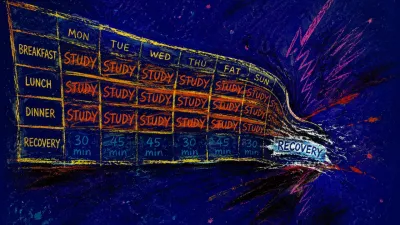
I knew the scene before Jordan finished describing it. As a Toronto undergraduate taking a reduced course load, they had opened the university degree-audit portal before breakfast, seen fewer completed credits than expected, and started recalculating their graduation timeline.
At 8:47 PM on a Tuesday, I pictured them on the TTC streetcar heading east through Toronto, scrolling through Instagram Stories of classmates at campus events and internships while the degree-audit tab stayed open behind the posts. Their phone was warm in their hand; the fluorescent carriage lights buzzed overhead; I saw their shoulders tighten each time another packed schedule appeared.
Jordan said, 'I chose fewer classes so I could actually learn, but now every open block looks like proof that I am losing ground. Why does a lighter course load make me feel behind?' They described reopening Google Calendar, a Google Sheets graduation calculator, and classmates' LinkedIn updates, then filling empty hours with certificates and extra readings.
I heard the anxiety as a fare gate locked around their chest: every credit number demanded a tap, every unfilled hour made their restless hands reach for another planning tab, and the effort to look on pace left behind a heavy fatigue. Shame, impatience, and guilt were riding underneath it.
I told Jordan, 'I believe that the lighter load was chosen for a reason, and I also believe the fear has real academic and financial questions attached to it. We do not have to dismiss either side. Let us draw a map of the loop, so we can separate facts from the verdict your nervous system keeps attaching to them.' An empty calendar block is not automatically an academic failure.
Choosing a Ladder Out of the Loop
I asked Jordan to put both feet on the floor, take one ordinary breath, and name the question without solving it. I shuffled slowly while they watched the cards; I treated the pause as a change of attention, not a supernatural test.
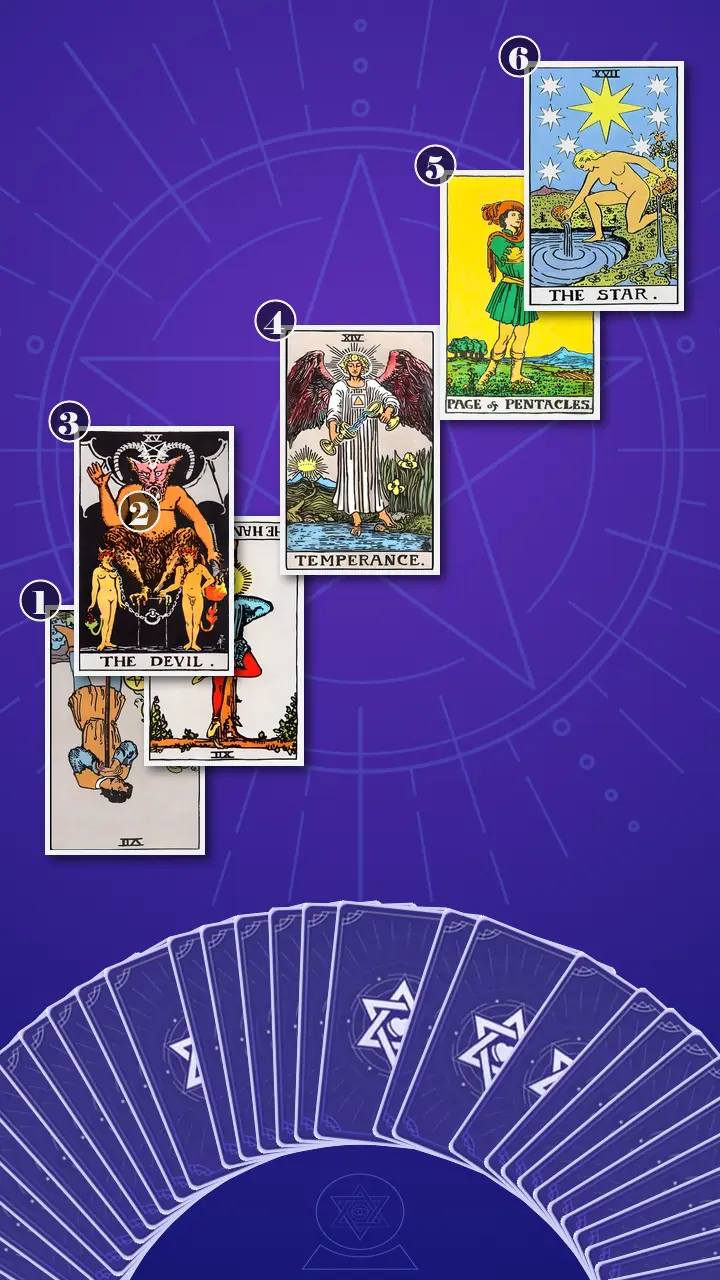
I explained that I was using the Six-card Four-Layer Insight Ladder: Context Edition, an original six-card tarot spread for reduced-course-load pace anxiety. Tarot can work here as a structured reflection tool: card meanings in context give us images and questions, while Jordan remains the person who checks degree requirements, chooses a timetable, and decides what evidence matters.
This spread suited the question because the question was causal, not a simple either-or decision. A decision spread would force a choice between paths; this ladder follows a self-reinforcing loop from visible symptom to root pattern, hidden fear, transformation, practical action, and integration. It lets a lighter course load be examined without turning tarot into a prediction about graduation.
I told Jordan that the first position would show the concrete behavior making the pace feel unsafe; the second would trace the delayed-gratification rule beneath it; the third would name the fear that turns course count into a verdict. The fourth would be the bridge, the fifth a one-week experiment, and the sixth the perspective available through conscious practice.
The Harvest That Looked Late
The Seven of Pentacles and the Unripe Evidence
Now turning is the card that represents this position's role: the concrete symptom from the diagnosis, where Jordan recalculates credits, compares peer timelines, and fills open calendar blocks because the reduced course load feels like visible loss. It is the Seven of Pentacles, in reversed position.
In the Rider-Waite-Smith image, the figure leans on the hoe to inspect a crop. Reversed, that pause has become an excess of premature progress-checking and a deficiency of trust in timing. I connected it to Jordan's shorter study day: no dramatic credit milestone appears, so they open the degree audit on the TTC, compare completed credits with a classmate's full schedule, and assign extra readings to the open blocks. Work is happening, but the harvest is being judged before it becomes visible.
I said, 'This card is not saying the work will fail. It is showing a blockage in receiving evidence that is quieter than a larger course count: an understood concept, a useful question, energy still available tomorrow. When the calendar has room, Jordan tries to make the day look more serious instead of asking what the original coursework has had time to become.'
Jordan gave a short laugh, but there was no amusement in it. 'That is too accurate. Almost cruel.' I let the sentence stand instead of rushing to make it inspirational. 'I hear a strategy that once offered control,' I said. 'We can examine whether it still protects the learning Jordan wants.' Their fingers stopped on the edge of the phone, and their mouth tightened before they looked back at the card.
I added, 'A lighter load needs a better measure, not a louder panic.' Jordan did not nod. They simply turned the phone face down for the first time that evening.
The Pause That Would Not Stay Empty
The Hanged Man and the Spreadsheet Called Preparation
Now turning is the card for this position's role: the psychological mechanics behind the symptom, the delayed-gratification rule and the Forced Blooming Trap that turn a necessary pause into pressure to accelerate. It is The Hanged Man, in reversed position.
The suspended body in the image could have offered a new viewpoint, but reversed energy resists suspension. I saw the Toronto library afternoon in Jordan's description: a recovery block deliberately left open after a difficult lecture, a cold coffee beside the notebook, and hands switching between the degree-audit portal, Google Calendar, and imagined catch-up plans. The pause was physically available, yet planning kept replacing it. Action had become an immediate source of relief, while perspective remained blocked.
I asked Jordan to repeat the scene, and they said, 'I call this preparation, but what I am actually avoiding is the feeling that a pause might count as wasted time.' The visible activity of opening tabs had no completed learning task attached to it. I watched their thumb hover over the trackpad, their shoulders rise, and then their eyes lose focus as the library scene replayed. The pause was not absent. It was being refused.
I cautioned that the answer was not to swing into total disengagement or abandon fixed obligations. The useful observation would be smaller: one fixed study block, one fixed recovery block, and a note about what each allowed. Planning could become a servant of observation instead of a substitute for it.
The Rule Hiding Under the Numbers
The Devil and the Loose Chain of Speed
Now turning is the card for this position's role: the underlying fear that a slower course load will prove a lack of control and self-worth, making academic pace feel like a personal verdict. It is The Devil, in upright position.
The chained figures in the Rider-Waite-Smith image gave form to an attachment rather than a prophecy. Upright energy here was a blockage in self-authored worth and an excess of compulsion around external metrics. I saw registration night as Jordan described it: a classmate posted a packed semester plan, and Jordan moved between Instagram, the course catalogue, and a spreadsheet comparing possible completion dates. The reduced timetable had been chosen deliberately, but the comparison still seemed able to decide whether that pace was legitimate.
I told Jordan that peer timelines had begun acting like an algorithmic recommendation feed. Every click on full schedules, internship posts, thesis announcements, and graduation countdowns trained the next screen to show more fast-moving milestones, until speed looked universal. The feed could not show health, finances, responsibilities, or learning needs, but repeated attention had promoted it to authority.
I asked, 'When the course count starts to feel like a verdict, what rule about being a serious student are you obeying?' Jordan looked at the dark pedestal on the card. Their jaw tightened, their hand closed around the pen, and then the pen rolled loose between their fingers.
'I should use every open hour,' they said. 'If I am not moving, everyone else passes me.'
I answered, 'That rule may have helped you mobilize, but it is not the same thing as truth. You cannot use a faster-looking schedule to manufacture proof that you are capable.' The fear was not simply delay. I could hear the deeper fear that slower visibility would expose a lack of control, and that a lack of control would somehow become a judgment about worth.
When Two Cups Made Room
Temperance and the Bridge Between Effort and Capacity
The room went quiet when I placed the next card in the centre of the ladder. Rain moved softly against the window, and the glass of water beside my notebook caught the lamplight. I did not treat the silence as an omen; I let it make space for a different kind of attention.
Now turning is the card for this position's role: the key shift from forcing visible progress to deliberately combining learning, recovery, and a self-authored measure of sustainable progress. It is Temperance, in upright position.
The angel's two cups translated immediately into a weekly Toronto student schedule. One cup held a clearly defined study outcome; the other held a protected recovery block that allowed material to settle. Upright Temperance brought balance as an active practice, not passive waiting. It offered a way to hold ambition and capacity together without asking either one to cancel the other.
After a decade of guiding people through the stars, I use a diagnostic lens I call Macro-Cycle Phase Identification. It helps me locate a person within a longer cycle of effort, consolidation, recovery, and renewed movement, without pretending that a cycle dictates their fate. In Jordan's reading, the reduced load looked less like a permanent retreat and more like a phase in which depth and capacity needed room to develop before visible accumulation could speak clearly.
I then applied my Systemic Friction Auditing. I asked which parts of the schedule were genuinely required and which extra tasks existed only to make the open space feel morally safe. Hustle could not override a structural pause; it could only add friction, drain attention, and make the original learning harder to absorb. That distinction did not make the degree timeline irrelevant. It made the pressure more accurately named.
I translated the card's inner dialogue aloud: 'If I am not filling the space, I must be failing' could become 'What if the space is part of what lets the work become mine?' I did not ask Jordan to solve the tension between ambition and recovery through forced optimism. I asked them to hold both cups long enough to observe what the combination made possible.
Before I gave Jordan the central line, I asked them to picture 8:47 PM on the Toronto streetcar: the phone warm from checking classmates' schedules, the degree-audit tab still open, and an unfilled study block looking suspiciously like evidence that everyone else was moving while they stood still.
You do not have to force a faster bloom to prove that you are progressing; let Temperance's two cups combine focused study and recovery, and use that balanced rhythm to loosen the delayed-gratification rule that equates fewer courses with falling behind.
For a moment, Jordan's breath stopped and their thumb froze above the phone. Then their gaze moved past the cards, unfocused, as if the streetcar lights and the degree-audit tab had returned around them. Their brow tightened. 'But does that mean I was wrong before?' The question came out sharp, with a flash of anger that I welcomed; insight should not erase the reasons they had sought safety. I said, 'It means the old measure was doing a job, and you can decide whether it is still the right job.' Jordan's clenched hand opened one finger at a time. A long breath left their chest; their shoulders dropped, then hovered there, uncertain. Their eyes reddened, not with a promised solution but with the strange exposure of having fewer excuses to keep running. They looked at Temperance, then at the empty space beside it, and whispered, 'Maybe recovery is part of the work.' The room settled as a streetcar bell sounded below my window, a small, ordinary punctuation.
I asked, 'Now, use this new perspective to recall whether there was a moment last week when this insight might have made you feel differently.'
I named the crossing clearly: this was a first movement from urgent peer comparison, shame, and guilt toward grounded self-trust in a self-defined academic rhythm. It was not certainty about the whole degree. It was permission to test whether learning depth and protected capacity could become evidence.
One Concept Held at Eye Level
The Page of Pentacles and the Small Academic Experiment
Now turning is the card for this position's role: the transformation translated into a one-week experiment, one specific learning outcome or manageable academic commitment that can provide evidence without overloading the schedule. It is the Page of Pentacles, in upright position.
The Page holds one pentacle at eye level, giving full attention to one tangible thing. Upright energy restored grounded effort and teachable patience. I connected it to Jordan choosing one modest target: explaining a difficult lecture concept in their own words, identifying the step in a problem set that had been unclear, or completing one defined section without turning the remaining calendar space into a second course.
I told Jordan, 'Let one understood concept count before you add another challenge.' The Page was not asking for a smaller identity or a guaranteed result. It was offering a reviewable piece of evidence, the academic equivalent of a small pull request rather than a promise to rebuild the whole future at midnight.
Jordan looked down at their notes app. Their shoulders stayed slightly raised, but their hand began writing instead of reopening the degree audit. They wrote one sentence about a lecture concept and left the rest of the page blank.
The Star Above the Same Calendar
The Star and a Self-Authored Horizon
Now turning is the card for this position's role: the emerging integrated orientation in which Jordan can use a lighter course load intentionally and evaluate progress without making peer speed the authority. It is The Star, in upright position.
The figure pouring water onto both the land and the pool showed me a kind of hope with practical edges. Upright energy here was renewal, openness, and a calmer connection to personal direction. It did not promise that every course requirement would fit perfectly or that the slower timeline would carry no consequences. It suggested that academic progress could nourish both the transcript and the capacity needed to remain engaged.
I asked Jordan to imagine finishing a week with fewer commitments but more fully absorbed material, enough energy to ask a useful question in office hours, and the same calendar still looking different from a classmate's. They looked toward the window, where Toronto's lights blurred in the rain. 'I might be able to judge the week by what I can carry forward,' they said.
I told them that The Star was not a public leaderboard. It was a personal navigation setting: a way to orient toward a direction without requiring another person's arrival time as proof. The invitation was not to stop caring about credits. It was to let more than credits participate in the evidence.
The One-Week Two-Cup Pace Check
When I read the six cards as one story, I saw a garden being judged every morning because it had not flowered yet. The reversed Seven of Pentacles showed Jordan inspecting the harvest too soon. The reversed Hanged Man showed planning replacing the pause. The Devil revealed the rule that made speed look like control and course count look like character. Temperance changed the direction of attention by blending study with recovery; the Page of Pentacles made that rhythm observable through one small piece of learning; The Star gave Jordan room to let a personal direction emerge without a promise about the final timeline.
The cognitive blind spot was not a lack of ambition or information. It was the assumption that a fuller schedule could make capability visible enough to feel safe. The more Jordan added, the more fatigue weakened concentration, and the weaker concentration appeared to confirm the original fear. The transformation direction was precise: replace the demand to prove progress through a faster course count with a weekly, self-authored measure of learning depth, completed academic commitments, and protected capacity.
I also reminded Jordan that tarot could not answer every practical question. Registration rules, graduation requirements, finances, accessibility needs, and future career implications belonged with the university adviser and with factual planning. The cards were helping Jordan examine the meaning attached to the numbers, not asking them to ignore the numbers.
For the first three days, I offered my Orbital Sync Protocol, a 72-hour exercise for pausing forced actions and bringing psychological expectations into alignment with actual cyclical reality. Jordan would pause only the extra readings, certificates, or catch-up tasks added solely to make empty space look legitimate. Fixed deadlines and necessary coursework stayed in place. The purpose was observation, not surrender: to see what became possible when the system stopped demanding a faster-looking orbit.
Two Small Tests for Sustainable Learning
- One-Outcome Evidence LogAfter one study session for one course this week, I asked Jordan to open their notes app for no more than ten minutes and write three short lines: one concept they understood, one academic commitment they completed, and one piece of capacity they protected. They would read the note once at the end of the week before adding any extra task.Use one sentence if three lines feel like another performance test. Record the evidence before opening Instagram or recalculating credits, and do not add work afterward to make the list look more impressive.
- The Two-Cup Pace CheckIn Google Calendar, I asked Jordan to schedule one 45- to 60-minute block with a single academic outcome and one 30-minute block labelled recovery for learning after a class or study session. Across the next 72 hours, they would leave one remaining block unassigned and pause any forced replacement task that existed only to fill it.Keep real obligations visible, but give the recovery block a clear stop time and turn notifications off. If the exercise becomes too activating, use a five-minute version or change the arrangement; it is a tool, not a new rule to obey.
I told Jordan that these were actionable next steps, not a new standard for proving that the lighter course load was responsible. They could keep the measures that produced useful information, revise the ones that created more pressure, and bring any factual degree-planning concerns to an adviser.

The Quiet Proof of a Deliberate Pace
A week later, I received a message from Jordan: 'I explained one hard concept, left the recovery block alone, and slept a full night.' The next morning still began with the thought What if I am wrong?, but they opened the notes app before the degree audit.
I could picture the same calendar with one protected block still open, no longer glowing like a missing assignment. The doubt had not vanished, and the academic timeline had not magically rearranged itself. But Jordan had gathered a different kind of proof: one concept understood, one commitment completed, and enough capacity preserved to keep learning tomorrow.
That was our Journey to Clarity. The cards had not taken control of Jordan's future; they had helped Jordan notice where attention was being spent, question the rule beneath the comparison, and choose a rhythm they could evaluate for themselves. A reduced course load was still a decision with practical consequences, but it no longer had to serve as a public defense of their capability.
When the degree audit leaves your chest tight and your hands reopening the same planning tabs, you can want a sustainable pace and still fear that every slower-looking week is exposing you as less capable.
If one week did not have to prove your entire academic future, what small piece of learning or protected capacity might you let count in your own measure?