The Eight Extra Slides: Overworking to Prove My Worth at a Career Crossroads
I recognized the pattern before Jordan sat down: ‘You are a 29-year-old product marketer in Toronto who notices a strategy meeting vanish from your calendar at 10:40 p.m. and responds to workplace invisibility by adding eight slides nobody requested.’ Jordan gave me the look of someone who had been described by an algorithm they did not remember training.
At 10:40 p.m. on a Tuesday, they had been standing in their condo kitchen with one hand on a mug of cold coffee when the Google Calendar invitation disappeared. The laptop fan hummed against their wrist, streetcar brakes scraped somewhere below, and the campaign deck reopened almost by itself. By midnight, eight unrequested slides sat inside it, polished enough to look like proof.
Jordan told me, ‘Nobody has said I am failing, yet everything important keeps moving around me. I keep treating silence like a request for more proof.’ Their role had drifted from strategic planning into fragmented execution, while praise for being reliable arrived alongside fewer planning invitations, reassigned deliverables, and almost no meaningful feedback. The drive to make effort count through overwork was meeting an obstruction that effort alone could not move.
The less access Jordan received, the more proof they produced; the more proof they produced, the less room remained to ask what had changed. Their exhaustion was not an abstract mood. It sat in their body like a phone stuck at two percent battery but refusing to shut down: tight jaw, raised shoulders, shallow breathing, and a wired heaviness that made stopping feel more dangerous than continuing.
I told Jordan, ‘You are not failing to try; you are trying to solve exclusion with the only lever that still feels controllable.’ I did not want to romanticize overwork or turn their employer into a villain whose motives I could magically read. I wanted to help us separate observable workplace facts from the story fear had built around them. Our Journey to Clarity would begin by drawing a map of the pattern, one that left Jordan in charge of the next decision.

The Transformation Path Grid and the Missing Route
I invited Jordan to take one slower breath and hold the question in plain language: Why do I keep overworking when my efforts are quietly sidelined? Then I shuffled slowly, using the movement as a psychological transition from replaying the calendar change to examining it. The cards were not a supernatural verdict. They were a structured way to notice patterns, test assumptions, and ask better workplace questions.
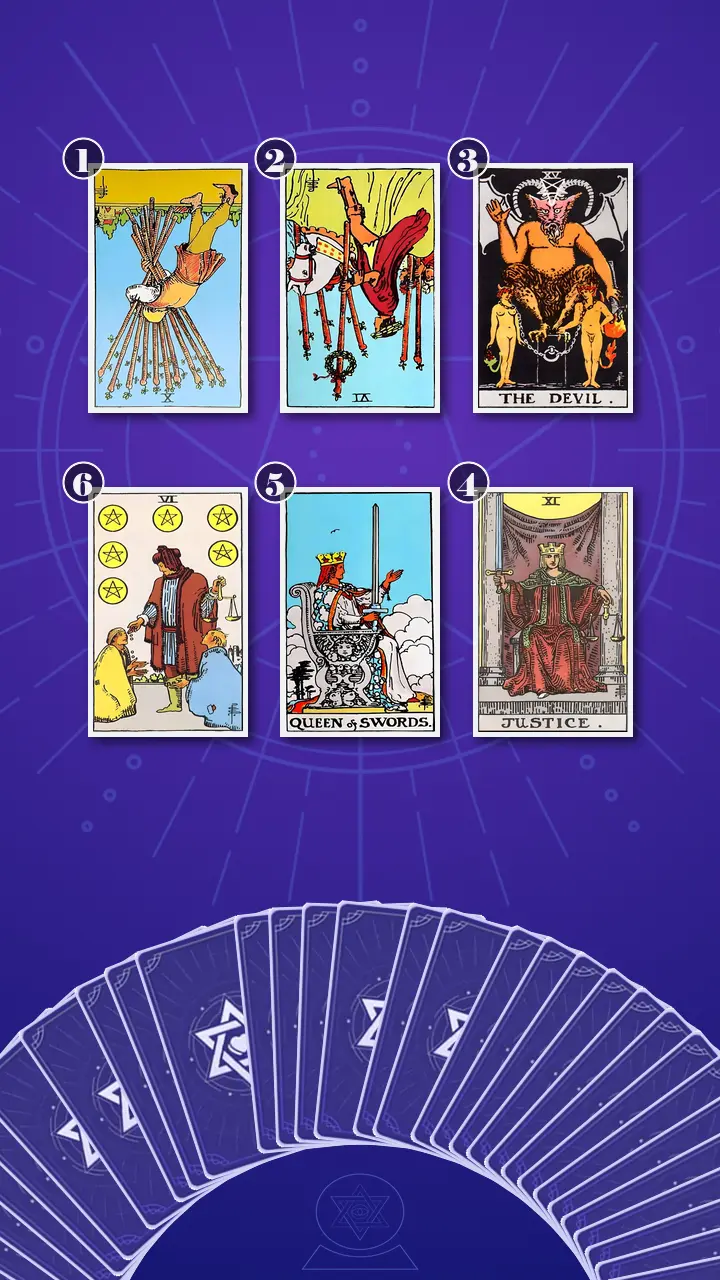
For this reading, I chose the six-position Transformation Path Grid. It is a six-card career tarot spread for workplace overwork, recognition, and boundaries because it can hold both sides of the problem: the internal defence that makes extra labour feel necessary and the external system that may be withholding access, ownership, or feedback. A Celtic Cross would have offered a wider snapshot, but its ten positions would have blurred this particular chain. This smaller grid could follow the symptom, the blockage, the root, the catalyst, the practical response, and the sustainable principle without predicting an employment outcome.
I explained the arrangement before turning the first card. The upper row would show the visible behaviour, the blocked recognition, and the belief beneath it. The lower row would move through the catalyst, the boundary-setting response, and the integrated standard for future effort. Its serpentine shape resembled a switchback path: first across the surface, then down to the deepest attachment, then back toward firmer ground.
I said, ‘We are not asking whether the cards can tell us what your manager will do. We are asking what becomes visible when your hours, access, ownership, feedback, and support are placed in the same conversation.’
The Weight Before the Question
The Ten of Wands and the Blocked View
I first turned to the position that depicts the presenting behaviour: Jordan responding to shrinking visibility by carrying more work, extending hours, and revising beyond scope.
The card was the Ten of Wands, reversed.
In its usual meaning, the Ten of Wands shows responsibility becoming a physical burden. Reversed, the burden has become unsustainable, delegation is weak, and the figure carrying it can no longer see the road ahead. In Jordan’s context, the bundled staffs became accumulated slides, handoff tasks, instant replies, and abandoned responsibilities. The energy was Fire in excess but perspective in deficiency. Jordan could see the next task clearly while losing sight of who requested it, which priority it served, what it replaced, and whether Jordan still owned the outcome.
I connected the card directly to that Tuesday night. The nearly finished deck had not needed eight more slides. The extra work had created a brief sense of control while concealing the more strategic question: if the meeting had vanished, would another layer of output restore access, or was the organisation changing the route around Jordan?
I asked, ‘Before accepting an additional task, what would happen if you first asked which current priority it replaces and waited for a clear answer?’
Jordan let out a short, bitter laugh. ‘That is accurate enough to feel a little rude,’ they said. Their breath paused, their fingers stopped around the coffee mug, and their eyes dropped to the deck as if replaying every late-night revision. Then their shoulders lowered by a fraction, followed by a slow exhale that carried both recognition and shame.
I did not treat that reaction as evidence that Jordan should simply become better at time management. I said, ‘The first card is not accusing you of carrying too much. It is showing how the load blocks your line of sight. For one workweek, let relevance be confirmed before effort expands.’
The Six of Wands with No Name on the Wreath
I moved to the position that identifies the immediate blockage: recognition, access, and meaningful ownership are not increasing in proportion to Jordan’s effort.
The card was the Six of Wands, reversed.
The Six of Wands normally depicts visible achievement, public acknowledgement, and the social signal that contribution has counted. Reversed, the victory wreath turns unstable. Praise may remain, but the position, access, and secure ownership that usually give praise substance are missing. This was blocked Fire. Jordan kept producing in a workplace where the public signals of recognition had become unreliable, then treated each missing signal as an assignment to become more impressive.
I brought the reading into Monday morning on the TTC Line 1. Jordan had opened a Slack recap from a planning meeting they had not been invited to and spotted their campaign language in a screenshot with no owner named. The carriage smelled of wet coats. The rails shrieked into Bloor-Yonge. Their stomach dropped, their thumb moved to the deck link, and the train kept moving while Jordan’s role felt stationary.
Jordan’s private sequence was simple and painful: I saw no acknowledgement, so I treated the absence as an assignment to improve. A brief ‘Looks great!’ reaction on a detailed deliverable became more emotionally powerful than its lack of feedback deserved. I named the distinction carefully: producing is not the same as being positioned to receive access, ownership, context, or credit. Praise without access is information, but it is incomplete information.
Jordan’s thumb hovered over the Slack thread. Their eyes went briefly unfocused, then returned to the screenshot. ‘I saw my idea in the meeting recap,’ they said, ‘and instead of asking why I was not there, I volunteered to execute the decision.’
I answered, ‘Silence is not a brief for more labour.’ The train announcement sounded sharply clear in the pause that followed. Jordan did not nod right away. They swallowed, looked at the card again, and then gave a small, reluctant nod that seemed to belong less to agreement than to the relief of having the exact injury named.
The Devil’s Auto-Renewing Subscription
I turned to the position that reveals the psychological root: the Workaholic Tendency binding output to worth, usefulness, belonging, and a temporary sense of control.
The card was The Devil, upright.
The Devil can represent bondage, material pressure, and a bargain that retains power by appearing inevitable. Here, the chains were real, but they were loose enough to be noticed. The root was not a lack of discipline. It was the repeated exchange of time, rest, and boundaries for a few hours of feeling useful. A non-urgent Slack message arrived at 11:18 p.m.; Jordan answered within two minutes and offered to revise the asset overnight. Saying yes quieted the fear of being dispensable, although the relief could not control the employer’s next decision.
I described the pattern as an auto-renewing subscription paid in evenings. Each exclusion charged Jordan another night. The payment produced temporary certainty, then the fear returned with a new notification. It was also an algorithm trained on one anxious click: every removed invite recommended more output, so overwork began to look like the only available response.
I asked, ‘When you say yes at 11:18 p.m., what does that yes promise for the next few hours: safety, usefulness, control, belonging, or protection from a feared answer?’
Jordan’s hand tightened around the phone. Their gaze moved from the green Slack dot to the dark window, as if a recent evening were playing there. Their breathing became shallow, then they released the phone onto the table and said, ‘Safety, I think. Or at least a way not to think about what I cannot control.’
I noticed that no Cups appeared in the spread. I told Jordan that this did not mean emotion was absent. It suggested that hurt and resentment had been converted directly into labour before they could be felt or named. A reassigned deliverable produced heat behind the ribs, but the next response was a checklist. A missing meeting invitation produced shame, but the next response was another update. The task list had become the private language of pain.
Jordan went quiet. I watched the recognition move through three small stages: first, the fixed stare and held breath of someone finding a familiar mechanism; then the eyes losing focus as they replayed saying, ‘I can take care of it’; finally, a deep exhale that softened their mouth without making the situation simple. The pattern could be examined without shaming ambition or ignoring Toronto rent and an uncertain job market.
When Justice Put the Facts on the Scales
Justice and the Two Columns of Evidence
The room seemed to become quieter before I turned the next card. Even the ventilation softened into a low, steady hum.
I moved to the position that supplies the leverage point: Jordan separates observable workplace evidence from self-critical assumptions and evaluates whether the exchange is fair.
The card was Justice, upright. This was the catalyst card.
Justice brings proportion, accountability, and decisions grounded in evidence. Its scales asked me to place Jordan’s hours, deliverables, and availability beside meeting access, named ownership, feedback, context, support, and organisational investment. Its upright sword represented the precise distinction between an observable event, such as a removed invitation, and an assumption, such as I am not valuable.
At this point, I used one of my signature analytical lenses, Career Cycle Phase Identification. I explained that I use it to distinguish a personal skill gap from an industry-wide contraction or an organisational shift. It does not predict layoffs or promise promotion. It asks which evidence belongs to Jordan’s capability, which evidence belongs to the company’s changing structure, and which facts remain unknown. Justice made that distinction possible without turning uncertainty into self-blame.
At 10:40 p.m., a meeting disappears from the calendar and the deck opens almost automatically. Eight new slides later, the work looks stronger, but the missing access, ownership, and feedback remain exactly where they were. Jordan is caught between self-accusation and the fear that stopping will make dispensability official.
You do not have to earn fairness through exhaustion; place the facts on Justice’s scales and let evidence, rather than the Workaholic Tendency, set the boundary for your effort.
Jordan’s hand stopped above the notebook. Their breath caught; their fingers curled around the pen without writing. Their gaze went unfocused, moving past the card as if replaying the vanished invite, the reassigned deck, and the midnight Slack reply. Then their thumb loosened, their shoulders dropped by a fraction, and a long, shaky exhale left their chest. A small laugh came next, not bright, more like disbelief finally finding an exit. Their eyes reddened. For a few seconds, the room felt almost too open: no task to hide inside, no extra slide to make, only the responsibility of seeing what the facts might say. They whispered, ‘So the missing invitation is information, not a performance review?’ I nodded. The relief did not erase the fear of rent, the job market, or an answer Jordan could not control. It simply gave that fear a chair instead of the steering wheel. Their hand returned to the notebook, this time writing one date rather than another deliverable.
‘Now use this new perspective to think back over last week,’ I said. ‘Was there a moment when this insight might have let you feel differently?’
This was the first movement from exhausted vigilance and proof-driven overwork toward evidence-based self-trust and grounded reciprocal boundaries. Jordan was not required to feel certain. They were learning to let workplace decisions become evidence to evaluate rather than verdicts on personal worth.
The Questions Before the Extra Slides
The Queen of Swords and the Three-Second Pause
I turned to the position that converts the catalyst into behaviour through concise questions about scope, ownership, decision access, feedback, and limits.
The card was the Queen of Swords, upright.
The Queen’s raised sword gave Justice a voice. Her open hand kept that voice curious rather than punitive. Her energy was clear Air: precise language, independent judgement, and boundaries shaped by experience. In modern life, this looked like a twenty-minute manager conversation with four questions written in a phone note: What are my current top three priorities? Which decisions am I expected to join? What do I own from brief through outcome? When will we review feedback and role scope?
I suggested sending the agenda with the meeting request so the purpose was documented without becoming accusatory. During the conversation, Jordan could ask one question at a time, leave three seconds of silence after each answer, and resist filling the space with apologies, extra context, or promises to work harder. A clear question can do what eight extra slides cannot.
Jordan frowned. ‘But if I ask directly, won’t I sound difficult? If the role is already shrinking, I cannot afford to make myself easier to remove.’
I acknowledged the material risk rather than arguing it away. ‘You do not need to disclose every private fear or stage a dramatic confrontation. You can be open to the answer without negotiating against yourself before it arrives. If a live meeting feels too exposed, begin with one written question: Which priority should this new task replace?’
Jordan opened a phone note and typed the four questions. Their shoulders remained lifted at first. Then they paused, deleted two paragraphs of explanation, and kept the questions. I saw the Queen’s balance in that small edit: firmness without accusation, curiosity without appeasement.
The Six of Pentacles and a Measured Exchange
I reached the final position, which defines cognitive integration as reciprocal contribution rather than a promised employment outcome: effort is given where expectations, resources, recognition, and responsibility are legible and proportionate.
The card was the Six of Pentacles, upright.
The Six of Pentacles concerns giving, receiving, resource allocation, and the power dynamics within an exchange. Its scales made the workplace tangible. Time, expertise, context, authority, ownership, feedback, credit, and compensation all belonged on the same ledger. The card did not pretend that every workplace exchange was equal, and it did not promise that Jordan’s employer would suddenly become fair. It offered a decision standard: contribute, renegotiate, document, or pause according to the evidence.
The two Sixes showed the change clearly. The Six of Wands reversed had asked whether anyone was applauding. The Six of Pentacles upright asked what was actually being exchanged, allocated, acknowledged, and supported. Jordan could still care about recognition without using ambiguous approval as a substitute for security.
Jordan looked at the scales and said, ‘So reliability is not the same thing as security.’
‘Exactly,’ I said. ‘Reliability without reciprocity is not the same as security.’
The Exchange Ledger, Not Another Test
When I read the six cards as one story, the sequence became practical. The reversed Ten of Wands showed Jordan carrying accumulated work until the road disappeared. The reversed Six of Wands showed what that burden was trying to buy: recognition, access, and proof that the contribution still counted. The Devil revealed the bargain beneath it, in which exceptional output purchased temporary usefulness while leaving organisational decisions outside Jordan’s control. Justice interrupted the bargain with evidence. The Queen of Swords gave that evidence language. The Six of Pentacles grounded the change in a reciprocal standard.
That answered the question of why Jordan kept overworking when efforts were quietly sidelined. The extra labour was not causing the workplace pattern, and it could not independently repair missing access or ownership. It was functioning as protection from uncertainty. The blind spot was confusing output with influence, praise with inclusion, and constant availability with job security. The transformation direction was a shift from answering exclusion with more proof to requiring explicit priorities, visible ownership, reciprocal support, and meaningful feedback before adding labour.
I also introduced my second career lens, Promotion Window Calibration. I use it to map organisational shifts and locate the path of least resistance for advancement. In Jordan’s case, that did not mean working harder at every fragmented task. It meant observing where decision access, sponsorship, resources, and visible ownership were moving, then deciding whether the emerging path matched Jordan’s skills and limits. A promotion window is something to evaluate through evidence, not something a card can guarantee.
I gave Jordan three small pieces of actionable advice. Each one was designed as a test, not a permanent declaration about the company or Jordan’s career.
- Run the Justice Reciprocity AuditOn Monday, create a private two-column note titled Labour Given / Workplace Reciprocity. Spend no more than ten minutes listing the previous two weeks of requested deliverables, extra hours, meeting access, named ownership, feedback, context, and support. Add one task’s agreed scope and mark what was actually received.Tip: Keep it descriptive, with dates and facts rather than guesses about motives. The minimum version is one row containing one task and one missing form of reciprocity.
- Use the Four-Question Clarity MeetingBefore the next manager conversation, write the four Queen of Swords questions in a phone note, request one twenty-minute meeting, and include the agenda in the invitation. Ask one question at a time, leave three seconds of silence after each answer, and send a five-sentence recap covering priorities, ownership, unknowns, the feedback date, and any task being paused or replaced.Tip: If a live conversation feels too exposed, begin in writing with ‘Which current priority should this new task replace?’ A boundary can be concise, neutral, and proportionate.
- Try the Micro-Orbit ObservationFor thirty days, spend five minutes at the end of each Friday tracking subtle organisational blueshifts and redshifts: more or less meeting access, clearer or weaker ownership, increased or reduced context, timely or missing feedback, and visible or fragmented opportunities. Mark a blueshift when access and support improve, and a redshift when they consistently narrow. Use the pattern to choose Continue, Renegotiate, Document, or Pause. As part of the experiment, mute non-urgent Slack notifications after 7:00 p.m. on three weekdays.Tip: These labels describe direction, not destiny. Do not doom-scroll the data or make a major career decision from one signal. Stop or shorten the exercise if it intensifies distress or creates workplace risk.
I reminded Jordan that the audit could remain private, and that a trusted colleague, mentor, union representative, or employment professional could be appropriate support if the workplace stakes became more serious. Tarot could help Jordan see the pattern, but Jordan remained the person who decided what to document, what to ask, what to pause, and where further support belonged.

A Small, Unpolished Proof
Four days later, I received a message: ‘I sent the four-question agenda and muted Slack after seven.’ Jordan had slept through the night, then woke with the old thought, What if I am wrong? They made coffee alone at the kitchen counter and let the question remain unanswered for ten minutes.
The manager’s reply had not solved the whole workplace situation. It had clarified one priority, left two ownership questions open, and created a follow-up date. That was enough for a first piece of evidence. Jordan did not add eight slides to compensate for the uncertainty. They documented the open questions and waited.
I did not call that a perfect breakthrough. It was lighter and more useful than that: the first small proof that discomfort could be present without automatically becoming labour. The old fear still existed, but it no longer had sole authority over the next action.
My decade of guiding people through cycles has taught me that a low tide is not a character flaw, and a changing orbit is not a command to chase every moving object. This Journey to Clarity gave Jordan a way to distinguish temporary uncertainty from a recurring exchange that needed a boundary. The cards did not take over the decision. Jordan did.
Ownership, Not Certainty
I use the six-position Transformation Path Grid tarot spread for workplace overwork, recognition, and boundaries because it brings the question back to the person living it. It can turn a calendar change, a reassigned deliverable, or a green Slack dot into evidence to examine rather than a verdict to obey. It can support grounded self-respect while leaving room for cautious openness.
When a calendar invite disappears and your jaw tightens before you reopen the work, the hardest part is not the extra task; it is the fear that stopping for one evening might prove you were never essential.
If one observable fact could matter more than the urge to prove yourself this week, which fact would you want to let onto the scale?
This story is adapted from psychological research, written so that those in a similar struggle can see their own pattern in it — and find their next step clearly.These insights are not a substitute for professional psychological, medical, legal, or financial advice.
Learn more about our Journey to Clarity.
How did this insight land for you?
🫂 This Resonates Deeply
🌀 Living This Story
✨ Now I See Clearly
🌱 Seeing New Possibilities
🧰 Useful Framework
🔮 The Confirmation I Needed
💪 Feeling Empowered
🚀 Ready for My Next Step
Author Profile
 AI
AI“After a decade of guiding people through the stars, I’ve come to see life much like the orbits of planets: everything has its inevitable cycles. When you feel lost, please don't blame yourself; you might just be in a natural low tide. I’m here to sit under the night sky with you, offering a gentle cosmic perspective to distinguish temporary pain from the beautiful breakthroughs just around the corner.”
In this Career Tarot Reading :
Core Expertise
- Career Cycle Phase Identification: Determining if your current bottleneck is a personal skill gap or an inevitable industry-wide macro contraction.
- Promotion Window Calibration: Mapping the trajectory of organizational shifts to locate the path of least resistance for advancement.
Service Features
- The Micro-Orbit Observation: A 30-day tracking strategy to detect subtle organizational 'blueshifts' (opportunities) and 'redshifts' (layoff risks).
Also specializes in :
Explore Related Patterns:
Defensive OverfunctioningFewer planning invitations and reassigned deliverables are followed by more slides, instant replies, and offers of overnight revision. Jordan takes on additional execution while receiving less context, ownership, and meaningful feedback. The compensatory effort is not moving the obstruction; it is expanding Jordan's side of an exchange that is already becoming less reciprocal. Defensive overfunctioning appears when doing more protects you from the vulnerability of waiting, asking, or discovering that effort cannot control the outcome. It can make exceptional reliability feel like the only remaining lever, even as that lever drains your capacity and leaves the power imbalance untouched. Recognizing the defense allows you to ask whether the next contribution serves an agreed priority or merely postpones contact with an answer you fear.
Productivity as SafetyThe eight polished slides give Jordan a brief sense of control after a meeting invitation disappears, even though the additional work changes nothing about access, ownership, or feedback. Later, Jordan identifies safety as the promise hidden inside an immediate late-night yes. Productivity is doing emotional work here: it converts an uncontrollable workplace question into a task with visible steps and a finish line. When productivity becomes a source of safety, you may not be working only to complete a deliverable. You may also be using measurable output to regulate uncertainty, hurt, or fear that has no immediate solution. The relief is real but temporary, because completing the task cannot control the external decision that triggered the fear; another ambiguous signal can restart the need to produce.
Usefulness-Based Self-WorthJordan's eight extra slides are polished enough to look like proof, and a missing acknowledgement is interpreted as an assignment to become more impressive. The late-night yes also offers a few hours of feeling useful and less dispensable. These moments show contribution carrying more than a professional purpose; usefulness is being recruited as evidence that Jordan still deserves a place in the room. When your sense of worth is tied to usefulness, reduced access can trigger more service rather than a direct evaluation of the exchange. You may keep giving because declining, pausing, or asking for clarity feels emotionally close to becoming irrelevant. Separating your worth from your immediate utility makes it possible to assess whether the workplace is actually providing the ownership, feedback, and support that sustained contribution requires.
Visibility Reassurance LoopEach time Jordan loses access or acknowledgement, they produce more proof: eight extra slides after a removed invitation, volunteered execution after seeing their language in an unnamed recap, and immediate availability after a late-night message. Each response creates temporary reassurance that the contribution still matters, but none restores stable ownership, context, or decision access. The next visibility loss therefore restarts the same sequence. A visibility reassurance loop can make you chase proof of relevance through output because effort produces a faster signal than the organization provides. The reassurance expires quickly when praise remains vague or access continues to narrow, so the behavior demands another demonstration. Breaking the loop requires evaluating substantive indicators such as ownership, feedback, and inclusion instead of asking additional labor to manufacture a sense of visibility.
Workplace Self-SilencingJordan sees their campaign language in a meeting recap from which their name and presence are missing, then volunteers to execute the decision instead of asking why they were excluded. They later admit that a direct question might make them sound difficult or easier to remove. Silence therefore protects against an anticipated professional cost, while extra labor fills the space where clarification would otherwise occur. When workplace self-silencing takes over, you may negotiate against yourself before anyone answers. Questions about scope, credit, or decision access can feel more dangerous than another evening of work, even when avoiding those questions preserves the ambiguity driving the overwork. A concise request for observable information can interrupt the pattern without requiring confrontation or disclosure of every private fear.
Emotional BypassingA reassigned deliverable produces heat behind Jordan's ribs, but the next response is a checklist; a missing meeting invitation produces shame, but the next response is another update. The story repeatedly shows hurt and resentment being translated directly into useful activity before either feeling can be named. Labor becomes the acceptable language for reactions that feel harder or riskier to hold. When you bypass an emotion through productivity, the work can look responsible while also functioning as a defense against the message carried by that emotion. Hurt may be signaling lost ownership, and resentment may be signaling an unequal exchange, but neither signal can inform a boundary if it is immediately converted into another task. Naming the reaction does not require acting impulsively on it; it restores information that overwork has been concealing.
Personalization BiasNobody has told Jordan they are failing, yet silence becomes a request for more proof and a removed invitation becomes evidence that they may not be valuable. Jordan also fears that stopping will make dispensability official. Ambiguous organizational behavior is therefore translated into a personal performance verdict before the missing context has been obtained. Personalization bias can make you assume that a workplace shift is primarily a statement about your worth, even when role changes, decision structures, and management choices remain partly unknown. That interpretation directs attention toward self-correction and away from investigating the system around you. Holding personal performance as one possible explanation, rather than the automatic explanation, creates room for clearer evidence and a more proportionate response.
Boundary DiscernmentJordan writes four questions about priorities, decision access, ownership, and feedback, then deletes two paragraphs of explanation and keeps only the questions. They also begin asking which current priority a new task should replace and mute non-urgent Slack after 7:00 p.m. These actions define where Jordan's responsibility ends and where the employer must provide information or make a decision. Boundary discernment allows you to distinguish committed effort from effort that expands because silence feels intolerable. The boundary is not a dramatic refusal or a prediction that the workplace is unfair; it is a requirement that scope, tradeoffs, and ownership become legible before more labor is added. That distinction returns choice to you while leaving the employer responsible for its own priorities and responses.
Reality TestingA meeting disappears from Jordan's calendar, but the later audit separates that observable event from the conclusion that Jordan is not valuable. Jordan records hours, deliverables, access, ownership, feedback, and support, then treats the manager's partial reply as mixed evidence: one priority is clear, two questions remain open, and a follow-up date now exists. Unknowns remain unknown instead of being filled with a self-critical verdict. Reality testing gives you a way to examine a threatening interpretation without dismissing the workplace facts that triggered it. You do not have to pretend that exclusion is harmless, and you do not have to treat it as a complete performance review. By separating event, interpretation, and missing information, you can let evidence determine the next boundary instead of allowing fear to automatically commission more work.
Uncertainty ToleranceFour days later, Jordan wakes with the thought 'What if I am wrong?' and lets it remain unanswered for ten minutes. The manager's reply is incomplete, but Jordan documents the unresolved questions and waits instead of adding compensatory slides. The uncertainty has not disappeared; what changes is its authority over the next action. Uncertainty tolerance means you can remain responsive without forcing an immediate sense of control through labor. You can acknowledge that the role may be changing, that the available evidence is incomplete, and that stopping work does not settle the question either way. This creates enough psychological space for your next decision to come from observed patterns and stated limits rather than from the fastest available relief.
Explore Related Struggles:
Control-Reciprocity LockAt 11:18 p.m., a non-urgent Slack message arrived and you answered within two minutes, offering to revise the asset overnight. The response gave you a controllable move when planning access, ownership, context, and feedback were outside your reach, so the work kept expanding even while the route to meaningful participation narrowed. The lock is between what you can supply and what must be supplied back for the role to function. More hours can change the deck, but they cannot manufacture a meeting seat, decision authority, or reciprocal support. A private record of what you give beside what is returned makes the exchange legible enough for you to continue, renegotiate, document, or pause on evidence.
Productivity-Worth FusionWhen the strategy meeting disappeared from your calendar at 10:40 p.m., you reopened the campaign deck and added eight slides nobody had requested. Later, a missing invitation, a reassigned deliverable, or a brief 'Looks great!' reaction could all become another reason to extend the work, because producing something tangible felt more available than knowing what the change meant. That makes output carry a second job: it has to prove that you are useful, safe to keep, and still essential. An overnight revision can give you a few hours of control, but it cannot decide whether your employer restores access or names your ownership. Seeing that exchange clearly lets you keep effort connected to a defined priority instead of asking labor to settle a question only workplace evidence can answer.
Responsibility-Authority SplitAfter being left out of a planning meeting, you volunteered to execute the decision instead of first asking why you had not been in the room. Handoff tasks, reassigned deliverables, and the question of whether you still owned the outcome kept responsibility in your hands while the context and decision access needed to direct it moved elsewhere. That split makes reliability function like a substitute for authority. You can carry the next task clearly while lacking the information needed to decide its priority, scope, or endpoint, and more effort then makes the imbalance harder to examine. Asking which priority a new request replaces, what you own from brief through outcome, and which decisions you are expected to join gives responsibility a visible boundary.
Recognition-Progress SplitYour role moved from strategic planning into fragmented execution while praise for reliability arrived beside fewer planning invitations and almost no meaningful feedback. When you saw your campaign language in a planning recap with no owner named, your contribution was being used as material without giving you the same access to the room where its direction was set. That separates recognition from progress. A quick compliment can confirm that an artifact is useful without confirming that your role is growing, your ownership is secure, or your voice is included. Treating those as separate signals helps you evaluate the position you actually occupy before adding more work to win a form of recognition that may not change your trajectory.
Systemic DepletionBy midnight, the deck held eight polished slides, while the cold coffee, tight jaw, raised shoulders, and shallow breathing showed what the extra cycle had taken from your body. The same exchange repeated through handoff tasks, instant replies, and overnight revisions: time, rest, and limits were spent, but access, ownership, context, and feedback stayed unresolved. When the method of repair keeps consuming the resource needed to keep going, the workload becomes its own obstruction. The short relief of having done more cannot compensate for a workplace exchange that remains unclear or one-sided. A measured ledger of labor and support lets you see whether another contribution is building a workable role or merely extending the drain.
Explore Related Emotions:
Invisible Labor DreadAt 10:40 p.m., the strategy meeting disappears from your calendar and the campaign deck reopens until eight unrequested slides sit inside it. Your effort is becoming more polished at the exact point where access, ownership, and feedback are becoming less visible, so the extra work carries the burden of trying to make an unseen contribution undeniable. When your language appears in a planning recap without your name and you volunteer to execute a decision made without you, the missing recognition is no longer a single awkward moment. You keep adding proof because output feels like the one lever still available, while the deeper ache comes from having to work around a place that is not clearly making room for you.
Replaceability DreadYour role has drifted from strategic planning into fragmented execution while planning invitations disappear and important decisions move around you. When you see your campaign language in a recap with no owner named, the unanswered question is not only why you were excluded; it is whether the organisation can quietly move on without you. That possibility makes a vanished invite feel larger than a calendar change. You reopen the deck and volunteer for execution to keep your contribution visible, because another layer of proof seems safer than waiting for information about where your role is going.
Usefulness-Based Belonging FearAt 11:18 p.m., you answer a non-urgent Slack message within two minutes and offer to revise the asset overnight. The yes buys a few hours of feeling useful and temporarily keeps the fear of being dispensable out of view, but it cannot decide whether the organisation will return access or ownership. Each removed invite then recommends more output, as though belonging can be secured by being the person who always absorbs the next task. The story places the pressure inside that exchange: your value starts to feel conditional on usefulness, so stopping feels like surrendering your place rather than simply ending a workday.
Grounded AgencyYour hand returns to the notebook and writes one date rather than another deliverable, then you document open questions after the manager clarifies one priority. The decision is no longer outsourced to the vanished invite, the green Slack dot, or the urge to make the deck stronger. You remain the person who chooses whether to continue, renegotiate, document, or pause. The workplace may still hold unknowns, but your next action can be selected from evidence and limits instead of being dictated by the need to prove that you belong.
White-Knuckle SecurityAt 11:18 p.m., a non-urgent Slack message arrives and you answer within two minutes, offering to revise the asset overnight. The response creates a few hours of control and safety, but it asks your body and evenings to stand guard over a decision the employer still owns. Rent, an uncertain job market, and the fear that stopping could make dispensability official keep the grip tight. You are not chasing comfort in the abstract; you are using continued availability as a fragile security signal, even though it cannot guarantee the access or stability you need.
Invalidation AcheOn the TTC, you see your language in a planning recap but no name attached to it, then move your thumb toward the deck instead of asking why you were absent. A brief Looks great reaction has to compete with missing context, ownership, access, and meaningful feedback, leaving the public praise disconnected from the position your contribution actually holds. That mismatch asks you to keep performing while giving you little usable information about how your work is being received. The ache is not a demand for applause; it is the strain of having your input circulate without a clear place for your voice, authority, or contribution to be acknowledged.
Cautious Self-RespectYou send the four-question agenda, mute non-urgent Slack after 7:00 p.m., and keep the concise version after deleting two paragraphs of apology. The boundary is small and practical, yet it refuses the old bargain in which your evenings must be spent proving that your work deserves a place. Sleep returns before the workplace situation is solved, and discomfort remains without automatically becoming labor. Your self-respect is careful rather than triumphant: it makes room for rent, the job market, and material risk while still treating your time, limits, and need for reciprocity as real evidence.
Clarity ReliefAfter the vanished invitation is placed beside the extra slides, the reassigned work, and the missing feedback, you ask whether the event is information rather than a performance review. The distinction gives the facts a separate place from the self-critical story, so the next action no longer has to carry every unknown. Deleting two paragraphs of explanation, keeping four direct questions, and writing one date instead of another deliverable shows the pressure loosening through precision. You do not need certainty to see more clearly; you need enough structure to stop an organisational signal from automatically becoming a verdict about your worth.
Grounded Self-TrustAt the kitchen counter, you wake with the thought What if I am wrong? and let it remain unanswered for ten minutes. When the manager's reply clarifies one priority, leaves two ownership questions open, and creates a follow-up date, you document the gaps instead of filling them with more slides. That sequence builds confidence from observation rather than reassurance. You can treat a workplace decision as evidence to evaluate, notice what is still unknown, and wait without abandoning your own judgment.
Resentful ExhaustionOne hand stays around a mug of cold coffee while the laptop fan hums against your wrist, and the deck keeps expanding into midnight. Tight jaw, raised shoulders, shallow breathing, and a wired heaviness show how the body is carrying a workload that the workplace has not made proportionate. Later, a reassigned deliverable creates heat behind the ribs and the response becomes another checklist. You are not simply tired from a long evening; you are worn down by repeatedly converting a sense of being sidelined into labor, with the bitter recognition that more effort still leaves the original obstruction in place.
Explore Related Contexts:
Responsibility Without AuthorityAt 10:40 p.m., a strategy meeting disappeared from Jordan's calendar, yet the role still supplied fragmented execution work and reassigned deliverables. Later, Jordan found their campaign language in a planning recap without a named owner and responded by volunteering to execute the decision. That combination keeps labour attached to the organisation while decision access and formal ownership move elsewhere. When you add proof to recover a place you were not given access to, effort becomes a substitute for authority. The observable mismatch is between what you deliver and the context, credit, and decisions available to you, so the relevant question is which responsibilities are actually authorized and reciprocated before another hour is spent.
Career Transition FogJordan is 29, working as a product marketer in Toronto, and the article places them at a career crossroads as strategic planning gives way to fragmented execution. Fewer planning invitations and reassigned deliverables make the next professional route difficult to read, while the surrounding job market remains uncertain. The central ambiguity is whether the shift reflects Jordan's capability or a change in the organisation's structure. That uncertainty makes overwork look like a way to keep every route open, but more output cannot identify which path still has decision access, sponsorship, or room to grow. You can treat the changing role as evidence to map: what is moving toward you, what is being withheld, and whether the emerging path matches your skills and limits.
Manager Feedback VoidJordan's role drifted from strategic planning into fragmented execution while meaningful feedback nearly disappeared. A detailed deliverable received only a brief 'Looks great!' reaction, and the later manager reply clarified one priority but left two ownership questions open. Approval was present in small doses, but it did not explain scope, access, or how contribution would be evaluated. When feedback is reduced to short praise and partial answers, you have no reliable channel for calibrating effort against the role that remains. The extra slides then become an attempt to generate clarity through output, even though only a documented conversation can establish priorities, ownership, and a review date.
Measured Reciprocity TrialJordan's private two-column note compares Labour Given with Workplace Reciprocity, including deliverables, extra hours, meeting access, named ownership, feedback, context, and support. After the manager's partial reply, Jordan recorded the open questions and waited instead of compensating with another polished deck. The workplace exchange becomes something observable to test, not a promise inferred from being called reliable. That standard gives you room to contribute without treating constant availability as security. When time, expertise, authority, credit, and support are not legible together, the next step can be chosen from the record rather than from the urge to prove yourself.
Workload Negotiation TrialJordan deleted two paragraphs of explanation, kept four direct questions, and sent an agenda for a twenty-minute manager conversation. The reply clarified one priority, left two ownership questions open, and created a follow-up date; Jordan documented the gaps instead of adding eight more slides. Those actions place scope and effort inside a visible workplace exchange. When you ask which current priority a new task replaces, you turn extra labour into a negotiated decision rather than an automatic proof of value. The trial is useful because it tests the organisation's response to clear questions while preserving your ability to continue, renegotiate, document, or pause from observable facts.
Career Direction Validation TrialJordan's role moved away from strategic planning while the article's Career Cycle Phase lens separates personal capability from organisational change or industry contraction. The Promotion Window Calibration lens then follows decision access, sponsorship, resources, and visible ownership to see where advancement is actually moving. Career direction is being evaluated against evidence rather than inferred from the volume of late-night work. At a career crossroads, you do not need to turn every ambiguous signal into another deliverable. You can compare the work you are asked to execute with the decisions you are invited to shape, then assess whether the route developing around you fits your skills and limits.