When "Commitment" Became Exhaustion: Measuring Work by Evidence

When Proving-Worth Burnout Makes “Done” Feel Dangerous
I knew the shape of Maya’s career crossroads before she finished her first sentence: a contract worker still online in a Toronto apartment after permanent colleagues had logged off, revising a report that already met the brief because proving-worth burnout had made “done” feel professionally dangerous.
At 7:40 p.m., I watched her sit at the kitchen table with Slack open beside the completed status report. The laptop fan pushed warm air across her wrist, a neighbour’s muffled television came through the wall, and her shoulders stayed lifted as she added an analysis nobody had requested.
She had volunteered for work beyond her contract scope, polished deliverables after they passed review, and skipped breaks whenever the conversion timeline went quiet. Her performance anxiety looked like a browser tab that kept refreshing: every new check offered a second of relief, then loaded another reason to stay awake.
“I know the work is done, but I don’t know if it’s impressive enough,” she said. “If I slow down now, they might think I was never that committed. I keep treating every week like the final audition.”
I told her that overwork can feel rational when the criteria are unclear and the stakes are real. My years at Cambridge and on archaeological digs have taught me to sit patiently with a fracture before calling it a permanent fate. I would not lecture her or predict the employer’s decision. We would use the cards as a clear, objective map and begin a Journey to Clarity together.

Choosing the Shadow Map
I asked Maya to put her phone face down, take one unforced breath, and hold the question without trying to solve it. I shuffled slowly while the room moved from reaction toward observation. The ritual was a psychological transition, not a demand for belief.
For this reading, I chose the five-card classic Shadow Spread. For anyone wondering how tarot works in a career reading, I use card meanings in context: each image becomes a structured question about observable behaviour, hidden assumptions, and available choices. The cards do not reveal what a manager secretly intends; they help us test the story Maya’s nervous system has been telling her.
This spread suited her because she was not asking whether to accept one job or another. She was asking why she kept proving her deservingness through excessive work. Five positions were enough to follow the complete loop: the visible burden, the fear underneath it, the defence that keeps it active, the corrective insight, and a sustainable way to integrate that insight.
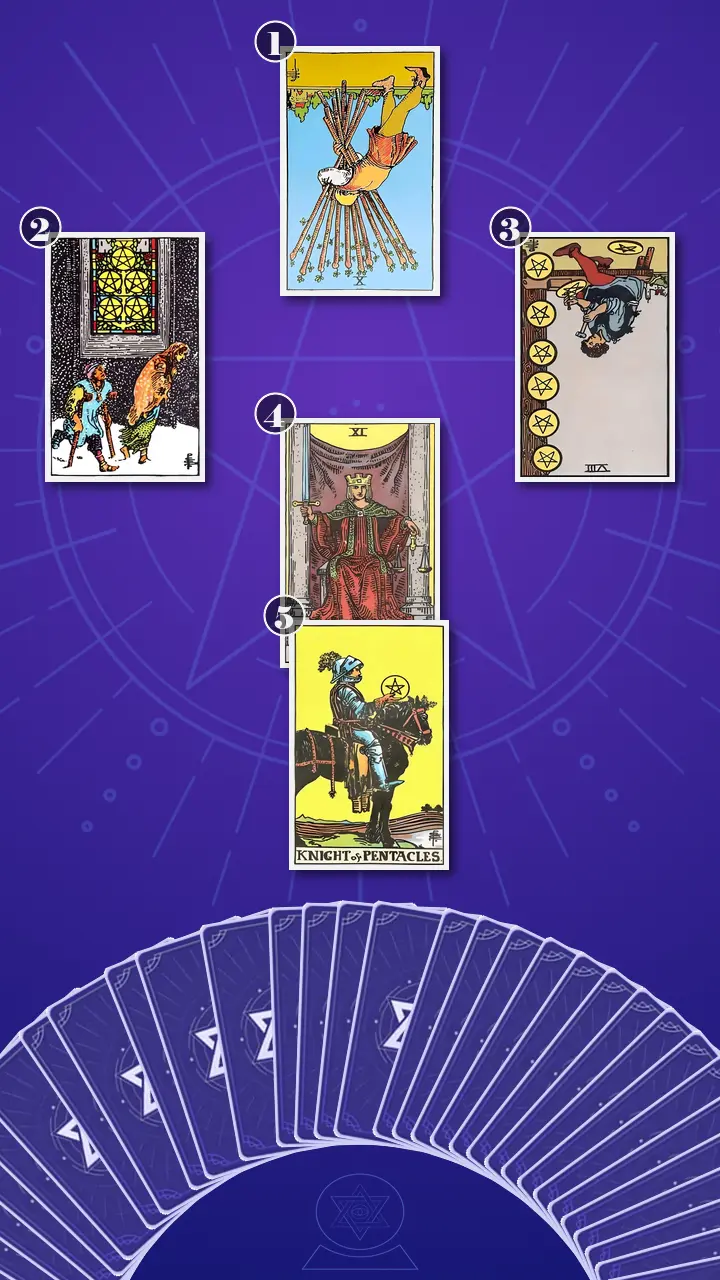
I explained that the first card would show the protective pattern colleagues could see. The second would uncover the fear of exclusion beneath it. The third would identify the repetitive work ritual that maintained the loop. Justice would provide the central transformation, and the Knight of Pentacles would turn that transformation into repeatable next steps.
Reading the Weight She Could Not See
Position 1: The Bundle Blocking the View
Now I turned over the card representing the visible symptom: carrying unnecessary work, revising completed tasks, and remaining available beyond reasonable hours. In the traditional sense, this position shows the conscious self, visible pattern, or protective mask presented to the world.
The card was the Ten of Wands, in reversed position.
At 6:06 p.m., Maya had watched a permanent colleague post a quick goodbye and log off. Then she gathered a requested report, two optional improvements, an unanswered hiring question, and the responsibility for appearing committed into one evening workload. The bundled wands blocking the carrier’s view mirrored her task list: assigned work, imagined expectations, and anxiety-generated work all packed into the same urgent column.
Reversed, the fire of the Ten of Wands was not absent; it was compressed into overload. Her motivation had become a blockage in her line of sight. She could no longer distinguish what the role required from what exhaustion might supposedly prove. The useful question was not whether she could carry more, but which parts of the burden had never actually been hers.
Maya did not nod. First, her breath caught and her fingers froze above the table. Then her eyes shifted toward the laptop, as though the 6:06 p.m. scene were replaying itself. Finally, she gave a small, bitter laugh. “That is almost rude,” she said. “They had logged off, and I opened another dashboard.”
“The card is naming the pattern, not judging you,” I said. “Scope is not a lack of commitment; it is how priorities become credible. We can separate a healthy boundary from abrupt disengagement by checking what was requested, what is urgent, and what belongs to the role.”
Position 2: The Cold Outside the Window
Now I turned over the card representing the hidden fear beneath the burden. This position reveals the disowned fear, vulnerable need, or belief operating beneath the conscious coping strategy.
It was the Five of Pentacles, in upright position.
At 12:34 p.m. on a Thursday, Maya had seen a permanent colleague included in a planning meeting connected with next quarter’s work. The kitchenette felt cold, the microwave beeped, and reheated food smelled sharp in the air. Before she knew why the invitation list had been chosen, she had moved from “I was not invited” to “They do not see a future for me.” Her next move was to offer a new dashboard instead of asking what the meeting covered.
The practical insecurity was real. Contract status could affect benefits, stable income, rent, and the ability to plan a life in an expensive city. I did not reduce that material pressure to a mindset problem. But the Five of Pentacles showed how practical uncertainty had acquired a second, harsher meaning: being left outside the permanent structure might feel like proof that she had never been valuable enough to belong inside it.
I asked her to complete the sentence she had been carrying: “If I am not selected, then maybe I was never...” Her mouth tightened before she answered, “Reliable enough. Good enough. Someone they would want to keep.” The card did not predict rejection. It gave the fear a name so an employment decision could stop impersonating a verdict on her worth.
Maya’s hand paused around her coffee cup. Her eyes went briefly unfocused, and then she looked at the bright meeting room beyond the glass as if measuring the distance between her contract and everyone else’s security. She took a long breath but did not yet relax.
Position 3: The Revision That Could Not Answer
Now I turned over the card representing the trigger and defence that kept the shadow active. This position identifies the recurring behaviour through which the hidden fear maintains influence.
The card was the Eight of Pentacles, in reversed position.
I returned to the 7:40 p.m. report. Maya’s cursor moved through one more unrequested analysis while she told herself, “One more pass, then I can stop.” Yet stopping depended on feeling safe, not on meeting the brief. The repeated pentacles and the craftsperson’s fixed downward gaze resembled version after version of the same deliverable while the larger employment conversation remained outside the frame.
Reversed, the earth of the Eight of Pentacles had become excessive repetition rather than useful craft. Discipline was still present, but it had been recruited as a reassurance ritual. Each revision produced a brief sense of control, then raised the private standard again. One more revision cannot answer a question only a conversation can clarify.
I thought of an archaeological trench I had worked on years ago. If I treated every loose fragment as equally important, I would bury the structure beneath my own careful sorting. Maya was doing something similar with her labour: preserving every possible proof while losing the shape of the actual role.
She winced when I said the word “ritual.” Her jaw released for half a second, then tightened again. “I keep thinking the next version will finally make me safe,” she said. I heard the honesty in that sentence, and I let it stand without asking her to turn it immediately into another task.
When Justice Took the Weight Off the Scale
Position 4: The Evidence File
The room became unusually still as I prepared to turn the next card. A streetcar bell sounded somewhere beyond the apartment, then faded. This position provides the central transformation by separating measurable role evidence from strain, self-sacrifice, and personal worth.
The card was Justice, in upright position: the Antidote in this spread. Its invoked energy was discernment, proportionality, self-respect, and the willingness to ask for transparent evaluation criteria. The balanced scales, upright sword, and steady frame offered a direct contrast to the private rule that more hours must always count as more deservingness.
At 7:40 p.m., the report already met the brief, but Slack was still open and Maya’s jaw was tight. She was not only improving the document; she was trying to make an uncertain employment decision feel controllable by piling effort onto a question only a clear conversation could answer.
You do not have to tip the scale with exhaustion; place evidence, boundaries, and the actual role criteria on Justice's balanced scales.
For a moment, Maya froze with her pen lifted above the page. Her breath stopped halfway in, her fingers held rigid, and the muscles along her jaw seemed to lock. Then her eyes went unfocused; I could see her replaying the green Slack dot, the unrequested dashboard, and the colleagues leaving on time. Finally, her hand opened. Her shoulders dropped a fraction, a shaky breath left her chest, and her eyes brightened with recognition rather than panic. “But does that mean I have been doing it wrong?” she asked, anger and grief briefly sharing the same sentence. “No,” I said. “It means the strategy protected you when the criteria were unclear. It has simply become too expensive.” I gave the silence time. “Now, use this new perspective to remember last week. Was there a moment when separating evidence from strain would have let you feel different?”
I did not ask her to make a hiring prediction or send a message while she was raw. I set a ten-minute timer and divided a page into “role evidence” and “strain.” I asked her to list three completed outcomes under the first heading and one late, optional behaviour under the second. When her breathing tightened again, I reminded her that the minimum version was one verified outcome, and that stopping was allowed.
This was where I used my diagnostic lens, Core Competency Excavation. I invited Maya to brush away the surface layers of green status dots, late hours, and the temporary title until the durable foundations appeared: coordinating operations, clarifying moving parts, delivering against a brief, and making systems easier for other people to use. Those transferable skills were evidence. Her capacity to suffer was not.
“You are being considered for your capability, not your capacity to suffer,” I told her. Justice did not guarantee a permanent role, and it did not erase the organisation’s responsibility to communicate clearly. It gave Maya a fairer scale on which to assess herself. This was the first movement from performance anxiety and physical tension toward evidence-based self-trust, sustainable boundaries, and steadier professional confidence.
Position 5: The Pace That Can Be Repeated
Now I turned over the card representing the practical method for integrating the insight. This position asks how shadow awareness can become a stable daily choice rather than a temporary moment of relief.
It was the Knight of Pentacles, in upright position.
I asked Maya to picture Friday at 5:43 p.m.: three realistic priorities completed, a four-line status update ready to send, and one optional task left for Monday. The knight’s single pentacle and grounded horse offered a different image from the crowded Ten of Wands and the repeated objects of the reversed Eight. Dependability could be quiet, visible, and repeatable.
Upright, the Knight’s earth was balanced. It did not ask Maya to become passive or careless. It asked her to define the meaningful work, communicate progress, and preserve enough energy to do it again tomorrow. The permanent-role outcome could remain uncertain while her working method became more stable.
Maya looked at the Knight for a long moment. Her shoulders softened slightly, but her hands still rested near the laptop as if ready to reopen it. “Part of me calls that not enough,” she said. “The record says the agreed work is complete,” I replied. She gave a cautious smile, the kind that makes room for doubt without handing it the steering wheel.
Finding Clarity in the One-Page Justice Sheet
When I placed the five cards in their funnel-shaped layout, the story became coherent. The Ten of Wands reversed showed the visible overload. The Five of Pentacles revealed why the burden felt protective: contract-to-permanent uncertainty had become fused with belonging. The Eight of Pentacles reversed converted that fear into repetitive polishing. Justice interrupted the loop by replacing self-accusation with explicit criteria and documented outcomes. The Knight of Pentacles carried that clarity into a pace Maya could repeat.
The blind spot was not that Maya worked hard. It was that she had quietly added exhaustion to the job description and treated it as an invisible hiring criterion. Her key shift was from proving commitment through unlimited effort to evaluating performance against stated role criteria and sustainable boundaries. In practical terms, she could ask what was requested, what changed because of her work, and what remained unknown enough to ask directly.
I also offered my Career Epoch Analogies perspective. A contract review can feel like the end of one professional era, but an era ending does not erase the skills built within it. Whether Maya stayed with this organisation or moved elsewhere, the foundation beneath the temporary title still belonged to her. The point was not to force the next chapter open; it was to stop mistaking the waiting period for a verdict.
The Resume Stratigraphy Review
To turn Justice into actionable advice, I used my Resume Stratigraphy Review. This was not a glossy CV makeover. It was a structured excavation of her professional narrative, designed to highlight durable assets beneath an obsolete job title and separate verified contribution from imagined tests of devotion.
- Run the Resume Stratigraphy Review.On Monday at 9:15 a.m., open a Google Doc or Notion page titled “Permanent Role Evidence.” Make three columns: stated responsibility, completed outcome, and supporting feedback or metric. Add only three verified examples, then name the transferable skill beneath each task.If three examples feel too exposed, begin with one. This is evidence gathering, not a request for reassurance.
- Ask the Justice question.Before the next one-to-one, send a short agenda note: “I would like to make sure I am prioritising the evidence that matters. Could we review the criteria and likely timeline for the permanent role?” Ask for the decision owner, the relevant criteria, and the expected timeline.Keep it factual and place it inside an existing meeting. The minimum version is drafting one question privately: “What evidence will matter most in the review?”
- Use the Knight’s stopping ritual.At the start of three workdays, choose three realistic priorities in a notebook or task app. Mark every new idea as optional until someone confirms that it outranks one of them. For one low-risk deliverable, write three acceptance criteria, complete one review, send a four-line update at 5:40 p.m., and close the laptop.If closing feels too abrupt, begin with one notification-free thirty-minute dinner. Communicate genuine urgent exceptions, but do not create an optional fourth task simply to make commitment visible.
These were small experiments, not commandments. Tarot had helped us see the mechanism, but Maya remained the person who could adapt the experiment, ask for more information, and decide what kind of working life she was willing to build.

The Quiet Proof That Can Be Repeated
A week later, Maya messaged me that she had asked how the permanent-role review would be evaluated, recorded three outcomes, and left one optional task for Monday. The role was still undecided. I was glad she had not mistaken a calmer workday for a guarantee; she had begun treating uncertainty as information to clarify rather than a command to overproduce.
On Friday at 5:43 p.m., Maya sent a four-line update, closed her laptop, and left one optional task for Monday. Rain tapped the window. At dinner, she thought, “What if they still do not choose me?” She noticed the fear, breathed, and did not reopen the file.
That was the first concrete evidence of her emotional transformation: not a solved career, but a completed task allowed to remain complete. The Shadow Spread had traced her path from proving commitment through unlimited effort to evidence-based self-trust. Maya, not the cards, had changed what counted on the scale.
When every task feels like an audition for belonging, even closing a finished document can tighten your jaw and make an ordinary evening feel like evidence against you. If your next workday were measured by Justice’s clear evidence rather than by how much strain you could absorb, what is one small thing you might allow to count as complete: the report, the status update, or the extra task that was never requested?