When the Old Schedule Ends

See how an unstructured break reshapes daily life through relevant tarot cards and reading insights from others navigating the same threshold.

Sabbatical Transition
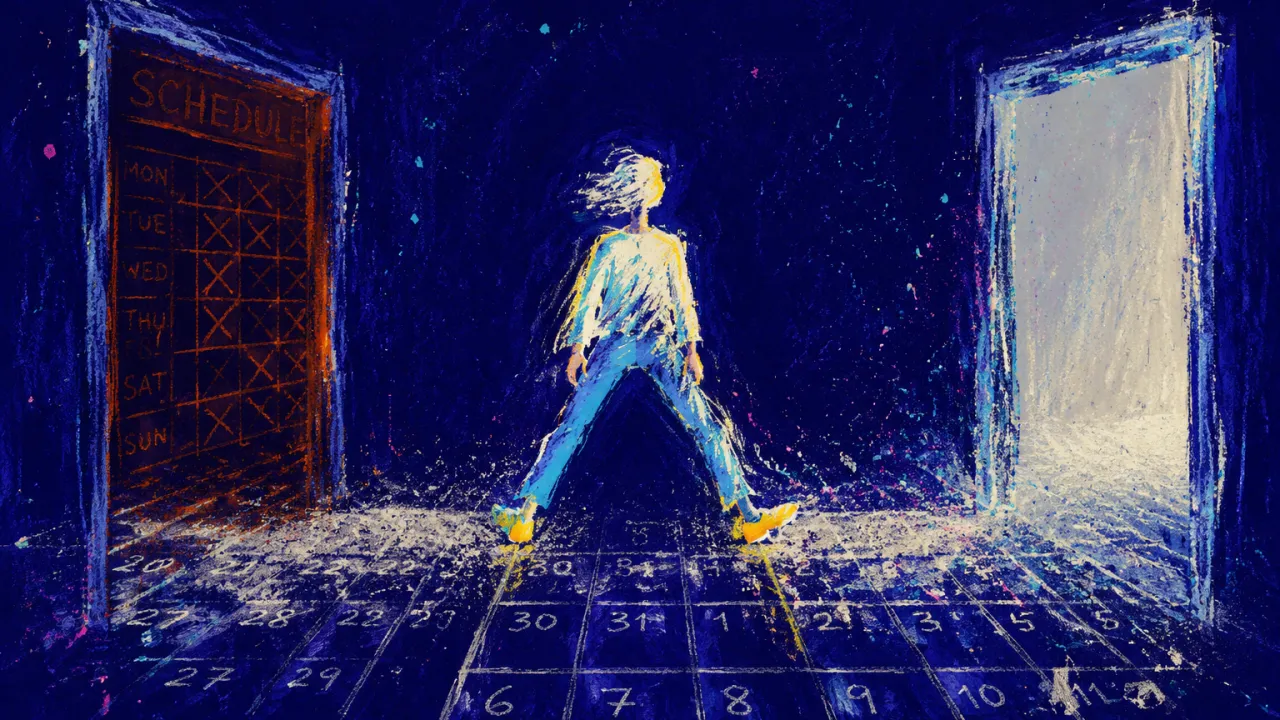
A solitary figure stands on the last marked calendar square as blank space widens toward a distant doorway

What is this situation?

Sabbatical Transition begins the moment the handover is finished, your out-of-office reply goes live, and the calendar that used to divide your week suddenly opens into long blank blocks. For the first few days, you still wake near the old alarm time and reach for your phone before remembering that no meeting is waiting; meanwhile, the workplace, academic program, or project you stepped away from keeps moving, messages accumulate at the edges, and other people inherit the deadlines that once organized your day. The break may have an approved duration, a savings limit, a return date, or none of those, so ordinary days now have to be built without the external rails of a commute, work shift, class schedule, or performance cycle. Friends and former colleagues ask whether you are travelling, resting, changing careers, or coming back, turning casual conversations into requests for a plan before the next role is settled. Online, everyone else's promotions, launches, and packed calendars remain visible, while forms, introductions, and networking conversations still expect a current title that fits on one line. Rest itself can become another task: mornings need a rhythm, money and energy need limits, and any travel, study, care, or creative work competes with the pressure to make the time count. As the weeks pass, the old routine loses its hold before a new structure has taken shape, leaving you between an exit you deliberately made and a re-entry that still needs dates, boundaries, and practical terms. You are not simply off work; you are crossing an exposed interval where the systems that once measured progress have withdrawn but still keep asking when you will return, much like The Fool beneath a bright sun, stepping through open cliffside space with a small bundle and no formal gate assigning the next role.

Why it's not you?

This uncertainty is not proof that you are wasting time or failing to use the break correctly. A sabbatical removes the deadlines, role labels, and shared timetable that used to organize each day, while employers, institutions, and social conversations continue to demand a clear next answer. The mismatch belongs to the transition itself: the old structure has ended before the next one is available.

Sabbatical Transition in Tarot Cards

When a Sabbatical Transition replaces a packed calendar with blank days, the hand that still reaches for the phone at the old alarm time shows how firmly the previous routine occupied your day. This is an environmental and structural dynamic: the schedule disappears at once, while workplaces, forms, and conversations continue to request a title, timeline, and re-entry plan. The Tarot Cards below reflect the visible contours of that interval between an ended routine and an unassigned next role.

The Fool
Upright
The staff and bundle resting across the Fool's shoulder show movement with limited load, not full production. The body is upright, the white dog is close, and the open sky gives the scene enough space for a pause to have structure. In timing work, this points to a sabbatical transition where stepping back is not wasted time; it is a different rhythm of preparation. You are not being asked to solve the whole road at once, but to notice whether a lighter season can restore contact with the next workable signal.
The Empress
Upright
The Empress rests on layered cushions with wheat in front of her and water moving behind her, a body held by an environment rather than pushed through it. The scene shows cultivated pause as a real condition: resources, softness, and time are arranged so growth can happen without constant output. For introspective work, that maps to a period where You are not failing to move; You are sitting inside a container that can rebuild psychological bandwidth. The pressure point is whether the pause is allowed to be a legitimate stage, instead of being treated as wasted time that has to prove its productivity.
The Hermit
Upright
The gray cloak, planted staff, and small lantern on the frozen ridge create a scene of chosen reduction: fewer voices, fewer tools, and a narrower field of movement. The mountain does not offer comfort, but it does offer distance from the noise that normally tells you what progress is supposed to look like. A Sabbatical Transition is the external shape of that distance. The card's light is small but controlled, suggesting that the useful question is not how fast you return to visibility, but what kind of inner map can survive the cold once the usual audience is gone.
The Hanged Man
Upright
Suspended by one ankle from the living wooden frame, the figure is not walking, climbing, or performing for anyone. The body is held in a pause that looks externally restrictive, yet the calm face and halo show that the interval has become readable rather than wasted. In a career context, this maps onto a sabbatical or intentional pause where movement has stopped but orientation is actively being rebuilt. You are not receiving the usual workplace proof of progress, so the structure asks a different question: what kind of work, recognition, and pace can actually sustain the next phase? The card links this context to a pause that has form, not collapse. The value of the interval lies in turning suspension into perspective, so the next career move is not just a reaction to pressure but a clearer re-entry into the working world.
Four of Swords
Upright
The reclining knight rests on a tomb-like platform, but the armor and composed hands keep the scene from becoming simple absence. The body is withdrawn inside a formal chamber, supported by a cushion and enclosed by architecture that gives the pause a sanctioned shape. A sabbatical transition in career terms requires more than exhaustion; it needs enough structure, permission, or material support to make stepping back possible. The card shows withdrawal as a designed container where professional identity can be reworked without constant exposure to output demands. For you, this context points to a break that changes the relationship between work and self-definition. The value of the pause is not escape; it is the chance to inspect what kind of work structure can hold your next phase without recreating the same depletion.

Sabbatical Transition in Tarot Card Reading Insights

When others bring a Sabbatical Transition into a reading, the blank calendar, pressure to make the break count, and unsettled re-entry often frame the session. The Tarot Reading Insights below collect readings centered on that same in-between period.

Psychological Contexts Related to Sabbatical Transition