Full Course Load, Open Form, and a Week That Tested a New Pace
Finding Clarity in the 10:43 p.m. Calendar
If your Sunday Scaries look like colour-coding a full semester while quietly deleting meals and breaks from the plan, the problem may not be time management at all.
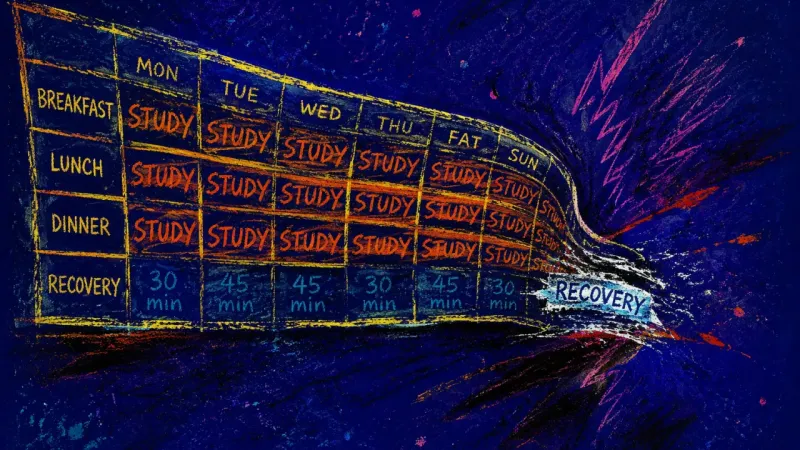
Taylor joined my video reading at 10:43 p.m. from the small kitchen table in her shared Toronto apartment. I could hear the radiator clicking through her microphone and a roommate's microwave beeping behind her. On the screen she shared with me, five courses filled Google Calendar in different colours. Dinner had been compressed into a narrow grey strip. The reduced-load form waited in another browser tab, half-hidden behind the timetable.
She rubbed the places where the warm laptop had pressed against her wrists. Her shoulders sat close to her ears, and her eyes had the dull shine of someone who had reread the same paragraph often enough to memorise its shape but not its meaning.
"I know I need time to recover," she said. "But every time I look at dropping one course, I think I should try harder first. Maybe I need a better schedule. Maybe I can make the full load work if I'm disciplined enough."
I asked what happened when an evening unexpectedly opened up.
"I panic," she said. "I check the portal. I usually find something to do. Rest is the prize at the end, not part of the plan."
I watched her fingers drift toward the trackpad even while she spoke about needing a break. The guilt in her body looked like a smoke alarm with a dying battery: quiet for a few seconds, then another sharp warning whenever stillness entered the room. She needed recovery, but the moment recovery became available, she reopened the work because motion seemed to prove discipline.
"I don't hear a lack of commitment," I told her. "I hear a person who has made productivity the price of permission to stop. We are not going to ask the cards to decide your course load. We are going to use them to separate the practical choice from the story your fear has attached to it. Let's draw a map through this fog and see what kind of clarity is already trying to form."

Choosing the Compass at the Course-Load Crossroads
I asked Taylor to close the learning portal, place both feet on the floor, and take one unforced breath. I shuffled slowly on my side of the screen. I do not treat this preparation as a supernatural performance. It is a psychological threshold, a way to stop feeding the question more noise and give sustained attention to what is actually being asked.
I chose the Decision Cross: Context Edition, a five-card tarot spread for a full versus reduced course-load decision. I use this spread when someone is facing a focused crossroads but the visible options have become tangled with delayed reward, avoided needs, and identity-level fear.
For readers wondering how tarot works in a situation like this, I see the spread as a structured reflective tool. It does not predict Taylor's grades, determine university policy, or tell her which course to keep. It gives each pressure a separate place on the table so that card meanings in context can reveal what ordinary overthinking keeps blending together.
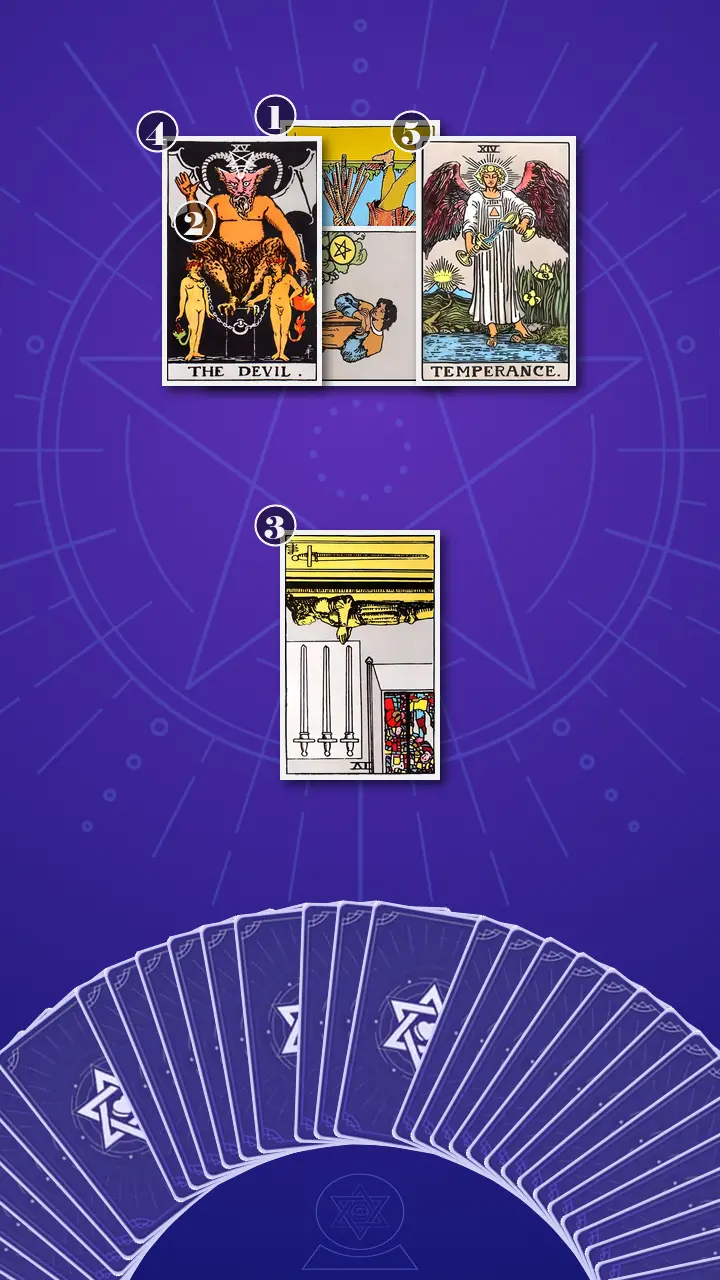
The centre position would show the observable bind: keeping the full load while moving recovery behind the next deadline. The crossing position would reveal the promise that made this arrangement feel worthwhile. The foundation would show the recovery need being pushed below the surface. The card to the left would name the hidden belief behind the decision, and the final card would offer an integrating direction rather than a verdict.
The layout looked like a small intersection viewed from above. I told Taylor that the centre was not a courtroom. It was simply the place where all the forces could finally be seen at once.
The Bundle, the Ledger, and the Background Tabs
Position 1: The Calendar That Blocked the View
I turned over the card representing the observable decision bind: the exact moment Taylor preserved a full course load and placed recovery after the coursework.
It was the Ten of Wands, reversed.
I pointed to the bent figure carrying a bundle of ten wands. The load did more than strain the body; it covered the figure's line of sight. A distant town promised relief somewhere ahead, but the person could barely see the road directly underfoot.
"This is your Sunday-night calendar," I said. "Five course blocks are held together by shrinking dinner, transit buffers, and recovery. The schedule only becomes technically possible after your present capacity has been removed from the calculation. The burden is not just the courses. It is the rule that nothing can be renegotiated until everything is finished."
Reversed, the card showed overloaded Fire becoming blocked. Taylor had plenty of effort, but almost no release. Carrying more had stopped being a route to completion and become a way to postpone the emotionally harder act of questioning the load.
I gave voice to the bargain underneath the planning: "If I make the week efficient enough, I will not have to remove anything."
Taylor let out a short, bitter laugh. She did not nod. She pressed two fingers against her forehead and said, "That is so accurate it feels a little cruel."
"Then let's be careful with what we do with the accuracy," I replied. "The card is not accusing you of carrying too much. It is showing that carrying everything has become protection from a different fear. You are not choosing between work and rest; you are postponing rest until it can no longer challenge your self-image."
I asked what she had done in the five minutes after last opening the reduced-load form.
"Compared timetables, checked a classmate's schedule, then added another study block," she said. "I closed the form when I got the calendar to fit."
I looked again at the bundle obscuring the figure's view. "Exactly. The full calendar gave you brief relief from making the decision, but it did not give you more capacity."
Position 2: The Harvest Ledger
I turned over the card representing the short-term promise of the full load: the delayed-gratification logic saying that more effort now would make later recovery feel deserved and secure.
It was the Seven of Pentacles, upright.
The figure in the card paused beside a living vine, leaning on a hoe and studying the pentacles already grown. This was Earth energy in its reflective form: investment, patience, and honest assessment. In Taylor's pattern, however, the investment side had become excessive while the assessment side remained underused.
I brought her back to a Thursday afternoon she had described in the campus library. She had opened a grade calculator beside the reduced-load deadline page. The ventilation hummed. Cold coffee left a bitter film on her tongue. She totalled completed assignments, tuition, and weeks invested while her heavy eyes slid over the same paragraph for the third time.
"Your internal ledger includes everything you have put in," I said, "but it excludes what the current pace is costing. You count hours, grades, and completed weeks. You do not count the interrupted meals, declining attention, shallow breathing, or the breaks that never become breaks."
Her gaze dropped to the Seven of Pentacles. One thumb pressed hard into the opposite palm.
"Dropping anything now would make all those late nights pointless," she said.
"Changing the pace does not cancel the effort already spent," I replied. "Past effort is real, but it cannot be the only vote on what happens next. The useful question in this card is not, 'Have I invested enough to justify continuing?' It is, 'What is this investment producing under present conditions?'"
I asked which future reward she expected the full load to secure.
"Graduating at the same time as my friends. Feeling like I handled it. Finally being proud instead of relieved," she said.
I understood why that promise had power. LinkedIn internship posts, StudyTok routines, and group chats about prerequisites can make everyone else's visible milestones look like a neutral standard. They rarely show the accommodations, private doubts, changing circumstances, or recovery costs outside the frame. Taylor was comparing her entire internal experience with other people's selected updates, then using that comparison to set her workload.
Position 3: The Break That Stayed on Call
I turned over the card representing the recovery need being pushed below the surface, especially the pattern of converting planned breaks into checking, planning, or catch-up time.
It was the Four of Swords, reversed.
I described the Tuesday-night scene Taylor had already given me: the overhead light switched off, cool sheets under her body, a comfort show murmuring through the wall, and her laptop open beside her hip. Blue course notifications flashed against the dark screen. Her body was horizontal, but her attention remained on call.
"It is like putting a laptop into sleep mode while dozens of background processes keep draining the battery," I said. "Or like Severance in reverse: you leave campus, but the academic version of you keeps receiving notifications at home."
The reversed Air energy showed a blockage in mental recovery. Rest existed on the calendar, but not in the nervous system. Every pause was interrupted by the looping sentence, "I am resting, but I should at least check." Because the break was never protected long enough to become restorative, Taylor had very little clean evidence about what recovery might do for her attention or capacity.
Her breathing paused. Her hand stopped halfway to the trackpad and hovered there. Then her eyes lost focus as if she were replaying a dozen supposed breaks at once. Finally, she lowered her hand into her lap and released a long breath from deep in her chest.
"My breaks aren't actually breaks," she said quietly. "I keep waiting for rest to fix me, but I never stop working long enough to find out what rest changes."
"That recognition is the catalyst in this spread," I said. "Difficulty resting is not proof that you do not need recovery. The urge to reopen the laptop is information. It tells us the pause has been occupied by academic vigilance, not that you have failed at relaxing."
Position 4: The Fine Print in the Productivity Contract
I turned over the card representing the hidden belief that reducing the load would waste Taylor's previous effort, prove a lack of discipline, and threaten her self-worth.
It was The Devil, upright.
Before Taylor could react to the name, I clarified that I did not read this card as punishment, danger, or an outside force controlling her future. In this position, the Devil represented attachment to a rule that offered certainty while narrowing choice.
I pointed to the chains around the figures' necks. They were visible, but they were also loose. The card did not pretend the attachment was easy to leave. It showed that the rule derived much of its power from repetition and self-judgment.
"Outside student advising, you looked at the reduced-load form and heard an internal contract," I said. "A full schedule proves discipline. Changing it proves I could not handle what I started. That contract turns an adjustable academic arrangement into a permanent verdict about who you are."
I leaned closer to the camera. "A full timetable is an academic arrangement, not a character reference."
Taylor became very still. Her mouth tightened before she said, "But if that rule is mine, doesn't that mean I've been doing this to myself? Doesn't it mean I was wrong the whole time?"
I heard anger in the first question and grief in the second. I did not rush to smooth either one away.
"It means the rule gave you a sense of control when uncertainty felt harder to tolerate," I said. "A strategy can be understandable and still become costly. Recognising the cost does not require you to shame the person who used it. It gives the person you are now more choices."
In my practice, I call this Systemic Friction Auditing. I separate the effort a person is making from the structure through which that effort must travel. Taylor's structure only appeared functional because it treated meals as compressible, recovery as optional, and guilt as an unlimited energy source. No amount of hustle could repair those design assumptions. More force would simply create more friction.
Her fingers tightened around her mug, then loosened. "So the problem isn't that I'm not pushing hard enough," she said. "The system is using pressure to hide that it doesn't have any space."
"Yes," I said. "And seeing that does not decide the course-load question. It finally lets you ask it clearly."
When Temperance Poured Time Between Two Cups
Position 5: The Bridge from Verdict to Experiment
I turned over the final card, representing the self-directed pacing principle that could help Taylor evaluate a full or reduced load without using either option as proof of personal worth.
It was Temperance, upright.
The radiator behind Taylor clicked once and fell quiet. On my table, the card showed an angel moving water between two cups, with one foot on solid land and the other in water. A path led toward distant light, but the figure was not rushing toward it. The work of the card was happening through careful exchange in the present.
Temperance offered balanced energy, not as perfect equilibrium but as responsive adjustment. The card refused the false binary between enduring the full load at any cost and abandoning everything in one exhausted reaction. Its two cups held study and recovery inside one system.
I named the trap first. Taylor had been colour-coding the week, compressing dinner, and leaving the reduced-load form behind the calendar. By the time the schedule looked possible, her shoulders were tight and recovery had disappeared from the evidence used to judge the plan.
Stop treating a full course load as the only proof of progress, and use Temperance's two cups to test a study-and-recovery rhythm before judging yourself or finalizing the pace.
I let the sentence remain between us for several breaths, then distilled the message once more.
A sustainable pace does not erase your commitment; it lets your commitment exist without requiring your exhaustion as proof.
Taylor's breath stopped at the top of an inhale. Her fingers remained suspended around the mug, and her pupils widened slightly before her eyes shifted away from the screen. I watched recognition move through her in stages. First came the freeze, as if the old argument had temporarily lost its next line. Then her gaze unfocused, replaying the weeks in which she had used heavy eyes and missed meals as evidence that she was trying hard enough. Colour rose across her cheeks. Her lower lip pressed inward, and her eyes became bright without spilling over.
Her shoulders dropped slowly, almost unevenly, as if one side of her body trusted the release before the other. The fist she had formed around the mug opened. She exhaled with a faint tremor and said, "I don't know who I am in this decision if suffering isn't the proof that I care."
There was relief in her voice, but also the light-headed vulnerability that can follow when a familiar burden is set down and the empty hand suddenly becomes visible. Clarity had not removed responsibility. It had returned responsibility to her without the usual punishment attached.
"Now, with this new perspective, think back to last week," I said. "Was there a moment when this insight could have changed how you felt?"
She remembered a Wednesday evening when a seminar had been cancelled. Instead of eating with her roommates, she had opened the course portal and spent two hours reorganising readings.
"I thought the free time was a test," she said. "Like a disciplined person would know how to use it. If I had seen it as one of the cups, I might have let it be recovery instead of evidence against me."
This was where I brought in the framework I call Macro-Cycle Phase Identification. After years of reading human lives through cycles, I have learned that resistance does not always mean someone needs more force. Sometimes it marks a phase of conservation, reassessment, or changing conditions. I was not using the card to predict how long Taylor's low-capacity period would last. I was helping her locate it without turning it into an identity.
"A low tide is not a character flaw," I told her. "It changes what movement costs. You can stand on the shore demanding that the water rise through discipline, or you can study the shoreline, protect what needs protecting, and choose the next movement from the phase you are actually in."
I paired that cycle identification with another brief friction audit. The current timetable could hold five courses only by excluding transit delays, shared-apartment noise, meals, sleep disruption, and recovery. Temperance did not ask Taylor to become less ambitious. It asked her to stop treating real conditions as personal excuses and start treating them as variables in an honest system.
That was the central crossing of the reading: from guilt-driven academic overcommitment toward measured pacing, clearer capacity awareness, and steadier self-trust. Taylor did not need to know the right answer for the whole semester that night. She needed to replace a moral verdict with a readable experiment.
The Two-Cup Pacing Test
I gathered the spread into one coherent story. The reversed Ten of Wands showed the visible burden and the way carrying everything postponed the decision. The Seven of Pentacles explained why the load still felt sacred: previous effort had become an investment Taylor believed only the original pace could protect. The reversed Four of Swords revealed that recovery had never received a fair trial. The Devil exposed the productivity contract joining an administrative choice to self-worth. Temperance restored the missing resource: the ability to adjust one variable, observe the result, and decide from evidence rather than guilt.
The cognitive blind spot was simple but consequential. Taylor had been asking whether the full load could fit into a calendar, not whether the calendar could support a human life repeatedly. Because present capacity was excluded from the evidence, every scheduling failure looked like a discipline failure.
I explained the transformation plainly. Recovery is not the prize after sustainable work; it is one of the conditions that makes sustainable work possible. The immediate goal was not to prove that Taylor should keep or reduce the load. It was to give recovery a protected place for one week, gather accurate institutional information, and see what the current pace actually supported.
I offered three actions as options, not as a new performance standard. Taylor could use the minimum version of any step and stop if the exercise created more pressure.
- Run the 72-Hour Orbital Sync For the next 72 hours, do not rebuild the semester or force a final course-load decision. On one ordinary weekday, place a protected 30-minute device-free block in Google Calendar before the first evening study session. Label it neutrally, such as "offline time." Before it begins, write the next study task on a sticky note, close the laptop, and let the task wait outside the pause. Tip: If 30 minutes feels impossible, use ten. A quiet walk, shower, or meal away from the desk counts. The protocol is designed to align expectations with current capacity, not test whether you can relax correctly.
- Ask One Administrative Question Open the timetable once and mark one task "minimum," one "deferrable," and one "ask about." Then send one specific email to an academic adviser, accessibility office, programme coordinator, or instructor about a practical issue such as funding, prerequisites, or graduation timing. Book a 15-minute slot later in the week to review the reply without requiring an immediate decision. Tip: Limit the first contact to one question and one recipient. Gathering facts is not a commitment to either course-load option, and Taylor did not owe anyone a defence of her work ethic.
- Build a Seven-Day Two-Cup Test In one existing calendar, show fixed commitments, minimum viable study blocks, meals, transit, sleep, and three recovery blocks at the same visual level. Adjust one variable only, such as deferring a low-priority reading or protecting one evening. After seven days, note changes in sustained attention, task follow-through, physical strain or sleep, and the intensity of guilt. Tip: Cap setup at ten minutes. Do not download a new app or optimise the whole week. A usable draft creates evidence; a perfect dashboard only recreates the original loop.
"You do not need a final verdict when a one-week experiment can give you better evidence," I told her. "When the week ends, you can bring those observations and the adviser's factual answer into the course-load conversation. The choice remains yours. The cards have clarified the forces around it, but they do not own the decision."

A Week Later: The Quiet Proof
Six days later, Taylor sent me a message. She had not submitted the reduced-load form, and she had not decided to keep every course. Instead, she had protected one Tuesday evening block, marked a non-essential reading as deferrable, and emailed an adviser one question about how a change might affect a prerequisite.
Her message ended with: "I slept through the night. I still woke up thinking, 'What if I'm falling behind?' But I didn't open the portal before breakfast."
I did not read that as a solved semester. I read it as a small, credible piece of capacity evidence. The fear was still present, but it no longer had automatic access to the trackpad. Taylor had created a few seconds in which observation could speak before guilt issued its next command.
That was the quiet proof of our Journey to Clarity. Tarot had not rescued Taylor or revealed a predetermined academic path. It had helped me hold the forces apart long enough for her to recognise her own authority. She was moving from overcommitment toward measured pacing, not through certainty, but through one protected pause, one factual question, and one week she was willing to observe honestly.
When your shoulders stay tight through a break and your hand reaches for the laptop before you have even exhaled, carrying every course can feel safer than facing what putting one down might seem to say about you. Noticing that hidden contract does not place you at the end of the journey, but it does mean you are no longer standing at its beginning.
If your pace did not have to prove anything about your discipline, which one of Temperance's two cups would you adjust for seven days, and what small change would you be curious to observe?