A Minimized Promotion Email Became Four Questions and One Boundary

The 9:47 p.m. Promotion Treadmill
If you are the person who gets called reliable in every review, yet your manager still cannot give you written criteria, a decision owner, or a date, I want to bring you into the evening Maya appeared on my screen.
It was 9:47 p.m. on a wet Tuesday in Toronto. A streetcar ground around the corner below her condo, its brakes scraping through the rain, while the blue-white light from two laptops sharpened the shadows under her eyes. When Maya shared her screen, I saw an approved presentation reopened beside a colour-coded accomplishment tracker. The draft asking for concrete promotion criteria was still minimized. She wrapped both hands around a mug, took a sip, and winced. “Cold,” she said. “Again.”
At twenty-nine, Maya was already the product operations specialist people contacted when a launch stalled, a role went vacant, or a cross-team process needed rescuing. Her manager regularly called her indispensable. The management position she had been working toward, however, had been postponed, redefined, and most recently removed during another reorganization.
“Every time the ladder moves, I climb faster,” she told me. “Why am I working harder when my promotion path keeps collapsing?”
Every time the structural promise changed, she increased her output because asking whether the role still existed felt more dangerous than completing one more measurable task. The pressure lived in her body like running full speed on a stopped escalator: her legs kept burning, the scenery stayed fixed, and she blamed herself for not reaching the next floor. Toronto rent made the title feel connected to financial breathing room, while every LinkedIn post beginning Thrilled to announce made the lack of movement feel publicly visible.
“It makes sense that working harder has become your quickest way to regain control,” I said. “I am not going to use tarot to predict whether your company will promote you. I want us to examine the loop objectively, separate your competence from the instability around the role, and draw a map through the fog. The goal is clarity you can act on, not certainty you have to depend on me to provide.”

Choosing the Switchback Map
I asked Maya to close the approved deck, place both feet on the floor, and take one unforced breath while holding the question in mind. I shuffled slowly under the camera. The pause was not a mystical performance; it was a deliberate transition from reacting inside the problem to observing it from a little distance.
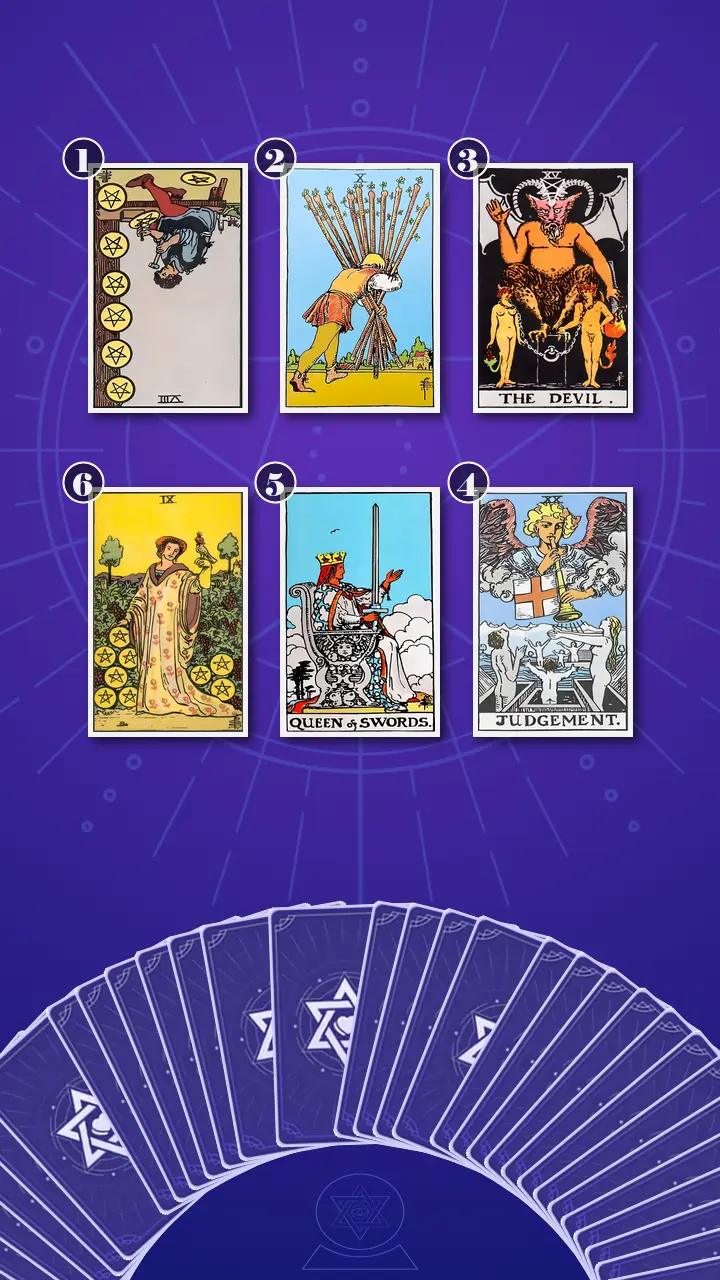
I chose the Transformation Path Grid · Context Edition, a six-card tarot spread for career overwork and promotion ambiguity. I arranged the cards in two rows of three, with the eye moving across the diagnostic row, dropping at the far edge, and returning along the transformation row like a switchback trail.
I chose this spread because Maya did not yet have two clean options to compare. A conventional decision spread would have rushed her toward stay or leave before establishing whether the internal route was credible. The Celtic Cross could have covered the subject, but ten cards would have diluted a mechanism that needed six precise functions: observable behaviour, immediate blockage, root attachment, catalyst, practical action, and sustainable integration.
This is how tarot works at its most useful in my practice. The images create enough psychological distance for a pattern to become visible, while the position roles stop the reading from becoming a collection of vague impressions. Card meanings in context matter more than isolated keywords.
The first card would show what Maya visibly did after each promotion setback. The second and third would reveal how accumulated work blocked her perspective and what deeper belief kept her consenting to the loop. The fourth, the key card, would interrupt that mechanism. The final two would translate the interruption into a workplace conversation and a more sustainable relationship with ambition.
The Work That Kept Reproducing Itself
Position 1: The Approved Deck That Would Not Stay Finished
Now I turned over the card representing Maya’s observable current-state behaviour: the Eight of Pentacles, reversed.
In the Rider-Waite-Smith image, the craftsperson concentrates on one pentacle while a row of nearly identical pieces climbs beside him and the wider town remains in the distance. Reversed, disciplined Earth energy had become blocked and overcorrected. Maya’s diligence was real, but repetition and refinement were no longer reliably producing development.
In her working life, this was the exact 9:47 p.m. scene in front of me: an approved presentation being polished again, another impact metric entering the tracker, and the direct promotion email receiving less attention than a slide no one had asked her to revise. The inner script was simple: Maybe this last improvement will make the case undeniable.
“Think about the twenty-four hours after the last promotion reset,” I said. “Did you ask for structural clarification, or did you reopen completed work?”
Maya gave one short laugh, but there was no amusement in it. Her fingers stopped moving over the trackpad. “That is so accurate it feels a little brutal. I thought I was just being ambitious.”
“Your ambition is not the problem,” I replied. “This card does not question your skill. It asks whether a proven skill is being invested where it can create a meaningful return. More proof cannot stabilize a path no one will define.”
Position 2: Carrying the Project Board in Her Arms
Now I turned over the card representing the accumulated responsibilities that prevented Maya from evaluating whether the promotion route remained viable: the Ten of Wands, upright.
The figure carries a compressed bundle so large that it blocks his view of the destination. Upright Fire was in excess here. Action had accumulated into burden, and competence had become the route through which still more responsibility reached her.
For Maya, the bundled wands looked like a Monday project board packed with rescued launches, unassigned tickets, recurring work only she knew how to do, and a vacant-role gap she had quietly absorbed. By the time her one-to-one arrived, delivery updates filled the agenda. Her prepared promotion questions were pushed into the final rushed minute, where another operational problem usually displaced them.
“I just need to get everyone through this deadline,” she said, repeating the promise she made to herself each week. “Then I can deal with my promotion.”
“And when the deadline passes?” I asked.
She looked away from the cards. Her chest rose, held, and then released in a longer breath. One shoulder lowered before the other. “There is always another one.”
I pointed to the figure’s blocked line of sight. “Being indispensable can become the reason they keep you exactly where you are. That does not prove anyone is deliberately trapping you. It means the current structure receives a reliable benefit from your overcapacity, while you lose the time and leverage needed to test your own path.”
Position 3: The Green Status Light as a Loose Chain
Now I turned over the card representing the root belief sustaining the workaholic promotion treadmill: The Devil, upright.
I clarified immediately that The Devil was not a warning of punishment, betrayal, or inevitable harm. In a Jungian psychological reading, this card often reveals an attachment that has gained authority because it remains partly unexamined. Its energy was a blockage: external advancement had become entangled with worth, control, and permission to feel successful.
I drew Maya’s attention to the loose chains around the two figures. The organizational uncertainty was real, but the chain also resembled the green Teams status she maintained after hours even when no one explicitly required it. Each late-night response had trained a workplace algorithm: availability produced urgent work, urgent work produced praise for reliability, and the praise encouraged more availability.
“I know the criteria keep changing,” Maya said. “But if I stop proving myself now, maybe they will see I was never ready.”
Her sentence landed more heavily than the card. Her thumb pressed into the side of her mug, her gaze lost focus as though she were replaying six months of postponed conversations, and then her grip loosened by a fraction.
“What has the promotion been asked to prove about you?” I said.
“That I am not just useful,” she answered quietly. “That I am actually going somewhere. That all this work meant something.”
I nodded. “That is the attachment. The title has become responsible for proving your competence, your progress, and the value of the effort already spent. Questioning the route therefore feels like questioning yourself. Busyness can feel like control while protecting ambiguity from scrutiny.”
When Judgement’s Trumpet Closed the Laptop
Position 4: Evidence Instead of a Verdict
Now I turned over the card representing the catalytic realization that could interrupt the cycle: Judgement, upright. As the card met the table, a streetcar bell sounded once through Maya’s open window. I did not treat the coincidence as an omen, but its clear note echoed the trumpet raised above the figures in the image, and the room seemed to become quieter around it.
Judgement carries the balanced energy of review, awakening, and response. It does not ask for another performance. It asks what the accumulated record already says. In Maya’s modern workplace, that meant closing the approved deck and placing six months of postponed reviews, changed criteria, added responsibilities, headcount caveats, and absent dates on one page.
At 9:47 p.m., the approved deck had been open again, the accomplishment tracker colour-coded, and the direct request for written criteria minimized. The activity felt productive because the harder question might return an answer that no amount of polish could change.
I used one of my core lenses, Imposter Syndrome Auditing, to separate two records that Maya had been treating as one. The first contained objective professional evidence: approved work, successful launches, expanded scope, repeated trust, and documented praise. The second contained subconscious exposure fears: If I slow down, I will be found out. If I ask for terms, I will sound difficult. If the role is not real, my work was worthless.
The audit could not prove that Maya was entitled to a particular title or that headcount existed. It did establish something equally important: organizational ambiguity was not evidence of professional incompetence. Having travelled through enough unfamiliar stations, I found myself thinking of departure boards. Running faster cannot restore a platform that has been removed; first I have to look up and verify where the train is actually leaving from.
I asked Maya to imagine that the promotion record belonged to a colleague she respected and that the colleague’s worth was not on trial. “What would the evidence support?”
She looked down at the card. “That she has already proved she can do the work,” she said. “And that the company has not proved it can offer the role.”
More output can prove your capacity; it cannot, by itself, prove that a promotion path exists. Clarity is not a reward you have to earn through exhaustion.
I let the sentence settle before giving her Judgement’s full instruction.
You do not need to earn clarity through exhaustion; answer Judgement's trumpet by reviewing the pattern, asking direct questions, and redirecting effort according to evidence.
Maya’s breath stopped first. Her fingers hovered above the keyboard, motionless, and her pupils widened before her eyes drifted away from the screen. I watched the meaning move from the card into memory: the postponed review, the rewritten framework, the extra launch, the praise with no date. Then her brows drew together.
“But doesn’t that mean I got it wrong?” she said, sharper than before. “I have spent six months trying to fix something that might not have been available.”
“It means you used a strategy that gave you control when the situation was unclear,” I replied. “That strategy was understandable, and it also has new evidence to answer now. You do not need to condemn the person who worked hard in order to protect the person deciding what comes next.”
Her jaw trembled once. The fist resting beside her laptop slowly opened, her shoulders descended, and moisture gathered at the rims of her eyes without spilling. She released a long, unsteady breath. Relief was present, but so was the slight dizziness of no longer having extra work as the automatic answer. Clarity had created space, and the space carried responsibility.
“Now, using this new perspective, think back to last week,” I invited. “Was there a moment when this insight could have made you feel different?”
Maya described the moment her manager had said they would revisit the promotion after another planning cycle. Within an hour, she had claimed an unassigned launch task. “I would still have been disappointed,” she said. “But maybe I would have asked what revisit actually meant before I opened Jira.”
I named the crossing I had just witnessed: from frustrated, self-blaming overdrive to evidence-based agency, selective ambition, and steadier self-respect. It was not a complete transformation or a final career decision. It was the first moment in which Maya could place both her effort and the promotion structure under review.
The Sword, the Garden, and the Return of Choice
Position 5: Four Questions in a Glass Meeting Room
Now I turned over the card representing the bounded workplace action that could carry Judgement into daily life: the Queen of Swords, upright.
Her sword stands vertically, establishing a standard, while her open hand permits an honest exchange. Air was in balance: clear language, discernment, and boundaries without hostility. In Maya’s next one-to-one, the card became four written questions: What is the target role and scope? What are the written criteria? Who owns the decision? What date can we use for a yes, no, or formal reset?
I used Authority Archetype Integration to name the psychological friction beneath that conversation. Maya’s established individual-contributor archetype earned safety by solving, absorbing, and making herself useful. The emerging authority archetype had to tolerate a different task: requesting ownership, defining terms, and allowing another person to be responsible for the gaps in their answer.
“Leadership here does not mean becoming colder,” I told her. “It means you stop treating every unowned organizational problem as a private test of your readiness. You can hear an incomplete answer without volunteering to complete it.”
Maya straightened slightly. She opened the minimized email, but I asked her not to send anything while activated. She placed four lines beneath the subject instead: role scope, written criteria, decision owner, achievable date.
“That feels direct,” she said.
“Direct is not the same as aggressive,” I replied. “You are asking a promotion process to provide the information a credible process should contain. The specificity of the response is data.”
Position 6: Ambition with a Hooded Falcon
Now I turned over the card representing the sustainable orientation Maya could develop through this review and conversation: the Nine of Pentacles, upright.
The figure stands inside a cultivated garden rather than working frantically for permission to enter it. A hooded falcon rests on her gloved hand: power remains present, but it is trained and directed. Earth had returned to balance. Skill, money, time, professional relationships, and fulfillment became resources Maya could govern rather than evidence she had to submit for certification.
In practical terms, Maya could continue pursuing the internal promotion while requiring it to compete with other possible uses of her effort. One employer’s decision would become information about an opportunity, not a certificate of her value. Her ambition did not need to disappear; it needed somewhere credible to land.
I also noted that no Cups card appeared anywhere in the spread. I did not interpret that absence as a prediction. I treated it as a diagnostic gap: Maya had tried to solve a structural and emotional problem almost entirely through work, action, and analysis. Fulfillment had barely been consulted.
“If this promotion were no longer the only measure of movement,” I asked, “what would a credible career week include?”
She considered it. “Doing my actual job well. One conversation that gives me real information. Maybe half an hour on my portfolio. And one evening where I do not monitor Teams like it is a heart-rate display.”
Her breathing softened as she looked at the falcon. “My competence already exists,” she said. “This decides where I invest it, not whether I have it.”
“Exactly,” I replied. “Your effort is an investment, not a character reference. The Nine of Pentacles does not guarantee a promotion or prescribe an exit. It returns stewardship to you.”
Drawing the Promotion Path Reality Check
I drew the six cards together into one causal story. Repeated promotion resets had taught Maya to answer uncertainty with more visible work. The Eight of Pentacles reversed showed that proof-making becoming detached from return. The Ten of Wands showed the resulting workload narrowing her line of sight. The Devil revealed why setting the load down felt dangerous: advancement had been recruited to prove her worth and justify the effort already spent.
Judgement introduced the unused resource, an honest review of the full record. The Queen of Swords turned that review into criteria, ownership, timing, and boundaries. The Nine of Pentacles restored practical autonomy by treating Maya’s ambition, income needs, time, and skills as a portfolio rather than placing every available hour into one volatile asset.
The core problem was not that Maya had failed to run hard enough. She had been running faster on a stopped escalator while reviewing only her own speed. Her cognitive blind spot was treating personal output as the only variable allowed to explain the delay, while vague praise was granted the weight of a structural commitment. The key shift was criteria before capacity: request written evidence, decision ownership, and a credible date before answering another setback with extra labour.
I gave her two small experiments. Neither required an immediate confrontation, a resignation, or a conclusion about her career. They were designed to produce better information while respecting her financial reality and nervous system.
- Run the Promotion Path Reality Check for ten minutes. On one evening this week, create a private note with four headings: Criteria, Decision Owner, Decision Date, and Evidence That Extra Work Changes the Outcome. Record only what has been explicitly confirmed and mark every unknown with a question mark. Then use my Competence Anchoring Exercise: add three verifiable achievements, the evidence for each, and the capability each demonstrates. Keep those facts separate from fears about being exposed or overlooked. If ten minutes feels too activating, use the two-minute version: write one confirmed fact, one unknown, and one achievement supported by evidence. Stop there. The note is private, and no stay-or-leave decision is required.
- Use Criteria Before Capacity at the next one-to-one. Before the meeting, send a short agenda and bring the four questions about role scope, written criteria, decision ownership, and an achievable decision date. For the next five workdays, pause before accepting extra work and label it promotion-critical, maintenance, or gap-filling. When a request arrives, use: I can review capacity and come back tomorrow; could you clarify whether this changes my scope or promotion criteria? Choose one low-risk gap-filling task to defer, narrow, rotate, or return for prioritization. The minimum version is asking only who owns the promotion decision. If a live meeting feels unsafe or pressured, send one neutral question in writing. Preserve core responsibilities and prioritize income and workplace safety.
I reminded Maya that a specific answer would be useful whether it was encouraging, disappointing, or incomplete. The purpose was not to force the organization to produce the outcome she wanted. It was to stop paying for ambiguity with unlimited availability.

A Week Later, One Green Dot Went Dark
Six days later, I received a message from Maya. She had sent the meeting agenda and asked who owned the promotion decision. Her manager acknowledged that the management role did not currently have approved headcount and could not offer a reliable date.
“I hated hearing it,” she wrote. “But it was an answer. When the launch channel asked for someone to clean up another deck, I said I would review capacity tomorrow. I did not volunteer that night.”
The promotion was still unresolved. Toronto rent had not become cheaper, and disappointment did not disappear because a tarot spread gave it better language. What changed was smaller and more credible: Maya had one confirmed structural fact, one boundary she had tested, and an evening that belonged to her again.
That night, she slept until 6:40. Her first thought was, What if that boundary cost me? Then she recognized the familiar script, smiled once, made coffee, and opened Teams after breakfast.
I understood that moment as the quiet proof of Maya’s Journey to Clarity. Tarot had not chosen her future or manufactured confidence for her. It had helped her externalize a subconscious loop, examine evidence without putting her worth on trial, and recover her authority over the next investment of effort.
If the path keeps moving, your jaw may tighten and your hand may reach for one more task, because questioning the system can feel frighteningly close to questioning whether you deserved advancement at all. I would ask you to remember Maya’s one-page audit: noticing that reach already creates a little distance between the loose chain and your hand.
If your worth were removed from the agenda, which line in your own Criteria, Decision Owner, and Decision Date note would you ask the promotion process to answer before you offer it another evening?