Sabbatical Productivity Guilt: How to Notice What the Pause Reveals

The 8:12 a.m. Productivity Audit
I met Morgan, a 29-year-old London product designer on a planned career sabbatical, at the exact point where one former colleague's LinkedIn promotion had moved a quiet reading block into a spreadsheet before breakfast.
As Morgan described that weekday morning, I could see the scene clearly: 8:12 a.m. in the kitchen of her London flat, the kettle clicking off while rain silvered the window and her phone grew warm in her palm. She had opened LinkedIn, read an “I'm excited to announce” post, and dragged two hours of reading into a colour-coded Google Sheet labelled “career development.” Her thumb kept scrolling even as the tea went untouched.
“I planned this pause to help me notice what matters,” she said, pressing one hand against the centre of her chest. “But the moment it gets quiet, I start producing proof that I'm still moving.”
The feeling she described was not vague unease. It was like standing at a railway turnstile while everyone else's train appeared to be leaving, hearing the gates click shut one by one, and forgetting that she had chosen to remain on the platform long enough to decide where she actually wanted to go.
At 67, I have lived through enough seasons to know that stillness can look alarmingly similar to failure when it is measured from the outside. I did not tell Morgan to relax, and I did not claim the cards would predict whether her sabbatical would lead to a better role. I told her, “I hear the pressure underneath all that planning. Let's use the cards as a mirror and make a map of the fog. The aim today is not to force an answer. It is to find out what your current definition of progress is preventing you from seeing.”
Choosing a Map for the Quiet
I invited Morgan to place both feet on the floor, take one unforced breath, and hold her question in mind: “What do I keep missing by seeing a sabbatical as falling behind?” I shuffled slowly, using the physical rhythm as a transition from scrolling and forecasting into sustained attention, not as a performance of mystery.
I chose The Shadow Spread · Context Edition, a five-card tarot spread for uncovering hidden beliefs and missed opportunities during a career sabbatical. I use this spread when the question is about a blind spot rather than a prediction or a choice between two fixed options. A decision spread could have reinforced Morgan's pressure to produce an immediate career verdict; this structure would instead show how one belief becomes a habit, what that habit makes invisible, and how awareness can become a practical next step.
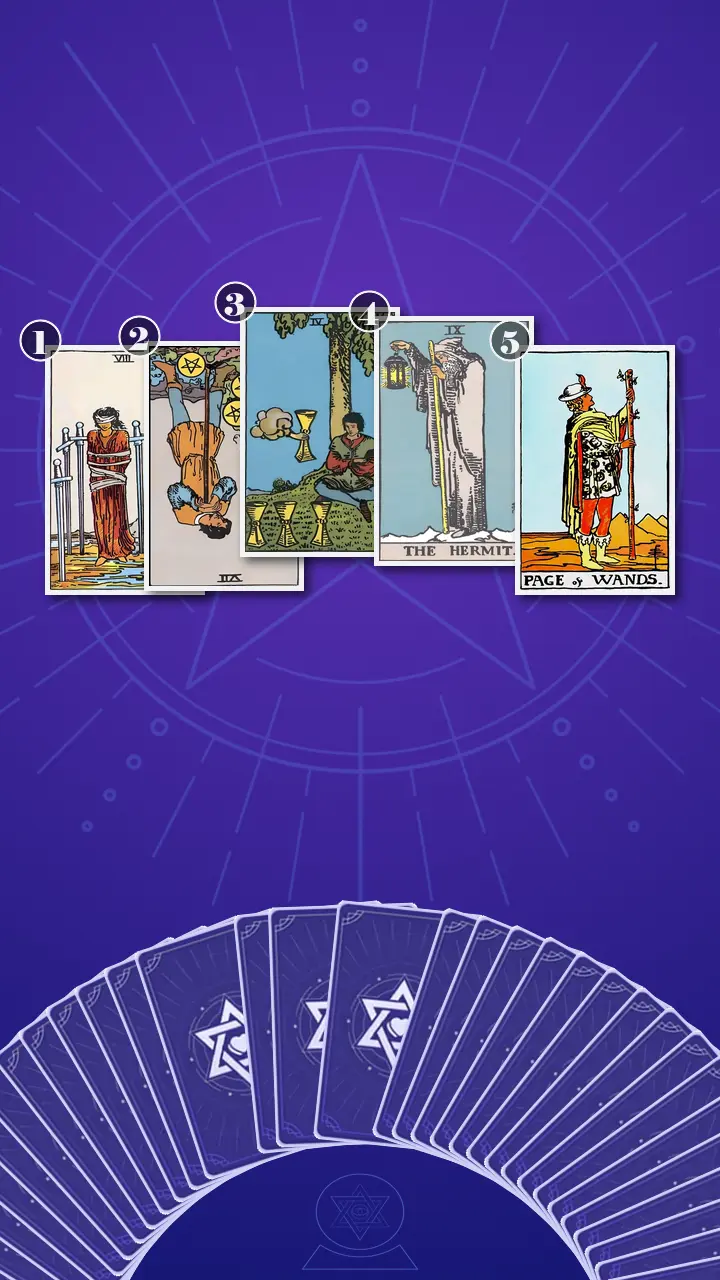
I laid the cards from left to right in a slight upward arc. The first position would surface the concealed conclusion making the pause feel unsafe. The second would show how that conclusion operated through everyday behaviour. The third would name the resource being missed. The fourth would offer the perspective shift, and the fifth would translate that shift into one small experiment. For anyone wondering how tarot works in a reading like this, I do not treat the cards as authorities issuing instructions. I use their symbols to separate facts, interpretations, habits, and available choices.
The Locked Door That Wasn't Locked
Position 1: The Conclusion Behind the Blindfold
I turned over the card representing the concealed belief that a sabbatical means falling behind and the comparison-based conclusion making the pause feel unsafe. It was the Eight of Swords, upright.
I drew Morgan's attention to the blindfolded figure, the loosely bound hands, and the visible gap between the surrounding swords. No one in the image was pretending the terrain looked easy. Yet the card distinguished between genuine constraint and an interpretation that had begun to behave like a locked door.
“This is the moment a promotion post appears in your London kitchen and you read it as evidence that your future options have narrowed,” I said. “You still have the practical freedom to read, rest, explore, apply, wait, or change course. But the blindfolded sentence arrives first: ‘If everyone else is moving, my pause must be a loss.'”
I read the upright Sword energy here as a blockage: analysis had narrowed into one dominant conclusion, while Morgan's ability to examine alternative explanations had become temporarily inaccessible. Strategic foresight was not inherently the problem. It had simply been recruited by fear, turning every visible career update into a forecast about her own worth.
“The sabbatical becomes a cage when one fearful conclusion is treated like a locked door,” I said. “What concrete option has actually closed since you saw that post? And which option only feels closed because someone else's timeline became your measuring stick?”
Morgan gave a short laugh with a bitter edge. “That's so accurate it's almost cruel.”
I let the laugh settle before answering. “Cruel would be calling the fear your destiny. This card is doing something more useful: it is separating an understandable conclusion from an external fact. The feeling is real. That does not make every story attached to it true.”
Her fingers paused against the warm mug. She looked again at the loose bindings, then at the open space between the swords. Her shoulders did not relax yet, but her gaze became less fixed.
Position 2: The Crop Put Through an Early Performance Review
I turned next to the card representing how the shadow operates through observable sabbatical habits: tracking output, refreshing job boards, enrolling in courses, and overplanning a return to work. The card was the Seven of Pentacles, in reversed position.
The RWS figure leans on a hoe beside one growing plant, studying the pentacles as if an immediate judgement must be made. Reversed, the image mirrored Morgan opening her sabbatical spreadsheet after an afternoon of reading, finding no completed application or credential, and adding a course and two networking calls so the day would produce visible career capital.
“The fuller calendar gives you brief relief,” I said. “But that relief is not always the same as genuine interest. The inner sentence is, ‘If I cannot point to a credential, I must be wasting the pause.'”
I read this reversal as an excess of evaluation combined with a deficiency of patience. Morgan was conducting a performance review before the process had generated enough information to assess. It was the equivalent of digging up a seed every afternoon to check whether its roots were working: the inspection looked responsible, but it repeatedly interrupted the growth being inspected.
“You are not measuring progress,” I told her. “You are measuring how easy it is to explain your pause.”
Morgan winced. Her hand lifted as though to reach for the phone beside her, stopped halfway, and returned to the mug. Then her eyes moved away from the cards for several seconds, as if she were replaying the previous Tuesday: the blank return-to-work document, the extra tabs, the rising shoulders, and the small hit of relief when the calendar finally looked full.
“I keep calling it strategy,” she said. “But sometimes I'm just trying to make sure nobody could accuse me of drifting. Nobody has actually accused me. I've built the imaginary tribunal myself.”
“Planning can protect financial and professional needs,” I said. “We do not need to shame it or abandon it. We only need to notice when planning stops serving a real decision and starts soothing the fear of being seen without one.”
Position 3: The Invitation Outside the Filter
I turned over the card representing what Morgan kept missing when visible career progress became the only acceptable measure, including rest, restored attention, emerging interests, and perspectives that could not yet be quantified. It was the Four of Cups, upright.
I pointed to the seated figure's folded arms, the three cups already in view, and the fourth cup entering from outside the chosen field of attention. I did not present that fourth cup as a guaranteed job opportunity. The card was about selective attention: the possibility that something useful was already present but had arrived in packaging Morgan's measurement system did not recognise.
Morgan had mentioned a recurring interest in how product teams might be designed around more sustainable working practices. It had surfaced while reading, on a quiet walk, and after a conversation with a former colleague. Each time, she had dismissed it because it did not map neatly onto an available role.
“The inner line here is, ‘It doesn't count unless I can explain where it leads,'” I said. “The Four of Cups shows what happens when your mental inbox is filtered to display only messages containing job titles, credentials, or strategic advantages. A useful invitation with an unfamiliar subject line never reaches your attention.”
I read the Cups energy as a blockage in receptivity. Morgan's capacity to receive rest, curiosity, and emotional information was present, but her attention kept returning to the absent proof of progress. The card did not claim every passing interest was important. It asked her to investigate before rejecting.
“A quiet day can contain information before it contains a credential,” I said. “What have you declined to notice because it could not yet survive the question, ‘How will this help my career?'”
Her breath paused. Her eyes lost focus for a moment, and I watched recognition move across her face before she spoke. “I had an idea for a workshop about humane critique cultures,” she said. “I opened a job site to see whether anyone was hiring for it. They weren't, so I closed the notebook.”
Her mouth tightened with regret, then softened. I could see both responses at once: sadness for the interest she had dismissed and a cautious willingness to look at it again. The fourth cup had not promised her a new identity. It had simply restored one overlooked question to the room.
When The Hermit's Lantern Changed the Pace
Position 4: Enough Light for the Next Honest Detail
The rain had been tapping steadily against my window, but it quieted as I reached the fourth position. I turned over the card representing the perspective shift that could reconnect Morgan's foresight to the present pause and make opportunity recognition possible without turning the sabbatical into a career verdict. It was The Hermit, upright, the key card and bridge of the reading.
I began with its practical meaning. The solitary figure carries a staff through a mountain landscape, but the lantern illuminates only a contained circle. Morgan did not need a complete five-year map. She needed enough undisturbed attention to notice the next honest detail: perhaps the same question about sustainable work returning during a slow walk along Regent's Canal.
At 8:12 that morning, Morgan had seen a promotion before breakfast and moved a reading block into a career spreadsheet. The day had become easier to defend, but her chest remained tight. She had been evaluating the pause as a public scoreboard instead of experiencing it as a source of information.
The image returned me briefly to Highland winters from my own life, when the ground looked inactive but was conserving what the next season would require. I call this diagnostic lens Seasonal Trajectory Alignment. It asks whether someone is genuinely stuck or whether they are demanding the visible harvest of spring from a life currently engaged in winter work: resting exhausted systems, gathering resources, and allowing direction to form beneath the surface.
“Your problem is not that you have stopped moving,” I said. “It is that you are using spring metrics during a winter phase. LinkedIn's algorithm can register blossoms: launches, titles, start dates, polished announcements. It cannot register roots. When that environment becomes your only soil report, recovery and emerging discernment appear to be zero growth.”
I let the lantern sit between us, its small painted light brighter against the grey afternoon.
You do not need to measure the pause by the speed of the crowd; carry The Hermit's lantern through one quiet review, notice what it illuminates, and let that observation become a testable next step.
First, Morgan's breathing stopped so completely that the room seemed to stop with it. Her fingers remained suspended above the edge of the card, and her eyes widened before slipping out of focus. I watched the sentence move inward as she replayed mornings of relabelled calendar blocks, walks turned into podcasts, and ideas cross-examined for commercial value. Then her jaw tightened. “But doesn't that mean I've been doing the sabbatical wrong?” she asked, irritation sharpening the last word. The anger held for a beat, then her fist slowly opened. Colour rose around her eyes; her shoulders dropped, and a low, unsteady breath left her chest. Relief had arrived, but so had the dizzying responsibility of no longer being able to blame the whole problem on time passing. I answered, “No. It means you used planning to feel safer. Now you have enough information to choose when that tool helps and when it blocks the view.”
I invited her immediately: “Now, using this new perspective, think back to last week. Was there a moment when the lantern's limited light might have been enough, even though you did not have the whole plan? What would have felt different?”
Morgan remembered walking beside Regent's Canal without a destination. She had noticed, for the third time, that she felt more energised by questions about team health than by polishing individual product features. Then she had opened LinkedIn and lost the thread.
“I don't need the whole plan to notice what keeps returning,” she said, testing each word slowly.
I set a ten-minute timer and asked her to write three private lines: one thing she had noticed, one capacity that felt slightly restored, and one question she could explore through a small experiment. I made the boundary explicit: she did not have to turn the notes into a CV bullet, publish them, or continue if the exercise felt exposing. Choosing to stop would remain part of her agency.
When she read the three lines back, a pale strip of afternoon light crossed the table and caught the lantern on the card. The outer circumstances had not changed. No job had appeared, and no final decision had been made. What had shifted was the quality of attention: one step from comparison-driven urgency, shame, and productivity-based self-worth towards discernment, self-trust, and curiosity at a deliberately chosen pace.
Position 5: A Prototype, Not a New Identity
I turned over the final card, representing the conscious integration of the reading: one small, self-directed experiment that would let Morgan learn from the sabbatical without demanding a finished identity or guaranteed outcome. It was the Page of Wands, upright.
The Page looks directly at a sprouting wand while standing in an open landscape. I connected that image to Morgan's idea about humane critique cultures. Instead of announcing a career pivot, she could give the interest one bounded test: a thirty-minute conversation, a rough service-design sketch, a short workshop, or a tiny prototype completed within a week.
I read the upright Wands energy as available potential moving towards balance. Curiosity was present, but it needed a container small enough to prevent Morgan's strategic mind from turning one experiment into another public examination of her worth.
“Treat it like a product in beta,” I said. “It is allowed to teach you what it is before anyone puts it through a performance review. The useful inner sentence is, ‘I can learn from this without making it prove the whole sabbatical worked.'”
Morgan looked from the Hermit's lantern to the Page's living wand. Her brow lifted, and the first uncomplicated interest of the session appeared in her voice. “I could sketch the workshop flow,” she said. “Not build a portfolio case study. Just see which part I care about enough to keep thinking about.”
“Exactly,” I replied. “Let the experiment answer a question, not defend your worth.”
The Sabbatical Observatory Review
I gathered the five cards into one coherent sequence. The Eight of Swords showed the fearful equation Morgan had begun treating as fact: visible peer movement meant her pause was reducing her options. The reversed Seven of Pentacles showed how that belief became a productivity audit, offering brief reassurance through courses, plans, and calendar density. The Four of Cups revealed the cost: rest, restored attention, and recurring interests disappeared because they did not resemble measurable career capital. The Hermit restored deliberate observation, and the Page of Wands gave that observation somewhere modest and practical to go.
The spread's core image was no longer a person stranded beside a moving train. I saw Morgan standing on the platform with a lantern, free to study the route before boarding. The pause was not automatically valuable, and stillness was not automatically wisdom. Its value would come from how honestly she observed it and what she chose to test.
I named the cognitive blind spot plainly: “You have been treating explainability as evidence of progress. Because rest and emerging interests are harder to explain, you have been marking them as empty. The shift is not from ambition to passivity. It is from proving momentum to recording information, then acting on one observed signal rather than on panic.”
Morgan glanced at the three-line note and said, “I can already see how I'd turn this into another Notion system with tags and weekly scores.”
“Then we make the structure deliberately resistant to overbuilding,” I said. “Plain notes, short limits, blank categories allowed. The review serves you; you do not perform for the review.”
- The Winter Dormancy ProtocolChoose one two-hour rest or reflection block this week. Before it begins, move LinkedIn and job-board apps out of immediate reach and write, “I am here to notice, not to prove.” At the end, open a plain notes app for no more than twenty minutes and write exactly one sentence under each heading: “What I noticed,” “What capacity felt restored,” and “What small question is worth testing.” Circle one detail that would never appear on a CV.Keep any heading blank if needed. This is deliberate winter resource-gathering, not another dashboard, and Morgan can end the experiment if it creates more pressure.
- The Page's One-Week BetaChoose one interest that has returned at least twice, then give it a single thirty-to-forty-five-minute test within seven days: message one person for a curious conversation, draw a rough workshop flow, attend a short session, or make a tiny prototype. Afterwards, answer only, “What did this teach me about my attention, energy, or curiosity?”Define the output as learning one thing. Do not turn the result into a career decision, public update, portfolio piece, or promise to continue.

A Week Later, One Honest Detail
Six days later, I received a message from Morgan with a screenshot of an unformatted note. Under “What I noticed,” she had written: “I keep returning to the design of healthier team cultures.” Under restored capacity: “I read for forty minutes without needing a podcast, feed, or plan.” Under the question worth testing: “What would a humane design critique actually look like in practice?”
She had sent one message to a former research lead and arranged a thirty-minute conversation. She had also drawn the rough opening of the workshop she had previously closed. She had not announced either action, added them to a portfolio, or decided that they represented her next career.
She also wrote that she had slept through the night. Her first thought at breakfast was still, “What if this is a mistake?” She smiled at the thought, moved LinkedIn off her home screen, and let the kettle finish before touching the phone.
I did not regard that message as proof that tarot had solved her career. The five-card Shadow Spread: Context Edition had provided a clear mirror, but Morgan had supplied the honesty, the boundary, and the experiment. Her sabbatical was becoming an observatory because she had chosen to observe. The movement from peer-timeline pressure to self-directed pacing belonged to her.
I have learned across many lived seasons that clarity often arrives before certainty and in a quieter form. It may begin as one restored capacity, one recurring question, or one honest detail that remains visible after the comparison feed leaves the room.
When your calendar goes quiet and your chest tightens at someone else's promotion, it can feel safer to manufacture a credential than to risk discovering that your worth cannot be displayed on demand. Simply noticing that impulse means the old productivity audit is no longer operating entirely in the dark.
If you let one quiet day become information rather than evidence against you, what small detail might The Hermit's lantern reveal that you would be curious enough to follow for one week without asking it to justify your worth?