The 9:14 p.m. Read Receipt Spiral
If you’re an early-career city person who can chase approvals all day at work but still gets hit with group chat anxiety when nobody answers the Friday plans message, what Maya brought into my studio will probably feel uncomfortably familiar.
She sat across from me with her winter coat still cold at the cuffs, but the first room I could feel was hers: 9:14 p.m. on a Wednesday in a small downtown Toronto condo kitchen. The fridge hummed. The overhead light made everything look a little too white. Her tea had already gone lukewarm by the time she sent, ‘still good for Friday?’, locked her phone for maybe forty seconds, and unlocked it again.
She told me one friend had posted an Instagram Story from a spin class. Another had reacted to a meme in a different chat. Her thumb was hovering over the thread before a full minute had passed. ‘I tell myself it’s just logistics,’ she said, ‘but I already know I’m annoyed. If I don’t send the second message, nothing happens.’
I could hear the whole nervous system in that sentence: the tight jaw, the shallow breath, the invisible scorekeeping. What she was describing had a name in my practice: friendship overfunctioning, the read receipt spiral version. Her resentment wasn’t loud. It was more like a phone vibration trapped in the teeth—constant, tiny, impossible to fully ignore. And under it sat the older ache: loneliness, disappointment, that hollow little drop in the chest that says maybe I matter less here than I hoped. Adult friendship can turn logistics into a belonging trigger fast.
I told her, as gently as I could, ‘Then let’s stop arguing with the pattern and map it. We don’t need to shame the second text. We need to understand why it feels like oxygen.’

Choosing the Compass: A Five-Card Cross for Friendship Overfunctioning
I asked Maya to put both feet on the floor and follow my count: in for four, out for six. In my work, breath is never just breath; it’s the quickest way to hear whether the body is bracing or receiving. While she settled, I shuffled slowly, not to make the moment mystical, but to give her mind a clean doorway out of the loop.
For this reading, I chose a Five-Card Cross tarot spread for group chat anxiety and friendship overfunctioning. A Celtic Cross would have been too much architecture for one tight relationship pattern. This spread is leaner and better at showing how tarot works in real life: card meanings in context, not vague fortune-cookie wisdom. It gives me a clean line from the visible symptom, to the force keeping it alive, to the wound underneath it, to the perspective that can actually change it, and then into practical next steps.
I told her what I tell my listeners on air when they ask how a reading becomes useful: the center card shows the concrete behavior happening right now. The crossing card shows what complicates it and keeps it running. The card below reveals the older story silence is waking up. The card above offers the corrective stance. And the card to the right shows what happens when reciprocity—not urgency—becomes the measure.
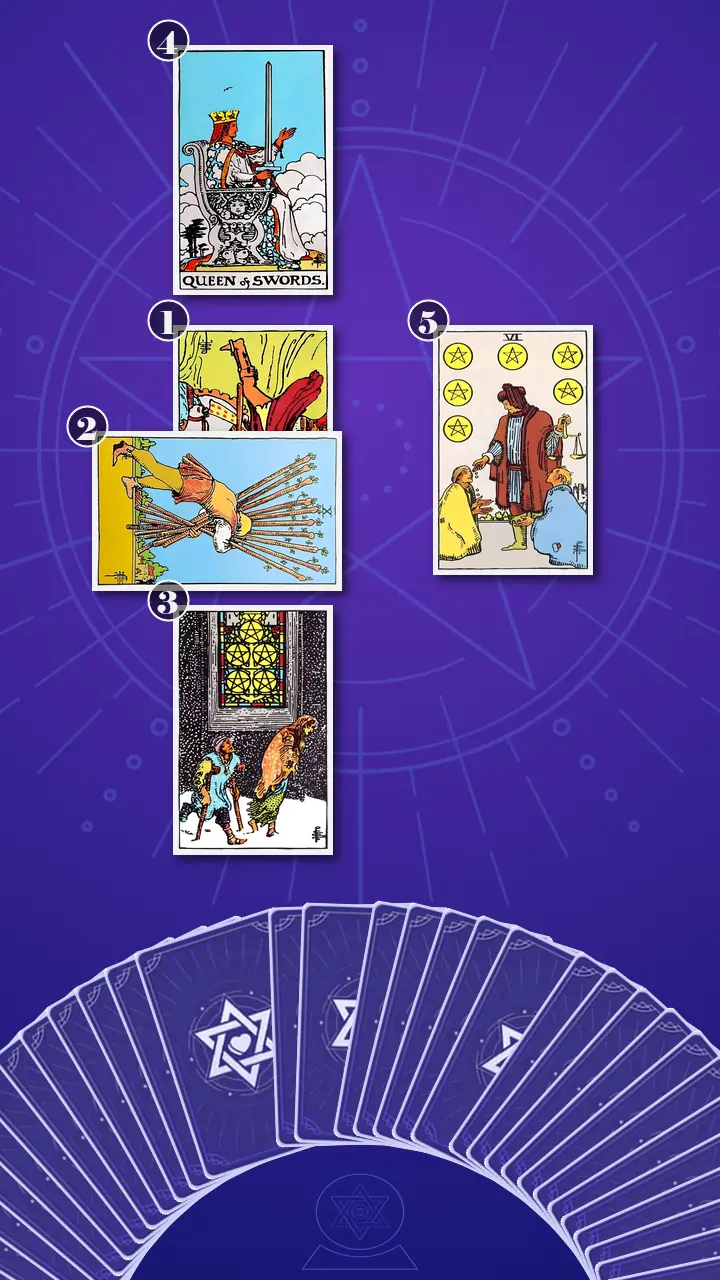
Where the Pressure Builds
At the Center: Six of Wands, Reversed
I turned the first card and said, ‘Now we’re looking at the card that shows the concrete group-chat behavior itself—the repeated nudges, the checking, and the resentment that follows.’ It was the Six of Wands, reversed.
I’ve learned to respect this card whenever someone is measuring closeness by visible response. In Maya’s life, it looked exactly like the pattern she had just described: she sends a perfectly friendly follow-up about Friday plans, then reopens the thread, notices who has been online, who posted elsewhere, who stayed silent, and starts treating the chat like a post that underperformed. The recognition energy here is blocked and over-sought at the same time. The issue isn’t really the dinner plan. It’s that response speed has become the fastest available metric for whether she matters in the group.
She gave a short laugh that landed with a wince. ‘Okay,’ she said, ‘that’s accurate enough to be rude.’ I smiled and shook my head. ‘Not rude—precise. Your nervous system is trying to turn uncertainty into numbers. You refresh because the crowd in this card matters too much in the moment. You want the chat to light up so the part of you that feels unseen can stand down.’ I watched her jaw tighten again, then release by a fraction.
Crossing It: Ten of Wands, Upright
I laid the second card horizontally across the first. ‘This one shows what keeps the pattern active even when it leaves you frustrated—especially the pull to carry more than your share.’ It was the Ten of Wands, upright.
As soon as I saw it, the scene sharpened: what started as a casual hangout had turned into a one-person coordination job. Maya suggests the patio, checks everyone’s TTC route, offers to make the reservation, keeps the tone light, keeps the thread moving, keeps the vibe from dying. This is excess energy—too much Fire, too much effort, too much load. Like becoming the unpaid project manager of a casual dinner plan. The figure in the card is so overloaded he can barely see where he’s going, and that’s what overfunctioning does: the more you carry, the less you can actually observe who would have stepped in on their own.
I told her, ‘The second text is often not about the plan. It’s about escaping what the silence brings up.’ She looked down at the crossed cards and rubbed her thumb over the edge of her phone. I could almost hear her internal dashboard opening: date, time, restaurant, tone, backup options, everyone’s emotional weather. ‘I always say I don’t mind doing it,’ she murmured. ‘And then ten minutes later I’m basically event staff.’
Underneath the Thread: Five of Pentacles, Upright
Then I turned to the card below the center. ‘This one points to the deeper belonging fear—the old story silence activates before you’ve even had a chance to fact-check it.’ The Five of Pentacles lay there, stark and unmistakable.
The whole temperature of the reading changed. I felt it the way I feel a studio drop from chatter into clean silence before a difficult song begins. In Maya’s life, this card was the cold Saturday streetcar platform version of the story: gray weather, gloves half off, bright phone screen stinging the eyes, and the stomach-drop of seeing her own message still sitting last in the thread. The energy here is lack—cold Earth, scarcity, exclusion. A quiet chat stops being neutral and starts feeling like standing outside a lit restaurant window in winter. Technically connected. Emotionally out in the wind.
‘This shouldn’t hurt this much,’ Maya said softly, almost to herself, ‘but it does.’ Her breath caught first. Then her eyes went unfocused, as if an older memory had slipped under the current one. Then came the smallest swallow, the kind people do when they’re trying not to let sadness get all the way into the room. I said what the card was asking me to say: ‘Being useful is not the same thing as being mutually chosen.’ That landed harder than anything so far. She nodded once and stared at the bright pentacles in the window. ‘So it’s not really about plans,’ she said. ‘It’s about that outside feeling.’
When the Queen Lifted Her Sword
Above the Wound: Queen of Swords, Upright
When I reached for the fourth card, the room seemed to simplify with me. The radiator clicked once. Traffic outside the window softened into a low hush. Years in radio taught me to notice this exact kind of silence—the moment when static falls away and the real signal is about to come through.
I turned the card and said, ‘Now we’re looking at the guidance position—the perspective that interrupts overfunctioning and restores clearer communication, boundaries, and self-respect.’ It was the Queen of Swords, upright.
I asked Maya to picture that Wednesday-night loop again: one upbeat message sent, the phone locked and unlocked almost immediately, breath getting shallow while the thread is asked to prove the friendship is still alive. Then I said the quieter truth out loud. Repeated nudges can wake up a chat, but they cannot tell you whether the connection is mutual. One clear ask often reveals more truth than three reassuring follow-ups.
Stop mistaking repeated taps on the chat for closeness; lift the Queen’s sword, make one clear ask, and let reciprocity—not panic—decide what happens next.
This, to me, is the Queen of Swords tarot meaning for friendship boundaries in real life: one clean sentence, one open hand, no extra vibe-management. Not colder—clearer. When I look at her upright sword, my producer brain flashes to a vocal track with the reverb stripped off. The lyric doesn’t become cruel when you remove the echo. It becomes audible. That is what this Queen was offering Maya: not distance, but signal.
Maya went utterly still. First came the physiological freeze—her fingers suspended against the ceramic mug, breath paused high in her chest. Then came the cognitive hit: her gaze slipped past me, unfocused, replaying some recent Wednesday in fast cuts—the too-white kitchen light, the Story from spin class, the second cheerful nudge she didn’t even want to send. When she finally spoke, there was resistance in it, and grief underneath. ‘But if I do that,’ she said, ‘then I actually find out whether anyone would have met me there. That’s kind of brutal.’ I nodded. ‘Yes. But brutal and clear are not the same thing.’ Then I gave her one of my own tools, a Breath Soundtrack: after one clean message, she would put the phone face-down and breathe in for four beats, out for six, for the length of one steady song. Not to become chill on command. To stop panic from remixing the meaning before reality had a chance to answer. Her shoulders dropped a little, then more. She let out a long breath like someone setting down grocery bags that had been cutting into their hands. There was relief in it, and also that strange lightheadedness that comes when clarity arrives with responsibility.
I asked her, ‘Now, with this lens, was there a moment last week when you would have felt something different if you had stopped after one clear ask?’ She didn’t answer right away. Then she said, ‘Yes. I would’ve realized I wasn’t asking about dinner anymore. I was asking if I mattered.’ That was the turning point I had been waiting for—the first clean movement from resentful vigilance and read-receipt spirals toward calmer discernment and steadier self-respect.
To the Right: Six of Pentacles, Upright
I turned the final card. ‘This one shows the healthier relational pattern when reciprocity becomes the measure instead of urgency.’ It was the Six of Pentacles, upright.
I loved the symmetry immediately. The spread began with a Six and ended with a Six, which told me the answer was not withdrawal from friendship. It was a new rule inside friendship. The first Six had her watching for engagement. This Six asked her to watch for exchange. Balanced Earth instead of shaky Fire. In real life, that meant putting more planning energy where effort already comes back: the friend who replies clearly, suggests another day, or picks the place without being coaxed into adulthood.
‘That actually feels… lighter,’ Maya said. And I could see why. This card didn’t ask her to become icy, detached, or anti-needs. It asked her to stop pouring equal effort into every thread and start noticing where care already moves in both directions. Fewer tabs open in the mind. Fewer invisible invoices. More choosing, less chasing.
Clear Ask, Clean Data
When I stepped back and looked at the whole Five-Card Cross, the logic chain was almost painfully clean. At the center, Maya was using visible response as a proxy for belonging. Crossing it, she was carrying the group’s momentum, tone, and logistics so she would not have to sit with uncertainty. Underneath that was the colder truth: silence was waking an outside-the-window fear that said, if I don’t keep this alive, I’ll discover I was the only one trying. The Queen of Swords did not tell her to care less. She told her to stop pressing the stalled elevator button. A clear ask gives you data. A chain of nudges gives you more labor.
I named the blind spot as plainly as I could: ‘You’ve been assuming extra effort creates closeness, when mostly it hides the data. If you always restart the conversation before anyone else has to, you never get to see who would actually step in.’ The transformation direction was just as clear: move from panic-driven prompting to one clean invitation, one clean boundary, and enough restraint to let reciprocity reveal itself.
Then I gave her actionable advice—the kind that respects how adult friendship actually works in a city, and how hard it can be to stop overfunctioning in friendships without sounding cold.
- Boundary-First InviteFor one plan this week, write the message in Notes first: ‘Are we still on for Friday at 7? Let me know by Thursday noon so I can plan my evening.’ Remove any extra cushioning sentence you only added to manage everyone’s feelings for them. Send it once, mute the chat, and use the Breath Soundtrack for one song: inhale for 4 beats, exhale for 6, with the phone face-down.If ‘Thursday noon’ feels too formal, warm the tone, not the boundary. The boundary is for your nervous system, not a punishment for theirs.
- No-Second-Text ExperimentFor seven days, do not send a second follow-up before the response window ends on social plans. When the urge spikes, open a note titled ‘What I know / What I’m assuming / What I need’ and give yourself three bullets—or a 60-second voice note—instead of another nudge.If the room suddenly feels too loud, use white noise or brown noise in headphones for two minutes. The goal is pause, not perfection.
- Reciprocity AuditPick three friendships and note who initiates, who replies clearly, who offers alternatives, and who follows through without needing a push. Put a small star beside the chats where effort already meets effort, and make your next plan there first.Keep it light. This is not a courtroom. It’s data collection for your heart.
Maya looked up at me and said, ‘Thirty minutes with my phone face-down is fantasy.’ I laughed softly. ‘Then make it ten. Or make it one song. We are building tolerance, not trying to win a purity contest.’
I ended that part of the reading with the simplest line I had: ‘Let the reply reveal the relationship.’

A Week Later: The Quiet Proof
Six days later, Maya messaged me. She had sent the clean invite. She had muted the thread. She had put on one steady instrumental track and walked to the corner store instead of reopening the chat every few minutes. Two friends answered clearly. One suggested Saturday instead. Another never replied. She made plans with the direct replier and did not send the rescue text.
Her update wasn’t dramatic, which is exactly why I trusted it. She wrote, ‘I still hated the first five minutes. But I didn’t feel as crazy. And I noticed who actually met me there.’ She slept a full night, but her first thought the next morning was still, What if I’m overreacting? This time, she laughed, made coffee, and didn’t reopen the thread.
That is what finding clarity looked like here. Not solving adult friendship forever. Not turning into someone who never cares. In this Five-Card Cross tarot spread for friendship resentment, clarity meant no longer confusing labor with love, and no longer outsourcing belonging to notification metrics. It meant one woman in Toronto putting her phone face-down long enough to hear her own self-respect coming back online.
There is a very specific kind of loneliness in staring at a quiet thread with your jaw tight, trying to act unbothered while part of you is already translating silence into maybe I matter less here. If your phone were face-down for one song and one clear message were allowed to be enough, what might you finally get to see about who meets you halfway?
This story is adapted from psychological research, written so that those in a similar struggle can see their own pattern in it — and find their next step clearly.These insights are not a substitute for professional psychological, medical, legal, or financial advice.
Learn more about our Journey to Clarity.
How did this insight land for you?
🫂 This Resonates Deeply
🌀 Living This Story
✨ Now I See Clearly
🌱 Seeing New Possibilities
🧰 Useful Framework
🔮 The Confirmation I Needed
💪 Feeling Empowered
🚀 Ready for My Next Step
Author Profile
 AI
AI“Through ten years of sound energy research, I’ve found that when we struggle, it's usually just our internal rhythm falling out of sync under pressure. I know firsthand the frustrating helplessness of wanting to move forward but feeling paralyzed. Without overwhelming theories, I want to be the soothing background track that helps you recalibrate, turning your heavy burdens back into a light, effortless, and harmonious melody.”
In this Introspection Tarot Reading :
Core Expertise
- Mental Noise Cancellation: Diagnosing severe internal friction not as a moral failing, but as a chaotic overlapping of incompatible psychological frequencies.
- Resonance Healing Calibration: Identifying the 'dissonant baseline' of your chronic anxiety and calculating the specific acoustic or rhythmic input needed to soothe it.
Service Features
- The Frequency Reset Pause: A customized rhythmic breathing or acoustic grounding technique to forcefully lower your brainwave state from a frantic beta frequency to a restorative alpha state.
Also specializes in :
Explore Related Patterns:
Defensive OverfunctioningMaya suggesting the patio, checking everyone’s TTC route, offering to make the reservation, and keeping the thread upbeat turns a casual Friday plan into a one-person coordination job. The repeated nudge is part of the same system: if she keeps the group moving, she does not have to sit still long enough to find out whether anyone else would move toward her. You can feel the defensive function in the sentence, “If I don’t send the second message, nothing happens.” Extra effort becomes a way to avoid the harder data. It protects you from the immediate sting of silence, but it also prevents you from seeing who would reply, suggest another time, pick a place, or let the plan drop without you rescuing it. The resentment is the audit trail of that hidden labor. It shows up when the strategy that once gave you control starts costing you self-respect. Defensive overfunctioning keeps the connection alive on the surface, but underneath it can quietly replace mutual friendship with unpaid emotional project management.
Reassurance SeekingMaya’s forty-second lock-and-unlock after sending “still good for Friday?” shows that the second message is doing more than moving dinner logistics along. The group chat has become a fast emotional gauge, and the reply is being asked to prove that the connection is still intact. You keep nudging because the nudge offers a short burst of regulation: it can make the silence stop, make the chat light up, and quiet the part of you that feels unseen. The resentment appears because the relief is temporary, while the cost is real. Each follow-up asks other people to reassure you indirectly, but it also leaves you carrying more labor than you actually wanted to give. The pattern is not weakness or neediness. It is a protective loop that tries to turn uncertainty into confirmation before the uncertainty has time to hurt. Once you see that, the question shifts from “Why am I so annoyed?” to “What am I asking this reply to soothe for me?”
Relational ScorekeepingMaya tracking who posted elsewhere, who stayed silent, who replied clearly, and who needed another push shows that the group chat has become a ledger. The resentment is not random; it is what happens when effort is being counted because it has not been cleanly negotiated. You keep nudging because the ledger creates a pressure to make the imbalance resolve. If someone finally replies after the second message, part of you can mark the plan as saved. But another part remembers that you had to push, manage, and restart the connection, which keeps the invisible invoice open. Relational scorekeeping often appears when a boundary has not yet been spoken. Instead of saying “I will ask once and see who meets me,” the mind keeps collecting evidence. The pattern feels protective because it tracks fairness, but it becomes corrosive when the tally replaces direct communication and mutual choice.
Rejection SensitivityMaya’s quiet thread turning into the image of standing outside a lit restaurant window in winter shows that delayed replies are not landing as neutral delays. The silence is waking a sharper belonging question: whether she is included, chosen, or quietly less important than she hoped. You keep nudging because the message is trying to stop the drop before it becomes a story about rejection. On the surface, the question is “Are we still on for Friday?” Underneath, it becomes “Do I matter enough for someone to meet me here?” That shift explains why a small logistics gap can feel emotionally oversized. Rejection sensitivity does not mean the group has done something malicious, and it does not mean your need for friendship is unreasonable. It means your system is quick to detect possible exclusion and then tries to reduce the threat through action. The resentment comes from having to perform calm logistics while another part of you is bracing for proof that you were the only one trying.
Relational HypervigilanceMaya noticing the spin-class Story, the meme reaction in another chat, who has been online, and who stayed silent shows how quickly her attention becomes a social monitoring system. The phone is no longer just a tool for making plans; it becomes a dashboard of possible belonging signals. You keep nudging because the monitoring creates pressure that needs an outlet. Once your attention has gathered enough micro-evidence, the second text can feel like a way to break the tension and force the social field to update. The problem is that every unrelated cue starts to look meaningful, even when it may not actually answer the question you care about. Relational hypervigilance makes silence feel louder than it is. It narrows the room around the thread, tightens the body, and turns normal delays into data points your nervous system wants to solve immediately. The nudge becomes less about communication and more about escaping the exhausting act of watching.
Boundary DiscernmentMaya sending one clean invitation, muting the thread, and putting the phone face-down creates a different psychological structure around the same friendship uncertainty. Instead of making the chat prove the relationship through constant responsiveness, she gives the other people a clear chance to respond and gives herself a boundary around waiting. You can see the shift in the line, “A clear ask gives you data. A chain of nudges gives you more labor.” Boundary discernment is not emotional withdrawal. It is the ability to separate your invitation from someone else’s response, so their delay does not automatically become your emergency. This pattern matters because it interrupts the resentment loop at the point where it usually becomes automatic. One clear ask lets reality answer. The pause afterward is uncomfortable, but it gives you something repeated nudges cannot give: clean information about who actually meets you halfway.
Emotional ReciprocityMaya’s update six days later gives the cleanest relational data: two friends answered clearly, one suggested Saturday instead, another never replied, and she made plans with the direct replier without sending the rescue text. The point was not to stop caring about friendship. It was to stop funding every connection with the same amount of urgency. You begin to leave the resentment loop when effort becomes something you place where it can circulate. Emotional reciprocity asks you to notice who initiates, who offers alternatives, who follows through, and who responds without needing to be repeatedly pulled into adulthood. This is not a courtroom for judging your friends. It is a shift from chasing engagement to recognizing exchange. When you let replies reveal the relationship, you can choose more calmly where your planning energy belongs.
Explore Related Struggles:
Clarity-Exposure SplitWhen Maya pictures sending one clean invite and stopping there, her body freezes because the next moment would no longer be protected by extra effort. You can hear the real threat in her line about actually finding out whether anyone would have met her there. The nudge protects against exposure by keeping the situation active. As long as you keep restarting the thread, the silence never has to become clean data. The plan stays alive, but the question of mutuality stays blurred. This is the split between wanting clarity and not wanting what clarity might reveal. A clear ask gives you information about the relationship; a chain of nudges gives you more work and a temporary delay from the answer you are scared to let arrive.
Read Receipt Worth LockMaya sends one friendly Friday-plans message, locks her phone for maybe forty seconds, and unlocks it again because the quiet thread has already started acting like a scoreboard. You can feel the dinner plan stop being simple logistics and become a live readout of whether you count in the group. The resentment builds because the metric is impossible to satisfy for long. A friend posting from spin class and another reacting in a different chat turn into data points, but they still cannot answer the deeper question the thread has been handed. You are not only waiting for a reply; you are asking a read receipt to carry belonging, reassurance, and social proof at the same time. That is why the nudge feels urgent and sour. It gives the body something to do while the worth question is still open, but it also keeps your sense of being chosen tied to the most unstable signal available: who typed back, how fast, and whether the chat lit up when you needed it to.
Utility-Belonging FusionMaya suggests the patio, checks everyone's TTC route, offers to make the reservation, keeps the tone light, and keeps the thread from going dead. You can see how a casual dinner plan quietly turns into proof that connection is still available if you can just be useful enough. The friction is that usefulness starts doing a job it was never built to do. Planning can secure a table, smooth the vibe, and keep the chat moving, but it cannot prove that people would choose you without being carried there. The second text becomes a way to keep belonging within reach while avoiding the exposed feeling of waiting. The resentment is the cost of letting utility stand in for mutual choice. You keep doing the work because it appears to protect the connection, then feel the sting of realizing the connection is being held up by labor you did not truly want to perform.
Reciprocity DeficitSix days later, Maya sends the clean invite, mutes the thread, and lets the replies arrive without a rescue text. Two friends answer clearly, one suggests Saturday, and another never replies, which gives the story its quiet proof: the exchange was never equal across every thread. Before that experiment, the second message kept the imbalance hidden. You could keep the group moving, but you could not see who was actually moving with you. The labor made the chat look more alive than the reciprocity underneath it really was. This struggle is not about demanding perfectly matched effort from everyone. It is about noticing where care travels in both directions and where you have been supplying both the invitation and the momentum, then calling that difference data instead of turning it into another reason to chase.
Unspoken Expectation LoadThe casual hangout becomes a private dashboard in Maya's mind: date, time, restaurant, backup options, transit routes, tone, and everyone's emotional weather. You are not only trying to get people to dinner; you are silently managing the conditions that might keep the plan from falling apart. Because the load is mostly invisible, it can masquerade as being easygoing. You keep the message warm, remove the sharper boundary, and hold the vibe steady, but the body knows it has taken on an unpaid coordination role. The resentment is not random; it is the receipt for labor that no one officially asked for and no one is clearly sharing. The lock happens when the hidden job becomes normal. The chat no longer feels like one social tool among many; it becomes the whole room, and you are left carrying momentum that should have belonged to the group.
Explore Related Emotions:
Conditional Belonging FearThe quiet chat turns from a stalled plan into the outside-of-the-window feeling: technically connected, emotionally out in the wind. Maya says it should not hurt this much, then names the real question under the dinner plan: whether she matters. Conditional Belonging Fear fits because the group response has become a gate that decides whether you are included enough. When belonging depends on the chat lighting up, a delayed reply can feel like evidence that your place is provisional, even before anyone has actually answered.
Mutuality HungerMaya keeps the thread moving, but the sharper line lands when she hears that being useful is not the same as being mutually chosen. She is not only asking who can make Friday; she is trying to see who will meet her effort without being pulled there. Mutuality Hunger is the ache for care that comes back on its own. You keep nudging because reciprocity has not yet shown itself clearly, and the nudge becomes a way to manufacture movement where you really want uncoaxed exchange.
Read Receipt AnxietyThe phone locks for maybe forty seconds before Maya unlocks it again; one friend has posted a spin class story, another reacted elsewhere, and the quiet Friday thread becomes a dashboard. Response speed starts acting like proof, so the body keeps collecting signals even when the actual question is only dinner plans. That is Read Receipt Anxiety because the unanswered message is no longer neutral information. You are not just waiting for logistics; you are watching the chat to see whether your place in the group is still visible, and the checking loop gives uncertainty a shape it can refresh.
Resentful WaitingShe sends the friendly follow-up, keeps the tone light, then feels the jaw tighten and the invisible scorekeeping begin. The wait is not empty; it is filled with all the coordination she has already done and all the effort she suspects no one else will pick up. That is Resentful Waiting: You stay available to the thread while part of you is already bracing against being the only one keeping it alive. The resentment grows because the pause is asking you to carry patience, politeness, and project management at the same time.
Unseen Effort GriefThe casual hangout has quietly become a one-person coordination job: patio, routes, reservation, tone, backup options, and the labor of keeping the vibe from dying. Because the work is social and soft, it can disappear while still taking up the whole evening inside her. Unseen Effort Grief names the hurt of doing relational labor that keeps everyone comfortable while no one quite sees the cost. You grieve less over a single unanswered message than over the possibility that your care is only noticed when you stop supplying it.
Clarity ReliefAfter the Queen of Swords moment, Maya pictures one clean ask, the phone face-down, and the breath counted through one steady song. The first relief does not come from everyone replying; it comes from stopping the extra taps long enough for the thread to produce real data. Clarity Relief fits because the loop loosens when you stop using effort to blur the result. You get a lighter feeling not because the relationship is instantly fixed, but because one clear sentence lets you see what is happening without remixing every silence into a verdict.
Quiet Self-RespectSix days later, Maya sends the clean invite, mutes the thread, walks to the corner store, and does not send the rescue text. Two friends answer clearly, one suggests another day, and she makes plans where the response actually comes back. Quiet Self-Respect is the steadier feeling that appears when you let your boundary hold without making it a performance. You are still allowed to care, but you stop proving your worth through extra labor, and that gives your own voice room to come back online.
Rejection ChillThe story drops into winter imagery when Maya sees her message still sitting last in the thread: gray platform, cold hands, bright phone screen, lit restaurant window. The room gets quieter because the silence in the chat has acquired a physical temperature. Rejection Chill is the body-level cold that arrives before there is clear proof of rejection. You can still know logically that people are busy, yet the unanswered thread lands like standing just outside the room where warmth is happening without you.
Explore Related Contexts:
Designated Organizer BurdenMaya is not just sending a second text about Friday dinner; she is building the whole plan around everyone else’s inertia. She suggests the patio, checks transit routes, offers to make the reservation, manages the tone, and keeps the thread alive while the rest of the group can remain passive. That pattern turns casual friendship logistics into an unpaid coordination role. You can see why the nudge creates resentment: the extra message is not a neutral follow-up, it is the moment where the group’s lack of movement becomes her job again. Designated Organizer Burden fits because the external pressure is not simply that Maya cares too much. The social structure around the plan has quietly assigned her the work of momentum, clarity, and emotional smoothness, leaving her with the labor of making friendship happen while others get to participate only when the plan is already stabilized.
Group Chat Follow-Through GapMaya says the clearest line in the story herself: 'If I don’t send the second message, nothing happens.' The Friday plan has no dependable path from invitation to confirmation unless she supplies another prompt, another tone adjustment, and another push. That is the structure of a Group Chat Follow-Through Gap. The issue is not one delayed response; it is a coordination system where social plans remain suspended until one person converts vague interest into actual commitment. This explains why the nudge feels both necessary and corrosive. You keep pressing the chat because the plan often does stall without you, but every rescue text also confirms that the group’s follow-through is not strong enough to carry its own weight.
Read Receipt PressureMaya sends 'still good for Friday?', locks her phone for less than a minute, and then opens the thread again while also noticing who posted an Instagram Story and who reacted in another chat. The pressure is coming from a digital environment where silence is no longer clean silence; it is surrounded by visible signs that people are active somewhere else. Read Receipt Pressure names the external stage that makes this loop so sticky. The group chat, Instagram activity, and response timing create a live dashboard of social availability, and Maya starts using that dashboard to measure whether she still counts inside the group. The nudge becomes resentful because it is trying to force certainty out of a platform structure built for partial visibility. You are not just waiting for a reply in this situation; you are watching a system that makes other people’s attention visible enough to interpret, but not reliable enough to give you real relational clarity.
Direct Communication TrialMaya eventually sends one clean invite, mutes the thread, puts on a steady track, and walks to the corner store instead of reopening the chat every few minutes. The message gives a clear response window, then leaves the group enough space to show who will actually answer. Direct Communication Trial is the constructive external stage in the story because Maya is not withdrawing from friendship; she is testing a cleaner communication structure. One clear ask replaces a chain of nudges, and the group’s responses become usable information rather than a constant stream of interpreted signals. The trial works because it changes what the chat is allowed to demand from her. You still care about the plan, but your role is no longer to keep pressing until the group becomes responsive; your role is to make the invitation clear enough that reciprocity can reveal itself.
Measured Reciprocity TrialAfter the clean invite, Maya receives actual data: two friends answer clearly, one suggests Saturday instead, and another never replies. She makes plans with the direct replier and does not send the rescue text. Measured Reciprocity Trial fits because the story moves from chasing response speed to observing follow-through. Maya begins putting more energy where effort already returns, rather than treating every stalled thread as a problem she must personally repair. This is directly tied to why the nudge has been making her resentful. You are learning to let reciprocity, not urgency, decide where your planning energy belongs; the friendship field becomes clearer when you stop filling every gap before anyone else has to step forward.
Scorekeeping FriendshipMaya notices who has been online, who posted from spin class, who reacted to a meme somewhere else, and who left her message sitting last in the thread. The friendship is no longer being experienced only through the plan itself; it is being tracked through a running ledger of attention and effort. Scorekeeping Friendship fits because the group chat turns reciprocity into something Maya has to calculate. Every delayed reply or visible activity elsewhere becomes another data point in an informal accounting system that asks who is investing, who is coasting, and who is making the plan possible. The resentment grows because scorekeeping often appears when the exchange is already uneven. You are not creating the imbalance by noticing it; you are trying to make sense of an environment where effort, responsiveness, and care are not landing in equal measure.
Low-Maintenance Friendship PressureMaya keeps the message friendly, the tone light, and the plan casual, even while she is doing the work of venue choice, transit checking, reservation management, and emotional smoothing. She says she does not mind, then ten minutes later she is effectively event staff. Low-Maintenance Friendship Pressure names the external script underneath that contradiction. Adult city friendships often reward the appearance of ease, so the person doing the labor can feel pressure to make coordination look casual while absorbing the actual cost privately. This context helps explain why the second nudge is loaded. You are not only asking for a reply; you are trying to keep the friendship looking effortless while your own effort has already become heavy, visible to you, and largely unacknowledged by the group.